
This present study delves into the first to quantify the diet composition of Chinese soft-shelled turtle (Pelodiscus sinensis) in the middle confines of the Yellow River, China. 24 stomach content samples were collected from wild-caught individuals from natural habitats, the analysis result showed that the species diet was noted to be primarily omnivorous and comprised 23 prey taxa classified into nine groups: plant (4), fish (1), frog (1), earthworm (1), insect (9), mollusk (3), shrimp (2), and other miscellaneous items.
Short Communication · Volume 54, Issue 3, 7 March 2022 · Open Access
Preliminary Diet Analysis of Chinese Soft-shelled Turtle (Pelodiscus sinensis) in the Middle Confines of the Yellow River, Shaanxi Province, China
· · · · ·
Affiliations & Notes ⌄
- 1Ministry of Education Key Laboratory for Ecology of Tropical Islands
- 2College of Life Sciences, Hainan Normal University, Haikou 571158, People’s Republic of China 2Shaanxi Institute of Zoology, Xi’an, 710032, People’s Republic of China * Corresponding author: haitao-shi@263.net
Article Info ⌄
- Journal:
- Pakistan Journal of Zoology
- Published:
- 7 March 2022

From the article
- The greatest prey frequency was constituted by insect, fish, mollusk and the unidentified category (%F=83.3, 76.7, 67.5 and 66.9, respectively).
- An interesting phenomena, however, was observed where plants occurred at least in 50.3% of stomach content samples of all turtles, thus accordingly, we infer its diet to be omnivorous.
- In spite of our great effort, majority of the food items were still difficult to identify to the species level hence a large proportion of unidentified matter.
- Thus, the diet composition of P. sinensis can as well be used as an indicator of the presence of the invasive red swamp crawfish.
Selected from the article's own text.
Abstract
Materials and methods
The study was conducted in the middle confines of Yellow River in Dali County, Shaanxi Province, China (N 34°53′33″-34°59′13″, E 110°10′23″-110°13′06″) from April 2017 to August 2018. Turtles were captured in large submerged turtle traps, and each digestive tract was cut open, and the stomachs as well as other partial gut contents were rinsed with tap water through a 0.3-mm-mesh sieve. All retained prey items were identified to the lowest taxonomic level possible using the guide to inland waters resources by Zhang and He (1990). The samples were sorted and reconstructed under a dissecting microscope (M205C; Leica Microsystems, Wetzlar, Germany) and wet volume measurements of each taxon obtained using a water displacement method in a 100-ml graduated cylinder.
Percentage number of prey individuals (%N), frequency of occurrence (%F), and volume (%V) for each identified prey taxon were calculated. Percent index of relative importance (%IRI) that incorporates %N, %F, and %V was calculated and it was used to gauge the importance of each prey taxon:
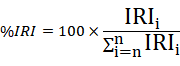
Where IRIi is (%Ni + %Vi) ×%Fi for prey type i and Ʃni-n IRIi is the sum of the IRI for all prey types i .
Results
A total of 24 stomachs of P. sinensis were collected. An analysis of the stomach contents showed 23 prey taxa classified into 9 food item groups: plant (4 prey taxa: corn, algae, sedge, duckweed), fish, frog (green pond frog), shrimp (2 prey taxa: oriental river prawn, red Swamp Crawfish), mollusk (3 prey taxa: pond snails, trumpet snails, clams), insect (9 prey taxa: butterflies, flies, mosquitoes, mantis, mayflies, water beetles, ground beetles, stink bugs, unidentified insect), earthworm, unidentified and miscellaneous. Of the 9 groups, the greatest amount for number of prey was constituted by insect, mollusk and plant (%N = 41.5, 24.8 and 14.5, respectively). The greatest amount for wet volume of prey was constituted by insect, fish, mollusk and the unidentified category (%V =25.9, 24.9, 14.8 and 12.3, respectively). The greatest prey frequency was constituted by insect, fish, mollusk and the unidentified category (%F=83.3, 76.7, 67.5 and 66.9, respectively). The greatest percent index of relative importance was constituted by insect, fish, mollusk and unidentified (%IRI = 46.3, 15.4, 13.1 and 12.7, respectively).
Discussion
P. sinensis has long been regarded as carnivorous ; ; . An interesting phenomena, however, was observed where plants occurred at least in 50.3% of stomach content samples of all turtles, thus accordingly, we infer its diet to be omnivorous. In spite of our great effort, majority of the food items were still difficult to identify to the species level hence a large proportion of unidentified matter. In relation to this, two propositions were put forth: (1) Since P. sinensis has an elaborate digestive system , incompletely digested remains were difficult to identify. (2) Tang (2015) illustrates a scenario involving feeding on carrion. After a subsequent ingestion and re-digestion of carrion, it will be very difficult to identify the food components that first constituted it.
A novel discovery for this study, the first record ever for wild specimens, was the presence of red swamp crawfish (Procambarus clarkii) in the stomach contents of P. sinensis. Crawfish has become one of the most famous invasive species in the world and has caused lot of damage to the freshwater ecosystems in China . This study shows that crawfish are also present in middle confines of the yellow river. Thus, the diet composition of P. sinensis can as well be used as an indicator of the presence of the invasive red swamp crawfish. Also, we could make a rational exploitation and profit from Chinese soft-shelled turtle’ biological control capability, as illustrated in Dong et al. (2012) where the predation capability had been applied to suppress the occurrence the invasive golden apple snail.
It is worth noting that the diets contained miscellaneous anthropogenic items including fishing wire, plastic, glass slag, and cloth debris. The prediction that plastic (and other persistent petroleum products such as nylon, polystyrene, rubber, etc.) pollution would be a major problem in the twenty-first century is now widely recognized . Plastic ingestion often causes sub-lethal effects, such as obstruction of the gastrointestinal tract and reduction of appetite. Debris ingestion can thus be a major threat to turtle populations . If these animals continued to eat the “rubbish”, this could even lead to greater conservation implications to this quite vulnerable species. Furthermore, the occurrence of a large proportion of plastics represented a major hazard for nesting female turtles.
P. sinensis is one of the fastest-declining turtle species and is listed as a vulnerable (VU) in the IUCN Redlist of threatened species . The findings of this research are deemed to add to the greater knowledge of the species and hence give researchers and wildlife managers’ insight on P. sinensis feeding natural history aspects that should be considered in developing management plans.
Acknowledgments
We thank Dr. Meixia Yang of the Laboratory of Shaanxi Institute of Zoology for expertise in prey identification. This study was supported by the National Natural Science Foundation of China (no. 31772486 to H.S.); Foundation of Shaanxi Science and Technology Department, China (2016JM3031, 2021SF-437); Foundation of Shaanxi Academy of Sciences, China (2017K-10); We greatly appreciate several reviewers who provided constructive feedback during manuscript preparation. This study was approved by HNECEE-2016-005, which is the Animal Research Ethics Committee of Hainan Provincial Education Centre for Ecology and Environment, Hainan Normal University (HNECEE-2016-005) and was carried out in strict accordance with the institutional guidelines.
Statement of conflict of interest
The authors have declared no conflict of interest.
References
- Cheung, S.M. and Dudgeon, D., 2006. Aquat. Conserv. Mar. Freshw. Ecosyst., 16: 751–770. https://doi.org/10.1002/aqc.803[CrossRef]
- Dong, S., Zheng, G., Yu, X. and Fu, C., 2012. Sci. Agric., 69: 142-146. https://doi.org/10.1590/S0103-90162012000200009[CrossRef]
- Ernst, C.H. and Barbour, R.W., 1989. Turtles of the World. Smithsonian Inst, Washington DC. pp.313.
- Huner, J.V., 1988. In: Freshwater crayfish: Biology, management and exploitation (eds. D.M. Holdich and R.S. Lowery). Timber Press, Portland, Oregon. pp. 239-261.
- Hyslop, E.J., 1980. J. Fish Biol., 17: 411-429. https://doi.org/10.1111/j.1095-8649.1980.tb02775.x[CrossRef]
- Mitsukuri, K., 1905. Bull. U.S. Bur. Fish., 24: 260-266.
- Pope, C.H., 1935. Natural history of central Asia. Vol.10. The repiles of China. American Museum of Natural History, New York.
- Ryan, P.G., Moore, C.J., van Franeker, J.A. and Moloney, C.L., 2009. Phil. Trans. R. Soc. B., 364: 1999–2012. https://doi.org/10.1098/rstb.2008.0207[CrossRef]
- Sul, J.A.I.D., Santos, I.R., Friedrich, A.C., Matthiensen, A. and Fillmann, G., 2011. Estuar. Coas., 34: 814-823. https://doi.org/10.1007/s12237-011-9392-8[CrossRef]
- Tang, W., 2015. Germplasm characteristics of soft-shelled turtle (Pelodiscus sinensis) from Yaojiang River, Shanghai. Shanghai Ocean University. pp. 3.
- TTWG (Turtle Taxonomy Working Group), 2017. Turtles of the world. Annotated checklist and atlas of taxonomy, synonymy, distribution, and conservation status, 8th edn. Chelonian Research Foundation and Turtle Conservancy (Chelonian Research Monographs 7), Lunenburg, Massachusetts.
- Xiao, M., Chen, Q., Bao, F., Cui, F., Wang, S., Li, S. and Kang, J., 2006. Chinese agric. Sci. Bull., 22: 384-386.
- Zhang, J., Zhou, Q., Yang, X., Yu, P., Zhou, W., Gui, Y., Yang, X. and Wan, Q., 2018. Conserv. Genet. Resour., pp. 1-4.
- Zhang, J. and He Z., 1990. Survey data reference manual of inland waters resources. Agriculture Press, Beijing.
Services
Article usage statistics
Loading…