Special Issue: Emerging and Re-Emerging Animal Health Challenges in Low and Middle-Income Countries · Volume 13, Issue 1, 13 January 2026 · Open Access
Potential of Phytase and Protease Enzymes on Tenderness and Cooking Loss in Kampung Unggul Balitbangtan (KUB) Chicken Thigh Meat
· · · · ·
Affiliations & Notes ⌄
1Faculty of Veterinary Medicine, Universitas Airlangga, Surabaya, Indonesia
2Department of Animal Husbandry, Faculty of Veterinary Medicine, Universitas Airlangga, Surabaya, Indonesia
3Department of Basic Veterinary Science, Faculty of Veterinary Medicine, Universitas Airlangga, Surabaya, Indonesia
4Department of Veterinary Public Health, Faculty of Veterinary Medicine, Universitas Airlangga, Surabaya, Indonesia. *Correspondence | Mirni Lamid, Department of Animal Husbandry, Faculty of Veterinary Medicine, Universitas Airlangga, Surabaya, Indonesia
This study confirms that enzyme supplementation in feed has a beneficial impact on the meat quality of KUB chicken.
Specifically, 400 mg/kg phytase, 300 mg/kg protease, and 500 mg/kg protease improved meat tenderness, while 200 mg/kg phytase and 300 mg/kg protease effectively reduced cooking loss.
Among these, 500 mg/kg protease was identified as the most effective dose for enhancing tenderness, and 200 mg/kg phytase was optimal for minimizing cooking loss.
Selected from the article's own text.
Abstract
This study investigates the potential of phytase and protease enzymes in improving meat tenderness and reducing cooking loss in Kampung Unggul Balitbangtan (KUB) chicken thigh meat. A true experimental design was employed, using a Completely Randomized Design (CRD) with seven treatment groups, including a control group. The treatments consisted of different dosages of phytase (200 mg/kg, 400 mg/kg, 600 mg/kg) and protease (300 mg/kg, 500 mg/kg, 700 mg/kg) enzyme supplementation. Data were analyzed using One-Way Analysis of Variant (ANOVA), followed by Duncan’s Multiple Range Test at a 95% significance level. The results revealed that the best meat tenderness was achieved with 500 mg/kg of protease supplementation, which produced the lowest shear force value of 14.05 N, followed by 400 mg/kg of phytase supplementation with a shear force value of 15.28 N. Meanwhile, the lowest cooking loss percentage was observed in the group supplemented with 200 mg/kg of phytase at 16.29%, followed by 300 mg/kg of protease supplementation at 18.65%. These findings indicate that the appropriate supplementation of phytase and protease enzymes can improve meat tenderness and reduce cooking loss in KUB chicken.
Local chicken is a potential livestock commodity because it contains complete protein ; . Its meat has a savory taste and lower fat content compared to broiler chicken . Processed products from local chicken meat are increasingly in demand, thus expanding market share. Thigh meat is more preferred by consumers because of its tenderness and better flavor .
The production of local chicken meat is relatively low due to poor quality breeding stock and suboptimal maintenance systems . The average body weight of three-month-old local chicken is only 0.80 kg for males and 0.70 kg for females . In addition, the texture of local chicken meat tends to be tough, thus requiring special treatment in its maintenance and processing .
The Agricultural Research and Development Agency (Balitbangtan), through the Animal Research Institute (Balitnak), has developed a superior local chicken called KUB chicken (Kampung Unggul Balitbangtan) . This chicken is the result of genetic selection over six generations. Its advantages include egg production of 160–180 eggs/year and slaughter weight of 800–900 g within 10 weeks ; . KUB chicken can be a solution to meet the demand for animal protein.
KUB chicken still has potential to improve its production, especially in terms of feed efficiency . The nutrient content in feed greatly affects the growth of chickens. Feed that does not meet nutritional needs can reduce chicken productivity . The application of feed additives, such as exogenous enzymes, has been shown to improve feed efficiency and carcass perfomance in native chickens, including KUB chickens ; . These additives help enchance nutrient utilization, thereby supporting better growth and meat quality in poultry ; . Phytase and protease are two of the most commonly used enzymes in chicken feed .
Phytase can reduce the antinutritional effects of phytic acid . Phytase helps release phosphorus bound in phytic acid, protein, and starch. According to Wang et al. (2019), the phosphorus content in feed affects the tenderness and cooking loss of meat. High phosphorus intake can result in more tender meat and lower cooking loss. Meanwhile, the protease enzyme plays an important role in helping digest protein sources in feed by converting protein into amino acids . Amino acids are essential for the formation of chicken meat. According to Krisnaningsih and Yulianti (2015), protease enzymes can improve tenderness and reduce cooking loss, thereby producing better meat quality.
Based on the explanation above, this study aims to determine the potential of phytase and protease supplementation in improving tenderness and reducing cooking loss of KUB chicken thigh meat. This research serves as a solution to support the SDGs goal of Zero Hunger through innovation in improving KUB chicken productivity with feed technology, in order to enhance meat quality, maintain food security, and produce healthy, high-quality, and safe products for consumption.
MATERIALS AND METHODS
The type of research used is true experimental with a Completely Randomized Design (CRD). This study consisted of seven treatment groups, including the control group, with four replications per group. The samples used in this study were male Day Old Chick (DOC) KUB chickens with an average body weight of ±50 grams at seven days of age, totaling 28 samples.
Research location and time
The research was conducted from March to October 2024. The treatments were carried out at Poultry Experimental Cage 2, Faculty of Veterinary Medicine, Universitas Airlangga; necropsy at the Animal Feed Laboratory, Faculty of Veterinary Medicine, Universitas Airlangga; and tenderness and cooking loss testing at the Animal Product Technology Laboratory, Faculty of Animal Science, Universitas Brawijaya.
Tools and materials
Equipment used included battery cages, scales, 5-watt lamps, dividers, trays, drinkers, minor surgical tools, lab coats, clip plastic bags, styrofoam boxes, freezer, dry ice, and testing devices such as Warner Bratzler Shear Force and waterbath (Memmert). Research materials consisted of male DOC KUB chickens, starter feed (ages 1–14 days), grower feed (15 days–harvest), drinking water, vaccines (ND, IB), vitamins, phytase and protease enzymes as treatment feed additives.
Cage preparation
Cages were prepared one week before DOC arrival, including cleaning and disinfection of walls, floors, and equipment. For 100 DOCs, brooding dividers sized 1×1 meter and 60 cm in height were used, equipped with four 5-watt yellow lamps as heaters. The brooding floor was lined with lime powder and 5 cm thick rice husk litter.
Experimental animal preparation
The brooding period for KUB chickens was conducted in the first two weeks. Newly arrived DOCs were immediately placed in the brooding dividers at 33℃, given feed and water ad libitum, and 3% sugar solution to reduce post-transport stress. Feed was given four times a day at 06.00, 10.00, 14.00, and 18.00 GMT+7. Brooding dividers were widened on the third and fifth days to adjust stocking density. On the seventh day, the chickens were weighed and graded to meet the study criteria. Selected DOCs were male, ± 50 grams, and physically healthy. Brooding divider size was then widened to 1 x 2 meters. On day 14, chickens were reweighed and transferred to individual battery cages, each containing one chicken, and covered with wire mesh to prevent escape.
Treatment
KUB chickens that had undergone a 14-day adaptation period were treated from day 15 to day 90 according to the test group. The study consisted of seven treatments with four replications. The treatments used were as follows:
The enzyme was administered orally by mixing it into the feed according to each treatment group’s dosage. Feed was given three times daily at 06.00, 12.00, and 17.00 GMT+7.
Harvest
After 90 days of maintenance, chickens were slaughtered, and thigh meat samples were taken for analysis. The meat was filleted (5x5 cm, ≥ 50 grams), packed in clip plastic bags, and placed in a styrofoam box with dry ice to be directly sent to the Animal Product Technology Laboratory, Faculty of Animal Science, Universitas Brawijaya.
Tenderness test
The tenderness test was conducted at the Animal Product Technology Laboratory, Faculty of Animal Science, Universitas Brawijaya using Warner Bratzler Shear Force device.
Cooking loss test
The cooking loss test was conducted at the Animal Product Technology Laboratory, Faculty of Animal Science, Universitas Brawijaya using water bath (Memmert).
Data analysis
Tenderness (in Newtons) and cooking loss (percentage) data were analyzed using One Way ANOVA at a 95% significance level. If significant differences were found, Duncan’s Multiple Range Test was performed using SPSS 30.
RESULTS AND DISCUSSIONS
Meat tenderness test
Statistical analysis showed that the addition of phytase and protease enzymes had a significant effect on the tenderness of KUB chicken meat (p<0.05), as shown in Table 1.
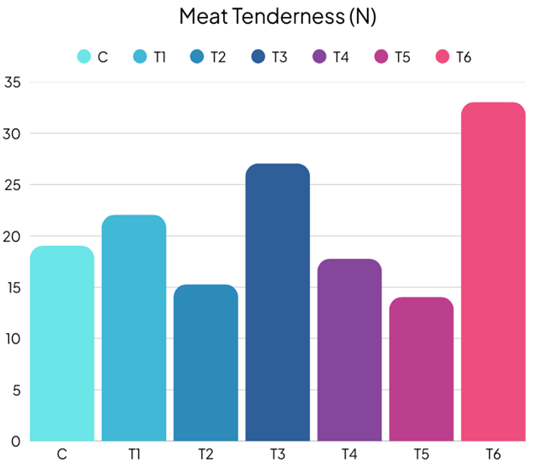
The lowest shear force value was recorded in group T5 (500 mg protease/kg feed) at 14.05 N, indicating the highest tenderness. Moderate doses of phytase (T2) and low to moderate doses of protease (T4 and T5) effectively reduced shear force values, indicating increased tenderness, as shown in Figure 1. T2 improved mineral absorption that supports muscle structure, while T4 and T5 played a role in optimal muscle protein degradation.
Table 1: Average and standard deviation of KUB chicken thigh meat tenderness with phytase and protease enzymes.
Treatment
Average meat tenderness ± SD (N)
C
19.03d ± 0.69
T1
22.05e ± 0.50
T2
15.28b ± 0.47
T3
27.05f ± 0.59
T4
17.78c ± 0.57
T5
14.05a ± 0.35
T6
33.03g ± 0.61
Notes: different superscripts in each column indicate significant differences (p<0.05).
Conversely, groups T1 (200 mg phytase/kg), T3 (600 mg phytase/kg), and T6 (700 mg protease/kg) showed increased shear force values, indicating tougher meat. This was caused by imbalances in phosphorus intake or excessive degradation of muscle proteins.
Phytase enhances tenderness by releasing phosphorus from phytic acid, which helps maintain muscle pH balance ; . Additionally, studies have shown that phytase supplementation contributes to improving the nutritional profile of poultry feed and may influence physiological parameters in chickens . Meanwhile, protease works directly by breaking down structural and myofibrillar proteins, making it more effective in improving tenderness . Therefore, protease is considered more effective than phytase in improving the tenderness of KUB chicken meat.
Cooking loss test
Statistical analysis showed that the use of phytase and protease enzymes had a significant effect (p<0.05) on the cooking loss of KUB chicken meat, as shown in Table 2.
Table 2: Average and standard deviation of KUB chicken thigh meat cooking loss with phytase and protease enzymes.
Treatment
Average cooking loss ± SD (%)
C
25.06c ± 0.98
T1
16.29a ± 0.71
T2
28.20d ± 1.17
T3
35.25f ± 1.19
T4
18.65b ± 0.80
T5
28.98d ± 1.40
T6
31.98e ± 1.23
Notes: different superscripts in each column indicate significant differences (p<0.05).
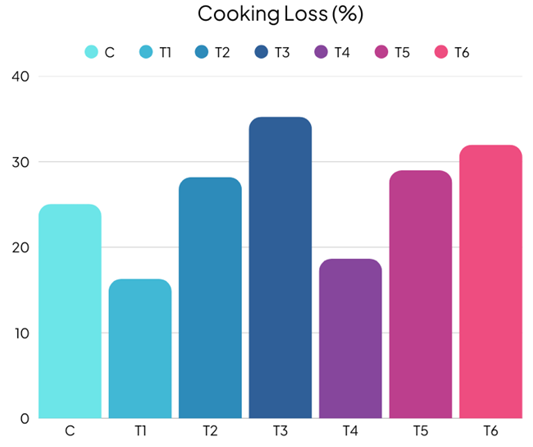
The results showed that groups T1 (200 mg phytase/kg) and T4 (300 mg protease/kg) experienced a decrease in cooking loss compared to the control. T1 recorded the lowest value at 16.29%, due to the increase in phosphorus which helps maintain muscle pH and water-holding capacity. T4 was also effective because minimal protein degradation contributed to reduced cooking loss, which is consistent with the pattern presented in Figure 2.
In contrast, groups T2, T3, T5, and T6 showed an increase in cooking loss. Moderate to high doses of phytase (T2, T3) may disrupt mineral balance, thereby reducing water-holding capacity. In T5 and T6, excessive protein degradation by protease also reduced the muscle’s ability to retain water.
Phytase functions by releasing phosphorus from phytic acid, which improves muscle composition and water-holding capacity , although excessive phosphorus may have the opposite effect . Protease helps reduce cooking loss by breaking down structural and myofibrillar proteins , but excessive degradation may decrease water-holding capacity . Thus, phytase is considered more effective than protease in maintaining meat moisture and reducing cooking loss in KUB chicken meat.
CONCLUSIONS
This study confirms that enzyme supplementation in feed has a beneficial impact on the meat quality of KUB chicken. Specifically, 400 mg/kg phytase, 300 mg/kg protease, and 500 mg/kg protease improved meat tenderness, while 200 mg/kg phytase and 300 mg/kg protease effectively reduced cooking loss. Among these, 500 mg/kg protease was identified as the most effective dose for enhancing tenderness, and 200 mg/kg phytase was optimal for minimizing cooking loss. These findings emphasize the importance of targeted enzyme application in local poultry feed, offering a promising strategy to improve meat quality through nutrition-based interventions. Further research is encouraged to explore combined enzyme effects and optimize dosage interactions, contributing to the advancement of sustainable poultry production and food quality enhancement.
ACKNOWLEDGEMENTS
We would like to thank Universitas Airlangga for funding and providing the opportunity to conduct this research in 2024 under contract number: 672/UN3/2024. We also thank the Animal Feed Laboratory at Universitas Airlangga and the Animal Product Technology Laboratory at Universitas Brawijaya for access to their facilities and technical assistance. Our sincere appreciation goes to the entire research team and all laboratory staff who contributed to sample collection and analysis with dedication and hard work.
NOVELTY STATEMENT
This study introduces a novel approach by incorporating dietary supplementation of phytase and protease enzymes to improve meat quality in KUB native chickens. The findings demonstrate the positive effects of these enzymes in enhancing meat tenderness and reducing cooking loss, indicating their potential application in optimizing growth performance and carcass quality in native chicken production systems.
AUTHOR’S CONTRIBUTION
VAIP: Conceptualized the study, conducted the investigation, analyzed the data, and prepared the manuscript. ML: Supervised the research, contributed to the methodology, and provided funding acquisition as well as essential resources. LM: Contributed to supervision, validation, and manuscript editing. B, SH, and SHW: contributed to validation and manuscript review. All authors reviewed and approved the final version of the manuscript.
Ethical approval
This research involved the use of experimental animals and has been approved by the Animal Care and Use Committee (ACUC), Faculty of Veterinary Medicine, Universitas Airlangga. The ethical clearance was granted with certificate number: 1.KEH.039.03.2024. All procedures were carried out in accordance with institutional and national guidelines for the care and use of laboratory animals.
Generative AI and AI-assisted technology statement
The authors used artificial intelligence–based tools solely for language polishing and grammar improvement. No AI tools were used in data analysis, interpretation, or the creation of scientific content. All results and interpretations were conducted and verified by the authors.
Conflict of interest
The authors have declared no conflict of interest.
Figures
Figure 1:.
Meat tenderness (N) of KUB chicken thigh meat in the control group (C) and treatment groups (T1-T6). Values are presented as mean. Lower values indicate more tender meat.
Figure 2:.
Cooking loss (%) of KUB chicken thigh meat in the control group (C) and treatment groups (T1-T6). Values are presented as mean. Lower values indicate reduced water loss during cooking.
References
Al-Arif MA, Warsito SH, Amin M, Lamid M (2020). Substitution of commercial feed with phytase-fermented rice bran and turmeric flour to increase EPA, DHA, and protein depositions in broiler meat. Biocatal. Agricult. Biotechnol., 24: 101535. https://doi.org/10.1016/j.bcab.2020.101535[CrossRef]
Anggraeni A, Wahyuni D, Cahya I (2022). Karakteristik sensoris daging ayam Kampung Unggul Balitbangtan (KUB) yang diberi tepung daun katuk (Sauropus androgynus) dalam ransum. J. Agripet, 22(2): 223-228. https://doi.org/10.17969/agripet.v22i2.22033[CrossRef]
Arshad MS, Kwon JH, Imran M, Sohaib M, Aslam A, Nawaz I, Amjad Z, Khan U Javed M (2016). Plant and bacterial proteases: A key towards improving meat tenderization, a mini review. Cogent Food Agric., 2(1): 1-10. https://doi.org/10.1080/23311932.2016.1261780[CrossRef]
Berlina CR, Hidanah S, Al Arif MA, Luqman EM, Yuniarti WM, Mufasirin M (2023). Efficacy of lactic acid bacteria probiotics on feed efficiency and carcass weight in Kampung Unggul Balitbangtan (KUB) chicken. J. Medik Vet., 6(3): 116-121. https://doi.org/10.20473/jmv.vol6.iss3.2023.116-121[CrossRef]
Bohrer BM (2018). Correlation of chicken breast quality and sensory attributes with chicken thigh quality and sensory attributes. Can. J. Anim. Sci., 99(3): 465-474. https://doi.org/10.1139/cjas-2018-0192[CrossRef]
Cardinal KM, Moraes MLD, Andretta I, Schirmann GD, Belote BL, Barrios MA, Santin E, Ribeiro AML (2019). Growth performance and intestinal health of broilers fed a standard or low-protein diet with the addition of a protease. Rev. Bras. Zoot., 48: e20180232. https://doi.org/10.1590/rbz4820180232[CrossRef]
Dameanti FNAEP, Firdaus MA, Titisari N, Aditya S, Guritno I (2020). Pengaruh faktor lingkungan terhadap produktivitas telur ayam Kampung Unggulan Balitbangtan (KUB) fase layer. J. Medik Vet., 3(2): 166-172. https://doi.org/10.20473/jmv.vol3.iss2.2020.166-172[CrossRef]
Hakami Z, Al Sulaiman AR, Alharthi AS, Casserly R, Bouwhuis MA, Abudabos AM (2022). Growth performance, carcass and meat quality, bone strength, and immune response of broilers fed low-calcium diets supplemented with marine mineral complex and phytase. Poult. Sci., 101(6): 101849. https://doi.org/10.1016/j.psj.2022.101849[CrossRef]
Kim SY, Song DH, Chung W, Choi HS, Han SG, Kim HW (2024). Evaluation of the physicochemical attributes of beef, chicken, and pork muscles injected with microbial proteases for designing senior-friendly processed meat products. Foods, 13(21): 3430. https://doi.org/10.3390/foods13213430[CrossRef]
Krisnaningsih ATN, Yulianti DL (2015). Pemanfaatan kombinasi ekstrak buah nanas dan pepaya untuk meningkatkan kualitas daging itik petelur afkir. Buana Sains, 15(1): 1-6.
Mahmood T, Mirza M, Nawaz H, Shahid M (2018). Exogenous protease supplementation of poultry by-product meal-based diets for broilers: Effects on growth, carcass characteristics and nutrient digestibility. J. Anim. Physiol. Anim. Nutr., 102(1): e233-41. https://doi.org/10.1111/jpn.12734[CrossRef]
Mas’ad K, Lokapirnasari WP, Al Arif MA, Soeharsono S, Kurnijasanti R, Harijani N (2020). Potensi probiotik terhadap feed efficiency dan egg mass pada ayam petelur. J. Medik Vet., 3(2): 203-207. https://doi.org/10.20473/jmv.vol3.iss2.2020.203-207[CrossRef]
Maynard CJ, Maynard CW, Mullenix GJ, Ramser A, Greene ES, Bedford MR, Dridi S (2023). Impact of phytase supplementation on meat quality of heat-stressed broilers. Animals, 13(12): 2043. https://doi.org/10.3390/ani13122043[CrossRef]
Muzhaffar AM, Hamid IS, Effendi MH, Wibawati PA, Sukmanadi M, Solfaine R (2023). Duodenum histomorphology of Bacillus subtilis and Bacillus coagulan isolate in laying hen strain Isa Brown. J. Basic Med. Vet., 12(2): 57-61. https://doi.org/10.20473/jbmv.v12i2.48030[CrossRef]
Nurfitri Y, Lamid M, Yuliani MGA, Al-Arif MA, Wahyuni RS, Aksono EB (2021). Potensi dedak padi yang difermentasi dengan enzim fitase dalam pakan basal terhadap kolesterol total darah ayam petelur. J. Basic Med. Vet., 9(2): 92-98. https://doi.org/10.20473/jbmv.v9i2.28588[CrossRef]
Oktavia H, Rochmi SE, Suprayogi TW, Legowo D (2021). Weight gain and feed conversion of broiler chickens in reviewed from cage temperature and humidity. J. Appl. Vet. Sci. Technol., 2(1): 5-9. https://doi.org/10.20473/javest.V2.I1.2021.5-9[CrossRef]
Oyeagu CE, Mlambo V, Lewu FB (2023). Histomorphometric traits, microbiota, nutrient digestibility, growth performance, carcass traits and meat quality parameters of chickens fed diets supplemented with different levels of bacillus protease. J. Appl. Anim. Res., 51(1): 137-155. https://doi.org/10.1080/09712119.2022.2161552[CrossRef]
Pratama HS, Lokapirnasari WP, Soeharsono S, Al-Arif MA, Harijani N, Hidanah S (2021). Effect of probiotics Bacillus subtilis on feed efficiency and egg mass of laying hens. J. Medik Vet., 4(1): 37-41. https://doi.org/10.20473/jmv.vol4.iss1.2021.37-41[CrossRef]
Rembo E, Bay JR (2023). Modifikasi pengembangan usaha ternak ayam KUB (Kampung Unggul Balitbang) sebagai upaya mengatasi rendahnya produktifitas ternak ayam kampung di Kabupaten Ngada. J. Pertan. Unggul, 2(1): 78-91.
Samard S, Maung TT, Gu BY, Kim MH, Ryu GH (2021). Influences of extrusion parameters on physicochemical properties of textured vegetable proteins and its meatless burger patty. Food Sci. Biotechnol., 30: 395-403. https://doi.org/10.1007/s10068-021-00879-y[CrossRef]
Sampath V, Gao S, Park JH, Kim IH (2023). Exogenous phytase improves growth performance, nutrient retention, tibia mineralization, and breast meat quality in ross-308 broilers. Agriculture, 13(10): 1906. https://doi.org/10.3390/agriculture13101906[CrossRef]
Sartika T, Resnawati H, Iskandar S, Purba M, Zaenuddin D, Unadi A (2014). Teknik formulasi ransum ayam kub berbasis bahan pakan lokal: 1st edn. Puslitbangnak, Indonesia.
Sutriyono S, Setianto J (2019). Pendapatan pedagang ayam kampung pada pasar tradisional di Kota Bengkulu. J. Sain Petern. Indonesia, 14(4): 440-447. https://doi.org/10.31186/jspi.id.14.4.440-447[CrossRef]
Wang L, Feng Y, Zhang X, Wu G (2019). Effect of probiotic Lactobacillus reuteri XC1 coexpressing endoglucanase and phytase on intestinal pH and morphology, carcass characteristics, meat quality, and serum biochemical indexes of broiler chickens. Rev. Brasil. Zoot., 48: e20180273. https://doi.org/10.1590/rbz4820180273[CrossRef]
Wardah, Avinda F, Sopandi T (2023). Characteristics of native chicken breast meat soaking in juice of pineapple hump and chayote fruit. Carpathian J. Food Sci. Technol., 15(1): 78-89. https://doi.org/10.34302/crpjfst/2023.15.1.7[CrossRef]
Wardiana NI, Prasetyo E, Judiyanti R (2021). Probiotik Bacillus subtilis pada pakan ayam ras meningkatkan kualitas telur dan daya simpan telur. J. Medik Vet., 4(1): 8-13.
Zurriyati Y, Simanjuntak A, Irfan, Novriandeni E (2021). Buku petunjuk teknis budidaya ayam KUB: 1st edn. BPTP Balitbangtan Riau. Indonesia.