Table 5: Fly Distribution in Ampel District (January 31-February 5, 2019).
Table 6: Fly distribution in Mojosongo District (January 31-February 5, 2019).
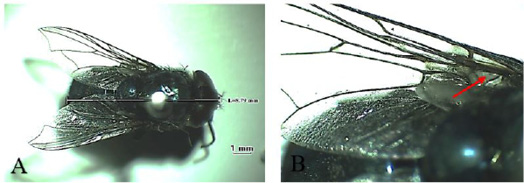
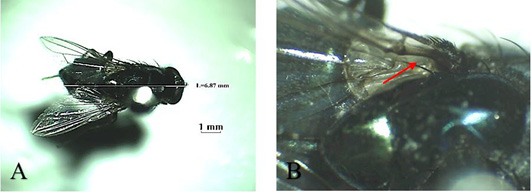
Different results were found in Mojosongo District, M. domestica (36.71%) and H. exigua (33.54%) dominate this region. H. exigua is more commonly found inside cowshed (Table 6). This fly is found on the body of cattle. M. domestica is more commonly found outside the cowshed. The most preferred places of this fly is the manure disposal and the animal feed waste. Sarwar (2016) explained that housefly is commonly found on livestock manure, feed waste and fermenting vegetable as its breeding sites and feed source. Besides raising dairy cattle, the community in Mojosongo District also raises beef cattle, goats and chickens. Some breeders also have quail farms. The diversity of livestock causes the variation of nuisance flies that dominate this area. H. exigua is more commonly found in dry regions and thrives in warmer climates (Iwasa and Ishiguro, 2010). The life cycle of the fly from eggs, larvae, pupae to adults requires supportive conditions. Optimum temperature and humidity maximize the life cycle of the fly in the environment (Iwasa and Ishiguro, 2010).
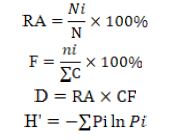
The species diversity was measured by using the Shannon-Wiener diversity index (H’). The diversity index criteria is divided into 3 categories: 1) H’ < 1: low diversity; 2) 1 < H’ < 3 : moderate diversity; and 3) H’ > 3: high diversity (Wilhm and Doris, 1986). The value of the diversity index in Ampel and Mojosongo Districts is shown in Table 4. Ampel District has a low diversity index value because based on diversity index analysis, the value is 0.389 (H’< 1). The low variance index means that the diversity of nuisance fly species in Ampel District is not much, 90.67% is dominated by S. calcitrans. The breed of livestock raised is relatively homogeneous. The livestock raised in this area are mostly Friesian Holstein. Mojosongo District has a moderate diversity index value (H’: 1.332). Types of flies that dominate in this region are more diverse, that are M. domestica, H. exigua and S. calcitrans. Livestocks raised in this region is more varied. In addition to dairy cattle, there are goats, sheep, chickens and quails. The variety of livestock breeds contributes to diverse breeding sites and feeding sources of the fly so that the competition between the flies is relatively low (Sarwar, 2016). Based on geographical conditions, it is known that Mojosongo District has lower elevation than Ampel District. It leads to the higher species diversity in Mojosongo District. Maaz et al. (2018) explained that the abundance of ectoparasites will decrease in line with increasing land fragmentation associated with modernization and population movement. Therefore, the diversity of nuisance fly species in Mojosongo District is relatively more varied because this area is close to Boyolali District which is more developed and modern. Boyolali and Mojosongo Districts are densely populated residential development areas, so these two districts are relatively more advanced than other districts.
Hygiene and sanitary conditions also affect the dominance of flies. Dairy farms in Boyolali Regency are traditional so the hygiene sanitation practice varies between the breeders. There are several cowsheds found merged with the residential house. The cattle manure disposal system is poor, even many breeders just throw the manure on the empty yard around the cowshed. Patra et al. (2018) explained that poor hygiene and sanitation conditions affect the presence of various species of flies that can potentially spread various diseases.
The role of ectoparasites in animal and human life has been widely known and the losses caused are also very diverse. Ectoparasites that live on the surface of the skin and between host hairs cause irritation, itching, inflammation, and myiasis (Hadi et al., 2011a). This condition causes an uncomfortable feeling that can reduce the nutritional status and productivity of the livestock. Ectoparasites also often make some people feel fear, disgust and hate towards them (entomophobia) such as cockroaches and flies (Hadi et al., 2011a). For some people who are sensitive, allergic reactions, itching and dermatitis are common. Some ectoparasites such as ticks can even cause paralysis due to the toxins they secrete (tick paralysis) (Hadi et al., 2011a).
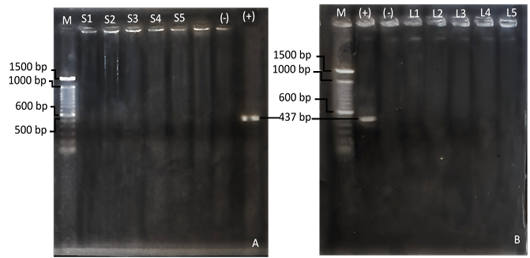
Another more dangerous aspect of ectoparasites is their role as vectors of various diseases. For example, mosquitoes do not only irritate the host with their bites, but also can transmit disease agents. Flies also have the potential to spread and transmit various diseases. One of the potential diseases in livestock that is spread by flies is lumpy skin disease (LSD). Lumpy skin disease is a disease caused by Lumpy Skin Disease Virus (LSDV), genus Capripoxvirus, family Poxviridae (Neamat-Allah, 2015; Neamat-Allah and Mahmoud, 2019). Cattle suffering this disease will experience decreased milk production, abortion, infertility and skin damage. In addition, the symptoms that appear in livestock are anorexia and fever at a temperature of 40.5-41.3°C (Neamat-Allah and Mahmoud, 2019). Nodules on the skin can develop from few to multiple lesions over time, and these lumps can then coalesce and ulcerate (Neamat-Allah and Mahmoud, 2019). Skin examination confirmed the presence of hair follicles of scattered eosinophilic intracytoplasmic inclusion bodies, which are characteristic pathognomonic lesions associated with LSD (Neamat-Allah and Mahmoud, 2019).
LSDV infected cattle in early stages revealed leucopenia and immunosuppressive effect, so immunostimulant therapy is required (Neamat-Allah, 2015). In late-stage revealed that hemolytic anemia, leucocytosis, and increase of Creatine phosphokinase serum could aid in diagnosis (Neamat-Allah, 2015). Disturbance in liver and kidney function may also occur. Neamat-Allah and Mahmoud (2019) explained that buffaloes are less susceptible to LSD and suggest that the presence of hypophosphatemia could exaggerate the hemolytic anemia and oxidant-anti-oxidant imbalance and pro-inflammatory cytokines. The liver, heart, and kidneys could also be affected by LSD infection (Neamat-Allah and Mahmoud, 2019).