
The current study was conducted on 100 lambs of Iraqi Awassi sheep, slaughtered at the age of 10 months. DNA extraction and PCR reactions were carried out at the biology sciences laboratory of the Marshes Research Center/Thi-Qar University. Sequencing technology was used to detect mutations in SSTR1 gene. The results of the multiple alignment analysis of the sequence of SSTR1 gene indicated the presence of one mutation 264 A>G. The obtained mutation produced three genotypes, namely AA, AG, and GG. The frequency of the genotypes AA, AG and GG were 0.50, 0.17 and 0.33, respectively. While the frequency of the A and G alleles were 0.58 and 0.42, respectively. There were significant impacts of SSTR1 gene polymorphisms and the weights of carcass characteristics including heart and liver weight alongside recovery rate. Meanwhile, there was no significant effects between polymorphisms of SSTR1 and the remaining carcass traits including live weight, carcass weight, clearance percentage, and spleen and kidneys weights. This study highlights the possible efficiency of using SSTR1 as candidate marker for carcass traits in sheep.
Research Article · Volume 11, Issue 10, 7 October 2023 · Open Access
Polymorphisms of Somatostatin Receptor (SSTR-1) Gene and its Relationship with Carcass Traits in Iraqi Awassi Sheep
· · · ·
Affiliations & Notes ⌄
- 1Department of Animal Production, College of Agriculture, University of Sumer, Iraq
- 2College of Agriculture, University of Alqasim Green, Iraq
- 3Marshes Research Center, University of Thi-Qar, Thi-Qar, 64001
- 4Department of Biology, College of Science, University of Misan, Iraq
- 5Department of Development of Animal Wealth, Faculty of Veterinary Medicine, Mansoura University, Mansoura 35516, Egypt. *Correspondence | Ahmed I Ateya, Department of Development of Animal Wealth, Faculty of Veterinary Medicine, Mansoura University, Mansoura 35516, Egypt
- 6Email: ahmed_ismail888@yahoo.com
Article Info ⌄
- Journal:
- Advances in Animal and Veterinary Sciences
- Published:
- 7 October 2023

From the article
- The sequencing of the amplified area of the SSTR1 gene underwent repeated alignment analysis, and the findings revealed one mutation at location 264 A>G (Figure 1).
- The polymorphisms of the SSTR1 gene did not have any significant effect on live weight, carcass weight, and clearance percentage of Awassi lambs (Table 4).
- PCR-DNA sequencing genetic assessment of SSTR1 gene revealed nucleotide sequence variants among Awassi sheep.
- SSTR1 is therefore seen as a genetic marker that could help to improve the native Awassi sheep carcass features.
Selected from the article's own text.
Abstract
INTRODUCTION
Sheep are one of the most significant livestock breeds in Iraq and contribute significantly to the country’s agricultural income. Sheep are one of the key components of animal production, and 58.2% of all sheep in Iraq originate from the Awassi region ; . Because it includes necessary elements that no other diet can match, animal meat plays a significant role in human nutrition and health .
Sheep characteristics that affect growth are highly valuable economically . In terms of growth, animals frequently exhibit phenotypic variance . By examining this variation at the DNA level, the genes/alleles underlying these qualities can be discovered. The best animals can then be selected using this knowledge . Utilizing genomic technology has enhanced molecular genetics and opened up intriguing possibilities for the identification of useful genes. Numerous single nucleotide polymorphisms (SNPs) have been discovered in the genomes of several livestock animals thanks to genome sequencing programs. These genetic markers, or SNPs, can be used to identify the genetic variation that underlies traits in livestock animals that are economically significant and to better understand how genetic variants connect to various phenotypes . In order to make it easier to choose breeding animals that will actually improve traits connected to growth, genetically based improvement programs should be created .
Numerous genes have been employed as genetic markers to choose animals with the finest growth characteristics and premium carcasses. SSTR1 is one of these genes . The fundamental control of metabolic systems that affect growth, such as obesity and dietary absorption, depends on somatostatin proteins (SST) and its receptors (SSTR1, SSTR2, SSTR3, SSTR4, and SSTR5). According to Zhao et al. (2018), somatostatin receptors (SSTRs) are hypothesized to control the growth-inhibitory effects of somatostatin as well as the production of growth hormone. According to ovine genome sequence (NC_019475.2), SSTR1 gene located on chromosome 18 and contains one large coding exon of 1173 base pair (nt 47172694-47173866).
According to Maecke and Reubi (2011), there are five somatostatin receptor subtypes in mammals (SSTR1–5). Widely present in the placenta, kidney, liver, pancreas, lungs, and central nervous system, SSTRs are engaged in a variety of biological functions , but they only function when they bind to G-protein-coupled SSTRs . In the first place, SSTRs inhibit the release of prolactin, thyroid-stimulating hormone (TSH), gastric secretory hormone, growth hormone releasing hormone (GHRH), secretin, glucagon, insulin, and SST itself in the pancreas . Second, by preventing the production of digestive enzymes and gastrointestinal hormones, SSTRs reduce the rate of food absorption in the gastrointestinal tract . Additionally, they reduce blood flow, gallbladder contraction, and gastrointestinal motility, which in turn affects feed conversion and growth traits . This controls the rate of digestion and absorption.
Mammals, particularly goats and sheep, have similarities in the structure and function of the SSTR1 gene, however there are some changes between sheep and goats in the sequence of the 3′-UTR region . A study on the SSTR1 gene in goats using the SSCP-PCR technique, it was revealed presence of four mutations, namely GU014693: g.647T>C, 844A>C, 970T>C and 1039T>A (Jin, et al., 2011). These SNPs resulted in two the two haplotypes, TATT and CCCA, were significantly associated with animal body length and body height. The results of a study on Romney sheep in New Zealand using the (PCR-SSCP) approach to identify polymorphisms in the 3′UTR of the SSTR1 gene revealed that three polymorphisms were identified (Zhaoa et al., 2018). It was discovered that the presence of A allele is linked to a reduction in the weight of hot carcasses. Meanwhile the presence of C allele is linked to an increase in subcutaneous deep fat as well as a reduction in birth weights.
The objective of the current study was to examine the SSTR1 gene’s sequence and identify any connections between potential mutations and growth and carcass traits of Iraqi Awassi sheep.
MATERIALS AND METHODS
Animals And Experimental Samples
The current study, which employed one hundred lambs of the Awassi sheep breed, was carried out at one of the breeders’ fields in the city of Al-Qasim, about 35 km away from it in the province of Babylon. Lambs had 37.81 kg average body weight. Animals were slaughtered when they were 10 months old. Broad spectrum anthelmintic was administered to the animals as directed as a prophylactic dose. All animals were housed in identical housing circumstances throughout the duration of the trial and had no prior history of metabolic or concomitant illnesses. The Composition of the concentrate feed mixture (CFM) fed to growing in kilograms (Kg) was as follows: 400 Corn, 300 wheat bran, 250 soya beans, 10 sodium chloride, 20 Ca carbonate, and 1 premix.
Lambs’ jugular veins were used to obtain blood samples for DNA extraction, which was done using a kit made by the Geneaid Taiwanese Company. One milliliter of blood was taken from the jugular vein of each lamb for DNA extraction.
Dna Extraction And Polymerase Chain Reaction
The Marshes Research Center/Thi-Qar University’s biology sciences lab performed DNA extraction and PCR procedures. DNA was extracted using the Geneaid/Korea extraction kit. A 718-bp fragment from the coding region of the SSTR1 gene was amplified using the following two primers F-5′ ACCATCAGGG-TGATCTTGCG -3′ and R-5′-CTGCAGACGGGATGGAAGAA -3′. The used primers were designed based on the reference transcript recorded in the GenBank under code XM_012098844.4. Table (1) shows the amplification program for the selected fragment of the SSTR1 gene. Table (2) shows the materials used in the amplification reaction and their quantities.
Dna Sequencing And Polymorphism Detection
Prior to the development of DNA sequencing, Jena Bioscience # pp-201s/Munich, based in Hamburg, Germany, developed techniques for purifying PCR and removing primer dimmers, nonspecific bands, and other impurities to yield the intended amplified product of the expected scope . By using a Nanodrop (Waltham, MA, USA, UV-Vis spectrometer Q5000) to assess PCR output, adequate quality and good concentrations were attained . All of the examined samples’ PCR products were transferred to the Korean business Macrogen for nucleotide sequencing examination. The alignment of all sequences was carried out using the BioEdit software version 7.2.5 after receiving the results of the SSTR1 gene sequencing .
Table 1: Amplification PCR protocol for SSTR1 gene.
Stage | Temperature | Time | Cycle |
| Initial | 96 ° C | 5 min | 1 |
| Denaturation | 96 ° C | 30 sec | 35 cycle |
| Annealing | 56° C | 30 sec | |
| Extension | 72° C | 1 min | |
| Final extension | 72° C | 7 min | 1 |
| Store | 4°C | ||
Table 2: PCR reaction components for SSTR1 gene.
Reagents | Volume µl |
| Master Mix | 13 µl |
| Primer forward | 1 µl |
| Primer reverse | 1 µl |
| DNA template (30-100ng) | 1-3 µl |
| Free water | 7-9 µl |
| Total | 25 µl |
Statistical Analysis
Allelic and genotypic frequencies and Hardy–Weinberg equilibrium were estimated using by POPGENE software v1.32. Chi-square- test was used to compare the percentages of alleles for each genotype in the studied sheep sample. Associations of the SSTR1 gene polymorphisms with growth and carcass traits were calculated by the SPSS statistical program (Version 22.0, 2013).
To test association between SSTR1 gene polymorphisms and growth traits, the following model was used:
Yijk = µ + Gi + eijk
Where, Yijk is the phenotypic value of the trait, µ is overall population mean, Gi is the effect of SSTR1 genotype, and eijk is the random error effect.
RESULTS AND DISCUSSION
DNA extraction showed that the DNA concentration ranged between 34 - 98 ng /μl and that the purity using wavelengths 260/280, ranged between 2.03 - 1.71 nm. The results of agarose gel electrophoresis showed the successful amplification of the SSTR gene, where the size of the PCR product was 718-bp.
The sequencing of the amplified area of the SSTR1 gene underwent repeated alignment analysis, and the findings revealed one mutation at location 264 A>G (Figure 1). Three genotypes AA, AG and GG were noticed. The valine amino acid code AGT was used to create the mutation, which resulted in the code changing to GGT. Of the 390 amino acids that make up the SSTR1 peptide chain, 141 remained in their original location in relation to the whole protein.
Table (3) shows genotypes and allele frequencies for SSTR1 gene polymorphisms. Results indicated that the frequency of the genotypes AA, AG and GG were 0.50, 0.17, and 0.33, respectively. While the frequency of the A and G alleles were 0.58 and 0.42, respectively. The polymorphisms of the SSTR1 gene did not have any significant effect on live weight, carcass weight, and clearance percentage of Awassi lambs (Table 4). This is consistent with . As for the percentage of recovery, the GG genotype was superior to the AA and AG.
Table 3: Genotype and allele frequencies for SSTR1 gene
Genotype | Genotype frequency | Allele | Allele Frequency | X2 | |
| AA | 50 | 0.50 | A | 0.58 | 10.36 |
| AG | 17 | 0.17 | G | 0.42 | |
| GG | 33 | 0.33 | |||
| Total | 100 | ||||
Table 4: Effect of SSTR1 gene polymorphisms on carcass traits
Traits | Genotype | N | Mean | Std. Error | P value |
| Live Weight | AA | 50 | 37.18 | 1.093 | 0.70 N.S |
| AG | 17 | 35.31 | 0.616 | ||
| GG | 33 | 40.01 | 1.154 | ||
| Total | 100 | 37.81 | 0.743 | ||
| Carcass Weight | AA | 50 | 17.27 | 0.552 | 0.32 N.S |
| AG | 17 | 16.12 | 0.229 | ||
| GG | 33 | 18.79 | 0.501 | ||
| Total | 100 | 17.59 | 0.371 | ||
| Clearance percentage | AA | 50 | 46.42 | 0.271 | 0.64 N.S |
| AG | 17 | 45.77 | 0.284 | ||
| GG | 33 | 46.98 | 0.226 | ||
| Total | 100 | 46.50 | 0.178 | ||
| Recovery percentage | AA | 50 | 73.86 b | 0.301 | 0.00 ** |
| AG | 17 | 70.52 c | 0.501 | ||
| GG | 33 | 75.25 a | 0.302 | ||
| Total | 100 | 73.77 | 0.380 |
- A= Adenine; G= Guanine; N= number; and STRR1=Somatostatin receptor
Table 5: Effect of SSTR1 gene polymorphisms on giblet weight traits.
Traits | Genotype | N | Mean | Std. Error | P value |
| Heart | AA | 50 | 0.1467 b | 0.005 | 0.001 ** |
| AG | 17 | 0.1475 b | 0.004 | ||
| GG | 33 | 0.1950 a | 0.012 | ||
| Total | 100 | .1629 | 0.006 | ||
| Liver | AA | 50 | 0.6817 b | 0.023 | 0.005 ** |
| AG | 17 | 0.5800 c | 0.034 | ||
| GG | 33 | 0.7712 a | 0.034 | ||
| Total | 100 | 0.6946 | 0.0215 | ||
| Spleen | AA | 50 | 0.0917 | 0.005 | 0.579 N.S |
| AG | 17 | 0.0825 | 0.004 | ||
| GG | 33 | 0.0937 | 0.007 | ||
| Total | 100 | .0908 | 0.003 | ||
| Kidneys | AA | 50 | 0.1433 | 0.005 | 0.21 N.S |
| AG | 17 | 0.1250 | 0.013 | ||
| GG | 33 | 0.1462 | 0.006 |
-A= Adenine; G= Guanine; N= number; and STRR1=Somatostatin receptor
Table (5) shows the effect of polymorphisms of the SSTR1 gene on giblets weight of Awassi lamb carcasses. A highly significant effect of polymorphisms on the weight of the heart and liver, as lambs bearing the polymorphism GG excelled on lambs bearing AA and AG genotypes. As for the spleen and kidneys, polymorphisms did not have any significant effect. The fundamental goal of the majority of genetic-selection programs is growth, which is one of the most significant economic variables measured in domestic animals . Body weight and body measurements, which serve as the primary indicators of growth features, have a significant impact on the production of meat and wool .
Depending on whether they are found in regulatory sequences or coding regions, single nucleotide polymorphisms (SNPs), which are characterized as a substitution, insertion, or deletion of a single nucleotide, are significant genetic sources for animal breeding . As it is well known, there are many elements that affect gene expression . One of these elements is SNPs. SNPs regulate how genes are expressed and how proteins work. According to Taboada et al. (2007), SSTR1 is a significant peptide hormone that modulates a variety of processes, including neurotransmission, cell proliferation, and, specifically, growth hormone production. The relatedness between SSTR1 gene polymorphism and growth traits of sheep is scarcely reported. Li et al. (2021) referred to his study on Chinese Hulun Buir sheep and revealed the relationship of the polymorphisms of the SSTR1 gene to the characteristics of growth and carcasses. The study revealed four SNPs mutations in the second exon of the gene. A significant effect of the CC genotype was noticed compared to CT resulting from the third mutation of the studied region of the gene, where the CC genotype was superior in the body weight, body height, body length, chest circumference, chest depth, chest width, hip width, and cannon circumference
Jin et al. (2011) found also two SNPs (GU014695:g.801 C>T, GU014695:g.948 C>T) in the SSTR1 gene that affect growth traits in caprines. Significant relationships between the three GU014695:801 C>T genotypes and chest circumference, body height, and length. These findings imply that goat development features may be influenced by the caprine SSTR1 genes. In the same respect, Zhao et al. (2017) screened for variation in the SSTR1 gene in New Zealand Romney sheep using polymerase chain reaction-single-strand conformational polymorphism (PCR-SSCP) analysis. DNA sequencing identified three distinct nucleotide sequences (A-C) and three distinct PCR-SSCP banding patterns. It was discovered that the presence of A was linked to a reduction in the weight of the heated carcass, whilst the presence of C was linked to higher subcutaneous fat depth and lower birth weights.
Depending on their chromosomal position, mutations have the capacity to change every step of gene expression. They have the ability to influence mRNA expression when found within transcriptional regulatory elements . SNPs can affect mRNA splicing, nucleo-cytoplasmic export, stability, and translation when they occur in genes. They can alter the function of a protein when they are found in a coding sequence and result in an amino acid change (also known as a non-synonymous SNP or mutation; . A non-synonymous SNP was elaborated by our findings. The mutation was made using the valine amino acid code AGT, which led to the code altering to GGT. In regard to the entire protein, 141 of the 390 amino acids that make up the SSTR1 peptide chain were left in their original positions. The aforementioned justifications led us to more successfully discover SNPs linked to growth traits using exon sequencing technologies.
CONCLUSION
PCR-DNA sequencing genetic assessment of SSTR1 gene revealed nucleotide sequence variants among Awassi sheep. There is a relationship between the SSTR1 gene polymorphisms and carcass characteristics. SSTR1 is therefore seen as a genetic marker that could help to improve the native Awassi sheep carcass features.
INSTITUTIONAL REVIEW BOARD STATEMENT
All animal management procedures, tested trial gathering, and sample discarding were carried out underneath the supervision of the University of Sumer, Iraq.
RECOMMENDATIONS
Future studies might focus on investigating the SSTR1 gene polymorphism on other sheep breeds. Large number of animals should be acknowledged during this investigation.
NOVELTY STATEMENT
The relatedness between SSTR1 gene polymorphism and growth traits of sheep is scarcely reported. Finding this polymorphism by SNPs could regulate how genes are expressed and how proteins work.
INFORMED CONSENT STATEMENT
All dairy farmers provided their knowledgeable agreement to contribute to the investigation.
DATA AVAILABILITY STATEMENT
Upon reasonable request, the supporting information for the study’s findings will be provided by the corresponding author.
ACKNOWLEDGMENTS
The authors acknowledge the staff at Department of Biology, College of Science, University of Misan, Iraq.
CONFLICT OF INTEREST
The authors declare no conflict of interest.
AUTHOR CONTRIBUTIONS
The experimentation was developed, the PCR completed, and the paper written by Dhurgham K. Seger. Rahman H. H. Al Qasimi, Azhar A. Jaffar, and Salah H. Faraj performed DNA sequencing and contributed to the writing of the paper. Contributions were made to the planning of the manuscript and data analyses by Ahmed I. Ateya. All authors have read and agreed to the published version of the manuscript.
Figures

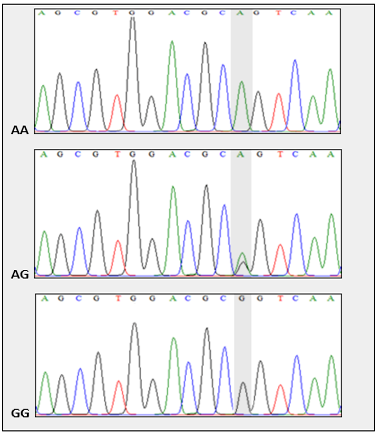
Chromatograph of DNA sequence for SSTR1 gene indicating AA, AG, and GG genotypes.
References
- Al-Qasimi R.H.H., Jaffar A.A., ALKhauzai A.L.D (2021). Relationship GDF9B (BMP-15) Gene Polymorphism with litter size in Iraqi Awassi Sheep. Euphrates J. Agri. Sci., 13 (4): 187-194.
- Anzola L.K., Rivera J.N., Dierckx R.A., Lauri C., Valabrega S., Galli F., Lopez S.M., Glaudemans A.W.J.M., Signore A. (2019). Value of Somatostatin Receptor Scintigraphy with 99mTc-HYNIC-TOC in Patients with Primary Sjögren Syndrome. J. Clin. Med., 8: 763. https://doi.org/10.3390/jcm8060763[CrossRef]
- Bhat M.M., Jalal H., Para P.A., Bukhari S.A., Ganguly S., BhatA.A., Wakchaure R., Qadri K. (2015). Fraudulent adulteration/substitution of meat: A review. Int. J. Recent Res. Appl.Stud., 2(12, 5): 22-33.
- Boesenberg-Smith K.A., Pessarakli M.M., Wolk D.M. (2012). Assessment of DNA yield and purity: An overlooked detail of PCR troubleshooting. Clin. Microbiol. Newsl., 34: 1-6 https://doi.org/10.1016/j.clinmicnews.2011.12.002[CrossRef]
- Boom R., Sol C.J., Salimans M.M., Jansen C.L., Wertheim-van Dillen P.M., Noordaa J.V.D. (1990). Rapid and simple method for purification of nucleic acids. J. Clin. Microbiol., 28: 495–503. https://doi.org/10.1128/jcm.28.3.495-503.1990[CrossRef]
- Daw E.W., Heath S.C., Lu Y. (2005). Single-nucleotide polymorphism versus microsatellite markers in a combined linkage and segregation analysis of a quantitative trait. BMC Genet., 6 (1): S32. https://doi.org/10.1186/1471-2156-6-S1-S32[CrossRef]
- Debus N., Dutour A., Vuaroqueaux V., Olivera C., Ouafik L.H. (2001). The ovine somatostatin receptor subtype 1 (osst1): partial cloning and tissue distribution. Domest. Anim. Endocrinol., 21:73–84. https://doi.org/10.1016/S0739-7240(01)00109-6[CrossRef]
- Hall T.A. (1999). BioEdit: A user-friendly biological sequence alignment editor and analysis program for Windows 95/98/NT. Nucleic Acids Sym. Ser., (4): 95-98.
- Ibrahim S., Al-Sharif M., Younis F., Ateya A., Abdo M., Fericean L. (2023). analysis of potential genes and economic parameters associated with growth and heat tolerance in sheep (Ovis aries). Animals (Basel)., 19: 13(3):353. https://doi.org/10.3390/ani13030353[CrossRef]
- Jin Q.J., Sun J.J., Fang X.T., Zhang C.L., Yang L., Chen D.X., Shi X.Y., Du Y., Lan X.Y., Chen H. (2010). Molecular characterization and polymorphisms of the caprine Somatostatin (SST) and SST Receptor 1 (SSTR1) genes that are linked with growth traits. Mol. Biol. Rep., 38: 3129–3135. https://doi.org/10.1007/s11033-010-9983-7[CrossRef]
- Koller D., Rodríguez M.S., Zubiaur P., Ochoa D., Almenara S., Román M., Romero-Palacián D., De Miguel-Cáceres A., Martín S., Gómez M.N., et al (2020). The effects of aripiprazole and olanzapine on pupillary light reflex and its relationship with pharmacogenetics in a randomized multiple-dose trial. Br. J. Clin. Pharmacol., 86: 2051–2062. https://doi.org/10.1111/bcp.14300[CrossRef]
- Li X., Ding N., Zhang Z., Tian D., Han B., Liu S., Liu D., Tian F., Zhao K. (2021). Identification of Somatostatin Receptor Subtype 1 (SSTR1) Gene Polymorphism and Their Association with Growth Traits in Hulun Buir Sheep. Genes (Basel)., 28: 13(1):77. https://doi.org/10.3390/genes13010077[CrossRef]
- Lloyd K.C., Amirmoazzami S., Friedik F., Chew P., Walsh J.H. (1997). Somatostatin inhibits gastrin release and acid secretion by activating sst2 in dogs. Am. J. Physiol. Content., 272: 1481–1488. https://doi.org/10.1152/ajpgi.1997.272.6.G1481[CrossRef]
- Luo W., Zhou Y., Wang J., Yu X., Tong J. (2021). Identifying candidate genes involved in the regulation of early growth using full-length transcriptome and RNA-seq analyses of frontal and parietal bones and vertebral bones in Bighead Carp (Hypophthalmichthys nobilis). Front. Genet., 11: 603454 https://doi.org/10.3389/fgene.2020.603454.[CrossRef]
- Luque R.M., Gahete M.D., Hochgeschwender U., Kineman R.D. (2006). Evidence that endogenous SST inhibits ACTH and ghrelin expression by independent pathways. Am. J. Physiol. Metab., 291: 395–403. https://doi.org/10.1152/ajpendo.00038.2006[CrossRef]
- Maecke H.R., Reubi J.C. (2011). Somatostatin Receptors as Targets for Nuclear Medicine Imaging and Radionuclide Treatment. J. Nucl. Med., 52: 841–844. https://doi.org/10.2967/jnumed.110.084236[CrossRef]
- Marai I.F.M., Bahgat L.B., Shalaby T.H., Abdel-Hafez M.A. (2000). Fattening performance, some behavioral traits and physiological reactions of male lambs fed concentrates mixture alone with or without natural clay, under hot summer of Egypt. Ann. Arid. Zone, 39: 449–460
- Mendell J. T., Dietz H. C. (2001). When the message goes awry: diseaseproducing mutations that influence mRNA content and performance. Cell, 107: 411–414. https://doi.org/10.1016/S0092-8674(01)00583-9[CrossRef]
- Muhana K.H., Jaffar A.A., Al Qasimi R.H.H. (2021). Relationship between calpastatin gene polymorphism and production traits in Awassi sheep in Iraq. Indian J. Ecol., 48 (17): 251-255.
- Nicholson P., Yepiskoposyan H., Metze S., Zamudio Orozco R., Kleinschmidt N., Muhlemann O. (2010). Nonsense-mediated mRNA decay in human cells: mechanistic insights, functions beyond quality control and the double-life of NMD factors. Cell. Mol. Life Sci., 67: 677–700. https://doi.org/10.1007/s00018-009-0177-1[CrossRef]
- Ocak S., Guney O. (2010). Physiological responses and some blood parameters of bucks under Mediterranean climate conditions. Anadolu. J. Agric. Sci., 25: 113–119
- Quan F.B., Desban L., Mirat O., Kermarquer M., Roussel J., Koëth F., Marnas H., Djenoune L., Lejeune F.-X., Tostivint H., et al. (2020). Somatostatin 1.1 contributes to the innate exploration of zebrafish larva. Sci. Rep., 10: 15235. https://doi.org/10.1038/s41598-020-72039-x[CrossRef]
- Salces-Ortiz J., González C., Moreno-Sánchez N., Calvo J.H., PérezGuzmán M.D., Serrano M.M. (2013). Ovine HSP90AA1 expression rate is affected by several SNPs at the promoter under both basal and heat stress conditions. PLoS ONE, 8: e66641. https://doi.org/10.1371/journal.pone.0066641[CrossRef]
- Singh K.P., Miaskowski C., Dhruva A.A., Flowers E., Kober K.M. (2018). Mechanisms and measurement of changes in gene expression. Biol. Res. Nurs., (4):369-382. https://doi.org/10.1177/1099800418772161[CrossRef]
- Spss. (2013). Statistical Package of Social Science .Ver . 22. Application Guide.Copy right by Spss Inc.USA.
- Stevenson K. (2015). Genetic diversity of Mycobacterium avium subspecies paratuberculosis and the influence of strain type on infection and pathogenesis: A review. Vet. Res., 46: 64. https://doi.org/10.1186/s13567-015-0203-2[CrossRef]
- Strowski M.Z., Parmar R.M., Blake A.D., Schaeffer J.M. (2000). Somatostatin inhibits insulin and glucagon secretion via two receptor subtypes: An in vitro study of pancreatic islets from somatostatin receptor 2 knockout mice. Endocrinol., 141:111–117. https://doi.org/10.1210/endo.141.1.7263[CrossRef]
- Taboada G.F., Luque R.M., Bastos W., Guimaraes R., Marcondes J.B., Chimlii L.M.C., Fontes R., Mata P.J.P., Filho P.N., Carvalho D.P., et al. (2007). Quantitative analysis of soma-tostatin receptor subtype (sstr 1-5) gene expression levels in somatotropinomas and non-function pituitary adenomas. Eur. J. Endocrinol., 156: 65. https://doi.org/10.1530/eje.1.02313[CrossRef]
- Tulassay Z (1998). Somatostatin and the Gastrointestinal Tract. Scand. J. Gastroenterol., 33: 115–121. https://doi.org/10.1080/003655298750026642[CrossRef]
- Weckbecker G., Lewis I., Albert R., Schmid H.A., Hoyer D., Bruns C. (2003). Opportunities in somatostatin research: Biological, chemical and therapeutic aspects. Nat. Rev. Drug Discov., 2: 999–1017. https://doi.org/10.1038/nrd1255[CrossRef]
- Zhao F., Zhou H., Li S., Fang Q., Luo Y., Hickford J.G.H. (2018). Growth and carcass trait association with variation in the somatostatin receptor 1 (SSTR1) gene in New Zealand Romney sheep. N. Z. J. Agric. Res., 61: 477–486. https://doi.org/10.1080/00288233.2017.1415942[CrossRef]
Services
Article usage statistics
Loading…