
Temperature stress affect a stress response of aquatic animals including physiological metabolism, immune defense and other metabolic processes, damaged their immune response even cause dead. In this study, the physiological and histological changes of Procambarus clarkii under the high temperature (30°C) and the low temperature (10°C) stress were investigated. With the increase of temperature, the pyruvate kinase activity in the hepatopancreas and gill tissues of crayfish was gradually increased, and the fatty acid synthase activity at 10°C and 30°C were significantly lower than the control group of 25°C. Furthermore, lysozyme, catalase and superoxide dismutase in 10 °C and 30 °C were significantly lower than that of 25 °C. ELISA revealed that HSP90 activities was enhanced with the increasing temperature in hepatopancreas after 36h of treatment. HE sections showed that high temperature stress or hypothermia caused deformation of R cells (storage cells), rupture of B cells (secretory cells), and partial rupture of the basement membrane (BM) in hepatopancreas, as well as the deformation of epithelial cells and respiratory epithelial cells of BM in gill tissues. While the temperature stress (30°C and 10°C treatment) caused the deformation of epithelial cells and respiratory epithelial cells, making rupture of the BM, comparing with the group at 25°C. The study provides the data about the response of crayfish to temperature stress at the molecular level, and benefit to develop the strategy to defend the damage in the crayfish aquaculture caused by the temperature neither in the different regions nor in the different season.
Research Article · Volume 56, Issue 1, 20 December 2023 · Open Access
Physiological and Histological Changes in Crayfish Procambarus clarkii after Acute Temperature Stress
· · · · · ·
Affiliations & Notes ⌄
- 1Key Laboratory of South China Sea Fishery Resources Exploitation and Utilization, Ministry of Agriculture and Rural Affairs, P.R. China, South China Sea Fisheries Research Institute, Chinese Academy of Fishery Sciences, Guangzhou, China 510300 2Shenzhen Base of South China Sea Fisheries Research Institute, Chinese Academy of Fishery Sciences, Shenzhen 518108, P.R. China 3College of Aqua-life Science and Technology, Shanghai Ocean University, Shanghai,201306, China 4Shenzhen animal Disease Preven
Article Info ⌄
- Journal:
- Pakistan Journal of Zoology
- Published:
- 20 December 2023

From the article
- Environmental temperature changes affect the physiological metabolism, immune defense and so on of aquatic animals.
- In addition, the CAT activity of both treatment group was significantly lower than the control, indicating high (30°C) and low temperature (10°C) caused different degrees of oxidative damage in the hepatopancreas and gill tissues of P. clarkii.
- The SOD activity in the hepatopancreas increased with the temperature, but it decreased in the gills in both treatment group, suggesting that the free radical metabolism rate of P. clarkii varies in different tissues, and the gill tissue is more sensitive than the hepatopancreas.
- The content of HSP90 in the hepatopancreas of P. clarkii increased with the rising temperature, which indicated that the content of HSP90 was positively correlated with temperature within a certain temperature range, and the high expression of HSP90 could cooperate with the body to resist environmental heat stress.
Selected from the article's own text.
Abstract
INTRODUCTION
Procambarus clarkii, native to the northern United States now is widely distributed in Europe, Africa, East Asia, South America and Central America. China, with the rapid development in the past ten years, has become a country with the largest annual production of P. clarkii . Chinese crayfish industry developing rapidly in many provinces, from north of China such as Shandong Province to southeast of China Hainan Province. However, there are still some problems has been faced in the industry ; ; . P. clarkii is sensitive to aquaculture water environmental temperature, and how to improve the production in a very hot or very cold region; how to overcome severe imbalance between the seasonal supply and demand of the market (such as the lack of supply in hot summer); how to avoid diseases caused by the environmental stress of P. clarkii and so on. Therefore, exploring the effects of temperature stress on P. clarkii will benefit to understand the physiological mechanism of the animals, and develop the strategy to cope with seasonal problem and improve the growth performance in different regions.
Changes in aquaculture temperature will cause short-term stress response of crustaceans. Studies have reported that within a certain temperature range, the metabolic rate of P. clarkii increases with the increase of water temperature, and its energy metabolism rate is the highest at 32 °C . Powell et al. (2010) found that the hemocyanin of P. clarkii has a relatively high oxygen binding affinity that increased the metabolic rate in the low dissolved oxygen water caused by high water temperature. Wu et al. (2017) reported that low temperature increased the activity of muscle lactate dehydrogenase in Litopenaeus vannamei, but decreased the activity of respiratory metabolic enzymes such as succinate dehydrogenase.
Changes in ambient temperature can also cause changes in the antioxidant status and immune function of crustaceans . The antioxidase superoxide dismutase (SOD), catalase (CAT) and immunity-related enzyme lysozyme (LYS), reported in the researches that fluctuated in different temperature ; . Furthermore, hemolymph immune enzymes phenol oxidase (PO), alkaline phosphatase (ALP) and SOD of Penaeus vannamei have the highest activity at 22-26 °C, and their activities will decrease above or below this temperature ; while SOD enzyme activity of Eriocheir sinensis significantly reduce under the very low temperature (Hong et al., 2007a).
The immune related genes or pathway of organisms were also changed under the temperature stress, such as heat shock proteins (HSPs), hemocyanin, P53 signal pathway, etc. ; , revealing a complex physiological and molecular process. Though we have shown that super high temperature (35°C) cause metabolic imbalance, immune disorders and apoptosis of P. clarkii by transcriptome, the other changes in the organisms need to be analysed . In order to understand the effects of acute temperature stress on the immunity, metabolism, and stress proteins and tissue structure of P. clarkii, the antioxidant, immune, metabolism-related enzyme activities and response of the hepatopancreas and gill tissues of P. clarkii under temperature stress were detected and the microstructure of hepatopancreas and gill tissue sections were observed in this study.
MATERIALS AND METHODS
Animal collection and treatment
P. clarkii was purchased from the local aquatic market in Shenzhen, with similar body length (averaging 6.0 ± 0.5 cm) and body weight (averaging 15.0 ± 2.0 g). They were temporarily raised in the recirculating aquaculture system of the Shenzhen Experimental Base of the South China Sea Fisheries Research Institute. A commercial crayfish diet was provided every day, and each feeding amount was 3% of the P. clarkii body weight. The water temperature was 25±1°C, the pH was 7.5, and the dissolved oxygen was 6.5±0.5 mg/L.
Ninety crayfishes were randomly selected and divided into three groups: the first group was medium temperature group (25°C±1°C), the second group was low temperature group (10°C±1°C), and the third group was high temperature group (30±1°C). After 36 h, three crayfishes of each group were sacrificed for sample. Half part of hepatopancreas from the midline, and half part of gill on side of carapace was cut and placed in liquid nitrogen for frozen storage, the other half of tissues was placed in 4% paraformaldehyde and stored in a refrigerator at 4°C.
Determination of enzyme activities and protein content
Taking out the hepatopancreas and gill tissue samples stored in liquid nitrogen, and after thawing, weighed 0.1 g of each sample, and then homogenized in 9 times the volume of PBS (PH=7.4) using a tissue crusher. Homogenates were centrifuge for about 10 min (3000-3500 r/min), collected the supernatant, and aliquot it for testing. SOD, LYS, CAT, Pyruvate kinase (PK) and FAT enzyme activities were measured using commercially available ELISA kits (Beijing Huabo Deyi Biotechnology Co., Ltd.) according to the manufacturer’s instructions. The determination of HSP90 content was carried out under the guidance of the instructions of the shrimp heat shock 90 kit (Beijing Huabo Deyi Biotechnology Co., Ltd.).
Histological examination
The hepatopancreatic tissue and gill tissue, preserved in 4% paraformaldehyde, were dehydrated using an alcohol gradient, and using xylene as a transparent agent. The tissues were embedded in paraffin and sliced into sections (5±1 μm thickness). Tissue sections were stained with hematoxylin-eosin (HE), and then observed under an Olympus microscope and images were collected.
RESULTS
Metabolic enzyme activities
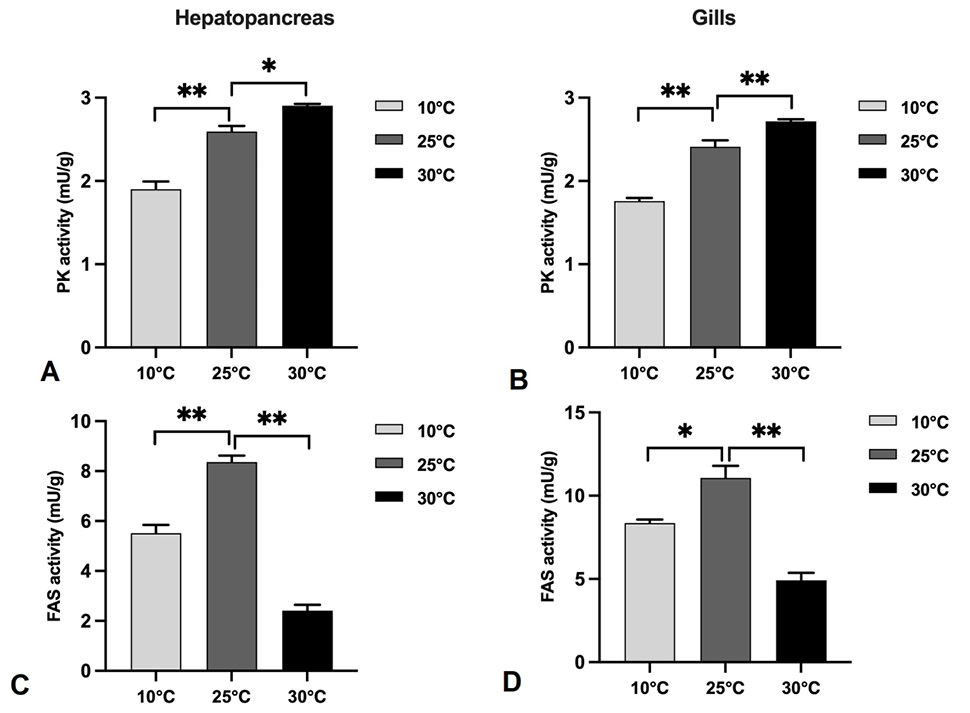
PK activity in the hepatopancreas and gill tissues of P. clarkii was gradually increased with the increase from 10°C to 30°C. The PK activity at high temperature of 30°C and low temperature of 10°C were apparently different from those of the control group at 25°C (p<0.05); while the activity of FAS was the highest in the control group at 25°C, but lower either in 10°C group or in the 30°C group (Fig. 1).
Immune-related enzyme and antioxidase activities
The activities of immune-related enzymes and antioxidase of P. clarkii were significantly different under the acute temperature stress (Fig. 2). The activities of LYS and CAT showed a trend of first increasing and then decreasing under the different temperature stresses in the hepatopancreas and gill tissues, and the low temperature group (10°C) and high temperature group (30°C) were obviously lower than the control group (25°C). In addition, the activity of SOD at low temperature of 10°C and high temperature of 30°C was also obviously different from the control group. However, the activity was the highest under high temperature (30°C) and the lowest (10°C) in the hepatopancreas. The control group (25°C) had the highest activity, followed by the low temperature group (10°C) and the high temperature group (30°C) was the lowest in the gill tissue.
HSP90 content
As the sensitive protein of temperature, HSP90 protein level was increase with the increasing temperature after 36h treatment (Fig. 3), which was lowest in the low temperature (10°C) group (p<0.05) and highest in the high temperature (30°C) group (p<0.05) in hepatopancreas. However, both of the treatments caused the increase of HSP90, though the difference was not significant in the low temperature (10°C) group.
Effect on hepatopancreas
Acute temperature stress had obvious effects on the structure of hepatopancreas (Fig. 4). Part of the basement membrane (BM) was ruptured, R cells (storage cells) were deformed and aggregated, and some B cells (secretory cells) were ruptured and vacuolated in the low temperature group (10°C) compared with the control group (25°C). Meanwhile, the volume of R cells significantly increased and the number was decreased, the B cells were ruptured and vacuolized. Furthermore, the lumen (L) became smaller, and part of the BM was unclear in the high temperature group (30°C).
Effect on gills
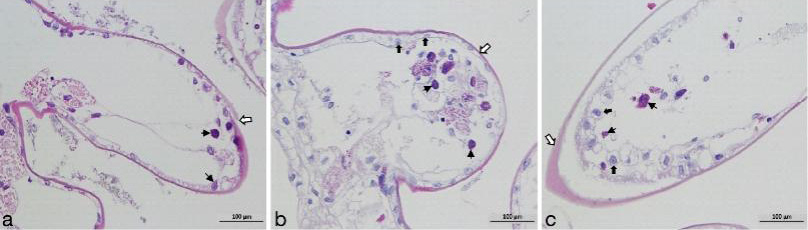
The gill membrane was intact, the structure of respiratory epithelial cells was clear, and there were some microcavity hemocyte in the control group (25°C). However, the gill membrane was ruptured, some microcavity hemocyte were lost, and the respiratory epithelial cells were swollen and unclear after low temperature (10°C) treatment.
Similarly, the gill membrane was blurred and unclear, and the respiratory epithelial cells became larger and shed from the gill membrane, and the microcavity hemocyte were lost and partially necrotic after high temperature (30°C) treatment (Fig. 5).
DISCUSSION
Environmental temperature changes affect the physiological metabolism, immune defense and so on of aquatic animals. Glucose metabolism and lipid metabolism are the main pathways in energy metabolism , in which stable PK and FAS activities are crucial for aquatic animals to adapt to changing environmental temperatures . Fish PK activities changed accompany with the water temperature .The PK activity in the hepatopancreas and gill tissues of P. clarkii in this experiment increased with the rising temperature (10-30°C). Previous studies have shown that low temperature could lead to a decrease in the rate of glycolysis in crustaceans, and the body need to accelerate the pentose phosphate pathway to glucose metabolism , therefore low temperature will lead to a decrease in PK activity, which is consistent with the results of our experiment. The suitable growth temperature of P. clarkii is 21-28°C. Below or above this temperature, the body would experience transient stress and require a lot of energy regulation to cope with environmental stress . In our study, the FAS activity in the hepatopancreas and gill tissues of P. clarkii was the highest at 25°C. The decrease in activity at low temperature of 10°C and high temperature of 30°C might suggest that under temperature stress, the synthesis of fatty acid in P. clarkii slowed down and accelerated the decomposition of fat to provide energy for the body to cope with environmental stress, which was similar to the findings of Seemann et al. (2017) in the Astacus astacus.
Changes in environmental temperature can also cause changes in the anoxidant status and immune function of aquatic animal (Hong et al., 2007b; . The serum lysozyme activity of Hippoglossus hippoglossus L. increased with rising temperature, but the activity decreased after the critical high temperature of 30°C . The immune response is suppressed remarkably at the temperature exceeds the appropriate survival temperature in grass carp . In this study, both high (30°C) and low temperature (10°C) inhibited the activity of LYS of P. clarkia, revealing 10°C and 30°C may be above and below the critical temperature of P. clarkii immunity. In addition, the CAT activity of both treatment group was significantly lower than the control, indicating high (30°C) and low temperature (10°C) caused different degrees of oxidative damage in the hepatopancreas and gill tissues of P. clarkii. The same report was found in mud crab and crayfish ; . The SOD activity in the hepatopancreas increased with the temperature, but it decreased in the gills in both treatment group, suggesting that the free radical metabolism rate of P. clarkii varies in different tissues, and the gill tissue is more sensitive than the hepatopancreas.
HSPs are a classic stress proteins family act as molecular chaperones to reduce the misfolding of damaged proteins . High mRNA expression of HSP70 and HSP90 gene in the hepatopancreas was induce by high or low temperature was confirmed in our former report . Similarly, was found in Litopenaeus vannamei under the both short-term and long-term heat stress . The content of HSP90 in the hepatopancreas of P. clarkii increased with the rising temperature, which indicated that the content of HSP90 was positively correlated with temperature within a certain temperature range, and the high expression of HSP90 could cooperate with the body to resist environmental heat stress. While there was no significant difference in HSP90 content between 10°C and 25°C in gill tissue, revealing tissue differences. Similar reports have also been reported in Scophthalmus maximus .
Environmental temperature also cause tissue damage. As an important tissues of detoxification, metabolism, and endocrine regulation , hepatopancreas tissue structure and number of B cells and R cells was affected by both stress in this study. R cells deformed and aggregated, some B cells ruptured and vacuolized, and the volume of transport vesicles increased at 10°C; the volume of R cells increased significantly, and B cells were arranged disorderly and vacuolized severely at 30°C, indicating that low temperature 10°C and high temperature 30°C stress caused a certain degree of structural damage to the hepatopancreas of P. clarkii. Similar type of finding were reported in L. vannamei and Eriocheir sinensis (Hong et al., 2007a) that hepatopancreas R cells and B cells were deformed with salinity or ammonia stress. Gill tissue was also damage in our study. Gill membrane was broken, the microcavity hemocyte were lost, part of them necrosis, and the respiratory epithelial cells are swollen under the temperature and pressure. Thermal stress indeed causes gill tissues were deformed, red blood cells were necrosis, and respiratory cells were expensed in carp . Our molecular evidence also supports that high temperature treatment triggers apoptosis . Besides, the rupture of the gill membrane will increase the infection rate of bacteria and viruses. The internal tissue of the gill membrane loses the protection of the cuticle and is more vulnerable to external erosion, which affects its physiological function and may threaten the survival of P. clarkii.
ACKNOWLEDGMENTS
This study was supported by the Shenzhen Science and Technology Plan of China (JCYJ20180504170233070), Industrial Technology System of Modern Agriculture (CARS-48), Natural Science Foundation of Guangdong Province(2021A1515012519), Special Fund for Scientific and Technological Innovation and Industrial Development of Dapeng New Area (PT202101-25).
Statement of conflict of interest
The authors have declared no conflict of interests.
Figures
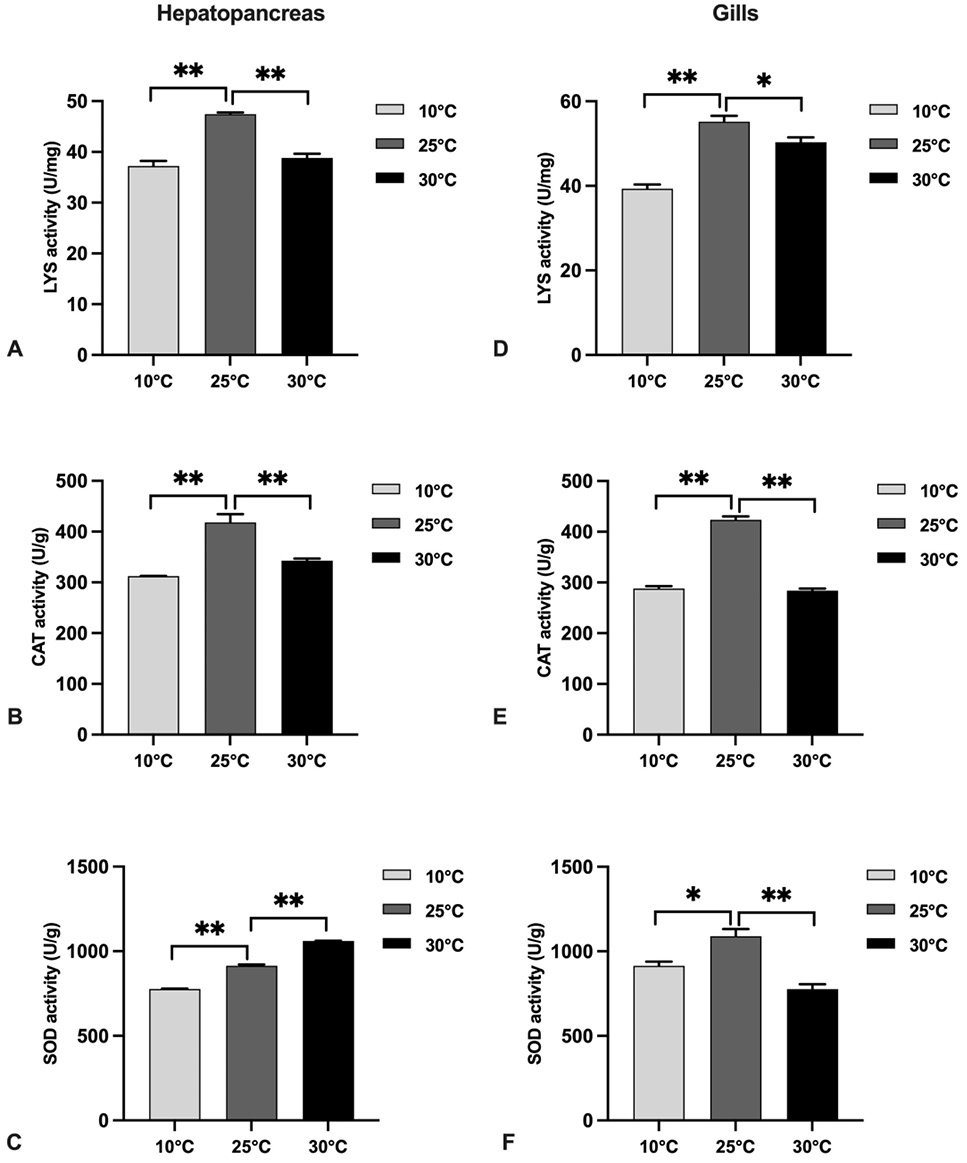
Effect of different temperature on LYS (A, D), CAT (B, E) and SOD (C, F) activities of hepatopancreas (A, B, C) and gills (D, E, F) of P. clarkii.
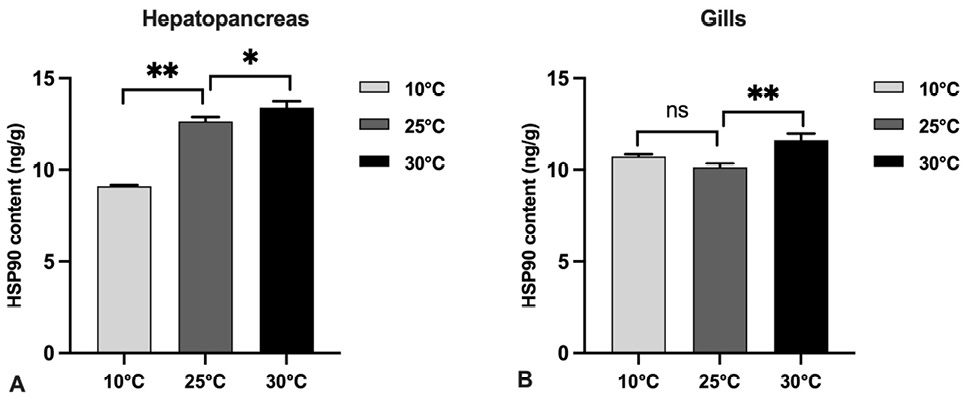
Effect of different temperature on HSP90 contents of hepatopancreas (A) and gills (B) of P. clarkii.
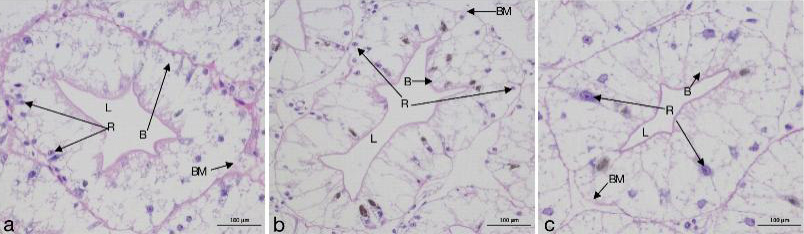
Effect of acute temperature stress on histological structure of hepatopancreas of cray fish. (a: 10°C, b: 25°C, c: 30°C) on the microstructure of the hepatopancreas of P. clarkii. B, secretory cells; R, storage cells; L, hepatopancreas tubules Lumen; BM, basement membrane. Stain: Hematoxylin & Eosin. Magnification 400X.
References
- Ashaf-Ud-Doulah, M., Shahjahan, M., Islam, S.M.M., Al-Emran, M., Rahman, M.S. and Hossain, M.A.R. 2019. Thermal stress causes nuclear and cellular abnormalities of peripheral erythrocytes in Indian major carp, rohu Labeo rohita. J. Therm. Biol., 86: 102450. https://doi.org/10.1016/j.jtherbio.2019.102450[CrossRef]
- Caceci, T., Neck, K.F. and Lewis, D., 1988. Ultrastructure of the hepatopancreas of the Pacific white shrimp, Penaeus vannamei (Crustacea: Decapoda). J. mar. Biol. Assoc. U. K., 68: 323. https://doi.org/10.1017/S002531540005222X[CrossRef]
- Cooke, S.L., Williamson, C.E., Leech, D.M., Boeing, W.J. and Torres, L., 2008. Effects of temperature and ultraviolet radiation on diel vertical migration of freshwater crustacean zooplankton. Can. J. Fish. aquat. Sci., 65: 1144-1152. https://doi.org/10.1139/F08-039[CrossRef]
- Cordiner, S. and Egginton, S., 1997. Effects of seasonal temperature acclimatization on muscle metabolism in rainbow trout, Oncorhynchus mykiss. Fish Physiol. Biochem., 16: 333-343. https://doi.org/10.1023/A:1007732003452[CrossRef]
- Croll, S.L. and Watts, S.A., 2004. The effect of temperature on feed consumption and nutrient absorption in Procambarus clarkii and Procambarus zonangulus. J. World Aquacult. Soc., 35: 478-488. https://doi.org/10.1111/j.1749-7345.2004.tb00113.x[CrossRef]
- Feder, M.E. and Hofmann, G.E., 1999. Heat-shock proteins, molecular chaperones, and the stress response: Evolutionary and ecological physiology. Annu. Rev. Physiol., 61: 243-282. https://doi.org/10.1146/annurev.physiol.61.1.243[CrossRef]
- Guo, K., Ruan, G., Fan, W., Wang, Q., Fang, L., Luo, J. and Liu, Y., 2020. Immune response to acute heat stress in the intestine of the red swamp crayfish, Procambarus clarkii. Fish Shellf. Immunol., 100: 146-151. https://doi.org/10.1016/j.fsi.2020.03.017[CrossRef]
- Hong, M., Chen, L., Gu, S. and Liu, C., 2007a. Effects of ammonia exposure on immunity indicators of haemolymph and histological structure of hepatopancreas in Chinese mitten crab (Eriocheir sinensis). J. Fish. Sci. China, 14: 412-418.
- Hong, M., Chen, L., Gu, S., Liu, C. and Zhang, L., 2007b. Effect of temperature change on immunochemical indexes of Eriocheir sinensis. Chin. J. appl. environ. Biol., 13: 818-822.
- Kong, X., Wang, G. and Li, S., 2012. Effects of low temperature acclimation on antioxidant defenses and ATPase activities in the muscle of mud crab (Scylla paramamosain). Aquaculture, 370-371: 144-149. https://doi.org/10.1016/j.aquaculture.2012.10.012[CrossRef]
- Langston, A.L., Hoare, R., Stefansson, M., Fitzgerald, R., Wergeland, H. and Mulcahy, M., 2002. The effect of temperature on non-specific defence parameters of three strains of juvenile Atlantic halibut (Hippoglossus hippoglossus L.). Fish Shellf. Immunol., 12: 61-76. https://doi.org/10.1006/fsim.2001.0354[CrossRef]
- Li, Q., Li, H., Jiang, C. and Wang, J., 2008. Comparison of immune parameters in the haemolymph of white-leg shrimp Litopenaeus vannamei at different temperatures. J. Dalian Fish. Univ., 23: 132-135.
- Li, X., Qu, Y., Zhang, Q.Q., Zhang, T.Y., Cao, R.W. and Zhao, J.M., 2020. Effects of seawater acidification and thermal stress on the antioxidant responses and enenrgy metabolism of Alpheus japonicus miers. Oceanol. Limnol. Sin., 51: 1412-1421.
- Liu, D., Huang, J., Yang, L. and Tan, L., 2020. Effects of multiple environmental factors on molting death of Procambarus clarkii and countermeasures. South China Fish. Sci., 16: 29-35.
- Luo, L., Huang, J., Liu, D., Tan, L., Jiang, S., Zhou, F., Jiang, S., Yang, Q. and Yang, L. 2019. Study on selection and spatial distribution of two kinds of caverns for Procambarus clarkii. S. China Fish. Sci., 15: 76-81.
- Luo, L., Huang, J.H., Liu, D.L., Jiang, S.G., Zhou, F.L., Jiang, S., Yang, Q.B., Li, Y.D., Li, T., Tan, L.Q. and Yang, L.S., 2021. Transcriptome reveals the important role of metabolic imbalances, immune disorders and apoptosis in the treatment of Procambarus clarkii at super high temperature. Comp. Biochem. Physiol. D, 37: 100781. https://doi.org/10.1016/j.cbd.2020.100781[CrossRef]
- Mock, A. and Peters, G., 1990. Lysozyme activity in rainbow trout Omorhynchus mykiss (Walbaum), stressed by handling, transport and water pollution. J. Fish Biol., 37: 873-885. https://doi.org/10.1111/j.1095-8649.1990.tb03591.x[CrossRef]
- Powell, L. and Watts, S.A., 2010. Response to long-term nutrient deprivation and recovery in the crayfishes Procambarus clarkii and Procambarus zonangulus: Oxygen consumption and metabolic enzymes. J. World Aquacult. Soc., 41: 81-91. https://doi.org/10.1111/j.1749-7345.2009.00315.x[CrossRef]
- Seemann, U.B., Lorkowski, K., Slater, M.J., Buchholz, F. and Buck, B.H., 2017. Feed alternatives for noble crayfish Astacus astacus based on fatty acid and lipid analyses. J. Shellf. Res., 36: 519-527. https://doi.org/10.2983/035.036.0223[CrossRef]
- Tan, L., Yang, L., Liu, D. and Huang, J., 2020. Scientific crayfish breeding: Research on new breeding and seedling techniques. China Agricultural University Press.
- Tian, X.L. and Dong, S.L., 2005. Advances in research effects of temperature fluctuation on aquatic fauna. Chin. J. appl. Ecol., 16: 1780-1785.
- Ulaje, S.A., Lluch-Cota, S.E., Sicard, M.T., Ascencio, F., Cruz-Hernandez, P., Racotta, I.S. and Rojo-Arreola, L., 2020. Litopenaeus vannamei oxygen consumption and HSP gene expression at cyclic conditions of hyperthermia and hypoxia. J. Therm. Biol., 92: 102666. https://doi.org/10.1016/j.jtherbio.2020.102666[CrossRef]
- Wang, Z., Qui, Y., Yan, M., Li, J., Zou, J. and Fang, L., 2019. Physiological responses of pacific white shrimp Litopenaeus vannamei to temperature fluctuation in low-salinity water. Front Physiol., 10: https://doi.org/10.3389/fphys.2019.01025[CrossRef]
- Winston, G.W., 1991. Oxidants and antioxidants in aquatic animals. Comp. Biochem. Physiol. C Toxicol. Pharmacol., 100: 173-176. https://doi.org/10.1016/0742-8413(91)90148-M[CrossRef]
- Wu, M., Chen, N., Huang, C.X., He, Y., Zhao, Y.Z., Chen, X.H., Chen, X.L. and Wang, H.L., 2017. Effect of low temperature on globin expression, respiratory metabolic enzyme activities, and gill structure of Litopenaeus vannamei. Biochemistory Moscow, 82: 844-851. https://doi.org/10.1134/S0006297917070100[CrossRef]
- Wu, Y., Pei, Y. and Qin, Y., 2011. Developmental expression of heat shock proteins 60, 70, 90, and A2 in rabbit testis. Cell Tissue Res., 344: 355-363. https://doi.org/10.1007/s00441-011-1151-4[CrossRef]
- Yang, X.L. and Zuo, W.G., 1997. Relationship between water temperature and the immune response of grass carp, Ctenopharyngodon idellus. Acta Zool. Sin., 43: 42-48.
- Zhang, J. and Sun, L., 2017. Transcriptome analysis reveals temperature-regulated antiviral response in turbot Scophthalmus maximus. Fish Shellf. Immunol., 68: 359-367. https://doi.org/10.1016/j.fsi.2017.07.038[CrossRef]
Services
Article usage statistics
Loading…