
Lipid oxidation is a major cause of deterioration in the quality of food and food products. Oxidation can occur in both triglycerides and phospholipids of food because lipids are divided into two main classes; polar lipids (phospholipids) and neutral lipids (triglycerides). Lipid oxidation has been long been recognized as a major problem in the storage of fatty acids in foods. Oxidation occurs by several molecular mechanisms such as generation of reactive oxygen precursors and free radicals. Oxidation affects many interactions among food constituents, leading to both desirable and undesirable products. Food lipids are the foods components that are most susceptible to oxidation, therefore oxidation reactions are one of the major sources of deterioration that occurs during manufacturing, storage, distribution and final preparation of foods. Lipid oxidation products are omnipresent in foods, although much variation exists in their kind and levels present. Although levels of these compounds are generally low, the problem of lipid oxidation severely compromises the quality of some food products and limits the shelf-life of others. Oxidative changes can cause rancidity such as off flavours, loss of colour, altered nutrient value, and may produce toxic compounds, which can be detrimental to the health of consumers. Antioxidants and chelating agents are the most helpful inhibitors of lipid oxidation.
Review · Volume 32, Issue 3, 29 August 2016 · Open Access
Oxidation of Lipids in Foods
· · · · ·
Affiliations & Notes ⌄
- 1Section of Food Science & Technology, Department of Agriculture, University of Haripur, Khyber-Pakhtunkhwa, Pakistan
- 2Nuclear Institute for Food and Agriculture (NIFA), Peshawar, Khyber-Pakhtunkhwa, Pakistan
- 3Department of Food Science, Swedish University of Agricultural Sciences Box 7051, 750 07 Uppsala, Sweden. mj_awan@hotmail.com
Article Info ⌄
- Journal:
- Sarhad Journal of Agriculture
- Published:
- 29 August 2016

From the article
- Lipid oxidation is one major cause of deterioration of the quality of stored food.
- This review deals with the mechanisms of lipid oxidation, as well as the interaction of lipid oxidation products with other food components.
- In order to prevent lipid oxidation in food the mechanisms of lipid oxidation should be comprehensively understood and in particular the control of free radical formation is very important because free radical is able to initiate free radical chain reactions.
- General chemistry of oxidation of lipids suggests that further efforts should be directed to a detailed understanding of the effects of this process in specific foods and food products.
Selected from the article's own text.
Abstract
Autoxidation
Autoxidation reaction leads to lipids breakdown and formation of wide range of oxidation products . When lipid substrate (LH) exposed to heat, light or metal ions their hydrogen atom of double bond is extracted and free or alkyl radical (L•) is formed . These free radicals reacts with oxygen and peroxy radical (LOO•) are formed with subtracting hydrogen atom from another unsaturated fatty acids. It leads to the formation of primary oxidation products called hydro-peroxides (LOOH) by the mechanisms of initiation, propagation and termination . The length of propagation cycle is directly proportional to the degree of lipid unsaturation . These primary oxidation products are not stable and further break down into carbonyl compounds such as aldehyde, ketones and alcohols .
- • Initiation: LH → L∙ + H∙
- • Propagation: L∙ + O2 → LOO∙
- • LOO∙ + LH → LOOH + L∙
- • Termination: LOO∙ + LOO∙ → non-radical product
- • LOO∙ + L∙ → non-radical product
- • L∙ + L∙ → non-radical product
Further reaction of hydro-peroxide (LOOH) with ferrous ion (Fe2+) yield peroxyl radical (LOO•) and alkoxyl radicals (LO•). This reaction will be fast and Fe2+ will be regenerated but the regeneration of Fe2+ will be slow .
- • Fast reaction: Fe2+ + LOOH → Fe3+ + LO• + OH--
- • Slow reaction: Fe3+ + LOOH → LOO • + Fe2++ H+
Alkyl radicals (R’CH2•) and aldehydes (R” CHO) form due to degradation and β-scission of alkoxyl radical LO•. Free radicals are removed in termination cycle and two radicals combine to form a non-radical compound and finally the propagation cycle is terminated as shown in Figure 1 .
Oxidation of Omega-3 Fatty Acids
Fish oil without having any antioxidant undergoes rapid autoxidation. Purified menhaden oil when exposed to air at ambient temperature deteriorates rapidly and peroxide value also increase 5 to 12 fold within two days . Normally during fish oil production from fish meal the Peroxide value (PV) ranged from 6-22 mEq O2/kg. Different fatty acids have different rate of oxidation, where during oxidation PV increases and omega-3 fatty acids content decreases . Autoxidation of ethyle EPA and DHA is much faster as compared to ethyle linoleate (Lo) and ethyle linolenate (Ln) .
Oxidation in fish and fish oil occurs as a result of because of high concentration of polyunsaturated fatty acid exposure to air (Kubow, 1990). These fatty acids are more susceptible to radical initiated triple oxygen oxidation than monounsaturated fatty acids. As singlet oxygen can also react with electron rich double bonds of unsaturated molecules but the rate of triplet oxygen reaction increase as degree of unsaturation increase . Volatile oxidation products formed in fish oil such as 1-penten-3-one,
Figure 1: Autoxidation of unsaturated lipids
hexanal, 4-(Z)-heptenal, 2,4-(E,E)-heptadienal, nonanal and 2,6-(E,Z)-nonadienal are responsible for off-odors and are good indicators for the oxidation status in fish oil .
EPA and DHA are most polyunsaturated fatty acids (PUFA) in fish oil having five and six double bonds. These are susceptible to oxidation by three phases i.e. initiation, propagation and termination . Free radicals and peroxides are produced during initiation phase when molecular oxygen reacts with unsaturated fatty acids. But in propagation phase some other reactive chemical products form from peroxides such dihydroperoxides because peroxides are unstable and have active methylene group, but in termination phase non-reactive secondary oxidation products such as hydrocarbon, aldehydes and ketones are formed and cause off-flavour . In these PUFA peroxide value is not a good indicator of autoxidation because their hydro-peroxides are not stable and secondary oxidation products play important role in oxidative deterioration in these fatty acids ester .
Photo- Oxidation
Photo-oxidation produce aliphatic and aromatic oxidized compounds, such as ketones, aldehydes, carboxylic acids, fatty acids, esters, epoxies, sulfoxides, sulfones, phenols, anhydrides, quinones and alcohols . In the presence of light photosensitizers convert triplet oxygen into singlet oxygen, which is highly reactive and non-radical molecule. It requires low energy to activate the reaction with food as compared to triplet oxygen, so temperature has little effect on the oxidation caused by singlet oxygen than triplet oxygen . When oils are exposed to solar radiation, photo-oxidati on will occur in crude and refine oils . If wave length of solar light is less than 220 nm then unsaturated fatty acids cannot absorb light, but during photo oxidation sensitizer molecules like chlorophyll, porphyrin or dyes such as rose bengal absorb light energy and convert triplet state sensitiser to singlet state sensitiser. Fluorescent light is emitted by sensitiser molecules and to form triplet sensitiser, this triplet sensitiser react by two mechanism . In first mechanism sensitiser react with lipid substrate to form complex mixture of free radical and singlet sensitiser then this mixture further react with triplet oxygen and give hydroperoxide similar in structure as form by autoxidation.
- • 3Sens + lipid substrate (LH) → Free radical (L• ) + singlet sensitiser (SensH)
- • Free radical (L• ) + singlet sensitiser (SensH) 3O2 → Hydroperoxide (LOOH )
In second mechanism triplet sensitiser also react with triplet oxygen and give singlet oxygen . This singlet oxygen directly reacts with double bond of unsaturated lipids and produce hydroperoxides. These hydroperoxide are different from autoxidation products and in this case radical scavengers do not interfere because no involvement of free radicals ; .
- • 3Sens + 3O2 (triplet oxygen) → 1O2
(singlet oxygen)
- • 1O2 (singlet oxygen) + LH → LOOH
(Hydroperoxide)
Singlet oxygen produce peroxides by direct reacting with fatty acids without abstracting H atom and proceed chain reaction during lipid peroxidation process. Small amount of singlet oxygen also produce by colliding of peroxyl radicals, illumination of certain compounds in the presence of oxygen by absorbing light and entering to higher energy state .
Enzymatic Oxidation
Hydro-peroxide formed by enzymatic oxidation process are intermediates in the synthesis process of prostagladins and eicosanoids . Enzymatic mechanisms also catalysis the oxidation of lipids in foods by lipoxygenase and cytochromes P450 to produce hydro-peroxides. But oxidation of poly unsaturated fatty acids initiated by lipoxygenases via a free radical mechanisms to form specific hydro-peroxides ; . Lipoxygenase enzymes molecules contain one heme iron, 1, 4 –cis,cis-pentadiene system that desired in the fatty acid as a substrate for lipoxygenase. Ferric form of lipoxygenase enzyme oxidized 1,4 –cis,cis-pentadiene fatty acid moiety into pentadienyl radical, which react with molecular oxygen to form peroxyl radical and finally produce hydroperoxides ; . These hydro-peroxides are precursor of further transformation by enzymatic chemical reaction, because lipoxygenase reaction initiates the synthesis of a single fatty acid hydro-peroxide from substrate of fatty acids .
- • Fat + Water Lipoxygenase / cytochromes P450 Free fatty acids + Glycerol
- • Free fatty acids oxidation Hydroperoxides degradation Aldehyde, Ketones
Fatty Acids Hydro-peroxides Isomerization
Isomeric monohydroperoxides formed from autoxidation of methyl linoleate are not stable and isomerizes further into geometrical hydro-peroxide cis-trans and trans-trans isomers . These hydro-peroxides go through rearrangement leading to their isomerization in which their OOH group is relocated and stereochemistry of double bond change by a free radical chain mechanism . Trans, trans-conjugated dienes of hydro-peroxides are produce under thermodynamic control while trans, cis-conjugated dienes of hydro-peroxides are produce under kinetic control . The ratio of trans, cis /trans, trans products form during the oxidation depend on temperature, concentration of fatty acids and solvent ; . Fatty acids hydro-peroxides are formed by lipoxygenases catalyze dioxygenation of polyunsaturated fatty acids. This reaction is based on initial stereospecific abstraction of a hydrogen atom from a bis-allylic methylene group followed by antarafacial attack by dioxygen at one of the terminal carbon atom of the pentadienyl radical .
Formation of Hydro-peroxides of Fatty Acids
Hydro-peroxides, as primary oxidation products of lipid are formed through the mechanisms of autoxidation, photo-oxidation and enzymatic oxidation of lipids . Autoxidation is a reaction between oxygen and the unsaturated lipids to form a lipid hydro-peroxide, which then undergoes further reaction with or without the participation of other compounds. This reaction is enhanced by light and metal ions . Another pathway for the formation of hydro-peroxides is photoxidation, where hydro-peroxides are produced from unsaturated fatty acids with the reaction of singlet oxygen. During photoxidation mechanisms each double bond of fatty acid react with singlet oxygen and produces hydro-peroxide that causes flavour deterioration of food by monohydroperoxides hemolytic and heterolytic cleavage mechanisms . Enzyme such as lipoxygenase tightly controls the reaction with molecular oxygen that form mixed products and permit the release of free radicals .
Decomposition of Hydro-peroxides
Long chain poly unsaturated fatty acids degrade in the presence of oxygen and metals ion that causes deterioration of sensory properties, like taste and odor due to formation of primary oxidation products by decomposition of hydro-peroxides . In the presence of metal catalysts hydro-peroxides decomposed thermally by involvement of hemolytic cleavage of O-O bond of hydro-peroxides to produce alkoxyl and hydroxyl free radicals, reaction of these radicals with lipid substrate propagate the chain reaction and produce hydrocarbons, alcohols and hydro-peroxides . These hydro-peroxides decompose in to α., β-unsaturated aldehydes like 9, 12-dioxo-10(E)-dodecenoic acid, 4-oxo-2(E)-nonenal, 4, 5-epoxy-2(E)-decenal and 4-hydroxy-2(E)-nonenal . Decomposition of hydroperoxides of cyclohexene, linoleic, linolenic acids and their methyl esters produce carbonyls. Decomposition of methyl ester hydro-peroxides are slow than of free fatty acids and produce wide range of carbonyl compounds such as hydrocarbons and furans that contributes to flavour deterioration of foods . Lipids hydro-peroxides reduce into dimmers and polymers that can breakdown and produce volatile products such as malonaldehyde. These malonaldehyde as bifunctional breakdown products can interact with amino group of enzymes, proteins and DNA to cause cellular damage .
Free Radical Reactions in Decomposition of Hydroperoxides
Formation of peroxyl or alkoxyl radical is the initial step during decomposition of hydroperoxides through free radicals. This reaction is reversible for peroxyl radicals and irreversible for alkoxyl reaction .
- • LOOH → LOO• + H•
- • LOOH → LO• + O H
It relatively difficult to generate peroxyl and alkoxy radicals from hydro-peroxides. Rate of radical reaction is initiated by heat, light and catalyst species. The energy required to dissociate a LOO-H bond is 90 kcal/mol while for LO-OH bond is 44 kcal/mol . Hydrogen ion abstraction occurs with another radical then peroxyl radicals formed from hydroperoxides as shown is the below reaction:
- • LOOH + L• → LOO + LH
Bimolecular reaction decomposes hydroperoxides by forming peroxyl and aloxyl radical ; .
- • 2 LOOH → LO• + LOO• + H2O
Trace metals play important role in the decomposition of hydro-peroxides, whereas activity of various metal ions also affected by various variables like pH, complexity of their ligands and solvents. Decomposition of hydro-peroxides through metals ion is high in speed than those of autocatalytic reactions ; . Higher oxidation process by metal ions produce peroxyl radicals while with lower oxidation process metal ions produce alkoxy radicals ; .
- • LOOH + M(n+1)+ → LOO• + H+ + Mn+
(peroxyl radicals)
- • LOOH + Mn+→ LO• + OH- + M(n+1)+
(alkoxy radicals)
Conclusion
Lipid oxidation is one major cause of deterioration of the quality of stored food. This review deals with the mechanisms of lipid oxidation, as well as the interaction of lipid oxidation products with other food components. In order to prevent lipid oxidation in food the mechanisms of lipid oxidation should be comprehensively understood and in particular the control of free radical formation is very important because free radical is able to initiate free radical chain reactions. Iron and copper ions play very important role in lipid peroxidation and act as free radical which can directly and indirectly catalyze the initiation of lipid peroxidation by extracting hydrogen from lipid molecule. General chemistry of oxidation of lipids suggests that further efforts should be directed to a detailed understanding of the effects of this process in specific foods and food products. Codex Alimentarius provided some guidance that accepts levels of about 10 meq/kg of peroxides in fats and oils for edible purpose, based on establishment of acceptable limits of oxidation criteria of wholesomeness, nutritional and safety values. Possible targets for future research are:
- i) Elucidation of the initiation step of oxidation in specific foods and possibilities and mechanisms of inhibition.
- ii) Standardization and development of set of analytical procedures for evaluating the level of lipid oxidation in foods and completely decay the level of oxidation and isolation of oxidized lipids in individual foods under conditions that protect from breakdown of the unstable and formation of new products.
- iii) Study of methods to identify the oxidation products from lipids, lipid extraction and analysis of the synergistic effects of per-oxidizing lipids and adjoining food constituents.
- iv) Investigation of the content of antioxidant such as tocopherol, butylated hydroxytoluene and oxidized products from antioxidants such as tocopherol quinone or free radical.
Acknowledgments
The financial support of Higher Education Commission (HEC), Pakistan is gratefully acknowledged.
Authors’ Contribution
This review article is a part of Ph.D. thesis of Mukhtiar Ahmed. Dr. Muhammad Jahangir was the research supervisor. Muhammad Liaquat, Taufiq ahmad, Jana Pickova and Abid Farid contributed during writing up and correction of manuscript.
Figures
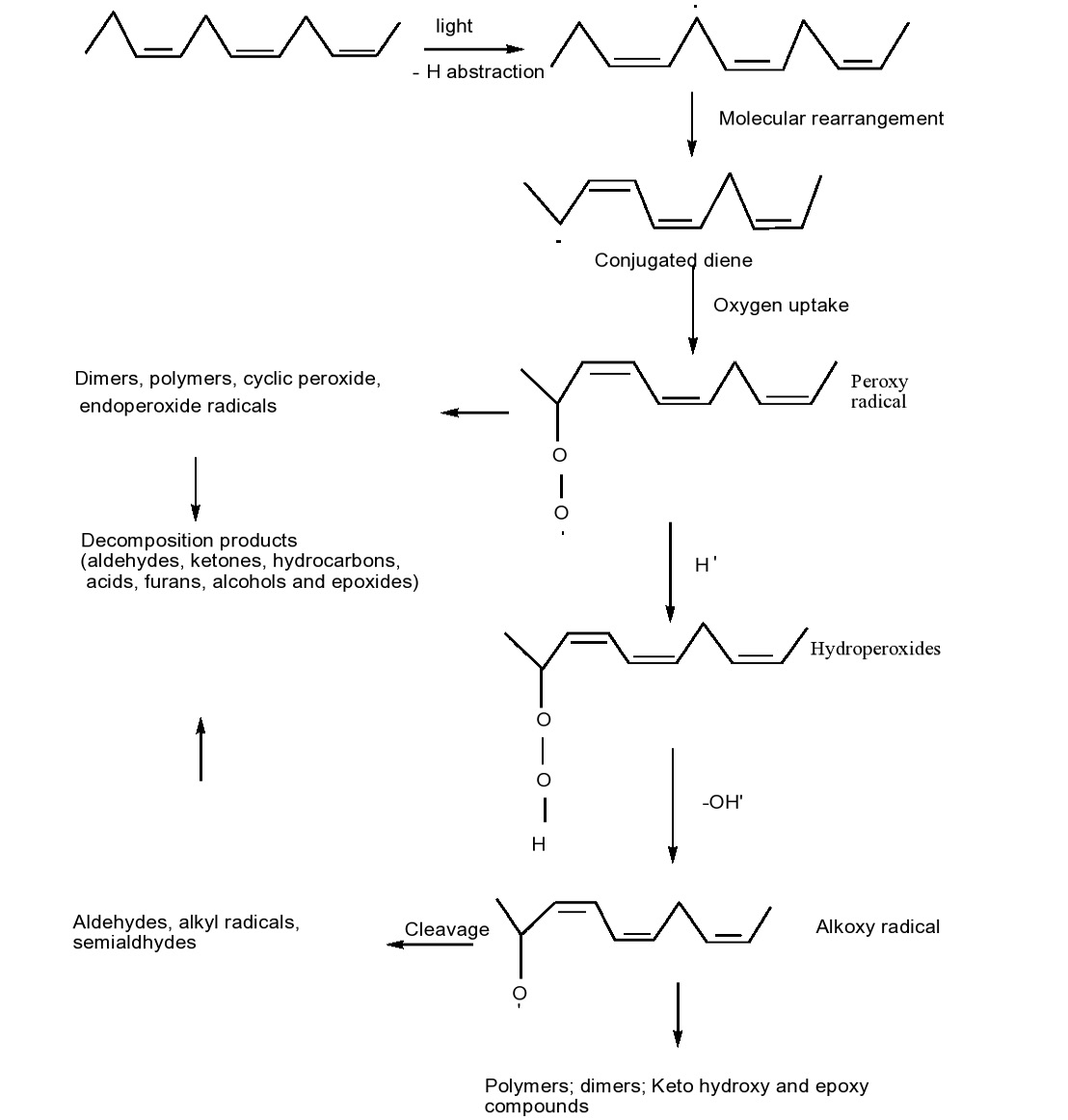
Autoxidation of unsaturated lipids (Kubow, 1992)
References
- Adrian, L.K., B.P. Ronald, S. Anwesha and D.C. Brian. 2015. Update on the methods for monitoring UFA oxidation in food products. Euro. J. Lipid Sci. Technol. 117(1):1-14. http://dx.doi.org/10.1002/ejlt.201400119[CrossRef]
- Aidos, I., C. Jacobsen, B. Jensen, J.B. Luten, A.V.D. Padt and R.M. Boom. 2002. Volatile oxidation products formed in crude herring oil under accelerated oxidative conditions. Euro. J. Lipid Sci. Technol. 104(12):808-818. http://dx.doi.org/10.1002/1438-9312(200212)104:12<808::AID-EJLT808>3.0.CO;2-J[CrossRef]
- Barden, L., D. Vollmer, D. Johnson and E. Decker. 2015. Impact of iron, chelators, and free fatty acids on lipid oxidation in low-moisture crackers. J. Agri. Food Chem. 63(6):1812–1818. http://dx.doi.org/10.1021/jf5048018[CrossRef]
- Blair, I. A. 2001. Lipid hydroperoxide-mediated DNA damage. Exp. Gerontol. 36(9):1473-1481. http://dx.doi.org/10.1016/S0531-5565(01)00133-4[CrossRef]
- Böttcher, S., U. Steinhäuser and S. Drusch. 2015. Off-flavour masking of secondary lipid oxidation products by pea dextrin. Food Chem. 169(1):492-498. http://dx.doi.org/10.1016/j.foodchem.2014.05.006[CrossRef]
- Bruheim, I. 2009. Solid-phase microextraction (SPME) in the fish oil industry. LC. GC. Europe. 22(3):1-3.
- Choe, E., and D.B. Min. 2005. Chemistry and reactions of reactive oxygen species in foods. J. Food Sci. 70(9):R142-R159. http://dx.doi.org/10.1111/j.1365-2621.2005.tb08329.x[CrossRef]
- Csallany, A.S., I. Han, D.W. Shoeman, C. Chen and J. Yuan. 2015. 4-Hydroxynonenal (HNE), a toxic aldehyde in french fries from fast food restaurants. J. Am. Oil Chem. Soc. 92(10):1413-1419. http://dx.doi.org/10.1007/s11746-015-2699-z[CrossRef]
- Elisia, I., and D.D. Kitts. 2011. Quantification of hexanal as an index of lipid oxidation in human milk and association with antioxidant components. J. Clin. Biochem. Nutr. 49(3):147–152. http://dx.doi.org/10.3164/jcbn.10-142[CrossRef]
- Feussner, I. and C. Wasternack. 2002. The lipoxygenase pathway. Ann. Rev. Plant Bio. 53:275-297. http://dx.doi.org/10.1146/annurev.arplant.53.100301.135248[CrossRef]
- Frey, P.A., A.D. Hegeman and G.H. Reed. 2006. Free radical mechanisms in enzymology. Chem. Rev. 106(8):3302–3316. http://dx.doi.org/10.1021/cr050292s[CrossRef]
- Gajera, H.P., D.D. Savaliya, S.V. Patel and B.A. Golakiya. 2015. Lipoxygenase-related defense response induced by Trichoderma viride against Aspergillus niger Van Tieghem, inciting collar rot in groundnut (Arachis hypogaea L.). Phytoparasitica. 43(2):229-240. http://dx.doi.org/10.1007/s12600-014-0435-0[CrossRef]
- Galano, J-M., Y.Y. Lee, T. Durand and J.C-Y. Lee. 2015. Special Issue on “Analytical Methods for Oxidized Biomolecules and Antioxidants” The use of isoprostanoids as biomarkers of oxidative damage, and their role in human dietary intervention studies. Free Radical Res. 49(5):583–598. http://dx.doi.org/10.3109/10715762.2015.1007969[CrossRef]
- Gutowski, M. and S. Kowalczyk. 2013. A study of free radical chemistry: their role and pathophysiological significance. Acta Biochimica Polonica. 60(1):1-13.
- Jimenez-Alvarez, D., F. Giuffrida, P.A. Golay, C. Cotting, F. Destaillats, F. Dionisi and B. Keely. 2008. Profile of volatile compound in milk containing fish oil analyzed by HS-SPME-GC/MS. Euro. J. Lipids Sci. Technol. 110(3):277-283. http://dx.doi.org/10.1002/ejlt.200700148[CrossRef]
- Juan, L., M.S. Kevin, A. Luis, Z. Jie, C. Arranee, L.B.D. Jose, C. Alexander, B. David, J.B. Peter and S. Subramaniam. 2015. Effect of blueberry extract from blueberry pomace on the microencapsulated fish oil. J. Food Process. Preserv. 39(2):199-206. http://dx.doi.org/10.1111/jfpp.12222[CrossRef]
- Julia, K., C. Caroline, B. Corinne, A.G. Marizel, B. Ana-Paulina, R. Michel, d.S.S.D. María, S. Robert, N.S. Anne and G. Françoise. 2015. Antiatherogenic and antitumoral properties of Opuntia cladodes: inhibition of low density lipoprotein oxidation by vascular cells, and protection against the cytotoxicity of lipid oxidation product 4-hydroxynonenal in a colorectal cancer cellular model. J. Physiol. Biochem. 71(3):557-587.
- Kerrihard, A.L., K. Nagy, B.D. Craft, M. Beggio and R.B. Pegg. 2015. Oxidative stability of commodity fats and oils: modeling based on fatty acid composition. J. Am. Oil Chem. Soc. 92(8):1153-1163. http://dx.doi.org/10.1007/s11746-015-2686-4[CrossRef]
- Kolanowski, W., D. Jaworska and J. Weibbrodt. 2007. Importance of instrumental and sensory analysis in the assessment of oxidative deterioration of omega-3 long-chain polyunsaturated fatty acids-rich foods. J. Sci. Food Agri. 87(2):181-191. http://dx.doi.org/10.1002/jsfa.2733[CrossRef]
- Kubow, S. 1992. Routes of formation and toxic consequences of lipid oxidation products in food. Free Radical Biol. Med. 12(1):63-81. http://dx.doi.org/10.1016/0891-5849(92)90059-P[CrossRef]
- Lee, J., N. Koo and D.B. Min. 2004. Reactive oxygen species, aging, and antioxidative nutraceuticals. Comprehensive Rev. Food Sci. Food Safe. 3(1):21-33. http://dx.doi.org/10.1111/j.1541-4337.2004.tb00058.x[CrossRef]
- Lee, R.F. 2003. Photo-oxidation and photo-toxicity of crude and refined oils. Spill Sci. Technol. Bull. 8(2):157-162. http://dx.doi.org/10.1016/S1353-2561(03)00015-X[CrossRef]
- Lu, T., A.F. Harper, J. Zhao, M.J. Estienne and R.A. Dalloul. 2014. Supplementing antioxidants to pigs fed diets high in oxidants: I. Effects on growth performance, liver function, and oxidative status. J. Anim. Sci. 92(1):5455-5463. http://dx.doi.org/10.2527/jas.2013-7109[CrossRef]
- Mandal, S., A. Dahuja, A. Kar and I.M. Santha. 2014. In vitro kinetics of soybean lipoxygenase with combinatorial fatty substrates and its functional significance in off flavor development. Food Chem. 146(1):394-403. http://dx.doi.org/10.1016/j.foodchem.2013.08.100[CrossRef]
- Marsili, R., and C. Laskonis. 2014. The importance of odourant synergy effects in understanding malodour problems in DHA and EPA products. Lipid Technol. 26(2): 31-34. http://dx.doi.org/10.1002/lite.201400009[CrossRef]
- Medina-Meza, I.G., C. Barnaba and G.V. Barbosa-Cánovas. 2014. Effects of high pressure processing on lipid oxidation: A review. Innov. Food Sci. Emerg. Technol. 22(1):1-10. http://dx.doi.org/10.1016/j.ifset.2013.10.012[CrossRef]
- Min, D.B., and J.B. Boff. 2002. Chemistry and reaction of singlet oxygen in foods. Comprehens. Rev. Food Sci. Food Safe. 1(2):58-72. http://dx.doi.org/10.1111/j.1541-4337.2002.tb00007.x[CrossRef]
- Min, B. and D.U. Ahn. 2005. Mechanism of lipid peroxidation in meat and meat products -A Review. Food Sci. Biotechnol. 14(2):152–163.
- Miyashita, K. 2014. Paradox of omega-3 PUFA oxidation. Euro. J. Lipid Sci. Technol. 116(10): 1268–1279. http://dx.doi.org/10.1002/ejlt.201400114[CrossRef]
- Morales, A., S. Marmesat, M. Victoria Ruiz-Méndez, G. Márquez-Ruiz and J. Velasco. 2014. Formation of oxidation products in edible vegetable oils analyzed as FAME derivatives by HPLC-UV-ELSD. Food Res. Int. 62(1):1080-1086. http://dx.doi.org/10.1016/j.foodres.2014.05.063[CrossRef]
- Niki, E., Y. Yoshida, Y. Saito and N. Noguchi. 2005. Lipid peroxidation: Mechanisms, inhibition, and biological effects. Biochemical and Biophysical Res. Commun. 338(1):668-678. http://dx.doi.org/10.1016/j.bbrc.2005.08.072[CrossRef]
- Oliw, E.H., U. Garscha, T. Nilsson and M. Cristea. 2006. Payne rearrangement during analysis of epoxyalcohols of linoleic and α-linolenic acids by normal phase liquid chromatography with tandem mass spectrometry. Anal. Biochem. 354(1): 111-126. http://dx.doi.org/10.1016/j.ab.2006.04.010[CrossRef]
- Olpin, S.E. 2005. Fatty acid oxidation defect as a cause of neuromypathic disease in infants and adults. Clin. Lab. 51(5-6):289-306.
- Porter, N.A. 2013. A perspective on free radical autoxidation: The physical organic chemistry of polyunsaturated fatty acid and sterol peroxidation. J. Organic Chem. 78(8):3511–3524. http://dx.doi.org/10.1021/jo4001433[CrossRef]
- Pratt, D.A., K.A. Tallman and N.A. Porter. 2011. Free radical oxidation of polyunsaturated lipids: New mechanistic insights and the development of peroxyl radical clocks. Accounts of Chem. Res. 44(6):458-467. http://dx.doi.org/10.1021/ar200024c[CrossRef]
- Rác, M., M. Křupka, S. Binder, M. Sedlářová, Z. Matušková, M. Raška and P. Pospíšil. 2015. Oxidative damage of U937 human leukemic cells caused by hydroxyl radical results in singlet oxygen formation. Plos One. 10(3):1-19. http://dx.doi.org/10.1371/journal.pone.0116958[CrossRef]
- Schneider, C. 2009. An update on products and mechanisms of lipid peroxidation. Mol. Nut. Food Res. 53(3):315–321. http://dx.doi.org/10.1002/mnfr.200800131[CrossRef]
- Song, W., S. Bardowell and K. O’Shea. 2007. Mechanistic study and the influence of oxygen on the photosensitized transformations of microcystins (Cyanotoxins). Env. Sci. Technol. 41(15):5336-5341. http://dx.doi.org/10.1021/es063066o[CrossRef]
- Sun, Y.E., W.D. Wang, H.W. Chen and C. Li. 2011. Autoxidation of unsaturated lipids in food emulsion. Crit. Rev. Food Sci. Nut. 51(5):453-466. http://dx.doi.org/10.1080/10408391003672086[CrossRef]
- Thanonkaew, A., S. Benjakul, W. Visessanguan and E.A. Decker. 2006. The effect of metal ions on lipid oxidation, colour and physicochemical properties of cuttlefish (Sepia pharaonis) subjected to multiple freeze–thaw cycles. Food Chem. 95(4):591-599. http://dx.doi.org/10.1016/j.foodchem.2005.01.040[CrossRef]
- Tirosh, O., A. Shpaizer and J. Kanner. 2015. Lipid peroxidation in a stomach medium is affected by dietary oils (olive/fish) and antioxidants: The mediterranean versus western diet. J. Agric. Food Chem. 63(31):7016–7023. http://dx.doi.org/10.1021/acs.jafc.5b02149[CrossRef]
- Turner, R., C.H. McLean and K. Silvers. 2006. Are the health benefits of fish oils limited by products of oxidation? Nut. Res. Rev. 19(1):53-62. http://dx.doi.org/10.1079/NRR2006117[CrossRef]
- Ubhayasekera, S.J.K.A. 2009. Sterols and oxysterols occurrence and analysis in by-products. In: Chemistry of fats and oils. Ph.D Thesis, SLU, Uppsala, Sweden. Pp.12.
- Uchida, K. 2015. Aldehyde adducts generated during lipid peroxidation modification of proteins. Free Radical Res. 49(7):896-904. http://dx.doi.org/10.3109/10715762.2015.1036052[CrossRef]
- Umesha, S.S., and K.A. Naidu. 2015. Antioxidants and antioxidant enzymes status of rats fed on n-3 PUFA rich Garden cress (Lepidium Sativum L) seed oil and its blended oils. J. Food Sci. Technol. 52(4):1993-2002. http://dx.doi.org/10.1007/s13197-013-1196-3[CrossRef]
- Waraho, T., D.J. McClements and E.A. Decker. 2011. Mechanisms of lipid oxidation in food dispersions. Trends Food Sci. Technol. 22(1):3-13. http://dx.doi.org/10.1016/j.tifs.2010.11.003[CrossRef]
- Wardhani, D.H., P. Fuciños, J.A. Vázquez and S.S. Pandiella. 2013. Inhibition kinetics of lipid oxidation of model foods by using antioxidant extract of fermented soybeans. Food Chem. 139(1-4):837-844. http://dx.doi.org/10.1016/j.foodchem.2013.01.049[CrossRef]
- Williams, M.V., J.S. Wishnok and S.R. Tannenbaum. 2007. Covalent adducts arising from the decomposition products of lipid hydroperoxides in the presence of cytochrome c. Chem. Res. Toxicol. 20(5):767-775. http://dx.doi.org/10.1021/tx600289r[CrossRef]
- Yin, H., L. Xu and N.A. Porter. 2011. Free radical lipid peroxidation: mechanisms and analysis. Chem. Rev. 111(10):5944–5972. http://dx.doi.org/10.1021/cr200084z[CrossRef]
Services
Article usage statistics
Loading…