Ovariohysterectomy (Spaying) in a Rabbit: A Case Report from Bangladesh
· · · ·
Affiliations & Notes ⌄
1Faculty of Veterinary Medicine, Chattogram Veterinary and Animal Sciences University, Chattogram-4224, Bangladesh
2Faculty of Veterinary Medicine and Animal Science, Gazipur Agricultural University, Gazipur-1706, Bangladesh
3Faculty of Veterinary Medicine, Jashore University of Science and Technology, Jessore-7408, Bangladesh
4Department of Microbiology and Hygiene, Faculty of Veterinary Science Bangladesh Agricultural University, Mymensingh-2202, Bangladesh. *Correspondence | Kazi Abdus Sobur, Department of Microbiology and Hygiene, Faculty of Veterinary Science Bangladesh Agricultural University, Mymensingh-2202, Bangladesh
Ovariohysterectomy (spaying) in rabbits is a well-established surgical procedure that effectively prevents reproduction and reduces undesirable behaviors such as aggression.
This case report highlights the successful application of the technique in a rabbit in Bangladesh, demonstrating its simplicity, affordability, and efficacy when performed under appropriate conditions.
Postoperative recovery was uneventful, with no observed complications, and the rabbit showed significant improvement in behavior within two weeks.
Additional investigations into the long-term effects of spaying on rabbit health and behavior would provide valuable insights for veterinary practitioners and pet owners alike.
Selected from the article's own text.
Abstract
Ovariohysterectomy (OHE), commonly known as spaying, is a surgical practice to aggressive behavior and prevent unwanted breeding of female animals. The purpose of this case study was to perform the standard surgical method of a local breed female rabbit, 8 months old and weighing 2 kg. The surgery was performed under general anesthesia using a standard open surgical approach. After the successful operation, the rabbit was kept in a clean squeeze cage for seven days. In addition, povidone iodine ointment was used until the wound was completely healed. Post-operative complications were observed during the patient’s follow-up. This surgical procedure for rabbit spaying was simple, inexpensive, and highly effective.
Keywords | Ovariohysterectomy, Spaying, Rabbit, Surgical technique, General anesthesia, Case study
Introduction
Ovariohysterectomy also known as spaying and neutering is a common surgical procedure in domestic animals from ancient times . Rabbits (Oryctolagus cuniculus) are neutered or spayed to prevent breeding and unwanted behaviors . Spayed or neutered rabbits are also more friendly and affectionate toward their pet owner. Spaying and neutering our bunnies often eliminate their deeply ingrained desire to reproduce by altering their hormonal response, which is a huge step toward improving unwanted aggressive behaviors . It is also done to protect them from certain diseases . Biomedical researchers often use spayed or neutered rodents and rabbits in research .
During an ovariohysterectomy (OHE), the female reproductive tract is completely removed. Spaying an animal not only prevents it from becoming pregnant, but it also prevents it from going into heat twice a year. Rodents and rabbits are the same as those for dogs and cats . One of the most common major abdominal surgery in veterinary medicine is ovariohysterectomy . Ovariohysterectomy (OVH), which is performed under appropriate general anesthesia and sterile operating procedures is an irreversible procedure used to sterilize female animals .
Technically, once a female reaches sexual maturity in the ages of 3 and 6 months, she can safely undergo her respective procedures. Depending on the rabbit’s size, breed, and current health, a veterinarian may advise waiting until the rabbit is a little older. The size of the incision is determined by the surgeon and the animal’s size. Hemorrhage from uterine and ovarian vessels, anesthesia-related mishaps, tissue reaction to suture material, wound infection (self-licking), evisceration, or delayed healing are some of the short-term or immediate surgical complications that may arise ; ; .
Nowadays spaying and neutering have been widely practiced in veterinary medicine. Recent advancements in anesthesia as well as surgical techniques have made these procedures more accessible and efficient . This study aims to evaluate the traditional surgical technique for ovariohysterectomy in rabbits, focusing on its execution and outcomes, while also assessing the associated anesthetic risks by analyzing the pre-anesthetic and post-anesthetic conditions of spayed does. The study highlights the growing significance of spaying in rabbits, a practice not only pivotal in pet management but also in research settings. Despite its benefits, spaying in rabbits remains underexplored, particularly in regions like Bangladesh.
Case description
A female local breed rabbit, 6 months old and weighing 2 kg, was brought to Razz Pet Care in Chattogram. It was difficult to handle, and the owner wished to halt reproduction due to a lack of space in her home. The owner wished to spay the rabbit to reduce its aggression and prevent reproduction. A general examination revealed that it was in good health, with a respiratory rate of 40 beats per minute (normal), a heart rate of 160 beats per minute (normal), no dehydration, and pink mucous membrane.
Surgical technique
As a pre-anesthetic, 5mg/kg body weight Xylazine hydrochloride (Inj. Xylazine® @Indian immunological ltd, India) was administered intramuscularly. After proper cutting and shaving, the surgical site was aseptically prepped for the procedure. After premedication, ketamine hydrochloride (Inj. G-ketamine®, Gonoshasthaya Pharmaceuticals Ltd, and Bangladesh) was administered intravenously at a dose rate of 30mg/kg body weight. During the surgery, the maintenance of an aesthetic dose was half of the original dose. During the operation, 3ml/min of normal saline was administered intravenously.
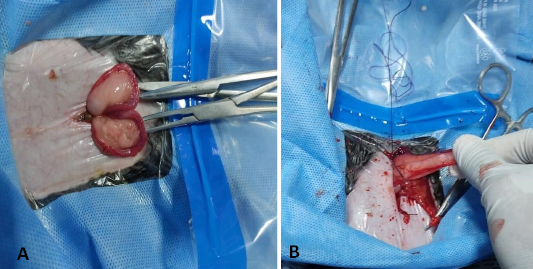
In the caudal midline, a 1 cm incision was made 2 fingers below the umbilicus. In that order, incisions were made in the skin, subcutaneous tissue, muscle, and peritoneum. After all layers were completed, the surgeon’s index finger was introduced toward the left flank into the abdominal cavity, uterine horn, and broad ligament to remove it outside the incision. The ovary was gripped between the thumb and index finger and retrieved for ligation. Manual tension with the finger ruptured the suspensory ligament of the ovary. By making a wide incision in the broad ligament with fingers, the ovarian connection and its blood vessels were exposed. A double chromic catgut ligation was used to ligate the ovarian pedicle. The attachments of the ligature and the ovary were separated (Figure 1).
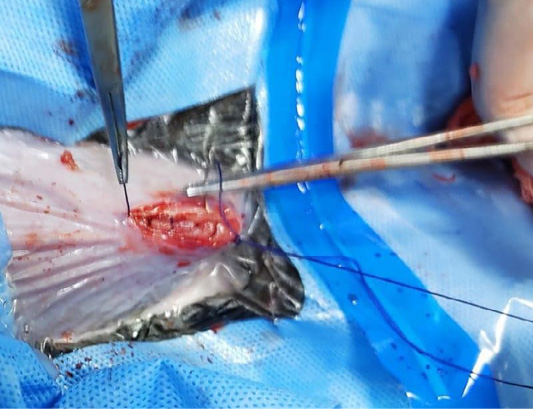
After removing one ovary, another was discovered and removed in the same way. The body of the uterus was extracted from the abdomen. The uterine vessels were split and ligated on each side. Following that, the uterine stump was meticulously checked to rule out any bleeding. The peritoneum, muscles, and fascia were all sutured separately in a basic continuous suture pattern using 1-0 catgut. The skin was subsequently sutured with non-absorbable nylon suture material horizontal mattress sutures, followed by 2-0 catgut subcuticular suture (Figure 2).
For 5 days following surgery, the antibiotic ceftriaxone @ 20mg/kg body weight (Ceftron IM 250mg) was injected intramuscularly. For 5 days, antihistaminic Pheneramine maleate @ 0.5 mg/kg bwt (Alerin 10ml) was injected intramuscularly. Meloxicam at 0.2 mg/kg bwt (Melvet 10ml) was used as an analgesic for three days. Antiseptic povidone iodine ointment was used on the incision site until it healed completely.
Sutures inserted outside the skin was removed after seven days. Sutures inserted beneath the skin was dissolve in 14-21 days. The rabbit recovered completely 14 days after the operation and no complexity was found after 3 months post-surgical check-up.
Discussion
Spaying an animal can restrict reproduction and make it docile, according to a previous study . Spaying may also help prevent uterine infection, uterine cancer, and other reproductive system cancers. In this study, the owner of this rabbit sought to neuter it to reduce its aggressiveness and prevent reproduction.
The surgery is carried out while the patient is sedated. The abdomen’s hair is cut and surgically cleansed. In the case of dogs and cats, a tiny incision is made along the midline, where there are fewer blood veins . The same procedure was used in this investigation when it came to spaying.
A generic surgical pack is used to find the uterus and uterine horns. The uterus and ovaries are removed completely, and the blood arteries are closed. After suturing the inside body wall using absorbable suture material, the exterior skin layer was closed. A similar strategy was followed in this inquiry.
To evaluate the procedure’s effectiveness, specific metrics such as wound healing time (14 days), absence of post-surgical infections, and observable behavioral changes were considered. The rabbit demonstrated a noticeable reduction in aggressiveness post-surgery, aligning with the findings of Isaza and Isaza (2020). No postoperative complications, such as wound infections or delayed healing, were observed during the follow-up period. Although the technique was straightforward and effective, the absence of comparative data with other spaying methods limits broader conclusions.
Conclusions and Recommendations
Ovariohysterectomy (spaying) in rabbits is a well-established surgical procedure that effectively prevents reproduction and reduces undesirable behaviors such as aggression. This case report highlights the successful application of the technique in a rabbit in Bangladesh, demonstrating its simplicity, affordability, and efficacy when performed under appropriate conditions.
Postoperative recovery was uneventful, with no observed complications, and the rabbit showed significant improvement in behavior within two weeks. This study emphasizes the importance of proper surgical protocols, anesthetic management, and postoperative care in achieving favorable outcomes.
While the findings confirm the procedure’s effectiveness, further studies comparing alternative methods and larger sample sizes are recommended to improve procedural refinement and mitigate potential risks. Additional investigations into the long-term effects of spaying on rabbit health and behavior would provide valuable insights for veterinary practitioners and pet owners alike.
Acknowledgement
The authors acknowledged Razz Pet Care, Chattogram.
Novelty Statement
This is one of the first case report in Spaying in Rabbits in Bangladesh.
Author’s Contribution
Iqbal Hossain : Study design and performing surgery.
Kazi Shams Al-Arefin: Validation and performing surgery.
Rayhan Ahmmed Pranto: Assist surgeon and writing.
Deepanjana Sarker: Assist surgeon and drafting manuscript.
Kazi Abdus Sobur: Prepare original manuscript and review.
Conflict of interest
The authors have declared no conflict of interest.
Figures
Figure 1:.
A: After passing the ovary, two ligations were employed in the vascular and avascular portions. A pair of artery forceps and a scalpel were used to remove the ovaries. After the uterine body had been sutured, it was then removed. B: Removal of ovaries.
Figure 2:.
Suturing technique for closing the incision, a precise incision was created through the body’s midline.
References
Böhmer F, Erber K, Ewringmann A, Klein R, Reese S, Böhmer C, Walter B (2022). Anti-Müllerian hormone concentrations in female rabbits and its relation to spay status, pseudopregnancy and ovarian follicle numbers. Reprod. Domest. Anim., 57: 1636-1643. https://doi.org/10.1111/rda.14240[CrossRef]
Bushby PA (2012). Surgical techniques for spay/neuter. Shelter medicine for veterinarians and staff, pp. 625-645. https://doi.org/10.1002/9781119421511.ch39[CrossRef]
Burrow R, Batchelor D, Cripps P (2005). Complications observed during and after ovariohysterectomy of 142 bitches at a veterinary teaching hospital. Veterinary Record., 157(26): 829-833. https://doi.org/10.1136/vr.157.26.829[CrossRef]
Hart LA, Hart BL (2021). An ancient practice but a new paradigm: personal choice for the age to spay or neuter a dog. Front. Vet. Sci., 8: 603257. https://doi.org/10.3389/fvets.2021.603257[CrossRef]
Isaza N, Isaza R (2020). Neutering procedures and considerations in rabbits and other small mammals. High-quality, high-volume spay and neuter and other shelter surgeries, pp. 295-323. https://doi.org/10.1002/9781119646006.ch15[CrossRef]
Janssens LAA, Janssens GHRR (1991). Bilateral flank ovariectomy in the dog- surgical technique and sequelae in 72 animals. J. Small Anim. Pract., 32: 249-252. https://doi.org/10.1111/j.1748-5827.1991.tb00557.x[CrossRef]
Kirsan I, Enginler SO, Toydemir TSF, Erzengin OM, Sonmez K, Sennazl G (2013). Gynecological complications following improper ovariohysterectomy in a dog. Int. J. Vet. Sci., 4: 121-124.
Margeti C, Kostakis C, Tsioli V, Karagianni K, Flouraki E (2024). Local anaesthesia techniques in dogs and cats: A review study. In Pets, 1: 88-119. https://doi.org/10.3390/pets1020009[CrossRef]
Murray MJ (2006). Spays and neuters in small mammals.
Olson ME, Bruce J (1986). Ovariectomy, ovariohysterectomy and orchidectomy in rodents and rabbits. Can. Vet. J., 27(12): 523.
Pearson H (1973). The complications of ovariohysterectomy in the bitch. J. Small Anim. Pract., 14: 257-266. https://doi.org/10.1111/j.1748-5827.1973.tb06457.x[CrossRef]