
The breeding season of S. chizothorax plagiostomus was studied River Panjkora from February 2014 to January 2015. Kumrat valley in Khyber Pakhtunkhwa. The GSI values recorded monthly ranged from 2 to 13.5, the highest value was recorded in March while the lowest was recorded in April and October. We inferred that S. plagiostomus spawn twice a year, once in March-April and then in October-November.
Short Communication · Volume 49, Issue 2, 7 April 2017 · Open Access
On the Breeding Season of Schizothorax plagiostomus
· · · ·
Affiliations & Notes ⌄
- 1Department of Zoology, Shaheed Benazir Bhutto University, Sheringal Dir Upper, Khyber Pakhtunkhwa, Pakistan
Article Info ⌄
- Journal:
- Pakistan Journal of Zoology
- Published:
- 7 April 2017

From the article
- The lengths and weights of different collected specimens and their average absolute fecundity is given in Table I. The monthly recorded values of GSI for S. plagiostomus are shown in Figure 1.
- Mature ripened ovaries (Fig. 2) were found from December to March and then from June to September.
- Spawning and spent ovaries were found in the months of April and May and to some extent in October and November.
Selected from the article's own text.
Abstract
Materials and methods
S. plagiostomus samples were collected fortnightly from River Panjkora from Kumrat Valley Thal to Chukyatan (Dir upper district spans from 34° N latitude and 72° 20E longitude from February 2014 to January 2015. Mature gravid females were dissected to obtain the ovaries for gonadosomatic index (GSI) estimation. Stake nets, bag nets, cast nets, drag nets and some other types of traps were used to capture fishes according to the topography, depth and velocity of water at different locations.
Spawning season was determined by examining monthly variations in GSI and microscopic analysis of maturity stages of ova periodically.
Results and Discussion
The lengths and weights of different collected specimens and their average absolute fecundity is given in Table I.
The monthly recorded values of GSI for S. plagiostomus are shown in Figure 1. Mature ripened ovaries (Fig. 2) were found from December to March and then from June to September. Spawning and spent ovaries were found in the months of April and May and to some extent in October and November.
Table I.- Lengths and weights of Schizothorax plagiostomus and their average absolute fecundity.
| Weight class g | Length range | Total No. | Average absolute fecundity |
| 150-200 | 24.3-30.2 | 10 | 7169.88 |
| 200-300 | 30.2-32.9 | 11 | 7955.33 |
| 300-500 | 32.9-37.9 | 10 | 14185.83 |
| 500-700 | 38.2-40.8 | 15 | 21184.63 |
| 700-900 | 40.8-42.6 | 04 | 28671.11 |
A sudden pronounced drop in GSI was recorded in April showing its sharp breeding season. More or less similar situation was observed in the months of October and November; however the GSI drop was not so sharp. Some of the fishes were found with developing ovaries during the months of October and November, while the rest were in the spawning and spent stages. Hatchlings and fries were observed during December-February, further supporting the breeding season at November and December. Another fact observed was that fishes that were to spawn in April-May batch, had their eggs and ovaries matured right from December and January. The GSI values ranged from 2 to 13.5. Highest value was observed in the month of March, while lowest value was recorded in the month of April.
The fish remain sexually dormant because of intense cold and extremely low temperature of water. Finally some exteroceptive factors and favorable environmental conditions click the fish to spawn in spring season (Malhotra, 1967; Jyoti et al., 1973; ; .
In the River Panjkora, fishes were found to migrate slightly upper parts of the River during their spawning period. We collected fishes from all along the study site right from Thal Valley to Chukyatan Dir Upper. Mature gravid fishes that were ready to spawn were observed to move slightly in ascending direction to the upper parts of the River.
According to Lambert and Ware (1984), batch spawning reproductive strategy may be associated with increase in probability of survival of offspring. Bhatangar (1964), Qadri et al. (1982) and Jan et al. (2014) are of the view that S. plagiostomus spawns twice a year. In contrast, Jhingran and Sehgal (1978) reported that it spawns only once in different months of the year at different elevations of a given river. Our study area covers a length of about 80 km of River Panjkora and elevation difference of only 500 meters. Our study suggests that this much elevation cannot account for a spawning difference of 5 months as we have found. Therefore, we also suggest that S. plagiostomus might be spawning twice a year. Water temperature may be the principal environmental factor to synchronize the endogenous physiological rhythms .
In the present study, gonadal development of S. plagiostomus initiated in May and continued upto September, which suggests that gonadal development may be induced by increasing water temperature. The ovaries keep on growing and maturing from November to March of the following year. It does not spawn until the water temperature increases in April although the ovaries matured even during the cold season but the fish did not begin to spawn until late spring. Qadri et al. (1982) have found similar finding about the timing of maturation and spawning for S. richardsonii.
Statement of conflict of interest
Authors have declared no conflict of interest.
Figures
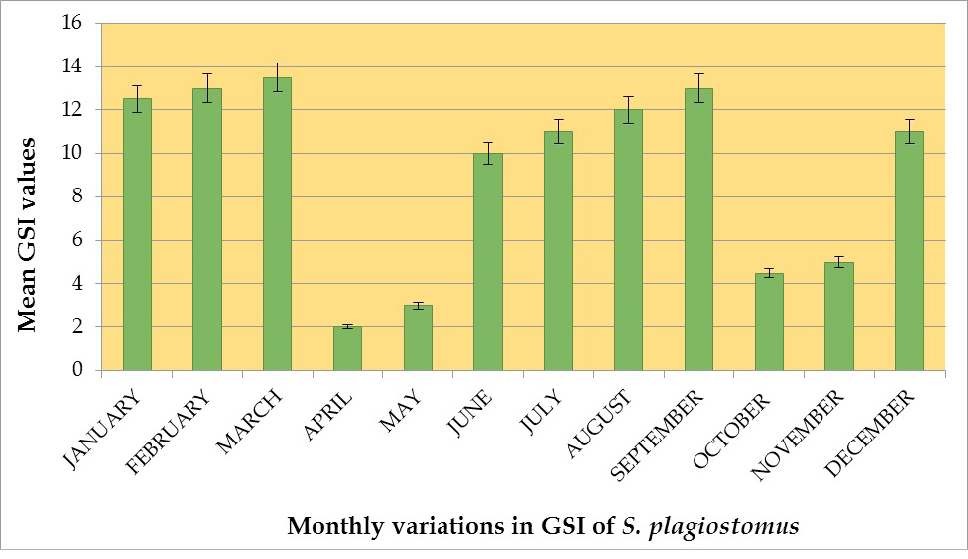
Monthly variations in GSI of S. splagiostomus.
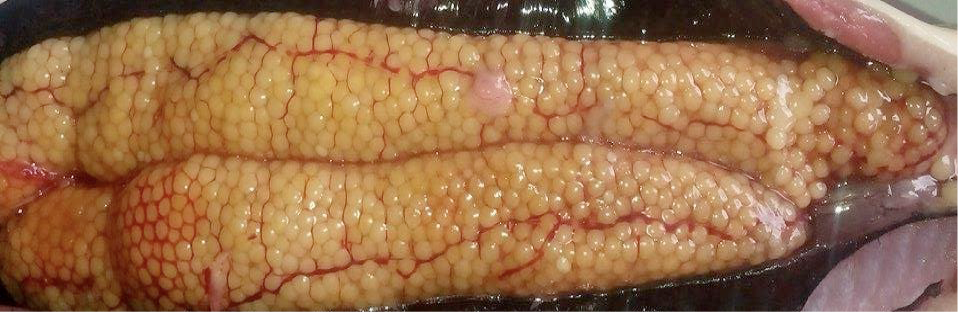
Bi-lobed ripened ovaries of the gravid female fish
References
- Bhatangar, G.K., 1964. Indian J. Fish., 11: 485-502.
- Chen, Y. F. and Cao, W. X., 2000. Schizothoracinae. In: Fauna sinica osteicthtyes cypriniformes III (ed. P.Q. Yue PQ). Science Press, Beijing, pp. 273–388.
- Day, F., 1958. The fishes of India: Being a natural history of the fishes known to inhabit the seas and fresh waters of India, Burma and Ceylon, Vol. 1 (text). William Dawson and Sons Ltd., London, pp. 564.
- He, D. and Chen, Y., 2006. J. Biogeogr., 33: 1448–1460. https://doi.org/10.1111/j.1365-2699.2006.01510.x[CrossRef]
- Jan, A., Rab, A., Ullah, R., Shah, H., Haroon, Ahmad, I., Younas, M. and Ullah, I., 2016. Current Scenario and Threats to Ichthyo-Diversity in the Foothills of Hindu Kush: Addition to the Checklist of Coldwater Fishes of Pakistan. Pakistan J. Zool., vol. 48(1), pp. 285-288.
- Jan, M., Jan, U. and Shah, G.M., 2014. J. threat. Taxa, 6: 5375-5379.
- Javed, M.N., Azizullah and Pervaiz, K., 2012. Biologia (Pakistan), 58: 175-178.
- Jhingran, V.G. and Sehgal, K.L., 1978. Coldwater fisheries of India. Inland Fisheries Society of India Barrackpore. p. 239.
- Jobling, M., 1995. Biol. Bull., 148: 402–415.
- Jyoti, M.K., 1973. Studies on the feeding and gonadal cycles of some fishes of Jammu and Kashmir State. Ph.D. thesis. University of Jammu, pp. 242.
- Khan, N., 2012. African J. Pl. Sci., 6: 21-31.
- Kullander, S. O., Fang, F., Delling, B. and Ahlander, E., 1999. Fishes of the Kashmir Valley. Department of Vertebrate Zoology, Swedish Museum of Natural History.
- Lam, T.J., 1983. Environmental influences on gonad activity in fish. In: Fish physiology (eds. W.S. Hoar, D.J. Randall, and E.M. Donaldson), Volume 9 part B. Academic Press, New York, pp. 65–116.
- Lambert, T.C. and Ware, D.M., 1984. Can. J. Fish. aquat. Sci., 41: 565-1569. https://doi.org/10.1139/f84-194[CrossRef]
- Malhotra, Y.R., 1967. Indian J. Fish., 14: 313-317.
- Papoulias, D.M., Chapman, D. and Tillitt, D.E., 2006. Hydrobiologia, 571: 355–360. https://doi.org/10.1007/s10750-006-0260-7[CrossRef]
- Qadri, M.Y., Mir, S. and Yousuf, A.R., 1982. J. Indian. Inst. Sci., 64: 73-81.
- Raizada, S.B., 1985. Breeding, development and culture prospects of the Himalayan barbel, S. plagiostomus (Heckel). J. Bombay Nat. Hist. Soc., 82: 130-137
- Sunder, S., 1992. A review on the biological studies of schizothoracids in J and K State and elsewhere in India and their cultural possibilities. In: Recent researches in coldwater fisheries (ed. K.L. Sehgal), pp. 157-171.
- Wang, S.B. and Chen, C.T., 1995. Fish. Res., 23: 127-141. https://doi.org/10.1016/0165-7836(94)00335-T[CrossRef]
Services
Article usage statistics
Loading…