
A survey was conducted to investigate root-knot nematode presence and distribution of plant-parasitic nematode genera in okra fields across various sections of the Prayagraj district in Uttar Pradesh. Four blocks were selected for the study, which included Bahadurpur, Phulpur, Chaka, and Jasra, covering 20 different villages. The results showed that disease incidence throughout the various locations studied showed a wide range, which extended from 26.7 to 83.3 percent. Chaka showed the highest disease rate among all blocks whereas Phulpur showed the lowest rate of disease transmission. The research identified multiple nematode genera in the area, with Meloidogyne appearing as the most common and widely found species, while Pratylenchus, Tylenchus, Rotylenchus and Helicotylenchus followed behind, and Heterodera and Xiphinema showed presence at a much lower rate. The frequency analysis confirmed that Meloidogyne emerged as the most prevalent species throughout the surveyed locations. Nematode populations varied between blocks because Chaka block had the highest population and Jasra and Bahadurpur followed as the next highest blocks, whereas Phulpur had the lowest population. The study found that nematode populations showed a positive association with both disease incidence and gall index. The study shows that plant-parasitic nematodes exist throughout okra-growing areas of Prayagraj, which highlights the need for ongoing monitoring and effective management methods to prevent crop losses.
Research Article · Volume 44, Issue 2, 15 September 2026 · Open Access
Occurrence and Distribution of Plant-Parasitic Nematodes in Okra Fields of Prayagraj District, Uttar Pradesh, India
·
Affiliations & Notes ⌄
- 1Department of Zoology, C.M.P., P.G College, University of Allahabad, Prayagraj - 211002, U.P., India. *Correspondence | Hemlata Pant, Department of Zoology, C.M.P., P.G College, University of Allahabad, Prayagraj- 211002, U.P., India
- 2Email: panthemlata8@gmail.com
Article Info ⌄
- Journal:
- Pakistan Journal of Nematology
- Published:
- 15 September 2026
From the article
- The block of Chaka showed the highest root-knot disease incidence through its 83.3 percent rate while Jasra and Bahadurpur followed behind and Phulpur block recorded the lowest rate.
- The incidence of root-knot nematodes showed different levels of presence across various villages examined within the selected study areas.
- The different plant-parasitic nematode genera showed different distribution patterns in all the studied villages according to the data (Table 2).
- The present survey demonstrated a wide distribution of plant-parasitic nematodes in okra-growing regions of Prayagraj district, with noticeable variation in disease incidence and nematode population among different blocks and villages.
Selected from the article's own text.
Abstract
Introduction
Okra (Abelmoschus esculentus (L.) Moench) belongs to the Malvaceae family and serves as one of the essential vegetable crops which people cultivate throughout tropical and subtropical areas. The product holds value because it provides essential nutrients through its protein and mineral and vitamin content while also delivering industrial value through its fiber manufacturing applications. India ranks among the leading producers of okra globally and the crop contributes to vegetable production and export earnings through its significant agricultural output.
Plant-parasitic nematodes represent one of the main biotic stresses which pose economic challenges to okra cultivation because they cause severe damage to crops. Root-knot nematodes (Meloidogyne spp.) rank as the most harmful nematode species because they can infect many different host organisms and they breed rapidly and survive in various environmental settings. Nematodes invade plants and create root-galls which block the normal physiological processes of plants and stop them from absorbing water and nutrients necessary for proper growth. Earlier reports have indicated substantial yield losses in okra due to root-knot nematodes which sometimes exceeded 20-40 percent under favorable conditions ; .
The distribution and occurrence of plant-parasitic nematodes depends on various factors which include soil type and climatic conditions and cropping pattern and agricultural practices . The vegetable-growing regions exhibit a presence of multiple genera which include Meloidogyne, Pratylenchus, Rotylenchus and Helicotylenchus that grow together in their shared rhizosphere ; . The recent studies established that environmental conditions and management practices control nematode population dynamics and community composition which results in their distribution across different locations ; . Recent studies have also documented nematode diversity in mushroom-producing composts and the distribution of plant-parasitic nematodes in vegetable-growing areas ;
Root-knot nematodes show widespread distribution in vegetable crops throughout eastern Uttar Pradesh. This study found multiple locations that had high infestation rates of root-knot nematodes in the Prayagraj region of eastern Uttar Pradesh . The presence of multiple nematode genera within the same field presents a challenge for effective management which requires detailed surveys to determine their distribution and relative importance. Recent investigations have also highlighted the increasing importance of nematode problems in intensively cultivated vegetable ecosystems, especially under changing climatic conditions ; .
Although several studies have been conducted on plant-parasitic nematodes in different regions, systematic information on their occurrence in okra-growing areas of Prayagraj district remains limited ; . Therefore, the present investigation was undertaken to assess the incidence of root-knot nematodes and to study the distribution of different plant-parasitic nematode genera associated with okra in selected blocks of Prayagraj district.
Materials and Methods
Study area
The present investigation was conducted in different okra-growing areas of Prayagraj district, Uttar Pradesh, India. The region is characterized by a subtropical climate, which is favorable for the development and multiplication of plant-parasitic nematodes.
Survey and sampling
A systematic survey was carried out during the cropping season to assess the incidence of plant-parasitic nematodes in okra. Four blocks, namely Bahadurpur, Phulpur, Chaka and Jasra, were selected for the study (Table 1). From each block, five villages were surveyed, making a total of twenty villages. In each village, three fields were randomly selected, and ten plants were examined from each field, resulting in a total of thirty plants per village. Soil samples were collected at a depth of 15–20 cm from the rhizosphere zone. Samples of infected roots and around 500 g of soil were taken from each field and transported to the laboratory for nematode extraction and identification.
Assessment of disease incidence
The incidence of root-knot nematode was recorded based on the number of infected plants. Disease incidence was calculated using the formula:

Estimation of gall index
Root galling was assessed using a standard 0-5 rating scale based on the severity of gall formation, and the mean gall index was calculated following the method described by Taylor and Sasser (1978).
Nematode extraction and identification
Soil and root samples were collected from the rhizosphere of selected plants and processed in the laboratory. Nematodes were extracted from soil samples using the modified Cobb’s sieving and decanting method , followed by the Baermann funnel technique for further recovery of active nematodes . For microscopic examination, the extracted nematodes were killed, fixed and mounted on permanent slides. Identification was carried out up to the genus level using standard taxonomic keys based on morphological characteristics .
Statistical analysis
The collected survey data were evaluated using descriptive statistical analysis. To summarize the distribution of plant-parasitic nematodes in the surveyed areas, mean values, frequency of occurrence and standard error (SE) were calculated.
Results and Discussion
The survey conducted across different blocks of Prayagraj district revealed considerable variation in the incidence of root-knot nematode. The overall incidence ranged between 26.7 percent and 83.3 percent across the surveyed villages (Table 1). The block of Chaka showed the highest root-knot disease incidence through its 83.3 percent rate while Jasra and Bahadurpur followed behind and Phulpur block recorded the lowest rate. Chaka block displays higher nematode incidence because its soil and environmental conditions create ideal conditions for nematodes to reproduce and stay alive. The Prayagraj region showed similar results because more than 50 percent of fields were reported to be infested with root-knot nematodes which caused disease rates to reach 80 percent in specific areas . The previous studies have documented the root-knot nematode’s extensive presence across various agro-climatic regions .
The incidence of root-knot nematodes showed different levels of presence across various villages examined within the selected study areas. The highest incidence was recorded in villages such as Mahewa (83.3%), Chaka (80.0%) and Dandi (76.7%), where infection levels exceeded 70 per cent, whereas comparatively lower incidence was noted in villages like Tulsipatti (26.7%) and Rasulpur (30.0%). The village-level differences of this study can be explained through the different agricultural practices and irrigation methods and the environmental factors which affect nematode populations. The results demonstrate that nematode distribution patterns show different distribution patterns which exist between distinct locations within the same agro-climatic area. Previous research showed that different factors at the village level create variations in nematode populations. The research found that area-based soil and climate factors determine the presence and intensity of plant-parasitic nematodes as demonstrated by the studies conducted by ; .
Table 1: Village-wise incidence of root-knot nematode in okra.
|
Block |
Village |
Fields surveyed (No.) |
Total observed plants (No.) |
Total infected plants (No.) |
Incidence (%) |
Mean gall index |
Nematode population |
|
Bahadurpur |
Badra |
3 |
30 |
14 |
46.7 |
2.5 |
320 |
|
Bahadurpur |
Bahadurpur |
3 |
30 |
12 |
40.0 |
2.2 |
290 |
|
Bahadurpur |
Chak |
3 |
30 |
16 |
53.3 |
2.9 |
360 |
|
Bahadurpur |
Jhunsi |
3 |
30 |
15 |
50.0 |
2.7 |
340 |
|
Bahadurpur |
Katta |
3 |
30 |
13 |
43.3 |
2.4 |
310 |
|
Phulpur |
Dayalpur |
3 |
30 |
12 |
40.0 |
2.2 |
300 |
|
Phulpur |
Rasulpur |
3 |
30 |
9 |
30.0 |
1.8 |
230 |
|
Phulpur |
Shahpur |
3 |
30 |
11 |
36.7 |
2.0 |
280 |
|
Phulpur |
Tulsipatti |
3 |
30 |
8 |
26.7 |
1.6 |
210 |
|
Phulpur |
Korapur |
3 |
30 |
13 |
43.3 |
2.4 |
310 |
|
Chaka |
Chaka |
3 |
30 |
24 |
80.0 |
4.0 |
560 |
|
Chaka |
Mahewa |
3 |
30 |
25 |
83.3 |
4.3 |
600 |
|
Chaka |
Dandi |
3 |
30 |
23 |
76.7 |
3.9 |
540 |
|
Chaka |
Dadari |
3 |
30 |
18 |
60.0 |
3.2 |
410 |
|
Chaka |
Naini |
3 |
30 |
20 |
66.7 |
3.5 |
440 |
|
Jasra |
Jari |
3 |
30 |
22 |
73.3 |
3.8 |
500 |
|
Jasra |
Jasra |
3 |
30 |
17 |
56.7 |
3.0 |
390 |
|
Jasra |
Kanti |
3 |
30 |
21 |
70.0 |
3.6 |
480 |
|
Jasra |
Ghoorpur |
3 |
30 |
18 |
60.0 |
3.2 |
410 |
|
Jasra |
Iradatgang |
3 |
30 |
19 |
63.3 |
3.3 |
430 |
The different plant-parasitic nematode genera showed different distribution patterns in all the studied villages according to the data (Table 2). A total of several genera were identified, among which Meloidogyne was the most widely distributed genus, being present in almost all the villages surveyed. The study detected other genera which included Rotylenchus, Pratylenchus, Helicotylenchus, Tylenchus, Heterodera and Xiphinema at different levels of occurrence. The presence of multiple genera within the same village indicates a complex nematode community associated with the okra rhizosphere. The region demonstrates diverse plant-parasitic nematodes because environmental factors and cropping patterns and host plants create suitable conditions. Previous research has documented the presence of multiple nematode genera in vegetable-growing regions, where different genera existed together in the same agricultural field ; .
The occurrence of various plant-parasitic nematode genera in different locations is presented in Table 3. The surveyed area showed higher occurrences of Meloidogyne than any other recorded genus. Pratylenchus and Tylenchus spread throughout the blocks, while Rotylenchus and Helicotylenchus showed moderate occurrence. Heterodera and Xiphinema appeared less frequently, which showed they existed in the area as infrequent visitors. Meloidogyne dominates other genera because it can infect many host types and reproduce at high rates and thrive in various environmental situations. Previous research shows matching results because Meloidogyne has been found to be the most common economically significant plant-parasitic nematode in vegetable crops ; . Recent studies show similar patterns, which show how root-knot nematodes exist in all different agro-ecological regions.
Table 2: Occurrence of plant-parasitic nematode genera in different villages of surveyed blocks.
|
Village |
Meloidogyne |
Rotylenchus |
Helicotylenchus |
Pratylenchus |
Xiph- inema |
Heterodera |
Tylenchus |
|
Badra |
+ |
- |
+ |
+ |
+ |
- |
+ |
|
Bahadurpur |
+ |
- |
+ |
- |
+ |
- |
+ |
|
Chak |
+ |
+ |
- |
+ |
- |
- |
+ |
|
Jhunsi |
+ |
+ |
- |
+ |
- |
- |
- |
|
Katta |
- |
+ |
- |
+ |
- |
+ |
- |
|
Dayalpur |
+ |
- |
+ |
+ |
- |
- |
+ |
|
Rasulpur |
+ |
+ |
+ |
+ |
- |
+ |
+ |
|
Shahpur |
+ |
+ |
+ |
- |
- |
+ |
- |
|
Tulsipatti |
+ |
+ |
- |
+ |
- |
- |
- |
|
Korapur |
+ |
+ |
+ |
+ |
- |
+ |
- |
|
Chaka |
+ |
+ |
+ |
+ |
- |
- |
+ |
|
Mahewa |
+ |
+ |
- |
+ |
+ |
- |
+ |
|
Dandi |
+ |
- |
- |
+ |
- |
+ |
+ |
|
Dadari |
+ |
- |
+ |
+ |
- |
+ |
- |
|
Naini |
+ |
+ |
- |
- |
- |
- |
- |
|
Jari |
+ |
+ |
+ |
- |
- |
+ |
+ |
|
Jasra |
+ |
+ |
+ |
+ |
- |
+ |
- |
|
Kanti |
+ |
- |
+ |
- |
- |
+ |
+ |
|
Ghoorpur |
+ |
- |
- |
+ |
- |
+ |
+ |
|
Iradatgang |
+ |
- |
+ |
+ |
- |
- |
- |
+ = Present, − = Absent
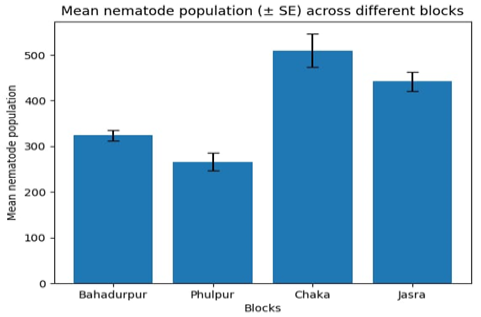
The average nematode population together with its distribution pattern throughout the different blocks of the study is presented in Table 4 and Figure 1. The results of the study indicated noticeable variation in nematode populations among the surveyed blocks. The highest mean population was recorded in Chaka block, followed by Jasra and Bahadurpur, while the lowest population was observed in Phulpur block. The higher nematode populations observed in certain blocks may be related to local environmental and agronomic factors. The standard error values further
Table 3: Frequency and distribution of plant-parasitic nematode genera associated with okra in surveyed areas.
|
S. No. |
Nematode genus |
Frequency (%) |
Distribution (Blocks) |
Remarks |
|
1. |
Meloidogyne spp. |
95 |
All blocks |
Dominant |
|
2. |
Rotylenchus spp. |
55 |
Bahadurpur, Phulpur, Chaka, Jasra |
Moderately distributed |
|
3 |
Helicotylenchus spp. |
50 |
Bahadurpur, Phulpur, Chaka, Jasra |
Moderately distributed |
|
4 |
Pratylenchus spp. |
70 |
All blocks |
Widely distributed |
|
5 |
Xiphinema spp. |
20 |
Chaka, Jasra |
Low occurrence |
|
6 |
Heterodera spp. |
30 |
Phulpur, Chaka, Jasra |
Sporadic |
|
7 |
Tylenchus spp. |
60 |
All blocks |
Moderately distributed |
indicated variability in nematode distribution within the blocks. The study found that nematode populations showed a positive association with both disease incidence and gall index. Similar trends of higher nematode populations in intensively cultivated vegetable-growing regions have been reported in earlier studies , as well as in recent investigations highlighting the influence of environmental and agronomic factors on nematode proliferation . These findings emphasize the need for effective nematode management strategies to minimize yield losses in okra cultivation.
Table 4: Mean nematode population and standard error (SE) across different blocks.
|
Block |
Mean nematode population |
SE (±) |
|
Bahadurpur |
324 |
12.1 |
|
Phulpur |
266 |
19.6 |
|
Chaka |
510 |
36.3 |
|
Jasra |
442 |
20.8 |
Values are mean of five villages per block; SE= standard error.
Conclusion
The present survey demonstrated a wide distribution of plant-parasitic nematodes in okra-growing regions of Prayagraj district, with noticeable variation in disease incidence and nematode population among different blocks and villages. Among the identified genera, Meloidogyne emerged as the most dominant and widely prevalent, followed by Pratylenchus, Tylenchus, Rotylenchus and Helicotylenchus, whereas Heterodera and Xiphinema were recorded with relatively lower frequency. Continuous cultivation of highly susceptible host crops and favourable environmental conditions may contribute to the higher incidence observed in certain areas. The presence of multiple genera in one area shows that different types of nematodes live in the okra rhizosphere. The study results show that researchers need to conduct ongoing monitoring while using appropriate control measures to achieve successful nematode management. The research establishes a foundational resource for upcoming studies which will support the creation of site-specific strategies that help reduce agricultural damage.
Acknowledgement
The authors are grateful to the Department of Zoology, C.M.P., P.G. College (University of Allahabad), Prayagraj, Uttar Pradesh, India, for providing the necessary facilities and support to carry out this study.
Novelty Statement
This study presents a field-based assessment of plant-parasitic nematodes associated with okra in four blocks and 20 villages of Prayagraj district, Uttar Pradesh, India. The study documents their occurrence, distribution and population levels at the village and block levels, providing useful information for future monitoring management of nematode problems in okra cultivation in the region.
Author’s Contribution
Aditya Sharma: Field survey and sampling, laboratory work, data collection, data analysis, interpretation of results, and manuscript prepa-ration and writing.
Hemlata Pant: Conceptualization, supervision, guidance, assistance with background and con-ceptual aspects, and critical review and correction of the manuscript.
Generative AI and AI assisted technology statement
The authors declare that no generative AI and AI assisted technology was used in the creation of this manuscript.
Conflict of interest
The authors have declared no conflict of interest.
Figures
Mean nematode population (± SE) accross different blocks surveyed.
References
- Baermann, G., 1917. Eine einfache Methode zur Auffindung von Ankylostomum (Nematoden) Larven in Erdproben. Geneeskundig Tijdschrift voor Nederlandsch-Indië, 57: 131–137.
- Baheti, B.L. and Bhati, D.S., 2017. Yield losses in okra due to root-knot nematode. Indian J. Nematol., 47(2): 150–154.
- Cobb, N.A., 1918. Estimating the nematode population of soil. Agricultural Technology Circular No. 1, Bureau of Plant Industry, United States Department of Agriculture, Washington, DC.
- Coyne, D.L., Cortada, L., Dalzell, J.J., Claudius-Cole, B., Haukeland, S., Luambano, N. and Talwana, H., 2018. Plant-parasitic nematodes and food security in sub-Saharan Africa. Ann. Rev. Phytopathol., 56: 381–403. https://doi.org/10.1146/annurev-phyto-080417-045833[CrossRef]
- Jabbari, H., 2025. Survey on nematodes biodiversity in Agaricus bisporus Producing composts in east Azarbaijan Province, Iran. Pakistan J. Nematol., 43: 110-121.
- Jones, J.T., Haegeman, A., Danchin, E.G.J., Gaur, H.S., Helder, J., Jones, M.G.K., Kikuchi, T., Manzanilla-López, R., Palomares-Rius, J.E., Wesemael, W.M.L. and Perry, R.N., 2013. Top 10 plant-parasitic nematodes in molecular plant pathology. Mol. Plant Pathol., 14(9): 946–961. https://doi.org/10.1111/mpp.12057[CrossRef]
- Kebede, G., Seid, A. and Habtegebriel, B., 2025. Distribution of plant parasitic nematodes associated with carrot (Daucus carota L., subsp. sativus) in North Showa Zone, Ethiopia. Pakistan J. Nematol., 43(1): 88-96.
- Lavhe, N.V., Patil, M.S. and Deshmukh, S.B., 2019. Survey and distribution of plant-parasitic nematodes associated with vegetable crops. J. Entomol. Zool. Stud., 7(3): 1234–1238.
- Mai, W.F. and Mullin, P.G., 1996. Plant-parasitic nematodes: A pictorial key to genera (5th ed.). Ithaca, NY: Cornell University Press. https://doi.org/10.7591/9781501728419[CrossRef]
- Pandey, R.K., Singh, K.P. and Sharma, R.K., 2003. Survey of root-knot disease of chickpea (Cicer arietinum L.) in and around district Allahabad, U.P. Pakistan J. Nematol., 21(2): 97·102.
- Pant, H., Pandey, R.K. and Singh, S., 2006. Biodiversity of plant-parasitic nematodes of chickpea in Allahabad region. J. Natural Resource Dev., 1(1): 36·39.
- Pant, H., Verma, J., Gupta, N., Yadav, A. and Sharma, A., 2025. Community analysis of plant parasitic nematodes in and around Prayagraj, Uttar Pradesh. J. Exp. Zool. India 28(1): 1041-1044. https://doi.org/10.51470/jez.2025.28.1.1041[CrossRef]
- Sachan, A., Pandey, R.K., Kumar, S., Kashyap, N. and Sengar, M.S., 2023. Survey and distribution of plant parasitic nematodes on tomato at Baruasagar in Jhansi (India). Am. J. Agric. Biol. Sci., 18(1): 48–60. https://doi.org/10.3844/ajabssp.2023.48.60[CrossRef]
- Sasser, J.N., 1979. Economic importance of root-knot nematodes. In Root-knot nematodes (Meloidogyne spp.): Systematics, biology and control. Academic Press. pp. 3–16. https://doi.org/10.1016/0048-4059(80)90044-2[CrossRef]
- Southey, J.F., 1986. Laboratory methods for work with plant and soil nematodes. Her Majesty’s Stationery Office, London.
- Srivastava, A.K., Mishra, R. and Singh, V., 2012. Occurrence and distribution of plant-parasitic nematodes in different agro-climatic zones. Indian J. Nematol., 42(1): 56–60.
- Taylor, A.L. and Sasser, J.N., 1978. Biology, identification and control of root-knot nematodes (Meloidogyne species). North Carolina State University Graphics, Raleigh, USA.
Services
Article usage statistics
Loading…