
Genus Leptophion Cameron, 1901 is moderately large genus of sub-family Ophioninae (Hymenoptera: Ichneumonidae). Pakistan has very rich Ophioninae fauna but no attempt has been made to study this genus. The specimens were collected from District Buner, Khyber Pakhtunkhwa during 2019. The genus Leptophion and the species L. maculipennis are described for the first time from Pakistan. Morphological description and digital images of the identified species and genus are given.
Research Article · Volume 39, Issue 3, 20 July 2023 · Open Access
Newly Recorded Genus of Sub-Family Ophioninae (Hymenoptera: Ichneumonidae) from Pakistan
· · · · ·
Affiliations & Notes ⌄
- 1Department of Entomology, The University of Agriculture, Peshawar, Khyber Pakhtunkhwa, Pakistan
- 2Department of Entomology, The University of Agriculture, Swat, Pakistan. *Correspondence | Adnan Ihsan, Department of Entomology, The University of Agriculture, Peshawar, Khyber Pakhtunkhwa, Pakistan
- 3Email: adnanihsanuap40@gmail.com
Article Info ⌄
- Journal:
- Sarhad Journal of Agriculture
- Published:
- 20 July 2023

Abstract
Introduction
Sub-family Ophioninae is one of the most diverse and major group of family Ichneumonidae. It comprised of 32 genera and about 1100 recorded species ; ; . The members of the sub-family Ophioninae are endoparasitoids and mainly parasitize the larva of Noctuidae, Sphingidae and Hesperiidae ; ; .
Mostly, all the genera of the Ophioninae are nocturnal and have long antenna, large eyes and orange brown body ; ; . Leptophion is highly diverse and 5th largest genus of sub-family Ophioninae which consist of 32 described species, distributed in Oriental, Oceanic and Australian regions ; .
The Ophioninae fauna of Pakistan is very much diverse but has been poorly studied so far. In the current study, the genus Leptophion and species L. maculipennis are reported for the 1st time from Pakistan.
Materials and Methods
A survey was carried out during 2019 for the collection of Ophioninae specimens from different areas of District Buner, Khyber Pakhtunkhwa Pakistan, using hand net and malaise trap. The collected specimens were observed under Nikon SMZ 745T stereomicroscope and identified with the help of literature provided by Gauld and Mitchell (1981). Layers of pictures were taken by using Nikon DS-Fi2 digital camera attached with microscope and combined with Helicon Focus 6.22 to get sharp image. Images were edited by using Adobe Photoshop.
Different indices used mainly adopted after Gauld and Mitchell (1981).
AI (Alar Index) = length of 1m- cu between 2m- cu and bulla/ length of 3rm
CI (Cubital index) = length of Cu1 between 1m- cu and Cu1a/ length of Cu1b
NI (Nervellar Index) = length of Cu1 between M and cu-a/ length of cu-a
Results and Discussion
Genus Leptophion Cameron, 1901
Leptophion : 227. Type species: Leptophion longiventris Cameron, by monotype.
Diagnostic characteristics
The following important morphological characters separates genera from other genera: Occipital carina laterally and dorsally complete (Figure 2C); mesosternum with posterior transverse carina complete (Figure 2B); forewing lacking alar sclerites (Figure 2G); hind tarsal claw with distal pecten longer (Figure 2E); R1 with penultimate hamulus curved and elongated (Figure 2G).
Host: Unknown. Adults were collected from coniferous evergreen forest by hand net and malaise trap.
Distribution: Palearctic, oriental, oceanic and Australian regions (Shimizu and Watanabe, 2015a; .
Leptophion maculipennis Cameron, 1905
Spilophion maculipennis : 125. Lectotype: female, Sri Lanka (British Museum of Natural History, London), designated by Gauld (1977): 34.
Diagnosis: Forewing with vein 1m-cu sinuous, disco sub-marginal cell lacking sclerite (Figure 2G); hind wing with marginal cell centrally hirsute, vein Rs with 1st abscissa curved (Figure 2G), R1 with penultimate hamulus curved and longer (Figure 2G); tarsal claw of hind leg with distal pecten longer and fully developed (Figure 2E).
Description: Body length. 22-23mm, body color. yellowish brown; mesoscutum with 3 blackish longitudinal vittae; meso and metapleuron, metasomal tergite 3 and 5-8 with blackish markings.
Head: Antenna 65-68 segmented; face hairy, polished and punctate; clypeus strongly convex, polished, hairy with sparse punctuation, 0.5x as long as wide; malar space 0.3-0.4x as long as basal width of the mandibles; mandibles weakly tapered and abstemiously long; upper tooth somewhat longer than lower; gena, vertex and frons finely punctate and polished.
Mesosoma: Mesosoma hairy, moderately polished, without notauli; mesoscutum hairy, finely punctate, 1.4–1.5x as long as wide; pronotum hairy, finely punctate, strongly polished; epicnemial carina present; scutellum with lateral longitudinal carine developed; metapleuron and mesopleuron with sparse hairs, smooth; sub-metapleural carina present; propodeum with dense hairs, rugos, rounded, anterior transverse carina complete.
Wings: Forewing 16-16.5 mm, AI = 1.23, CI = 0.2 to 0.4; vein 1m-cu without ramellus, sinuous strongly; disco-sub-marginal cell usually with glabrous area below pterostigma; Rs+2r weakly curved and broadened proximally, distally straight; marginal cell with proximal part usually with an infumate area. Hind wing 7-7.3 mm in length with NI=1.1–1.2; vein R1 with 6 hamuli, penultimate hamulus longer and curved; marginal cell with proximal part hairy, enclosed by glabrous area; vein Rs abruptly and strongly curved.
Legs: Front tibia with outer surface usually with numerous spines; hind coxa 1.9x as long as wide and rounded; hind femur 0.8x as long as tibia; hind tarsal claw usually with 9 pecten, distal pecten longer and well developed.
Metasoma: Metasoma polished with hairs; tergite 3 and terminal segments usually with black spots; tergite 1 with spiracle at posterior 3rd of tergite.
Material examined: 2♂, Buner, Khyber Pakhtunkhwa-Pakistan, 34.3943°N, 72.6151°E. 14 xi 2019 (Adnan Ihsan).
Distribution: Pakistan (New Record), oriental region (Sri Lanka, Nepal, Malaysia, Indonesia, India, China, Taiwan), Australian region (Papua New Guinea and Australia) .
Host: Unknown.
Remarks: Leptophion maculipennis belong to the species group maculipennis and is widely spread-out in Oriental and Australian region . This species is characterized by elongated penultimate hamulus and well developed pecten of hind tarsal claw . This species is new to the fauna of Pakistan (District Buner, Khyber Pakhtunkhwa).
Acknowledgments
The authors are very thankful to Mr. So Shimizu (Kobe University, Japan) for help in identification of the species.
Novelty Statement
This study is novel in describing the parasitoid group of family Ichneumonidae from district Buner, Khyber Pakhtunkhwa. The genus Leptophion and species L. maculipennis were reported new to the fauna of Pakistan.
Author’s Contribution
Adnan Ihsan: Recorded the species and wrote the article.
Najeeb Ullah, Riaz Hussain and Waqar Khan: Helped in identification of the specimens.
Kamran Sohail and Jawad Sarwar: Supervised the overall activities.
Conflict of interest
The authors have declared no conflict of interest.
Figures
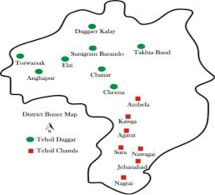
Map of District Buner, Khyber Pakhtunkhwa-Pakistan.
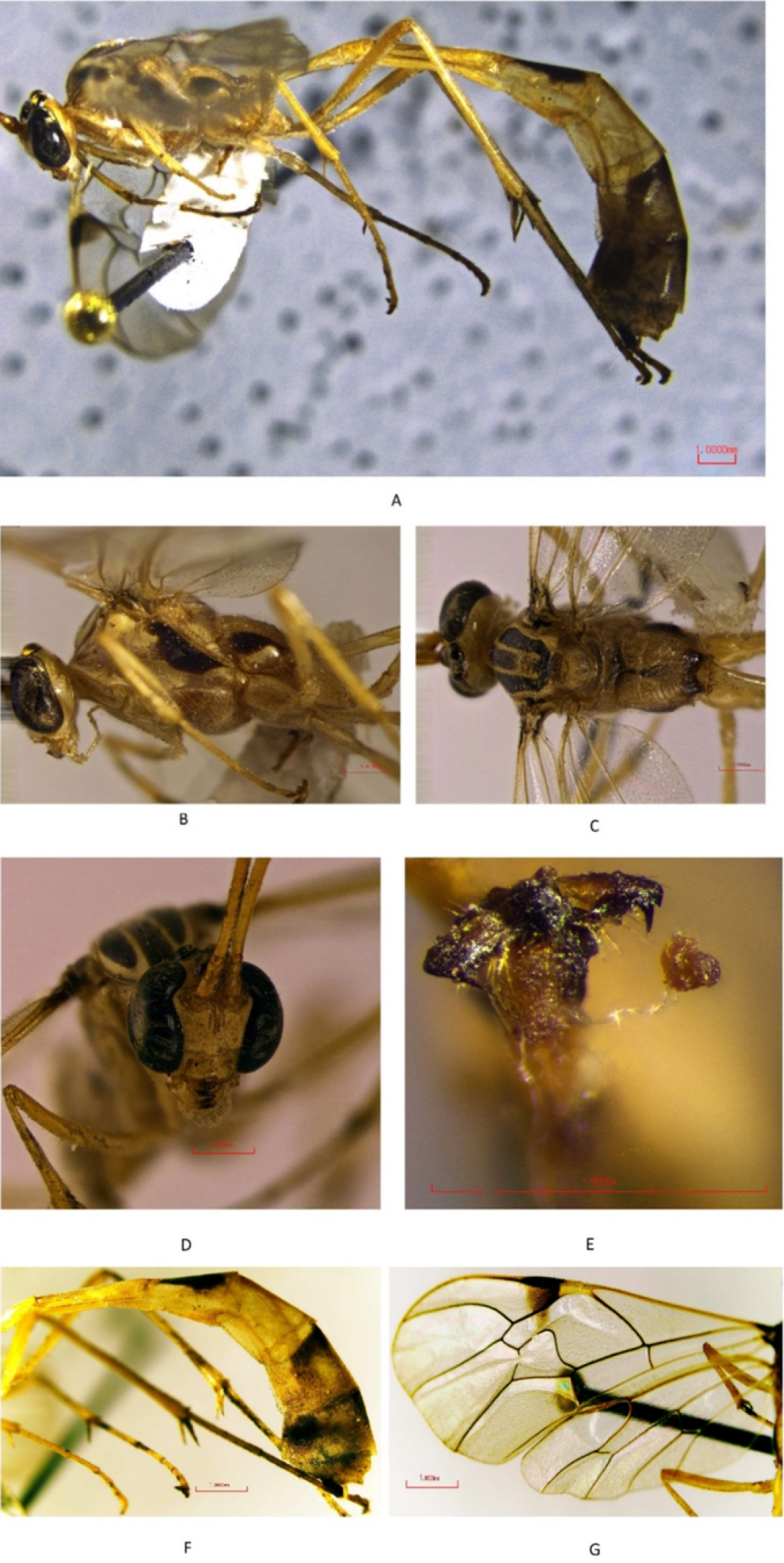
Leptophion maculipennis: A, Lateral view; B, Mesosoma lateral; C, Mesosoma dorsal; D, Head; E, Tarsal claw; F, Metasoma; G, Wings.
References
- Alvarado, M., 2014. Revision of the South American wasp genus Alophophion Cushman, 1947 (Hymenoptera: Ichneumonidae: Ophioninae). Rev. Peruana Biol., 21: 3–60. https://doi.org/10.15381/rpb.v21i2.9828[CrossRef]
- Cameron, P., 1901. On Hymenoptera collected in New Britain by Dr. Arthur Willey. Proc. Zool. Soc. Lon., 70: 224–248. https://doi.org/10.1111/j.1469-7998.1901.tb08542.x[CrossRef]
- Cameron, P., 1905. On the phytophagous and parasitic Hymenoptera collected by Mr. E. Green in Ceylon. Spolia Zeylanica, 3: 67–143.
- Cushman, R.A., 1947. A generic revision of Ichneumon-flies of the tribe Ophionini. Proc. U. S. Natl. Museum. 96: 417–482. https://doi.org/10.5479/si.00963801.96-3206.417[CrossRef]
- Gauld, I.D., 1977. A revision of the Ophioninae (Hymenoptera: Ichneumonidae) of Australia. Aust. J. Zool., 49: 1–112. https://doi.org/10.1071/AJZS049[CrossRef]
- Gauld, I.D., 1985. The phylogeny, classification and evolution of parasitic wasps of the subfamily Ophioninae (Ichneumonidae). Bull. Br. Museum Natl. Hist., 51: 61–185.
- Gauld, I.D. and D.H. Janzen. 2004. The systematics and biology of the Costa Rican species of parasitic wasps in the Thyreodon genus-group (Hymenoptera: Ichneumonidae). Zool. J. Linn. Soc., 141: 297–351. https://doi.org/10.1111/j.1096-3642.2004.00116.x[CrossRef]
- Gauld, I.D. and P.A. Mitchell. 1981. The taxonomy, distribution and host preferences of Indo-Papuan parasitic wasps of the subfamily Ophioninae. CAB: Slough. Commonwealth Institute of Entomology, London. pp. 611.
- Lima, A.R., C.M. Jacobi and A.F. Kumagai. 2013. Review of the Neotropical species of Stauropoctonus Brauns, 1889 (Hymenoptera: Ichneumonidae: Ophioninae). Zootaxa, 3750(5): 494–514. https://doi.org/10.11646/zootaxa.3750.5.4[CrossRef]
- Shimizu, S. and K. Watanabe. 2015a. Discovery of the genus Leptophion Cameron, 1901, from Japan and the Palearctic region, with description of two new species (Hymenoptera: Ichneumonidae: Ophioninae). Zootaxa. 4000(1): 111–122. https://doi.org/10.11646/zootaxa.4000.1.5[CrossRef]
- Short, M.W., S. Schmidt and M.J. Steinbauer. 2006. A key to some Australian genera of large nocturnal Ichneumonidae (Hymenoptera), including flight periodicities and influence of moon phase on light trap catches. Aust. Entomol., 33: 49–55.
- Szépligeti, G.V., 1905. Hymenoptera, Ichneumonidae. Wytsman P. Genera Insectorum., 34: 1–68.
- Thompson, W.R., 1957. A catalogue of the parasites and predators of insect pests. Section 2: Hosts of the Hymenoptera (Ichneumonidae). Hosts parasite catalogue, Part 4. p 33-561. In: Commonwealth Agricultural Bureaux, Commonwealth.
- Townes, H., 1971. The genera of Ichneumonidae. Part 4. Mem. Am. Entomol. Inst., 17: 1–372.
- Townes, H., M. Townes and V.K. Gupta. 1961. A catalogue and reclassification of the Indo-Australian Ichneumonidae. Mem. Am. Entomol. Inst., 1: 1–522.
- Yu, D.S., K. van Achterberg and K. Horstmann. 2012. Taxapad 2012, Ichneumonoidea 2011. Database on flash-drive, Ottawa, Ontario, Canada. Available from: http://www.taxapad.com.
Services
Article usage statistics
Loading…