
Respiratory diseases in poultry are the sum of the costliest problem plaguing today in the poultry industry due to high morbidity and mortality. Chronic respiratory disease (CRD) had a high prevalence rate in the last decade and thus established itself as a disease of the major economic importance of the poultry industry. The eradication of this contagious disease remains a challenge to the poultry industry that can be transmitted from infected birds to healthy ones by respiratory routes. The lack of proper isolation and diagnostic methods as well as improper use of antimicrobial therapy causes the treatment failure. Different types of antibiotics are used to treat it and different research use antibiotics of aminoglycoside group. For preventing the flock from infection separates the infected birds from healthy ones. Different treatments show average growth and good performance with the recovery of clinical signs, histopathological changes, mortality, and morbidity percentage. In this study, we represent a review with a descriptive analysis to identify the chronic respiratory poultry disease, method of prevention, their seasonal incidences, and the treatment by the use of good antibiotics and supportive therapy.
Research Article · Volume 11, Issue 1, 5 March 2023 · Open Access
Mycoplasma gallisepticum Infection, A Perpetual Problem
· · · · · ·
Affiliations & Notes ⌄
- 1Faculty of Veterinary Science, Shaheed Benazir Bhutto University of Veterinary and Animal Sciences, Sakrand, 67210, Pakistan
- 2Faculty of Veterinary Sciences, University of Agriculture, Faisalabad, Pakistan
- 3Institute of Physiology and Pharmacology, Faculty of Veterinary Science, University of Agriculture Faisalabad, Pakistan
- 4Allama Iqbal Open University (AIOU), Islamabad, Pakistan
- 5Faculty of Veterinary Sciences, University of Veterinary and Animal Sciences, Lahore, 54810, Pakistan
- 6Faculty of Animal Production and Technology, Shaheed Benazir Bhutto University of Veterinary and Animal Sciences, Sakrand-67210, Pakistan
- 7Department of Veterinary Pathology, Faculty of Veterinary Science, Shaheed Benazir Bhutto University of Veterinary and Animal Sciences, Sakrand, 67210, Pakistan. *Correspondence | Muhammad Ahmad, Majid Hussain Soomro Faculty of Veterinary Science, Shaheed Benazir Bhutto University of Veterinary and Animal Sciences, Sakrand, 67210, Pakistan
- 8Department of Veterinary Pathology, Faculty of Veterinary Science, Shaheed Benazir Bhutto University of Veterinary and Animal Sciences, Sakrand, 67210, Pakis
Article Info ⌄
- Journal:
- Research Journal for Veterinary Practitioners
- Published:
- 5 March 2023

From the article
- This study shows the high prevalence rate of CRD in adult broiler birds.
- For extending the poultry industry, CRD remains a consistent challenge.
- Proper identification and preparation for the prevention of the outcome of major poultry disease according to seasonal incidence can help to minimize the outcome of disease in birds.
- Increase in the poultry industries, very close poultry farms, rearing of mixed avian species and presence of the wild birds in close premises; have made the control of this disease very difficult.
Selected from the article's own text.
Abstract
Introduction
In various regions of the world, poultry meat consumption elevates day by day owing to being the cheapest source of animal protein and poultry meat is becoming the consumer’s first choice ; . Chicken meat is very nutritious with low content of fat, with more desirable unsaturated fatty acid according to other meat ;.
The production of poultry meat is possible when the health of birds will be good and according to need the demand for poultry meat will be fulfilled. Common respiratory diseases in poultry birds like CRD, infectious bronchitis (IB), infectious laryngotracheitis (ILT) etc. are very harmful to the health of birds and causes low production and high loss in the economy ; . The poultry industry is the second largest industry of Pakistan that contributing 1.4% to the national GDP annually ; ; David H. and Yoder Jr 2008; Arslan Ahmed, Akram, and Aslam 2018).
Among the major poultry disease, CRD in chicken is the most common respiratory disorder with the causative agent Mycoplasma gallisepticum (MG) and M. synoviae that cause a huge economical loss ; . MG is the main pathogenic mycoplasma that causes reproductive and respiratory disease in poultry . Due to its highly aerobic character, MG is chiefly encountered in the upper respiratory tract of poultry birds . In avian, different microbes of genus Bordetella (B. avium), Hemophilus, Pasturella (P. multocida, P. gslinsrum) are also involved in the complexity of respiratory diseases ; . Birds of all ages are prone to Mycoplasma, but young birds of different breeds are more susceptible to this pathogen. Slow and stunted growth, low FCR, less egg production and quality of eggs is also affected by the MG attack and causes severe economic loss (N. M. Ferguson-Noel & Williams, 2015; .
CRD is most common during the summer (May to July) and in the winter (December to January) months. In summer CRD may be due to heat stress and poor availability of oxygen increased the susceptibility of CRD in birds. The different incidence rate of CRD in broilers is reported by different researchers among different seasons CRD is at the highest rate during summer according to winter and rainy season, while in Pakistan 21.1% incidence rate of CRD in broiler is observed during April to June month . With other pathogens, concurrent infection of Mycoplasma is more common and reports of synergism of mycoplasma with other pathogens show great importance in poultry production ;.
The basic purpose of this study is to help the clinical diagnosis, postmortem lesion, treatment of birds that are affected by the disease CRD, and ways to manage, different preventive measures to prevent the birds from this type of infectious disease. However, this study aims to perform a descriptive analysis to identify the respiratory poultry diseases, method of prevention, their seasonal incidence, and the treatment using antibiotics and supportive therapy.
Etiology
The causative agent of CRD in poultry birds is Mycoplasma gallisepticum (MG) which belong to the Mycoplasmataceae family . Mycoplasma is the smallest prokaryote that does not have a cell wall but these are surrounded by three layers of the cell membrane . It can be detected in humans and animals with the ability to grow outside the host cell. The incubation period of mycoplasma in poultry is 16-21 days . It is an aerobic microbe, that lives in the upper respiratory tract and causes a chronic infection in the respiratory system of poultry (N. Ferguson-Noel et al., 2019; .
This pathogen causes upper respiratory tract infection by damaging the air sacs causing air sacculitis and bedding for other pathogens ;. Over 100 species of mycoplasma are known but the most significant effect in birds is shown by MG . In avian (primary host of Mycoplasma) more than 20 species of Mycoplasma have been derived, but MG is an important pathogen of poultry . Mycoplasma have distinctive characteristics like smallest, aerobic microbes, wall-less self-replicating microbes having flask shape appearance . The strain of Newcastle and infectious bronchitis virus vaccine shows marked respiratory reactions in MG infected birds (David H. & Yoder Jr, 2008).
Clinical History
In broiler, CRD was the first time described in 1905, but later it was isolated from other birds like turkeys and domestic poultry birds . In Pakistan, MG infection was the first time proved serologically in 1984 . In the Faisalabad division during 1991-1995 increased sero-prevalence of MG was recorded . In the Pakistan poultry industry, a huge incidence of MG infection in poultry birds has been reported in the last decade ; .
Sign and Symptoms
The birds show respiratory distress like difficulty in breathing and gargling sounds during breathing, wheezing, sneezing, coughing, swollen eye-lids, frothy exudate from the eye, ocular discharge, taking breathe by opening the mouth and embryonic mortality . Poor productivity, slow and stunted growth and abnormal feathers also can be observed in the flock. The postmortem lesions of infected birds include hemorrhages in the trachea, exudate and caseous material in the lumen of trachea, mucus becomes thick and purulent, classical thick cloudy changes in air sacs, cloudy exudate in internal nostrils, conjunctiva sac and consolidated lungs ; ; .
Mode of Transmission
This microbe is transferred from infected to healthy birds by hatchery, feeding, carrier, housing, equipment’s, vectors and fomites (David H. & Yoder Jr, 2008). It can be transmitted by both horizontal (from infected to healthy birds by infectious aerosols and by the contamination of feed, water etc.) and vertical routes (by poultry eggs from infected breeder yolk to progeny) as shown in Figure 1 ; ; .
The frequent use of antibiotics in the affected layer flock prevents the transmission of CRD to the next generation. There is a great risk to transfer mycoplasma in a highly-populated poultry area, and it is very difficult to maintain a flock free from infection .
Diagnoses
In an emergency, CRD can only be identified following the onset of the symptoms. Based on clinical symptoms such as stunted growth, low feed conservation ratio and postmortem lesion confirmed it as CRD. In post-mortem air sac and intestinal lesion, the score is very helpful for diagnoses of CRD and it was recorded by the method . Postmortem of infected poultry birds shows hemorrhagic lesion and mucopurulent exudates in the trachea, trachitis, sinusitis, bronchitis and nasal discharge ; .
For the diagnosing of CRD different laboratory test like rapid serum plate (RSP), enzyme-linked immunosorbent assay (ELISA), and fluorescent antibody technique etc. has been approved by the national poultry improvement plan of the USA ; . In the field, rapid slide plate agglutination test (SPAT) or enzyme-linked immunosorbent assay (ELISA) is helpful to diagnose MG infection in poultry . Hence PCR is a more convenient easy technique to diagnose CRD ; ; . The MG infection can be detected via in-vitro culture and DNA based polymerase chain reaction (PCR) (David H. & Yoder Jr, 2008; ; . By cultivation, Mycoplasma can be diagnosed but it is expensive, laborious and time-consuming. But by the culturing overgrowth of non-pathogenic mycoplasma is mostly seen and no growth of Mycoplasma is mostly seen by the cultivation in a laboratory ; ;. According to different researchers, the rate of MG among different types of birds was recorded 50-60% as shown in Table 1.
| Infection % of MG | References |
| 56.2% | |
| 47.7% | |
| 67.5% | |
| 79.8% |
Treatment of CRD
CRD is caused by the bacteria mycoplasma, so different types of antibiotics are helpful to treat it. Due to lack of cell wall, mycoplasma is not susceptible to cell wall synthesis inhibitor antibiotics such as penicillin etc., but susceptible to several classes of antibiotics like fluoroquinolone, tetracycline, erythromycin and others ; .
Different studies show different therapies, but commonly used drugs are aminoglycosides and Oxytetracycline group. In vitro sensitivity test by the use of different antibiotics for treatment of mycoplasma in poultry and proved that antibiotics of macrolide group like tylosin have a great effect on mycoplasma ; W. H. et al., 2012).
The use of tylosin injection in eggs that were affected by mycoplasma hatched and all the chicks were clear from infection. CRD was completely eradicated from the layer farm by the agglutination test and proper use of tylosin and proved no reaction of CRD in the second generation ; .
Prevention and control
In many countries, a control program for MG is based on the maintenance of infection-free commercial breeding stock by biosecurity, treatment, and vaccination. Many types of measures and procedures should be done in the shed that helps to prevent the outcomes of any types of pathogens that are harmful to birds because they caused different types of disease. It is said that “prevention is better than cure”. Before the arrival of birds, good management issues should be addressed and ensure that birds are free from MG and sterilize all the equipment and other things used in the shed with the disinfectant. Birds must be kept in a hygienic environment that helps to prevent the occurrence of any disease. If the respiratory disease occurs in the flock, then management and feeding should be improved, to reduce the crowding of birds and dust in the poultry house. CRD can be controlled by the proper antibiotic use and keeping the fertile egg in heat at 114.8oF for 12-14 hours for prevention in the next generation. The dust has a great role in the entry of E. coli and Mycoplasma inside the birds by the respiratory route and then E.coli come as secondary bacteria and causes severe infection ;. Give good and freshwater to the birds and give proper attention to the possibility of aflatoxin and orchatoxin in the feed of birds because it causes immunosuppression and precipitation of disease. If birds are vaccinated by the live strain for the prevention of CRD then this strain remains active for the whole life of birds .
Different types of vaccination by F strain, K-strain, MS-H strain, Ts-11 and 6/85 strain helps to prevent the prevalence of disease in birds (N. M. Ferguson-Noel & Williams, 2015; . Diseases are transferred by the horizontal (from infected to healthy birds) and vertical routes (from breeder egg to the new chicks) but vertical transmission is a major issue in poultry . So, try to breakup this transmission by using eggs in hatchery that are free from any type of pathogen and if a bird show any abnormality in shed then isolate the abnormal birds and treat these bird after proper and early clinical diagnoses. High level of biosecurity of breeder flock, routine monitoring of serological test and immediate slaughter of infected birds helps to prevent the prevalence of infection .
Vaccination of Mycoplasma
In different countries of the world, five types of live strain MG are available; F strain, K strain, MS-H strain, 6/85 and ts-11 but the use of these live vaccines are not permitted in all countries (N. M. Ferguson-Noel & Williams, 2015; . Australia and U.S.A. was the first time originated TS-11 and 6/85 live strain vaccine of CRD . A single dose of F-strain is helpful to protect birds against MG . Vaccinal F-strain of MG is proved a unique strain due to the strongly immunogenic epitope. It is considered that F-strain is low to moderate transmissibility and virulence but F-strain can induce respiratory signs in the broiler . In the whole life of the flock, this strain remains active in the upper tract of poultry birds . Different types of routes including intraocular, intranasal and spray are used to administer the F-strain of a vaccine. Chicken that is immunized by the MG Bactrian with adjuvant carrageenan (ICGN) were resistant to air sacculitis on challenged test in case of CRD.
Conclusion
The poultry sector is playing a great contribution in the uplifting economy and livelihood of people of Pakistan, by providing secure income source and expanding fast in the world. In backyard areas, people rear poultry birds at home and earn money by selling eggs, meat etc. It is possible only when we have healthy bird setup. This study shows the high prevalence rate of CRD in adult broiler birds. For extending the poultry industry, CRD remains a consistent challenge. Proper identification and preparation for the prevention of the outcome of major poultry disease according to seasonal incidence can help to minimize the outcome of disease in birds. Further according to many researchers, Mycoplasmosis control is generally based on the removal of infected birds from the flock. Vaccinations and medications are also part of the control strategy. Increase in the poultry industries, very close poultry farms, rearing of mixed avian species and presence of the wild birds in close premises; have made the control of this disease very difficult. Strict biosecurity measures and a proper hygienic environment is helpful for the prevention of birds from the attack of different microbe infection. Before adding the poultry birds to the flock, they should be tested, and breeding stock should be purchased from a certified infection-free source. Many researchers also convey the idea to repeat the testing and culling of carrier birds to eliminate the infection from the flock.
Author contributions
All the authors are contributed equally in the manuscript.
ORCID
Muhammad Ahmad https://orcid.org/0000-0003-3480-0615
Figures

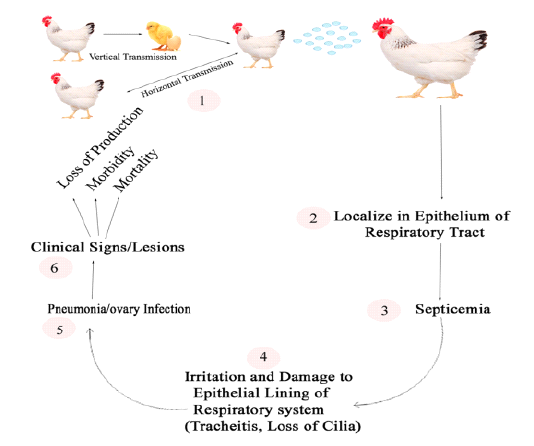
Pathogenesis of Mycoplasma gallisepticum (Huang et al., 2021; Marois et al., 2008; Thomas et al., 2008)
References
- Abbas N., Suleman M., Ahmad Khan N., Ali I., Rauf M., Rahman S. ur. (2018). Prevalence of Mycoplasma gallisepticum in Poultry and Wild Life Birds Suspected of Chronic Respiratory Disease in Northern Pakistan. Pakistan J. Zool., 50(3): 1071–1077. https://doi.org/10.17582/journal.pjz/2018.50.3.1071.1077[CrossRef]
- Abd El-Gawad R. A. (2005). Detection of mycoplasma infection in native layers by using recent techniques. MV Sc. MV Sc. Microbiol. Dept., Fac. Vet. Med., Kafrelsheikh, Tanta Univ.
- Abdel Halium M. M., Salib F. A., Marouf S. A., Abdel Massieh E. S. (2019). Isolation and molecular characterization of mycoplasma spp. in sheep and goats in Egypt. Vet. World., 12(5): 664–670. https://doi.org/10.14202/vetworld.2019.664-670[CrossRef]
- Ahmad A., Rabbani M., Yaqoob T., Shabbir M. Z., Akhtar F. (2008). Status Of Igg Antibodies Against Mycoplasma gallisepticum In Non-Vaccinated Commercial Poultry Breeder Flocks. J. Anim. Pl. Sci , 18(2–3): 61–63.
- Ahmed A., Khan T. A., Kanwal B., Raza Y., Akram M., Rehmani S. F., Lone N. A., Kazmi S. U., Lab M., Karachi P. (2007). Molecular Identification of Agents Causing Respiratory Infections in Chickens from Southern Region of Pakistan from. Int. J. Agric. Biol, 11: 325–328. http://www.fspublishers.org
- Baker Siddique A., Rahman S.-, Hussain I., Muhammad G. (2012). Frequency Distribution of Opportunistic Avian Pathogens in Respiratory Distress Cases of Poultry. Pakistan Vet. J., 32(3)” 386–389. www.pvj.com.pk
- Bradbury J. M. (2005). Poultry mycoplasmas: Sophisticated pathogens in simple guise. Brit. Poult. Sci., 46(2): 125–136. https://doi.org/10.1080/00071660500066282[CrossRef]
- Büyüktanir Ö., Yildirim T., Yakicier C., Genç O., Yurdusev N. (2008). A recombinant PvpA protein-based diagnostic prototype for rapid screening of chicken Mycoplasma gallisepticum infections. Vet. Microbiol., 129(1–2): 139–149. https://doi.org/10.1016/j.vetmic.2007.11.028[CrossRef]
- Cavani C., Petracci M., Trocino A., Xiccato G. (2009). Advances in research on poultry and rabbit meat quality. Italian J. Anim. Sci., 8(SUPPL. 2), 741–750. https://doi.org/10.4081/ijas.2009.s2.741[CrossRef]
- Cummins D. R., Reynolds D. L., Rhoades K. R. (1990). An avidin-biotin enhanced dot-immunobinding assay for the detection of Mycoplasma gallisepticum and M. synoviae serum antibodies in chickens. Avian Dis., 34(1): 36–43. https://doi.org/10.2307/1591331[CrossRef]
- Dal Bosco A., Cartoni Mancinelli A., Vaudo G., Cavallo M., Castellini C., Mattioli S. (2022). Indexing of Fatty Acids in Poultry Meat for Its Characterization in Healthy Human Nutrition: A Comprehensive Application of the Scientific Literature and New Proposals. Nutrients., 14(15). https://doi.org/10.3390/NU14153110[CrossRef]
- David H. L., Yoder Jr, H. W. (2008). Mycoplasma gallisepticum infection. In Dis. Poult. 12 (pp. 807–834).
- Dhondt A. A., Altizer S., Cooch E. G., Davis A. K., Dobson A., Driscoll M. J. L., Hartup B. K., Hawley D. M., Hochachka W. M., Hosseini P. R., Jennelle C. S., Kollias G. V., Ley D. H., Swarthout E. C. H., Sydenstricker K. V. (2005). Dynamics of a novel pathogen in an avian host: Mycoplasmal conjunctivitis in house finches. Acta Trop., 94(1): 77–93. https://doi.org/10.1016/j.actatropica.2005.01.009[CrossRef]
- El-Ghany W. A. A. (2008). Diagnostic Investigation On Mycoplasma Gallisepticum Infections In Different Egyptian Breeder And Broiler Chicken Flocks. J. Egyptian Vet. Med. Assoc., 68(3): 29–45.
- Ferguson-Noel N., Armour N. K., Noormohammadi A. H., El-Gazzar M., Bradbury J. M. (2019). Mycoplasmosis. Dis. Poult., 907–965. https://doi.org/10.1002/9781119371199.CH21[CrossRef]
- Ferguson-Noel N. M., Williams S. M. (2015). The efficacy of Mycoplasma gallisepticum K-strain live vaccine in broiler and layer chicken. Avian Pathol., 44(2): 75–80. https://doi.org/10.1080/03079457.2015.1005054[CrossRef]
- Ferraz P. N., Danelli M. D. G. M. (2003). Phenotypic and antigenic variation of Mycoplasma Gallisepticum vaccine strains. Brazilian J. Microbiol., 34(3): 238–241. https://doi.org/10.1590/S1517-83822003000300011[CrossRef]
- Garcia M., Jackwood M. W., Levisohn S., Kleven S. H. (1995). Detection of Mycoplasma gallisepticum, M. synoviae, and M. iowae by multi-species polymerase chain reaction and restriction fragment length polymorphism. Avian Dis., 39(3): 606–616. https://doi.org/10.2307/1591815[CrossRef]
- Gondal M. A., Rabbani M., Muhammad K., Yaqub T., Babar M. E., Sheikh A. A., Ahmad A., Shabbir M. Z., Khan M. I. (2015). Characterization Of Mycoplasma Gallisepticum Isolated From Commercial Poultry Flocks. J. Anim. Plant Sci., 25(1): 108–113.
- Hafez H. M. (2002). Diagnosis of Ornithobacterium Rhinotracheale. Int. J. Poult. Sci., 1(5): 114–118. https://doi.org/10.3923/ijps.2002.114.118[CrossRef]
- Hess J. B., Bilgili S. F., Parson A. M., Downs K. M. (2001). Influence of Complexed Zinc Products on Live Performance and Carcass Grade of Broilers. J. Appl. Anim. Res., 19(1): 49–60. https://doi.org/10.1080/09712119.2001.9706709[CrossRef]
- Hong Y., García M., Levisohn S., Savelkoul P., Leiting V., Lysnyansky I., Ley D. H., Kleven S. H. (2005). Differentiation of Mycoplasma gallisepticum strains using amplified fragment length polymorphism and other DNA-based typing methods. Avian Dis., 49(1): 43–49. https://doi.org/10.1637/7254-080504R[CrossRef]
- Huang A., Wang, S., Guo J., Gu Y., Li J., Huang L., Wang X., Tao Y., Liu Z., Yuan Z., Hao, H. (2021). Prudent Use of Tylosin for Treatment of Mycoplasma gallisepticum Based on Its Clinical Breakpoint and Lung Microbiota Shift. Front. Microbiol., 12. https://doi.org/10.3389/FMICB.2021.712473[CrossRef]
- Hussain J., Rabbani I., Aslam S., Ahmad H. A. (2015). An overview of poultry industry in Pakistan. World’s Poult. Sci. J., 71(4): 689–700. https://www.tandfonline.com/doi/abs/10.1017/S0043933915002366
- Kleven S. H. (1981). Transmissibility of the F strain of Mycoplasma gallisepticum in leghorn chickens. Avian Dis., 25(4): 1005–1018. https://doi.org/10.2307/1590076[CrossRef]
- Levisohn S., Kleven S. H. (2000). Avian mycoplasmosis (Mycoplasma gallisepticum). Rev. Scient. Tech. (International Office Epizootics), 19(2): 425–442. https://doi.org/10.20506/rst.19.2.1232[CrossRef]
- Ley D. (2003). Mycoplasma gallisepticum Infection In “Disease of Poultry” . Ed. By YM Saif, HJ Barnes, AM Fadly, JR Glisson, LR McDougald, DE Swayne.
- Liaqat, I. (2018). Pakistan Poultry Industry Growth and Challenges. Approaches in Poultry, Dairy & Veterinary Sciences, 2(4). https://doi.org/10.31031/apdv.2018.02.000543[CrossRef]
- Liu T., García M., Levisohn S., Yogev D., Kleven S. H. (2001). Molecular variability of the adhesin-encoding gene pvpA among Mycoplasma gallisepticum strains and its application in diagnosis. J. Clin. Microbiol., 39(5): 1882–1888. https://doi.org/10.1128/JCM.39.5.1882-1888.2001[CrossRef]
- Lysnyansky I., García M., Levisohn S. (2005). Use of mgc2-polymerase chain reaction-restriction fragment length polymorphism for rapid differentiation between field isolates and vaccine strains of Mycoplasma gallisepticum in Israel. Avian Dis., 49(2): 238–245. https://doi.org/10.1637/7285-10020R[CrossRef]
- Marangoni F., Corsello G., Cricelli C., Ferrara N., Ghiselli A., Lucchin L., Poli A. (2015). Role of poultry meat in a balanced diet aimed at maintaining health and wellbeing: an Italian consensus document. Food Nutrit. Res., 59(1): 27606. https://doi.org/10.3402/fnr.v59.27606[CrossRef]
- Marois C., Dufour-Gesbert F., Kempf I. (2008). Molecular Differentiation of Mycoplasma gallisepticum and Mycoplasma imitans Strains by Pulsed-Field Gel Electrophoresis and Random Amplified Polymorphic DNA. J. Vet. Med., Series B, 48(9): 695–703. https://doi.org/10.1111/j.1439-0450.2001.00496.x[CrossRef]
- Marouf S., Khalf M. A., Alorabi M., El-Shehawi A. M., El-Tahan A. M., El-Hack M. E. A., El-Saadony M. T., Salem H. M. (2022). Mycoplasma gallisepticum: a devastating organism for the poultry industry in Egypt. Poult. Sci., 101(3): 101658. https://doi.org/10.1016/J.PSJ.2021.101658[CrossRef]
- Marouf S., Moussa I. M., Salem H., Sedeik M., Elbestawy A., Hemeg, H. A., Dawoud T. M., Mubarak A. S., Mahmoud H., Alsubki R. A., Bahkali A. H. (2020). A picture of Mycoplasma gallisepticum and Mycoplasma synoviae in poultry in Egypt: Phenotypic and genotypic characterization. J. King Saud University - Sci., 32(3): 2263–2268. https://doi.org/10.1016/j.jksus.2020.02.036[CrossRef]
- Morrow C. J., Kreizinger Z., Achari R. R., Bekő K., Yvon C., Gyuranecz M. (2020). Antimicrobial susceptibility of pathogenic mycoplasmas in chickens in Asia. Vet. Microbiol., 250. https://doi.org/10.1016/J.VETMIC.2020.108840[CrossRef]
- Mugunthan S. P., Mani Chandra H. (2021). A Computational Reverse Vaccinology Approach for the Design and Development of Multi-Epitopic Vaccine Against Avian Pathogen Mycoplasma gallisepticum. Front. Vet. Sci., 8: 1214. https://doi.org/10.3389/FVETS.2021.721061/BIBTEX[CrossRef]
- Muhammad F., Fareed S. K., Zafar U., Khan T. A., Ahmad A. (2017). Development and evaluation of culture-enhanced tetra-PCR for differential diagnosis of Mycoplasma gallisepticum and M. synoviae. Pakistan J. Zool., 49(6): 2133–2140. https://doi.org/10.17582/journal.pjz/2017.49.6.2133.2140[CrossRef]
- Mukhtar M., Awais M. M., Anwar M. I., Hussain Z., Bhatti N., Ali S. (2012). Seroprevalence of Mycoplasma gallisepticum Among Commercial Layers in Faisalabad, Pakistan. J. Basic Appl. Sci., 8: 183–186. https://doi.org/10.1177/030098589503200102[CrossRef]
- Nascimento E., Pereira V., Nascimento M., Barreto M. (2005). Avian mycoplasmosis update. Brazilian J. Poult. Sci., 7(1): 1–9. https://doi.org/10.1590/s1516-635x2005000100001[CrossRef]
- Noormohammadi A. H. (2021). Welfare implications of bacterial and viral infectious diseases for laying hens. Anim. Prod. Sci., 61(10): 1018–1030. https://doi.org/10.1071/AN19595[CrossRef]
- Peebles E. D., Jacob R., Branton S. L., Evans J. D., Leigh S. A., Gerard P. D. (2015). Effects of different vaccine combinations against Mycoplasma gallisepticum on blood characteristics in commercial layer chickens. Poult. Sci., 94(9): 2108–2113. https://doi.org/10.3382/ps/pev225[CrossRef]
- Rauf, M., Chaudhary Z. I., Younus M., Anjum A., Ali M. A., Ahmad A. N., khalid M. U. (2013). Identification of Mycoplasma gallisepticum by polymerase chain reaction and conventional diagnostics from white leghorn layer flocks. J. Anim. Plant Sci., 23(2): 393–397. https://www.researchgate.net/publication/273455481
- Rehman A, Abdul Haleem S., Rahman S. (2018). Seroprevalance of Mycoplasma gallisepticum and Mycoplasma synoviae in Commercial Broilers and Backyard Poultry in Five Districts of Khyber Pakhtunkhwa-Pakistan. Pakistan Vet. J., 38(2): 149–152.
- Ricketts C., Pickler L., Maurer J., Ayyampalayam S., García M., Ferguson-Noel N. M. (2017). Identification of Strain-Specific Sequences That Distinguish a Mycoplasma gallisepticum Vaccine Strain from Field Isolates. J. Clin. Microbiol., 55(1): 244. https://doi.org/10.1128/JCM.00833-16[CrossRef]
- Rottem, S. (2003). Interaction of mycoplasmas with host cells. Physiolog. Rev., 83(2): 417–432. https://doi.org/10.1152/physrev.00030.2002[CrossRef]
- Sarkar S. K., Rahman M. B., Rahman M., Amin K. M. R., Khan M. F. R., Rahman M. M. (2005). Sero-Prevalence of Mycoplasma gallisepticum Infection of Chickens in Model Breeder Poultry Farms of Bangladesh. Int. J. Poult. Sci., 4(1): 32–35.
- Sawicka-Durkalec A., Kursa O., Bednarz Ł., Tomczyk G. (2021). Occurrence of Mycoplasma spp. in wild birds: phylogenetic analysis and potential factors affecting distribution. Scient. Rep. 2021 11:1, 11(1): 1–12. https://doi.org/10.1038/s41598-021-96577-0[CrossRef]
- Seifi S., Shirzad M. (2012). Seroprevalence and risk factors of Mycoplasma gallisepticum infection in Iranian broiler breeder farms. Int. J. Anim. Vet. Adv., 4(1): 45–48.
- Shah A. (1984). Occurrence of chronic respiratory disease of domestic fowls in West Pakistan. (Doctoral Dissertation, M. Sc. Thesis. Department of Veterinary Microbiology, University of Agriculture, Faisalabad, Pakistan).
- Shoaib M. (2019). Mycoplasmosis In Poultry, A Perpetual Problem. J. Microbiol. Biotech. Food Sci., 8(6): 1271–1275. https://doi.org/10.15414/jmbfs.2019.8.6.1271-127.[CrossRef]
- Siddique A. B., Rahman S. U., Ulhaq M., Naveed R. (2020). Occurrence, Molecular Identification And Antibiotic Resistance Profiling Of Mycoplasma Gallisepticum And Mycoplasma Synoviae From Chronic Respiratory Disease Cases In Poultry Birds And Farm Environment. Slovenian Veterinary Research, 57(2): 61–69. https://doi.org/10.26873/svr-598-2020[CrossRef]
- Thomas N., Hunter D., Atkinson C. (2008). Infectious diseases of wild birds. John Wiley & Sons. https://books.google.com/books?hl=en&lr=&id=2eFgGaKqwrIC&oi=fnd&pg=PP1&ots=TxLJHif6OS&sig=3ETmo1XwqQpPrCkESR1jNsh5kms
- Umar S., Munir M. T., Ur-Rehman Z., Subhan S., Azam T., Shah M. A. A. (2016). Mycoplasmosis in poultry: Update on diagnosis and preventive measures. World’s Poult. Sci. J., 73(1): 17–28. https://doi.org/10.1017/S0043933916000830[CrossRef]
- W. H., H., U. H., A., M. A., D., A. Z., Z. (2012). Bacteriological and Molecular studies on Mycoplasma infection in turkey from Egypt. Beni-Suef University J. Appl. Sci., 1(2): 69–79. https://www.researchgate.net/publication/303864145
- Xu Y., Egan W., Chang A., Webber K. (2003). Mycoplasma In-Process and Lot Release Testing: To PCR or Not to PCR. Proceedings of the WCBP CMC Strategy Forum. www.atcc.org
- Yiwen C., Yueyue W., Lianmei Q., Cuiming Z., Xiaoxing Y. (2021). Infection strategies of mycoplasmas: Unraveling the panoply of virulence factors. Virulence., 12(1): 788. https://doi.org/10.1080/21505594.2021.1889813[CrossRef]
- Yunus A. W., Nasir M. K., Aziz T., Böhm J. (2009). Prevalence Of Poultry Diseases In District Chakwal And Their Interaction With Mycotoxicosis: 2. Effects Of Season And Feed. J. Anim. Plant Sci., 19(1): 1–5.
- Zakeri A. (2010). Polymerase Chain Reaction of Mgc2 and 16S rRNA Genes for Detection of Mycoplasma gallisepticum. Iranian J. Appl. Anim. Sci., 6(1): 59–65. www.ijas.ir
Services
Article usage statistics
Loading…