Table 3: Antibiogram pattern of Pasteurella multocida isolated from clinically healthy, diseased and recently dead & slaughtered calves
2001) to 15.89% (Sayed and Zaytoun, 2009) isolation of P. multocida in Assuit Governorate Egypt, and 15% in England (Defra, 2006). Higher incidence rates of P. multocida were obtained elsewhere in Egypt i.e., 19.23% (Enany et al., 2012) and 22.73% (Khadr, 2005).
The VITEK2 compact system is well known for confirmation of biochemically identified organisms. The confirmatory identification by the VITEK2 compact system was based on GN cards. The identification cards contain 47 different biochemical tests. Concluding results were yielded in roughly 6–8 hours (Pincus, 2006). All tested isolates of P. multocida were confirmed by VITEK2 compact that showed 100% positively of P. multocida. The VITEK2
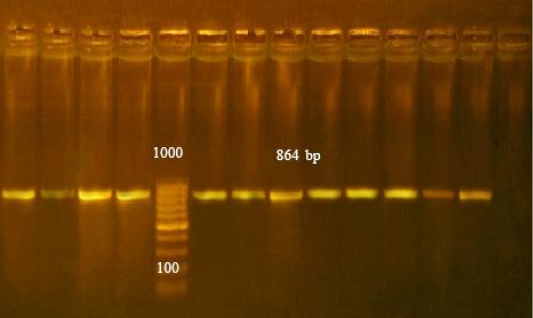
Figure 1: Agarose gel electrophoresis of PCR products of toxA gene of Pasteurella multocida isolates. PCR amplification of toxA gene among the investigated isolates revealed that all isolates were positive for toxA gene with amplified fragments at 864bp. Lane L: 100-1000 bp ladder as molecular size (DNA marker). Lane Pos: Control positive Pasteurella multocida. Lane Neg: Control negative. Lanes from 1 to 11: Positive Pasteurella multocida toxA gene (864 bp).
system poses quite the potential, is a highly automated novel tool for expedited identification of Gram-negative bacilli isolated from clinical specimens (Farid et al., 2014).
Antibiotic utilization in bovine respiratory disease (BRD) treatment is widely used. Multidrug-Resistant (MDR) pathogens related to BRD were observed and deemed as threats to the livestock industry (Klima et al., 2014). Antimicrobial susceptibility should be perpetually monitored to curb MDR strains not that even transforms from livestock to humans (Holman et al., 2015; Klima et al., 2014). In this study, P. multocida was sensitive to ciprofloxacin and gentamicin (100% each) and tetracycline (81.2%). These results agree with (Khamesipour et al., 2014) and (Kumar et al., 2009; Shayegh et al., 2010) who observed 100% sensitivity of the isolated P. multocida to ciprofloxacin. The results agree as well with (Algammal et al., 2020) who reported that all the tested isolates of P. multocida were sensitive to gentamicin, enrofloxacin, and norfloxacin, while it exhibited a multidrug resistance against ampicillin, amoxicillin, erythromycin, and streptomycin (100% each). The results disagree with (Varte et al., 2014) mentioned that the majority of the isolates of P. multocida were 100% sensitive to amoxicillin, cephalexin, chloramphenicol, ciprofloxacin, enrofloxacin, erythromycin, gentamicin, and tetracycline while it exhibited a multidrug resistance against oxytetracycline (93%) followed by ampicillin (87%) and amikacin (47%). In this study, the MAR index is calculated as the ratio of the number of antibiotics to which the organism is resistant to the total number of antibiotics to which the organism is exposed. The MAR index exceeded 0.2 due to the high risk of the used antibiotics. The antimicrobial susceptibility of P. multocida is important to determine resistance development and help pick the appropriate antibiotics against the diseases caused by P. multocida.
Virulence factors help the pathogen colonize and invade the host, avoid defense mechanisms, injure tissues, and stimulate inflammatory responses (Ewers et al., 2004).
The toxA gene is a virulence gene associated with P. multocida was identified by PCR in all tested isolates. Earlier research observed that PCR targeting the toxA gene is sensitive and crucial for pathogenic P. multocida detection (Varte et al., 2014). In the present study, all P. multocida strains showed bands at 864 bp (Figure 1). These results agree with Lichtensteiger et al. (1996). Many authors, (Ewers et al., 2006; Shayegh et al., 2010; Khamesipour et al., 2014) recorded toxA genes in P. multocida isolates. The toxA gene is not inserted into the bacterial chromosome but in a lysogenic bacteriophage that infects the agent (Pullinger et al., 2004) toxA plays an important role in destruction of lung tissues, and stimulation of a noxious host inflammatory response. Therefore, the toxA gene is considered an epidemiological marker found mostly in pneumonic P. multocida isolates (Harper et al., 2006).

