Research Article · Volume 14, Issue 1, 9 February 2026 · Open Access
Molecular Detection of Raillietina echinobothrida in Local Chickens from Al-Diwaniyah, Iraq
·
Affiliations & Notes ⌄
1College of Veterinary Medicine, University of Al-Qadisiyah, Al Diwaniyah, Iraq. *Correspondence | Afrah Abid, College of Veterinary Medicine, University of Al-Qadisiyah, Al Diwaniyah, Iraq
The shape and color of the eggs were consistent with previous reports of Raillietina spp. Molecular analysis also confirmed infection in 250 out of 300 samples.
In many areas, especially in rural backyard poultry systems, regular deworming is not practiced, which may contribute to the high prevalence of Raillietina observed in our region.
Our results are consistent with findings from Malaysia and Thailand, where R. echinobothrida was confirmed using both molecular and morphological methods.
This study presents the first detailed molecular and phylogenetic characterization of R. echinobothrida from local chickens in Al-Diwaniyah, Iraq.
Selected from the article's own text.
Abstract
Tapeworm infections are common in chickens, especially in rural areas. They can affect bird health and decrease egg and meat production. An important tapeworm is Raillietina echinobothrida (R. echinobothrida), which causes significant gut damage in poultry. This study was conducted to detect and identify R. echinobothrida in local chickens in Al-Diwaniyah Governorate, Iraq, using microscopic and molecular techniques. A total of 300 fecal samples were collected from local chickens between October 2024 and April 2025. The samples were taken from various areas of Al-Diwaniyah. All samples were kept cool and sent to the laboratory. Microscopic tests were performed using direct smear and sedimentation methods to detect tapeworm eggs. For the molecular analysis, DNA was extracted from 250 samples. PCR was conducted using specific primers for the 18S rRNA gene. Ten PCR products were sequenced and submitted to NCBI. Phylogenetic analysis was conducted using MEGA11 software. Microscopic examination showed that 250 samples (83%) were positive. The eggs observed were oval or round in shape and white or yellow in color. PCR results also confirmed infection in 250 samples (83%). Sequencing revealed 94% similarity with strains from China, the USA, Costa Rica, South Korea, and Rwanda. The phylogenetic tree indicated that local strains are closely related to the Chinese strain (MT907440). R. echinobothrida appears to be widespread in local chickens in Al-Diwaniyah. Molecular findings confirm that the local strain is closely related to those reported globally. Genetic variation in this parasite appears to depend on geographic region. Regular screening and control measures are essential to safeguard the health of local poultry.
Keywords | Chickens, DNA sequencing, Iraq, Phylogeny, Tapeworms, Raillietina echinobothrida
Introduction
Intestinal cestodes of the genus Raillietina are common among domestic chickens and are a cause of economic concern in the poultry-producing countries . The genus Raillietina includes numerous species of intestinal tapeworms (cestodes) known to parasitize domestic and wild gallinaceous birds. Among these birds, domestic chickens are well recognized as hosts for a range of different Raillietina spp. Once ingested by the definitive host, the eggs of Raillietina spp. are liberated in the gut and are subsequently hatched. Then, the larvae emerge from the egg and reach the hemocoel before invading the gut around the villi coating, where they grow and develop into mature adults . Adult parasites can cause various kinds of local damage in the gut of the host including changes in the physiology of the gut epithelium and the mucosal folds . Chickens can become infected with a range of Raillietina spp., however, Raillietina echinobothrida is the most prevalent cestode species among poultry. Raillietina spp. can reduce egg production in the host, with infected hosts producing fewer and smaller eggs . Chickens faced with high parasitism rates could also become anemic and malnourished with a down-regulated immune system as the result of chronic parasitism . There have been previous studies on the pathology of worm infections in wild birds. However, information on intestinal cestode infections in domestic chickens is lacking (Zhang et tal., 2021; .
Raillietina has cosmopolitan distribution affecting chickens, pigeons and other domestic birds. Light infections with this parasite remain unnoticed but result in decreased weight gains and egg-laying performance. They are generally recognized as environmentally transmitted. Birds harbouring adult raillietinids defecate parasitic eggs onto the ground. These eggs are in turn ingested by terrestrial insects, which serve as intermediate hosts to the larval stage of these cestodes. Upon ingestion of such an infected insect, a definitive host becomes infected. Therewith, the cycle is closed, as adult cestodes will again produce eggs that fecally exit the host ; .
Raillietina echinobothrida is one of the parasitic cestodes among the cyclophyllid group, it lays up to 15,000–20,000 eggs daily. The highest number of Raillietina spp. in chickens may have correlated with the feeding habits of the hosts and also supported by food availability ; . Raillietina comprises the largest genera of the cestode metacestodes, with worldwide distribution and affects chickens, pigeons and other domestic and a wide range of peri domestic birds. All the nine species are widespread on the Asian continent, where together with the Indian ocean islands, they are most diverse, with five species being reported from the region. While seven of the nine species have been reported from Australasia, the four New Guinean species: R. echinobothrida, R. hersuta, R. tetragona and R. tetragona are shared only with the Australian region, further setting disjunct populations. Clinically affected chickens showed complete anorexia, mild dyspnea, severe emaciation and paullor mucous membrane, dead after four days ; . Parasites of the genus Raillietina are tapeworms identified by well-developed head capsules with rounded suckers, neck, followed by typically numerous proglottids, beginning in a lantern shape and becoming wider and egg-producing towards the terminal gravid segments. The patent prepatent periods of Raillietina given thus far, 14-20 days, could explain the high prevalence. Raillietina spp. can also be dispersed in various parts of the globe. All age groups but particularly old chickens are vulnerable to the infection ; . This study was carried out to detect and identify R. echinobothrida in local chickens in Al-Diwaniyah Governorate, Iraq, using both microscope and molecular techniques.
Materials and Methods
Sampling
A total 300 fecal samples of local chickens consecutively from different areas of Al-Diwaniyah Governorate during the period from October to April 2025. These 300 samples were used in the microscopic method, and 250 samples were utilized in the molecular methods. These samples were transported immediately in an ice pack to the laboratory of the Veterinary Medicine College, University of Al-Qadisiyah, and were stored in a deep freezer under (-20 ºC). The effects of age, sex, and study area were analyzed statistically.
Microscopic examination
A total of 300 fecal samples were collected from local chickens in Al-Diwaniyah Province between October 2024 and April 2025. The feces of the birds were placed in clean, sealed plastic containers, and the animal number and the date of obtaining the sample were recorded on them. The samples were transported to the laboratory in a refrigerated manner, and laboratory tests were performed on them directly, using the direct fecal smear examination and sedimentation method to detect tapeworm eggs.
Molecular analysis
DNA was extracted and polymerase chain reaction (PCR) was performed using species-specific primers to detect different tapeworm species. DNA was extracted from fecal samples using a Geneaid DNA extraction kit (Korea). The concentration of extracted DNA was measured using a Quantus™ Fluorometer. Primers were designed in this study to target a specific partial region of the 18S rRNA gene (small subunit ribosomal RNA) of R. echinobothrida.
Polymerase chain reaction
The primers used in this study were designed based on the R. echinobothrida sequence (GenBank accession no. MT907440). The forward primer (F) was 5′-TCCAAGGGAGGCAGCAGGC-3′ and the reverse primer (R) was 5′-CAGGTTACATCCTCGCCATG-3′, amplifying a 390 bp fragment. PCR amplification was carried out with the following thermocycler conditions: initial denaturation at 95°C, denaturation at 95°C, annealing at 85°C, extension at 72°C, and a final extension at 72°C. PCR products were analyzed using 1.5% agarose gel electrophoresis. To prepare the gel, 1.5 grams of agarose powder were dissolved in 100 mL of 1× TBE buffer and heated in a microwave until reaching 95°C (approximately 2 minutes). The solution was then cooled to 60°C before adding 30 µL of ethidium bromide. The melted agarose was poured into a gel tray with a comb in place and allowed to solidify at room temperature for 15 minutes. After solidification, the comb was carefully removed, and the gel tray was placed into an electrophoresis tank filled with 1× TBE buffer. Then, 5 µL of each PCR product was loaded into the wells. Electrophoresis was performed at 100 V and 80 mA for 1 hour. Finally, PCR products were visualized under a UV transilluminator using a gel documentation system.
Amplicon sequencing and analysis
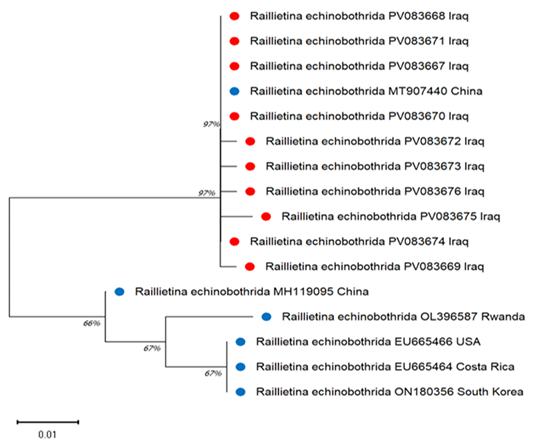
PCR products from 10 positive samples were sent to Macrogen (Korea) via DHL for DNA sequencing using the Sanger method. After receiving the raw sequences, poor-quality signal regions were trimmed, and the cleaned sequences were submitted to NCBI to obtain accession numbers. Phylogenetic analysis was performed by comparing the obtained sequences and their accession numbers with related global isolates. Sequence alignments were carried out using Clustal W, and the phylogenetic tree (phylogram) was constructed using MEGA11 (Molecular Evolutionary Genetics Analysis version 11) software. The analysis included 16 sequences and was performed using the Maximum Likelihood method. Sequence similarity was also confirmed through BLASTn on the NCBI server. The resulting phylogenetic tree revealed two main branches, with all local isolates clustering together in one branch. These local samples showed high similarity to the Chinese isolate MT907440.
Statistical analysis
The data collected in this study were tabulated and statistically analyzed using the Statistical Package for the Social Sciences (SPSS), version 26. The Chi-square test was employed to assess the significance of qualitative data. Differences between groups were considered statistically significant at p-values less than 0.05 .
Results
Microscopic findings
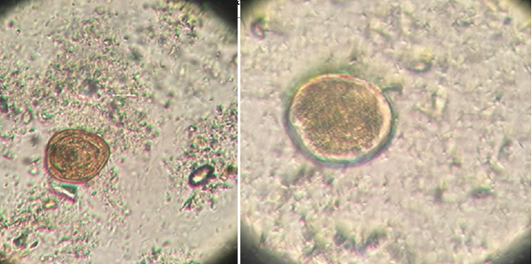
Out of the 300 fecal samples examined under the microscope, 250 samples (83%) were positive for Cestoda (tapeworm) eggs, while 50 samples (17%) were negative (Table 1). The eggs appeared round or oval in shape. Most eggs were either white or yellow in color. The positive samples were observed using both direct smear and sedimentation methods. The eggs were clearly visible under light microscopy. Their features were consistent with the morphology of Raillietina spp. (Figure 1).
Molecular findings
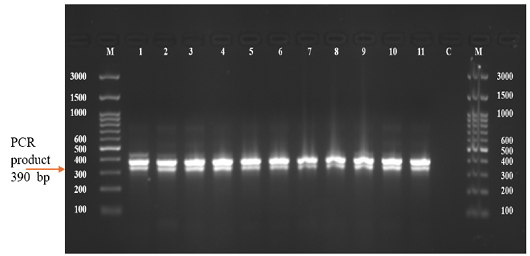
From the 300 samples, 250 fecal (positive) samples were selected for molecular testing. DNA was extracted successfully using the Geneaid kit. DNA quality and quantity were measured using a Quantus™ Fluorometer. Most samples had sufficient DNA concentration for PCR amplification. The PCR targeted the 18S rRNA gene of R. echinobothrida. A 390 bp fragment was successfully amplified in the positive samples (Figure 2).
Table 1: Infection percentage confirmed by both Taqman qPCR and conventional PCR.
Tested samples
Number analysed
Positive number
Negative number
Positive percentage (%)
Faeces
300
250
50
83
Table 2: NCBI sequences closely related to the Raillietina echinobothrida sequences obtained in the current study.
Sequence No.
Accession No.
Country of Match
GenBank Match
Identity (%)
1
PV083667
China
MT907440
100
2
PV083668
China
MH119095
93.75
3
PV083669
USA
EU665466
96.31
4
PV083670
Costa Rica
EU665464
95.94
5
PV083671
South Korea
ON180356
96.31
6
PV083672
Rwanda
OL396587
95.20
7
PV083673
China
MT907440
99.49
8
PV083674
China
MH119095
100
9
PV083675
USA
EU665466
95.20
10
PV083676
Costa Rica
EU665464
95.57
Sequencing and phylogenetic analysis
Ten PCR-positive samples were sent to Macrogen (Korea) for Sanger sequencing. The resulting sequences were cleaned and submitted to the NCBI GenBank database, receiving accession numbers PV083667 to PV083676. All sequences exhibited high similarity (95–100%) to R. echinobothrida sequences from other countries (Table 2 and Figure 3). These results confirm that R. echinobothrida isolates in Iraq are genetically similar to those reported from China, the USA, Costa Rica, Rwanda, and South Korea.
Discussion
This study confirms a high infection rate of R. echinobothrida in local chickens from Al-Diwaniyah. The microscopic infection rate was 83%, which is relatively high compared to other regions. Kumar et al. (2020) similarly reported high infection rates ranging from 70% to 85% in poultry and wild birds, indicating that Raillietina spp. remain a widespread parasitic burden in these populations.
The morphological characteristics of the eggs observed under light microscopy in this study, described as round or oval and predominantly white or yellow, align well with the typical egg morphology of Raillietina species noted in parasitology studies ; . This morphological consistency enhances the validity of the microscopic findings and supports the identification of the parasite as R. echinobothrida. The shape and color of the eggs were consistent with previous reports of Raillietina spp.
Molecular analysis also confirmed infection in 250 out of 300 samples. PCR targeted the 18S rRNA gene, producing clear bands of 390 bp. This gene is commonly used in parasite identification due to its stability and conservation. Our findings are consistent with those of previous studies where molecular tools have enhanced diagnostic sensitivity and specificity over traditional microscopic methods ; . Previous studies have shown that Raillietina species, especially R. echinobothrida, are widely spread and cause damage in poultry flocks. In Thailand, similar species were detected using PCR in broiler chickens and backyard poultry .
This global genetic match suggests that the parasite has a conserved genetic structure, although slight mutations may occur in certain regions. Phylogenetic trees from other studies also placed isolates from Asia and America in the same branch . Genetic tools like PCR and sequencing are now the standard for parasite detection. In Thailand, high-performance triplex PCR was used to identify three species of Raillietina from chicken feces . This technique helps in detecting mixed infections. Our results showed 95–100% identity with reference sequences in GenBank. These sequences matched with isolates from China and USA. The highest identity was 100% with MT907440 from China. These findings are consistent with previous studies that sequenced tapeworms from chickens in Asia . While our microscopic examination effectively detected eggs, PCR was essential for confirming the species. The use of 18S rRNA primers in this study proved reliable, as this gene is commonly targeted in genetic studies of Raillietina, including reports from India and Thailand . The 18S rRNA gene helps distinguish closely related species. In many areas, especially in rural backyard poultry systems, regular deworming is not practiced, which may contribute to the high prevalence of Raillietina observed in our region. Similar trends have been reported in Vietnam and Ethiopia ; .
The link between environment and infection is strong. In regions with more insects, the infection rate increases. This is because insects serve as intermediate hosts for the tapeworm. Studies from Nigeria and Saudi Arabia showed the same pattern ; . Seasonal variation may also affect infection rates. In India, a study reported higher infections during the rainy season when intermediate hosts are more active . Future studies in Iraq should consider the role of season in Raillietina spread. In this study, molecular results matched well with microscopy. However, PCR gave a more accurate identification. Other research supports that PCR is more sensitive than visual methods for detecting Raillietina eggs . Our results also highlight the importance of GenBank sequence submission. By uploading our sequences, other researchers can compare their samples. Sequence submission improves global understanding of parasite genetics .
The evolutionary tree in this study showed two main branches. One included all local samples. This suggests a shared local origin or limited variation. Another branch included global sequences, mainly from East Asia and the Americas. Phylogenetic methods used in this study, such as Maximum Likelihood, are widely accepted. MEGA software is Our results agree with the findings from Malaysia and Thailand where R. echinobothrida was confirmed through molecular and morphological tools .
Our results are consistent with findings from Malaysia and Thailand, where R. echinobothrida was confirmed using both molecular and morphological methods. Combining these approaches provides a comprehensive understanding of parasite identity. Effective control of Raillietina requires more than just treatment; environmental hygiene, insect control, and public awareness are essential components. Unfortunately, backyard farmers often neglect these measures, resulting in recurrent infections. Tapeworm infections in chickens also pose food safety risks, as infected birds may transmit parasites to consumers if proper inspection is lacking particularly in live bird markets. Our findings highlight the importance of routine screening for tapeworm infections in poultry, utilizing both simple microscopic techniques and advanced PCR methods ; .
Conclusion
This study presents the first detailed molecular and phylogenetic characterization of R. echinobothrida from local chickens in Al-Diwaniyah, Iraq. Our results contribute new genetic sequences to the global database. Future research should explore treatment trials using local medicinal plants, as well as investigate seasonal variations and host immune responses to gain deeper insights into parasite dynamics.
Acknowledgement
The researchers express their thanks and gratitude to the College of Veterinary Medicine, University of Al-Qadysia.
Novelty Statement
The author declare that the work has novelty compare to other studies.
Author’s Contribution
Afrah Abid: conceptualization, methodology and writing-original draft, methodology, and editing, formal analysis, data curation, supervision and writing-review and funding acquisition. Azhar Chafat Karawan: conceptualization, conceptualization, supervision and writing-review resources and validation; investigation and project administration and conceptualization.
Ethical approval
The study was conducted based on the Ethical Approval issued by the College of Veterinary Medicine, University of Al-Qadisiyah, Iraq (1111 on Oct 22, 2023).
Generative AI and AI-assisted technology statement
No generative AI or AI-assisted technologies were used in the preparation of this manuscript
Conflict of interest
The authors have declared no conflict of interest.
Figures
Figure 1:.
Microscopic images showing the eggs of Raillietina echinobothrida.
Figure 2:.
PCR products were run on a 1.5% agarose gel. Bands at 390 bp were visible in lanes 1 to 11. Lane C was the negative control (Hâ‚‚O instead of DNA). Lane M was the molecular marker (100–3000 bp).
Figure 3:.
The phylogenetic tree based on the 18S rRNA gene of R. echinobothrida.
References
Abdullah SM, Barman A, Ali MY, Islam MS, Mohanta UK (2021). Morphological identification and prevalence of gastrointestinal helminths in backyard chicken from selected areas of Bangladesh. Res. Agric. Livest. Fish., 8(1): 145-155. https://doi.org/10.3329/ralf.v8i1.53276.[CrossRef]
Al-Marsomy WA, Al-Hamadaani HS (2016). Association of cestoda Raillietina echinobothrida in rock pigeon (Columba livia) from Baghdad, Iraq. Baghdad Sci. J., 13(3): 463–468. https://doi.org/10.21123/bsj.13.3.463-468[CrossRef]
Aswathi PB, Vergis J (2023). Advanced training in poultry production with emphasis on antimicrobial resistance and food safety. SERB High-end Workshop, KVASU, Kerala, India. ISBN: 978-93-91716-09-7
Benton LW (2018). Effects of housing management on vaccination success against Eimeria infection in chickens.https://egrove.olemiss.edu/hon_thesis/593
Daniel WW, Cross CL (2018). Biostatistics: A foundation for analysis in the health sciences. Wiley.ISBN: 1119282373, 9781119282372
Dutta AK, Dkhar B, Tandon V, Das B (2017). Significance of PEP carboxykinase in Raillietina echinobothrida and effect of phytoestrogens. Parasitol., 144(9): 1264–1274. https://doi.org/10.1017/S0031182017000518[CrossRef]
Hassan WS, Abdulrazzaq KM, Al-Obaidi QT, Al-Azow KA (2024). Molecular detection of Anaplasma platys in dogs, Iraq. Iraqi J. Vet. Sci., 38(3): 677–682. https://doi.org/10.33899/ijvs.2024.148465.3592[CrossRef]
Haydar H (2024). Effect of sweet bean and Roselle seeds on growth performance of common carp. Mesopotamia J. Agric., 52(2): 68–81. https://doi.org/10.33899/mja.2024.146824.1374[CrossRef]
Hussen H, Chaka H, Deneke Y, Bitew M (2012). Gastrointestinal helminths in scavenging chickens, Ethiopia. Pak. J. Biol. Sci., 15(6): 284–289. https://doi.org/10.3923/pjbs.2012.284.289[CrossRef]
Kerroucha R, Medjoual I, Bourguig L, Senouci K (2022). Helminths of local chickens in Oran. Helminthologia, 59(2): 170. https://doi.org/10.2478/helm-2022-0015[CrossRef]
Khidhir Z, Hamma A, Mohammed M, Mahmood A, Al-Obaidi A, Aldoori Z (2024). Effect of longevity spinach powder on frozen broiler thigh meat. Mesopotamia J. Agric., 52(2): 82–90. https://doi.org/10.33899/mja.2024.145203.1310110131[CrossRef]
Kumar, R., Bisht, A., Sharma, D., Masand, R., Asrani, R.K. (2020). Concurrent multiple parasitic infection in four spontaneous cases of free ranging common myna (Acridotheres tristis).
Li, J., Dan, X., Zhu, K., Li, N., Guo, Y., Zheng, Z., Xiao, L. (2019). Genetic characterization of Cryptosporidium spp. and Giardia duodenalis in dogs and cats in Guangdong, China. Parasites and Vectors, 12(1), 571.
McGarry JW, Elsheikha HM, Taylor S (2024). Colour Atlas of companion animal parasites. CABI. https://doi.org/10.1079/9781800627369.0000[CrossRef]
Mehrdel B, Yehya AHS, Dheyab MA, Jameel MS, Aziz AA, Nikbakht A, Kareem AA (2023). Antibacterial and toxicity of mycosynthesized Ag nanoparticles from Agaricus bisporus. Phys. Scr., 98(12): 125007. https://doi.org/10.1088/1402-4896/ad080f[CrossRef]
Midala CA, Kyari F, Thekisoe O, Onyiche TE (2025). Parasites of poultry in Nigeria: 1980–2022 review. J. Parasit. Dis., 1–25. https://doi.org/10.1007/s12639-025-01792-5[CrossRef]
Mohammed BR, Simon MK, Agbede RIS, Arzai AH (2019). Intestinal helminths of pigeons in Kano, Nigeria. Vet. Parasitol. Reg. Stud. Rep., 16: 100289. https://doi.org/10.1016/j.vprsr.2019.100289[CrossRef]
Nolte, T., Mysore, J.V., Rogers, A.B., Junginger, J. (2025). Digestive Tract. In Toxicologic Pathology (pp. 127-168). CRC Press.
Panich W, Chontananarth T (2021). Molecular detection of three Raillietina species in poultry. Avian Pathol., 50(4): 321–326 https://doi.org/10.1080/03079457.2021.1926920.[CrossRef]
Panich W, Nak-On S, Chontananarth T (2022). Triplex PCR detection of Raillietina spp. Acta Trop., 232: 106516. https://doi.org/10.1016/j.actatropica.2022.106516[CrossRef]
Panich W, Tejangkura T, Chontananarth T (2021). LAMP-LFD detection of Raillietina spp. Vet. Parasitol., 292: 109396. https://doi.org/10.1016/j.vetpar.2021.109396[CrossRef]
Qui NH (2023). Baker’s yeast and poultry production: A review. Iraqi J. Vet. Sci., 37(1): 213–221. https://doi.org/10.33899/ijvs.2022.132912.2146[CrossRef]
Ramnath Jyrwa DB, Dutta AK, Das B, Tandon V (2014). Molecular characterization of Raillietina echinobothrida from India. J. Parasit. Dis., 38: 22–26. https://doi.org/10.1007/s12639-012-0184-2[CrossRef]
Sadeq JN, Mizher BM, Alsaedi AA, Khudhair OH (2024). Listeria monocytogenes in ewe milk and antibacterial activity of MgO nanoparticles. Adv. Life Sci., 11(3): 634–640. https://doi.org/10.62940/als.v11i3.2905[CrossRef]
Saied MQ, Hameed HM (2023). Role of nano and organic selenium on reproductive traits of laying hens. Iraqi J. Vet. Sci., 37(2): 325–331. https://doi.org/10.33899/ijvs.2022.134401.2364[CrossRef]
Salam S, S Mir M, R Khan A (2010). Prevalence and pathology of Raillietina cesticillus in chickens in Kashmir. Vet. Arhiv., 80(2): 323–328.DOI 10.56308/2985-1130.3706.
Saleh S, Elseadawy R, Elmorsy MA, Essam A, Abbas I, El-Alfy ES (2024). Intestinal parasites of domestic pigeons in Egypt. J. Parasit. Dis., pp. 1–12.
Sandholt AK, Wattrang E, Lilja T, Ahola H, Lunden A, Troell K Staffan G Soderlund R (2021). Dual RNA-seq of caecal tissue during Eimeria tenella infection. BMC Genom., 22: 1–19. https://doi.org/10.1186/s12864-021-07959-7[CrossRef]
Sarba EJ, Bayu MD, Gebremedhin EZ, Motuma K, Leta S, Abdisa K, Borena BM (2019). GI helminths in backyard chickens, Ethiopia. Vet. Parasitol. Reg. Stud. Rep., 15: 100265. https://doi.org/10.1016/j.vprsr.2019.100265[CrossRef]
Shifaw A, Feyera T, Sharpe B, Elliott T, Walkden-Brown SW, Ruhnke I (2023). GI helminths in cage-free chickens in Australia. Vet. Parasitol. Reg. Stud. Rep., 37: 100819. https://doi.org/10.1016/j.vprsr.2022.100819[CrossRef]
Siddiqui TR, Hoque MR, Roy BC, Alam MZ, Khatun MS, Dey AR (2023). Morphological and phylogenetic analysis of Raillietina spp. in Bangladesh. Saudi J. Biol. Sci., 30(10): 103784. https://doi.org/10.1016/j.sjbs.2023.103784[CrossRef]
Sreedevi C, Jyothisree C, Rama Devi V, Annapurna P, Jeyabal L (2016). Seasonal prevalence of GI parasites in desi fowl. J. Parasit. Dis., 40: 656–661. https://doi.org/10.1007/s12639-014-0553-0[CrossRef]
T Salam S, S Mir M, R Khan A (2010). Prevalence and pathology of Raillietina cesticillus in chickens in Kashmir. Vet. Arhiv., 80(2): 323–328.
Ullah K, Parveen L, Ijaz M, Islam N (2022). Helminths fauna in domestic and wild birds in Pakistan. J. Appl. Health Sci. Med., 2(1): 15–24.
Van NT, Cuong NV, Yen NT, Nhi NT, Kiet BT, Hoang NV Hien VO, Thwaites G, Carrique M, Ribas A (2020). GI helminths in small-scale chicken flocks, Vietnam. Trop. Anim. Health Prod., 52: 53–62. https://doi.org/10.1007/s11250-019-01982-3[CrossRef]
Wuthijaree K, Tatsapong P, Yung-Rahang S, Thirawong P, Pongmanee K (2024). Natural GI helminths in Thai indigenous chickens. Adv. Anim. Vet. Sci., 12(4): 693–702. https://doi.org/10.17582/journal.aavs/2024/12.4.693.702[Full text][CrossRef]
Yu CL, Huang YL (2024). Prevalence and pathology of endoparasites in rock pigeons in Taiwan. Thai J. Vet. Med., 54(3): 1–13. https://doi.org/10.56808/2985-1130.3706[CrossRef]
Zahrani MR, Ashour AA, Shobrak MY (2012). Tapeworms of rock doves and chickens in Taif, Saudi Arabia. J. Egypt. Soc. Parasitol., 42(3): 507–513. https://doi.org/10.12816/0006336[CrossRef]
Zhang D, Wu G, Yang X, Tian W, Huo N (2021). Molecular phylogenetic identification of Raillietina echinobothrida in commercial chickens in North China. Parasitol. Res., 120: 1303–1310. https://doi.org/10.1007/s00436-021-07081-3[CrossRef]