Research Article · Volume 14, Issue 2, 25 January 2026 · Open Access
Moderate Antioxidant Activity of Exopolysaccharides from Dangke Derived Enterococcus faecium
· · · ·
Affiliations & Notes ⌄
1Department of Animal Science, Faculty of Animal Science, Hasanuddin University, Jl. Perintis Kemerdekaan KM. 10, Makassar, 90245, South Sulawesi, Indonesia
2Food Science Division, Faculty of Agriculture, Kagawa University, Ikenobe, Miki-Cho, Kita-Gun, Kagawa 761-0795, Japan. *Correspondence | Ratmawati Malaka, Department of Animal Science, Faculty of Animal Science, Hasanuddin University, Jl. Perintis Kemerdekaan KM. 10, Makassar, 90245, South Sulawesi, Indonesia
This study establishes a quantitative DPPH benchmark for EPS preparations produced by Dangke-derived E. faecium.
The EPS exhibited reproducible concentration-dependent scavenging but low potency compared with Trolox and ascorbic acid; 50% inhibition was not reached at 10 mg/mL, so EPS IC₅₀ is conservatively reported as >10 mg/mL and TEAC as an upper bound (< 3 × 10⁻³ mg Trolox/mg EPS).
These findings place the Dangke EPS preparations toward the weak end of LAB-EPS performance in the DPPH assay and support interpreting them as poor direct radical scavengers under these assay conditions.
Because EPS structural characterization were not performed, structure-activity explanations cannot be made from the present dataset.
Selected from the article's own text.
Abstract
Oxidative reactions contribute to food deterioration and are implicated in oxidative stress related disorders, motivating interest in natural antioxidants. This study evaluated the antioxidant activity of exopolysaccharides (EPS) produced by Enterococcus faecium strains isolated from Dangke, a traditional Indonesian dairy product. EPS were produced in a whey-based medium and recovered by heat treatment, enzymatic clarification, centrifugation, ethanol precipitation, dialysis, and freeze drying. Antioxidant capacity was quantified using a microplate-based 2,2-diphenyl-1-picrylhydrazyl (DPPH) assay. In the tested range (1-10 mg/mL), all EPS samples showed concentration-dependent scavenging but low potency at 10 mg/mL, inhibition reached 38.6-40.6%, whereas at 1 mg/mL it was 0.8-2.4%. Because 50% inhibition was not achieved within the tested range, EPS ICâ‚…â‚€ values are reported conservatively as ICâ‚…â‚€ > 10 mg/mL. Corresponding Trolox equivalent antioxidant capacity (TEAC) values are therefore reported as an upper bound (TEAC < 3.0 × 10⻳ mg Trolox/mg EPS), indicating substantially lower activity than Trolox and ascorbic acid under the same assay conditions. Structural characterization and technological functionality tests were not performed. Therefore, mechanistic explanations and application claims remain beyond the scope of this work. Overall, this study provides a quantitative benchmark for EPS from a previously uncharacterized traditional dairy niche and supports prioritizing structural characterization and matrix-relevant assays in future screening.
Oxidative stress remains a central concept in both biomedical and food science. When the generation of reactive oxygen species exceeds endogenous antioxidant defenses, oxidative reactions can damage lipids, proteins, and nucleic acids, contributing to chronic diseases ranging from cancer and diabetes to cardiovascular and neurodegenerative disorders ; ; . Similar processes occur in food matrices, where reactive species accelerate spoilage and reduce sensory quality . Free radicals such as hydroxyl radicals can initiate chain reactions that impair macromolecular integrity and promote oxidative deterioration ; . As a result, the development of safe and effective antioxidant strategies is important both for maintaining food stability and for supporting health-related research on oxidative mechanisms.
Naturally occurring antioxidants are attractive alternatives to synthetic compounds, partly because of safety considerations and consumer demand for cleaner ingredient labels ; . Lactic acid bacteria (LAB), long associated with fermented foods, have been studied as microbial sources of antioxidant-associated metabolites. Previous work indicates that LAB can scavenge radicals, reduce oxidative markers, or modulate antioxidant enzymes In vitro and in vivo ; ; . Among LAB products, exopolysaccharides (EPS) have attracted interest because they can be produced extracellularly and have been reported to show bioactivities that vary strongly by strain and preparation ; .
Importantly, antioxidant activity reported for LAB-derived EPS spans a wide range and is frequently modest, depending on chemical composition and structure ; ; . Structural features including branching patterns, molecular weight, and the presence of hydroxyl, carboxyl, or sulfate groups are often discussed as influencing radical scavenging by affecting electron donation capacity and reactivity toward radicals ; . From a screening perspective, identifying weak activity is not a negative outcome, it provides a quantitative baseline, helps avoid overinterpretation of novelty as potency, and clarifies where a new source sits within the broader performance spectrum relative to standard antioxidants.
In dairy fermentations, EPS are also widely discussed for technological roles such as effects on viscosity, moisture retention, emulsification, and syneresis reduction . However, such functionality must be demonstrated using rheological and stability measurements, and these technological properties were not evaluated in the present work. Here, the focus is on quantitative antioxidant benchmarking using a DPPH radical scavenging assay.
Traditional fermented dairy products are rich reservoirs of EPS-producing LAB. Microbial surveys of artisanal cheeses and fermented milks highlight how local ecosystems can select for strains with distinct technological and bioactive traits ; ; . Dangke is a fresh, high-protein cheese traditionally produced from bovine or buffalo milk using simple acid coagulation in small scale settings in Indonesia, typically without standardized starter cultures . Under these conditions, the milk and whey matrix composition and processing environment (e.g., tropical temperatures, limited refrigeration, and repeated heating/holding steps) may shape the composition and stress adaptation of resident LAB and could influence EPS yield and properties. However, EPS from Enterococcus faecium isolates associated with Dangke remain largely uncharacterized.
Enterococcus faecium is frequently isolated from artisanal dairy products and has been associated with flavor development and antimicrobial activity in certain fermented-food contexts ; . At the same time, E. faecium also includes lineages with virulence factors and antibiotic resistance determinants. Therefore, while Dangke is a food-associated products, any future application involving live strains would require strain-level safety assessment. The present study evaluates EPS preparations produced by Dangke isolates and does not propose direct use of the isolates as starter or probiotic cultures.
Although EPS from several LAB, including E. faecium, have been reported to possess antioxidant activity in traditional dairy products, such as EPS from E. faecium BDU7 isolated from Ngari and EPS MC-5 from E. faecium strains associated with traditional Iranian Kishk , the range of products and ecological contexts that have been quantitatively characterized remains limited. Many studies focus on whole cells or crude culture supernatants rather than purified EPS fractions ; and some do not benchmark against standardized reference antioxidants such as ascorbic acid and Trolox, which is important for interpreting relative potency ; . In particular, no data are currently available on the antioxidant properties of dialysis-purified EPS produced by E. faecium strains isolated from Dangke.
Accordingly, the present study quantifies DPPH radical scavenging activity of EPS produced by Dangke-derived E. faecium strains across a defined concentration range and benchmarks activity using IC₅₀ and Trolox equivalent antioxidant capacity (TEAC) relative to ascorbic acid and Trolox. The aim is to position these EPS within the broader spectrum of LAB-derived EPS activity, including the possibility that they fall toward the weak end and to provide a quantitative baseline for this previously unexplored traditional-dairy niche. Further work should prioritize EPS structural characterization, together with matrix-relevant antioxidant assays.
Materials and Methods
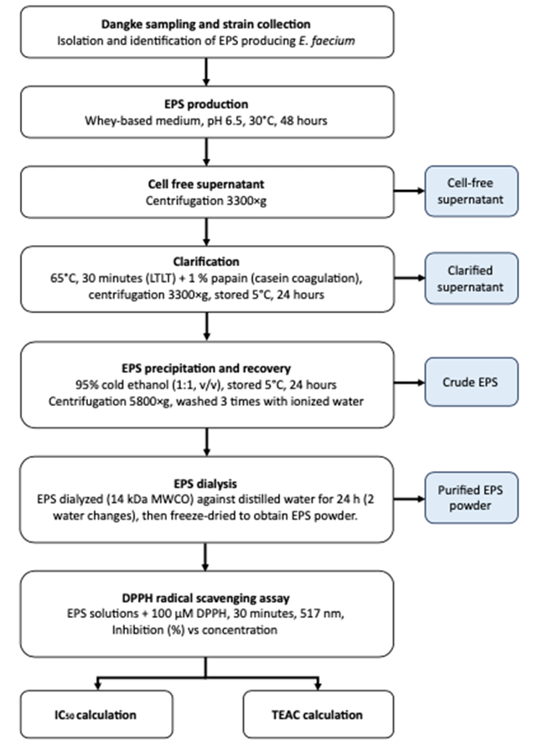
A schematic overview of the experimental workflow, from Dangke sampling and isolation of E. faecium strains through EPS extraction, and antioxidant evaluation is presented in Figure 1.
Bacterial strains, culture media, and EPS production
Enterococcus faecium strains used in this study were previously isolated from Dangke using phenotypic and molecular approaches commonly applied in surveys of LAB from artisanal dairy products . Cultures were maintained on standard LAB media at 4 °C, with long-term stocks stored at -80 °C ; . EPS production was carried out in a whey-based medium enriched with glucose and nitrogen sources to support polysaccharide synthesis. The pH of the production medium was adjusted to 6.5 before inoculation, and cultures were incubated at 30 °C for 48 hours under static conditions, consistent with reported optimal ranges for LAB EPS biosynthesis ; .
Exopolysaccharides extraction
EPS from Dangke-derived E. faecium isolates were extracted with modifications to Malaka et al (2020). Cells were removed by centrifugation (3300×g), and the resulting cell-free supernatant was heated at 65 °C for 30 min (LTLT) to inactivate endogenous enzymes. To remove co-extracted proteins (e.g., casein and other peptides), a 1% (w/v) papain solution was added and the mixture was incubated under conditions sufficient for proteolysis, followed by centrifugation (3300×g) to remove insoluble material. To reduce potential interference from nucleic acids and other low-molecular-weight compounds that may contribute to apparent antioxidant activity, the clarified supernatant was subjected to ethanol precipitation (95% cold ethanol, 1:1 v/v) and stored at 5 °C for 24 h before centrifugation (5800×g). The resulting precipitate was re-dissolved in distilled water and washed three times (each wash followed by centrifugation) to remove residual medium components. The washed EPS fraction was then dialyzed to remove small metabolites and free sugars: the precipitate was dissolved in distilled water (1:20 w/v) and placed in a 14 kDa MWCO dialysis membrane, dialyzed against distilled water for 24 h with two water changes. Dialyzed material was freeze-dried to obtain EPS powder. No structural characterization was performed. Therefore, structure activity relationships and mechanistic interpretations of antioxidant activity are explicitly considered outside the scope of this study and are treated as a limitation when interpreting the DPPH results.
2,2-diphenyl-1-picrylhydrazyl (DPPH) assay
Antioxidant activity was evaluated using a a microplate based DPPH assay following established protocols ; . EPS were dissolved in distilled water at the desired concentrations immediately before analysis. A 100 µM DPPH solution in methanol was prepared, and equal volumes of sample solution and DPPH solution were mixed and incubated in the dark for 30 min. Absorbance was measured at 517 nm . Trolox and ascorbic acid were used as reference antioxidants.
The percentage of DPPH radical scavenging (inhibition) was calculated according to the following equation:
Inhibition (%) = [(A₀ − A₁) / A₀] × 100
Where, A₀ is the absorbance of the control (DPPH solution mixed with solvent) and A₁ is the absorbance of the reaction mixture containing DPPH and the EPS or standard antioxidant solution .
IC50 and trolox equivalent antioxidant capacity (TEAC)
Dose-response curves (percent inhibition vs. concentration) were generated for each EPS preparation and for Trolox and ascorbic acid. IC₅₀ was defined as the concentration required to achieve 50% inhibition. For Trolox and ascorbic acid, IC₅₀ values were determined by linear interpolation between the two concentrations bracketing 50% inhibition using y = ax + b (not forced through the origin) and solving for y = 50. For EPS preparations, because 50% inhibition was not achieved at the highest tested concentration (10 mg/mL), IC₅₀ values were conservatively reported as IC₅₀ > 10 mg/mL. TEAC was calculated using the IC₅₀ ratio approach :
Because EPS IC₅₀ values are reported as >10 mg/mL, TEAC values for EPS are reported as an upper bound, TEAC < IC₅₀(Trolox) / 10.
Data analysis
All experiments were performed in triplicate and results are presented as mean ± standard deviation (SD). All data were statistically evaluated using SPSS software, in which a two-way analysis of variance (ANOVA) applied to examine whether the differences observed among various treatment groups were statistically significant. When the ANOVA indicated significant effects, Tukey’s honestly significant difference (HSD) post hoc test was used to identify which specific group means differed significantly.
Results and Discussion
2,2-diphenyl-1-picrylhydrazyl (DPPH) assay
The antioxidant activity of exopolysaccharides (EPS) isolated from E. faecium strains was evaluated using the DPPH radical scavenging assay. All EPS samples showed a clear concentration-dependent increase in scavenging capacity, with higher concentrations yielding greater inhibition of DPPH radicals (Table 1). At the highest concentration tested (10 mg/mL), EPS from strain DCC1 showed the highest inhibition (40.61 ± 0.01%), followed by EPS DCB3 (40.17 ± 0.01%) and EPS DCC3 (38.56 ± 0.01%). In contrast, at 1 mg/mL, inhibition was low for all EPS (0.8-2.4%), indicating limited radical scavenging at concentrations that are closer to those of typical small-molecule antioxidants. Statistically analysis confirmed that both strain and concentration, as well as their interaction, had significant effects on DPPH inhibition (p < 0.05).
The concentration dependent trend observed here is consistent with previous reports that LAB-derived EPS generally display increasing DPPH scavenging as dosage rises, reflecting the need for relatively high polymer concentrations to provide enough reactive sites . However, the absolute magnitude of scavenging observed for the Dangke-derived EPS is modest. Even at 10 mg/mL, inhibition remains below 41%, which places these samples at the lower end of the activity range reported for LAB EPS in comparable DPPH assays. In contrast, the standard antioxidants Trolox and ascorbic acid exhibited very high scavenging at much lower concentrations (Table 2). Ascorbic acid inhibited DPPH radicals by >99% at 0.1 mg/mL, while Trolox achieved >90% inhibition at the same concentration. These results highlight the far greater potency of small, highly mobile electron donors compared with high-molecular-weight polysaccharides in the DPPH system. Consequently, although EPS from strains DCC1 and DCB3 showed the highest activity among the Dangke isolates, their overall radical-scavenging efficiency remains substantially lower than that of Trolox and ascorbic acid.
Table 1: DPPH Scavenging activity (%) of EPS samples produced by E. faecium isolated from Dangke cheese.
Concentration (mg/mL)
Inhibition (%)
EPS DCA2
EPS DCA3
EPS DCB3
EPS DCB5
EPS DCC1
EPS DCC3
1
0.81 ± 0.01a
1.03 ± 0.01b
1.23 ± 0.01c
1.62 ± 0.02d
2.04 ± 0.00e
2.43 ± 0.02f
2
4.27 ± 0.01g
4.68 ± 0.02h
5.70 ± 0.00i
5.90 ± 0.00j
6.52 ± 0.01k
7.53 ± 0.02l
4
11.20 ± 0.01n
11.21 ± 0.01n
10.80 ± 0.00m
14.08 ±0.01q
11.82 ± 0.01p
11.62 ± 0.01o
6
19.78 ± 0.02v
19.17 ± 0.01u
18.14 ± 0.03r
21.03 ±0.01w
18.76 ± 0.01s
18.97 ± 0.01t
8
28.34 ± 0.03x
29.58 ± 0.02z
30.38 ± 0.03aa
31.41 ±0.01ab
33.86 ± 0.01ac
28.97 ± 0.00y
10
37.93 ±0.02ad
39.17 ± 0.01ag
40.17 ± 0.01ah
38.34 ±0.03ae
40.61 ± 0.01ai
38.56 ± 0.01af
IC50 (mg/mL)
>10
>10
>10
>10
>10
>10
Data are shown as mean ± SD (n=3). Different superscript indicated a significant difference (Tukey test; p<0.05).
Table 2: DPPH Scavenging activity (%) of ascorbic acid and trolox as the reference antioxidants.
Concentration (mg/mL)
Inhibition (%)
Ascorbic acid
Trolox
0.01
49.82 ± 0.01c
32.44 ± 0.01a
0.02
62.59 ± 0.00e
44.47 ± 0.00b
0.04
70.27 ± 0.02f
55.91 ± 0.01d
0.06
81.03 ± 0.02h
71.41 ± 0.01g
0.08
89.54 ± 0.03j
83.27 ± 0.02i
0.10
99.64 ± 0.27l
92.85 ± 0.00k
IC50 (mg/mL)
0.010
0.030
Data are shown as mean ± SD (n=3). Different superscript indicated a significant difference (Tukey test; p<0.05).
As summarized in Tables 1 and 2, inhibition increased steadily with EPS concentration, whereas ascorbic acid and Trolox achieved very high inhibition (>70%) even at 0.02 mg/mL. The relatively low inhibition of the EPS at 1-10 mg/mL therefore reflects genuinely weak radical-scavenging potency in the DPPH assay rather than high experimental variability, which was small across triplicate measurements.
When compared with other studies of DPPH activity for LAB derived EPS, the Dangke EPS clearly fall at the lower end of the spectrum. For example, EPS from mixed LAB cultures in fermented coconut beverages have been reported to achieve 42-76% inhibition at concentrations similar to those used here , and EPS from Weissella cibaria, Lactobacillus plantarum, and several dairy isolates often exceed 50% inhibition at 10 mg/mL ; . Research by Vasough et al. (2021) showed that EPS extracted from E. durans K48, E. faecium R114, and E. faecium T52 exhibited 38-50% inhibition at 10 mg/mL, while Abdhul et al. (2014) reported 63.5% inhibition for EPS from E. faecium BDU7 at the same concentration. These comparisons indicate that the EPS from Dangke derived E. faecium strains display comparatively weak DPPH scavenging.
Previous work suggests that differences in EPS structure, including monosaccharide composition, molecular weight distribution, branching, and the abundance of electron-donating functional groups, can substantially affect radical-scavenging efficiency ; ; ; . In the present study, we did not carry out detailed structural characterization of the EPS, and parameters such as molecular-weight distribution, linkage pattern, and specific functional groups were not determined. As a result, our suggestion that structural features underlie the relatively low DPPH activity should be regarded as hypothesis-generating and based primarily on the broader EPS literature rather than on direct structural evidence from the present samples. Comprehensive structural analysis, including monosaccharide composition, molecular-weight profiling, and more detailed linkage information, will be an essential focus of future work and will be required to establish more definitive mechanistic links between EPS structure and antioxidant function.
IC50 and TEAC values
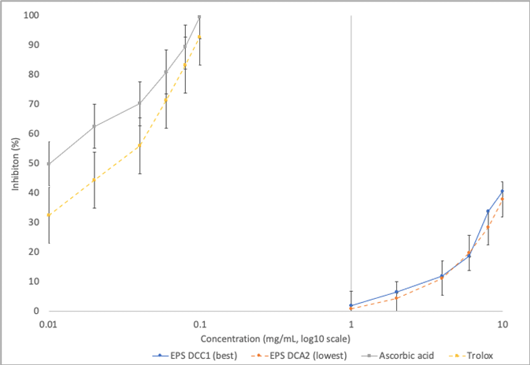
IC₅₀ is defined as the concentration required to inhibit 50% of DPPH radicals. For all EPS preparations, 50% inhibition was not achieved within the tested range (1-10 mg/mL). Consistent with Table 1, the highest inhibition observed at 10 mg/mL was 38-41% (maximum 40.61%). Therefore, IC₅₀ values for the EPS preparations could not be determined by interpolation and are reported conservatively as IC₅₀ > 10 mg/mL. This interpretation is supported by Figure 2, which shows a shallow dose–response across 1-10 mg/mL, with curves remaining well below 50% inhibition and clustering closely, indicating only minor between-strain differences under the present assay conditions. In contrast, the reference antioxidants show substantially higher potency, achieving comparable or greater inhibition at much lower concentrations.
For Trolox, 50% inhibition occurred within the tested range (44.47% at 0.02 mg/mL and 55.91% at 0.04 mg/mL), allowing IC₅₀ estimation by linear interpolation (0.03 mg/mL). Because EPS IC₅₀ values are reported as >10 mg/mL, TEAC for EPS cannot be reported as a single point estimate and is instead reported as an upper bound: TEAC(EPS) < IC₅₀(Trolox)/10, corresponding to TEAC (EPS) < 3.0 × 10⁻³ mg Trolox/mg EPS under the present assay conditions.
To contextualize this low TEAC, we estimated the EPS level required to match a typical food addition of ascorbic acid (0.01%, w/w = 100 mg/kg). As ascorbic acid showed >70% scavenging at 0.02 mg/mL, its IC₅₀ is <0.02 mg/mL and TEAC 1.5 mg Trolox/mg. Thus, 0.01% ascorbic acid corresponds to >150 mg Trolox-equivalents per kg, whereas achieving the same Trolox-equivalent contribution with EPS would require >50 g EPS/kg (>5% w/w), which is likely technologically and economically impractical for most foods. This disparity is typical when comparing small, rapidly diffusing antioxidants with high-molecular-weight polysaccharides in the DPPH assay ; , and reinforces that Dangke-derived EPS are weak direct radical scavengers relative to Trolox and ascorbic acid.
Conclusions
This study establishes a quantitative DPPH benchmark for EPS preparations produced by Dangke-derived E. faecium. The EPS exhibited reproducible concentration-dependent scavenging but low potency compared with Trolox and ascorbic acid; 50% inhibition was not reached at 10 mg/mL, so EPS IC₅₀ is conservatively reported as >10 mg/mL and TEAC as an upper bound (< 3 × 10⁻³ mg Trolox/mg EPS). These findings place the Dangke EPS preparations toward the weak end of LAB-EPS performance in the DPPH assay and support interpreting them as poor direct radical scavengers under these assay conditions. Because EPS structural characterization were not performed, structure-activity explanations cannot be made from the present dataset. Future work should combine compositional characterization with matrix-relevant oxidation models.
Acknowledgments
The author would like to thank for PMDSU scholarship support by the Indonesia Ministry of Higher Education, Science and Technology and Kagawa University for elaborating the joint research collaboration. The author would like to express gratitude also to the Indonesia Directorate General of Higher Education for funded this study.
Novelty Statement
This study is novel in that it reports and benchmarks the antioxidant activity of exopolysaccharides (EPS) produced by Enterococcus faecium isolated from Dangke, a traditional Indonesian fermented dairy product for which EPS bioactivity has been scarcely documented. It also contributes novelty by using a standardized in vitro antioxidant assay framework with appropriate reference antioxidants, enabling clearer comparison and positioning of Dangke-derived EPS for future functional and structural investigations.
Author’s Contribution
Conceptualization: RWK, RM. Methodology: RWK, RM. Formal analysis: RWK. Validation: RWK, RM, NN, MO, WW. Supervision: RM, NN, MO, NN. Writing original draft preparation: RWK, RM, NN. Writing review and editing: RWK, RM, NN, WW.
Generative AI and AI-assisted technology statement
The authors declare that no generative AI or AI-assisted technologies were used to generate, analyze, or interpret the research data. Generative AI tools were used only to assist in improving the grammar and readability of the manuscript during the revision stage, and all scientific interpretations and conclusions are entirely the authors’ own.
Conflict of interest
The authors have declared no conflict of interest.
Figures
Figure 1:.
Schematic overview of the experimental design.
Figure 2:.
Dose–response curves for DPPH inhibition by EPS from E. faecium strains DCC1 (best) and DCA2 (worst) compared with ascorbic acid and Trolox. Concentration is plotted on a log10 scale. Values are mean ± SD (n = 3).
References
Abdhul K, Ganesh M, Shanmughapriya S, Kanagavel M, Anbarasu K, Natarajaseenivasan K (2014). Antioxidant activity of exopolysaccharide from probiotic strain Enterococcus faecium (BDU7) from Ngari. Int. J. Biol. Macromol., 70: 450–454. https://doi.org/10.1016/j.ijbiomac.2014.07.026[CrossRef]
Abduxukur D, Tursuntay A, Zhu X, Wang X, Rahman N (2023). Antioxidant capacity of lactic acid bacteria and yeasts from Xinjiang traditional fermented dairy products. Fermentation, 9(7): 639. https://doi.org/10.3390/fermentation9070639[CrossRef]
Adebayo-Tayo B, Fashogbon R (2020). In vitro antioxidant, antibacterial, in vivo immunomodulatory, antitumor and hematological potential of exopolysaccharide produced by wild type and mutant Lactobacillus delbureckii subsp. bulgaricus. Heliyon, 6(2): e03268. https://doi.org/10.1016/j.heliyon.2020.e03268[CrossRef]
Adebayo-Tayo BC, Ogundele BR, Ajani OA, Olaniyi OA (2024). Characterization of lactic acid bacterium exopolysaccharide, biological, and nutritional evaluation of probiotic formulated fermented coconut beverage. Int. J. Food Sci., 1: 8923217. https://doi.org/10.1155/2024/8923217[CrossRef]
Adelekan AO, Olurin, TO, Ezeani AO (2020). Antioxidant activities of exopolysaccharides produced by lactic acid bacteria isolated from commercial yoghurt samples. Adv. Microbiol., 10(8): 359–374. https://doi.org/10.4236/aim.2020.108026[CrossRef]
Adesulu-Dahunsi AT, Sanni AI, Jeyaram K (2018). Production, characterization and in vitro antioxidant activities of exopolysaccharide from Weissella cibaria GA44. LWT, 87: 432–442. https://doi.org/10.1016/j.lwt.2017.09.013[CrossRef]
Ahmed HI, Ransom-Jones E, Sadiq S, Vitlic A, McLay N, Rojas MF, Ale EC, Binetti AG, Collett A, Humphreys PN, Laws AP (2020). Structural characterisation of two medium molecular mass exopolysaccharides produced by the bacterium Lactobacillus fermentum Lf2. Carbohydrate Res., 488: 107909. https://doi.org/10.1016/j.carres.2020.107909[CrossRef]
Alhudhud M, Humphreys P, Laws A (2014). Development of a growth medium suitable for exopolysaccharide production and structural characterisation by Bifidobacterium animalis ssp. lactis AD011. J. Microbiol. Methods, 100: 93–98. https://doi.org/10.1016/j.mimet.2014.02.021[CrossRef]
Chooruk A, Piwat S, Teanpaisan R (2017). Antioxidant activity of various oral Lactobacillus strains. J. Appl. Microbiol., 123(1): 271–279. https://doi.org/10.1111/jam.13482[CrossRef]
Fadlillah HN, Nuraida L, Sitanggang AB, Palupi NS (2021). Production of antioxidants through lactic acid fermentation: Current developments and outlook. The Annals of the University Dunarea de Jos of Galati Fascicle VI. Food Technol., 45(2): 203–228. https://doi.org/10.35219/foodtechnology.2021.2.13[CrossRef]
Fguiri I, Ziadi M, Atigui M, Ayeb N, Arroum S, Assadi M, Khorchani T (2016). Isolation and characterisation of lactic acid bacteria strains from raw camel milk for potential use in the production of fermented Tunisian dairy products. Int. J. Dairy Technol., 69(1): 103–113. https://doi.org/10.1111/1471-0307.12226[CrossRef]
Ge Q, Yang B, Liu R, Jiang D, Yu H, Wu M, Zhang W (2021). Antioxidant activity of Lactobacillus plantarum NJAU-01 in an animal model of aging. BMC Microbiol., 21(1): 182. https://doi.org/10.1186/s12866-021-02248-5[CrossRef]
Hakim ABN, Xuan NJ, Oslan SNH (2023). A comprehensive review of bioactive compounds from lactic acid bacteria: Potential functions as functional food in dietetics and the food industry. Foods, 12(15): 2850. https://doi.org/10.3390/foods12152850[CrossRef]
Hernández-González JC, Martínez-Tapia A, Lazcano-Hernández G, García-Pérez BE, Castrejón-Jiménez NS (2021). Bacteriocins from lactic acid bacteria. A powerful alternative as antimicrobials, probiotics, and immunomodulators in veterinary medicine. Animals, 11(4): 979. https://doi.org/10.3390/ani11040979[CrossRef]
Jiménez AM, Murcia MA, Parras P, Martínez‐Tomé M (2008). On the importance of adequately choosing the ingredients of yoghurt and enriched milk for their antioxidant activity. Int. J. Food Sci. Technol., 43(8): 1464–1473. https://doi.org/10.1111/j.1365-2621.2007.01701.x[CrossRef]
Jin, Y, Zhang N, Huang Y, Zhang Z, Jin E, Kong Y, Sui W, Wu T, Zhang M (2025). Identification and screening of novel antioxidant peptides from yak skin and their protective effect on H2O2-induced HepG2 cells oxidation. Int. J. Mol. Sci., 26(13): 5976. https://doi.org/10.3390/ijms26135976[CrossRef]
Kadir RW, Malaka R, Nahariah N, Wahniyathi W, Arief FA (2025). Isolation and characterization of lactic acid bacteria isolated from traditional dairy product dangke cheese using molecular 16s rRNA gene sequence PCR method. Int. J. Agric. Biosci., 14(4): 614–620.
Kim KT, Kim JW, Kim SI, Kim S, Nguyen TH, Kang CH (2021). Antioxidant and anti-inflammatory effect and probiotic properties of lactic acid bacteria isolated from canine and Feline Feces. Microorganisms, 9(9): 1971. https://doi.org/10.3390/microorganisms9091971[CrossRef]
Kumar S, Kumar S, Bumbadia M, Singh SK (2022). Prospects and functionality of bacterial exopolysaccharides in dairy foods: A review. J. Agrisearch, 9(01): 1-5. https://doi.org/10.21921/jas.v9i01.9884[CrossRef]
Li X, Chen S, Li JE, Wang N, Liu X, An Q, Ye XM, Zhao ZT, Zhao M, Han Y, Ouyang KH, Wang WJ (2019). Chemical composition and antioxidant activities of polysaccharides from Yingshan cloud mist tea. Oxid. Med. Cell. Longev., 1: 1915967. https://doi.org/10.1155/2019/1915967[CrossRef]
Liu J, Willför S, Xu C (2015). A review of bioactive plant polysaccharides: Biological activities, functionalization, and biomedical applications. Bioact. Carbohyd. Dietary Fibre, 5(1): 31–61. https://doi.org/10.1146/annurev-arplant-050213-040327[CrossRef]
Lü J, Lin PH, Yao Q, Chen C (2010). Chemical and molecular mechanisms of antioxidants: Experimental approaches and model systems. J. Cell. Mol. Med., 14(4): 840–860. https://doi.org/10.1111/j.1582-4934.2009.00897.x[CrossRef]
Malaka R, Maruddin F, Dwyana Z, Vargas MV (2020). Assessment of exopolysaccharide production by Lactobacillus delbrueckii subsp. bulgaricus ropy strain in different substrate media. Food Sci. Nutr., 8(3): 1657–1664. https://doi.org/10.1002/fsn3.1452[CrossRef]
Malaka, R, Maruddin F, Baco S (2022). Dangke Keju Tradisional Enrekang, Sulawesi Selatan. Unhas Press, Indonesia.
Manzanares P, Gandía M, Garrigues S, Marcos JF (2019). Improving Health-promoting effects of food-derived bioactive peptides through rational design and oral delivery strategies. Nutrients, 11(10): 2545. https://doi.org/10.3390/nu11102545[CrossRef]
Navajas-Porras B, Pérez-Burillo S, Hinojosa-Nogueira D, Douros K, Pastoriza S, Rufián-Henares JÁ (2022). The gut microbiota of obese children releases lower antioxidant capacity from food than that of lean children. Nutrients, 14(14): 2829. https://doi.org/10.3390/nu14142829[CrossRef]
Navajas-Porras B, Pérez-Burillo S, Valverde-Moya ÁJ, Hinojosa-Nogueira D, Pastoriza S, Rufián-Henares JÁ (2020). Effect of cooking methods on the antioxidant capacity of plant foods submitted to in vitro digestion–fermentation. Antioxidants, 9(12): 1312. https://doi.org/10.3390/antiox9121312[CrossRef]
Ozcan T, Yilmaz-Ersan L, Akpinar-Bayizit A, Delikanli B (2017). Antioxidant properties of probiotic fermented milk supplemented with chestnut flour (Castanea sativa Mill). J. Food Proc. Preserv., 41(5): e13156. https://doi.org/10.1111/jfpp.13156[CrossRef]
Ozturkoglu-Budak S, Arkadaş M, Yıldırım Z, Avşar YK (2023). Assessment of bacteriocin producing Enterococcus faecium HZ as adjunct culture to improve the aroma formation and antimicrobial activity in white-brined cheese. Acta Alimentaria, 52(3): 469–479. https://doi.org/10.1556/066.2023.00086[CrossRef]
Pieniz S, Andreazza R, Okeke BC, Camargo FAO, Brandelli A (2015). Antimicrobial and antioxidant activities of Enterococcus species isolated from meat and dairy products. Braz. J. Biol., 75(4): 923–931. https://doi.org/10.1590/1519-6984.02814[CrossRef]
Taj R, Masud T, Sohail A, Sammi S, Naz R, Sharma-Khanal BK, Nawaz MA (2022). In vitro screening of EPS‐producing Streptococcus thermophilus strains for their probiotic potential from Dahi. Food Sci. Nutr., 10(7): 2347–2359. https://doi.org/10.1002/fsn3.2843[CrossRef]
Terzic-Vidojevic A, Veljovic K, Tolinacki M, Nikolic M, Ostojic M, Topisirovic L (2009). Characterization of lactic acid bacteria isolated from artisanal Zlatar cheeses produced at two different geographical location. Genetika, 41(1): 117–136. https://doi.org/10.2298/GENSR0901117T[CrossRef]
Torino MI, Font de Valdez G, Mozzi F (2015). Biopolymers from lactic acid bacteria. Novel Applications in foods and beverages. Front. Microbiol., 6: 834. https://doi.org/10.3389/fmicb.2015.00834[CrossRef]
Vasough PR, Najafi MBH, Dovom MRE, Javadmanesh A, Mayo B (2021). Evaluation of antioxidant, antibacterial and cytotoxicity activities of exopolysaccharide from Enterococcus strains isolated from traditional Iranian Kishk. J. Food Measur. Characteriz., 15(6): 5221–5230. https://doi.org/10.1007/s11694-021-01092-5[CrossRef]
Wu J, Chen J, Wei Z, Zhu P, Li B, Qing Q, Chen H, Lin W, Lin J, Hong X, Yu F, Chen X (2023). Fabrication, evaluation, and antioxidant properties of carrier-free curcumin nanoparticles. Molecules, 28(3): 1298. https://doi.org/10.3390/molecules28031298[CrossRef]
Xiao F, Xu T, Lu B, Liu R (2020). Guidelines for antioxidant assays for food components. Food Front., 1(1): 60–69. https://doi.org/10.1002/fft2.10[CrossRef]
Yang T, Yang J, Tang K, Zhi W, Chen R, Tan H (2022). Antioxidative properties analysis of gastrointestinal lactic acid bacteria in Hainan black goat and its effect on the aerobic stability of total mixed ration. Front. Microbiol., 13: 974925. https://doi.org/10.3389/fmicb.2022.974925[CrossRef]
Zhang M, Luo T, Zhao X, Hao X, Yang Z (2020). Interaction of exopolysaccharide produced by Lactobacillus plantarum YW11 with whey proteins and functionalities of the polymer complex. J. Food Sci., 85(12): 4141–4151. https://doi.org/10.1111/1750-3841.15522[CrossRef]
Zhang Q, Tong X, Li Y, Wang H, Wang Z, Qi B, Sui X, Jiang L (2019). Purification and characterization of antioxidant peptides from Alcalase-Hydrolyzed Soybean (Glycine max L.) hydrolysate and their cytoprotective effects in human intestinal Caco-2 cells. J. Agric. Food Chem., 67(20): 5772–5781. https://doi.org/10.1021/acs.jafc.9b01235[CrossRef]
Zhang YJ, Gan RY, Li S, Zhou Y, Li AN, Xu DP, Li HB (2015). Antioxidant Phytochemicals for the prevention and treatment of chronic diseases. Molecules, 20(12): 21138–21156. https://doi.org/10.5888/pcd12.140553[CrossRef]
Zhou Y, Gong W, Xu C, Zhu Z, Peng Y, Xie C (2022). Probiotic assessment and antioxidant characterization of Lactobacillus plantarum GXL94 isolated from fermented chili. Front. Microbiol., 13: 99740. https://doi.org/10.3389/fmicb.2022.997940[CrossRef]