Although the diploid chromosome number in many taxa is greater than 50, there are 50 or fewer chromosomes in only Muntiacus reevesi reevesi, Muntiacus reevesi micrurus, Muntiacus feae, Muntiacus muntjak, Mazama temama and Mazama nana.
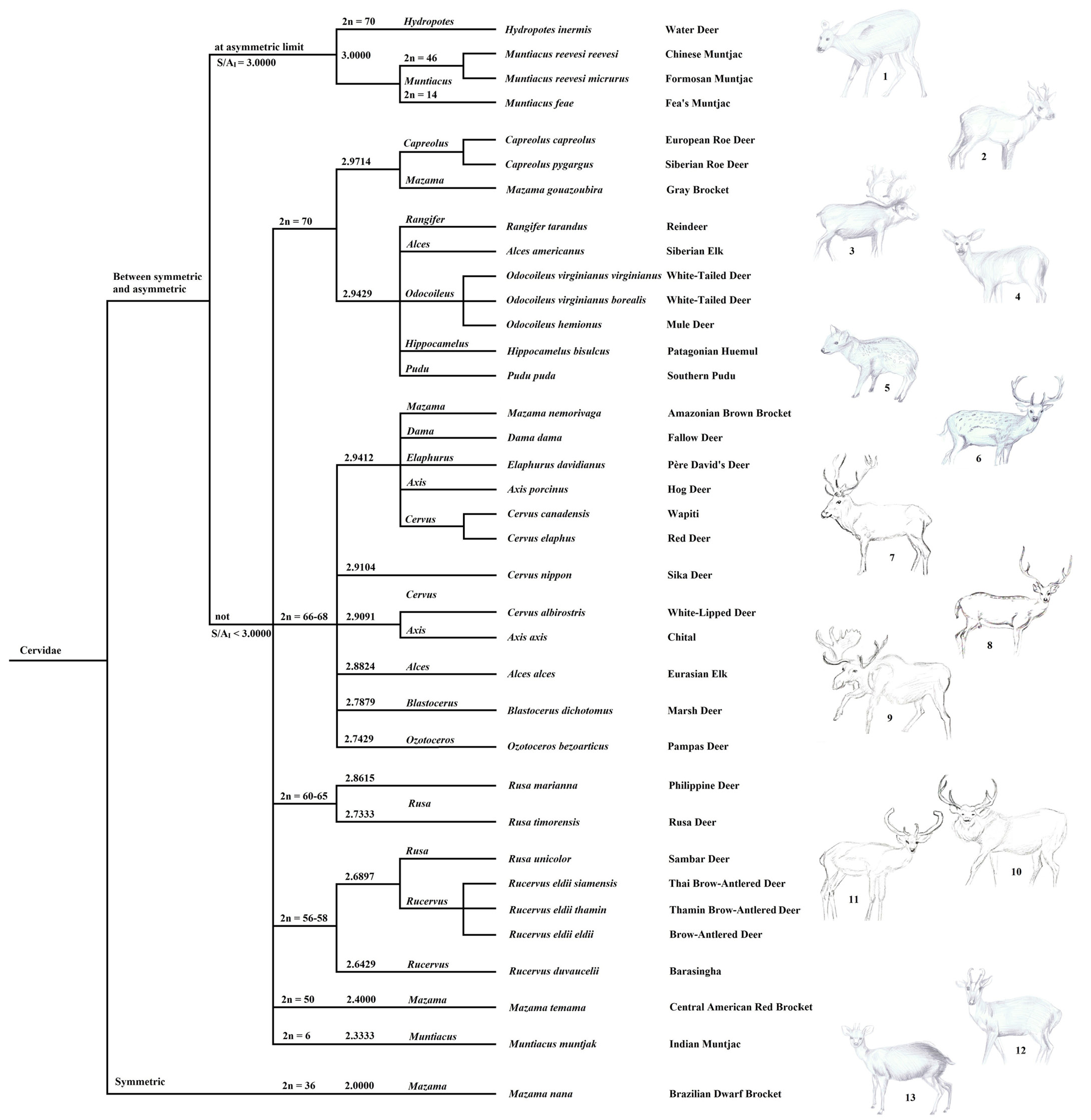
In Figure 1 while the karyotype is between symmetric and asymmetric in the 17 genera and 35 taxa, it is symmetric in the only one genus and taxon.
The female karyotype symmetry/asymmetry values of 36 taxa are between 2.0000 and 3.0000 with an average of 2.8343 ± 0.21.
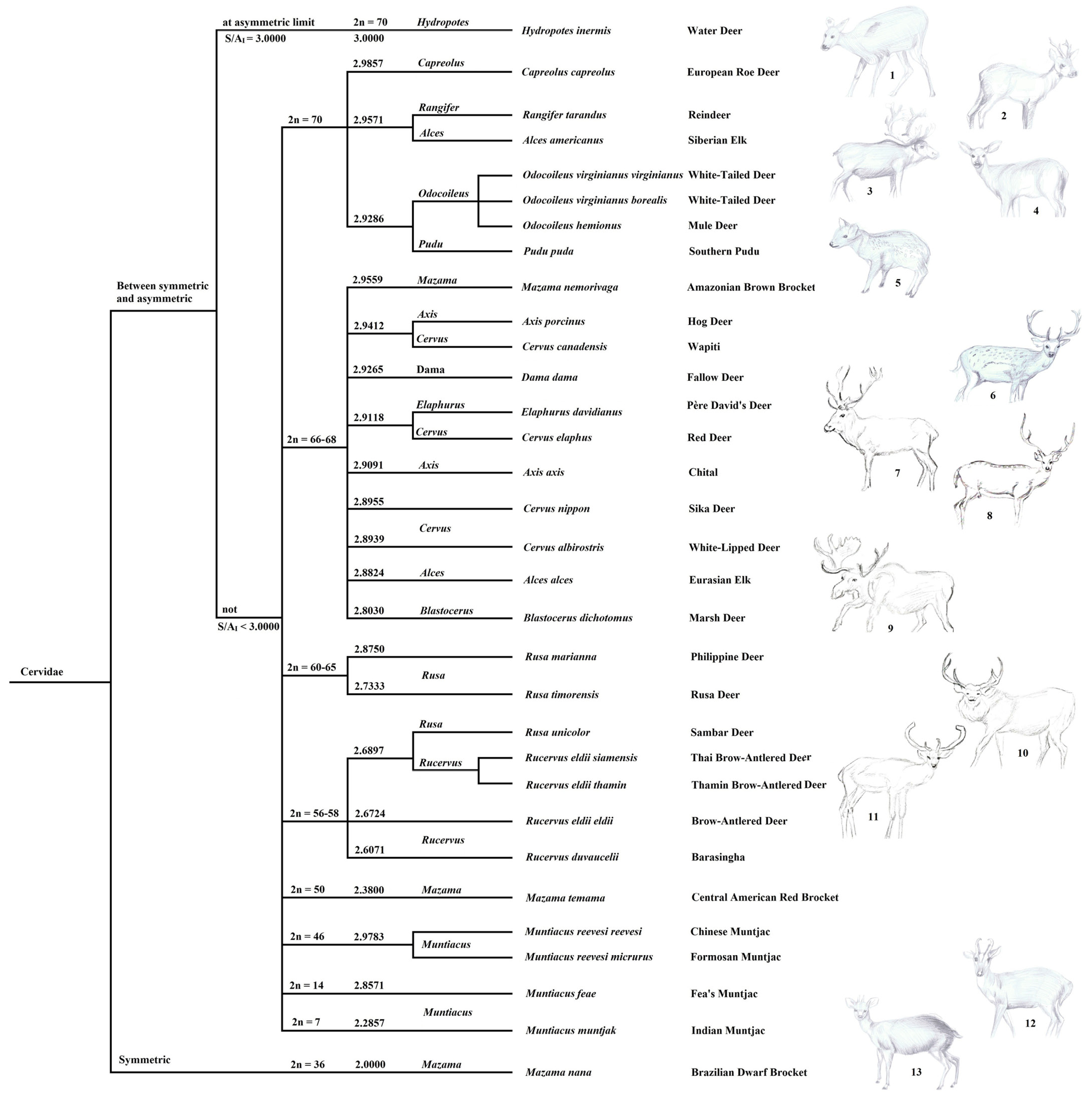
In Figures 1 and 2 while the karyotype of Mazama nana is symmetric, others are between symmetric and asymmetric.
Selected from the article's own text.
Abstract
Karyotype asymmetry is one of the most widely used approaches in cytotaxonomic studies. The symmetry/asymmetry index (S/AI) is used to determine karyotype asymmetry in higher animals and humans. The formula designed by the number of chromosome types is S/AI = (1 × M) + (2 × SM) + (3 × A) + (4 × T) / 2n. The S/AI value varies from 1.0000 (full symmetric) to 4.0000 (full asymmetric). After a detailed literature review, the chromosomal data of 36 female species and 32 male species of family Cervidae were detected, namely (i) karyotype formulae, (ii) symmetry/asymmetry index values (iii) karyotype types. According to the chromosomal data, two phylogenetic trees were formed. The phylogenetic trees were showed karyotypic relationships among the taxa.
Novelty Statement | This is the first report on karyotype asymmetry of Cervidae. Karyotypic relationships are useful to infer processes of evolution and speciation. Karyotype asymmetry is an important parameter that helps to establish phylogenetic relationships among various species.
Introduction
Cervidae (Goldfuss, 1820) is placed in the order Artiodactyla (Owen, 1848). The family consists of at least 51 wild species in 19 genera. The Cervidae are the most widespread family of extant Artiodactyla after Bovidae . They are distributed naturally in all continents except Antarctica and Australia . The number of cervids decreases with human effects as a result of uncontrolled hunting, especially in Europe, Asia and America. According to the International Union for the Conservation of Nature (IUCN) Red List, the seven species are categorized as Endangered (EN). In addition, Axis kuhlii (bawean deer), Elaphurus davidianus (père David’s deer) and Rucervus schomburgki (Schomburgk’s deer) are categorized as Critically Endangered (CR), Extinct in the Wild (EW) and Extinct (EX), respectively .
The family Cervidae is one of the most important members of the world’s wildlife. Therefore, many taxonomic and cytotaxonomic studies have been reported related cervids till now and some of them have been summarized. The chromosome numbers of Cervidae are generally 2n = 50–70 (Wurster and Benirschke, 1967a, 1967b; Hsu and Benirschke, 1973a, 1973b; . The majority of species have 66–70 chromosomes ; Wurster and Benirschke, 1967a, 1967b; ; ; ; ; . As an extreme example, Muntiacus muntjak has the lowest diploid chromosome number among mammals (female 2n = 6; male 2n = 7) . The chromosome numbers of genus Muntiacus are extremely diverse, ranging from 6 in Muntiacus muntjak to the relatively high number of 46 in Muntiacus reevesi reevesi (Wurster and Benirschke, 1967a; and Muntiacus reevesi micrurus . In addition, there are B chromosomes in the family Cervidae ; ; . B chromosomes, are not necessarily necessary chromosomes, are extra chromosomes that do not comply with Mendelian inheritance rules. They are commonly found in mammals .
Karyotype asymmetry is an important parameter in karyotype studies. Many parameters have been proposed in the calculation of karyotype asymmetry, which are parameters of Stebbins classification, TF (total form percentage), AsK (karyotype asymmetry index percentage), Syi (symmetric index), Rec (ratios of each chromosome), A1 (intrachromosomal asymmetry index), A2 (interchromosomal asymmetry index), DI (dispersion index), A (asymmetry index), CVCL (coefficient of variation of chromosome length), CVCI (coefficient of variation of centromeric index), MCA (mean centromeric asymmetry) and S/AI. All except S/AI have been proposed for the calculation of plant karyotype asymmetries ; ; . The S/AI is used to determine karyotype asymmetry in higher animals and humans . All methods use basic measurement data such as long and short arms of chromosomes. The symmetrical karyotype is characterized by chromosomes with central centromere that do not differ much between long and short arm lengths. On the contrary, the asymmetric karyotype is characterized by chromosomes with very different long and short arm lengths and without a central centromere . The aim of this study is to reveal the karyotypic relationships of Cervidae taxa by determining the karyotype asymmetries.
Materials and Methods
The karyotype symmetry/asymmetry index
Eroğlu (2015) reported a formula to calculate karyotype symmetry/asymmetry index with two important matters. Firstly, while other parameters use chromosome arm lengths, the S/AI parameter uses the karyotype formula. Secondly, the chromosomal lengths may contain small differences in different karyotype studies of the same species. The differences do not affect the karyotype formula and S/AI value. The S/AI formula is shown below.
S/AI = (1 × M) + (2 × SM) + (3 × A or ST) + (4 × T) / 2n
The formula was designed according to the number of chromosome types, namely the chromosome number of metacentric (M), submetacentric (SM), acrocentric (A), subtelocentric (ST) and telocentric (T). In addition, a classification model was given according to the S/AI value, namely 1.0 = S/AI (full symmetric), 1.0 < S/AI ≤ 2.0 (symmetric), 2.0 < S/AI ≤ 3.0 (between symmetric and asymmetric), 3.0 < S/AI < 4.0 (asymmetric) and 4.0 = S/AI (full asymmetric).
Sample application of symmetry/asymmetry on taxa
The karyotypes of the sample application belong to Cervidae taxa. The Cervidae includes the ruminant mammals commonly known as deer, elk, moose and caribou. After a detailed literature review, the information about family Cervidae was detected namely; (i) scientific/common names and author(s), (ii) karyotype formulae with B-chromosomes, if any (iii) symmetry/asymmetry index values (iv) karyotype types (Table 1).
Table 1 includes the scientific/common names and author(s) of the taxa. The databases were used for the control of scientific names, namely IUCN Red List and the Integrated Taxonomic Information System , because sometimes scientific names can be expressed with different names in different sources. The genus Rucervus is an important example. The names of genus are Cervus ; ; ; and Rucervus ; .
In addition, Table 1 includes the symmetry/ asymmetry index values and the karyotype types. Calculation of these values is given below with Cervus albirostris karyotype. In Table 1, the karyotype formulae are 2n = 66 = 2M + 2SM + 62A in female and 2n = 66 = 2M + 3SM + 61A in male.
2.0 < S/AI (female)≤ 3.0 (between symmetric and asymmetric)
S/AI (male)= (1 × M) + (2 × SM) + (3 × A) + (4 × T) / 2n
S/AI (male) = (1 × 2) + (2 × 3) + (3 × 61) / 66
S/AI (male) = 2.8939
2.0 < S/AI (male) ≤ 3.0 (between symmetric and asymmetric)
The phylogenetic trees formed by chromosomal data in Table 1 present the karyotype relationships among the taxa of Cervidae (Figures 1 and 2). The Figures 1 and 2 include 36 female taxa and 32 male taxa, respectively. For two reasons, four taxa are not included in the male phylogenetic tree: (i) The male subjects were not studied in Capreolus pygargus, Mazama gouazoubira and Ozotoceros bezoarticus; only female reports ; ; . (ii) In the karyotype study of Hippocamelus bisulcus, there are small Y chromosomes that cannot be examined. Therefore, chromosome cannot be classified . Finally, drawings of some species were added to the figures to further clarify the karyotype relationships among taxa.
Table 1: The karyotype formulae, index values and karyotype types of the taxa.
*The X chromosomes were fused to the chromosome paired 1; **The X chromosomes were fused to the chromosome paired 3; ***There is no male in the karyotype study; ****Could not determine the type of chromosome; *****In only female karyotype.
Results and Discussion
The ancestral cervid karyotype is 2n = 70 . The diploid chromosome number in the family Cervidae is a wide range. According to the Table 1, it is observed from 6–7 in the Muntiacus muntjak to 70 in many taxa. Although the diploid chromosome number in many taxa is greater than 50, there are 50 or fewer chromosomes in only Muntiacus reevesi reevesi, Muntiacus reevesi micrurus, Muntiacus feae, Muntiacus muntjak, Mazama temama and Mazama nana.
In Figure 1 while the karyotype is between symmetric and asymmetric in the 17 genera and 35 taxa, it is symmetric in the only one genus and taxon. The female karyotype symmetry/asymmetry values of 36 taxa are between 2.0000 and 3.0000 with an average of 2.8343 ± 0.21.
In Figure 2 while the karyotype is between symmetric and asymmetric in the 15 genera and 31 taxa, it is symmetric in the only one genus and taxon. The male karyotype symmetry/asymmetry values of 32 taxa are between 2.0000 and 3.0000 with an average of 2.8132 ± 0.23.
In Figures 1 and 2 while the karyotype of Mazama nana is symmetric, others are between symmetric and asymmetric. The chromosome numbers are polymorphic in genus Mazama. The genus has different chromosome number as 2n= 36, 50, 68, 70 and different types of chromosomes ; ; ; . Therefore, Mazama gouazoubira, Mazama nemorivaga and Mazama temama are characterized by greater number of chromosomes than Mazama nana. Their karyotype is between symmetric and asymmetric. Mazama temama was earlier classified as a subspecies of Mazama americana. Jorge and Benirschke (1977) reported that the karyotype of Mazama temama was different from Mazama americana. The chromosome numbers of Mazama nemorivaga and Mazama nana have been determined as 2n= 67–69 and 2n= 36–39 , respectively. B chromosomes or microchromosomes can cause variant karyotype. These chromosomes were not considered in the calculation of the diploid numbers because there was interindividual and intraindividual variations . Fiorillo et al. (2013) showed that there are variable (2–7) numbers of B chromosomes in the Mazama nemorivaga. They are very small and similar to the acrocentric Y chromosome. Abril and Duarte (2008) stated that there are variable (1–6) numbers of B chromosomes in the Mazama nana. Besides Mazama gouazoubira has B chromosomes . It was believed that B chromosomes in genus Mazama could originate from Robertsonian translocations involving biarmed chromosomes, which lose centromeric fragments .
.
An asymmetric karyotype is characterized by mainly acrocentric/subtelocentric and telocentric chromosomes and the index value is 3.0 < S/AI < 4.0 . Despite the karyotypes of Hydropotes inermis (Figures 1 and 2), Muntiacus reevesi reevesi, Muntiacus reevesi micrurus and Muntiacus feae (Figure 1) are very close to the asymmetric, there is no asymmetric karyotype in all studied species. The similar results are available in the literature. The karyotypes of family Felidae are symmetric in 10 species, and between symmetric and asymmetric in 13 species . The karyotypes of infraorder Cetacea are also symmetric in seven species, and between symmetric and asymmetric in 19 species. In addition, human karyotype is symmetric . The karyotypes of genus Alburnus (Rafinesque, 1820) are symmetric in two species, and between symmetric and asymmetric in five species . Pelophylax ridibundus (Pallas, 1771) and Bos taurus indicus (Linnaeus, 1758) have symmetric, and between symmetric and asymmetric karyotypes, respectively ; .
The chromosome numbers are polymorphic in genus Muntiacus. Muntiacus muntjak has the lowest diploid chromosome number among mammals (female 2n= 6; male 2n= 7) . The chromosome numbers of Muntiacus feae (2n= 14) and Muntiacus reevesi (2n= 46) are quite different (Wurster and Benirschke, 1967a; ; . These species have different index values and positions in Figures 1 and 2. The chromosome numbers of Muntiacus muntjak have been determined as 2n= 6, 7 and 9. The X chromosomes were fused to the chromosome paired 1 in female and 3 in male. The chromosome numbers of Muntiacus feae have been determined as 2n = 12–14. The X chromosomes were fused to the chromosome paired 1. The centric fusions are thought to have caused the chromosome number and karyotype differences .
The chromosome numbers and index values of Capreolus and Odocoileus are greater than Cervus and Axis (Figures 1 and 2). Because of the karyotype homology and other similarities, the genera Cervus and Axis can interbreed and produce fertile generations . Wilson and Reeder (1993) related that Cervus canadensis was classified in Cervus elaphus. There is no strong consensus regarding the relationship between Cervus canadensis and Cervus elaphus . Randi et al. (2001) showed that Cervus canadensis and Cervus elaphus are distinct species by patterns of mtDNA variation. In Figures 1 and 2 Cervus canadensis and Cervus elaphus are close, but they are distinct species.
Although there is still some debate about the status of species or subspecies of Alces americanus, Wilson and Reeder (1993) reported that Alces americanus and Alces alces are distinct species. In Figures 1 and 2 Alces americanus and Alces alces have different chromosome numbers, index values and positions, but these values of Alces americanus and Rangifer tarandus are same. There are several karyotypic similarities between Rangifer tarandus and Alces alces. The chromosome number of Alces alces is 2n = 68 as a consequence of centric fusion between two acrocentric chromosomes forming a new metacentric chromosome .
Blastocerus dichotomus and Ozotoceros bezoarticus are the only species in genera Blastocerus and Ozotoceros, and they are close species ; . Spotorno et al. (1987) showed that Ozotoceros bezoarticus was classified as Blastoceros bezoarticus. In Figure 1 the karyotypes, index values and positions of these species are similar. Neitzel (1987) accepted that the genus Blastocerus was included in genus Odocoileus by some cytogenetic data. In our study as same as Duarte and Giannonis (1992) study, cytogenetic and morphological differences between two genera are reported.
In Figure 1 the index values of Dama dama, Elaphurus davidianus, Axis porcinus, Cervus canadensis and Cervus elaphus are identical, in Figure 2 they are not. The main reason is a heteromorphism between X and Y chromosomes in Dama dama, Elaphurus davidianus and Cervus elaphus. The X chromosome is acrocentric and the Y chromosome is metacentric ; and submetacentric (Wurster and Benirschke, 1967a; . The main characteristic in many species of Cervidae is identical X chromosome, which is the largest acrocentric chromosome. There are chromosomal polymorphisms in Dama dama. The chromosome number of Dama dama is 2n = 66–68. The centric fusions are the most frequent change in karyotype evolution .
There are chromosomal polymorphisms in genus Rusa. The chromosome numbers of Rusa unicolor (2n = 56 to 64–65), Rusa timorensis (2n = 60) and Rusa marianna (2n = 64–65) are quite different ; Hsu and Benirschke, 1973a; ; Bonnet–Garnier et al., 2003). The centric fusions are thought to have caused the chromosome number and karyotype differences (Bonnet–Garnier et al., 2003). Although there are chromosomal polymorphisms, these species are located close in Figures 1 and 2.
The species of genus Rucervus are located close in Figures 1 and 2. The karyotypes of three subspecies of Rucervus eldii are identical excluding the Y chromosome of Rucervus eldii eldii. In Figures 1 and 2 although the index values is close, the chromosome number of Rucervus duvaucelii (2n= 56) is different from Rucervus eldii (2n= 58).
The ancestral karyotype with 70 acrocentric chromosomes, which is varied by intraspecific karyotypic variations, appears to be common in family Cervidae. . Hydropotes inermis has the ancestral karyotype (Hsu and Benirschke, 1973b). In addition, in Table 1 Capreolus capreolus, Capreolus pygargus, Mazama gouazoubira, Rangifer tarandus, Alces americanus, Odocoileus virginianus, Odocoileus hemionus, Hippocamelus bisulcus and Pudu puda have the ancestral karyotype with some metacentric and submetacentric chromosomes. The karyotypic variations were primarily occurred by the centric fusions and hybridization events between different taxa . Fontana and Rubini (1990) expressed that there are three mechanisms using chromosome arrangement in the evolutional history of Cervidae. The first mechanisms are centric fusions causing the chromosomes decreasing to 68. The second mechanisms are centric fusions and pericentric inversions that causative to the submetacentric X and one submetacentric autosomal chromosome. The chromosome number is 2n = 70. The third mechanisms are centric fusions and tandem fusion chromosome rearrangements resulting with 2n = 46.
The karyotypic relationships of Cervidae were determined with the karyotype symmetry/asymmetry index. In this regard, the karyotypic phylogenetic tree is similar to the phylogenetic tree of the relationships among 19 species of family Cervidae based on whole mitochondria genomes made by Zhang and Zhang (2012). Particularly similarity is more pronounced between Rangifer tarandus and Odocoileus virginianus, and between genus Muntiacus and Hydropotes inermis. In addition, the karyotypic phylogenetic tree shows parallelism and differences with the cladograms constructed for mitochondrial rRNA genes and nuclear beta-spectrin gene fragment proposed by Kuznetsova et al. (2005). The parallelism and differences are more pronounced between Rangifer tarandus and Odocoileus virginianus, and genus Cervus and genus Muntiacus, respectively. As a result, the SAI parameter together with the other parameters will contribute to phylogenetic trees of mammals.
Acknowledgements
The author wish to thank Mr. Mehmet Eroğlu and Mrs. Melisa Kılıç for the drawings of Cervidae.
Conflict of interest
The authors have declared no conflict of interest.
Figures
Figure 1:.
Phylogenetic tree showing relationships of the female index values among the taxa of cervids.
Abril, V.V. and Duarte, J.M.B., 2008. Chromosome polymorphism in the Brazilian dwarf brocket deer, Mazama nana (Mammalia, Cervidae). Genet. Mol. Biol., 31: 53-57. https://doi.org/10.1590/S1415-47572008000100011[CrossRef]
Amancio, A.P., Duarte, S.S.M., Silva, R.C., da Cruz, A.S., Silva, D.C., da Silva, C.C. and da Cruz, A.D., 2019. Banded karyotype of Nelore cattle (Bos taurus indicus Linnaeus, 1758). Comp. Cytogenet., 13: 265-275. https://doi.org/10.3897/CompCytogen.v13i3.36449[CrossRef]
Asher, G.W., Gallagher, D.S., Tate, M.L. and Tedford, C., 1999. Hybridization between sika deer (Cervus nippon) and axis deer (Axis axis). J. Hered., 90: 236-240. https://doi.org/10.1093/jhered/90.1.236[CrossRef]
Benirschke, K., Brownhill, L., Low, R. and Hoefnagel, D., 1963. The chromosomes of the white–tailed deer, Odocoileus virginianus borealis, Miller. Mamm. Chromosome. News., 10: 82-83.
Bonnet-Garnier, A., Claro, F., Thevenon, S., Gautier, M. and Hayes, H., 2003. Identification by R–banding and FISH of chromosome arms involved in Robertsonian translocations in several deer species. Chromosome Res., 11: 649-663. https://doi.org/10.1023/A:1025981508867[CrossRef]
Canpolat, E., Şişman, T., Tepe, Y. and Türkez, H., 2018. Karyotypic characteristics of Pelophylax ridibundus. Süleyman Demirel Üniversitesi Eğirdir Su Ürünleri Fakültesi Dergisi, 14: 253-264. https://doi.org/10.22392/egirdir.398815[CrossRef]
Chandra, H.S., Hungerford, D.A. and Wagner, J., 1967. Chromosomes of five artiodactyl mammals. Chromosoma, 21: 211-220. https://doi.org/10.1007/BF00343646[CrossRef]
Chavananikul, V., Suwattana, D., Wattanodrom, S. and Arsaithommakul, V., 1995. Karyotype of brow–antlered deer (Cervus eldi) at Dusit Zoo. Proc. Kasetsart Univ., 33: 3-11.
Chiang, P.Y., Lin, C.C., Liao, S.J., Hsieh, L.J., Li, S.Y., Chao, M.C. and Li, Y.C., 2004. Genetic analysis of two subspecies of reeves, muntjac (Cervidae: Muntiacus reevesi) by karyotyping and satellite DNA analyses. Zool. Stud., 43: 749-758.
Duarte, J.M.B. and Giannoni, M.L., 1992. Cytogenetic analysis of the marsh deer, Blastocerus dichotomus (Mammalia, Cervidae). Rev. Bras. Genet., 18: 245-248.
Eroğlu, H.E., 2015. Which chromosomes are subtelocentric or acrocentric? A new karyotype symmetry/asymmetry index. Caryologia, 68: 239-245. https://doi.org/10.1080/00087114.2015.1032614[CrossRef]
Eroğlu, H.E., 2016. The comparison of the genus Alburnus (Cyprinidae) species with karyotype symmetry/asymmetry index (S/AI). Yunus Res. Bull., 4: 293-298.
Eroğlu, H.E., 2017. The comparison of the Felidae species with karyotype symmetry/asymmetry index (S/AI). Punjab Univ. J. Zool., 32: 229-235.
Eroğlu, H.E., Şimşek, N., Koç, M. and Hamzaoğlu, E., 2013. Karyotype analysis of some Minuartia L. (Caryophyllaceae) taxa. Plant Syst. Evol., 299: 67-73. https://doi.org/10.1007/s00606-012-0703-8[CrossRef]
Fiorillo, B.F., Sarria-Perea, J.A., Abril, V.V. and Duarte, J.M.B., 2013. Cytogenetic description of the Amazonian Brown brocket Mazama nemorivaga (Artiodactyla, Cervidae). Comp. Cytogenet., 7: 25-31. https://doi.org/10.3897/compcytogen.v7i1.4314[CrossRef]
Fontana, F. and Rubini, M., 1990. Chromosomal evolution in Cervidae. Biosystems, 24: 157-174. https://doi.org/10.1016/0303-2647(90)90008-O[CrossRef]
Gilbert, C., Ropiquet, A. and Hassanin, A., 2006. Mitochondrial and nuclear phylogenies of Cervidae (Mammalia, Ruminantia): Systematics, morphology, and biogeography. Mol. Phylogenet. Evol., 40: 101-117. https://doi.org/10.1016/j.ympev.2006.02.017[CrossRef]
Gripenberg, U., Wessman, M. and Nieminen, M., 1986. The chromosomes of reindeer (Rangifer tarandus). Rangifer, 6: 109-109. https://doi.org/10.7557/2.6.1-App.625[CrossRef]
Gustavsson, I. and Sundt, C., 1968. Karyotypes in five species of deer (Alces alces L., Capreolus capreolus L., Cervus elaphus, Cervus nippon nippon Temm and Dama dama L.) Hereditas, 60: 233-248. https://doi.org/10.1111/j.1601-5223.1968.tb02204.x[CrossRef]
Herzog, S., 1987. The karyotype of the red deer (Cervus elaphus L.). Caryologia, 40: 299-305. https://doi.org/10.1080/00087114.1987.10797832[CrossRef]
Hsu, T.C. and Benirschke, K., 1969. Alces alces americana. Atlas Mamm. Chromosomes, 3: 133. https://doi.org/10.1007/978-1-4615-6424-9_34[CrossRef]
Hsu, T.C. and Benirschke, K., 1971. Elaphurus davidianus (Pere David’s deer). Atlas Mamm. Chromosomes, 5: 161-163. https://doi.org/10.1007/978-1-4615-6430-0_41[CrossRef]
Hsu, T.C. and Benirschke, K., 1973a. Cervus unicolor (Sambar deer). Atlas Mamm. Chromosomes, 7: 209-211. https://doi.org/10.1007/978-1-4612-9826-7_44[CrossRef]
Hsu, T.C. and Benirschke, K., 1973b. Hydropotes inermis (Chinese water deer). Atlas Mamm. Chromosomes, 7: 213-215. https://doi.org/10.1007/978-1-4612-9826-7_45[CrossRef]
ITIS (Integrated Taxonomic Information System), 2019. https://www.itis.gov/ (accessed 25 Jan 2019).
IUCN, 2018. https://www.iucnredlist.org/ (accessed 25 Jan 2019).
Jorge, W. and Benirschke, K., 1977. Centromeric heterochromatin and G–banding of the red brocket deer, Mazama americana temama (Cervoidea, Artiodactyla) with a probable non–Robertsonian translocation. Cytologia, 42: 711-721. https://doi.org/10.1508/cytologia.42.711[CrossRef]
Koulischer, L., Tyskens, J. and Mortelmans, J., 1972. Mammalian cytogenetics. VII. The chromosomes of Cervus canadensis, Elaphurus davidianus, Cervus nippon (Temminck) and Pudu pudu. Acta Zool. Pathol. Ant., 56: 25-30.
Kuznetsova, M.V., Kholodova, M.V. and Danilkin, A.A., 2005. Molecular phylogeny of deer (Cervidae: Artiodactyla). Russian J. Genet., 41: 742-749. https://doi.org/10.1007/s11177-005-0154-1[CrossRef]
Naik, S.N., Bhatia, H.M., Baxi, A.J. and Naik, P.V., 1964. Hematological study of Indian spotted deer (Axis deer). J. Exp. Zool., 155: 231-235. https://doi.org/10.1002/jez.1401550210[CrossRef]
Neitzel, H., 1987. Chromosome evolution of Cervidae: Karyotypic and molecular aspects. In: Obe, G., Basler, A (eds), Cytogenetics, basic and applied aspects. Springer Verlag, Germany. pp. 90-112. https://doi.org/10.1007/978-3-642-72802-0_5[CrossRef]
Palestis, B.G., Trivers, R., Burt, A. and Jones, R.N., 2004. The distribution of B chromosomes across species. Cytogenet. Genome Res., 106: 151-158. https://doi.org/10.1159/000079281[CrossRef]
Peruzzi, L. and Eroğlu, H.E., 2013. Karyotype asymmetry: again, how to measure and what to measure? Comp. Cytogenet., 7: 1-9. https://doi.org/10.3897/compcytogen.v7i1.4431[CrossRef]
Randi, E., Mucci, N., Claro-Hergueta, F., Bonnet, A. and Douzery, E.J.P., 2001. A mitochondrial DNA control region phylogeny of Cervinae: speciation in Cervus and implications for conservation. Anim. Conserv., 4: 1-11. https://doi.org/10.1017/S1367943001001019[CrossRef]
Resende, J.P.A., Abril, V.V. and Duarte, J.M.B., 2011. Preliminary analysis of karyotype differences of brazilian gray brockets (Mazama gouazoubira and Mazama nemorivaga; Artiodactyla; Cervidae). 2ª Reuniao Brasileira De Citogenetica. Águas de Lindóia SP.
Sokolov, V.E., Orlov, V.N., Chudinovskaya, G.A. and Danilkin, A.A., 1978. Chromosomal differences between two roe subspecies (Capreolus capreolus L. and Capreolus capreolus pygargus Pall.). Zool. Zh., 57: 1109-1112.
Spotorno, A., Brumm, N. and Di Tomaso, M., 1987. Comparative cytogenetics of South American deer. Fieldiana Zool., 39: 473-483.
Tanomtong, A., Chaveerach, A., Phanjun, G., Kaensa, W. and Khunsook, S. 2005. New records of chromosomal features in Indian muntjacs (Muntiacus muntjak) and Fea’s muntjacs (M. feae) of Thailand. Cytologia, 70: 71-77. https://doi.org/10.1508/cytologia.70.71[CrossRef]
Thevenon, S., Claro, F., Bonnet, A. and Volobouev, V., 2000. Karyotype identity of two subspecies of Eld’s deer [Cervus eldi (Cervinae, Artiodactyla)] and its consequences for conservation. J. Hered., 91: 402-405. https://doi.org/10.1093/jhered/91.5.402[CrossRef]
Wang, Z. and Du, D.R., 1983. Karyotypes of Cervidae and their evolution. Acta Zool. Sinica, 29: 214-222.
Wilson, D.E. and Reeder, D.M., 1993. Mammal species of the World. A taxonomic and geographic reference. Smithsonian Institution Press, USA.
Wurster, D.H. and Benirschke, K., 1967a. Chromosome studies on some deer, the springbok, and the pronghorn with notes on placentation in deer. Cytologia, 32: 273-285. https://doi.org/10.1508/cytologia.32.273[CrossRef]
Wurster, D.H. and Benirschke, K., 1967b. The chromosomes of twenty three species of Cervoidea and Bovoidea. Mamm. Chromosome Newsl., 8: 226-229.
Zhang, W.Q. and Zhang, M.H., 2012. Phylogeny and evolution of Cervidae based on complete mitochondrial genomes. Genet. Mol. Res., 11: 628-635. https://doi.org/10.4238/2012.March.14.6[CrossRef]