
Integrated use of organic and inorganic fertilizers enhances wheat productivity. This research was conducted on integrated management of fertilizer nitrogen and poultry manure for wheat improvement at New Developmental Research Farm, Khyber Pakhtunkhwa Agricultural University, Peshawar in 2010-11. Three levels of fertilizer nitrogen (75, 100 and 125 kg ha-1) and two poultry manure levels (0 and 4 tones ha-1) were allotted to main plot while time of fertilizer nitrogen application were as: full at land preparation, full at boot stage and ½ at land preparation + ½ at boot stage, to the subplot. Poultry manure was incorporated into the soil at the time of land preparation. Compared to 75 and 125 kg/ha, inorganic nitrogen rate of 100 kg ha-1 produced more productive tillers m-2 (238), increased leaf area (27.87 cm2), grains spike-1 (42), thousand grains weight (48.38 g), biological yield (7244 kg ha-1), grain yield (2644 kg ha-1) and harvest index (36.30 %). More productive tillers m-2 (5.4%), leaf area (6.7%), grains spike-1 (5%), 1000 grain weight (4.4%), biological yield (5.8%), grain yield (16.7%) and harvest index (11.2%) were observed in PM incorporated plots compared to control. Optimum population of productive tillers (239), wider leaf area (27.9 cm2), more number of grains per spike (43), thousand grains weight (48.85 g), biological yield (7147 kg ha-1), grain yield (2701 kg ha-1) and harvest index (37.82%) resulted from split application of inorganic N in comparison to both early and late full applications. Thus, the use of 100 kg N ha-1 as half at sowing and half at boot stage with poultry manure incorporation is recommended for improving growth, yield and yield components of wheat.
Research Article · Volume 31, Issue 3, 20 August 2018 · Open Access
Integrated Management of Fertilizer Nitrogen and Poultry Manure Enhance Wheat Production
· · · · · · · · ·
Affiliations & Notes ⌄
- 1Department of Agronomy, Faculty of Crop Production Sciences, Khyber Pakhtunkhwa Agricultural University, Peshawar, Pakistan
- 2Cereal Crops Research Institute, Pirsabak, Nowshera, KP, Pakistan
- 3Agricultural Research Institute, Tarnab, KP, Peshawar, Pakistan. tanzim_khan383@yahoo.com
Article Info ⌄
- Journal:
- Pakistan Journal of Agricultural Research
- Published:
- 20 August 2018
Abstract
Introduction
Wheat is a self-pollinated, long day and winter crop and belongs to the plants family Poaceae. It is grown for grains as well as for fodder purposes to fulfill human and livestock requirements . Globally, the use of wheat is more than it is produced . This lower production is due to inappropriate level and timing of fertilizers , alkalinity, nitrogen and organic matter deficit soils of the area . Huge quantity of inorganic N lost during the crop growth and causes pollution . In such situation, organic and synthetic fertilizers applied in combination improve yield and yield components of wheat and made the soil structure better .
Nitrogen is the major element of chlorophyll, protein and amino acids and play an important role in wheat productivity . Dwarfed wheat growth and lodging were recorded due to under-and over-application of nitrogen respectively than the optimum level . Nitrogen enhances spike population and has a greater contribution in yield components , increased leaf area index and grain yield . Research on synthetic nitrogen fertilizers depleted soil nitrogen showed that inorganic N fertilizers mainly in ammonium form reduced the mass of organic carbon due to more consumption through microorganisms and decreased total nitrogen within the soil because of more nitrogen uptake by the grains. Chaudhary et al. (2009) have reported that high cost, degradation of soil and environmental pollution are the major problems of commercial fertilizer applied alone.
Organic source of N not only boosted wheat production but also increased organic matter of the soil , more nutrient bio-availability and resultant higher yield . Synthetic N applied along with poultry manure not only enhance microorganism’s activity in the soil but also increase the availability of potash and phosphorus and brings lesser nitrogen loss , develop protein content and economic yield as compared to single inorganic fertilizer application. A field trial on nitrogen mineralization pointed out that synthetic N along with poultry manure addition in soil converted unavailable N to available form of N. Due to better nutritional status, farm yard manure might be replaced with poultry manure .
Split application of inorganic N resulted in lesser nitrogen loss and better growth , more grains protein and target yield . Higher protein content and 1000 grains weight have been achieved through application of N in split doses . Higher grain filling rate, grain nitrogen content, 1000 grain weight and economic yield were recorded through split application of fertilizer nitrogen . Addition of nitrogen fertilizer at tillering or in three split doses (tillering, booting and anthesis stages) enhances protein content and does not decrease economic yield of wheat .
In the current research, a field experiment was carried out to evaluate the best combination of fertilizer nitrogen (amount and time) and poultry manure for better crop growth and higher productivity in wheat.
Materials and Methods
Fertilizer application treatments distribution
The experiment contained two factors i.e. Factor A consisted of Fertilizer N and Poultry manure (PM) and the various treatment combinations were (75, 100 and 125 kg N per ha without PM or with 4 tonnes (t) PM per ha) and were allotted to main plot. Where, factor B comprised of fertilizers N application time (Full at land preparation, full at boot stage and 50% at land preparation and 50% at boot stage) were allotted to subplot. Phosphorus was applied at the rate of 90 kg/ ha in the form of DAP. Urea was used as an inorganic and poultry manure as an organic source of N. Full PM was incorporated in to the soil at the time of land preparation while N was added as planned. Total N was determined in soil (0.5 mg/ kg) and PM (2.93 mg/ kg) samples before planting with Kjeldhal apparatus.
Experimental model and data collection
The trial was carried out in randomized complete block (RCB) design with split plot arrangement replicated four times. A subplot size of 4 x 2 m having eight rows, 25 cm apart with 4 m length. The crop was sown on 13th November 2010. Data was collected on productive tillers per sq. meter, leaf area, grains per spike, 1000 grain weight, biological yield, grain yield and harvest index.
Productive tillers per sq. meter was at three randomly selected places in one-meter row length recorded from the following formula:
Productive tillers at three randomly selected places in one-meter row length =
Productive tillers counted
------------------------------
R-R x number of rows x row length
Leaf area was calculated as:
Leaf area =leaf L × leaf W × 0.65
Where;
L and W are length and width of all the leaves from five randomly selected tillers taken with simple meter rod and 0.65 is leaf area factor.
Biological yield was converted in to kg ha-1 by using formula:
Biological yield of harvested rows
= -------------------------------- x 10000
R-R x rows harvested x row length
Grain yield (kg ha-1) was determined as:
Grain yield of harvested rows
= -------------------------------- x 10000
R-R x rows harvested x row length
Harvest index for each treatment was measured as:
Grain yield
= ------------------x 100
Biological yield
Irrigation plan
Irrigations were applied at seedling, booting and grain development stages, while no irrigation was given at tillering and heading stages due to high rain fall and low temperature in the months of December, 2010 and February, 2011 (Figure 1). Two weeding were done manually and chemical bactril super was used for controlling broad leaf weeds like fumaria indica, mellilotus parviflora etc.
Source: Pakistan Forest Institute, Peshawar, Khyber Pakhtukhwa.
Statistical data analysis
Fertilizer N amount, poultry manure and Fertilizer N application timing along with their interactive responses (N × PM, N × M, PM × M and N × PM × M) were compared through MS EXCEL software. The data were subjected to analysis of variance . Least Significant Differences test was used to compare means among different treatments at α= 0.05 level of probability when F test was significant.
Results and Discussion
Productive tillers m-2
Synthetic N and, poultry manure and application time of synthetic N significantly affected productive tillers m-2. Similarly, all the interactive responses were found significant (Table 1). Less productive tillers per square m were recorded for N applications i.e. 75 kg ha-1 (222) and 125 kg ha-1 (227) as compared to 100 kg ha-1 (238). This may be due to insufficient as well as excessive quantities of N had a negative impact on the crop growth and yield of wheat . Greater number of productive tillers m-2 (235) was observed through poultry manure Incorporation in comparison to control plots (223). Plenty of moisture and nutrients availability in poultry manure incorporated plots may have provided favorable environment for wheat growth. Application of inorganic N produced more productive tillers m-2 (239) than full at sowing (220) and/or at boot stage (229). This may be associated with N availability in sufficient amount at suitable crop stage , could enhance number of productive tillers. Interaction between N and PM indicated that in PM control plots, increased N rate enhanced productive tillers linearly, while in PM incorporated plots productive tillers showed a quadratic trend (Figure 2). Similar response to N and PM through interaction (N x PM) was also proved in all the parameters determined in this field trial (Figure 5, 6, 7, 8, 11 and 14). N x M interaction clarified that boosting N rate at either application time, brought quadratic response with respect to productive tillers m-2 (Figure 3). Interactive response of PM and M, regardless of application time of N and increasing the PM level, resulted in linear improvement in the number of productive tillers (Figure 4).
Leaf area
Data related to leaf area indicated that fertilizer N, poultry manure and time of fertilizer N had significant effects (Table 1). N x PM was found significant, whereas other interactive responses were not significant for leaf area. The application of 100 kg N ha-1 enhanced leaf area (27.87 cm2) in comparison to 75 kg N ha-1 (25.12 cm2) and was not different from 125 kg N ha-1 (26.68 cm2). Higher chlorophyll content in response to adequate N may increase leaf area. Maximum leaf area (27.42 cm2) was recorded through poultry manure fertilization as opposed to non-fertilized plots (25.70 cm2). This may be correlated with best utilization of nutrients released through the decomposition of poultry manure , which may enhance leaf area. Addition of synthetic N in split doses and full at boot stage resulted in increased leaf area (27.90 and 27.16 cm2), respectively in comparison to full N application at land preparation (24.62 cm2). This is in contradiction with Yahya et al. (2008), who found that more nitrogen loss (gaseous form) at the end of vegetative stage that may cause reduction in leaf area.
Table 1: Productive tillers m-2, leaf area, grains spike-1 and 1000 grain weight of wheat as affected by Fertilizer-N, poultry manure and Fertilizer-N application time.
| Treatments | Parameters | |||
| Fertilizer-N (kg ha-1) | Productive tillers m-2 | Leaf area (cm2) | Grains spike-1 | 1000-grain weight (g) |
| 75 | 222 c | 25.12 b | 40 b | 45.01 c |
| 100 | 238 a | 27.87 a | 42 a | 48.38 a |
| 125 | 227 b | 26.68 ab | 41 ab | 46.57 b |
| LSD 0.05 | 3.85 | 1.36 | 1.23 | 1.07 |
| Poultry manure (PM)(t ha-1) | ||||
| 0 | 223 b | 25.70 b | 40 b | 45.64 b |
| 4 | 235 a | 27.42 a | 42 a | 47.66 a |
| Significance | ** | * | ** | * |
| Time of N application (M) | ||||
| Full at sowing | 220 c | 24.62 b | 40 b | 45.10 b |
| Full at boot stage | 229 b | 27.16 a | 40 b | 46.00 b |
| ½ at sowing + ½ at boot | 239 a | 27.90 a | 43 a | 48.85 a |
| LSD 0.05 | 3.51 | 1.12 | 1.34 | 1.35 |
| Interactions | P-values | |||
| N x PM | 0.00 | 0.01 | 0.01 | 0.00 |
| N x M | 0.01 | 0.86 | 0.86 | 0.20 |
| PM x M | 0.02 | 0.40 | 0.90 | 0.18 |
| N x PM x M | 0.00 | 0.06 | 0.32 | 0.58 |
**Significant at 1% level of probability
Grains per spike
ANOVA for grains per spike revealed that fertilizer N, poultry manure and application time of fertilizer N had significant effects. All interactions were non-significant except N x PM (Table 1). More grains per spike (42) were gained from 100 kg N/ ha application than N rate of 75 kg per ha (40), but was not statistically different from 125 kg ha-1 (41). These results are in line with Khalil et al. (2011) who reported that sufficient nitrogen may have favorable effects on number and filling of grains. The plots where no PM was used, lesser grains spike-1 (40) were recorded than PM used plots (42). This may be due to prolong nutrients availability through the whole life cycle of wheat , which may have enhanced the number of grains. Synthetic N added in split doses resulted greater quantity of grains per spike (43) where lesser from full applications either at planting (40) or boot stage (40). This response may be related with more nutrients available throughout growing season of the plant growth , which may bring vigorous growth and more grains.
1000 grains weight
Statistical analysis of 1000 grain mass showed that inorganic N, poultry manure and time of inorganic N had significant effects. Only the interaction (N x PM) was significant while the others were non-significant (Table 1). Addition of 100 kg N per ha resulted in heavier grains (48.38 g) than nitrogen levels of 75 kg/ ha (45.01 g) and 125 kg/ ha (46.57 g). Similar findings obtained by Maqsood et al. (2014) who recorded greater assimilate translocation from leaves and stem to grains in response to proper nitrogen level. Higher thousand grains weight (47.66 g) was gained from poultry manure addition than plots having no poultry manure (45.64 g). Improvement in water and nutrient holding capacity due to poultry manure incorporation , could produce heavier grains. Split application of inorganic N produced heavier grains (48.85 g) than 100% at sowing (45.10g) and 100% at boot stage (46 g). This may be related with more nitrogen accessibility and decrease in losses due to leaching etc. , which may have enhanced the weight of grains.
Biological yieldx
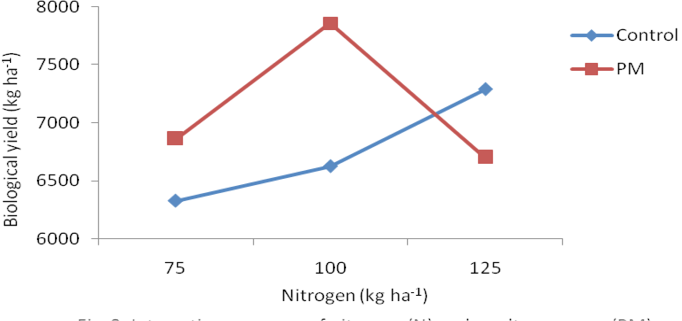
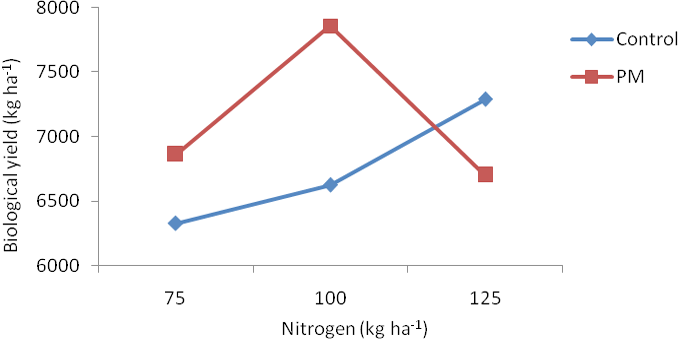
Inorganic N Level, poultry manure and application time of N significantly affected biological yield (Table 2). All interactions were significant for biological yield of wheat. Higher biomass weight (7244 kg ha-1) was recorded in treatments involving addition of 100 kg N ha-1 as compared to lowest nitrogen rate (6594 kg ha-1) and highest one (6995 kg ha-1). Adequate nitrogen rate than lower and over doses may produce more productive tillers per unit area , which may improve the biomass production. Poultry manure control plots gave lower biological yield (6747 kg ha-1) than poultry manure applied plots (7141 kg ha-1). The variation in biomass production may be due to more moisture and nutrients available during whole season . Split dose application of synthetic fertilizer N boosted biological yield (7147 kg ha-1) than whole at planting (6686 kg ha-1), but was not statistically different to whole at boot stage (6999 kg ha-1). This finding may be associated with greater availability of nitrogen in critical stages of wheat growth , thus higher biological yield may be acquired. Interaction (N x M) showed that biomass weight was boosted in linear trend by increasing N rate used as full at sowing, while full N at boot and/or in split doses indicated a quadratic response (Figure 9). Regardless of M, when PM was incorporated, enhanced biomass weight linearly (Figure 10).
Grain yieldy
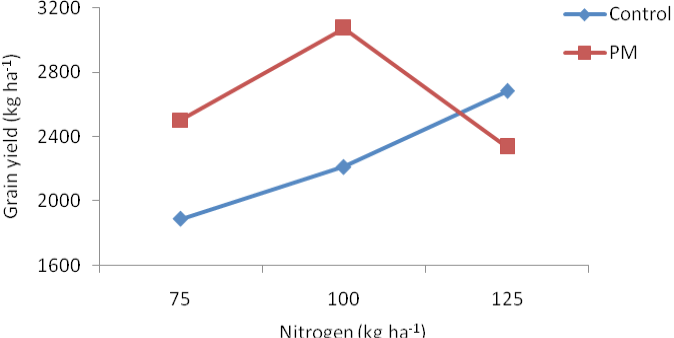
Grain yield was significantly affected by synthetic N rate and timings and poultry manure. All of the interactions (N x PM, N x M, PM x M and N x PM x M) proved significant for grain yield (Table 2). The addition of 100 kg N ha-1 resulted in greater grain yield (2644 kg ha-1) than other two nitrogen levels ha-1 i.e. 125 (2510 kg ha-1) and 75 (2197 kg ha-1). This is possibly due to enough nitrogen accessible to the crop , may result better growth and promoted leaf area. Using poultry manure brought higher grain yield (2639 kg ha-1) than plots where no poultry manure was added (2262 kg ha-1). More nutrients availability and lesser N losses or more nitrogen uptake during life cycle of crop , could bring higher grain yield. Concerning dose and times of inorganic N application, better performance (2701 kg ha-1) was recorded through split application than whole both at boot stage (2449 kg ha-1) and at land preparation (2201 kg ha-1). Nitrogen availability at the correct time and minimum N loss , may enhance grain yield. Enhancing N levels boosted grain yield linearly when applied in split doses, while full applications either at planting or boot stage presented a quadratic response (Figure 12). A linear trend was observed from control to PM incorporation when N applied in any amount at any growth stage (Figure 13).
Table 2: Biological yield, grain yield and harvest index of wheat as affected by fertilizer-N, poultry manure and fertilizer-N application time.
| Treatments | |||
| Fertilizer-N (kg ha-1) | Biological yield (kg ha-1) | Grain yield (kg ha-1) | Harvest index (%) |
| 75 | 6594 c | 2197 c | 33.25 b |
| 100 | 7244 a | 2644 a | 36.30 a |
| 125 | 6995 b | 2510 b | 36.02 a |
| LSD 0.05 | 192.62 | 127.40 | 2.10 |
| Poultry manure (PM)(t ha-1) | |||
| 0 | 6747 b | 2262 b | 33.32 b |
| 4 | 7141 a | 2639 a | 37.06 a |
| Significance | ** | ** | ** |
| Time of N application (M) | |||
| Full at sowing | 6686 b | 2201 c | 32.90 b |
| Full at boot stage | 6999 ab | 2449 b | 34.85 b |
| ½ at sowing + ½ at boot | 7147 a | 2701 a | 37.82 a |
| LSD 0.05 | 160.86 | 132.70 | 2.08 |
| Interactions | |||
| N x PM | 0.00 | 0.00 | 0.00 |
| N x M | 0.00 | 0.01 | 0.02 |
| PM x M | 0.04 | 0.03 | 0.01 |
| N x PM x M | 0.00 | 0.02 | 0.01 |
**Significant at 1% level of probability.
Harvest indexz
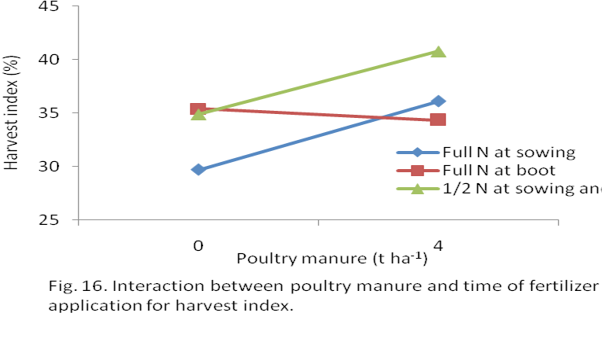
The Table 2 shows that fertilizer N, poultry manure and time of fertilizer N significantly affected harvest index. Similarly, the overall interactions were also significant. Higher harvest indices (36.30 and 36.02 %) were recorded through application of 100 and 125 kg N ha-1, respectively as compared to 75 kg N ha-1 (33.25 %). Improvement in grain yield relative to biomass , may have enhanced harvest index of the crop. Maximum harvest index (37.06 %) was obtained from N + PM application whereas lesser from without poultry manure (33.32 %). Prolonged availability of water and essential elements may result bumper growth and enhanced leaf area , thus boosting harvest index of wheat. Application of inorganic nitrogen as full at planting or at boot stage produced lower harvest indices (32.90 and 34.85 %) respectively than 50% at planting and 50% at boot stage (37.82 %). This result is similar to more development in economic yield in comparison to biomass production so that higher harvest indices means may be obtained. Interaction (N x M) revealed that through either application times, quadratic relationship was observed between N levels and harvest index except for split application, which presented linear enhancement (Figure 15). Whole N applied at sowing and in split doses increased the harvest index linearly with PM incorporation except full N at boot stage, which resulted in decline of harvest index (Figure 16).
Conclusions and Recommendation
It is concluded from the research work that application of 100 kg N ha-1 applied as ½ at land preparation and ½ at boot stage along with poultry manure incorporation performed better regarding growth, yield and yield components of wheat and incorporation of optimum nitrogen level in split doses with poultry manure could be recommended for higher wheat productivity.
Author’s Contribution
Tanzim Ullah Khan: Data collection, conducting experiment and wrote the paper.
Mohammad Tariq Jan: Conceived the idea and technical support.
Ahmad Khan: Technical input at every step.
Gulzar Ahmad: Incoporated reviewers comments.
Muhammad Ishaq: Data entry and statistical analysis.
Khilwat Afridi: Overall management of the article.
Murad Ali: Analysis of soil and poultry manure samples.
Muhammad Adeel Qureshi: Incoporated reviewers comments.
Imtiaz Ahmad: Review of paper.
Muhammad Saeed: Helped in references.
Figures
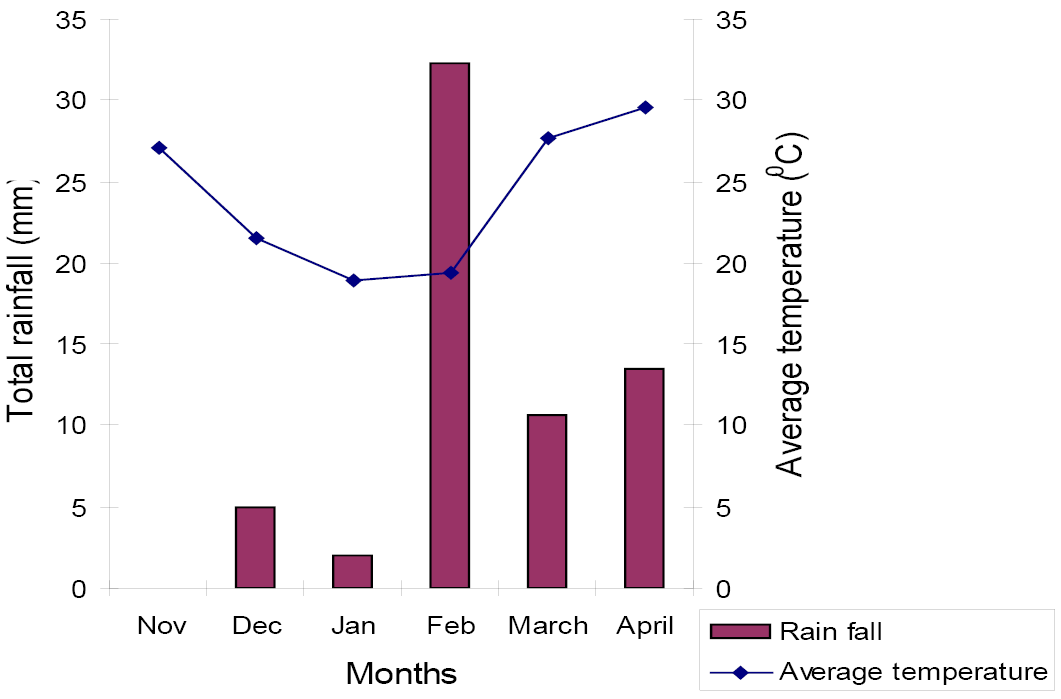
Total rainfall and monthly average temperature from November, 2010 to April, 2011 for Peshawar-Pakistan.
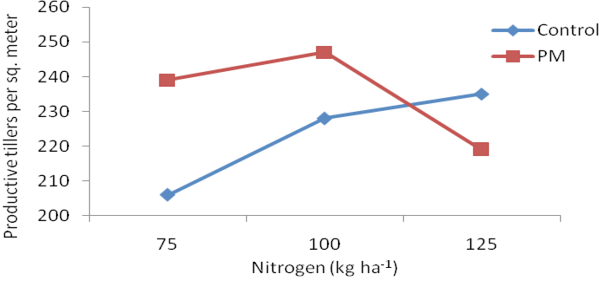
Interactive reponse of fertilizer nitrogen (N) and poultry manure (PM) for produductive tillers per sq. meter.
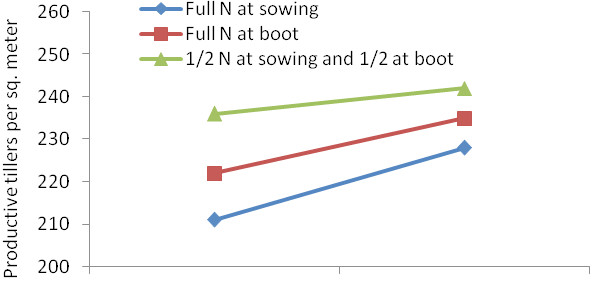
Interactive reponse of fertilizer nitrogen (N) and application time of fertilizer N (M) for produductive tillers per sq. meter.
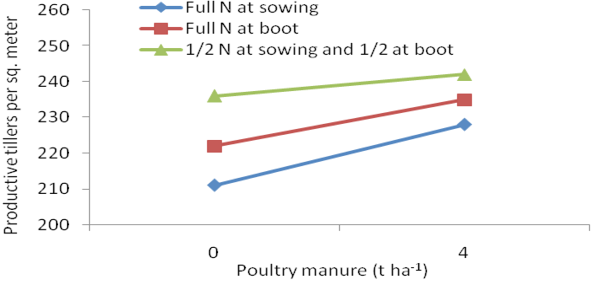
Poultry manure (PM) and application time of fertilizer N (M) interactive reponse for produductive tillers per sq. meter.
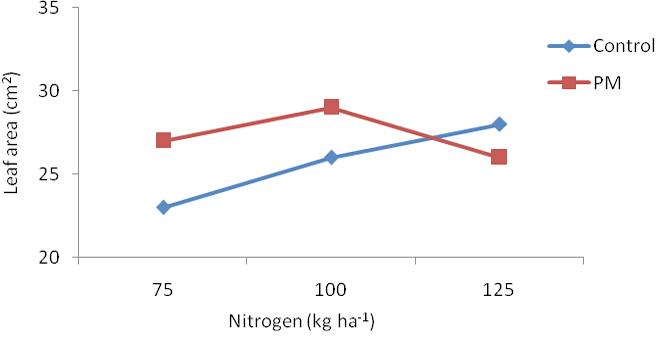
Interaction between fertilizer nitrogen (N) and poultry manure (PM) for leaf area
Interaction between fertilizer nitrogen (N) and poultry manure (PM) for number of grains per spike.
Interactive response (N × PM) for thousand grains weight.
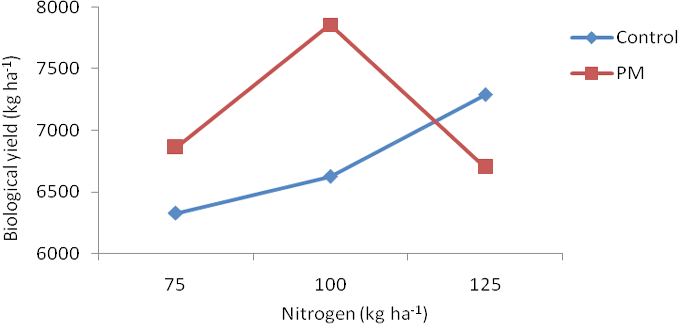
Interaction response of nitrogen (N) and poultry manure (PM) for biological yield.
Interactive response (N × M) for biological yield
Interaction between poultry manure (PM) and fertilizer N application time (M) for biological yield.
Fertilizer nitrogen (N) and poultry manure (PM) interactive response for grain yield.
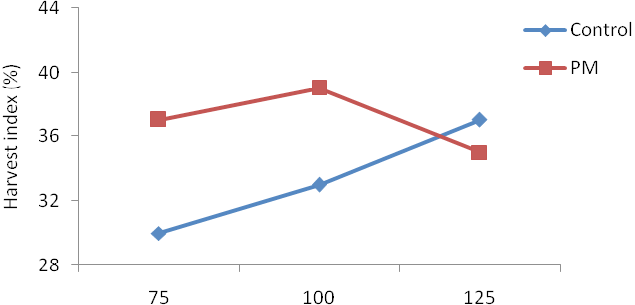
Interaction between fertilizer nitrogen (N) and application time of fertilizer N (M) for grain yield.
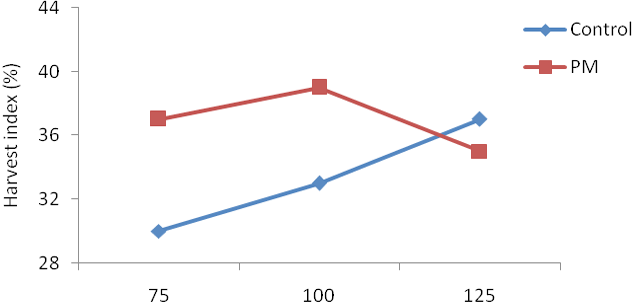
Interaction between poultry manure (PM) and application time of fertilizer N for grain yield.
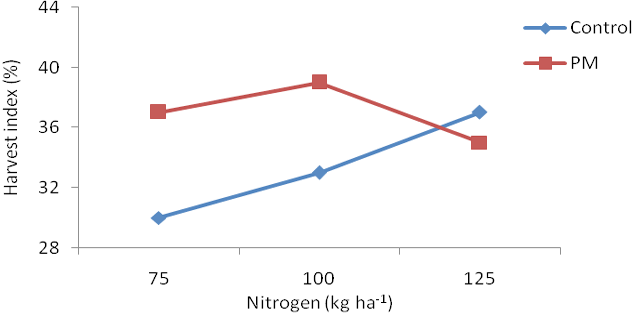
Interaction response of N and PM for Harvest Index.
Fertilizer nitrogen rate and time interactive for harvest index.
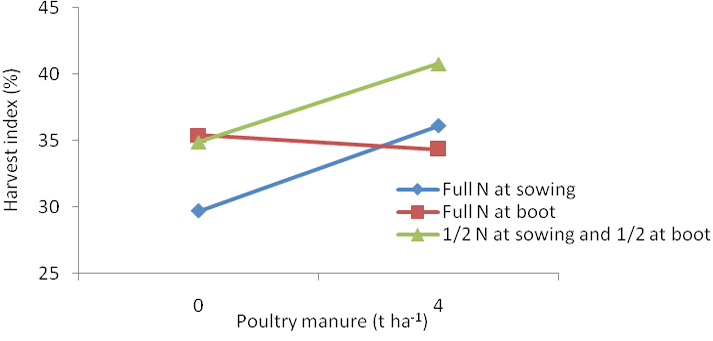
Interaction between poultry manure and time of fertilizer N application for harvest index.
References
- Abbas, G., J.Z.K. Khattak, A. Mir, M. Ishaque, M. Hussain, H.M. Wahedi, M.S. Ahmed and A. Ullah. 2012. Effect of organic manures with recommended dose of NPK on the performance of wheat (Triticum aestivum L.). J. Anim. Plant Sci. 22(3): 683-687.
- Abbasi, M.K. and A. Khaliq. 2016. Nitrogen mineralization of a loam soil supplemented with organic–inorganic amendments under laboratory incubation. Front. Plant Sci. 7: 1038. https://doi.org/10.3389/fpls.2016.01038[CrossRef]
- Abedi, T., A. Alemzadeh and S.A. Kazemeini. 2011. Wheat yield and grain protein response to nitrogen amount and timing. Aus. J. Crop Sci. 5(3): 330-336.
- Ahmed, B.E.A.M., A.A. Ishag, M.K. Hassan and M.O. Ahmed. 2017. Response of two wheat cultivars (Triticum aestivum L.) to amended nitrogen fertilizer on yield and grain quality in Halfa Elgadidah area. MOJ. Biol. Med. 1(5): 00029.
- Amanullah and P. Shah. 2010. Timing and rate of nitrogen application influence grain quality and yield in maize planted at high low densities. J. Sci. Food Agric. 90: 21-29. https://doi.org/10.1002/jsfa.3769[CrossRef]
- Anonymous. 2013. World wheat supply and demand. Available online at: http://www.uswheat.org/ar/cqp/doc/DFAAD699D7A6E43385257C3D004F5BB0/$File/1309%20IMF%20S&D%20-%20Final%20-2.pdf?OpenElement.
- Bashir, M.U., S.A. Wajid, A. Ahmad, M. Awais, M.A.S. Raza, G.M. Tahir, U. Saeed, M.H.U. Rehman, M. Waqas and S. Abbas. 2017. Irrigation scheduling of wheat at different nitrogen levels in semi-arid region. Turk. J. Field Crops. 22(1): 63-70. https://doi.org/10.17557/tjfc.303880[CrossRef]
- Chaudhry, A.N., G. Jilani, M.A. Khan and T. Iqbal. 2009. Improved processing of poultry litter to reduce nitrate leaching and enhance its fertilizer quality. Asian J. Chem. 21: 4997-5003.
- Dikinya, O. and N. Mufwanzala. 2010. Chicken manure-enhanced soil fertility and productivity: Effects of application rates. J. Soil Sci. Environ. Manage. 1(3): 46-54.
- Ferrari, M., V.J. Szareski, M. Nardino, A.J. de-Pelegrin, I.R. Carvalho and V. Queiroz de Souza. 2016. Effects of sources and split application of nitrogen fertilizer on wheat genotypes performance. Aus. J. Crop Sci. 10(12): 1669-1674. https://doi.org/10.21475/ajcs.2016.10.12.p7741[CrossRef]
- Hammad, H.M., A. Ahmad, K.Q. Laghari, F. Abbas, W. Nasim, W. Farhad and A.H. Malik. 2011. Organic farming in wheat crop under condition of Pakistan. Pak. J. Agric. Sci. 48(2): 97-102.
- Hawkesford, M.J. 2014. Reducing the reliance on nitrogen fertilizer for wheat production. J. Cereal Sci. 59(3): 276-283. https://doi.org/10.1016/j.jcs.2013.12.001[CrossRef]
- Jan, M.T., M.J. Khan, A. Khan, M. Arif, Farhatullah, D. Jan, M. Saeed and M.Z. Afridi. 2011. Improving wheat productivity through source and timing of nitrogen fertilization. Pak. J. Bot. 43(2): 905-914.
- Jan, M.T., P. Shah, P.A. Hollington, M.J. Khan and Q. Sohail. 2009. Agriculture Research: Design and Analysis. Dept. Agronomy, KP Agric. Univ. Peshawar, Pakistan.
- Kabesh, M.O., M.F. El-kramany, G.A. Sary, H.M. El-Naggar, Gehan and S.H. Bakhoum. 2009. Effect of sowing methods and some bio-organic fertilization treatments on yield and yield components of wheat. J. Agric. Biol. Sci. 5(1): 97-102.
- Khalil, I.A. 2008. Crops and cropping in Pakistan. HEC, Islamabad. pp. 71-72.
- Khalil, S.K., F. Khan, A. Rehman, F. Muhammad, Amanullah, A.Z. Khan, S. Wahab, S. Akhtar, M. Zubair, I.H. Khalil, M.K. Shah and H. Khan. 2011. Dual purpose wheat for forage and grain yield in response to cutting, seed rate and nitrogen. Pak. J. Bot. 43(2): 937-947.
- Maltas, A., R. Charles, B. Jeangros and S. Sinaj. 2013. Effect of organic fertilizers and reduced-tillage on soil properties, crop nitrogen response and crop yield: Results of a 12-year experiment in Changins, Switzerland. Soil and Tillage Res. 126: 11-18. https://doi.org/10.1016/j.still.2012.07.012[CrossRef]
- Maqsood, M., M.A. Shehzad, Y. Ramzan and A. Sattar. 2014. Effect of nitrogen nutrition on growth, yield and radiation use efficiency of different wheat (Triticum aestivum L.) cultivars. Pak. J. Agric. Sci. 51(2): 441-448.
- Mattas, K.K., R.S. Uppal and R.P. Singh. 2011. Effect of varieties and nitrogen management on the growth, yield and nitrogen uptake of durum wheat. Res. J. Agric. Sci. 2(2): 376-380.
- Mulvaney, R.L., S.A. Khan and T.R. Ellsworth. 2009. Synthetic nitrogen fertilizers deplete soil nitrogen: A global dilemma for sustainable cereal production. J. Environ. Qual. 38: 2295–2314. https://doi.org/10.2134/jeq2008.0527[CrossRef]
- Naderi, R. and H. Ghadiri. 2010. Urban waste compost, manure and nitrogen fertilizer effects on the initial growth of corn (Zea mays L.). Desert. 15: 159-165.
- Shah, S.A., S.M. Shah, W. Mohammad, M. Shafi, H. Nawaz, S. Shehzadi and M. Amir. 2010. Effect of integrated use of organic and inorganic nitrogen sources on wheat yield. Sarhad J. Agric. 26(4): 559-563.
- Shah, W.A., H.U. Khan, S. Anwar and K. Nawab. 2011. Yield and yield components of wheat as affected by different seed rates and nitrogen levels. Sarhad J. Agric. 27(1): 17-25.
- Shahzad, K. and M. Akmal. 2017. Yield performance of wheat under split N application rates and timing. Sarhad J. Agric. 33(3): 350-356. https://doi.org/10.17582/journal.sja/2017/33.3.350.356[CrossRef]
- Yahya, A., Al-Rawashdeh and A.H. Abdel-Ghani. 2008. Effect of nitrogen application timing on dry matter and nitrogen assimilation and partitioning in six wheat cultivars under rain-fed conditions of Jordan. Archives Agron. Soil Sci. 54(2): 149–162. https://doi.org/10.1080/03650340701829621[CrossRef]
- Yildirim, M., Z. Yakut, C. Akinci, F. Kurt and F. Kizilgeci. 2016. Nitrogen rate and timing implementation on durum wheat in a bed planting system. Sains Malays. 45(2): 221–228.
- Zhang, H.Q., X.Y. Yu, B.N. Zhai, Z.Y. Jin and Z.H. Wang. 2016. Effect of manure under different nitrogen application rates on winter wheat production and soil fertility in dryland. IOP Conf. Ser.: Earth Environ. Sci. 39: 012048. https://doi.org/10.1088/1755-1315/39/1/012048[CrossRef]
Cited by 2 articles
In journals published by ResearchersLinks.
- Management of Nitrogen Sources with and without Beneficial Microbes and its Application Timing for Wheat Crop stand and Phenology ImprovementSarhad Journal of Agriculture · 2022
- Biochar Improves Phenological and Physiological Attributes of Wheat in Soil Amended with Organic and Inorganic Nitrogen SourcesSarhad Journal of Agriculture · 2020
Services
Article usage statistics
Loading…