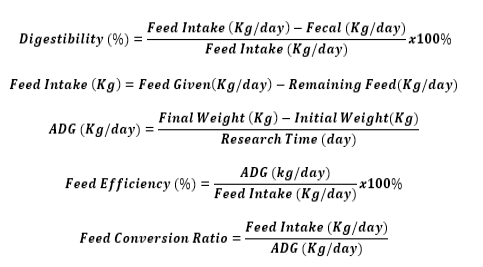
The ADG on T3 treatment is higher than the male Pesisir cows weaning off until the age of 2 years 0.21 kg/head/day, and the age of 3-4 years 0.12 kg/day, and it almost the same as the ADG from birth to weaning around 0.32 kg/day. The ADG in this study was lower than the Afdal and Khasrad (2006) which obtained ADG values of Pesisir cattle in the range of 0.58-0.80 kg/head/day. The high value is due to the TDN value of the rations given is 68% and experimental livestock experiences a compensatory growth effect.
Dry matter intake in treatment T4 (3.23 Kg) is not as high as in treatment T1 (3.53 Kg) but this is comparably inverted when viewed from the added weight body, wherein treatment T4 the weight gain body is greater compared with body weight gain in treatment T1. Consumption of high rations does not guarantee the increase of body weight too. Likewise, Usman et al. (2013), stated that not all of livestock that consume more rations will grow higher compared to those who consume fewer rations.
The treatment of T1 had the highest feed conversion compared to other treatments. However, when viewed from weight gain, treatment T1 has the weight gain lowest weight gain. Conversion value on ration T1 means to produce 1 kg of body weight per day required 128.09 kg of material dry ration. Then, the conclusions showed that giving treatment T1 ration did not produce good feed conversion. So, it can be concluded that the feed conversion in T1 treatment is not good because the feed is consumed a lot but less effective in the meat formation. The nutritional value of feed at treatment T1 ratio is low. Similarly, Jamarun and Zain (2013) demonstrated that the ability of livestock in converting feed into meat is very dependent on the quality of the feed especially the content of protein, energy, and crude fiber.
The lowest rations conversion value contained in treatment T3 with dry matter intake of 3.74 kg and body weight up to 0.31 Kg. A good ration conversion rate is when low ration consumption can increase high body weight gain. It is presumably due to the feed intake in treatment T3 has fulfilled the physiological needs of livestock with content protein and optimal energy. Therefore, feed conversion of livestock is low as it is expressed by Maynard and Loosli (1979), the higher nutritional value in rations will influence the low conversion ratio.
Ration conversion values in treatment T2 (16.82) and T4 (40.41) are poor conversion rates because dry matter intake of 3.53 Kg and 3.23 Kg only increase ADG by 0.21 Kg and 0.08 Kg. The research result indicates that the ration conversion in treatment T3 is lower than treatment T2 and T4. It can be concluded that the availability of the energy source in treatment T3 is more optimal for microorganisms in rumen activity that work optimally.
The best feed conversion was obtained at T3 treatment (P <0.05). This condition illustrates that the quality of this T3 ration is very good and suitable for livestock and has a good palatability value. Based on Church and Pond (1995) stated that feed quality will determine feed conversion. Also, good quality feed will result in high ADG. Feed conversion is influenced by cattle breed, genetics, cow condition, age, ADG, the ability of livestock to digest feed, feed palatability, type of feed ingredients, availability of nutrients in the ration, season conditions, and management (Pazla et al., 2018b; Suyitman et al., 2020; Jusman et al., 2020). Sugiharto et al. (2004) state that the feed conversion of cows that are fed locally according to the habits of farmers on dry land is 13.6, while the ideal feed conversion for beef cattle is 9 (Tillman et al., 1991).
Treatments T2 and T3 showed the best ratio of feed efficiency so that the ADG in this treatment was also higher than treatment T1 and T4. The ratio of protein and energy in treatment T2 and T3 was very optimal in affecting the performance of rumen microbes in degrading feed, thereby increasing feed efficiency (Pazla, 2015). The low feed efficiency in treatment T1 and T4 was due to the imbalance of crude protein and TDN content in the rations. Similarly, Ariesafera (2019) states that the CP and TDN ratio in the rations is closely related to feeding efficiency. Pesisir cow will consume feed efficiently if the CP and TDN ratio in the rations is balanced. The feed efficiency in this study was higher than the research of Jusman et al. (2020) which was 7.78% and lower than the research of Suyitman et al. (2020) which was 12.22%. This difference is caused by the type of cow, the type of feed ingredients for the ration, and the quality of the feed used.