
This study aimed to investigate the protective impact of synthesized curcumin selenium nanoparticles (CurSeNPs), using a hydroalcoholic extract of Curcuma longa rhizomes, in reducing disruption to hormonal profiles, redox homeostasis, inflammatory parameters, and ovarian tissue PTEN gene expressions in rats treated with doxorubicin. CurSeNPs were synthesized using sodium hydrogen selenite and a hydroalcoholic extract derived from Curcuma longa. The in vivo study utilized thirty-two mature female rats divided into four experimental groups over a two-week treatment period as follows: Rats in the control group (C) received distilled water orally, Group G1 received intraperitoneal injections of doxorubicin (4.40 mg/kg B.W), Group G2 was administered CurSeNPs (10.47 μg/kg B.W), and Group G3 received both doxorubicin and CurSeNPs at the same doses. Blood samples were collected from anesthetized rats; serum was analyzed to assess levels of FSH, estrogen, TGF-β, and NF-κB. Additionally, ovarian tissue was extracted to measure levels of malondialdehyde (MDA) and superoxide dismutase (SOD) concentrations, and to estimate ovarian gene expression of PTEN. The findings indicated a notable decrease in tissue SOD, serum FSH, and estrogen levels, along with an elevation in tissue MDA, serum TGF-β, NF-κB, and PTEN gene expression levels in the G1 group. However, the results demonstrated that administration of CurSeNPs in the G2 and G3 groups effectively improved oxidative stress-related factors, hormonal profiles, inflammatory criteria, and reduced expression of the PTEN gene. The present investigation has shown that CurSeNPs exhibit preventive actions against doxorubicin toxicity in adult female rats, possibly through their antioxidant, anti-inflammatory, and anticancer properties.
Research Article · Volume 12, Issue 3, 2 September 2024 · Open Access
Insights into Curcumin-Selenium Nanoparticles in Modulating Hormonal Levels and Promoting PTEN Gene Expression in Doxorubicin Treated Rats
·
Affiliations & Notes ⌄
- 1Department of Physiology, Biochemistry and Pharmacology, College of Veterinary Medicine, University of Baghdad. *Correspondence | Rawya Sh. Mohammed, Department of Physiology, Biochemistry and Pharmacology, College of Veterinary Medicine, University of Baghdad
- 2Email: rawia.mirza2106p@covm.uobaghdad.edu.iq, baraa.n@covm.uobaghdad.edu.iq, najimbaraa@gmal.com
Article Info ⌄
- Journal:
- Journal of Animal Health and Production
- Published:
- 2 September 2024

Abstract
INTRODUCTION
Nanobiotechnology is a developing field within nanotechnology that has gained global attention. Green nanotechnology is a highly effective strategy for reducing the impacts of nanomaterial production and use, while simultaneously minimizing the potential dangers connected with alternative approaches ; . The study investigates the antioxidant activity and renal protective benefits of silver nanoparticles derived from Salvia officinalis against the harmful effects of methotrexate in rats . Doxorubicin, often known as DOX or adriamycin, is a commonly employed cytotoxic anthracycline antibiotic in treating cancer in premenopausal individuals . The chemotherapeutic effects of this substance on cancer cells may be attributed to various processes, including its ability to intercalate into deoxyribonucleic acid (DNA) and inhibit topoisomerase-II-mediated DNA repair. Additionally, it can generate free radicals that cause damage to cellular membranes, DNA, and proteins . DOX exhibit deleterious effects on ovarian follicles in rodents, including follicular atresia, overactivation ; ; and reduced production of 17beta-estradiol (E2) . Selenium demonstrates biological properties linked to the defence system, antioxidation, antiviral characteristics, as well as anticancer effects . Simultaneously, selenium nanoparticles (SeNPs) also contribute to the reduction and alleviation of heavy metal toxicity, it possess the benefits of a high absorption rate, elevated biological activity, and less toxicity ; . The stability of these nanoparticles becomes better due to their natural organic molecular coating, which prevents any accumulation over time ; . The black currant selenium nanoparticle works as an antioxidant and hypolipidemic agent. It exhibits both prophylactic and therapeutic properties in mitigating the harmful impact of D-galactose . In rats, Avena sativa seed crude extract protects the heart from DOX-induced toxicity .
Curcumin, derived from the rhizomes of Curcuma longa, exhibits significant pharmacological effects such as anti-tumor , antioxidant and anti-inflammatory properties. Multiple studies have documented that curcumin possesses the ability to postpone the progression of ovarian cancer, enhance its responsiveness to chemotherapy, and minimize the adverse effects of chemotherapy medications, also evidence has demonstrated the significant potential of this substance in fighting cancer by encouraging apoptosis, limiting the process of cell division, triggering the self-degradation of cells, preventing the spread of tumors, and controlling the activity of enzymes . These particles have been proven to be nanoparticles, which possess future uses in numerous sectors, medicine, and therapy . One of the many biological functions of curcumin phytosome nanoparticles (CPNPs) is their ability to reduce inflammation and lower cholesterol levels . Previous studies have further confirmed the hypothesis that phytochemicals play a crucial role in regulating the formation of metal nanoparticles . Therefore, this study was designed to explore the risks resulting from exposure to DOX on certain parameters of ovarian tissues in adult female rats.
MATERIALS AND METHODS
The current study was conducted at an animal center affiliated with the College of Veterinary Medicine, University of Baghdad. Ethical approval (P.G. 2641 dated 29-11-2023) was obtained from the local committee of animal care and use for the study involving animals, conducted in strict compliance with the code of ethics for animal experiments at the University of Baghdad’s College of Veterinary Medicine. Thirty-two adults female Wistar rats were used in this experiment and were randomly and evenly divided into four experimental groups after an acclimatization period. The rats received the following treatments for two weeks: Rats in the control group (C) were orally administered distilled water; Group G1 received intraperitoneal injections of doxorubicin (STADA Pharm, Germany) at a dose of 4.40 mg/kg B.W; Group G2 received CurSeNPs at a dose of 10.47 μg/kg B.W; and Group G3 received both doxorubicin and CurSeNPs at the same doses. Rats were anesthetized and blood samples were collected by heart puncture. Serum levels of FSH, estrogen, NF-κB, and TGF-β were measured. Additionally, specimen ovarian tissues were discarded to measure serum Malondialdehyde (MDA) and superoxide dismutase (SOD) using enzymatic kits (BTLAB, China), as well as the gene expression of PTEN. Total RNA from the ovarian tissue was extracted using an RNA extraction kit from Genaid Korea. The quantification of gene expression was carried out using forward primer (5ˊ-TGGATTCGACTTAGACTTGACCT-ˊ3) and reverse primer (5ˊ - GGTGGGTTATGGTCTTCAAAAGG-ˊ3) for PTEN and forward primer: 5ˊ- CACCCACTCCTCCACCTTTG-ˊ3 and reverse primer: 5ˊ- CCACCACCCTGTTGCTGTAG-ˊ3 for GAPDH with the AddScript RT-qPCR Syber master kit from AddBio, Korea. The RT-qPCR results were evaluated based on the criteria outlined by Schmittgen and Livak (2008).
Statistical analysis
The data were analyzed using the statistical software SPSS version 26, and the results are presented as means ± standard deviation (SD). One-way analysis of variance (ANOVA) followed by Tukey’s post-hoc test was employed for statistical analysis. The study also utilized the Least Significant Difference (LSD) test for between-group comparisons, with statistical significance set at P < 0.05 (Baarda and van Dijkum, 2019).
Result and Discussion
Redox status
The group treated with doxorubicin revealed a significant rise (P<0.05) in MDA with a significant decline in SOD concentrations in ovarian tissues compared to other groups (Figure 1A, B). Whereas the G2 and G3 groups showed a significant (P< 0.05) decrease in MDA associated with a significant (P<0.05) increase in SOD levels in ovarian tissues as compared to group G1. This study pointed out that doxorubicin-induced oxidative stress in ovarian tissue via changes in redox status through elevating lipid peroxidation (LPO), which was documented by an increase in tissue MDA concentration representing increased cellular membrane tissue injury. This result was agree with ; ; .
Numerous studies confirm that curcumin treatments have been demonstrated to significantly increase the concentrations of antioxidant enzymes, such as CAT, SOD and GSH-Px, as observed in different investigations , 2020). Curcumin is believed to have a role in alleviating the oxidative stress and cardiotoxicity caused by DOX ; Yarmohammadi et al., 2020a). Particularly it can improve the antioxidant defense mechanisms by activating the Nrf2 pathway and its associated signaling molecules ; ; via four separate mechanisms, including inhibiting Keap1, altering the upstream regulators of Nrf2, modulating the expression of Nrf2 and its target genes, and enhancing the nuclear translocation of Nrf2 ; ; . The modulation of gene and protein expressions of Nrf2, Keap1, HO-1, and NQO1, confirmed the antioxidant modulation mechanism of curcumin on mice subjected to intense exercise . Another findings reported that curcumin can reduce oxidative stress via activating the Keap1-Nrf2-ARE signaling pathway , as well as administering hexa-hydrocurcumin to rats revealed a considerable reduction in oxidative stress levels accompanied with an increase in the expression of Nrf2 and HO-1, antioxidative enzyme activity, and SOD activity .
FSH and estrogen
The findings demonstrated a significant decline in serum FSH and estrogen concentrations in group G1 compared to the control group and group G2. Rats administered CurSeNPs (G2) demonstrated a significant parallel increase (P > 0.05) in serum FSH and estrogen levels compared to groups C, G1, and G3. The FSH and estrogen hormones in group G3 showed a non-significant difference (P > 0.05) in FSH and estrogen concentrations compared to the control group (Figure 2A, B). These results agree with ; ; ; . Doxorubicin disturbs the hormonal balance of the hypothalamic-pituitary-gonadal (HPG) axis, affecting essential hormones causing impairment in the process of folliculogenesis and oogenesis, resulting in the loss of ovulation and the uterine cycle which is associated with reduction in the duration of the pro-estrous and estrous phases in rodent models. Additionally, doxorubicin induces mitochondrial failure in oocytes that have compromised calcium signaling and endoplasmic reticulum stress ; and caused a significant reduction in the average number of primary, secondary, and Graafian follicles in treated rats .
DOX prevent the synthesis of topoisomerase II and the generation of reactive oxygen species, which results in impairment of the cell membrane, DNA damage, hyperactivation of primordial follicles and apoptosis ; , consequently exhaust the supply of ovarian follicles and disruption of the female reproductive capacity ; ; ; van der Zanden et al., 2021). The synergistic properties of CurSeNPs, which result from the combination of selenium and the active substances found in Curcuma longa, have been found to reduce the impact of free radicals and maintain the levels of FSH and estrogen within the normal range . Curcumin shows a beneficial impact on ovarian disorders due to its anti-inflammatory , anti-apoptotic ; and antioxidant characteristics . Moreover, curcumin effectively decreases hyperglycemia, hypogonadism and impaired insulin resistance in diverse conditions, such as polycystic ovary syndrome (PCOS) .
NF-KB and TGF-β
The results presented in Figure 3A, B, exhibited that there is a remarkable (P<0.05) increase in the serum NF-KB and TGF-β concentrations in the doxorubicin treated group. These results are in line with ; . Doxorubicin treatment has been found to increase levels of proinflammatory mediators such as TNF-α, intercellular adhesion molecule-1 (ICAM-1), cyclooxygenase-2 (COX-2), TGF-β, NF-κB, MPO, IL-1β, and IL-6 in cardiac cells ; Al-. TGF-β acting as a cytokine, can enhance proliferation and differentiation and promote fibrosis by stimulating fibroblast proliferation and conversion to myofibroblasts ; ; . Findings showed that DOX enhanced the mRNA expression of TGF-β1, TNF-α, IL-6, and IL-10, initiating strong inflammatory responses that cause severe damage to cardiomyocytes . Also, oxidative stress can directly stimulate the activation of NF-κB, which in turn leads to the activation of NF-κB, causing an increase in the expression of NLRP3 . A recent study demonstrated that lowered extracts have significant antioxidative and anti-inflammatory effects due to the combined action of selenium and phytochemicals (Al-Brakati et al., 2021; . Curcumin effectively minimises or inhibits the inflammatory process by decreasing the generation of inflammatory factors and possesses the capacity to regulate cellular signaling pathways, so it could be preventing the development of inflammation by modulation of cell division and programmed cell death signaling pathways, or by suppressing the expression of genes associated with tumor growth .
PTEN
The mRNA protein from rats’ ovarian tissues showed a significant increase (P < 0.05) in PTEN gene expression observed in doxorubicin-treated rats (Figures 4, 5, and 6), whereas groups G2 and G3 exhibited a significant reduction in this gene expression. Doxorubicin has the potential to increase PTEN gene expression by modulating the PI3K and mTOR signaling pathways . In contrast, CurSeNPs may mitigate doxorubicin-induced ovarian damage in rats by targeting these pathways ; . Major signaling pathways controlling the recruitment and growth of primordial follicles include phosphatase and tensin homolog on chromosome 10 (PTEN), phosphatidylinositol 3-kinase (PI3K), and protein kinase B (PKB, Akt). Additionally, impaired DNA damage response (DDR)
may occur due to accelerated primordial follicle activation through this mechanism . The PI3K/Akt signaling pathway disruption significantly impacts ovarian follicular granulose cells which involved in the development of insulin resistance, mitochondrial mutations and polycystic ovary syndrome (PCOS) ; ; . Curcumin, a major active polyphenolic compound, impacts the female reproductive system by exerting anti-inflammatory effects and regulating endocrine function . Many investigations have demonstrated that curcumin plays a role in preserving the ovarian reserve’s steadiness is achieved via regulating the PTEN-AKT-FOXO3a pathway. Collectively, the findings indicate that curcumin has the potential to serve as a preventive measure against chemotherapy-induced ovarian damage and as a viable pharmaceutical option for treating patients ; .
Conclusions and Recommendations
CurSeNPs utilize Curcuma longa extract to naturally produce nanoparticles that demonstrate preventive and therapeutic actions against ovarian toxicity induced by doxorubicin in mature female rats. CurSeNPs represent a therapeutic approach with antioxidant, anti-inflammatory, and anticancer properties.
Acknowledgement
This experiment was carried out with the aid of the University of Baghdad’s College of Veterinary Medicine.
Novelty Statement
The novelty of this manuscript lies in illustrating how curcumin selenium nanoparticles increase PTEN gene expression in rat ovarian tissues by mitigating the adverse effects of anticancer drugs through inhibition of the PI3K and mTOR pathways.
Author’s Contribution
Baraa Najim was responsible for designing the experiment. Rawya Shakir conducted data analysis, interpretation, and experimental procedures. Baraa Najim provided technical support, wrote the article, and also provided conceptual advice.
Conflict of interest
The authors have declared no conflict of interest.
Figures

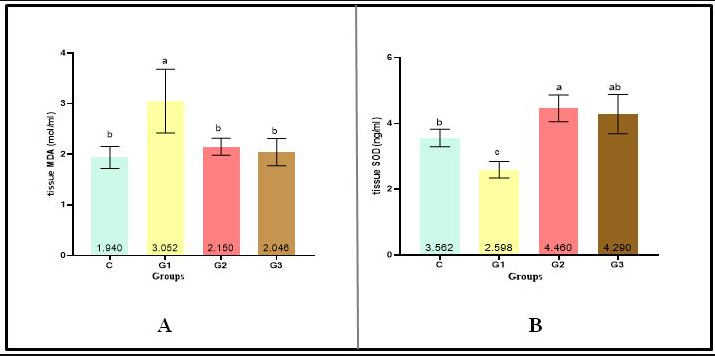
Effect of CurSeNPs, doxorubicin and both on (A) tissue MDA and (B) tissue SOD in adult female rats after 14 days.
Values are expressed as mean ± SD, n=5. C= Control group. G1 = Injected with i/p doxorubicin 4.40 mg /kg. B.W. G2 = Administrated with CurSeNPs 10.47 μg / kg B.W orally. G3 = Administrated with CurSeNPs 10.47 μg / kg B.W orally and with doxorubicin 4.40 mg/ kg B.W i/p. Different small letters present on bars indicate significant differences between groups at P<0.05.
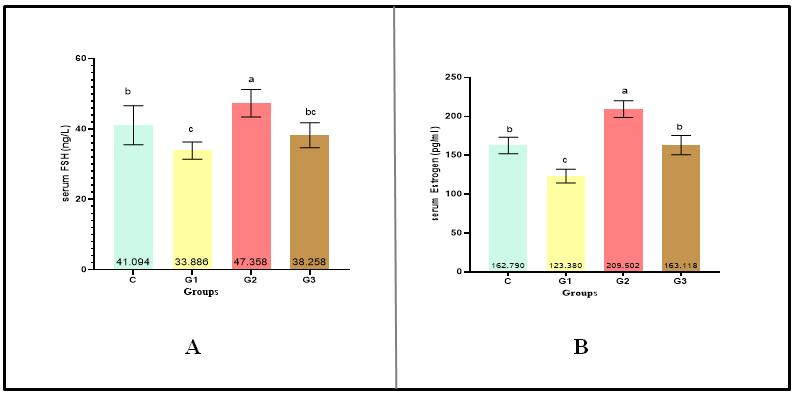
Effect of CurSeNPs, doxorubicin and both on (A) serum FSH and (B) serum estrogen in adult female rats after 14 days.
Values are expressed as mean ± SD, n=5. C= Control group. G1 = Injected with i/p doxorubicin 4.40 mg /kg. B.W. G2 = Administrated with CurSeNPs 10.47 μg / kg B.W orally. G3 = Administrated with CurSeNPs 10.47 μg / kg B.W orally and with doxorubicin 4.40 mg/ kg B.W i/p. Different small letters present on bars indicate significant differences between groups at P<0.05.
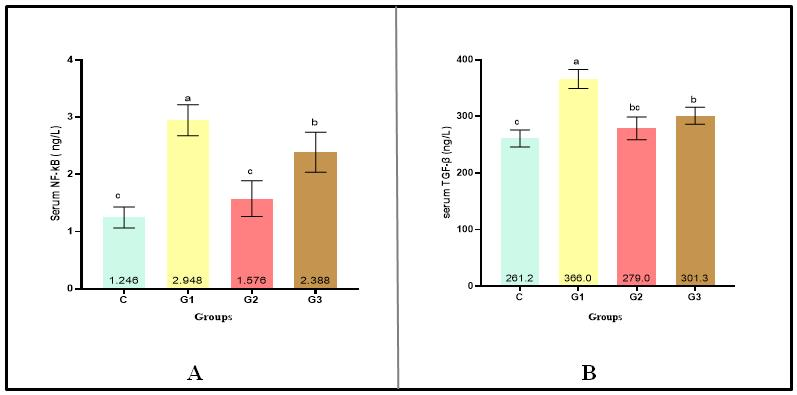
Effect of CurSeNPs, doxorubicin and both on (A) serum NF-κB and (B) serum TGF-β in adult female rats after 14 days.
Values are expressed as mean ± SD, n=5. C= Control group. G1 = Injected with i/p doxorubicin 4.40 mg /kg. B.W. G2 = Administrated with CurSeNPs 10.47 μg / kg B.W orally. G3 = Administrated with CurSeNPs 10.47 μg / kg B.W orally and with doxorubicin 4.40 mg/ kg B.W i/p. Different small letters present on bars indicate significant differences between groups at P<0.05.
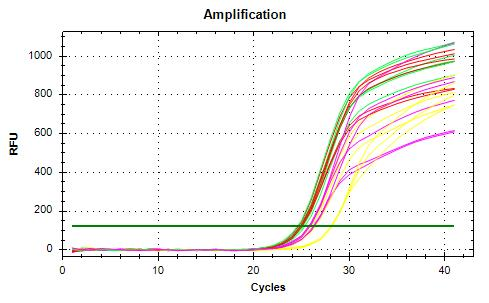
The real-time amplification plots of PTEN gene expression of ovarian tissue in rats experimental samples. The purple plots (control group), green plots (G1 group), red plots (G2 group), yellow plots (G3 group).
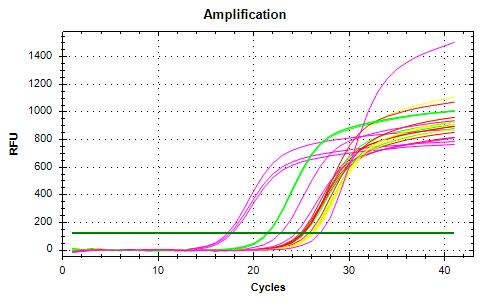
The real-time amplification plots of housekeeping (GAPDH) gene expression of ovarian tissue in rats experimental samples. The purple plots (control group), green plots (G1 group), red plots (G2 group), yellow plots (G3 group).
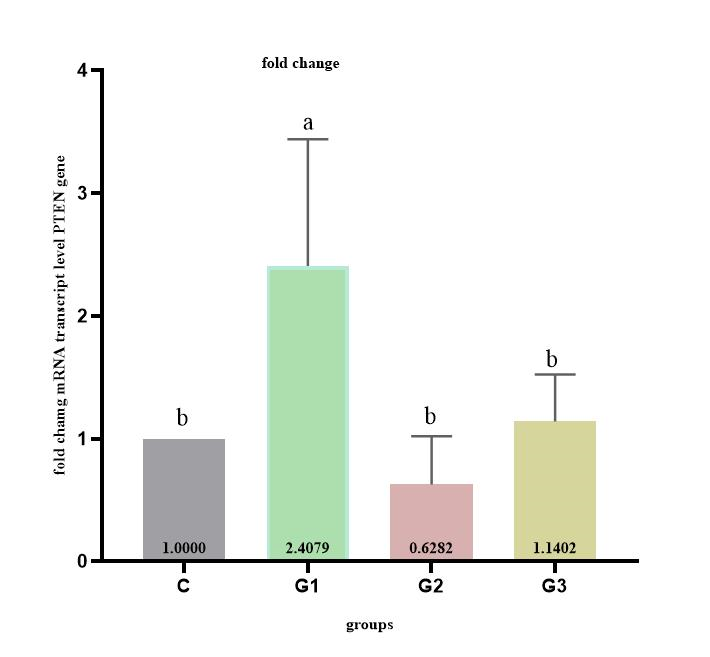
Assessment of PTEN gene expression in ovarian tissues of rats treated with CurSeNPs, doxorubicin and both after 14 days.
Values are expressed as mean ± SD, n=5. C= Control group. G1 = Injected with i/p doxorubicin 4.40 mg /kg. B.W. G2 = Administrated with CurSeNPs 10.47 μg / kg B.W orally. G3 = Administrated with CurSeNPs 10.47 μg / kg B.W orally and with doxorubicin 4.40 mg/ kg B.W i/p. Different small letters present on bars indicate significant differences between groups at P<0.05.
References
- Akbari, S., Kariznavi, E., Jannati, M., Elyasi, S., Tayarani-Najaran, Z. (2020). Curcumin as a preventive or therapeutic measure for chemotherapy and radiotherapy induced adverse reaction. Food Chem. Toxicol., 145: 111699. https://doi.org/10.1016/j.fct.2020.111699[CrossRef]
- Akter, T., Zahan, M.S., Nawal, N., Rahman, H., Tanjum, T.N., Arafat, K.I., Uddin, M.J. (2023). Potentials of curcumin against polycystic ovary syndrome: Pharmacological insights and therapeutic promises. Heliyon. 9(6): E16957. https://doi.org/10.1016/j.heliyon.2023.e16957[CrossRef]
- Alanazi, A.M., Fadda, L., Alhusaini, A., Ahmad, R., Hasan, I.H., Mahmoud, A.M. (2020). Liposomal resveratrol and/or carvedilol attenuate doxorubicin-induced cardiotoxicity by modulating inflammation, oxidative stress and S100A1 in rats. Antioxidants, 9(2): 159. https://doi.org/10.3390/antiox9020159[CrossRef]
- Al-Brakati, A., Alsharif, K.F., Alzahrani, K.J., Kabrah, S., Al-Amer, O., Oyouni, A.A., Abdel Moneim, A.E. (2021). Using green biosynthesized lycopene-coated selenium nanoparticles to rescue renal damage in glycerol-induced acute kidney injury in rats. Int. J. Nanomed., 16: 4335-4349. https://doi.org/10.2147/IJN.S306186[CrossRef]
- Al-Kurdy, M.J. and Khudair K.K. (2020). Effect of selenium loaded Ribes nigrum nanoparticles on genetic markers in male rats with D-galactose induced toxicity. Onderstepoort J. Vet. Res., 24(5): 312-327.
- Al-Okaily, B.N., Murad, H.F., (2021). Role of alpha lipoic acid in protecting testes of adult rats from lead toxicity. Iraqi J. Vet. Sci., 35(2): 305-312. https://doi.org/10.33899/ijvs.2020.126814.1386[CrossRef]
- Alqayim, M.A., (2019). Biosynthesis, characterization and bioactivity of selenium nanoparticles synthesized by propolis. Iraqi J. Vet. Med., 43(1): 197-209. https://doi.org/10.30539/iraqijvm.v43i1.490[CrossRef]
- Ashrafizadeh, M., Ahmadi, Z., Mohammadinejad, R., Farkhondeh, T., Samarghandian, S., (2020). Curcumin activates the Nrf2 pathway and induces cellular protection against oxidative injury. Curr. Mol. Med., 20(2): 116-133. https://doi.org/10.2174/1566524019666191016150757[CrossRef]
- Azami, S.H., Nazarian, H., Abdollahifar, M.A., Eini, F., Farsani, M.A., Novin, M.G., (2020). The antioxidant curcumin postpones ovarian aging in young and middle-aged mice. Reprod. Fertil. Dev., 32(3): 292-303. https://doi.org/10.1071/RD18472[CrossRef]
- Aziz, M.M., Abd El-Fattah, M.A., Ahmed, K.A., Sayed, H.M. (2020). Protective effects of olmesartan and l-carnitine on doxorubicin-induced cardiotoxicity in rats. Can. J. Physiol. Pharmacol., 98(4): 183-193. https://doi.org/10.1139/cjpp-2019-0299[CrossRef]
- Baarda, B., and van Dijkum, C. (2019). Introduction to Statistics with SPSS. Routledge. https://doi.org/10.4324/9781003021704[CrossRef]
- Bellezza, I., Giambanco, I., Minelli, A., Donato, R. (2018). Nrf2-Keap1 signaling in oxidative and reductive stress. Biochim. Biophys. Acta (BBA)-Mol. Cell Res., 1865(5): 721-733. https://doi.org/10.1016/j.bbamcr.2018.02.010[CrossRef]
- Bhardwaj, J.K., Bikal, P., Sachdeva, S.N. (2023). Chemotherapeutic drugs induced female reproductive toxicity and treatment strategies. J. Biochem. Mol. Toxicol., 37(7): e23371. https://doi.org/10.1002/jbt.23371[CrossRef]
- Chen, H., Zhou, C., Zheng, J., Zhang, Z., Deng, Y., Cheng, C., Guo, Z., Huo, G., Yin, C., Sun, X. (2022a). PTEN and AKT/GSK-3β/CRMP-2 signaling pathway are involved in neuronal apoptosis and axonal injury in early brain injury after SAH in rats. Genes Dis. 9(1): 252-267. https://doi.org/10.1016/j.gendis.2020.05.002[CrossRef]
- Chen, N., Yao, P., Zhang, W., Zhang, Y., Xin, N., Wei, H., Zhao, C. (2023). Selenium nanoparticles: Enhanced nutrition and beyond. Crit. Rev. Food Sci. Nutr., 63(33): 12360-12371. https://doi.org/10.1080/10408398.2022.2101093[CrossRef]
- Chen, Y., Jiang, W., Liu, X., Du, Y., Liu, L., Ordovas, J.M., Shen, L. (2020). Curcumin supplementation improves heat-stress-induced cardiac injury of mice: Physiological and molecular mechanisms. J. Nutr. Biochem., 78: 108331. https://doi.org/10.1016/j.jnutbio.2019.108331[CrossRef]
- Chen, Y., Liu, X., Jiang, C., Liu, L., Ordovas, J.M., Lai, C.Q., Shen, L. (2018). Curcumin supplementation increases survival and lifespan in Drosophila under heat stress conditions. BioFactors, 44(6): 577-587. https://doi.org/10.1002/biof.1454[CrossRef]
- Chen, Y., Wang, J., Jing, Z., Ordovas, J.M., Wang, J., Shen, L. (2022b). Anti-fatigue and anti-oxidant effects of curcumin supplementation in exhaustive swimming mice via Nrf2/Keap1 signal pathway. Curr. Res. Food Sci., 5: 1148-1157. https://doi.org/10.1016/j.crfs.2022.07.006[CrossRef]
- Dabravolski, S.A., Nikiforov, N.G., Eid, A.H., Nedosugova, L.V., Starodubova, A.V., Popkova, T.V., Orekhov, A.N. (2021). Mitochondrial dysfunction and chronic inflammation in polycystic ovary syndrome. Int. J. Mol. Sci., 22(8): 3923. https://doi.org/10.3390/ijms22083923[CrossRef]
- dos Santos Silva, R.L., Lins, T.L.B.G., do Monte, A.P.O., de Andrade, K.O., de Sousa Barberino, R., da Silva, G.A.L., de Matos, M.H.T. (2023). Protective effect of gallic acid on doxorubicin-induced ovarian toxicity in mouse. Reprod. Toxicol., 115: 147-156. https://doi.org/10.1016/j.reprotox.2022.12.008[CrossRef]
- Fareed, S., Kabir, M., Hussain, S., Batool, S., Khan, F., Badshah, J. (2023). Protective role of olive oil in the doxorubicin induced ovarian toxicity in female rats. Pak. J. Physiol., 19(3): 31-35. https://doi.org/10.69656/pjp.v19i3.1507[CrossRef]
- Gencer, S., Oleinik, N., Kim, J., Panneer Selvam, S., De Palma, R., Dany, M., Ogretmen, B. (2017). TGF-β receptor I/II trafficking and signaling at primary cilia are inhibited by ceramide to attenuate cell migration and tumor metastasis. Sci. Signal., 10(502): eaam7464. https://doi.org/10.1126/scisignal.aam7464[CrossRef]
- Ishaq, A., Gulzar, H., Hassan, A., Kamran, M., Riaz, M., Parveen, A., Fahad, S. (2021). Ameliorative mechanisms of turmeric-extracted curcumin on arsenic (As)-induced biochemical alterations, oxidative damage, and impaired organ functions in rats. Environ. Sci. Pollut. Res., 28: 66313-66326. https://doi.org/10.1007/s11356-021-15695-4[CrossRef]
- Ismail, M.B., Rajendran, P., AbuZahra, H.M., Veeraraghavan, V.P. (2021). Mangiferin inhibits apoptosis in doxorubicin-induced vascular endothelial cells via the Nrf2 signaling pathway. Int. J. Mol. Sci., 22(8): 4259. https://doi.org/10.3390/ijms22084259[CrossRef]
- Iwamoto, T., Hara, F., Uemura, Y., Mukai, H., Watanabe, T., Ohashi, Y. (2020). NSAS-BC02 substudy of chemotherapy-induced amenorrhea (CIA) in premenopausal patients who received either taxane alone or doxorubicin (A) cyclophosphamide (C) followed by taxane as postoperative chemotherapy. Breast Cancer Res. Treatment, 182: 325-332. https://doi.org/10.1007/s10549-020-05692-5[CrossRef]
- Jadaan, G.H., Khudair, K.K. (2023). Curcumin phytosome as an anti- inflammatory and hypolipidemic in nano-silicon treated female rats. Adv. Anim. Vet. Sci., 11(12): 2023-2029. https://doi.org/10.17582/journal.aavs/2023/11.12.2023.2029[Full text][CrossRef]
- Jaffar, H.I., Hussein, S.I. (2015). Preparation and some characterization of curcumin-silica materials by sol-gel method. J. Adv. Res. Sci. Eng. Technol., 6: 1153-1160.
- Joshi, P., Joshi, S., Semwal, D., Bisht, A., Paliwal, S., Dwivedi, J., Sharma, S. (2021). Curcumin: an insight into molecular pathways involved in anticancer activity. Mini Rev. Med. Chem., 21(17): 2420-2457. https://doi.org/10.2174/1389557521666210122153823[CrossRef]
- Kabel, A.M. (2018). Zinc/alogliptin combination attenuates testicular toxicity induced by doxorubicin in rats: Role of oxidative stress, apoptosis and TGF-β1/NF-κB signaling. Biomed. Pharmacother., 97: 439-449. https://doi.org/10.1016/j.biopha.2017.10.144[CrossRef]
- Kamal, D.A.M., Salamt, N., Yusuf, A.N.M., Kashim, M.I.A.M., Mokhtar, M.H. (2021). Potential health benefits of curcumin on female reproductive disorders: A review. Nutrients, 13(9): 3126. https://doi.org/10.3390/nu13093126[CrossRef]
- Khudair, K.K.; Al-Kurdy, M.J. and Al-Kinani, L.H. (2020). Synthesis and characterization of black currant selenium nanoparticles (Part I). Iraqi J. Vet. Med., 44(2): 25-34. https://doi.org/10.30539/ijvm.v44i2.974[CrossRef]
- Kim, D.H., Choi, Y.M., Ki, Y.K., Cho, K.S., Choi, Y.J., Kim, W.T. (2019). Topically applied melatonin ameliorates radiation-induced skin fibrosis in mice. Int. J. Radiat. Res., 17(4): 617-624.
- Lee, J., Choi, M.K., Song, I.S. (2023). Recent advances in doxorubicin formulation to enhance pharmacokinetics and tumor targeting. Pharmaceuticals, 16(6): 802. https://doi.org/10.3390/ph16060802[CrossRef]
- Li, Y., Deng, X., Tan, X., Li, Q., Yu, Z., Wu, W., Wang, X. (2024). Protective role of curcumin in disease progression from non-alcoholic fatty liver disease to hepatocellular carcinoma: A meta-analysis. Front. Pharmacol., 15: 1343193. https://doi.org/10.3389/fphar.2024.1343193[CrossRef]
- Liu, M., Zhu, H., Zhu, Y., Hu, X. (2021). Guizhi fuling wan reduces autophagy of granulosa cell in rats with polycystic ovary syndrome via restoring the PI3K/AKT/mTOR signaling pathway. J. Ethnopharmacol., 270: 11382. https://doi.org/10.1016/j.jep.2021.113821[CrossRef]
- Liu, T., Zhang, L., Joo, D., Sun, S.C. (2017). NF-κB signaling in inflammation. Signal Trans. Target. Ther., 2(1): 1-9. https://doi.org/10.1007/978-1-4939-6786-5_12[CrossRef]
- Liu, X., Qi, M., Li, X., Wang, J., Wang, M. (2023). Curcumin: A natural organic component that plays a multi-faceted role in ovarian cancer. J. Ovarian Res., 16(1): 47. https://doi.org/10.1186/s13048-023-01120-6[CrossRef]
- Lu, Z., Gao, Z., Song, H., Zhou, Y., Yuan, W., Wang, X., Chang, C. (2023). Synthesis, biological evaluation and action mechanism study of new mitochondria‐targeted curcumin derivative as potential antitumor drugs. Chem. Biodiv., 20(7): e202300086. https://doi.org/10.1002/cbdv.202300086[CrossRef]
- Lv, Y., Cao, R.C., Liu, H.B., Su, X.W., Lu, G., Ma, J.L., Chan, W.Y. (2021). Single-oocyte gene expression suggests that curcumin can protect the ovarian reserve by regulating the PTEN-AKT-FOXO3a pathway. Int. J. Mol. Sci., 22(12): 6570. https://doi.org/10.3390/ijms22126570[CrossRef]
- Maidarti, M., Anderson, R.A., Telfer, E.E. (2020). Crosstalk between PTEN/PI3K/Akt signalling and DNA damage in the oocyte: Implications for primordial follicle activation, oocyte quality and ageing. Cells, 9(1): 200. https://doi.org/10.3390/cells9010200[CrossRef]
- Memarzia, A., Khazdair, M.R., Behrouz, S., Gholamnezhad, Z., Jafarnezhad, M., Saadat, S., Boskabady, M.H. (2021). Experimental and clinical reports on anti‐inflammatory, antioxidant, and immunomodulatory effects of Curcuma longa and curcumin, an updated and comprehensive review. BioFactors, 47(3): 311-350. https://doi.org/10.1002/biof.1716[CrossRef]
- Mohamed, K.M., Abdelfattah, M.S., El-khadragy, M., Al-Megrin, W.A., Fehaid, A., Kassab, R.B., Abdel Moneim, A.E. (2023). Rutin-loaded selenium nanoparticles modulated the redox status, inflammatory, and apoptotic pathways associated with pentylenetetrazole-induced epilepsy in mice. Green Process. Synth., 12(1): 20230010. https://doi.org/10.1515/gps-2023-0010[CrossRef]
- Mohammed, H.S., Hosny, E.N., Khadrawy, Y.A., Magdy, M., Attia, Y.S., Sayed, O.A., AbdElaal, M. (2020). Protective effect of curcumin nanoparticles against cardiotoxicity induced by doxorubicin in rat. Biochim. Biophys. Acta (BBA)-Mol. Basis Dis., 1866(5): 165665. https://doi.org/10.1016/j.bbadis.2020.165665[CrossRef]
- Mohan, U.P., PB, T.P., Iqbal, S.T.A., Arunachalam, S. (2021). Mechanisms of doxorubicin-mediated reproductive toxicity. A review. Reprod. Toxicol., 102: 80-89. https://doi.org/10.1016/j.reprotox.2021.04.003[CrossRef]
- Murthy, H.A., Ghotekar, S., Kumar, V.B., Roy, A. (2021). Graphene: A multifunctional nanomaterial with versatile applications. Adv. Mater. Sci. Eng., 2021: 1-8. https://doi.org/10.1155/2021/2418149[CrossRef]
- Niringiyumukiza, J.D., Cai, H., Chen, L., Li, Y., Wang, L., Zhang, M., Xiang, W. (2019). Protective properties of glycogen synthase kinase-3 inhibition against doxorubicin-induced oxidative damage to mouse ovarian reserve. Biomed. Pharmacother., 116: 108963. https://doi.org/10.1016/j.biopha.2019.108963[CrossRef]
- Nishi, K., Gunasekaran, V.P., Arunachalam, J., Ganeshan, M. (2018). Doxorubicin-induced female reproductive toxicity: An assessment of ovarian follicular apoptosis, cyclicity and reproductive tissue histology in Wistar rats. Drug Chem. Toxicol., 41(1): 72-81. https://doi.org/10.1080/01480545.2017.1307851[CrossRef]
- Pistollato, F., Iglesias, R.C., Ruiz, R., Aparicio, S., Crespo, J., Lopez, L.D., Battino, M. (2017). The use of natural compounds for the targeting and chemoprevention of ovarian cancer. Cancer Lett., 411: 191-200. https://doi.org/10.1016/j.canlet.2017.09.050[CrossRef]
- Qiu, Z., Dong, J., Xue, C., Li, X., Liu, K., Liu, B., Huang, F. (2020). Liuwei Dihuang Pills alleviate the polycystic ovary syndrome with improved insulin sensitivity through PI3K/Akt signaling pathway. J. Ethnopharmacol., 250: 111965. https://doi.org/10.1016/j.jep.2019.111965[CrossRef]
- Rabah, H.M., Mohamed, D.A., Mariah, R.A., Abd El-Khalik, S.R., Khattab, H.A., AbuoHashish, N.A., Eltokhy, A.K. (2023). Novel insights into the synergistic effects of selenium nanoparticles and metformin treatment of letrozole-induced polycystic ovarian syndrome: Targeting PI3K/Akt signalling pathway, redox status and mitochondrial dysfunction in ovarian tissue. Redox Rep., 28(1): 2160569. https://doi.org/10.1080/13510002.2022.2160569[CrossRef]
- Rad, P., Safari, F., Mohammadi, J., Delaviz, H. (2021). Preserved ovarian function following toxicity with doxorubicin in rats: Protective effect of nasturtium officinale extract. Iran. J. Toxicol., 15(1): 57-64. https://doi.org/10.32598/IJT.15.1.747.1[CrossRef]
- Ramalingam, M., Kokulnathan, T., Tsai, P.C., Valan Arasu, M., Al-Dhabi, N.A., Prakasham, K., Ponnusamy, V.K. (2021). Ultrasonication-assisted synthesis of gold nanoparticles decorated ultrathin graphitic carbon nitride nanosheets as a highly efficient electrocatalyst for sensitive analysis of caffeic acid in food samples. Appl. Nanosci., 13: 707–718. https://doi.org/10.1007/s13204-021-01895-4[CrossRef]
- Ren, G., Yi, S., Zhang, H., Wang, J. (2017). Ingestion of soy–whey blended protein augments sports performance and ameliorates exercise-induced fatigue in a rat exercise model. Food Funct., 8(2): 670-679. https://doi.org/10.1039/C6FO01692H[CrossRef]
- Salim, A.G., Hasan, H.F. (2022). The role of Avena sativa seeds alcoholic extract and enalapril against doxorubicin-induced cardiac toxicity in female rats. Biochem. Cell. Arch., 22(1): 2153.
- Samare-Najaf, M., Zal, F., Safari, S. (2020). Primary and secondary markers of doxorubicin-induced female infertility and the alleviative properties of quercetin and vitamin E in a rat model. Reprod. Toxicol., 96: 316-326. https://doi.org/10.1016/j.reprotox.2020.07.015[CrossRef]
- Schmittgen, T.D., Livak, K.J. (2008). Analyzing real-time PCR data by the comparative CT method. Nat. Protoc., 3(6): 1101-1108. https://doi.org/10.1038/nprot.2008.73[CrossRef]
- Shareef, B.Q., Al-Qadhi, H.I., Shayma’a, A.J. (2024). Antioxidant effects of selenium nanoparticles prepared from eruca sativa extract on ketoconazole–induced testicular oxidative damage in male rats. J. Fac. Med. Baghdad, 66(1): 58-66. https://doi.org/10.32007/jfacmedbagdad.6612174[CrossRef]
- Sood, M.A., Khudiar, K.K. (2019). Role of Salvia officinal’s silver nanoparticles in attenuating renal damage in rats exposed to methotrexate (Part I). Iraqi J. Vet. Med., 42(2): 7-20. https://doi.org/10.30539/iraqijvm.v42i2.281[CrossRef]
- Spears, N., Lopes, F., Stefansdottir, A., Rossi, V., De Felici, M., Anderson, R.A., Klinger, F.G. (2019). Ovarian damage from chemotherapy and current approaches to its protection. Hum. Reprod. Update, 25(6): 673-693. https://doi.org/10.1093/humupd/dmz027[CrossRef]
- Subburaman, S., Ganesan, K., Ramachandran, M. (2014). Protective role of naringenin against doxorubicin-induced cardiotoxicity in a rat model: Histopathology and mRNA expression profile studies. J. Environ. Pathol. Toxicol. Oncol., 33(4): 363-376. https://doi.org/10.1615/JEnvironPatholToxicolOncol.2014010625[CrossRef]
- Thorn, C.F., Oshiro, C., Marsh, S., Hernandez-Boussard, T., McLeod, H., Klein, T.E. and Altman, R.B. (2011). Doxorubicin pathways: pharmacodynamics and adverse effects. Pharmacogenet. Genom., 21(7): 440-446. https://doi.org/10.1097/FPC.0b013e32833ffb56[CrossRef]
- van der Zanden, S.Y., Qiao, X., Neefjes, J. (2021). New insights into the activities and toxicities of the old anticancer drug doxorubicin. FEBS J., 288(21): 6095-6111. https://doi.org/10.1111/febs.15583[CrossRef]
- Wafi, A.M., Hong, J., Rudebush, T.L., Yu, L., Hackfort, B., Wang, H., Gao, L. (2019). Curcumin improves exercise performance of mice with coronary artery ligation-induced HFrEF: Nrf2 and antioxidant mechanisms in skeletal muscle. J. Appl. Physiol., 126(2): 477-486. https://doi.org/10.1152/japplphysiol.00654.2018[CrossRef]
- Wang, J., Chen, H., Zhou, Y., Su, Q., Liu, T., Li, L., (2017). Levosimendan pretreatment inhibits myocardial apoptosis in swine after coronary microembolization. Cell. Physiol. Biochem., 41(1): 67-78. https://doi.org/10.1159/000455950[CrossRef]
- Wang, Y., Liu, M., Johnson, S.B., Yuan, G., Arriba, A.K., Zubizarreta, M.E., Xiao, S. (2019). Doxorubicin obliterates mouse ovarian reserve through both primordial follicle atresia and overactivation. Toxicol. Appl. Pharmacol., 381: 114714. https://doi.org/10.1016/j.taap.2019.114714[CrossRef]
- Wang, Y., Liu, M., Zhang, J., Liu, Y., Kopp, M., Zheng, W., Xiao, S. (2018). Multidrug resistance protein 1 deficiency promotes doxorubicin-induced ovarian toxicity in female mice. Toxicol. Sci., 163(1): 279-292. https://doi.org/10.1093/toxsci/kfy038[CrossRef]
- Wicha, P., Tocharus, J., Janyou, A., Jittiwat, J., Changtam, C., Suksamrarn, A., Tocharus, C. (2017). Hexahydrocurcumin protects against cerebral ischemia/reperfusion injury, attenuates inflammation, and improves antioxidant defenses in a rat stroke model. PLoS One, 12(12): e0189211. https://doi.org/10.1371/journal.pone.0189211[CrossRef]
- Wu, R., Mei, X., Wang, J., Sun, W., Xue, T., Lin, C., Xu, D. (2019). Zn (ii)-Curcumin supplementation alleviates gut dysbiosis and zinc dyshomeostasis during doxorubicin-induced cardiotoxicity in rats. Food Funct., 10(9): 5587-5604. https://doi.org/10.1039/C9FO01034C[CrossRef]
- Xia, Z.H., Zhang, S.Y., Chen, Y.S., Li, K., Chen, W.B., Liu, Y.Q. (2020). Curcumin anti-diabetic effect mainly correlates with its anti-apoptotic actions and PI3K/Akt signal pathway regulation in the liver. Food Chem. Toxicol., 146: 111803. https://doi.org/10.1016/j.fct.2020.111803[CrossRef]
- Xiao, S., Zhang, J., Liu, M., Iwahata, H., Rogers, H.B., Woodruff, T.K. (2017). Doxorubicin has dose-dependent toxicity on mouse ovarian follicle development, hormone secretion, and oocyte maturation. Toxicol. Sci., 157(2): 320-329. https://doi.org/10.1093/toxsci/kfx047[CrossRef]
- Xie, Z., Wu, B., Shen, G., Li, X., Wu, Q. (2018). Curcumin alleviates liver oxidative stress in type 1 diabetic rats. Mol. Med. Rep., 17(1): 103-108. https://doi.org/10.3892/mmr.2017.7911[CrossRef]
- Yadav, Y.C., Pattnaik, S., Swain, K. (2019). Curcumin loaded mesoporous silica nanoparticles: assessment of bioavailability and cardioprotective effect. Drug Dev. Ind. Pharma., 45(12): 1889-1895. https://doi.org/10.1080/03639045.2019.1672717[CrossRef]
- Yarmohammadi, F., Hayes, A.W., Karimi, G. (2021a). Protective effects of curcumin on chemical and drug-induced cardiotoxicity: A review. Naunyn-Schmiedeberg’s Arch. Pharmacol., 394(7): 1341-1353. https://doi.org/10.1007/s00210-021-02072-8[CrossRef]
- Yarmohammadi, F., Rezaee, R., Karimi, G. (2021b). Natural compounds against doxorubicin‐induced cardiotoxicity: A review on the involvement of Nrf2/ARE signaling pathway. Phytother. Res., 35(3): 1163-1175. https://doi.org/10.1002/ptr.6882[CrossRef]
- Zhang, S., Liu, Q., Chang, M., Pan, Y., Yahaya, B.H., Liu, Y., Lin, J. (2023). Chemotherapy impairs ovarian function through excessive ROS-induced ferroptosis. Cell Death Dis., 14(5): 340. https://doi.org/10.1038/s41419-023-05859-0[CrossRef]
- Zhang, T., Qi, M., Wu, Q., Xiang, P., Tang, D., Li, Q. (2023). Recent research progress on the synthesis and biological effects of selenium nanoparticles. Front. Nutr., 10: 1183487. https://doi.org/10.3389/fnut.2023.1183487[CrossRef]
- Zhou, N., Long, H., Wang, C., Yu, L., Zhao, M., Liu, X. (2020). Research progress on the biological activities of selenium polysaccharides. Food Funct., 11(6): 4834-4852. https://doi.org/10.1039/C9FO02026H[CrossRef]
Cited by 1 article
In journals published by ResearchersLinks.
Services
Article usage statistics
Loading…