
The aim of this study was to explore the potential of harmaline as new, safe and more effective larvicidal of mosquitoes. Lethal and sublethal effects of harmaline were studied against the larvae of deltamethrin-resistant strain of Aedes albopictus. Laboratory bioassays were performed to determine the lethal and sublethal effects of harmaline on the larvae of Ae. albopictus, according to the standard WHO larval susceptibility test methods. The results indicated that harmaline exhibited strong larvicidal activity against the mosquito larvae, and the lethal effect on larval mortality of Ae. albopictus increased in a concentration-dependent manner. The mortality of four instar larvae peaked at 72 h after exposure. Among four instar larvae tested, the first-instar larvae was the most sensitive to harmaline with LC50 value of 23.02 mg/L, and the fourth-instar larvae was the most tolerant to harmaline with LC50 value of 42.58 mg/L at 72 h after exposure. In addition, sublethal dosage (LC10 and LC30) of harmaline could significantly delay the development of larvae and pupae (P<0.05). The LC30 concentration of harmaline also significantly decreased the pupation and adult emergence rates of larvae treated (P<0.05). The present study demonstrated that harmaline has a significant toxic effect against the deltamethrin-resistant strain larvae of Ae. albopictus. Particularly, harmaline might still cause markedly sublethal effects to the larvae, even at very low concentration (LC10) of harmaline. It is, therefore, worth further exploring the use of harmaline as a potential larvicide against vector mosquitos. four larval stages of Ae. albopictus.
Research Article · Volume 57, Issue 5, 20 August 2025 · Open Access
Insecticidal Activity of Harmaline from Peganum harmala Against the Larvae of Deltamethrin-Resistant Strain of the Asian Tiger Mosquito, Aedes albopictus
· · ·
Affiliations & Notes ⌄
- 1School of Biology and Food Engineering, Fuyang Normal University, Anhui, 236037, China 2Jiangsu Distance Education Association, Jiangsu, 210008, China 3Key Laboratory of Environmental Medicine Engineering, Ministry of Education, School of Public Health, Southeast University, Jiangsu, 210009, China * Corresponding author: jiangnan_fuyang@163.com
Article Info ⌄
- Journal:
- Pakistan Journal of Zoology
- Published:
- 20 August 2025

From the article
- In this study, the high rate of larval mortality of the different larval stages observed at higher concentrations (80 and 110 μg/mL) of harmaline), within a 24 h exposure indicates the high toxicity of the alkaloid.
- In this research, our results also clearly showed that the insecticidal activity of harmaline against fourth-instar larvae increased significantly with exposure time, such as at 24 h, 48 h, 72 h, 96 h and 120 h after exposure, LC50 values were 52.73, 46.01, 41.83, 41.52, and 40.19 mg/L, respectively.
- In this study, harmaline from P. harmala seeds against the larvae of deltamethrin-resistant strain of Ae.
- The results indicated that harmaline exhibited strong larvicidal activity against the mosquito larvae, and the lethal effect on larval mortality of Ae.
Selected from the article's own text.
Abstract
INTRODUCTION
The Asian tiger mosquito, Aedes albopictus (Skuse) (Diptera: Culicidae) is one of the most significant pathogen vectors of the twenty-first century. Originating from Asia, it has invaded a wide range of eco-climatic regions worldwide ; ; . Ae. albopictus has proven to be an infectious vector, which can transmit a spectrum of at least 23 human pathogens causing various diseases including dengue virus, West Nile virus and chikungunya virus ; . According to the WHO estimates, about 2.5 billion people live in dengue-risk areas around the world with 50 million dengue infections occurring every year. At present, there are no drugs or vaccines against the main pathogens and parasites transmitted by Ae. albopictus. As a result, it is well known that one way to reduce the mosquito populations is targeting mosquito larvae with chemical insecticides, such as pyrethroids, organophosphates, and insect growth regulators. However, repeated use of these chemical insecticides can lead to the development of resistance in mosquitoes or to human health or to undesirable effects on non-target organisms ; ; ; . For these reasons, there is an urgent need to develop new insecticides which are more environmentally safe and also biodegradable and target specific against vector mosquitoes ; . From this point of view, botanical-based insecticides are promising for mosquito control strategies, since they are rich storehouse of chemicals of diverse larvicide activity, more biodegradable and less hazardous. Particularly, the resistance by vectors against plant-derived insecticides has not been reported so far, and by controlling larval mosquitoes, adults may never become a problem ; . Indeed, plant extracts and plant-derived compounds belonging to many families have been reported to possess larvicidal properties against Aedes, Culex and Anopheles mosquitoes (Diptera: Culicidae) ; ; .
Harmaline was originally isolated from Peganum harmala (Zygophyllaceae), which is a perennial herbaceous and widely distributed in Middle East, India, Mongolia and China . This plant is rich in alkaloids and contains about 2% to 6% total alkaloids (dry weight), the alkaloid compounds illustrate well the diversity of pharmacological and biological activities compounds also found in various plants, its active alkaloids include beta-carbolines such as harmaline, harmine and harmalol ; ; ; . Modern pharmacology has also revealed that P. harmala alkaloids can inhibit acetylcholinesterase (AChE), butyrylcholinesterase (BChE), monoamine oxidase A (MAO-A), interact with-aminobutyric acid (GABA), and induce apoptosis and DNA damage ; . Currently, studies have shown that harmaline is one of the major active components of beta-carboline alkaloids and has multiple biochemical and pharmacological activities ; ; .
At present, some researchers have reported significant insecticide activity of beta-carboline alkaloids and total alkaloid extracts (TAEs) from P. harmala against various pests ; ; ; ; ; . Interestingly, in addition to lethal effects, several studies have also revealed that P. harmala total alkaloids or its beta-carboline alkaloids could induce sublethal effects on insect development, reproduction, and behavior ; ; ; . We have previously evaluated the insecticidal activity of TAEs and its alkaloids against many pests under laboratory and field conditions ; ; ; . Although studies investigated the insecticidal activities of some beta-carboline alkaloids and alkaloid extracts from P. harmala, but there is little evidence of being used as insecticides for controlling the vector mosquitoes like Ae. albopictus. Thus, the aim of this study was to evaluate the lethal and sublethal effects of harmaline against the deltamethrin-resistant strain larvae of Ae. albopictus.
MATERIALS AND METHODS
Harmaline and insect
Harmaline was purchased from Sigma-Aldrich (Sigma-Aldrich, St. Louis, MO) and the highest purity available (>98%), which obtained from the seeds of P. harmala. Deltamethrin powder (95% effective content) was purchased from Jiangsu Yangnong Chemical Group Co., Ltd. Tween 80 (Tedia Company, Inc., 1000 Tedia way, Fairfield, OH, USA).
Ae. albopictus, maintained for more than 100 generations without exposure to any known insecticide, was obtained from laboratory colonies in the State Key Laboratory of Pathogen and Biosecurity, Institute of Microbilogy and Epidemiology, Beijing. According to following the standard World Health Organization larval susceptibility test methods (WHO, 2005), and the deltamethrin-resistant colony of 15 generations, and the lethal concentration that kills 50% of the fourth instars larvae to deltamethrin (LC50) was 16.87 mg/L when it was used for this experiment. Eggs for the study were obtained by feeding mated 15 generations females with provided 10% sucrose solution for 12 h, and then provided with a rat placed in resting cages (25×25×35 cm) overnight for blood feeding by females. Larvae were fed a diet of dog biscuits, milk powder, beef liver, and yeast powder in a ratio of 2:1:1:1, respectively. The insectary room was maintained at a photoperiod of 14:10 (L/D) h, temperature of 27 ± 2°C and relative humidity of 75%-85%.
Lethal bioassays
The larval mortality bioassays were performed according to the test method of larval susceptibility as recommended by the World Health Organization methods (WHO, 2005). The different concentrations of harmaline solution were prepared with distilled water (0.05% Tween 80 as a carrier solvent), Tween 80 (0.05%) served as a control. Bioassays were performed on first to fourth instars of Ae. albopictus using concentrations of harmine as 20, 50, 80 and 110 mg/L, and thirty randomly-selected larvae per concentration was introduced into all the experiments. For mortality tests, thirty larvae each of the second, third and fourth instar larvae were introduced to a 250 ml glass beaker containing various concentrations of harmaline, and supplemented with 30 mg/L of the mixture food for larvae. A control was also maintained with Tween 80 (0.05%). Each treatment was replicated five times, and each replicated set contained one control for comparison. Larvae were exposed to various concentrations of harmaline at different hours after treatment. Mortality was recorded every 24 h after treatment. The larvae did not respond to the gentle prodding with forceps tip were judged as dead. The mortality rate was corrected when necessary for mortality in the controls using Abbott formula . The lethal concentration (LC50 and LC90) and their 95 % confidence limit was calculated using probit analysis .
Sublethal bioassays
The LC10 and LC30 concentrations required to kill 10% and 30% of the second-instar larvae within 72 h, which had already been determined from lethal bioassays, were selected as sublethal concentration of harmaline. Thirty larvae of early second instars were placed in 250 ml beaker and exposed to the LC10 and LC30 doses of each tested. And 72 h after treatment, dead larvae were counted and only alive larvae were transferred to glass beakers through a small filter, and larvae were provided with the mixture larval food at a concentration of 50 mg/L until pupation (WHO, 2005). For each treatment and control, seven replicates were performed in this experiment. Larval development was monitored daily until all larvae had either pupated or died. Pupae from each treatment were removed daily, and were transferred into a cups with deionized water until adults emerged. The development of mosquito larvae, and pupae and adults emerging each day was recorded.
Statistical analysis
Data from larval mortality tests were subjected to analysis of variance (ANOVA of square root transformed percentages). Differences between the treatments were determined by Tukey’s multiple range test to compare differences at P<0.05 significance level. The sulethal and lethal dosages of harmaline to the tested larvae were calculated by using probit analysis. And other statistics at 95 % confidence limits of upper confidence limit and lower confidence limit, and Chi-square (χ2) values were calculated using SPSS 12.0 software. The results with P < 0.05 were considered statistically significant to be statistically significant level.
RESULTS
Acute toxicity of harmaline on the larvae of Ae. albopictus
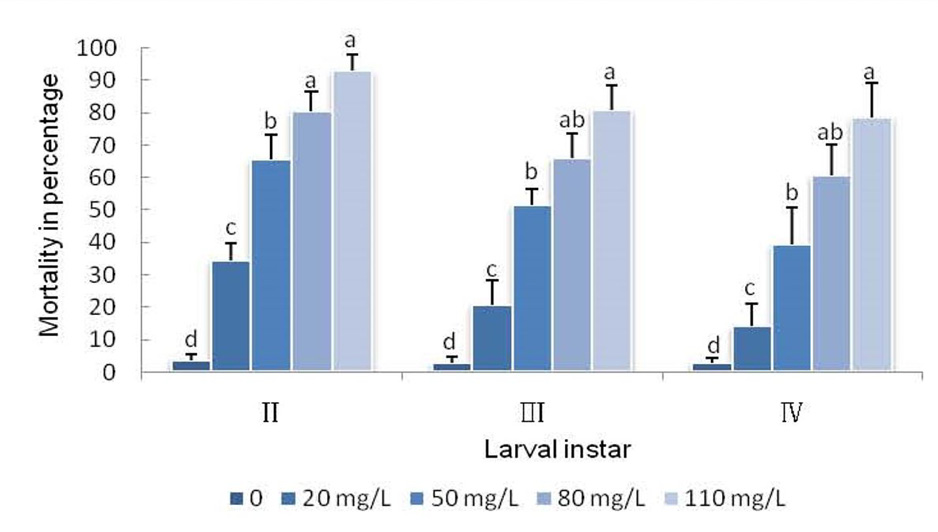
The larval mortality rates of Ae. albopictus were gradually increase with the rise in concentrations of harmine, after treating with harmine for 24 h (Fig. 1). In a high-dose treatment (80 and 110 μg/mL), more than 70 % of the observed mortality occurred within the first 24 h, and with a significant level when compared with the control (P<0.05). In a low-dose treatment (20 and 50 μg/mL), the mortality rates of all the larval instars were lower. The present investigation also showed that the observed mortality rate of the second-instar larvae of Ae. albopictus was higher than that of the third- and fourth-instar larvae in all concentrations examined. Thus, Ae. albopictus larval mortality varied in a concentration-dependent manner.
The action of harmaline on the early fourth-instars of Ae. albopictus was slower at all concentrations examined (Table I). Harmaline did not show that the highest toxicity on the larvae of Ae. albopictus until 72 h after experiments. The LC50 concentrations at 24, 48, 72, 96 and 120 h were 52.73, 46.01, 41.83, 41.52 and 40.99 mg/L, respectively. Similarly, the LC90 concentrations at 24, 48, 72, 96 and 120 h were 96.55, 86.57, 83.13, 84.27 and 83.63 mg/L, respectively. Thus, the LC50 and LC90 concentrations obviously were decreased with the time of exposure, and the best time for assessing the susceptibility of Ae. albopictus larvae to harmaline was 72 h after treatment.
Susceptibility of four larval stages of Ae. albopictus to harmaline
In this experiment, four larval stages of Ae. albopictus showed different susceptibilities to harmaline at 24, 48, and 72 h after exposure, respectively (Table II). Among four instar larvae, the first-instar larvae was the most sensitive to harmaline, the LC50 values were 27.98, 26.21 and 23.02 mg/L at 24, 48, and 72 h after exposure, respectively. The fourth-instar larvae are the most tolerant to harmaline, the LC50 values were 54.12, 47.94 and 42.58 mg/L at 24, 48 and 72 h after treatment, separately. Similarly, the
Table I. Toxicity of harmaline against the fourth-instar larvae of Aedes albopictus at different time after treatment.
| Treatment time (h) | LC50 (mg/L) (95% CL) | LC90 (mg/L) (95% CL) | Slope ± SE | χ2 (df=4) |
| 24 | 52.73 (42.35-54.63) | 96.55 (86.31-102.96) | 3.18±0.65 | 13.09* |
| 48 | 46.01 (38.52-52.51) | 86.57 (79.85-97.45) | 3.07±0.24 | 12.07* |
| 72 | 41.83 (37.91-48.25) | 83.13 (79.71-93.13) | 2.17±0.22 | 11.83* |
| 96 | 41.52 (36.58-47.21) | 84.27 (80.15-91.72) | 2.29±0.43 | 10.87* |
| 120 | 40.19 (35.86-45.95) | 83.63 (78.91-89.79) | 2.59±0.58 | 10.05* |
LC50 lethal concentration that kills 50% of the exposed larvae; LC90 lethal concentration that kills 90% of the exposed larvae; 95%CL is the 95% confidence limits. The means of the five replicates ± SE are shown. χ2 chi-square, df degree of freedom, each value of slope represented the regression slope of the relationship between larval mortality and lethal time. * Significance at P<0.05 level.
Table II. The susceptibility of four larval stages of Aedes albopictus to harmaline at 24, 48 and 72 h after exposure.
| T (h) | Instar | LC50 (mg/L) (95% CL) | LC90 (mg/L) (95% CL) | Slope ± SE | χ2 (df=4) |
| 24 | 1 | 27.98 (24.83-31.67) | 52.66 (42.87- 58.01) | 3.14±0.38 | 10.75* |
| 2 | 30.91 (26.18-35.16) | 57.46 (51.85-64.01) | 2.78±0.44 | 11.87* | |
| 3 | 43. 77 (36.84-50.31) | 82.66 (78.92-90.71) | 2.83±0.35 | 10.02* | |
| 4 | 54.12 (48.74-61.57) | 96.83 (87.26-105.85) | 2.01±0.47 | 12.73* | |
| 48 | 1 | 26.21 (22.75-31.04) | 51.07 (42.35-59.47) | 3.49±0.62 | 10.31* |
| 2 | 28.23 (24.86-33.01) | 53.84 (46.12-57.63) | 2.71±0.33 | 9.58* | |
| 3 | 37.68 (31.57-43.61) | 70.59 (64.61-76.83) | 2.98±0.63 | 11.06* | |
| 4 | 47.94 (40.75-53.76) | 85.95 (80.57-103.99) | 3.02±0.47 | 12.03* | |
| 72 | 1 | 23.02 (21.75-30.76) | 44.31 (40.62-48.07) | 3.29±0.45 | 9.92* |
| 2 | 25.79 (21.02-30.92) | 48.39 (43.08-54.62) | 2.53±0.29 | 10.49* | |
| 3 | 31.09 (26.13-36.18) | 65.25 (47.85-73.48) | 2.96±0.35 | 12.45* | |
| 4 | 42.58 (37.69-50.91) | 82.69 (78.66-87.23) | 2.87±0.46 | 11.98* |
T is the hours after treatment when larval mortality was evaluated. Instar: 1~4 is representing the first, second, third and fourth instar larvae of Aedes albopictus, respectively. χ2 chi-square, df degree of freedom, each value of slope represented the regression slope of the relationship between larval mortality and lethal time. *Significance at P<0.05 level.
Table III. Comparison of development time, pupation and emergence rates of surviving larvae of the second-instar larvae of Aedes albopictus in sublethal dosages of harmaline at 72 h post-exposure.
| Treatment | Larvae development duration (mean ± SE) | Pupa period (h) | Pupation rate % | Emergence rate % | ||
| Second instar (h) | Third instar (h) | Fourth instar (h) | ||||
| Control | 37.5 ± 7.2 | 31.6 ± 6.8 | 66.2 ± 5.9 | 102.3 ± 10.5 | 96.8 ± 2.1 | 94.1 ± 3.9 |
| LC10 | 43.4 ± 5.5 | 45.3 ± 5.7* | 95.6 ± 7.1* | 130.7± 13.3* | 89.7 ± 5.9 | 83.3 ± 6.3 |
| LC30 | 56.3 ± 8.1* | 62.1 ± 6.1* | 104.4 ± 6.3* | 149.2± 12.8* | 74.5 ± 6.2* | 65.4 ± 5.1* |
LC10 lethal concentration that kills 10% of the exposed larvae; LC30 lethal concentration that kills 30% of the exposed larvae; The means of the five replicates ± SE are shown. * Significance at P <0.05 level.
third-instar larvae was more tolerant to harmaline than the second-instar larvae. The LC50 and LC90 values of four instar larvae of Ae. albopictus to harmaline decreased with the extension of exposure time. Thus, the results showed that the early larval instars were more sensitive to harmaline than that of the later instars.
Sublethal effects of harmaline on the second instar larvae of Ae. albopictus
After the second-instar larvae of Ae. albopictus exposure to sublethal concentration (LC10 and LC30) of harmaline for 72 h, the results showed that the development, pupation and adults emergence were affected at different treatments (Table III). Compared with control, the development of larvae exposed to LC10 and LC30 concentrations had significant influence (P<0.05). The developmental durations of larvae tested by LC10 and LC30 concentrations were longer 48.3 h and 87.5 h from second instar to larvae pupation, and 28.4 h and 46.9 h in pupa duration. Moreover, the LC30 concentration of harmaline could significantly affect the pupation and emergence rates of the survivors (P<0.05), and the pupation and emergence rates of larvae treated by LC30 concentration were 23.1% and 38.5% of control, respectively. Therefore, the results suggested that sublethal dosages of harmaline could delay the development of larvae, and decrease the pupation and adult emergence of Ae. albopictus.
DISCUSSION
In recent decades, the global use of synthetic insecticides to control mosquitoes has caused environmental pollution and led to the widespread development of insecticide resistance in many mosquito species, including Ae. Albopictus ; ; ; Montgomery et al., 2021; . With the increasing demand for more eco-friendly products for mosquito control, plants may be valuable sources for mosquito control products. Plants can produce a vast repository of secondary compounds with a wide range of biological activities such as insecticide activity. Plant alkaloids, either as plant-derived insecticides or as pure compounds, provide unlimited opportunities for new and selective pesticide discoveries because of the multiple insecticidal active targets and unmatched availability of chemical diversity ; ; . Harmaline (7-Methoxy-1-methyl-4,9-dihydro-3H-beta-carboline), is one of a major active compound of β-carboline alkaloids, and has many biological activities, such as cytotoxic effect, DNA intercalation ability and anti-Leishmania activity ; ; ; . In this study, the high rate of larval mortality of the different larval stages observed at higher concentrations (80 and 110 μg/mL) of harmaline), within a 24 h exposure indicates the high toxicity of the alkaloid. At lower concentrations (20 and 50 μg/mL) of harmaline, the mortality rates of all the larval instars were lower, and which could lead to morphological malformations of some larvae lived. The lethal effect on larval mortality was dependent on concentration of harmaline. Previous studies have also shown similar results, showing that several beta-carboline alkaloids and alkaloid extracts from the plant of P. harmala have significant lethal effects on many pests, such as Spodoptera litura , Plodia interpunctella , Spodoptera exigua , Fasciola hepatica , and Caenorhabditis elegans . In this research, our results also clearly showed that the insecticidal activity of harmaline against fourth-instar larvae increased significantly with exposure time, such as at 24 h, 48 h, 72 h, 96 h and 120 h after exposure, LC50 values were 52.73, 46.01, 41.83, 41.52, and 40.19 mg/L, respectively. The results indicated that the best time to assess the susceptibility of Ae. albopictus larvae to harmaline was 72 h after treatment. This finding is also supported by our previous investigations and other studies ; ; . Interestingly, four larval stages of Ae. albopictus larvae showed different susceptibilities to harmaline, and the early larval instars were more sensitive than the later instars in this study. Therefore, the chemical control should be directed against the first and second instar stages, if harmaline is used as larvicide of resistant strain of Ae. albopictus larvae in practice.
In addition to the lethal effect, the sublethal concentrations (LC10 and LC30) of harmaline on Ae. albopictus induced larval development delay, pupation and adult emergence rates decreased in this study. Thus, the results indicated that harmaline, even at very low dosages, might still obvious bioactivity to the larvae of deltamethrin-resistant strain of Ae. albopictus. Previous studies have found that harmaline and several beta-carboline alkaloids can induce cells to produce large quantities of singlet oxygen and/or superoxide radical, and these toxic oxygen species have high cytotoxicity, and can attack the membrane to cause unsaturated lipids, as well as destroy the structure and function of the membranes ; ; . Especially, a study found that P. harmala extracts exhibited many sublethal effects on Tribolium castaneum, including α-amylase activity, larval development, and progeny production . Similarly, another two studies also observed sublethal effects of total alkaloids from P. harmala on Spodoptera exigua and Caenorhabditis elegans, which involved nutrient metabolism and larval development ; , as confirmed by our previous study . Thus, these findings suggest that harmaline and other beta-carboline alkaloids have multiple insecticide targets, and imply a possible the mechanisms underlying harmaline-induced changes in mosquito lethal and sublethal trials including effects on acute toxicity, mosquito physiology, larval metabolism and development.
Currently, the growing resistance of Ae. albopictus populations to the synthetic pesticides has hindered the efforts to control dengue vector effectively. Thus, there is an urgent need to develop new insecticides that are more environmentally safe, biodegradable and target specific against mosquitoes. Nowadays, biopesticides, including plant-based insecticides, can enhance the control efficiency of insecticide-resistant mosquitoes ; Gari1 and Lindtjorn, 2018; . Two recent studies found that the impact of deltamethrin-resistance in Ae. albopictus on its fitness cost and vector competence, such as the resistance prolonged the growth and development of larvae, as well as shorten the life span of resistant Ae. albopictus adults ; Gomard et al., 2021; . Indeed, the biological activity of plant-based insecticides for controlling resistant pests indicates that in addition to lethal effects, potential sublethal physiological effects such as growth inhibition, reproductive interference, repellents, and behavioral effects may also occur. In this study, harmaline offers a potential against the larvae of deltamethrin-resistant strain of Ae. albopictus, particularly in its markedly sublethal effects. Therefore, it may provide theoretical information for further research on the mechanisms underlying insecticidal activity of harmaline and other beta-carboline alkaloids, and development of environment friendly pesticides.
CONCLUSION
In this study, harmaline from P. harmala seeds against the larvae of deltamethrin-resistant strain of Ae. albopictus was studied in the bioassay. The results indicated that harmaline exhibited strong larvicidal activity against the mosquito larvae, and the lethal effect on larval mortality of Ae. albopictus increased in a concentration-dependent manner. The mortality of four instar larvae peaked at 72 h after exposure. Interestingly, harmaline could cause markedly sublethal effects to the larvae, even at very low concentrations (LC10 and LC30) of harmaline. It is, therefore, worth further exploring the use of harmaline as a potential larvicide against vector mosquitos.
Declarations
Acknowledgments
Authors would like to acknowledge Dr. Wu Fengrui for providing guidance for statistical analysis.
Funding
This work was supported by the Key project of natural science research of Anhui provincial education department (KJ2021ZD0072), Key Project of Natural Science Foundation of Fuyang Normal University (2021FSKJ08ZD), and Provincial Nature Science Research Project of Anhui Colleges (KJ2021A0670).
Statement of conflict of interest
The authors have declared no conflict of interest.
Figures
References
- Abbott, W.S., 1925. A method of computing the effectiveness of an insecticide. J. econ. Ent., 18: 265-267. https://doi.org/10.1093/jee/18.2.265a[CrossRef]
- Al-mazra’awi, M.S. and Ateyyat, M., 2009. Insecticidal and repellent activities of medicinal plant extracts against the sweet potato whitefly, Bemisia tabaci (Hom.: Aleyrodidae) and its parasitoid Eretmocerus mundus (Hym.: Aphelinidae). J. Pest Sci., 82: 149–154. https://doi.org/10.1007/s10340-008-0233-x[CrossRef]
- Alomar, M.L., Rasse-Suriani, F.A.O., Ganuza, A., Cóceres, V.M. and Cabrerizoand, F.M., 2013. In vitro evaluation of β-carboline alkaloids as potential anti-toxoplasma agents. BMC Res. Notes, 6: 193-199. https://doi.org/10.1186/1756-0500-6-193[CrossRef]
- Ayres, G. and Constancia, F.J., 2016. Identification of zika virus vectors and implication for control. Lancet Infect. Dis., 16: 278-279. https://doi.org/10.1016/S1473-3099(16)00073-6[CrossRef]
- Bara, J.J., Montgomery, A. and Muturi, E.J., 2014. Sublethal effects of atrazine and glyphosate on life history traits of Aedes aegypti and Aedes albopictus (Diptera: Culicidae). Parasitol. Res., 113: 2879–2886. https://doi.org/10.1007/s00436-014-3949-y[CrossRef]
- Baskar, K., Sudha, V., Nattudurai, G., Ignacimuthu, S., Duraipandiyan, V., Jayakumar, M., al-Dhabi, N.A., and Benelli, G., 2018. Larvicidal and repellent activity of the essential oil from Atalantia monophylla on three mosquito vectors of public health importance, with limited impact on non-target zebra fish. Physiol. Mol. Pl. Pathol., 101: 197–201. https://doi.org/10.1016/j.pmpp.2017.03.002[CrossRef]
- Benelli, G., 2015. Plant-borne ovicides in the fight against mosquito vectors of medical and veterinary importance: A systematic review. Parasitol. Res., 114: 3201-3212. https://doi.org/10.1007/s00436-015-4656-z[CrossRef]
- Bhatt, S., Gething, P.W., Brady, O.J., Messina, J.P., Farlow, A.W., Moyes, C.L., Drake, J.M., Brownstein, J.S., Hoen, A.G., Sankoh, O., Myers, M.F., George, D.B., Jaenisch, T., William Wint, G.R., Simmons, C., Scott, T.W., Farrar, J.J. and Hay, S.I., 2013. The global distribution and burden of dengue. Nature, 496: 504-507. https://doi.org/10.1038/nature12060[CrossRef]
- Cao, R.H., Peng, W.L., Wang, Z.H. and Xu, A.L., 2007. β-Carboline alkaloids: Biochemical and pharmacological functions. Curr. med. Chem., 14: 479-500. https://doi.org/10.2174/092986707779940998[CrossRef]
- Chen, Y., Gao J.R., Yang, L., Li, C.Y., Chen, R.H., Xie, Z.H., and Ren, R.W., 2019. A predominant dengue virus-1 endemic strain and the vector competence of Aedes albopictus from Guangzhou City, China. Acta Trop., 199: 104975. https://doi.org/10.1016/j.actatropica.2019.03.029[CrossRef]
- Demok, S., Endersby-Harshman, N., Vinit, R., Timinao, L., J. Robinson, L., Susapu, M., Makita, L., Laman, M., Hofmann, A. and Karl, S., 2019. Insecticide resistance status of Aedes aegypti and Aedes albopictus mosquitoes in Papua New Guinea. Parasit. Vectors, 12: 333. https://doi.org/10.1186/s13071-019-3585-6[CrossRef]
- Deng, J., Guo, Y., Su, X., Liu, S., Yang, W., Wu, Y., Wu, K., Yan, G. and Chen, X.G., 2021. Impact of deltamethrin-resistance in Aedes albopictus on its fitness cost and vector competence. PLoS Negl. Trop. Dis., 15: e0009391. https://doi.org/10.1371/journal.pntd.0009391[CrossRef]
- Di Giorgio, C., Delmas, F., Ollivier, E., Elias, R., Balansard, G. and Timon-David, P., 2004. In vitro activity of the beta-carboline alkaloids harmane, harmine, and harmaline toward parasites of the species Leishmania infantum. Exp. Parasitol., 106: 67-74. https://doi.org/10.1016/j.exppara.2004.04.002[CrossRef]
- Dinesh, D.S., Kumari, S., Kumar, V. and Das, P., 2014. The potentiality of botanicals and their products as an alternative to chemical insecticides to sand flies (Diptera: Psychodidae): A review. J. Vector Dis., 51: 1-7.
- Dusfour, I., Vontas, J., David, J-P., Weetman, D., Fonseca, D.M., Corbel, V., Raghavendra, K., Coulibaly, M.B., Martins, A.J., Kasai1, S. and Chandre, F., 2019. Management of insecticide resistance in the major Aedes vectors of arboviruses: Advances and challenges. PLoS Negl. Trop Dis., 13: e0007615. https://doi.org/10.1371/journal.pntd.0007615[CrossRef]
- Finney, D.J., 1971. Probit analysis. Cambridge University Press, London, pp. 333.
- Gamez, S., Antoshechkin, I., Mendez-Sanchez, S.C. and Akbari, O.S., 2020. The developmental transcriptome of Aedes albopictus, a major worldwide human disease vector. G3-Genes Genom. Gen., 10: 1051-1062. https://doi.org/10.1534/g3.119.401006[CrossRef]
- Gari1, T. and Lindtjørn, B., 2018. Reshaping the vector control strategy for malaria elimination in Ethiopia in the context of current evidence and new tools: Opportunities and challenges. Malar. J., 17: 454. https://doi.org/10.1186/s12936-018-2607-8[CrossRef]
- Gomard, Y., Alout, H., Lebon, C., Latreille, A., Benlali, A., Mavingui, P., Tortosa, P. and Atyame, C., 2022. Fitness costs associated with a GABA receptor mutation conferring dieldrin resistance in Aedes albopictus. Heredity (Edinb), 129: 273-280. https://doi.org/10.1038/s41437-022-00565-7[CrossRef]
- Gou, Y., Li, Z., Fan, R., Guo, C., Wang, L., Sun, H., Li, J., Zhou, C., Wang, C. and Wang, Y., 2020. Ethnobotanical survey and evaluation of traditional mosquito repellent plants of Dai people in Xishuangbanna, Yunnan Province, China. J. Ethnopharmacol., 262: 113124. https://doi.org/10.1016/j.jep.2020.113124[CrossRef]
- Guan, H.J., Liu, X.D., Peng, W.L., Cao, R.H., Ma, Y., Chen, H.S. and Xu, A.L., 2006. β-carboline derivatives: Novel photosensitizers that intercalate into DNA to cause direct DNA damage in photodynamic therapy. Biochem. biophs. Res. Commun., 342: 894-901. https://doi.org/10.1016/j.bbrc.2006.02.035[CrossRef]
- Jbilou, R., Amri, H., Bouayad, N., Ghailani, N., Ennabili, A. and Sayah, F., 2008. Insecticidal effects of extracts of seven plant species on larval development, a-amylase activity and offspring production of Tribolium castaneum (Herbst) (Insecta: Coleoptera: Tenebrionidae). Bioresour. Technol., 99: 959–964. https://doi.org/10.1016/j.biortech.2007.03.017[CrossRef]
- Jiang, N., Li Chen, Li, J.M., Li, W.Y. and Jiang, S.L., 2023. Lethal and sublethal toxicity of beta-carboline alkaloids from Peganum harmala (L.) against Aedes albopictus larvae (Diptera: Culicidae). Toxics, 11: 341. https://doi.org/10.3390/toxics11040341[CrossRef]
- Jiang, S.L., Guo, X.Q., Zhan, G.L. and Liu, B., 1999. A preliminary study on the resources of botanical insecticides in East Gansu province. Acta Bot. Bor-Occid Sin, 19: 209-211. (In Chinese with English abstract).
- Kartal, M., Altun, M.L., and Kurucu, S., 2003. HPLC method for the analysis of harmol, harmalol, harmine and harmaline in the seeds of Peganum harmala L. J. Pharmaceut. Biomed., 31: 263-269. https://doi.org/10.1016/S0731-7085(02)00568-X[CrossRef]
- Khan, F.A., Maalik, A., Iqbal, Z. and Malik, I., 2013. Recent pharmacological developments in β-carboline alkaloid harmaline. Eur. J. Pharmacol., 721: 391–394. https://doi.org/10.1016/j.ejphar.2013.05.003[CrossRef]
- Li, J.M., Mu, K., Jiang, S.L., Li, D.K., Li, W.Y., Ma, T.F. and Li, Y.M., 2016. Toxicity effects of total alkaloids of Peganum harmala against Spodoptera frugiperda larvae blood corpuscles and in vitro cultured Sf9 cells. J. Northwest A. F. Univ., 44: 127–133. (In Chinese with English abstract).
- Li, S.P., Cheng, X.M. and Wang, C.H., 2017. A review on traditional uses, phytochemistry, pharmacology, pharmacokinetics and toxicology of the genus Peganum. J. Ethnopharmacol., 203: 127-162. https://doi.org/10.1016/j.jep.2017.03.049[CrossRef]
- Li, Y., Zhou, G., Zhong, D., Wang, X., Hemming-Schroeder. E., David, R.E., Lee, M.C., Zhong, S., Yi, G., Liu, Z., Cui, G. and Yan, G., 2021. Wide spread multiple insecticide resistance in the major dengue vector Aedes albopictus in Hainan Province, China. Pest Manage. Sci., 77: 1945-1953. https://doi.org/10.1002/ps.6222[CrossRef]
- Manni, M., Guglielmino, C.R., Scolari, F. Vega, R.A., Failloux, A.B., Somboon, P., Lisa, A., Savini, G., Bonizzoni, M., Gomulski, L.M., Malacrida, A.R. and Gasperi. G., 2017. Genetic evidence for a worldwide chaotic dispersion pattern of the arbovirus vector, Aedes albopictus. PLoS Negl. Trop. Dis., 11: e0005332. https://doi.org/10.1371/journal.pntd.0005332[CrossRef]
- Miao, X., Zhang, X., Yuan, Y.Y., Zhang, Y.L., Gao, J., Kang, N.N., Liu, X.K., Wu, J.R., Liu, Y.G. and Tan, P., 2020. The toxicity assessment of extract of Peganum harmala L. seeds in Caenorhabditis elegans. BMC Complement. Med., 20: 256. https://doi.org/10.1186/s12906-020-03051-x[CrossRef]
- Mina, C.N., Mohammad, H.F. and Gholamreza, A., 2015. Medicinal properties of Peganum harmala L. in traditional Iranian medicine and modern phytotherapy: A review. J. Tradit. Chin. Med., 35: 104-109. https://doi.org/10.1016/S0254-6272(15)30016-9[CrossRef]
- Mitchell, C.J., 2020. The role of Aedes albopictus as an arbovirus vector. Parassitologia, 37: 108-113.
- Moazeni, M., Ardakani, Z.S., Saharkhiz, M.J., Jalaei, J., Khademolhoseini, A.A., Abad, S.S.E., and Alavi, A.M., 2017. In vitro ovicidal activity of Peganum harmala seeds extract on the eggs of Fasciola hepatica. J. Parasitic Dis., 41: 467- 472. https://doi.org/10.1007/s12639-016-0830-1[CrossRef]
- Montgomery, M., Harwood, J.F., Yougang, A.P., Wilson-Bahun, T.A., Tedjou, A.N., Keumeni, C.R., Kilpatrick, A.M., Wondji, C.S. and Kamgang, B., 2022. Spatial distribution of insecticide resistant populations of Aedes aegypti and Ae. albopictus and first detection of V410L mutation in Ae. aegypti from Cameroon. Infect. Dis. Poverty, 11: 90. https://doi.org/10.1186/s40249-022-01013-8[CrossRef]
- Ngoagouni, C., Kamgang, B., Brengues, C., Yahouedo, G., Paupy, C., Nakouné, E., Kazanji, M. and Chandre, F., 2016. Susceptibility profile and metabolic mechanisms involved in Aedes aegypti and Aedes albopictus resistant to DDT and deltamethrin in the Central African Republic. Parasit. Vectors, 9: 599. https://doi.org/10.1186/s13071-016-1887-5[CrossRef]
- Pleydell, D.R.J. and Bouyer, J., 2019. Biopesticides improve efficiency of the sterile insect technique for controlling mosquito-driven dengue epidemics. Commun. Biol., 2: 201. https://doi.org/10.1038/s42003-019-0451-1[CrossRef]
- Rharrabe, K., Bakrim, A., Ghailani, N. and Sayah, F., 2007. Bioinsecticidal effect of harmaline on Plodia interpunctella development (Lepidoptera: Pyralidae). Pestic. Biochem. Phys., 89: 137–145. https://doi.org/10.1016/j.pestbp.2007.05.002[CrossRef]
- Rizwan-ul-Haq, M., Hu, Q.B., Hu, M.Y., Lin, Q.S. and Zhang, W.L., 2009. Biological impact of harmaline, ricinine and their combined effects with Bacillus thuringiensis on Spodoptera exigua (Lepidoptera: Noctuidae). J. Pest Sci., 82: 327-334. https://doi.org/10.1007/s10340-009-0257-x[CrossRef]
- Shang, X., Xiao, H., Guo, X., Li, B., Pan, H., Zhang, J., and Miao, X., 2016. Microwave-assisted extraction of three bioactive alkaloids from Peganum harmala L. and their acaricidal activity against Psoroptes cuniculi in vitro. J. Ethnopharmacol., 192: 350–361. https://doi.org/10.1016/j.jep.2016.07.057[CrossRef]
- Smith, L.B., Kasai, S., and Scott, J.G., 2016. Pyrethroid resistance in Aedes aegypti and Aedes albopictus: Important mosquito vectors of human diseases. Pestic. Biochem. Physiol., 133: 1-12. https://doi.org/10.1016/j.pestbp.2016.03.005[CrossRef]
- Weng, Q.F., Zhong, G.L., Hu, M.Y., Luo, J.J., and Li, X.G., 2005. Bioactivities and physiological effects of extracts of Peganum harmala against Bursaphelenchus xulophilus. Sci. Agric. Sin., 10: 2014-2022. (In Chinese with English abstract).
- World Health Organization (WHO), 2005. Guidelines for laboratory and field testing of mosquito larvicides World Health Organization communicable disease control, prevention and eradication World Health Organization Pesticide Evaluation Scheme (WHOPES). Geneva, Switzerland, pp. 1-41.
- Zhao, C.C., Zhu, C.Y., Jia, Q.C., Yan, D.M., Liu, G.J., Wu, H.X., Song, X.P., Liu, Q.Y., Wang, J. and Meng, F.X., 2020. Resistance of Aedes albopictus to commonly used insecticides in different areas of China, 2017-2018. Chin. J. Vector Biol. Contr., 31: 126-132.
- Zhao, G.L., Jiang, S.L. and Xue, L.G., 1997. A preliminary report on the field control effect of the extract of Peganum harmala to phytophagy spider mites. J. Northw. Sci. Tech. Univ. Agric. For., 25: 111–114.
Services
Article usage statistics
Loading…