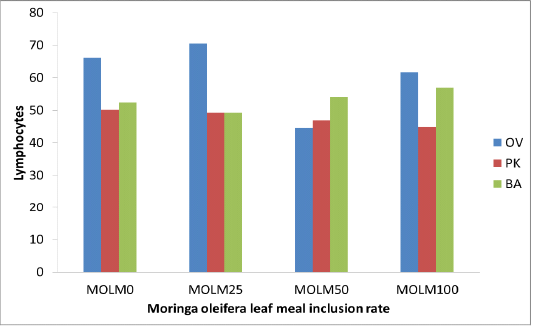
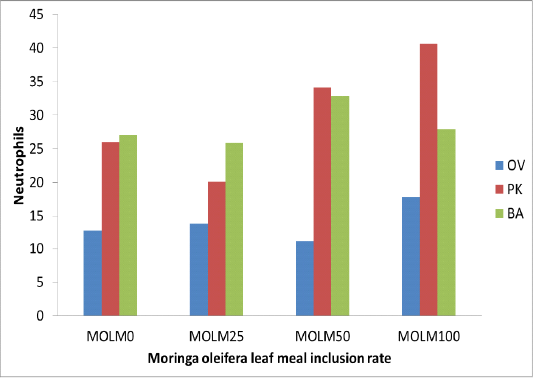
This study was conducted at the North West University Experimental Farm (Molelwane), Mafikeng (25.8 º S and 25.5 º E), South Africa. Moringa oleifera leaves were obtained from Patience Wellness Centre in Limpopo Province (24.305º S 29.565º E). The leaves were air-dried at a room temperature and then milled to pass through a 2 mm sieve. Four diets were constituted using M. oleifera leaf meal (MOLM) as follows: 100% basal mash (MOLM0); 97.5% basal mash and 2.5% MOLM (MOLM25); 5% MOLM and 95% basal mash (MOLM50); and 10% MOLM and 90% basal mash (MOLM100). The composition of MOLM and experimental diets are presented in Table 1 for descriptive purposes. Experimental diets were formulated to be isonitrogenous and isoenergetic.
Two hundred and sixteen (216) male chickens from Potchefstroom Koekoek, Ovambo and Black Australorp strains were raised on a commercial starter mash for three weeks. At four weeks of age, the chickens from each breed were randomly allocated to the 4 experimental diets. A 3 (chicken strains) x 4 (diets) factorial treatment arrangement in a complete randomised design (CRD) was used for this experiment. The experimental unit was a pen holding 6 birds, which was replicated 4 times, resulting in a total of 36 floor pens (measuring 60 x 50 x 75 cm). Feed and water were offered ad libitum during the 13 weeks. Continuous lightning was provided for first four weeks, which was then gradually decreased to that of natural day light. The study was conducted according to the guidelines of the ethics committee of North West University. All animal husbandry practices were performed with full consideration of animal welfare.
At the end of the 13-week feeding trial, blood samples were collected from all 6 birds in each feeding trial. About 2 ml of blood was collected from each bird into two sets of sterilised bottles, one of them holding EDTA as anticoagulant and the other tube without. Haematological parameters (haemoglobin (Hb g/L), red blood cells (RBC1012/L), white blood cells (WBC109/L), haematocrit (HCT %) and mean corpuscular haemoglobin (MCH pg) were determined using an automated Idexx Laser Cyte Haematology (IDEXX Laboratories, Inc) and the values were recorded in g/100 ml. Mean corpuscular haemoglobin concentration (MCHC) was calculated as:
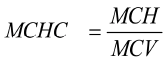 , where MCH is mean corpuscular haemoglobin and MCV is the mean corpuscular volume. Clotted blood (collected in red top tubes) was centrifuged in a macro centrifuge to generate serum for biochemical analysis. Total protein (TP g/L), Urea (mmol/L), creatinine (µmol/L), albumin (g/L), serum cholesterol (mmol/L), aspartate transaminase (AST) (U/L), alanine transaminase (ALT) (U/L) and alkaline phosphate (ALKP) (U/L) were analysed using an automated Idexx Vet Test Chemistry Analyser (IDEXX Laboratories, Inc).
At 13 weeks of age, all chickens were electrically stunned and killed by manual exsanguination. Weights of the liver, gizzard (cleaned), heart, lungs, and pancreas as well as the length of small intestines were determined using a sensitive weighing balance and measuring tape (cm), respectively.
Variation in organ size, haematological and serum biochemical indices data was analysed using SAS (2008) software according to the following general linear model:

Where Yijk = dependent variable (organ size, haematolog
Table 1: Gross composition of Moringa oleifera leaf meal (MOLM) based experimental diets
1Diet: MOLM0=broiler without MOLM inclusion; MOLM25= broiler finisher diluted with 25 g MOLM /kg; MOLM50= broiler finisher diluted with 50 g MOLM /kg; MOLM100= broiler finisher diluted at 100 g MOLM/kg. MOL = Moringa oleifera leaf
Premix2: vitamin A, 40,000 IU; vitamin D3, 8,000 IU; vitamin E, 10 IU; vitamin K3, 4.0 mg; vitamin B1, 4.0 mg; vitamin B2, 12.0 mg; vitamin B6, 6.0 mg; vitamin B12, 0.02 mg; niacin, 250 mg choline; 60.0 mg; pantothenic acid, 20 mg; folic acid, 2.0 mg; biotin, 0.02 mg; Fe, 30.0 mg; Zn, 25.0 mg; 20.0 mg; Cu, 5.0 mg; Se, 0.1 mg
ical and serum biochemical indices), µ = overall mean, Si = effect of bird strain level i, Dj = effect of experimental diet level j, (S × D) ij = interactive effect of bird strain and diet and Eijk = random error. The significance was declared when p < 0.05. For parameters where significant variation was detected, multiple comparisons of treatment means were carried out using the probability of difference (pdiff) option of the General Linear Models (GLM) procedures of SAS.