
Asian citrus greening disease is one of the leading causes of the citrus decline in many parts of the world, including Pakistan. Adequate information about disease incidence is essential for the eradication and controlling measures of disease. In this context, a survey regarding the incidence of citrus green disease (CGD) was recorded in two cultivars Kinnow (Citrus reticulate Blanco) and Mosambi (Citrus sinensis (L.) Osbeck), among significant citrus-growing areas of Sargodha district based on symptoms. Random samples of trees within orchards were scored based on characteristic symptoms like blotchy mottle, lopsided unripe fruits, and aborted seeds were observed. The highest incidence of 26% was recorded in Kot Momin, while the lowest incidence of 4.6% was found in Sahiwal. Among the cultivars, the highest disease incidence in mosambi (C. sinensis)and Kinnow (C. reticulate)was recorded 26% in Kot Momin and 23% in Bhalwal, respectively. Leaves samples were collected from the diseased trees to isolate DNA and to confirm greening pathogen with two primer pairs, which amplified the specific DNA (~1160bp) and βoperon (~703bp) regions. The present study not only detects the molecular detection of CGD in already identified samples through the iodo-starch test but also provides reliability for quick indexing of disease in the aforesaid field. Moreover, molecular detection also revealed the (standardization) of primers used in previous and current studies. Characteristic symptoms combined with molecular detection would be useful to formulate the management strategies.
Research Article · Volume 37, Issue 1, 7 March 2021 · Open Access
Incidence and Molecular Detection of Greening Disease in Two Citrus Cultivars in Sargodha, Pakistan
· · · · ·
Affiliations & Notes ⌄
- 1Department of Plant Pathology, College of Agriculture, University of Sargodha, Sargodha, Pakistan, 40100
- 2Department of Plant Breeding and Genetics, College of Agriculture, University of Sargodha, Sargodha, Pakistan, 40100
- 3Department of Horticulture, College of Agriculture, University of Sargodha, Sargodha, Pakistan, 40100 , *Correspondence | Yasir Iftikhar, College of Agriculture, University of Sargodha, Sargodha, Pakistan
- 4Email: yasir.iftikhar@uos.edu.pk
Article Info ⌄
- Journal:
- Sarhad Journal of Agriculture
- Published:
- 7 March 2021

From the article
- Citrus greening disease incidence ranged between 4.6 - 24% among the mandarin and mousambi cultivars in various districts of the central Punjab.
- The disease may be recognized on the basis of its characteristic symptoms and may threaten the sustainability of the regions’ citriculture.
- Regardless of symptoms, molecular markers provide us an efficient tool for the detection of the pathogen.
- The present study used molecular markers that amplified 16s rRNA of pathogen visualized through a PCR product of 703 bases compared to no amplification in disease-free plants.
Selected from the article's own text.
Abstract
Introduction
Citrus is infected by several different pathogens, including fungi, prokaryotes, viruses, nematodes, and virus-like pathogens . Among these pathogens, the citrus greening disease is one of the most devastating and widely distributed pathogens in citrus orchards of significant citrus-growing areas of the world and Pakistan ; . Citrus greening (CGD) disease is now alternatively termed as Huanglongbing (HLB) and is known with different names in different countries owing to their local languages. All the citrus cultivars are affected by this disease regardless of the rootstock. This graft transmissible disease can also be transmitted through an insect vector very efficiently ; . HLB being a century-old disease, probably originated at the end of the 19th century in China ; Bove, 2006). The greening disease is caused by gram-negative unculturable phloem limited bacterium named Candidatus liberibacter. Jagoueix et al. (1996) characterized this bacterium on the basis of 16s rDNA sequence for the first time. Ha et al. (2019) have successfully cultured greening bacterium on biofilm after long and untiring efforts. This pathogen has three strains, viz., Candidatus liberibacter asiaticus (Las), Candidatus liberibacter africanum (Laf), Candidatus liberibacter americanum (Lam), based on geographical distribution and insect vector. Symptomology is the primary criterion for initial detection in the field. Characteristic symptoms of HLB under natural conditions are chlorosis, mottling (Zinc deficiency-like symptoms), aborted seeds in the fruit, and lopsided fruit (Bove 2006; . At maturity, citrus fruits from the styler end remain green while; sometimes it remains green at the peduncular end, which is known as “color inversion” or “red nose” ; .
Kinnow (Citrus reticulate) and Mosambi (Citrus sinensis (L.) Osbeck) are the most susceptible citrus cultivars . Molecular markers have been employed for the detection of CGD after the symptomology. These markers characterized the CGD on the basis of 16s rDNA and βoperon regions. The PCR method detected the liberibacter species in citrus samples by 1160 bp fragment amplification . Different molecular and serological techniques have also been developed and optimized. Recently, established and advanced techniques like molecular, biological, and serological assays for pathogen detection have been reviewed ; . PCR and qPCR have been engaged for the detection of two markers, one for the 16s rDNA (OI1 and OI2C) and the other for Las (Boperon) A2/J5 ; . Correct and quick detection of a pathogen provides a base to formulate the management strategies for HLB. The present study is a combination of CGD symptomatic and molecular diagnosis in all the tehsils of Sargodha district.
Materials and Methods
Incidence of CGD
Two commercially grown citrus cultivars, viz., Kinnow and Musambi were targeted for their citrus orchards’ availability. Citrus samples infected with CGD were collected on the basis of characteristics symptoms from the citrus orchards of all the tehsils of district Sargodha viz., Sargodha, Bhalwal, Sillanwali, Sahiwal, Shahpur, Bhera, and Kot Momin. A total of 150 samples/tehsil with apparent symptoms were monitored for the record of disease incidence. Leaves from the marked citrus trees were collected and pooled for PCR detection and confirmation. Disease incidence was calculated as follows;

Molecular detection
Polymerase chain reaction: The polymerase chain reaction was used for molecular detection from the pool of leaves samples. DNA was extracted by using a DNA extraction kit (GF-1 Vivantis Malaysia with provided standard protocol). Two primer sets (OI1 GCGCGTATGCAATACGAGCGGCA Forward and OI2c GCCTCGCGACTTCGCAACCCAT Reverse) described by and (A2 TATAAAGGTTGACCTTTCGAGTTT Forward and J5 ACAAAAGCAGAAATAGCACGAACAA Reverse) described by Hocquellet et al. (1999) were used to amplify 16s rDNA and β operon respectively from the processed samples of citrus. A total of 25µl PCR reaction mixture for 1X (d2H2O 14.3µl; Buffer 10X 2.5µl; MgCl2 (25mM) 2.0 µl; dNTPs (2.0 mM) 2.0 µl; Primers F (1µM) 1.0 µl; Primers R (1µM) 1.0 µl; Taq DNA Polymerase 0.2 µl and Template DNA 2.0 µl) was used. The conditions for PCR were; initial denaturation at 94°C for 2 minutes (1 cycle); 94°C for 30 seconds, 58°C for 1 minute and 72°C for 1 minute (35 cycles); final extension at 72°C for 10 minutes (1 cycle). The PCR product after the reaction was held at 4°C for infinity.
Gel electrophoresis
The PCR products were analyzed by gel electrophoresis using 0.8 % agarose in 0.5X TBE buffer. Ethidium bromide was used to stain the PCR product. The gel was run at 80 volts for 45 minutes.
Results and Discussion
Symptomology and incidence of CGD
The characteristic symptoms were observed during the survey (Figure 1A-E). Blotchy mottling and chlorosis were observed in the leaves samples (Figure 1C, D). Aborted seeds (Figure 1E), lopsided fruits, and full or half green fruits were observed (Figure 1A, B). Our results regarding symptomology were in accordance with Batool et al. (2007). They reviewed the characteristic symptoms like yellowing of leaves, Lopsided fruits, blotchy mottle, aborted seeds, and unripe fruits (Fruit remain green). Similar results have also been reported by ; . Yellowing of leaves, blotchy mottling, upright growth of CGD infected trees, and lopsided fruits were observed during our study which is in accordance with McCollum and Baldwin (2017). As disease progresses, the leaves drop, shoots remain stunted later on the branches die gradually . Symptomology of CGD-affected fruits has also been reviewed by . Regarding the incidence in different tehsils of Sargodha district (Table 1), the highest incidence of CGD 24% was recorded in Kot Momin with followed by Bhalwal 22%, whereas the least incidence was recorded in Sahiwal tehsil with 4.6%. Similarly, Mosambi (Citrus sinensis (L.) Osbeck) showed the highest incidence 26% in Kot Momin and the least incidence 8% was recorded in Sahiwal. Kinnow had the highest incidence of 23% in Kot Momin at par with Bhalwal. The least incidence, of CGD in Kinnow (C. reticulate), was 3% in Sahiwal. CGD has been reported in around 44 countries of Asia and America (Ajene et al., 2019). Initially, the incidence of CGD in Pakistan was recorded by Catara et al. (1991) and Akhtar and Ahmed (1999) in KPK and the Punjab. They recorded a high incidence of CGD in Kinnow 22%, Sweet orange 25-40% in the Punjab. They mainly collected the citrus samples from Sargodha region. The results of our studies are also in agreement with their study. Similar types of symptoms were observed during the sample collections. The CGD was confirmed in 41% of citrus samples collected from different orchards in the Punjab during a survey . CGD incidence of 42% in kinnow and sweet orange was recorded by Zafarullah et al. (2016). Saifullah et al. (2015) recorded the disease incidence ranging 8-11% in all the tehsils of Sargodha district. They also observed characteristics symptoms of CGD such as mottling, zinc deficiency like symptoms, lopsided fruit and aborted seeds. Our results are also in accordance with the previous studies. We also observed the same type of symptoms and trend in CGD incidence. A different number of samples were collected in different months of a year and found positive for CGD detection. High incidences were found in February, April, and May . Therefore, symptomology plays a vital role in the early detection of CGD in the field.
Table 1: Disease incidence in varieties at different places.
| Sr. No. | Tehsil | Disease incidence (%) (Over all) | Disease incidence in varieties (%) | |
| Kinnow | Mosambi | |||
| 1 | Sargodha | 18 | 18 | 16 |
| 2 | Bhalwal | 22 | 23 | 20 |
| 3 | Kot momin | 24 | 23 | 26 |
| 4 | Shahpur | 14 | 16 | 10 |
| 5 | Sillanwali | 14 | 14 | 14 |
| 6 | Bhera | 10 | 10 | 10 |
| 7 | Sahiwal | 4.6 | 3 | 8 |
Molecular detection
Due to the inability of “CLas” to be cultured in vitro conditions , it is very much difficult to study ecology, epidemiology, and management of this pathogen . PCR confirmed the greening pathogen in leaves samples of both citrus cultivars, including Kinnow and Mosambi (Figure 2A and 2B). DNA of citrus cultivars was amplified by two primer pairs, which amplified the PCR products at the desired size of ~1160bp and ~703bp, respectively. PCR product size has been confirmatory through previous literature that also reported similar band sizes using their respective primer pairs ; ; . The primer used in these studies is based on the amplification of bacterial 16s rDNA and β operon regions. Citrus greening disease in citrus orchards of North-Eastern Indian region was also confirmed through PCR , which was also recently reported by Kokane et al. (2020). The identified isolates of CLas from Bhutan reported by Ghosh et al. (2020) were analogous to Indian isolates of North-East regions based on CLIBASIA_01645 locus. Davi et al. (2020) detected HLB in citrus species, viz., C. reticulate, Citrus jambhiri, Citrus maxima, Citrus medica, Citrus macroptera using 16S rRNA amplicon fragment and found that its resemblance with “Ca. Liberibacter asiaticus” sequenced from the rest of the World. A high CLas DNA level in the HLB symptomatic leaves was detected through qPCR . Primer A2/J5 was used to distinguish between CLas and CLaf. Specific amplification of r-protein genes directly identified the two species based on DNA band size . Specific amplification by CLas was 703 bp, while CLaf produced a band of 669 bp size . Specific amplification of 703bp was observed in all infected samples from HLB-CM using A2/J5 primers . They also recorded that no amplification was found in healthy or asymptomatic plants. Molecular-based detection of pathogens, including Huanglongbing, has been robust and could detect pathogens at very low intensity even before the symptoms’ physical appearance . Therefore, it is recommended that molecular methods should be employed for the sanitation of citrus nurseries to reduce disease incidence and the establishment of disease-free new orchards.
Conclusions and Recommendations
Citrus greening disease incidence ranged between 4.6 - 24% among the mandarin and mousambi cultivars in various districts of the central Punjab. The disease may be recognized on the basis of its characteristic symptoms and may threaten the sustainability of the regions’ citriculture. Regardless of symptoms, molecular markers provide us an efficient tool for the detection of the pathogen. The present study used molecular markers that amplified 16s rRNA of pathogen visualized through a PCR product of 703 bases compared to no amplification in disease-free plants. Thus molecular markers may be a recommended strategy in symptomless plants and in the sanitation of nursery to reduce further spread of this disease.
Acknowledgments
The authors are highly thankful to ORIC for the financial support of the Project entitled “Monitoring of devastating effects of Citrus greening disease (CGD) in the declining orchards of Sargodha and its management through micronutrients to help the citrus industry.” The authors presented research work as a part of a Doctoral dissertation in the Department of Plant Pathology, College of Agriculture, SU.
Novelty Statement
This is paucity of data on molecular characterization of HLB in Pakistan. This study will strengthen the knowledge about the diversity of this pathogen in Punjab, Pakistan.
Author’s Contribution
AS conducted the experiments. MUG was the major supervisor and conceived the idea and monitored the execution of work. SR helped and monitored the molecular work. ZH was the CO-PI of the project and helped in collection of samples and manuscript writeup. SA Proof read and improved the manuscript. YI was the principal investigator of the project and provided the materials for experimentation.
Conflict of interest
The authors have declared no conflict of interest.
Figures
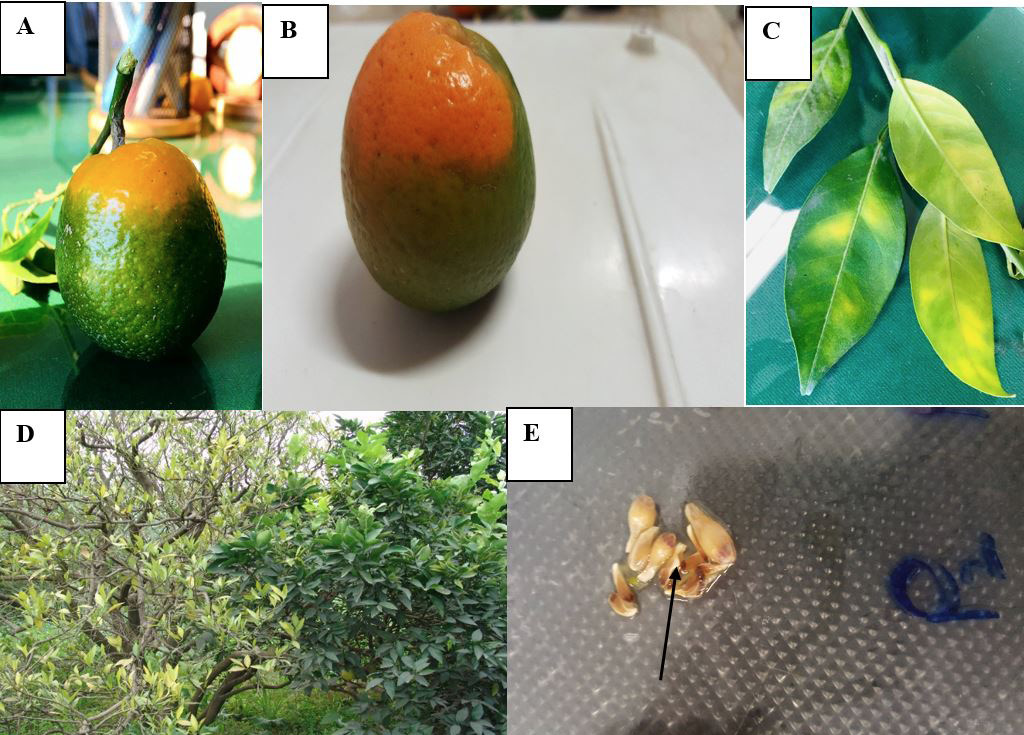
(A and B): CGD infected lopsided and half green fruit; (C and D): Mottle leaf and Chlorosis on tree; (E): Aborted seeds.
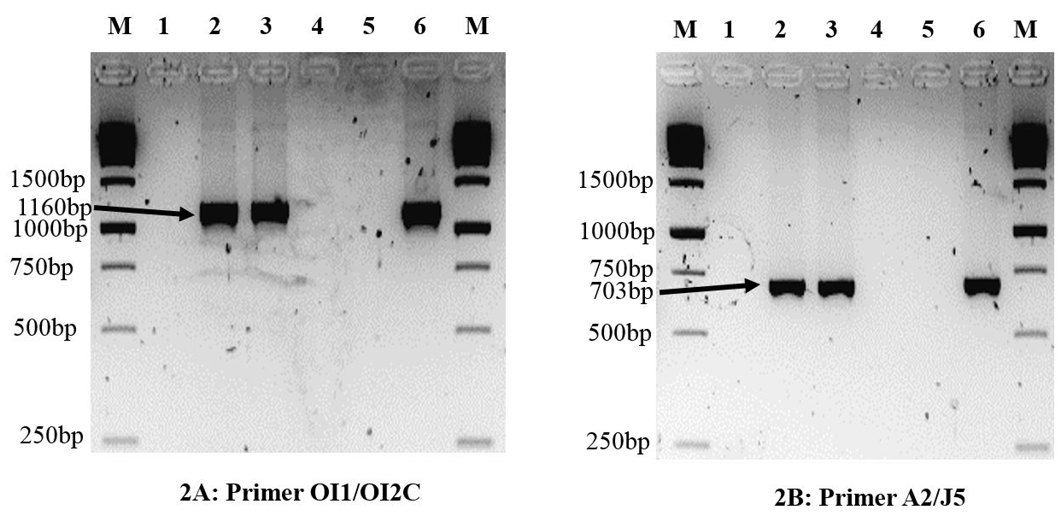
(A and B) Lane M= 1kb DNA Ladder, Lane 1: Negative Control (dH2O), Lanes 4, 5 = DNA samples from healthy trees (asymptomatic); Lanes 2, 3= DNA samples from CGD infected (Symptomatic plants) (Kinnow and Mosambi, respectively). Lane 6= Positive Control (Already confirmed CGD sample).
References
- Ajene, I.J., F. Khamis, B. van Asch, G. Pietersen, B.A. Rosowo, S. Ekasi and S. Mohammed. 2020. Habitat suitability and distribution potential of Liberibacter species (Candidatus Liberibacter asiaticus and Candidatus Liberibacter africanus) associated with citrus greening disease. Divers Distrib., 26: 575–588. https://doi.org/10.1111/ddi.13051[CrossRef]
- Akhtar, M.A. and I. Ahmad. 1999. Incidence of citrus greening disease in Pakistan. Pak. J. Phytopath., 11: 1-5.
- Batool, A., Y. Iftikhar, S.M. Mughal, M.M. Khan, M.J. Jaskani, M. Abbas and I.A. Khan. 2007. Citrus greening disease-a major cause of citrus decline in the world-a review. Hort. Sci. (Prague). 34: 159-166. https://doi.org/10.17221/1897-HORTSCI[CrossRef]
- Bové, J.M., 2006. Huanglongbing: A destructive, newly-emerging, century-old disease of citrus. J. Plant Pathol., 1: 7-37.
- Catara, A., A. Azzaro, M. Davino, V. Grimaldi, M. Hussain, M. Saleem and M.S. Mirza. 1991. A survey of tristeza and greening in Punjab, Pakistan. In: BRLANSKY R. H. Lee, R.F and L.W. Timmer (eds), Proc. of the 11th Conf. of the Intl. Organ. of Citrus Virologists (IOCV). CA, Riverside. Pp. 166-170
- Chohan, S.N., R. Qamar, I. Sadiq, M. Azam, P. Holford and A. Beattie. 2007. Molecular evidence for the presence of Huanglongbing in Pakistan. Aust. Plant Dis. Notes, 2: 37-38. https://doi.org/10.1071/DN07019[CrossRef]
- Dala-Paula, B.M., A. Plotto, J. Bai, J.A. Manthey, E.A. Baldwin, R.S. Ferrarezi and M.B.A. Gloria. 2019. Effect of huanglongbing or greening disease on orange juice quality. A review. Front. Plant Sci., 9: 1976. https://doi.org/10.3389/fpls.2018.01976[CrossRef]
- Das, A.K., C.N. Rao and S. Singh. 2007. Presence of citrus greening (Huanglongbing) disease and its psyllid vector in the North-Eastern region of India confirmed by PCR technique. Curr. Sci., 92(12): 1759-1763.
- Devi, E.J., R.K. Labala, R. Modak, N.S. Singh, N.S and H.S. Devi. 2020. Molecular detection of “Candidatus Liberibacter asiaticus” causing HLB in Manipur and correlation of its incidence with elevation. Trop. Plant Path. 45(6): 658-667. https://doi.org/10.1007/s40858-020-00392-3[CrossRef]
- Ding. F., Shu-ang Peng and J.S. Hartung. 2020. Enhanced Serologically Based Detection of Liberibacters Associated with Citrus Huanglongbing. Plant Dis., 105(6): 1584-1588. https://doi.org/10.1094/PDIS-12-19-2679-SC[CrossRef]
- Ghosh, D.K., A. Kokane, S. Kokane, J. Tenzin, M.G., Gubyad, P. Wangdi and S. Gowda. 2020. Detection and molecular characterization of ‘Candidatus Liberibacter asiaticus’ and Citrus tristeza virus associated with citrus decline in Bhutan. Phytopathology, (ja). https://doi.org/10.1094/PHYTO-07-20-0266-R[CrossRef]
- Ghosh, D.K., M. Motghare and S. Gowda. 2018. Citrus greening: overview of the most severe disease of citrus. Adv. Agric. Res. Tech. J., 2: 83-100.
- Graca, J.D., 1991. Citrus greening disease. Ann. Rev. Phytopathol., 29: 109-136. https://doi.org/10.1146/annurev.py.29.090191.000545[CrossRef]
- Ha, P.T., R. He, N. Killiny, J.K. Brown, A. Omsland, D.R. Gang and H. Beyenal. 2019. Host-free biofilm culture of Candidatus Liberibacter asiaticus, the bacterium associated with Huanglongbing. Biofilm, 1: 100005. https://doi.org/10.1016/j.bioflm.2019.100005[CrossRef]
- Hocquellet, A., P. Toorawa, J.M. Bové and M. Garniner. 1999. Detection and identification of the two Candidatus Liberobacter species associated citrus huanglongbing by PCR amplification of ribosomal protein genes of the operon. Mol. Cell. Probes., 13: 373-379. https://doi.org/10.1006/mcpr.1999.0263[CrossRef]
- Iftikhar, Y., S. Rauf, U. Shahzad and M.A Zahid. 2016. Huanglongbing: Pathogen detection system for integrated disease management–A review. J. Saudi Soc. Agric. Sci., 15: 1-11. https://doi.org/10.1016/j.jssas.2014.04.006[CrossRef]
- Inoue, H., S. Yamashita-Muraki, K. Fujiwara, K. Honda, H. Ono, T. Nonaka and Y. Masaoka. 2020. Fe2+ ions alleviate the symptom of citrus greening disease. Int. J. Mol. Sci., 21(11): 4033. https://doi.org/10.3390/ijms21114033[CrossRef]
- Jagoueix, S., J.M. Bové, and M. Garnier. 1996. PCR detection of the two ‘Candidatus’ liberobacter species associated with greening disease of citrus. Mol. Cell. Probes, 10: 43-50. https://doi.org/10.1006/mcpr.1996.0006[CrossRef]
- Khan, N., A.A. Khan, M. Ahmad, M. Nouman and B. Islam. 2016. Evaluation and screening of sweet orange cultivars for vegetative growth and citrus canker. Sarhad J. Agric., 32(2): 121-126. https://doi.org/10.17582/journal.sja/2016/32.2.121.126[CrossRef]
- Knapp, J.L., S. Halbert, R. Lee, M. Hoy, R. Clarkand M. Kesinger. 2004. The Asian citrus psyllid and citrus greening disease. Citrus Ind., 79: 1028-1029.
- Kokane, S.B., S. Bhose, A. Kokane, M. Gubyad and D.K. Ghosh. 2020. Molecular detection, identification, and sequence analysis of ‘Candidatus Liberibacter asiaticus’ associated with Huanglongbing disease of citrus in North India. 3 Biotech., 10(8): 1-14. https://doi.org/10.1007/s13205-020-02334-x[CrossRef]
- McCollum, G. and E. Baldwin. 2017. Huanglongbing: devastating disease of citrus. Horticult. Rev. 44: 315–361
- Murray, R.G.E. and K.H. Schleifer. 1994. Taxonomic notes: A proposal for recording the properties of putative taxa of procaryotes. Int. J. Syst. Bacteriol., 44: 174-176. https://doi.org/10.1099/00207713-44-1-174[CrossRef]
- Razi, M.F., I.A. Khan and M.J. Jaskani. 2011. Citrus plant nutritional profile in relation to Huanglongbing prevelance in Pakistan. Pak. J. Agric. Sci., 48(4): 299-304.
- Razi, MF., M.L. Keremane, C. Ramadugu, M. Roose, I.A. Khan and R.F. Lee. 2014. Detection of citrus huanglongbing-associated ‘Candidatus Liberibacter asiaticus’ in citrus and Diaphorina citri in Pakistan, seasonal variability, and implications for disease management. Phytopath, 104: 257-268. https://doi.org/10.1094/PHYTO-08-13-0224-R[CrossRef]
- Ruangwong, O. and A. Akarapisan. 2006. Detection of Candidatus Liberibacter asiaticus causing Citrus Huanglongbing disease. J. Agric. Technol., 2(1): 111-120.
- Saifullah, I.U., Haq, Y. Iftikhar, S.A. Khan, M.J. Jaskani, Samiullah and R.M.S. Tariq. 2015. Quick Indexing of Huanglongbing on the basis of symptomology and Iodo-starch test in relation to environmental factors. Pak. J. Agric. Sci., 52(4): 1005-1009
- Tipu, M.M.H., M.M. Rahman, M.M. Islam, F.E. Elahi, R.Jahan and M.R. Islam. 2020. Citrus greening disease (HLB) on Citrus reticulata (Mandarin) caused by Candidatus Liberibacter asiaticus in Bangladesh. Physiol. Mol. Plant Path., 112 (2020): 101558. https://doi.org/10.1016/j.pmpp.2020.101558[CrossRef]
- Yaqub, MS., A.K. Iqra, U. Muhammad and A.R. Iqra. 2017. Molecular detection of candidatus liberibacter asiaticus, the causal organism of Huanglongbing (citrus greening) in Paisalabad, Pakistan for huanglongbing management. Pak. J. Agric. Sci., 54(1): 21-26. https://doi.org/10.21162/PAKJAS/17.4455[CrossRef]
- Zafarullah, A., N. Shagufta and S. Faiza. 2016. Detection and Molecular characterization of Candidatus Liberibacter spp. causing Huanglongbing in indigenous citrus cultivars in Pakistan. Pak. J. Bot., 48(5): 2071-2076.
- Zhang, X.H., N. Pizzo, M. Abutineh, X.L. Jin, S. Naylon, T.L. Meredith, L. West and J.M. Harlin. 2020. Molecular and cellular analysis of orange plants infected with Huanglongbing (citrus greening disease). Plant Gr. Reg., 92: 333–343. https://doi.org/10.1007/s10725-020-00642-z[CrossRef]
Cited by 2 articles
In journals published by ResearchersLinks.
Services
Article usage statistics
Loading…