
Owing to alarming increase of diabetes mellitus around the world, there is a need to discover new molecules to tackle with the problem. In this work, sulfonamides and sulfonylurea-sulfonamide hybrids were synthesized from simple molecule of 4-aminobenzenesulfonamide by its reaction with aryl sulfonyl chlorides. Anti-diabetic activities of these pharmacophores were studied by oral glucose tolerance test (OGTT) percentage analysis on Sprague Dawley (SD) rats at the dose of 20mg/kg using glibenclamide (GC). Among these synthesized pharmacophores, six compounds exhibited percentage reduction (20.47±2.54 to 44.97±2.16 %) and (20.79±1.55 to 37±2.94 %) in blood glucose level at 20mg/kg dose compared to glibenclamide (74±3.10 % reduction) 50mg/kg dose of glibenclamide after 2 and 5 hours of oral administration respectively. Present results showed that these compounds might be excellent addition in the drugs used to suppress the higher level of blood glucose level in diabetes mellitus.
Research Article · Volume 52, Issue 3, 26 February 2020 · Open Access
In vivo Anti-Diabetic Studies of Sulfonylurea-Sulfonamide Hybrids
· · · · · ·
Affiliations & Notes ⌄
- 1Institute of Chemistry, University of the Punjab, Quaid-e-Azam Campus, Lahore-54590, Pakistan 2Key Laboratory of Synthetic and Natural Functional Molecular Chemistry of Ministry of Education, Department of Chemistry and Materials Science, Northwest University, Xi’an 710127, China 3Pakistan Council of Scientific and Industrial Research Laboratories Complex, Lahore-54000, Pakistan , * Corresponding author: rehman_pcsir@hotmail.com
Article Info ⌄
- Journal:
- Pakistan Journal of Zoology
- Published:
- 26 February 2020

From the article
- The C=O band appeared in the range of 1710-1685 cm-1 in all sulfonylurea-sulfonamide compounds, confirmed the coupling of sulfonamide with 3-chlorophenyl isocyanate.
- In 1HNMR spectra of all the sulfonylurea-sulfonamide compounds, the most downfield signal appeared around 11 ppm can be attributed to NH proton flanked between -SO2 and -CO- moieties.
- The signal of one proton -SO2NH-Ar can be observed in all sulfonylurea-sulfonamide compounds between 10 ppm and 11 ppm slightly upfield to the most downfield signal depending on the nature of attached group.
- Percentage glucose reduction of these compounds was observed in comparison with the standard (GC) and excellent results in blood glucose reduction rats were observed by the compounds 3c, 3e, 3g, 4b, 4f and 4g.
Selected from the article's own text.
Abstract
INTRODUCTION
Diabetes mellitus (DM) is characterized by hyperglycemia and can be classified into type 1 and type 2, which may have differences in their pathogenesis . In type 2 diabetes (T2D), pancreas stops producing insulin to maintain normal blood glucose levels in human body along with the development of resistance of the body towards the injected insulin . Insulin release in the beta cells is stimulated by blood glucose due to the fact that plasma membrane of these cells contains ATP-sensitive K+ (KATP) channels which remain open in normal conditions and voltage-gated Ca2+ channels which remain closed ; . Potassium ions due to their positive charge diffuse out of the cell resulting a decreased concentration gradient inside the β cell creating a relatively negative charge with respect to the outer medium . In inactive state, it poses a potential difference of -70 mV across the cell membrane surface . An increase in this ratio forces the ATP-sensitive K+ (KATP) channels to close suppressing the further diffusion of potassium ions out of the cell . Due to accumulation of potassium ions inside the cell, potential difference across the membrane becomes more positive which in turn causes the opening of voltage-gated Ca2+ channels permitting Ca+2 ions to enter the β cells hence decreasing its concentration outside the cell ; .
Many drugs are being used for the treatment of diabetes among which sulfonylureas are the most common due to their inexpensive and safe nature. These drugs activate the rise in calcium concentration and stimulate insulin release by obstructing performance of a protein that brings potassium ions into the cells . These are mainly useful for the patients affected with T2D whose β cells are yet to release insulin and are being marketed since 1950 when Tolbutamide was introduced in the market. Following the introduction of Tolbutamide, a number of other sulfonylurea-based drugs have been introduced such as chlorpropamide, glyclopyramide, tolazamide, acetohexamide, and glibenclamide for the treatment of T2D ; ; ; (Fig. 1).
In this study, synthesis of various sulfonamides and sulfonylurea-sulfonamide hybrids along with their in vivo studies as anti-diabetic agents on SD rats is reported. Rats were orally administered with synthesized compounds 30 min before the glucose dose (2 g/kg). Percentage reduction in blood sugar levels was noted at interval 1, 2, and 5 h of glucose dose (2 g/kg) and GC was used as reference drug and carboxymethyl cellulose (CMC) as control. Some compounds exhibited good results in blood glucose reduction.
MATERIALS AND METHODS
All the reagents and chemicals used were of analytical grade and were used without further purification. Most of the chemicals were purchased from Merck and Fluka. Melting points of the compounds were determined on Gallenkamp melting point apparatus. Perkin Elmer Spectrum BX was used for recording FT-IR spectra while 1HNMR spectra were recorded on Bruker DPX 300 (75) MHz instrument. Chemical shifts in 1HNMR spectra were taken in ppm downfield from TMS, while coupling constants (J) are reported in Hz.
Experimental animals
Sprague Dawley male albino rats (200-300 g) were used and maintained in animal house at controlled temperature (25±5 °C) and humidity (50±10 %). Animals were provided with free access to autoclaved tap water and pathogen free feed for 24 h. Animal experiments were approved by Institutional ethical committee. International ethical guidelines for the care of laboratory animals were followed to maintain rats in animal house.
Anti-diabetic activity studies
The anti-hyperglycemic activity of synthesized compounds (3a-g and 4a-g) was performed in SD rats to find percentage reduction in blood glucose level. The Oral Glucose Tolerance Test (OGTT) was performed on normal rats (200-300g), fasted 18 h before the activity having glucose level 80-100 mg/dL. The rats were administered orally with compounds 30 min before the glucose dose of 2g/kg. The blood glucose was measured at intervals 0, 1, 2 and 5 h after glucose load with calibrated glucometer.
Synthesis of sulfonamides and sulfonylurea-sulfonamide hybrids
Sulfonamides (3a-3g) was synthesized by a general procedure as shown in Figure 2. Typically, an equimolar mixture of 4-aminobenzenesulfonamide (0.5 g, 2.9 mmol) and substituted/unsubstituted benzene sulfonyl chlorides (2.9 mmol) was stirred in dry pyridine (10 mL) at ambient temperature for 4 h. On completion of reaction (as indicated by TLC), dilute hydrochloric acid was added and the precipitates obtained were filtered and washed with cold water.
N-{4-[(4-sulfamoylphenyl) sulfamoyl] phenyl} acetamide (3a)
White compound (3a) was obtained from the reaction of 4-aminobenzene sulfonamide (0.5 g, 2.9 mmol) with 4-(acetylamino) benzenesulfonyl chloride (0.678 g, 2.9 mmol). Yield: 0.75 g, 70%. FT-IR (ν-cm-1) 3359, 3268 (-NH str.).
4-Nitro-N-(4-sulfamoylphenyl) benzenesulfonamide (3b)
White precipitates of compound (3b) were obtained from the reaction of 4-aminobenzene sulfonamide (0.5 g, 2.9 mmol) with 4-nitrobenzenesulfonyl chloride (0.643 g, 2.9 mmol). Yield: 0.85 g, 82.05%. FT-IR (ν-cm-1) 3359, 3268 (-NH str.).
4-Methoxy-N-(4-sulfamoylphenyl)benzenesulfonamide (3c)
White crystals of compound (3c) were obtained from the reaction of 4-aminobenzene sulfonamide (0.5 g, 2.9 mmol) and 4-methoxybenzenesulfonyl chloride (0.59 g, 2.9 mmol). Yield: 0.82 g, 82%. FT-IR (ν-cm-1) 3359, 3268 (-NH str.).
4-Methyl-N-(4-sulfamoylphenyl ) benzenesulfonamide (3d)
The compound (3d) was obtained as off-white precipitates by the reaction of 4-aminobenzene sulfonamide (0.5 g, 2.9 mmol) with 4-methylbenzenesulfonyl chloride (0.55 g, 2.9 mmol). Yield: 0.948 g, 74%. FT-IR (ν-cm-1) 3362, 3237 (-NH str.).
4-[(Propylsulfonyl) amino] benzenesulfonamide (3e)
Pink compound (3e) was prepared from the reaction of 4-aminobenzene sulfonamide (0.5 g, 2.9 mmol) and propane-1-sulfonyl chloride (0.413 g, 2.9 mmol). Yield: 0.7g, 86.6%. FT-IR (ν-cm-1) 3432, 3272 (-NH str.).
3-Nitro-N-(4-sulfamoylphenyl) benzenesulfonamide (3f)
The compound (3f) was obtained from the reaction of 4-aminobenzene sulfonamide (0.5g, 2.9 mmol) with 3-nitrobenzenesulfonyl chloride (0.643g, 2.9mmol). Yield: 0.80 g, 77%. FT-IR (ν-cm-1) 3432, 3272 (-NH str.).3430, 3270 (-NH str.).
N-(4-Sulfamoylphenyl) benzenesulfonamide (3g)
The compound (3g) was obtained from the reaction of 4-aminobenzenesulfonamide (0.5g, 2.9 mmol) with benzenesulfonylchloride (0.512g, 2.9 mmol). Yield: 0.91 g, 79.12%. FT-IR (ν-cm-1) 3358, 3269 (NH str.).
Synthesis of sulfonylurea-sulfonamide hybrids
A mixture of substituted/unsubstituted N-(4-sulfamoylphenyl)benzenesulfonamides (3a-3g) (0.001 mol) and anhydrous K2CO3 (0.002 mol) in dry acetone (20 mL) was stirred and refluxed for one hour followed by drop-wise addition of corresponding 3-chlorophenyl isocyanate (0.001 mol). The reaction mixture was further refluxed for 18 h followed by removal of acetone under vacuum. Residue was treated with distilled water and acidified with hydrochloric acid (2M). The precipitated product was filtered, washed with cold water and dried in air.
N-[(3-chlorophenyl)carbamoyl]-4-[(phenylsulfonyl) amino] benzenesulfonamide (4a)
The title compound (4a) was obtained by the reaction N-(4-sulfamoylphenyl) benzenesulfonamide (0.312 g, 0.001 mol) with 3-chlorophenylisocyanate (0.153 g, 0.001 mol). Yield: 0.380 g, 81.7%. FT-IR (ν-cm-1)1684 (C=O), 3370, 3337, 3238, 3060 (-NH str.).1HNMR (DMSO d6, 300 MHz): δH: 11.06 (1H, s, -SO2-NH-CO-), 10.68 (1H, bs, -SO2-NH-), 9.04 (1H, s, -CO-NH-Ph-3Cl), 7.88-7.82 (4H, m), 7.63-7.55 (3H, m), 7.49 (1H, t,J = 2.0 Hz), 7.33-7.24 (3H, m), 7.19 (1H, d, J = 8.7 Hz), 7.07 (1H, d, J = 8.7 Hz).
N-(4-{[(3-Chlorophenyl) carbamoyl] sulfamoyl} phenyl)-4-nitrobenzenesulfonamide (4b)
Yellow compound was prepared from the reaction of 4-nitro-N-(4-sulfamoylphenyl) benzenesulfonamide (0.357 g, 0.001 mol) with 3-chlorophenyl isocyanate (0.153 g, 0.001 mol). Yield: 0.410 g, 80%. FT-IR (ν-cm-1)1701(C=O), 3568,3464, 3409 (-NH str.) 1HNMR (DMSO d6, 300 MHz): δH :11.21 (1H, s, -SO2NH-CO), 10.91 (1H, s, -SO2NH), 9.01(1H, s, -CONH-3Cl-Ph), 8.58-8.47 (4H, m), 7.78 (2H, d, J = 8.7 Hz), 7.53 (1H, t, J = 2.0 Hz), 7.31-7.24 (3H, m), 7.20 (1H, d, J = 8.4 Hz), 7.05 (1H, d, J = 7.8 Hz).
N-(4-{[(3-Chlorophenyl) carbamoyl] sulfamoyl} phenyl)-3-nitrobenzenesulfonamide (4c)
The compound (4c) was synthesized by the reaction of 3-nitro-N-(4-sulfamoylphenyl) benzenesulfonamide (0.357 g, 0.001 mol) with 3-chlorophenyl isocyanate (0.153 g, 0.001 mol).Yield:0.401 g, 78%.FT-IR (ν-cm-1) 1701 (C=O), 3405, 3360, 3241, 3106 (NH str.) 1HNMR (DMSO d6, 300 MHz): δH:11.23 (1H, bs, -SO2-NH-CO-), 10.93 (1H, bs, -SO2-NH-), 9.04 (1H, s, -CO-NH-3-Cl-Ph), 8.58 (1H, t, J = 1.8 Hz), 8.45 (1H, dd, J = 8.7 Hz, J = 2.0 Hz), 8.26 (1H, d, J = 7.8 Hz), 7.90-7.85 (3H, m), 7.48 (1H, t, J = 1.8 Hz), 7.34 (2H, d, J = 8.7 Hz), 7.28 (1H, t, J = 8.0 Hz), 7.18 (1H, d, J = 8.1 Hz),7.07 (1H, t, J = 8.1 Hz).
4-Bromo-N-(4-{[(3-chlorophenyl)carbamoyl] sulfamoyl}phenyl) benzenesulfonamide (4d)
The title compound (4d) was synthesized by the reaction of 4-bromo-N-(4-sulfamoylphenyl) benzenesulfonamide (0.278 g, 0.001 mol) with 3-chlorophenyl isocyanate (0.153 g, 0.001 mol).Yield:0.40 g, 76%. FT-IR (ν-cm-1) 1701 (C=O), 3401, 3309, 3260, 3110 (NH). 1HNMR (DMSO d6, 300MHz): δH:11.07 (1H, s, -SO2-NH-CO-), 10.89 (1H, bs, -SO2-NH-), 9.09 (1H, s, -CO-NH-Ph-3Cl), 7.86-7.74 (6H, m), 7.49 (1H, t, J = 2.0 Hz), 7.31-7.25(3H, m), 7.19 (1H, d, J = 8.1 Hz), 7.07 (1H, d, J = 7.8 Hz).
4-Chloro-N-(4-{[(3-chlorophenyl) carbamoyl] sulfamoyl}phenyl) benzenesulfonamide (4e)
The compound (4e) was prepared from the reaction of 4-chloro-N-(4-sulfamoylphenyl) benzenesulfonamide (0.346 g, 0.001 mol) with 3-chlorophenyl isocyanate (0.153 g, 0.001 mol). Yield: 0.390 g, 78%. FT-IR (ν-cm-1) 1701 (C=O), 3460, 3308, 3257(NH str.).1HNMR (DMSO d6, 300MHz): δH: 11.11(1H, s, -SO2-NH-CO-), 10.87 (1H, bs, -SO2-NH-), 9.07 (1H, s, -CO-NH-Ph-3Cl), 7.86-7.83(4H, d, (two overlapped doublets), J = 8.7 Hz), 7.65 (2H, d, J = 8.7 Hz), 7.49(1H, t, J = 2.0 Hz), 7.32-7.25(3H, m), 7.19 (1H, d, J = 8.4 Hz), 7.07 (1H, d, J = 7.8 Hz).
N-(4-{[(3-Chlorophenyl) carbamoyl] sulfamoyl} phenyl)-4-methylbenzenesulfonamide (4f)
Light brown compound was synthesized from the reaction of 4-methyl-N-(4-sulfamoylphenyl) benzenesulfonamide (0.326 g, 0.001 mol) with 3-chlorophenyl isocyanate (0.153 g, 0.001 mol). Yield: 0.326 g, 71%. FT-IR (ν-cm-1) 1697 (C=O), 3410, 3350 3240, 3105 (-NH str.). 1HNMR (DMSO d6, 300MHz): δH : 10.98 (1H, s, -SO2NH-CO), 10.67 (1H, s, SO2-NH-), 8.90 (1H, s, CO-NH-3Cl-Ph), 7.85-7.80 (4H, m), 7.66 (2H, d, J = 8.1 Hz), 7.49 (1H, t, J = 2.0Hz), 7.34-7.24 (3H, m), 7.21 (1H, d, J = 8.4 Hz), 7.01 (1H, d, J = 7.8 Hz), 2.34 (1H, s, -CH3).
N-[(3-Chlorophenyl )carbamoyl] -4-[(propylsulfonyl) amino] benzene sulfonamide (4g)
Dark brown compound was obtained from the reaction of 4-[(propylsulfonyl) amino] benzenesulfonamide (0.278 g, 0.001 mol) with 3-chlorophenyl isocyanate (0.153 g, 0.001 mol). Yield: 0.320 g, 74%. FT-IR (ν-cm-1) 1701 (C=O), 3432, 3366 3268, 3108 (-NH str.). 1HNMR (DMSO d6, 300MHz): δH : 10.79 (1H, s, -SO2NH-CO-), 10.52 (1H, s, -SO2-NH-), 8.86 (1H, s, -CO-NH-Ph), 7.93 (2H, d, J = 8.7Hz), 7.51 (1H, t, J = 7.5 Hz), 7.36-7.27 (3H, m), 7.18 (1H, d, J = 8.7 Hz), 7.06 (1H, d, J = 8.7 Hz), 3.23 (2H, t, J = 7.5 Hz, -CH2-SO2-), 1.10 (2H, sext., J = 7.5 Hz, -CH2-), 0.939 (3H, t, J = 7.5 Hz, -CH3).
RESULTS AND DISCUSSION
In the FT-IR spectra of the compounds (3a-3g), bands at 3360 cm-1 and 3310 cm-1 may be attributed to NH stretch and the bands 1658 cm-1 are observed due to C=O group. The bands at 1130 cm-1 and 1360 cm-1 are observed due to O=S=O (symmetric and asymmetric stretch). The substituted/ unsubstituted sulfonylurea-sulfonamide hybrids (4a-4g) were prepared by the reaction of equimolar substituted/ unsubstituted N-(4-sulfamoylphenyl)benzenesulfonamides (3a-3g) with 3-chlorophenyl isocyanate after its treatment with potassium carbonate in acetone.
Structures of the synthesized compounds (4a-4g) were confirmed by spectral analysis (FT-IR, 1HNMR). In the FT-IR spectra, all compounds showed bands corresponding to NH stretch in the range of 3389 cm-1 - 3210 cm-1. The C=O band appeared in the range of 1710-1685 cm-1 in all sulfonylurea-sulfonamide compounds, confirmed the coupling of sulfonamide with 3-chlorophenyl isocyanate. In 1HNMR spectra of all the sulfonylurea-sulfonamide compounds, the most downfield signal appeared around 11 ppm can be attributed to NH proton flanked between -SO2 and -CO- moieties. The combined electronic and anisotropic effect of these moieties is the possible reason of this downfield shift. The signal of one proton -SO2NH-Ar can be observed in all sulfonylurea-sulfonamide compounds between 10 ppm and 11 ppm slightly upfield to the most downfield signal depending on the nature of attached group. Another singlet corresponding one proton appeared around 8.8 ppm to 9.2 ppm which could be assigned to -CO-NH-Ar. The aromatic protons in all the compounds appeared in their respective positions influenced by the nature of substituents attached to aromatic rings.
Table I. Percentage OGTT results of the compounds 3a-3g and 4a-4g.
| Compounds | OGTT (%) | ||
| 1h | 2h | 5h | |
| 3a | -32.55±2.82 | 32.45±3.74 | 14.28±2.16 |
| 3b | -8.04±3.55 | 20.21±3.3 | 1.33±4.32 |
| 3c | -25.49±4.11 | 27.34±2.54 | 26.88±5.09 |
| 3d | - | 10.57±6.16 | -23.65±3.7 |
| 3e | -63.63±2.39 | 35.41±5.09 | 22.58±3.09 |
| 3f | -116.6±4.14 | 44.97±2.16 | -8.60±4.5 |
| 3g | -81.42±2.64 | 20.47±2.87 | 20.79±1.55 |
| 4a | -25.96±2.48 | 28.24±5.35 | -5.31±2.94 |
| 4b | -41.3±5.35 | 34±2.83 | 37±2.94 |
| 4c | -6.79±2.16 | 10±2.94 | 4.04±4.32 |
| 4d | -79.31±2.2 | 21.79±4.54 | 8.19±4.30 |
| 4e | -10.86±3.55 | 14.70±3.09 | -8.04±3.1 |
| 4f | -41.74±3.77 | 30±3.92 | 32.15±2.46 |
| 4g | -9.27±3.30 | 29±4.54 | 28.53±2.38 |
| GC | 14.58±2.56 | 74±3.10 | 90±2.64 |
| Control | -32.55±3.55 | 28±2.29 | 22±2.12 |
Anti-diabetic activity
Oral glucose tolerance test (OGTT) was used to evaluate the glucose suppressive effects of sulfonamides and sulfonylurea-sulfonamide hybrid compounds. The synthesized compounds showed excellent percentage reduction of glucose level in rats after 2 and 5 h at the dose of 20mg/kg. Among the sulfonamides (3a-3g)
3c, 3e and 3f showed an impressive influence in blood glucose reduction after 2 and 5 h (Fig. 3), while the compounds 3b, 3d and 3f did not show much influence on the blood glucose reduction (Fig. 3, Table I). Furthermore, sulfonylurea-sulfonamide hybrid compounds (4a-4g) were found to be more active in percentage reduction of hyperglycemia at their 20 (mg/kg) as compared to control rat which was administered only with CMC and GC was used as reference drug. Compounds 4b, 4f and 4g showed impressive effects on blood glucose reduction compared with the reference drug (Fig. 3, Table I).
CONCLUSIONS
In vivo anti-diabetic studies of synthesized sulfonamides and their sulfonylurea hybrids have been carried out, which were characterized by FT-IR and 1H-NMR spectroscopy. Percentage glucose reduction of these compounds was observed in comparison with the standard (GC) and excellent results in blood glucose reduction rats were observed by the compounds 3c, 3e, 3g, 4b, 4f and 4g. Owing to their results, it is envisaged that these molecules might be found useful as antidiabetic drug after their investigation at molecular levels.
Statement of conflict of interests
The authors declare that there is no conflict of interests regarding the publication of this paper.
Figures
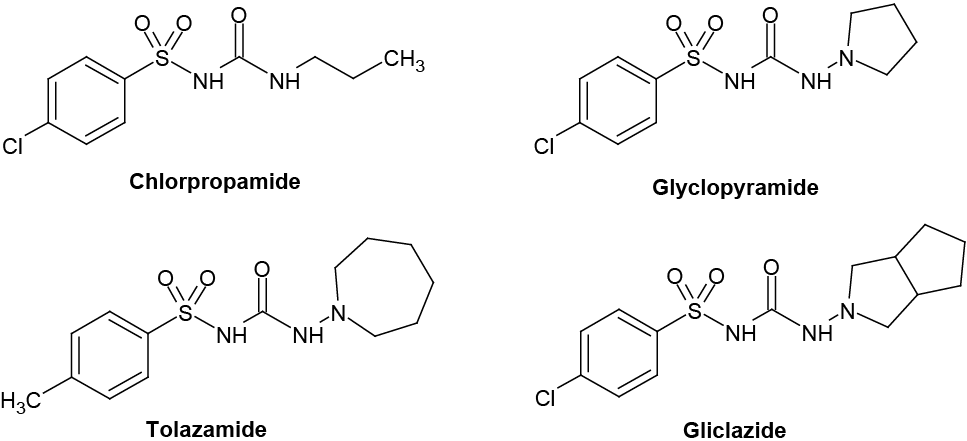
Chemical structures of selected anti-diabetic drugs.
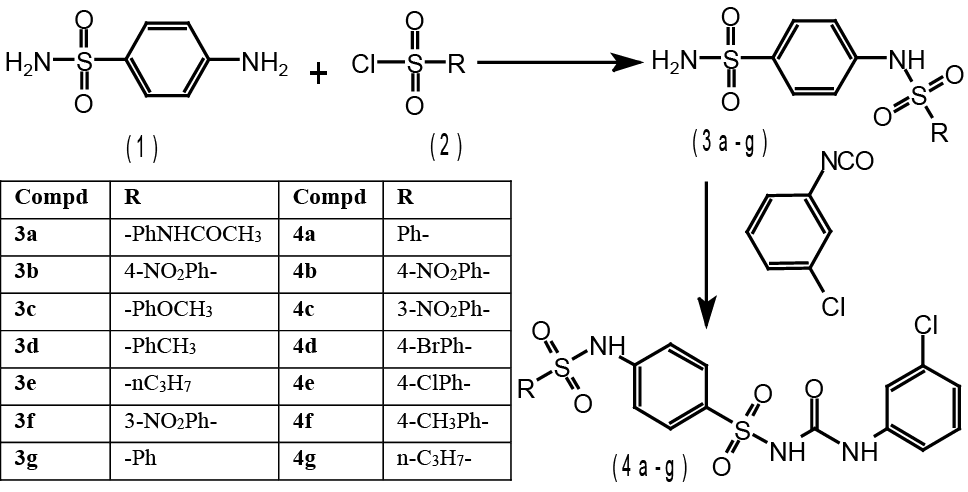
Synthesis of sulfonylurea-sulfonamide hybrids.
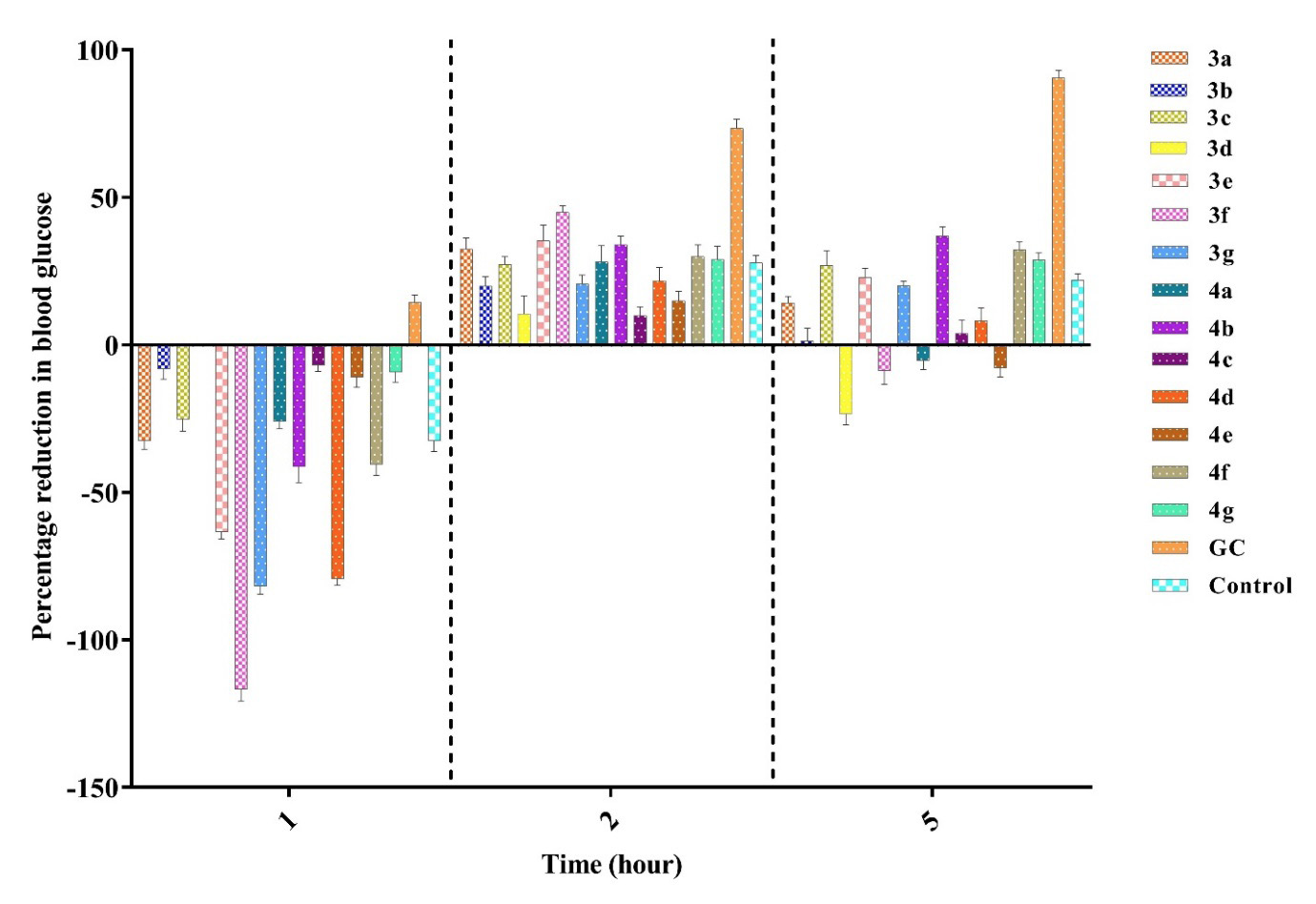
OGTT activity of the compounds 3a-3g and 4a-4g. Oral glucose tolerance test was performed for the synthesized compounds in SD rats at the dose of 20mg/kg. Rats were orally administered with compounds 3a-3g and 4a-4g 30 min before the glucose dose (2 g/kg). The percentage reduction was noted at the interval 1, 2, and 5 hour of glucose dose (2 g/kg) and GC was used as reference drug.
References
- Ashcroft, F.M. and Rorsman, P., 1990. ATP-sensitive K+ channels: a link between B-cell metabolism and insulin secretion. Biochem. Soc. Trans., 18: 109-111. https://doi.org/10.1042/bst0180109[CrossRef]
- Boland, B.B., Rhodes, C.J. and Grimsby, J.S., 2017. The dynamic plasticity of insulin production in β-cells. Mol. Metabol., 6: 958-973. https://doi.org/10.1016/j.molmet.2017.04.010[CrossRef]
- Clare, B.W. and Supuran, C.T., 1999. Carbonic anhydrase inhibitors. Part 61. Quantum chemical QSAR of a group of benzenedisulfonamides. Eur. J. med. Chem., 34: 463−474. https://doi.org/10.1016/S0223-5234(99)80096-8[CrossRef]
- De Vos, A., Heimberg, H., Quartier, E., Huypens, P., Bouwens, L., Pipeleers, D. and Schuit, F., 1995. Human and rat beta cells differ in glucose transporter but not in glucokinase gene expression. J. clin. Invest., 96: 2489-2495. https://doi.org/10.1172/JCI118308[CrossRef]
- Edgerton, D.S., Kraft, G., Smith, M., Farmer, B., Williams, P.E., Coate, K.C., Printz, R.L., O’Brien, R.M. and Cherrington, A.D., 2017. Insulin’s direct hepatic effect explains the inhibition of glucose production caused by insulin secretion. JCI Insight, 2: e91863. https://doi.org/10.1172/jci.insight.91863[CrossRef]
- Henry, R.J.,1943. The mode of action of sulfonamides. Bact. Rev. 7: 175-262.
- Inzucchi, S.E., Bergenstal, R.M., Buse, J.B., Diamant, M., Ferrannini, E., Nauck, M., Peters, A.L., Tsapas, A., Wender, R. and Matthews, D.R., 2012. Management of hyperglycemia in type 2 diabetes: a patient-centered approach: position statement of the American Diabetes Association (ADA) and the European Association for the Study of Diabetes (EASD). Diabetes Care, 35: 1364-1379. https://doi.org/10.2337/dc12-0413[CrossRef]
- Jarald, E.E., Joshi, S.B., Jain, D.C. and Edwin, S., 2013. Biochemical evaluation of the hypoglycemic effects of extract and fraction of cassia fistula linn. in alloxan-induced diabetic rats. Indian J. Pharm. Sci., 75: 427-434. https://doi.org/10.4103/0250-474X.119823[CrossRef]
- Keizer, J. and Magnus, G., 1989. ATP-sensitive potassium channel and bursting in the pancreatic beta cell. A theoretical study. Biophys. J., 56: 229-242. https://doi.org/10.1016/S0006-3495(89)82669-4[CrossRef]
- Lang, V. and Light, P.E., 2010. The molecular mechanisms and pharmacotherapy of ATP-sensitive potassium channel gene mutations underlying neonatal diabetes. Pharmacogen. Personal. Med., 3: 145-161. https://doi.org/10.2147/PGPM.S6969[CrossRef]
- Luzi, L. and Pozza, G., 1997. Glibenclamide: an old drug with a novel mechanism of action. Acta Diabetol., 34: 239-244. https://doi.org/10.1007/s005920050081[CrossRef]
- MacDonald, P.E., Joseph, J.W. and Rorsman, P., 2005. Glucose-sensing mechanisms in pancreatic beta-cells. Phil. Trans. R. Soc. London. Ser. B. Biol. Sci., 360: 2211-2225. https://doi.org/10.1098/rstb.2005.1762[CrossRef]
- Melander, A., 1998. Pharmacological intervention: the anti-diabetic approach. Eur. J. clin. Invest., 28: 23-26. https://doi.org/10.1046/j.1365-2362.1998.0280s2023.x[CrossRef]
- Nayak, Y., Hillemane, V., Daroji, V.K., Jayashree, B.S. and Unnikrishnan, M.K., 2014. Anti-diabetic activity of benzopyrone analogues in nicotinamide-streptozotocin induced type 2 diabetes in rats. Scient. World J., 2014: 1-12. https://doi.org/10.1155/2014/854267[CrossRef]
- Proks, P., Reimann, F., Green, N., Gribble, F. and Ashcroft, F., 2002. Sulfonylurea stimulation of insulin secretion. Diabetes, 51: S368-376. https://doi.org/10.2337/diabetes.51.2007.S368[CrossRef]
- Ramachandran, S., Rajasekaran, A. and Adhirajan, N., 2013. In vivo and In vitro anti-diabetic activity of Terminalia paniculata bark: An evaluation of possible phytoconstituents and mechanisms for blood glucose control in diabetes. ISRN Pharmacol., Article ID 484675, 10 pages. https://doi.org/10.1155/2013/484675[CrossRef]
- Santulli, G., Pagano, G., Sardu, C., Xie, W., Reiken, S., D’Ascia, S.L., Cannone, M., Marziliano, N., Trimarco, B., Guise, T.A., Lacampagne, A. and Marks, A.R., 2015. Calcium release channel RyR2 regulates insulin release and glucose homeostasis. J. clin. Invest., 125: 1968-1978. https://doi.org/10.1172/JCI79273[CrossRef]
- Sola, D., Rossi, L., Schianca, G.P., Maffioli, P., Bigliocca, M., Mella, R., Corliano, F., Fra, G. P., Bartoli, E. and Derosa, G., 2015. Sulfonylureas and their use in clinical practice. Arch. med. Sci., 11 : 840-848. https://doi.org/10.5114/aoms.2015.53304[CrossRef]
Services
Article usage statistics
Loading…