Research Article · Volume 13, Issue 2, 15 May 2025 · Open Access
In Vitro Anthelmintic Activity of Tectona grandis Linn. Leaves Nanoemulsion
· · · ·
Affiliations & Notes ⌄
1Faculty of Veterinary Medicine, Universitas Gadjah Mada, Bulaksumur Sleman, Yogyakarta, Indonesia
2Department of Internal Medicine, Faculty of Veterinary Medicine, Universitas Gadjah Mada, Bulaksumur Sleman, Yogyakarta, Indonesia
3Research Center for Animal Husbandry, National Research and Innovation Agency (BRIN), Jakarta, Indonesia. *Correspondence | Irkham Widiyono, Department of Internal Medicine, Faculty of Veterinary Medicine, Universitas Gadjah Mada, Bulaksumur Sleman, Yogyakarta, Indonesia
T. grandis leaves exhibits significant anthelmintic activity; however, the time required for inducing mortality in the worms is relatively prolonged.
In the present study, 7% T. grandis leaves nanoemulsion exhibited a similar ability to eliminate Haemonchus sp. within the same timeframe.
The mortality of these worms is likely attributed to damage sustained in various body parts, including the buccal area and cuticle, as a result of contact with metabolites present in the nanoemulsion derived from T. grandis leaves.
The 7% teak leaf nanoemulsion demonstrated anthelmintic activity against Haemonchus sp. This study establishes a foundation for the use of nanoemulsions as an anthelmintic agent.
Selected from the article's own text.
Abstract
Frequent use of pharmaceutical anthelmintic has resulted in a marked increase in anthelmintic resistance. This resistance is characterized by the inherited reduction in sensitivity of a parasite population to an anthelmintic that was previously effective against it. This study aimed to evaluate the potential of Tectona grandis (teak) leaf nanoemulsion as a bioanthelmintic. The nanoemulsion was prepared using leaves of T. grandis grown in Gunungkidul, Yogyakarta. The anthelmintic effect was assessed through an in vitro mortality test on Haemonchus sp. worms and analyzed using scanning electron microscopy. Observations were made at 0.5 hours, 1 hour, 2 hours, 3 hours, 4 hours, 6 hours, 8 hours, and 12 hours during the in vitro mortality test of Haemonchus sp. worms. A one-way analysis of variance (ANOVA) was performed, followed by Duncan’s test to determine significant differences. The results of the in vitro study indicated that concentrations of 3%, 5%, and 7% of T. grandis Linn. leaf nanoemulsion inhibited Haemonchus sp., with the 7% concentration causing the death of all adult Haemonchus sp. worms by the 4th hour. Scanning electron microscopy analysis of the nanoemulsion revealed damage to the cuticle structures of the worms. The inclusion of up to 7% T. grandis leaf nanoemulsion may serve as a promising alternative for combating Haemonchus sp.
Helminths are a diverse group of parasites that represent a significant health challenge for animals across the globe. Gastrointestinal worm infections are prevalent in ruminants and represent a significant barrier to their productivity . Among these infections, haemonchiasis stands out as a critical concern for livestock. The nematode Haemonchus sp. is recognized as the most pathogenic species affecting the gastrointestinal tract of sheep and goats globally. According to the Food and Agriculture Organization (FAO, 1991), the prevalence of haemonchiasis in goats in Indonesia is reported to be 89.4%, resulting in annual economic losses estimated at USD 1 million. The primary approach to managing helminth infections has been the use of pharmaceutical anthelmintics. However, the widespread and frequent use of these drugs has resulted in a marked increase in anthelmintic resistance. This resistance is characterized by the inherited reduction in sensitivity of a parasite population to an anthelmintic that was previously effective against it .
The management and control of gastrointestinal nematodes in livestock production primarily rely on the application of macrocyclic lactone anthelmintics . Consequently, this practice fosters selective pressure within practice populations, leading to the development of resistance against macrocyclic lactones . Notably, widespread reports have documented resistance among ruminant livestock, particularly towards ivermectin . Recent research has identified numerous phytochemical properties of various plants that can be utilized to address health issues in livestock. Plant-derived natural anthelmintics have gained popularity regarding the management of nematode infections in ruminant animals and are anticipated to mitigate the development of resistance to conventional anthelmintics in the future . Multiple studies have highlighted the potential of active compounds obtained from plant-based agro-industrial waste for alternative treatments in livestock. These compounds have been reported to act as bio-anthelmintics, bio-antibacterials, methane reduction agents, and productivity enhancers ; ; ; ; ; ; . Additionally, Baihaqi et al. (2023, 2024) also supported these findings.
Tectona grandis (T. grandis) is recognized for its medicinal significance, with numerous claims regarding its efficacy in treating severe illnesses according to traditional Indian medicine. The survey indicated that the plant is utilized for the treatment of urinary discharge, bronchial disorders, cold, and headaches. Additionally, it is employed as a laxative, sedative, diuretic, and anti-diabetic agent. The flowers of T. grandis are utilized in the management of bronchitis, biliousness, and urinary discharge. Both the flowers and seeds serve as diuretics, while the wood exhibits expectorant, anti-inflammatory, anti-bilious, and anthelmintic properties. The bark functions as a potent astringent, particularly in cases of bronchitis. The roots are employed for managing anuria and urinary retention. Additionally, nut oil is used in the treatment of scabies and other skin conditions, as well as for promoting hair growth . Ogunmefun et al. (2017) stated that T. grandis leaves contain secondary metabolites, namely alkaloids, flavonoids, tannins, saponins, cardiac glycosides, total phenolics, and carotenoids as listed in Table 1. According of Gururaja et al. (2011) the anthelmintic activity of the ethanolic extract derived from the fruits of T. grandis preliminary phytochemical analysis of the crude ethanolic extract indicated the presence of flavonoids. At a concentration of 50 mg/ml, the ethanolic extract induced paralysis in Pheretima posthuma within 21 minutes and resulted in mortality within 32 minutes .
Table 1: Secondary metabolite of Tectona grandis Leaves.
Phytochemical name
Presence in T. grandis leaf
Alkaloid (mg per 100 g)
1778.30
Flavonoids (mg per 100 g)
666.60
Tannins (mg per 100 g)
1583.00
Saponins (mg per 100 g)
406.60
Cardiac glycosides (mg per 100 g)
20.00
Total phenolics (GAE per g)
69.50
Carotenoids (µg per 100 g)
1268.33
adopted from Ogunmefun et al (2017).
Nanoemulsion is a thermodynamically stable lipid-based drug delivery system composed of oil, surfactants, cosurfactants, and water, characterized by droplet sizes in the nanometer range . Nanoemulsion have been reported to possess several advantageous properties, including high drug solubility, substantial protective capabilities, thermodynamic stability, enhanced oral bioavailability, and a droplet size smaller than 100 nm . Currently, anthelmintics formulated as nanoemulsion are not widely available. Therefore, this study aims to determine the potential of T. grandis leaf nanoemulsion as an alternative anthelmintic for Haemonchus sp. worms in small ruminants.
MATERIALS AND METHODS
Ethical Clearance
The Institutional Ethics Committee of the Faculty of Veterinary Medicine at Universitas Gadjah Mada in Yogyakarta, Indonesia, has granted approval for the study under the reference number: 70/EC-FKH/int./2024
Area of Study and Collection of Samples
The study was carried out from July to November, 2024. The in vitro anthelmintic experiments were conducted at the Animal Parasitology Laboratory in the Department of Internal Medicine, Faculty of Veterinary Medicine, Universitas Gadjah Mada. Scanning electron microscopy were carried out at the Research Center for Animal Husbandry, National Research and Innovation Agency (BRIN), Indonesia. T. grandis leaves samples were collected from community forests located in Gunungkidul, Yogyakarta. Concurrently, adult Haemonchus sp. nematodes were collected from the abomasum of sheep that exhibited clinical symptoms, including thin, dull hair, and pale. The sheep selected for this study were sourced from the Mutiara Domba Slaughterhouse in Godean, Yogyakarta.The procedure involved carefully opening the abomasum with scissors and extracting the worm using tweezers, which were then placed in a sodium chloride (NaCl) solution for preservation. The collected specimens were specifically identified as female worms, characterized by alternating red and white coloration on their bodies . A total of 100 female worms were required for this experiment, sourced from seven different abomasums.
Extraction and Nanoemulsion
Collected and selected T. grandis leaves were first cut into smaller pieces and then dried in an oven at 55°C until fully desiccated. The dried leaves were subsequently ground into a fine powder. Ethanol (70%) was gradually added during the evaporation process using a rotary evaporator until the desired extract was obtained . The extract was then formulated into an oil-in-water nanoemulsion, where the oil phase is dispersed within the aqueous phase. The nanoemulsion was produced using a high-energy method with an ultrasonic homogenizer, resulting in smaller and more stable particle sizes . The T. grandis leaf nanoemulsion was prepared at three different concentrations: 3%, 5%, and 7%, with formulation details provided in Table 2. This formulation was adapted from the study by Sreeja and Poulose (2017). The formulation consists of leaf extract, virgin coconut oil (VCO) as the oil phase, Tween 80 as the surfactant, polyethylene glycol 400 (PEG 400) as a cosurfactant, chitosan as an antiparasitic agent, and distilled water as the aqueous phase.
Table 2: Formulation of Tectona grandis Leaves nanoemulsion.
Adult female Haemonchus sp. were obtained from an abattoir in Yogyakarta. In vitro anthelmintic experiments were conducted using a combination of methodologies . Haemonchus sp. worms were divided into three treatment groups: nanoemulsion at concentrations of 3%, 5%, and 7%; a negative control group with 0.9% sodium chloride; and a positive control group with 2 mg/ml albendazole, with 20 worms per group. Each group consisted of four repetitions. The worms were placed in 50 mm Petri dishes containing nanoemulsion, sodium chloride, or albendazole solution and incubated at 37°C for 0.5, 1, 2, 3, 4, 6, 8, and 12 hours. The Petri dishes were covered with a black cloth. The incubation period was recorded, and the number of surviving worms was noted. Mortality was confirmed by applying pressure to the body of the worm using tweezers. Worms that exhibited no movement were classified as deceased. A worm was considered dead when it lost its motility and showed a noticeable fading of color.
Scanning Electron Microscopy Analysis
Specimens of Haemonchus sp. collected from the in vitro assay studies were preserved in a 2% glutaraldehyde solution within a 0.1 M sodium cacodylate buffer for 4 hours at 4°C . The worms were subsequently dehydrated using a gradient of ethanol from 30% to absolute concentration, critically dried with an EMSCOPE CPD 750 (Ashford, Great Britain), and coated with gold-palladium for 5 minutes. The parasites were then examined using a Hitachi S450 scanning electron microscope.
Statistical Analysis
The worm mortality data were evaluated using a one-way analysis of variance (ANOVA). Statistical variations among the means were evaluated using Duncan’s multiple-range test. Result were deemed statistically significant at p<0.05. The analyses were conducted using IBM Statistical Package for the Social Sciences (SPSS) version 30.0.
RESULTS
In vitro Test for the Mortality of Adult Worm
Table 3 presents the results of the mortality test on Haemonchus sp. The nanoemulsion of T. grandis leaves was found to be effective in causing the death of Haemonchus sp.
Table 3: In vitro Haemonchus sp. mortality test with Tectona grandis leaves nanoemulsion.
Treatment
Mortality of Haemonchus sp.
P value
0.5 h
1 h
2 h
3 h
4 h
6 h
8 h
12 h
3%
0±0.00
0±0.00
0±0.00a
0±0.00a
15±1.0a
30±2.58b
60±1.63b
75±1.91b
0.001
5%
0±0.00
0±0.00
5±1.0a
10±1.15a
20±2.82a
55±1.0c
65±1.0b
90±1.15b
0.001
7%
0±0.00
0±0.00
20±0.00b
45±1.0b
100±0.00b
100±0.00d
100±0.00c
100±0.00b
0.001
NaCl
0±0.00
0±0.00
0±0.00a
0±0.00a
0±0.00a
0±0.00a
10±2.0a
15±3.0a
0.001
Albendazole
0±0.00
0±0.00
50±1.15c
100±0.00c
100±0.00b
100±0.00d
100±0.00c
100±0.00b
0.001
P value
-
-
0.001
0.001
0.001
0.001
0.001
0.001
-
Significant differences (P = 0.001) were recorded between various treatment groups for the mortality of Haemonchus sp. which was also affected by the incubation time (P = 0.001). At a concentration of 3%, the nanoemulsion starts to kill the worms after 4 hours. At concentrations of 5% and 7%, the nanoemulsion begins to cause worm mortality after 2 hours. The positive control, albendazole, kills all the worms within 3 hours. Compared to the positive control, the 7% T. grandis leaf nanoemulsion shows a similar effect, with all worms dying by the 4th hour.
Scanning Electron Microscopy
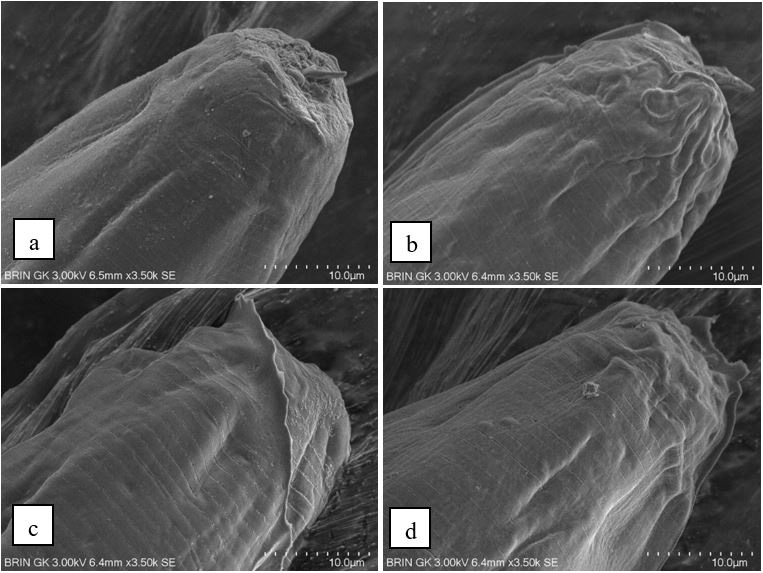
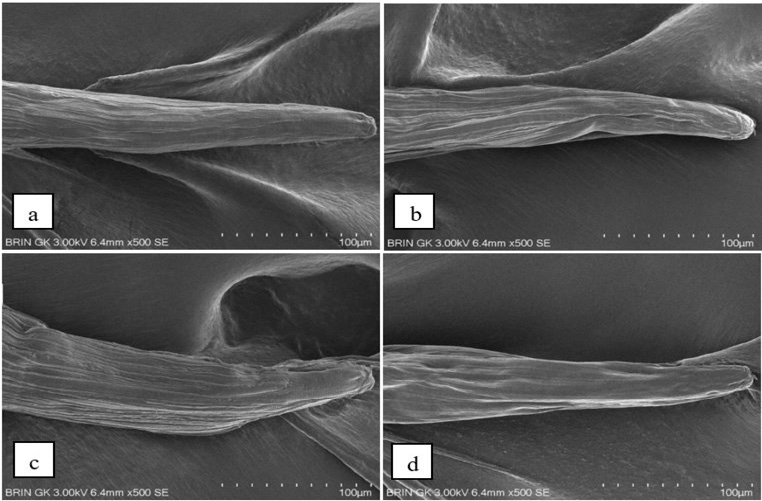
Figure 1 and 2 display scanning electron microscopy images of adult female Haemonchus sp. of the front region and cuticle. Haemonchus sp. has damage to the buccal area and cuticle. Figure 1 illustrates that worms immersed in sodium chloride (NaCl) solution, serving as the negative control, exhibit a smooth cuticle surface without any signs of damage. In contrast, those treated with albendazole (positive control) display damage in the buccal region, accompanied by the presence of aggregates. Furthermore, Haemonchus sp. worms subjected to T. grandis leaves nanoemulsion treatment at concentrations of (b) 3%, (c) 5%, and (d) 7%, demonstrated damage to the buccal area. Figure 2 shows worms immersed in sodium chloride (NaCl) solution, serving as the negative control, which exhibit smooth cuticles devoid of aggregates and display an undamaged reticular pattern on their longitudinal dorsal surfaces. In contrast, following treatment with teak leaf nanoemulsion at concentrations of 3%, 5%, and 7%, Haemonchus sp. worms exhibited wrinkling in the annular cuticle. Additionally, worms treated with albendazole (positive control) displayed numerous wrinkles in both the annular and dorsal longitudinal regions.
DISCUSSION
Secondary metabolites derived from plants are crucial in the realm of drug discovery and development. These compounds are extracted from plant materials through various extraction processes, which involve the separation of desired substances from their mixtures using specific solvents
. In the case of teak leaves, a 70% ethanol solution is employed for extraction. The choice of solvent in the extraction process is primarily determined by its polarity, which influences the solubility of the target compounds . Ethanol is a polar solvent that is able to extract flavonoid compounds, which are also polar so they are easily soluble . Moreover, ethanol is favored for its safety profile, making it suitable for the extraction of phytochemicals and bioactive compounds from plants. It is less susceptible to microbial contamination by fungi and bacteria, does not introduce toxins, remains inert with respect to the extracted substances, and exhibits favorable absorption characteristics .
The ethanol extract of teak leaves is formulated into an oil-in-water (o/w) nanoemulsion, which consists of an oil phase dispersed within a water phase. The production of this nanoemulsion employs a high-energy technique utilizing an ultrasonic homogenizer, which is known to yield nanoemulsions with smaller and more stable particle sizes . The oil phase in this formulation is VCO, which serves as a solvent for lipophilic active substances . In the emulsification process, the oil phase forms droplets within the dispersion medium, facilitated by surfactants and cosurfactants. Tween 80, a non-ionic surfactant characterized by its sorbitan ester bond resulting from the reaction between sorbitol and fatty acids with ethylene oxide, is utilized in this formulation . The cosurfactant employed is PEG 400, a colorless and viscous liquid that is soluble in water. The role of the cosurfactant is to enhance the emulsification process and improve the stability of the nanoemulsion . Additionally, chitosan is incorporated into the formulation to inhibit the growth of bacteria and fungi in the nanoemulsion preparations . Preliminary phytochemical analysis T. grandis Linn has revealed the presence of glycosides, alkaloids, carbohydrates, proteins, tannins, and flavonoids in the ethanolic extracts. T. grandis leaves methanol extract contains Sinapic, gallic, p-hydroxybenzoic, ferulic, p-coumarate, chlorogenic, cinnamic, vanillic acid . T. grandis leaves aqueous extract also contains Sinapic, gallic, p-hydroxybenzoic, ferulic, p-coumarate, chlorogenic, cinnamic, vanillic acid .
T. grandis is recognized for its medicinal significance, with numerous reports indicating its efficacy in treating various diseases according to traditional Indian systems of medicine. Surveys indicate that this plant is utilized for the management of conditions such as urinary discharge, bronchitis, colds, and headaches. Additionally, it is employed in the treatment of scabies and is known for its laxative and sedative properties, as well as its diuretic, anti-diabetic, analgesic, and anti-inflammatory effects . The leaves of T. grandis are rich in secondary metabolites, which include alkaloids, tannins, saponins, flavonoids, anthraquinones, and carotenoids . Many studies have been undertaken to assess the efficacy of tannins as anthelmintics, both in vitro and in vivo. T. grandis leaves exhibits significant anthelmintic activity; however, the time required for inducing mortality in the worms is relatively prolonged. According to Javalgikar at al. (2019) T. grandis Linn caused paralysis within 19 to 32 minutes and resulted in death within 30 to 49 minutes. In comparison, the standard drug induced paralysis within 20 minutes and led to mortality at 48 minutes. These findings suggest that the test drug demonstrates a potent effect relative to the standard treatment. Toklo et al. (2021) reported that the evaluation of anthelmintic activity demonstrated that the extracts at various doses, along with all tested compounds at a concentration of 150 mg/ml, significantly inhibited larval migration and the motility of adult parasitic worms when compared to the negative control, which consisted of a phosphate buffer solution. The study conducted by Handayanta et al. (2023) demonstrated that a 12% of Acacia auriculiformis leaves achieved 100% mortality of Haemonchus contortus within six hours. This finding suggests that T. grandis leaves nanoemulsion exhibits a higher efficacy in eliminating Haemonchus sp. Another study consucted by Mumed et al. (2022) demonstrated that a 500 mg/ml extract of Croton macrostachyus leaves achieved 100% mortality of Haemonchus contortus within four hours. In the present study, 7% T. grandis leaves nanoemulsion exhibited a similar ability to eliminate Haemonchus sp. within the same timeframe. Generally, the capacity of tannins to bind proteins enables them to penetrate various structures of nematodes. The cuticle, in particular, is a structure that is easily penetrated by macromolecules like tannins. A series of microscopic analyses have demonstrated detrimental effects on the cuticle that also impact the underlying tissues across various nematode species .
In nematodes, saponins have been linked to the formation of complexes with components of cellular membranes at various stages of the nematode life cycle. This interaction results in increased membrane permeability, ultimately leading to the mortality of these parasites . Exposure to medicinal ethnoveterinary plant extracts induces characteristic alterations in the surface morphology of worms. This hypothesis is supported by numerous prior reports documenting the anthelmintic activity of plant extracts against helminths. The process induces membrane destabilization, alters membrane permeability, and results in the loss of membrane potential, ultimately leading to cellular lysis and damage to the cuticle. Flavonoids exhibited the most pronounced activity, with flavones showing particularly strong effects, suggesting their potential for further development into derivatives that may enhance anthelmintic efficacy . Alkaloids possess neurotoxic properties by inhibiting acetylcholinesterase, leading to acetylcholine accumulation, which induces spasms in the body wall muscles, followed by flaccid paralysis and eventual death of gastrointestinal parasites .
Nematodes are the sole group of parasites that have a robust protective outer layer called the cuticle. This cuticle is made up of a syncytium of proteins, primarily composed of collagen. The mortality of these worms is likely attributed to damage sustained in various body parts, including the buccal area and cuticle, as a result of contact with metabolites present in the nanoemulsion derived from T. grandis leaves. This structure functions not only as a protective barrier but also as the structural framework for the organism’s body . In nematodes, it is evident that anthelmintic drugs disrupt the structural integrity of the cuticle primarily by targeting cuticular proteins, which serves as their main mechanism of action . Martínez-Ortíz-de-Montellano et al. (2013) reported that alterations occur in adult Haemonchus sp. worms following in vitro exposure to tannin-rich extracts. In contrast to the control worms, which exhibited a smooth cuticle surface, the parasites treated with both tannin-rich plant extracts displayed significant morphological changes, including longitudinal and transverse folds as well as thicker ridges on the cuticle. These lesions were observed across the entire body of the nematodes or in patches, affecting both the cephalic region and other parts of the body, including the distal ends of the. Notably, the most pronounced changes were observed as aggregates surrounding the buccal capsule, female vulva, or anus. Barone et al. (2018) observed that the buccal region of Haemonchus sp. exposed to condensed tannins (CTs) from cranberry vines exhibited damage and the presence of aggregats. In contrast, the worms that were not subjected to exposure to these active compounds appeared normal. Tresia et al. (2016) reported that the anthelmintic activity of active compounds in plants is exerted synergistically through the damage to the cuticle and alterations in the form and permeability of the worm’s cuticle.
CONCLUSIONS AND RECOMMENDATIONS
The 7% teak leaf nanoemulsion demonstrated anthelmintic activity against Haemonchus sp. This study establishes a foundation for the use of nanoemulsions as an anthelmintic agent. However, additional in vivo studies are necessary to validate the potential application of this medicinal plant in ruminants.
ACKNOWLEDGMENTS
The authors wish to acknowledge The Ministry of Research, Technology and Higher Education of the Republic of Indonesian through Penelitian Pascasarjana Magister Program Grant Number 048/E5/PG.02.00.PL/2024. The authors wish to acknowledge Research Center for Animal Husbandry, National Research and Innovation Agency (BRIN) and Directorat of Research, Universitas Gadjah Mada.
NOVELTY STATEMENTS
The study on the anthelmintic activity of Tectona grandis leaves nanoemulsion against haemonchus in ruminants has never been done before.
AUTHOR’S CONTRIBUTIONS
Dian Indriati, Yulita Nadzifa Erista, Irkham Widiyono, Zein Ahmad Baihaqi and Yanuartono: Designed the study, collected samples, and conducted laboratory examinations; Dian Indriati: composing the initial draft. All authors contributed to drafting and revising the manuscript. All authors have read, evaluated, and given their approval for the final manuscript.
Conflict of Interest
There were no conflicts of interest reported.
Figures
Figure 1:.
Scanning electron microscopy of Haemonchus sp buccal area. (a) negative control, Tectona grandis leaves nanoemulsion (b) 3%, (c) 5%, and (d) 7%.
Figure 2:.
Scanning electron microscopy results of Haemonchus sp surface. (a) negative control, Tectona grandis leaves nanoemulsion (b) 3%, (c) 5%, and (d) 7%
References
Ahmad N, Ahmad R, Al-Qudaihi A, Alaseel SE, Fita IZ, Khalid MS, Pottoo FH (2019). Preparation of a novel curcumin nanoemulsion by ultrasonication and its comparative effects in wound healing and the treatment of inflammation. RSC Adv., 9: 20192–20206. https://doi.org/10.1039/C9RA03102B[CrossRef]
Amin N, Das B (2019). A review on formulation and characterization of nanoemulsion. Int. J. Curr. Pharm. Sci., 11: 1-5. https://doi.org/10.22159/ijcpr.2019v11i4.34925[CrossRef]
Asdaq SMB, Ayeem N, Alam MT, Alaqel, SI, Imran M, Hassan EE, Rabbani SI (2022). Tectona grandis L.f: A comprehensive review on its patents, chemical constituents, and biological activites. Saudi J. Biol. Sci., 29: 1456-1464. https://doi.org/10.1016/j.sjbs.2021.11.026[CrossRef]
Baihaqi ZA, Widiyono I, Nurcahyo W (2020). Potential of Carica pubescens fruit peel as an alternative method to control Haemonchus contortus in small ruminants. Livestock Res. Rural Dev., 32: 106.
Baihaqi ZA, Widiyono I, Angeles AA, Suwignyo B, Nurcahyo W (2023). Anthelmintic activity of Carica pubescens aqueous seed extract and its effects on rumen fermentation and methane reduction in indonesian thin-tailed sheep: An in vitro study. Vet. World, 16: 1421–1428. https://doi.org/10.14202/vetworld.2023.1421-1428[CrossRef]
Baihaqi ZA, Sofyan A, Suwignyo B, Angeles A, Widiyono I, Nurcahyo W, Ibrahim A, Putri E, Wulandari (2024). In vivo study: The effects of Carica pubescens seed extract on the anthelmintic activity, feed digestibility, performance, and clinical parameters of thin-tailed sheep. IOP Conf. Ser. Earth and Environ. Sci., 1341:1-12. https://doi.org/10.1088/1755-1315/1341/1/012119[CrossRef]
Balqis U, Hambal M, Rinidar, Athaillah F, Ismail, Azhar, Vanda H, Darmawi (2017). Cuticle surface damage of Ascaridia galli adult worms treated with Veitchia merrillii betel nuts extract in vitro. Vet. World, 7: 732-737. https://doi.org/10.14202/vetworld.2017.732-737[CrossRef]
Charoensit P, Sawasdipol F, Tibkawin N, Suphrom N, Khorana N (2021). Development of natural pigments from Tectona grandis (teak) leaves: agricultural waste material from teak plantations. Sustain. Chem. Pharm., 19: 1-9. https://doi.org/10.1016/j.scp.2020.100365[CrossRef]
Chaudhary S, Kumar S, Kumar V, Sharma R (2020). Chitosan nanoemulsions as advanced edible coatings for fruits and vegetables: Composition, fabrication and developments in last decade. Int. J. Bio. Macromol., 152: 154-170. https://doi.org/10.1016/j.ijbiomac.2020.02.276[CrossRef]
FAO (1991). Food losses due to non-infectious and production diseases in developing countries. FAO, United Nations.
Fissiha W, Kinde MZ (2021). Anthelmintic resistance and its mechanism: A review. Infect. Drug Resist., 14: 5403–5410. https://doi.org/10.2147/IDR.S332378[CrossRef]
Gasbarre LC, Smith LL, Lichtenfels JR, Pilitt PA (2009). The identification of cattle nematode parasites resistant to multiple classes of anthelmintics in a commercial cattle population in The US. Vet. Parasitol., 166: 281–285. https://doi.org/10.1016/j.vetpar.2009.08.018[CrossRef]
Greiffer L, Liebau E, Herrmann FC, Spiegler V (2022). Condensed tannins act as anthelmintics by increasing the rigidity of the nematode cuticle. Sci. Rep., 12: 1–13. https://doi.org/10.1038/s41598-022-23566-2[CrossRef]
Gururaja, Himanshu J, Ishwara B, Satyanarayana D, Shastry CS (2011). Anthelmintic activity of Tectona grandis linn fruits. Int. Res. J. Pharm., 2: 219-221.
Handayanta E, Hadi R, Barido FH (2023). Screening the anthelmintic effects of leaves and fruit extracts from various Acacia species as a potential feed for small-ruminant animals. Biodiversitas, 24: 3140-3144. https://doi.org/10.13057/biodiv/d240606[CrossRef]
Hikmawanti NP, Fatmawati S, Asri AW (2020). The effect of ethanol concentrations as the extraction solvent on antioxidant activity of katuk (Sauropus androgynus (L.) Merr.) leaves extracts. IOP Conf. Ser. Earth Environ. Sci., 755. https://doi.org/10.1088/1755-1315/755/1/012060[CrossRef]
Hrckova G, Velebny S (2013). Pharmacological potential of selected natural compounds in the control of parasitic disease. Springer Wien Heidelberg New York Dordrecht London, 1325-1327.
Hou B, Yong R, Wuen J, Zhang Y, Buyin B, Subu D, Zha H, Li H, Hasi S (2022). Positivity rate investigation and anthelmintic resistance analysis of gastrointestinal nematodes in sheep and cattle in Ordos, China. Animals, 12(7). https://doi.org/10.3390/ani12070891[CrossRef]
Javalgikar A, Shaikh H, Sargar M, Survanshi H, Rathod M (2019). In vitro anti-inflamatory and anthelmintic activity of Tectona grandis leaves extract. Int. J. Herb. Med., 7: 36-40.
Koffi EN, Meudec E, Adje FA, Lozand PR, Lozand YF, Bekroa YA (2015). Effect of reserve osmosis concentration coupled with drying processes on polyphenols and antioxidant activity obtained from Tectona grandis leaf aqueous extracts. J. Appl. Res. Med. Aromat. Plants, 2: 54-59. https://doi.org/10.1016/j.jarmap.2015.03.001[CrossRef]
Lalthanpuii PB, Lalchhandama K (2020). Scanning Electron Microscopic Study of the anthelmintic effects of some anthelmintic drugs on poultry nematode, Ascaridia galli. Adv. Anim. Vet., 8: 788-793. https://doi.org/10.17582/journal.aavs/2020/8.8.788.793[Full text][CrossRef]
Lisnanti EF, Lokapirnasari WP, Hestianah EP, Al Arif MA, Baihaqi ZA (2023). The Effectiveness of Giving Marsh Fleabane (Pluchea indica L.) Water Extract On Broiler Hematology and Blood Glucose. Adv. Anim. Vet., 11: 1348-1356. https://doi.org/10.17582/journal.aavs/2023/11.8.1348.1356[Full text][CrossRef]
Lokapirnasari WP, Al-Arif MA, Hidayatik N, Safiranisa A, Arumdani DF, Zahirah AI, Yulianto AB, Lamid M, Marbun TD, Lisnanti EF, Baihaqi ZA, Khairullah AR, Kurniawan SC, Pelawi EBS, Hasib A (2024). Effect of probiotics and acidifiers on feed intake, egg mass, production performance, and egg yolk chemical composition in late-laying quails. Vet. World, 17: 462–469. https://doi.org/10.14202/vetworld.2024.462-469[CrossRef]
Macedo F, Marsico ET, Conte-Júnior CA, Furtado LA, Brasil TF, Pereira NAD (2015). Short communication: Macrocyclic lactone residues in butter from Brazilian markets. J. Dairy Sci., 98: 3695–3700. https://doi.org/10.3168/jds.2014-9130[CrossRef]
Maestrini M, Tava A, Mancini S, Salari F, Perrucci S (2019). In vitro anthelmintic activity of saponins derived from Medicago spp. plants against donkey gastrointestinal nematodes. Vet. Sci., 6: 1-8. https://doi.org/10.3390/vetsci6020035[CrossRef]
Markham KR (1988). Distribution of flavonoids in the lower plants and its evolutionary significance in the flavonoids. Springer, 427-468. https://doi.org/10.1007/978-1-4899-2913-6_12[CrossRef]
Martínez-Ortíz-de-Montellano C, Arroyo-López C, Fourquaux I, Torres-Acosta JFJ, Sandoval-Castro CA, Hoste H (2013). Scanning electron microscopy of Haemonchus contortus exposed to tannin-rich plants under in vivo and in vitro conditions. Exp. Parasitol., 133(3): 281–286. https://doi.org/10.1016/j.exppara.2012.11.024[CrossRef]
Miro MV, Luque S, Cardozo P, Lloberas M, Sousa DM, Soares AMS, Costa-Junior LM, Virkel GL, Lifschitz L (2020). Plant-derived compounds as tool for the control of gastrointestinal nematodes: modulation of abamectin pharmacological action by carvone. Front. Vet. Sci, 7:601750. https://doi.org/10.3389/fvets.2020.601750[CrossRef]
Mondal H, Hossain H, Awang K, Saha S, Rashid SMU, Islam MK, Rahman MS, Jahan IA, Rahman MM, Shilpi JA (2015). Anthelmintic activity of ellagic acid, a major constituent of Alternanthera sessilis against Haemonchus contortus. Pak. Vet. J., 35: 58–62.
Mumed HS, Nigussie DR, Musa KS, Demissie AA (2022). In vitro anthelmintic activity and phytochemical screening of crude extracts of three medicinal plants against Haemonchus contortus in sheep at Haramaya Municipal abbatoir, Eastern Hararghe. J. Parasitol. Res., 6331740. https://doi.org/10.1155/2022/6331740[CrossRef]
Murukan G, Kumara M (2018). Comparison of phenolic acids and antioxidant activities of young and mature leaves of Tectona grandis. Asian J. Pharm, 11: 60. https://doi.org/10.22159/ajpcr.2018.v11i1.19430[CrossRef]
Ogunmefun OT, Ekundayo EA, Akharaiyi FC, Ewhenodere D (2017). Phytochemical screening and antibacterial activities of Tectona grandis L.f (teak) leaves on microorganisms isolated from decayed food samples. Trop. Plant Res., 4: 376–382. https://doi.org/10.22271/tpr.2017.v4.i3.049[CrossRef]
Page AP, Stepek G, Winter AD, Pertab D (2014). Enzymology of the nematode cuticle: A potential drug target. Int. J. Parasitol, 4: 133–141. https://doi.org/10.1016/j.ijpddr.2014.05.003[CrossRef]
Prasetyo EN, Rokana E, Baihaqi ZA, Samudi S (2024). Anthelmintic effects of podang mango (Mangifera Indica) fruit peel waste extract through in vivo application on Indonesian Etawa goat production and health. Vet. World, 17: 1291–1298. https://doi.org/10.14202/vetworld.2024.1291-1298[CrossRef]
Prayudi SKA, Effendi MH, Lukiswanto BS, Az Zah-Ra RL, Benjamin MI, Kurniawan SC, Khairullah AR, Silaen OSM, Lisnanti EF, Baihaqi ZA, Widodo A, Riwu KHP (2023). Detection of genes on Escherichia coli producing extended spectrum β-lactamase isolated from the small intestine of ducks in traditional markets Surabaya city, Indonesia. J. Adv. Vet. Res., 13: 1600-1608.
Puspitasari D, Rahmawati N, Putri NK, Pradipta MP (2022). Nanoemulsi ekstrak wortel dan virgin coconut oil sebagai suplemen pro- vitamin a untuk mencegah kekurangan vitamin a. Agritech, 42: 65–74. https://doi.org/10.22146/agritech.47743[CrossRef]
Rokana E, Fatimah IR, Dianingtyas BD, Hasanah N, Wulandari, Baihaqi ZA (2024). Impact of various fiber sources in ration formulas on feedlot performance of sheep in Indonesia. J. Anim. Health. Prod., 12: 325-330. https://doi.org/10.17582/journal.jahp/2024/12.3.325.330[Full text][CrossRef]
Sakti AA, Baihaqi ZA, Suwignyo B, Sofyan A, Herdian H, Kustantinah (2024). Anthelmintic activity of red macroalgae Acrocystis sp. and Acanthophora sp. etanolic extract against Haemonchus contortus in sheep in vitro. IOP Conf. Ser.: Earth Environ. Sci., 1360: 012004. https://doi.org/10.1088/1755-1315/1360/1/012004[CrossRef]
Sa’adah H, Nurhasnawati H (2017). Perbandingan pelarut etanol dan air pada pembuatan ekstrak umbi bawang tiwai (Eleutherine americana Merr) menggunakan metode maserasi. Jurnal Ilmiah Manuntung, 1:149–153. https://doi.org/10.51352/jim.v1i2.27[CrossRef]
Sadeq ZA (2020). Review on nanoemulsion: preparation and evaluation. Int. J. Drug Deliv. Technol, 10: 187-189. https://doi.org/10.25258/ijddt.10.1.33[CrossRef]
Sreeja MK, Poulose PA (2017). Comparative study of anthelmintic activity of albendazole nano emulsion containing oregano essential oil. Int J Recent Sci Res, 8: 20111-20119.
Toklo PM, Ladeken EY, Linden A, Hounzangbe-Adote S, Kouam SF, Gbenou JD (2021). Anthelmintic flavonoids and other compounds from Combretom glutinosum perr. ex dc (Combretaceae) leaves. Acta Cryst., C77: 505–512. https://doi.org/10.1107/S2053229621007841[CrossRef]
Tresia GE, Evvyernie D, Tiuria R (2016). Phytochemical screening and in vitro ovicidal, larvacidal, and nematicidal effects of Murraya paniculata (L.) jack extract on gastrointestinal parasites of goats. Media Peternakan, 39: 173–179. https://doi.org/10.5398/medpet.2016.39.3.173[CrossRef]
Vatsraj S, Chauhan K, Pathak H (2014). Formulation of a novel nanoemulsion system for enhanced solubility of a sparingly water soluble antibiotic, clarithromycin. J. Nanosci., 1–7. https://doi.org/10.1155/2014/268293[CrossRef]
Victor S, Ouwor B, Yusuf A (2014). In-vitro anthelmintic bioactivity study of Eclipta prostrata L. (whole plant) using adult Haemonchus contortus worms a case study of Migori country, Kenya. IOSR J. Pharm. Biol. Sci., 9(6): 45–53. https://doi.org/10.9790/3008-09644553[CrossRef]
Yanuartono, Indarjulianto S, Nururrozi A, Raharjo S, Purnamaningsih, H (2020). Penggunaan antiparasit ivermectin pada ternak: antara manfaat dan risiko. Jurnal Sain Peternakan Indonesia, 15: 110–123. https://doi.org/10.31186/jspi.id.15.1.110-123[CrossRef]