Research Article · Volume 14, Issue 3, 8 March 2026 · Open Access
In silico Evaluation of Quercetin as a Neuraminidase Inhibitor Against Influenza A (H5N1)
· · · · · · · ·
Affiliations & Notes ⌄
- 1Faculty of Veterinary Medicine, Universitas Airlangga, Surabaya, Indonesia
- 2Professor Nidom Foundation, Surabaya, Indonesia
- 3Faculty of Medicine, Universitas Airlangga, Surabaya, Indonesia
- 4Indonesia Army Cellcure Center, Gatot Soebroto Central Army Hospital, Jakarta, Indonesia
- 5Riset AIRC Indonesia, Surabaya, Indonesia
- 6Global Biosains Teknologi, Malang, Indonesia
Article Info ⌄
- Journal:
- Advances in Animal and Veterinary Sciences
- Published:
- 8 March 2026

From the article
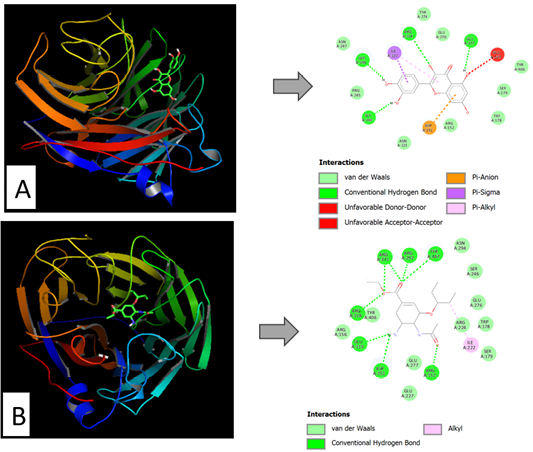
- In the present study, molecular docking analysis demonstrated that quercetin, exhibited a more negative docking score in the best-scoring pose toward the H5N1 neuraminidase (NA) protein compared with oseltamivir (Table 1; Figure 1).
- A more negative docking score suggests the formation of a potentially stable protein-ligand complex based on in silico analysis, rather than confirming biological potency.
- In conclusion, this in silico study indicates that quercetin shows a stable binding interaction with the neuraminidase protein of Influenza A (H5N1) as suggested by molecular docking analysis.
- While these findings suggest that quercetin may interact with neuraminidase, the results should be interpreted as preliminary due to the limitations inherent to docking-based predictions.
Selected from the article's own text.
Abstract
Introduction
Avian influenza A virus is regarded as one of the most virulent influenza viruses, capable of infecting birds, humans, and various mammalian species ; . Among its subtypes, Influenza A (H5N1) has been identified by the World Health Organization as a major threat to human health due to its high pathogenicity and mortality rate (Maines et al., 2011). The high mutation rate of avian influenza viruses, driven by their segmented genome, contributes to the continuous emergence of new variants and may limit the effectiveness of existing antiviral therapies .
Neuraminidase (NA) is one of the major surface glycoproteins of the influenza virus and plays a crucial role in viral replication by facilitating the release of newly formed virions from infected host cells. Due to its essential function, NA has become an important target in antiviral drug development ; . Neuraminidase inhibitors such as oseltamivir have been widely used for influenza treatment; however, their clinical utility may be limited by adverse effects and the emergence of resistance-associated mutations, including substitutions within the neuraminidase gene .
Indonesia is rich in medicinal plants that have long been utilized in traditional medicine. Guazuma ulmifolia and Centella asiatica are two medicinal plants commonly used for their therapeutic properties. Centella asiatica contains various bioactive compounds, including flavonoids, which have been reported to exhibit antioxidant, anti-inflammatory, and antimicrobial activities ; . Guazuma ulmifolia leaf extracts are also rich in polyphenols and flavonoids, including quercetin, which has attracted attention for its potential biological activities .
Previous studies have reported that Guazuma ulmifolia leaf extract significantly enhances humoral immune responses, as evidenced by increased IgG levels, which has been attributed to its flavonoid content . Centella asiatica is rich in flavonoids, including quercetin, kaempferol, apigenin, rutin, and naringin . Beyond their immunomodulatory effects, flavonoids particularly quercetin have also been reported to exhabit direct antiviral activity. In vitro studies have demonstrated that quercetin derived flavonol glycosides exhibit moderate antiviral activity against influenza A virus through significant inhibition of neuraminidase activity, although their antiviral potency is lower than that of oseltamivir . Flavonoids have been widely reported to exhibit antiviral and immunomodulatory activities, supporting their potential role in host defense against viral infections ; .
Therefore, this study aimed to evaluate the interaction of quercetin derived from Guazuma ulmifolia and Centella asiatica with neuraminidase of Influenza A (H5N1) using a molecular docking approach.
Materials and Methods
The three-dimensional structure of neuraminidase (NA) from Influenza A virus was retrieved from the Protein Data Bank (PDB ID: 3CKZ). The protein structure was prepared by removing crystallographic water molecules and any co-crystallized ligands, followed by the addition of polar hydrogens and assignment of partial charges using AutoDock tools prior to molecular docking. The prepared protein was then saved in the appropriate format for docking analysis.
The ligand quercetin (PubChem CID: 5280343), a major flavonoid component of Guazuma ulmifolia and Centella asiatica, was obtained from the PubChem database. The ligand structure was energy-minimized and converted into a three-dimensional format suitable for docking. Oseltamivir (PubChem CID: 65028) was used as a reference neuraminidase inhibitor for comparative analysis.
Molecular docking was performed using PyRx version 0.9.9 (Scripps Research, USA), which employs the AutoDock Vina scoring function to predict ligand-protein interactions. The docking grid box was defined to cover the active site region of neuraminidase, with the grid center and dimensions adjusted to ensure complete coverage of the binding pocket. Docking was performed for each ligand, and the best binding pose generated by Auto Dock Vina was selected based on the lowest binding energy and appropriate orientation within the neuraminidase binding region.
Visualization and analysis of docking interactions were carried out using PyMOL version 2.5.4 (Schrödinger, Inc., USA) under an academic license to examine ligand–residue interactions and binding conformations.
Result and Discussions
Medicinal plants have long been utilized worldwide as complementary or alternative therapeutic agents due to their rich content of secondary metabolites that contribute to various biological activities ; . However, the presence of complex phytochemical mixtures in crude extracts may also lead to undesirable toxic effects at high concentrations, highlighting the importance of identifying specific active compounds with favorable pharmacological properties .
In the present study, molecular docking analysis demonstrated that quercetin, exhibited a more negative docking score in the best-scoring pose toward the H5N1 neuraminidase (NA) protein compared with oseltamivir (Table 1; Figure 1). Figure 1 shows that quercetin binds near the neuraminidase active site through hydrogen bond and van der Waals interactions. A more negative docking score suggests the formation of a potentially stable protein-ligand complex based on in silico analysis, rather than confirming biological potency. These findings suggest
Table 1: Molecular docking results of quercetin and oseltamivir against Influenza A (H5N1) neuraminidase.
| No. | Ligand-receptor complex | Binding Affinity (kcal/mol) | Interactions type | Amino acid residues involved |
| 1. | Quercetin Neuraminidase | -8.5 | Van der Waals; Hydrogen bonds | Ser179(A), Trp178(A), Tyr406(A), Arg152(A), Glu276(A), Tyr274(A), Asn221(A), Pro245(A), Asn247(A); Glu277(A), Arg224(A), Ser246(A), Gly244(A) |
| 2. | Oseltamavir Neuraminidase | -6.6 | Van der Waals; Hydrophobic; Hydrogen bonds | Asn294(A), Ser246(A), Glu227(A), Glu276(A), Trp178(A), Arg224(A), Ser179(A), Glu277(A), Tyr406(A), Arg156(A); Ile222(A); Arg152(A), Asp151(A), Glu119(A), Arg118(A), Arg371(A), Arg292(A), Tyr347(A) |
Note: vdW: Van der Waals; HI: hydrophobic interaction; H-bond: hydrogen bond.
that quercetin may interact with neuraminidase and warrant further investigation as a potential neuraminidase-interacting compound using additional computational and experimental approaches.
This molecular docking analysis was conducted as an initial in silico screening, and the reported binding energy represents a single best-scoring pose generated by AutoDock Vina. Repeated docking simulations and statistical analyses (mean ± standard deviation) were not performed in this study; therefore, the observed difference in docking scores should be interpreted qualitatively rather than statistically. Further computational studies, including repeated docking and molecular dynamics simulations, are warranted to confirm the stability and reproducibility of the interaction.
Although quercetin was predicted to bind within the neuraminidase binding region, its interaction pattern differed from that of oseltamivir. Notably, quercetin did not form direct interactions with key catalytic residues such as Arg292 and Arg371, which are critical for the competitive inhibition mechanism of oseltamivir . In contrast, oseltamivir formed hydrogen bond interactions with key catalytic residues Arg292 and Arg371, whereas quercetin did not, suggesting a distinct binding mode. The absence of interactions with these residues indicates that quercetin is unlikely to act as a classical competitive neuraminidase inhibitor based on in silico analysis.
In addition, the drug-likeness properties of quercetin were assessed using Lipinski’s rule of five, which considers molecular weight, lipophilicity, hydrogen bond donors and acceptors, and molar refractivity. Quercetin exhibited a molecular weight of 302.24 g/mol, a predicted LogP value of approximately 1.8, five hydrogen bond donors, and seven hydrogen bond acceptors, fulfilling Lipinski’s rule of five .
The results of the present molecular docking study are in line with previous studies reporting the antiviral activity of quercetin against influenza viruses. Quercetin derivatives exhibit significant antiviral effects against influenza A virus in vitro, indicating that these compounds may interfere with viral replication . In addition, structure activity relationship analyses have suggested that quercetin, as a rigid flavonol, contains structural features associated with antiviral activity and neuraminidase inhibition . This is consistent with the present docking results, in which quercetin demonstrated a stable interaction with the neuraminidase active site in silico.
Quercetin has been widely reported to exhibit antiviral and anti-inflammatory activities, which may complement its predicted interaction with neuraminidase by simultaneously limiting viral replication and host inflammatory responses. Taken together, the observed docking behavior in the best-scoring pose and the previously reported antiviral properties of quercetin suggest that this compound may represent a promising neuraminidase-interacting candidate for further investigation against Influenza A (H5N1), pending experimental validation.
Conclusion
In conclusion, this in silico study indicates that quercetin shows a stable binding interaction with the neuraminidase protein of Influenza A (H5N1) as suggested by molecular docking analysis. While these findings suggest that quercetin may interact with neuraminidase, the results should be interpreted as preliminary due to the limitations inherent to docking-based predictions.
Acknowledgements
The Professor Nidom Foundation, based in Surabaya, Indonesia provided funding for this work. We also acknowledge the editing work done by members of Professor Nidom Foundation (PNF), Indonesia (http://pnfinstitute.org).
Novelty Statement
This study presents a novel in silico evaluation of quercetin derived from Guazuma ulmifolia and Centella asiatica as a neuraminidase inhibitor against Influenza A (H5N1), providing molecular docking evidence of its potential antiviral relevance.
Authors Contribution
Methodology: EDP, TWM, and CAN. Software: ANN, ZIA, IYR, and JJ. Validation: SI and RVN. Formal analysis: ANN, ZIA, IYR, and JJ. Investigation: ANN, ZIA, IYR and JJ. Resources: EDP, TWM, and CAN. Data curation: EDP, TWM, and CAN. Writing original draft: EDP and TWM. Writing review and editing: RVN and SI. Visualization: ANN, ZIA, IYR, and JJ. Supervision: SI, RVN, and CAN. Project administration: EDP, TWM, and CAN. All authors have read and agreed to the published version of the manuscript.
Generative AI and AI-assisted technology statement
The authors declare that generative AI was used solely for language editing and grammar improvement. The authors take full responsibility for the content of the manuscript.
Conflict of interest
The authors have declared no conflict of interest.
Figures

Docking complexes of Influenza A (H5N1) neuraminidase with (A) quercetin and (B) oseltamivir.
References
- Choi HJ, Song JH, Park KS, Kwon DH (2009). Inhibitory effects of quercetin 3-rhamnoside on influenza A virus replication. Eur. J. Pharm. Sci., 37: 329-333. https://doi.org/10.1016/j.ejps.2009.03.002[CrossRef]
- De Clercq E, Neyts J (2007). Avian influenza A (H5N1) infection: Targets and strategies for chemotherapeutic intervention. Trends Pharmacol. Sci., 6: 280-285. https://doi.org/10.1016/j.tips.2007.04.005[CrossRef]
- Duan J, Lou J, Zhang Q, Ke J, Qi Y, Shen N, Zhu B, Zhong R, Wang Z, Liu L, Wu J, Wang W, Gong F, Miao X (2014). A genetic variant rs1801274 in fcgr2a as a potential risk marker for kawasaki disease: A case-control study and meta-analysis. PLoS One., 9(8): 10.1371. https://doi.org/10.1371/journal.pone.0103329[CrossRef]
- Khalafalla MM (2010). Active principle from moringa oleifera Lam leaves effective against two leukemias and a hepatocarcinoma. Afr. J. Biotechnol., (9): 8467-8471
- Maya PG, Mahayasih W, Harizal, Herman, Ahmad I (2021). In silico identification of natural products from Centella asiatica as severe acute respiratory syndromecoronavirus 2 main protease inhibitor. J. Adv. Pharma. Technol. Res., 12(3): 261-266. https://doi.org/10.4103/japtr.JAPTR_297_20[CrossRef]
- Ngwa W, Kumar R, Thompson D, Lyerly W, Moore R, Reid TE, Lowe H, Toyang N (2020). Potential of flavonoid-inspired phytomedicines against COVID-19. Molecules., 25(11): 2707. https://www.mdpi.com/1420-3049/25/11/2707 https://doi.org/10.3390/molecules25112707[CrossRef]
- Niu B, Lu Y, Wang J, Hu Y, Chen J, Chen Q, He G, Zheng L (2019). 2D-SAR, Topomer CoMFA and molecular docking studies on avian influenza neuraminidase inhibitors, Comput. Struct. Biotechnol. J., 17: 39-48. https://doi.org/10.1016/j.csbj.2018.11.007[CrossRef]
- PubChem (2024). Quercetin (CID: 5280343). National center for biotechnology information.https://pubchem.ncbi.nlm.nih.gov/compound/5280343. Accessed, on December 2024
- Jeyaram R, Priyadarzini T, Radha CA, Shanmugam NS, Ramakrishnan C, Gromiha MM, Veluraja K (2019). Molecular dynamics simulation studies on influenza A virus H5N1 complexed with sialic acid and fluorinated sialic acid. J. Biomol. Struct. Dyn., https://doi.org/10.1080/07391102.2019.1568304[CrossRef]
- Rhomah, Eka Hayati, Safitri, Dewi (2021). Pharmacological activities of Guazuma ulmifolia. J. Inf. Kesehatan., 1(11).
- Sardrood SG, Saadatmand S, Assareh MH, Satan TN (2019). Chemical composition and biological activity of essential oils of Centella asiatica (L.). Toxicol. Environ. Health Sci., 11: 125-131. https://doi.org/10.1007/s13530-019-0397-1[CrossRef]
- Sihombing YR, Siska F (2025). Activity test of Daun Jati Belanda (Guazuma ulmifolia Lamk.) on lymphocyte proliferation and immunoglobulin g expressionas an immunostimulatory agent. J. Farmasimed, 8(1): 220-227. https://doi.org/10.35451/7mw45p98[CrossRef]
- Sugianto P, Ferriastuti W, Ritarwan K, Tampubolon DPR (2022). Medicinal plants - a promising breakthrough in the management of alzheimer’s disease progression compared to NSAID: A systematic review. Bali Med. J., 11(3): 1982-1986. https://doi.org/10.15562/bmj.v11i3.3899[CrossRef]
- TR-Maines, LM Chen, N Van Hoeven, TM Tumpey, O Blixt, JA Belser, KM Gustin, MB Pearce, C Pappas, J Stevens, NJ Cox, JC Paulson, R Raman, R Sasisekharan, JM Katz, RO Donis (2011). Effect of receptor binding domain mutations on receptor binding and transmissibility of avian influenza H5N1 viruses. Virology, 413(1): 139-147. https://doi.org/10.1016/j.virol.2011.02.015[CrossRef]
- Vasavi HS, Arun AB, Rekha, PD (2016). Anti-quorum sensing activity of flavonoid-rich fraction from Centella asiatica L. against pseudomonas aeruginosapao. J. Microbiol. Immunol. Infect., 49(1): 8-15. https://doi.org/10.1016/j.jmii.2014.03.012[CrossRef]
- Verma RP, Hansch C (2006). A QSAR study on influenza neuraminidase inhibitors. Bioorg. Med. Chem., 14(4): 982-996. https://doi.org/10.1016/j.bmc.2005.09.016[CrossRef]
- Von Itzstein M (2007). The war against influenza: discovery and development of sialidase inhibitors. Nat. Rev. Drug Discov., 6(12): 967-974. https://doi.org/10.1038/nrd2400[CrossRef]
- Wang X, Li H, Zhang Y (2022). Antigenic shift mechanisms in influenza viruses. Nat. Rev. Microbiol., 20(6): 367-381.
- Yang Z, Bai L, Huang WB, Li XZ, Zhao SS, Zhong N, Jiang Z (2014). Comparison of in vitro antiviral activity of tea polyphenols against influenza A and B viruses and structure activity relationship analysis. Fitoterapia, 93: 47-53. https://doi.org/10.1016/j.fitote.2013.12.011[CrossRef]
- Zakaryan H, Arabyan E, Oo A, Zandi K (2017). Flavonoids: promising natural compounds against viral infections. Arch. Virol., 162(9): 2539-2551. https://doi.org/10.1007/s00705-017-3417-y[CrossRef]
- Zink T, Chaffin J (1998). Herbal health products: What family physicians need to know. Am. Fam. Phys., 58: 1133-1140.
Services
Article usage statistics
Loading…