Specail Issue: Artificial Intelligence in Veterinary Medicine: Current Status and Future Prospects · Volume 13, Issue 1, 6 December 2025 · Open Access
Identification of Bacterial Pathogens Causing Arthritis in Broiler Chickens, and Assessment of their Antibiotic Resistance Patterns
· · ·
Affiliations & Notes ⌄
1Avian and Rabbit Medicine Department, Faculty of Veterinary Medicine, Suez Canal University, Ismailia, 41522, Egypt
2Department of Avian and Rabbit Medicine, Faculty of Veterinary Medicine, Suez Canal University, Ismailia 41522, Egypt. *Correspondence | Dalia Mansour Hamed, Department of Avian and Rabbit Medicine, Faculty of Veterinary Medicine, Suez Canal University, Ismailia 41522, Egypt
S. aureus and E. coli are highly pathogenic bacteria implicated in poultry arthritis, could be due to their virulence genes (fnbA and tsst in S. aureus and iss and tsh in E. coli).
The rise of antibiotic resistance, driven by misuse and overuse of antibiotics in broiler production, has rendered conventional antimicrobial treatments largely ineffective.
Developing effective vaccines offers a promising approach to mitigate the economic losses associated with these infections and improve poultry health.
Selected from the article's own text.
Abstract
Antibiotic resistance in poultry bacterial pathogens poses a significant threat to the poultry industry and public health and requires ongoing monitoring. This study investigated the frequency of isolation, virulence-related genes, and antibiotic resistance profile of bacterial pathogens associated with lameness, and joint swelling in broiler flocks in Damietta, Egypt. Therefore, a total of 172 aseptic swab samples were collected from joints of 27 broiler flocks aged 5 to 48 days, exhibiting clinical signs and mortality rates up to 8%. Microbiological analysis, identified Staphylococcus aureus as the most prevalent pathogen (30.2%), followed by E. coli (21.5%), with Enterococcus spp. and Pseudomonas spp. each accounting for 9.9%. The highest detection rates for E. coli, Enterococcus spp., and Pseudomonas spp. occurred in flocks aged 11-20 days, while S. aureus was most common in flocks aged 21-40 days. Antibiotic susceptibility testing showed that over 78.1% (25/32) of S. aureus isolates exhibited high-level of resistance to penicillin, erythromycin, chloramphenicol, levofloxacin, and tetracycline; however, all isolates remained sensitive to linezolid, minocycline, rifampin, vancomycin, and daptomycin. A subset of 8 isolates demonstrated multidrug (MRSA) resistant to macrolides, clindamycin, and beta-lactams. E. coli isolates were generally resistant to ampicillin 95% (19/20), chloramphenicol 75% (15/20), and ciprofloxacin 50% (10/20), Molecular analysis showed that S. aureus contained virulence-related genes, with 2/4 isolates containing fnbA and 1/4 carrying tsst, while 3/3 of the E. coli carried iss and tsh in 2/3 of the tested isolates. Overall, the results underscore the prominence of S. aureus and E. coli in broiler joint bacterial infections and reveal the concerning prevalence of multidrug-resistant and virulent strains. These insights emphasize the urgent need for effective control strategies in poultry health management.
Keywords | Antibiotic resistance, Arthritis, Broiler, E. coli, S. aureus, Virulence genes
INTRODUCTION
Broiler meat provides an accessible and high-quality source of protein essential for feeding the expanding global population. The short production cycle of broiler chickens reduces operating costs and ensures a reliable and stable supply of poultry meat, making it an important and accessible source of efficient and economical animal protein ; . However, the rapid growth rate and heavy body weight reached over a short time increase susceptibility to the development of bone abnormalities and lameness . Poultry lameness has a complex array of causes including genetic, environmental, nutritional and infectious factors that together lead to reduced activity, decreased feed intake, delayed market readiness, reduced productivity, increased treatment costs and culling rates ; . Among the etiological factors, bacterial infections affecting joints and skeletal tissues are predominant, with pathogens such as Staphylococcus aureus (S. aureus), Escherichia coli (E. coli), Enterococcus faecalis, and Pseudomonas aeruginosa frequently implicated ; .
S. aureus, a Gram-positive pathogen, is known for causing septic arthritis and osteomyelitis in poultry, facilitated by its numerous virulence factors, fnb A, and clf A are the most important bacterial adhesions, which thought to be an important step in the beginning of the infections . In addition, E. coli frequently causes arthritis-osteomyelitis syndrome in broiler chickens that is a sequelae of septicemia, and may be associated with intestinal or respiratory diseases . The most observed lesions are joint edema and inflammation, which are responsible for large financial losses in poultry production . Other opportunistic pathogens such as Enterococcus spp. and Pseudomonas spp. are increasingly recognized in poultry, with Enterococcus spp. associated with secondary skeletal infections, often displaying high-level aminoglycoside resistance, further challenging treatment protocols (Alzahrani et al., 2022).
Sustainable surveillance programs that simultaneously monitor the antimicrobial resistance profile of S. aureus and healthcare and veterinary settings are necessary to adequately improve control measures ; . The indiscriminate use of antibiotics as a preventive measure, rather than solely as a treatment, has exacerbated the emergence of drug-resistant strains . Resistant bacteria survive and multiply, while sensitive bacteria die .
The rising incidence of multidrug-resistant strains poses a significant challenge to the poultry industry, complicates control efforts and amplifies public health concerns ; , emphasizing the necessity for molecular characterization studies that elucidate virulence profiles and resistance mechanisms. Such insights are crucial for developing targeted interventions, improving antimicrobial stewardship, and safeguarding both poultry health and public safety. Therefore, the aim of the current study is to investigate the prevalence of bacterial agents linked to lameness, confirmed by molecular characterization of virulence genes, and detect antimicrobial resistance strains.
MATERIALS AND METHODS
Animal ethics
The birds were handled with great care in this study to avoid or minimize suffering and pain. Birds experiencing severe or chronic pain that cannot be relieved will be euthanized. This protocol has been reviewed and accepted by the Scientific Research and Bioethics Committee of the Faculty of Veterinary Medicine, Suez University, Ismailia, Egypt, with approval number (2020092).
Sampling and clinical investigation
One hundred and seventy-two swabs were collected from joints of 27 commercial broiler chicken flocks (4-10 swabs/flock) in Damietta, Egypt, under aseptic conditions. The broiler flocks were (5-48) days old and exhibited a variety of clinical signs suggestive of lameness, as well as general symptoms of illness with mortality rate ranged from 0.1% to 8%. A thorough clinical and necropsy examination was performed on clinically diseased and recently dead birds.
Isolation and identification of S. aureus and other bacteria
The swabs were aseptically inoculated into 5-10 ml of buffered peptone water or nutrient broth (Oxoid, UK), then incubated aerobically at 37°C for 18-24 hours. A loopful from each broth was subculture on blood, MacConkey, and nutrient agar (Oxoid, UK) and incubated at 37°C for 24 hours. Pure colonies were transferred to selective media such as mannitol salts, Cled, or EMB agar. Bacterial identification involved Gram’s staining, motility testing, colony observation, hemolytic activity on blood agar, and biochemical analysis as described by .
Slide coagulase test (bound coagulase test)
A loop of staphylococcal culture was mixed into a drop of saline, then rabbit plasma was added and mixed thoroughly on a microscope slide. Gently shake the slide, clumping within one minute indicates positive for S. aureus .
Antimicrobial susceptibility testing
Antimicrobial susceptibility testing was performed on the isolated bacterial strains using an automated turbidity method with the ID and AST System MA120 (Render Biotech Co., China), following the manufacturer’s instructions. The system quantitatively assessed bacterial growth in the presence of various antibiotics to determine susceptibility profiles. The following antimicrobial agents were involved azithromycin, clarithromycin, clindamycin, trimethoprim/sulfamethoxazole, penicillin, erythromycin, oxacillin, doxycycline, tetracycline, linezolid, minocycline, rifampicin, vancomycin, daptomycin, ciprofloxacin, chloramphenicol, gentamicin, and levofloxacin. The classification of resistance or susceptibility was interpreted in accordance with the Clinical and Laboratory Standards Institute .
Molecular typing of virulence-determining genes
This study conducted molecular analysis on four S. aureus and three E. coli isolates to detect key virulence genes (fnbA, tsst, iss, and tsh), selected for their roles in disease development. Genomic DNA was extracted using a QIAamp DNA Mini Kit, following the manufacturer’s instructions. PCR amplification was performed in 25 µl reactions containing specific primers (obtained from Metabion, Germany, listed in Table 1), PCR master mix, DNA template, and water, using an Applied Biosystems 2720 thermal cycler. The PCR products were analyzed via 1% agarose gel electrophoresis stained with ethidium bromide and visualized with a gel documentation system. Fragment sizes were compared against a 100-bp DNA ladder to confirm the presence of target genes.
RESULTS and DISCUSSION
Clinical and post-mortem findings
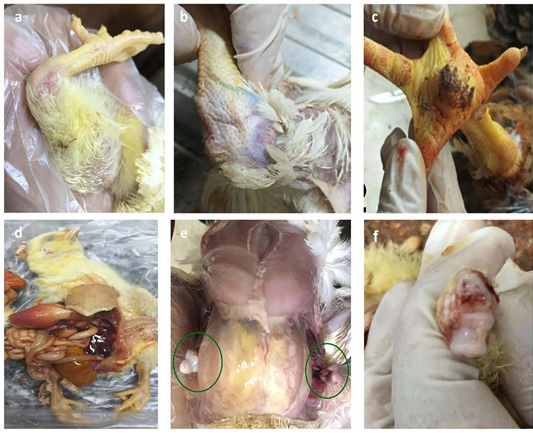
The examined broiler chickens exhibited clinical signs indicative of systemic illness, including dullness, ruffled feathers, reduced activity, wing dropping, decreased feed intake, weight loss, and diarrhea. The most frequently observed clinical manifestations were lameness, loss of mobility, and joint swelling (Figure 1). Post-mortem examinations revealed persistent lesions such as arthritis and erosions of joint surfaces, along with other pathological changes including pneumonia, fibrinous pericarditis, perihepatitis, air sacculitis, splenomegaly, unabsorbed yolk sacs, distended gall bladders, nephritis, and enteritis (Figure 1).
Microbiological identification of pathogens
Microbiological analysis of 172 samples collected from various anatomical sites identified S. aureus as the most prevalent pathogen, with a detection rate of 30.2%. Other pathogenic bacteria included E. coli (21.5%), Enterococcus spp. (9.9%), and Pseudomonas spp. (9.9%) (Table 2). S. aureus isolates were confirmed based on characteristic morphological and biochemical features: colonies on Mannitol Salt Agar displayed yellow to golden coloration, with beta-hemolysis on blood agar; no growth was observed on MacConkey and EMB agars. Microscopic examination revealed Gram-positive cocci arranged in grape-like clusters and non-motile, consistent with typical S. aureus morphology. The highest prevalence of E. coli was observed in flocks aged 11–20 days, accounting for 57.1% of E. coli isolates. Enterococcus spp. and Pseudomonas spp. were most frequently detected in the same age group, with detection rates of 100% and 50%, respectively. S. aureus was predominantly isolated from flocks aged 21-40 days, with a detection rate of 77%.
Table 1: Oligonucleotide primers sequences.
Reference
Amplified segment
Primer sequence (5'-3')
Gene
Bacteria
Delicato et al., 2003
620 bp
GGT GGT GCA CTG GAG TGG
Tsh
E. coli
AGT CCA GCG TGA TAG TGG
Yaguchi et al., 2007
266 bp
ATGTTATTTTCTGCCGCTCTG
Iss
CTATTGTGAGCAATATACCC
Vancraeynest et al., 2004
127 bp
CATAAATTGGGAGCAGCATCA
fnbA
S. aureus
ATCAGCAGCTGAATTCCCATT
Mehrotra et al., 2000
326 bp
ACCCCTGTTCCCTTATCATC
tsst
TTTTCAGTATTTGTAACGCC
Table 2: Frequency of S. aureus and other bacterial pathogens isolated from broiler chickens.
Bacterial species
Total number of examined samples
Positive flocks
No
%
S. aureus
172
52
(30.2%)
E. coli
37
(21.5%)
Enterococcus spp.
17
(9.9%)
Pseudomonas spp.
17
(9.9%)
Environmental sampling indicated that wood shavings litter served as a significant bacterial reservoir, supporting pathogen persistence and transmission. Co-infections of S. aureus and E. coli were found on two farms, with mortality rates of 5.3% and 5.8%, respectively, which were higher than those on other farms, as well as coinfections of S. aureus and Pseudomonas spp. was observed in one farm.
Antimicrobial susceptibility profiles
Antimicrobial susceptibility testing was conducted on 40 S. aureus and 20 E. coli isolates to assess their response to various antibiotics. S. aureus exhibited high resistance over 78.1% to penicillin, erythromycin, chloramphenicol, levofloxacin, and tetracycline. All S. aureus isolates remained sensitive to linezolid, minocycline, rifampin, vancomycin, and daptomycin. A subset of 8 isolates (20%) demonstrated MRSA resistance, resistant to macrolides (azithromycin, clarithromycin, erythromycin), clindamycin, and beta-lactams (penicillin, oxacillin) (Table 3). E. coli isolates were generally resistant to ampicillin 95% (19/20), chloramphenicol 75% (15/20), and ciprofloxacin 50% (10/20) (Table 4).
Virulence-determining genes
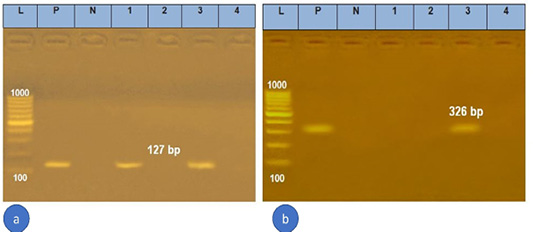
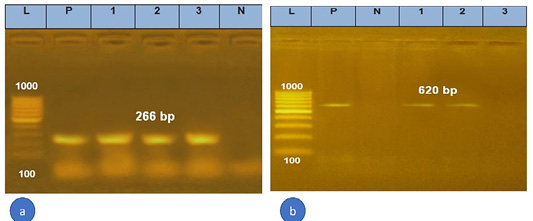
PCR detection of virulence genes in selected isolates demonstrated that S. aureus harbored fnbA in 50% (2/4) and tsst in 25% (1/4) of isolates (Figure 2). Among E. coli isolates (n=3), the iss gene was present in all isolates (100%), while tsh was detected in 66.6% (2/3) (Figure 3). The presence of these virulence factors suggests their potential role in disease severity and pathogen persistence.
Lameness remains a significant welfare concern and a major economic challenge within the global broiler industry, primarily due to its association with high culling rates and diminished performance metrics ; ; . There is limited local information about it in Egypt, especially in Damietta. This makes it difficult to determine the best ways to address the issue. Since Damietta is heavily involved in poultry farming, our study aims to learn more about this problem. The pathogenesis of lameness is often linked to the mechanical stress exerted on rapidly growing bones, such as the femur and tibia, which may predispose these structures to bacterial infections . Notably, there is an increasing trend in lameness cases attributable to infectious pathogens like S. aureus, which raises public health concerns due to its zoonotic potential . The present study was designed to elucidate the prevalence of bacterial pathogens associated with lameness in broiler chickens, alongside their antimicrobial resistance profiles and the molecular characterization of key virulence determinants.
In this investigation, 172 samples were subjected to comprehensive microbiological analyses to determine the spectrum and prevalence of pathogenic bacteria. The results demonstrated that S. aureus was the most frequently isolated pathogen, accounting for 30.2% of the cases, underscoring its prominent role in bacterial lameness. E. coli emerged as the second most common isolate, representing 21.5% of the total, with other opportunistic pathogens such as Enterococcus spp. and Pseudomonas spp. each constituting 9.9%. These findings reinforce the notion that S. aureus is a primary contributor to bacterial lameness in broiler populations, with E. coli also playing a significant role-aligning with previous reports .
The prevalence of S. aureus identified in this study was 30.2%, a figure that aligns with prior research recognizing S. aureus as a predominant pathogen implicated in arthritis and lameness among broilers .
Table 3: Antibiotic susceptibility profile of 8 isolates S. aureus (MRSA).
Antibiotic
Sensitive
Intermediate
Resistant
MIC (µg/mL)
No.
%
MIC (µg/mL)
No.
%
MIC (µg/mL)
No.
%
Trimethoprim/ Sulfa
<=2/38
1/8
12.5%
-
0
0%
>4/76
7/8
87.5%
Azithromycin
<=2
0
0%
=4
0
0%
>=8
8/8
100%
Clarithromycin
<=2<
0
0%
=4
0
0%
>=8
8/8
100%
Clindamycin
<=0.5
0
0%
=1-2
0
0%
>4
8/8
100%
Penicillin
<=0.12
0
0%
-
0
0%
> 0.25
8/8
100%
Erythromycin
<=0.5
0
0%
1-4
0
0%
>=8
8/8
100%
Oxacillin
<=2
0/8
0%
-
0%
>4
8/8
100%
Doxycycline
<=4
1/8
12.5%
=8
2/8
25%
>=16
5/8
62.5%
Tetracycline
<=4
0
0%
=8
0
0%
>=16
8/8
100%
Linezolid
<=4
8/8
100%
-
0
0%
>=8
0
0%
Minocycline
=4
8/8
100%
=8
0
0%
>=8
0
0%
Rifampin
=0.5
8/8
100%
=2
0
0%
>=4
0
0%
Vancomycin
< 2
8/8
100%
4–8
0
0%
>=16
0
0%
Daptomycin
<=1
8/8
100%
-
0
0%
-
0
0%
Ciprofloxacin
<=1
1/8
12.5%
=2
0
0%
>=4
7/8
87.5%
Chloramphenicol
<=8
0
0%
=16
0
0%
>=32
8/8
100%
Gentamicin
<= 4
6/8
75%
=8
2/8
25%
>=16
0
0%
Levofloxacin
<=1
0
0%
=2
0
0%
>=4
8/8
100%
Interpretive criteria of sensitivity according to CLSI, 2017. MIC: minimum inhibitory concentration
Table 4: Antibiotic sensitivity test of 20 isolates of E. coli.
Antibiotic
Sensitive
Intermediate
Resistant
MIC
(µg/mL)
No.
%
MIC
(µg/mL)
No.
%
MIC
(µg/mL)
No.
%
Trimethoprim/ Sulfa
<=2/38
15/20
75%
-
0
0%
>4/76
5/20
25%
Ciprofloxacin
<1
6/20
30%
=2
4/20
20%
>=4
10/20
50%
Chloramphenicol
<8
5/20
25%
=16
0
0%
>=32
15/20
75%
Gentamicin
<=4
12/20
60%
=8
0
0%
>=16
8/20
40%
Ampicillin
<=8
0
0%
=16
1/20
5%
>=32
19/20
95%
Cefazolin
<=16
10/20
50%
-
0
0%
>=32
10/20
50%
Tobramycin
<=4
15/20
75%
=8
0
0%
>=16
5/20
25%
Amoxicillin/CA
<=8/4
0
0%
=16/8
6/20
30%
>=32/16
14/20
70%
Ampicillin/ Sulbactam
<=8/4
2/20
10%
=16/8
9/20
45%
=32/16
9/20
45%
Cefepime
<=8
9/20
45%
=16
0
0%
>=32
11/20
55%
Cefoxitin
<=8
15/20
75%
=16/8
0
0%
>=32
5/20
25%
Meropenem
<=1
20/20
100%
=2
0
0%
>=4
0
0%
Piperacillin/ Tazobactam
=16/4
20/20
100%
32/4–64/4
0
0%
>=128/4
0
0%
Cefuroxime
<=8
10/20
50%
=16
0
0%
>=32
10/20
50%
Ertapenem
<=0.5
15/20
75%
=1
0
0%
>=2
5/20
25%
Cefotaxime
<=8
12/20
60%
16–32
4/20
20%
>64
4/20
20%
Amikacin
<=16
20/20
100%
=32
0
0%
>=64
0
0%
Ceftazidime
<=4
15/20
75%
=8
0
0%
>=16
5/20
25%
Aztreonam
<=0.25
16/20
80%
=2
1
5%
>=16
3/20
15%
Levofloxacin
<=2
3/20
15%
=2
15/20
75%
>=8
2/20
10%
Interpretive criteria of sensitivity according to Clsi, 2017. MIC: minimum inhibitory concentration.
Nonetheless, notable discrepancies exist when comparing our findings with other studies, which have reported S. aureus prevalence rates spanning from as low as 7.4% to as high as 62.8% ; ; ; . These variations are likely influenced by numerous factors, including geographical location, differences in management and husbandry practices, sample sizes, and the diagnostic techniques employed in different investigations ; . Recognizing and understanding these epidemiological disparities are critical steps toward designing effective, targeted intervention strategies aimed at controlling bacterial lameness and improving overall poultry health.
The current study detected Enterococcus spp. in 9.9% of the samples from arthritic broilers. While this incidence is comparatively lower than that of S. aureus and E. coli, its detection underscores the emerging significance of such potential pathogen associated with lameness, arthritis, and osteomyelitis in poultry. Historically, enterococci have been considered primarily as commensal organisms of the gastrointestinal tract, with limited pathogenic potential; however, recent evidence suggests their role in systemic infections warrants further attention .
Furthermore, Pseudomonas spp. was isolated at a rate of 9.9%, emphasizing their role as opportunistic pathogens within poultry production systems ; . Although the occurrence was relatively low in our study, Pseudomonas spp. remain significant due to their association with conditions such as omphalitis, septicemia, arthritis, and elevated mortality rates, particularly in young chicks . Interestingly, the highest detection rates of E. coli (57.1%), Enterococcus spp. (100%), and Pseudomonas spp. (50%) were observed in broiler chickens aged 11 to 20 days, suggesting that younger birds might be more susceptible to these infections. This increased susceptibility could be attributed to the immaturity of their immune systems , as well as potential hatchery-related infection sources . Conversely, S. aureus was most frequently isolated from broiler flocks aged between 21 and 40 days, with most cases occurring around 35 days, consistent with previous reports ; . The observed age-dependent increase in infection rates underscores the critical role of age-specific management strategies and biosecurity protocols in mitigating bacterial infections within broiler flocks. Broiler chickens at this age are demonstrably vulnerable to lameness and associated bacterial infections, including S. aureus, with prevalence increasing with both age and weight . This heightened susceptibility likely stems from the increasing biomechanical stress placed on developing skeletal systems as the birds mature.
Litter quality clearly emerges as a significant risk factor for leg health and bacterial infections in broiler chickens. Wet or poor-quality litter, such as observed in some farms, appears to increase the incidence of hock burns and footpad dermatitis, providing opportunistic entry points for S. aureus ; . Interestingly, our findings show a correlation between wood shavings litter and higher bacterial isolation rates compared to straw litter, suggesting a direct influence of litter type and management on the environmental microbial load ; (Figure 2).
The observed co-infections, particularly of S. aureus and E. coli in 2 farms, Pseudomonas spp. and S. aureus in one farm, highlight the complex interplay of bacterial species and their potential synergistic effects on disease development. The prevalence of multiple bacterial pathogens at similar frequencies further emphasizes the need for comprehensive disease control strategies. These observations align with previous reports by .
Birds exhibited general signs of illness such as dullness, inactivity, and reduced feed intake, alongside specific signs of lameness, loss of mobility, and swollen joints. The postmortem observations of arthritis and erosions of joint surfaces, along with other pathological changes including pneumonia, fibrinous pericarditis, perhepatitis, air sacculitis, splenomegaly, unabsorbed yolk sacs, and enteritis align with previous research reports by ; , which established a connection between staphylococcal infections and systemic issues like osteomyelitis, synovitis, and bumble-foot. Furthermore, the presence of colibacillosis likely contributed to a weakened bird immune system, increasing their vulnerability to concurrent staphylococcal infections. These findings suggest a multifactorial disease process impacting multiple organ systems, consistent with bacterial, viral, or parasitic infections common in poultry.
Molecular analysis of E. coli virulence genes revealed the consistent presence of the (iss) gene in 3/3, and the (tsh) gene in 2/3 of isolates. These findings corroborate those of , who also reported 100% (iss) gene detection. The high prevalence of (iss) suggests its crucial role in E. coli pathogenesis. The (iss) gene’s ability to facilitate evasion of host defenses, multiplication, and spread likely contributes significantly to disease progression, as previously hypothesized . Staphylococcal infections are often associated with the presence of virulence genes. Fifty percent (2/4) of the tested isolates carried fnbA and 25% (1/4) of the tested isolates carried (tsst). The presence of (fnbA) in our isolates is noteworthy, as this staphylococcal adhesion factor is crucial for the initial stages of infection . However, The current results contrast with a prior study , which reported the absence of (tsst) but high prevalence of other adhesion/coagulation genes. These differing findings highlight the potential variability in the genetic makeup of staphylococcal isolates and the complex interplay of virulence factors in infection development. Further investigation is needed to understand the specific factors contributing to these discrepancies. This variation may be related to geographical differences, sample sources and strain diversity. The combination of virulence-determining genes and antibiotic resistance pattern may lead to the emergence of unexpected new bacterial strains with high mortality and morbidity rates. In this study, eight MRSA strains exhibited a multidrug-resistant phenotype, being completely resistant to macrolides (azithromycin, clarithromycin, erythromycin), clindamycin, and β-lactams (penicillin, oxacillin). E. coli isolates were generally resistant to ampicillin 95% (19/20), chloramphenicol 75% (15/20), and ciprofloxacin 50% (10/20). The resistance patterns highlight the emergence and prevalence of multidrug-resistant strains, underscoring the importance of rational antibiotic use and continuous resistance monitoring. Despite antibiotic restrictions, tetracyclines, macrolides, lincosamides, and β-lactams are permitted in subtherapeutic doses to promote weight gain in animals ; .The threats from wide spreading of MRSA strains have been previously reported ; ; . Detection of antibiotic resistant MRSA among the broilers at marketing ages provokes a risk of contamination of chicken meat and possibly MRSA and other virulent and antimicrobial resistant strains of S. aureus enter and spread through the food chain by marketing chicken . This is alarming, considering the rate at which food pathogens have developed resistance against some of these antibiotics (Chinemerem-Nwobodo et al., 2022).
Staphylococcal isolate and the interaction of virulence factors, as evidenced by differing results compared to previous studies, underscore the need for further investigation into the underlying determinants of these discrepancies. Potential contributing factors include geographical location, sample origin, and strain diversity. The combined effects of virulence genes and antibiotic resistance profiles, particularly the observed multidrug resistance in eight MRSA isolates (including complete resistance to macrolides such as azithromycin), may drive the emergence of novel, highly pathogenic strains with significant clinical implications.
CONCLUSION AND RECOMMENDATIONS
S. aureus and E. coli are highly pathogenic bacteria implicated in poultry arthritis, could be due to their virulence genes (fnbA and tsst in S. aureus and iss and tsh in E. coli). The rise of antibiotic resistance, driven by misuse and overuse of antibiotics in broiler production, has rendered conventional antimicrobial treatments largely ineffective. Therefore, implementing strict management practices, especially biosecurity measures, is essential for controlling bacterial infections. Developing effective vaccines offers a promising approach to mitigate the economic losses associated with these infections and improve poultry health. Future studies should focus on elucidating the genetic variability of these pathogens and their virulence mechanisms to develop targeted interventions.
Acknowledgement
Authors thank National laboratory for Veterinary Quality Control on Poultry Production, Animal Health Research Institute, for conducting molecular identification of the virulence-determining genes.
NOVELTY STATEMENT
Bacteriological examination of swab samples collected from joints of broiler chickens aged 5 to 48 days from Damietta governorate, Egypt, exhibiting clinical signs of lameness and mortality rates up to 8% showed that S. aureus is the main bacterial pathogen (30.2%), followed by E. coli (21.5%). Over 78.1% (25/32) of S. aureus isolates exhibited high-level resistance to penicillin, erythromycin, chloramphenicol, levofloxacin, and tetracycline; however, all isolates remained sensitive to linezolid, minocycline, rifampin, vancomycin, and daptomycin. A subset of 8 isolates demonstrated multidrug (MRSA) resistant to macrolides, clindamycin, and beta-lactams. E. coli isolates were generally resistant to ampicillin 95% (19/20), chloramphenicol 75% (15/20), and ciprofloxacin 50% (10/20). Therefore, strict management measures should be implemented, and antibiotic use should be drastically reduced to prevent the further emergence of drug-resistant strains.
AUTHOR’S CONTRIBUTION
Each author contributed equally to the writing of this article, offering their technical expertise and insights.
Ethical consideration
Ethical issues (including plagiarism, consent to publish, misconduct, data fabrication and/or falsification, double publication and/or submission, and redundancy) have been checked by all the authors.
Generative AI and AI-assisted technology statement
authors utilize artificial intelligence and AI assistant technologies, employing language tools and grammar checkers to improve the readability and language quality of the article, and uses endnotes to organize references.
Conflict of interest
The authors have declared no conflict of interest.
Figures
Figure 1:.
Clinical signs of swollen joints were seen in 14- and 26-day-old Cobb broilers (a and b), respectively, and severe footpad dermatitis was seen in 48-day-old Sasso broilers reared on wood shaving litter (c). Post-mortem lesions of unabsorbed yolk sac and dehydration in 5-day-old Cobb broiler (d), ascites and hip joint (hip-femoral joint) erosion in 35-day-old Cobb broiler (e) and erosions of the joint surfaces (f).
Figure 2:.
PCR gel pattern for four isolates of S. aureus virulence genes (fnbA, tsst). Lane L: 100bp DNA ladder, Lane 1:4: tested samples, Lane P: positive control, Lane N: negative control.
Figure 3:.
PCR gel pattern for three isolates of E. coli virulence genes (iss, tsh). Lane L: 100bp DNA ladder, Lane 1:3: tested samples, Lane P: positive control, Lane N: negative control.
References
Abd El-Ghany, W.A. 2021, Pseudomonas aeruginosa infection of avian origin: Zoonosis and one health implications. Veterinary world, 14, 2155. https://doi.org/10.14202/vetworld.2021.2155-2159[CrossRef]
Abd El-Naser, A., Mohmoud, F., EL-Shabiny, L., Hassanein, Z., Abbas, A. 1994, Studies on major bacterial agents causing arthritis in chickens in Kaluobia Province. Veterinary Medical Journal (Giza), 42, 277-285. https://doi.org/10.21608/vmjg.1994.372088[CrossRef]
Abdel-Tawab, A.A., Nasef, S.A., Ibrahim, O.A. 2016, Bacteriological and molecular studies on bacteria causing omphalitis in chicks with regard to disinfectant resistance. Global Veterinaria, 17, 539-545.
Alzahrani, O.M., Fayez, M., Alswat, A.S., Alkafafy, M., Mahmoud, S.F., Al-Marri, T., Almuslem, A., Ashfaq, H., Yusuf, S. 2020, Antimicrobial resistance, biofilm formation, and virulence genes in Enterococcus species from small backyard chicken flocks. Antibiotics, 11, 380. https://doi.org/10.3390/antibiotics11030380[CrossRef]
Amen, O., Hussein, A., Ibrahim, R., Sayed, A. 2019, Detection of antibiotics resistance genes in Staphylococcus aureus isolated from poultry farms. Assiut Veterinary Medical Journal, 65, 1-9. https://doi.org/10.21608/avmj.2019.166588[CrossRef]
Arciola, C.R., Campoccia, D., Gamberini, S., Baldassarri, L., Montanaro, L. 2005, Prevalence of cna fnbA and fnbB adhesin genes among Staphylococcus aureus isolates from orthopedic infections associated to different types of implant. FEMS microbiology letters, 246, 81-86. https://doi.org/10.1016/j.femsle.2005.03.035[CrossRef]
Awan, M., Matsumoto, M. 1998, Heterogeneity of staphylococci and other bacteria isolated from six-week-old broiler chickens. Poultry science, 77, 944-949. https://doi.org/10.1093/ps/77.7.944[CrossRef]
Ayugustin, A., Fifian, F.P.S., Oktarina, Y. 2022, Break event point analysis on broiler farms of Oku regency. International Journal of Social Science, 2, 1329-1334. https://doi.org/10.53625/ijss.v2i2.2729[CrossRef]
Bakheet, A.A., Amen, O., Habaty, S.H., Darwish, S.F. 2018, Prevalence of Staphylococcus aureus: In Broiler Chickens with Special Reference to Beta-Lactam Resistance Genes in the Isolated Strains. Alexandria Journal of Veterinary Sciences, 57. https://doi.org/10.5455/ajvs.297627[CrossRef]
Borg, M.A., de Kraker, M., Scicluna, E., van de Sande-Bruinsma, N., Tiemersma, E., Monen, J. Grundmann, H. 2007, Prevalence of methicillin-resistant Staphylococcus aureus (MRSA) in invasive isolates from southern and eastern Mediterranean countries. Journal of Antimicrobial Chemotherapy, 60, 1310-1315. https://doi.org/10.1093/jac/dkm365[CrossRef]
Boussaada, T., Lakhdari, K., Meradi, S.A. 2022, Effects of common litter types and their physicochemical properties on the welfare of broilers. Veterinary World, 15, 1523. https://doi.org/10.14202/vetworld.2022.1523-1529[CrossRef]
Braga, J. F., Chanteloup, N.K., Trotereau, A., Baucheron, S., Guabiraba, R., Ecco, R., Schouler, C. 2016, Diversity of Escherichia coli strains involved in vertebral osteomyelitis and arthritis in broilers in Brazil. BMC Veterinary Research, 12, 140. https://doi.org/10.1186/s12917-016-0762-0[CrossRef]
Chinemerem Nwobodo, D., Ugwu, M.C., Oliseloke Anie, C., Al-Ouqaili, M. T., Chinedu Ikem, J. Victor Chigozie, U., Saki, M. 2022, Antibiotic resistance: The challenges and some emerging strategies for tackling a global menace. Journal of Clinical Laboratory Analysis, 36, e24655. https://doi.org/10.1002/jcla.24655[CrossRef]
Clsi, C.I. 2017. Clinical and Laboratory Standards Institute: Performance standards for antimicrobial susceptibility testing. 27th ed 424 informational supplement. CLSI Doc. M100-S20 ).
Cook, M. 2000, Skeletal deformities and their causes: introduction. Poultry Science, 79, 982-984. https://doi.org/10.1093/ps/79.7.982[CrossRef]
Cox, L.M. 2016, Antibiotics shape microbiota and weight gain across the animal kingdom. Animal Frontiers, 6, 8-14. https://doi.org/10.2527/af.2016-0028[CrossRef]
Dale, A.P., Woodford, N. 2015, Extra-intestinal pathogenic Escherichia coli (ExPEC): disease, carriage and clones. Journal of Infection, 71, 615-626. https://doi.org/10.1016/j.jinf.2015.09.009[CrossRef]
Delicato, E.R., de Brito, B.G., Gaziri, L.C., Vidotto, M.C. 2003, Virulence-associated genes in Escherichia coli isolates from poultry with colibacillosis. Veterinary Microbiology, 94, 97-103. https://doi.org/10.1016/S0378-1135(03)00076-2[CrossRef]
Devriese, L.A., Pot, B., Van Damme, L., Kersters, K., Haesebrouck, F. 1995, Identification of Enterococcus species isolated from foods of animal origin. International Journal of Food Microbiology, 26, 187-197. https://doi.org/10.1016/0168-1605(94)00119-Q[CrossRef]
Diaz-Sanchez, S., Moscoso, S., Solís De Los Santos, F., Andino, A. Hanning, I. 2015, Antibiotic use in poultry: a driving force for organic poultry production. Food Prot. Trends, 35, 440-447.
Eichner, G., Vieira, S., Torres, C., Coneglian, J., Freitas, D., Oyarzabal, O. 2007, Litter moisture and footpad dermatitis as affected by diets formulated on an all-vegetable basis or having the inclusion of poultry by-product. Journal of Applied Poultry Research, 16, 344-350. https://doi.org/10.1093/japr/16.3.344[CrossRef]
El-Jakee, J., Nagwa, A.S., Bakry, M., Zouelfakar, S.A., Elgabry, E., El-Said, W. 2008, Characteristics of Staphylococcus aureus strains isolated from human and animal sources. American-Eurasian Journal of Agricultural and Environmental Sciences, 4, 221-229.
Faraj, R., Ramadan, H., Bentum, K. E., Alkaraghulli, B., Woube, Y., Hassan, Z., Samuel, T., Adesiyun, A., Jackson, C.R., Abebe, W. 2025, Antimicrobial Resistance, Virulence Gene Profiling, and Spa Typing of Staphylococcus aureus Isolated from Retail Chicken Meat in Alabama, USA. Pathogens, 14, 107. https://doi.org/10.3390/pathogens14020107[CrossRef]
Fisher, K., Phillips, C. 2009, The ecology, epidemiology and virulence of Enterococcus. Microbiology, 155, 1749-1757. https://doi.org/10.1099/mic.0.026385-0[CrossRef]
González-Machado, C., Alonso-Calleja, C., Capita, R., 2024, Prevalence and types of methicillin-resistant Staphylococcus aureus (MRSA) in meat and meat products from retail outlets and in samples of animal origin collected in farms, slaughterhouses and meat processing facilities. A review. Food Microbiol, 123, 104580. https://doi.org/10.1016/j.fm.2024.104580[CrossRef]
Granquist, E.G., Vasdal, G., De Jong, I.C., Moe, R.O. 2019, Lameness and its relationship with health and production measures in broiler chickens. Animal, 13, 2365-2372. https://doi.org/10.1017/S1751731119000466[CrossRef]
Hamed, D.M., Youssef, A.I. 2013, Clinical features of methicillin-resistant Staphylococcus aureus (MRSA) infection in rabbits and its zoonotic potentials. Pakistan Journal of Nutrition, 12, 244. https://doi.org/10.3923/pjn.2013.244.249[CrossRef]
Joh, S.J., Kim, M.C., Kwon, Y.k., Kim, J.H. 2005, Occurrence of Pseudomonas aerusinosa infection in the broilers in Korea. Korean Journal of Veterinary Research, 45, 71-74.
Kense, M., Landman, W.J. 2011, Enterococcus cecorum infections in broiler breeders and their offspring: molecular epidemiology. Avian Pathology, 40, 603-612. https://doi.org/10.1080/03079457.2011.619165[CrossRef]
Kierończyk, B., Rawski, M., Józefiak, D., Świątkiewicz, S. 2017, Infectious and non-infectious factors associated with leg disorders in poultry-a review. Annals of Animal Science, 17, 645. https://doi.org/10.1515/aoas-2016-0098[CrossRef]
Koneman, E., Allen, S., Janda, W., Schreckenberger, P., Winn Jr, W. 1997. The gram-positive cocci. I. Staphylococci and related organisms. Color Atlas and Textbook of Diagnostic Microbiology. 5th ed. Lippincott/The Williams and Wilkins Co. Philadelphia, Pa, 539-576.
Lebdah, M.A., Youssef, F.M., Elwan, E. 2015, Bacterial leg infections in broiler chickens. Zagazig Veterinary Journal, 43, 179-188. https://doi.org/10.21608/zvjz.2015.28455[CrossRef]
Lee, J.H. 2003, Methicillin (oxacillin)-resistant Staphylococcus aureus strains isolated from major food animals and their potential transmission to humans. Applied and Environmental Microbiology, 69, 6489-6494. https://doi.org/10.1128/AEM.69.11.6489-6494.2003[CrossRef]
López, V., Serrano, I., Delgado, P., Rodríguez, L., Olague-Marchán, M., Rodríguez, S., Luna, M., De La Torre, A., Santoyo, R. 2017, Genes of virulence and phylogenetic group in isolates of avian pathogenic Escherichia coli. Archives of Medicine, 9, 5.
Mahros, M.A., Abd-Elghany, S.M., Sallam, K.I. 2021, Multidrug methicillin and vancomycin resistant Staphylococcus aureus isolated from ready-to-eat meat sandwiches: An ongoing food and public health concern. Int. J. Food Microbiol, 346, 109165. https://doi.org/10.1016/j.ijfoodmicro.2021.109165[CrossRef]
Mamza, S., Geidam, Y., Mshelia, G., Egwu, G., 2019, Carriage, antibiotic susceptibility, and beta-lactamase production profiles of coagulasepositive Staphylococcus aureus isolated from chickens in North-Eastern Nigeria. Annals of Clinical and Medical Microbiology, 4, 1022-1031.
Marcon, A.V., De Oliveira, G., Caldara, F.R., Garcia, R.G., Matins, R., Marcon, A., Crone, C. Assunción, A. S. d. A., 2019, Bacteriological and histopathological evaluation of articulations of chickens diagnosed with arthritis. Brazilian Journal of Poultry Science, 21, eRBCA-2018-0805. https://doi.org/10.1590/1806-9061-2018-0805[CrossRef]
McNamee, P.T., Smyth, J.A., 2000, Bacterial chondronecrosis with osteomyelitis (femoral head necrosis) of broiler chickens: A review. Avian Pathology, 29, 477-495. https://doi.org/10.1080/030794500750047243[CrossRef]
Mehrotra, M., Wang, G., Johnson, W. M., 2000, Multiplex PCR for detection of genes for Staphylococcus aureus enterotoxins, exfoliative toxins, toxic shock syndrome toxin 1, and methicillin resistance. Journal of Clinical Microbiology, 38, 1032-1035. https://doi.org/10.1128/JCM.38.3.1032-1035.2000[CrossRef]
Momtaz, H., Dehkordi, F.S., Rahimi, E., Asgarifar, A., Momeni, M., 2013, Virulence genes and antimicrobial resistance profiles of Staphylococcus aureus isolated from chicken meat in Isfahan province, Iran. Journal of Applied Poultry Research, 22, 913-921. https://doi.org/10.3382/japr.2012-00673[CrossRef]
Morishita, T.Y. 2023. Enterococcosis in Poultry. Retrieved from https://www.msdvetmanual.com/poultry/enterococcosis/enterococcosis-in-poultry.
Oliveira, E., Cardozo, M., Borzi, M. M., Borges, C., Guastalli, E., Ávila, F., 2019, Highly pathogenic and multidrug resistant avian pathogenic Escherichia coli in free-range chickens from Brazil. Brazilian Journal of Poultry Science, 21, eRBCA-2019-0876. https://doi.org/10.1590/1806-9061-2018-0876[CrossRef]
Olkowski, A., Laarveld, B., Wojnarowicz, C., Chirino-Trejo, M., Chapman, D., Wysokinski, T., Quaroni, L., 2011, Biochemical and physiological weaknesses associated with the pathogenesis of femoral bone degeneration in broiler chickens. Avian Pathology, 40, 639-650. https://doi.org/10.1080/03079457.2011.626017[CrossRef]
Quinn, P.J., Markey, B.K., Leonard, F.C., Hartigan, P., Fanning, S., Fitzpatrick, E. 2011. Veterinary Microbiology and Microbial Disease: John Wiley and Sons.
Rahman, S., Hollis, A., 2023, The effect of antibiotic usage on resistance in humans and food-producing animals: a longitudinal, One Health analysis using European data. Frontiers in Public Health, 11, 1170426. https://doi.org/10.3389/fpubh.2023.1170426[CrossRef]
Shepherd, E., Fairchild, B., 2010, Footpad dermatitis in poultry. Poultry Science, 89, 2043-2051. https://doi.org/10.3382/ps.2010-00770[CrossRef]
Sid, H., Benachour, K., Rautenschlein, S. 2015, Co-infection with multiple respiratory pathogens contributes to increased mortality rates in Algerian poultry flocks. Avian Diseases, 59, 440-446. https://doi.org/10.1637/11063-031615-Case.1[CrossRef]
Susanti, H.I. 2023, Study of Closed-House Systems in Broiler Production. Jurnal Ilmiah Agribisnis, 8, 214-219. https://doi.org/10.37149/jia.v8i3.188[CrossRef]
Szafraniec, G.M., Szeleszczuk, P., Dolka, B., 2022, Review on skeletal disorders caused by Staphylococcus spp. in poultry. Veterinary Quarterly, 42, 21-40. https://doi.org/10.1080/01652176.2022.2033880[CrossRef]
Van Boeckel, T.P., Brower, C., Gilbert, M., Grenfell, B.T., Levin, S A., Robinson, T.P., Teillant, A., Laxminarayan, R., 2015, Global trends in antimicrobial use in food animals. Proceedings of the National Academy of Sciences, 112, 5649-5654. https://doi.org/10.1073/pnas.1503141112[CrossRef]
Vancraeynest, D., Hermans, K., Haesebrouck, F., 2004, Genotypic and phenotypic screening of high and low virulence Staphylococcus aureus isolates from rabbits for biofilm formation and MSCRAMMs. Veterinary Microbiology, 103, 241-247. https://doi.org/10.1016/j.vetmic.2004.09.002[CrossRef]
Walker, S., Sander, J., Cline, J., Helton, J., 2002, Characterization of Pseudomonas aeruginosa isolates associated with mortality in broiler chicks. Avian Diseases, 46, 1045-1050. https://doi.org/10.1637/0005-2086(2002)046[1045:COPAIA]2.0.CO;2[CrossRef]
Wallinga, D., Smit, L.A., Davis, M.F., Casey, J.A., Nachman, K.E. 2022, Review of the effectiveness of current US policies on antimicrobial use in meat and poultry production. Current Environmental Health Reports, 9, 339-354. https://doi.org/10.1007/s40572-022-00351-x[CrossRef]
Wideman Jr, R.F. 2016, Bacterial chondronecrosis with osteomyelitis and lameness in broilers: A review. Poultry Science, 95, 325-344. https://doi.org/10.3382/ps/pev320[CrossRef]
Wijesurendra, D.S., Chamings, A.N., Bushell, R.N., Rourke, D.O., Stevenson, M., Marenda, M.S. Noormohammadi, A. H., Stent, A. 2017, Pathological and microbiological investigations into cases of bacterial chondronecrosis and osteomyelitis in broiler poultry. Avian pathology, 46, 683-694. https://doi.org/10.1080/03079457.2017.1349872[CrossRef]
Yaguchi, K., Ogitani, T., Osawa, R., Kawano, M., Kokumai, N., Kaneshige, T., Noro, T., Masubuchi, K., Shimizu, Y. 2007, Virulence factors of avian pathogenic Escherichia coli strains isolated from chickens with colisepticemia in Japan. Avian Diseases, 51, 656-662. https://doi.org/10.1637/0005-2086(2007)51[656:VFOAPE]2.0.CO;2[CrossRef]
Younis, W., Sabra, M., Sayed, H.H. 2021, Occurrence and characterization of coagulase positive and negative Staphylococci isolated from Japanese quails and broiler chickens at Qena Governorate, Egypt. SVU-International Journal of Veterinary Sciences, 4, 1-15. https://doi.org/10.21608/svu.2021.92987.1146[CrossRef]