
Recent extinctions of coastal dolphin species indicate that marine mammal populations are susceptible to rapid decline. Yet, effective conservation efforts depend on population-level ecological data. To obtain principal baseline data that will inform management efforts, we characterized the habitat and recorded the behaviour of a Guiana dolphin (Sotalia guianensis) population within one of the most well-preserved estuaries off southern Brazil. Monthly surveys were conducted for one year (August 1999 - July 2000) within an area of approximately 100 km2, within the Paranaguá Bay Estuary. We employed the group follow protocol, which resulted in 260 h of direct observation. Our results revealed feeding as the most frequent activity in the estuary, totaling nearly two thirds of all records. We also identified two sites of Guiana dolphin habitat preference in our study area, where sightings remarkably totalled > 62% of observation records. These sites (especially Guaraqueçaba Bay) were not only important for feeding, but also for S. guianensis socialization. The detection of these key areas should facilitate both local and broad-scale efforts to preserve critical habitats for this population of dolphins, and by extension may help inform management plans for ecologically vulnerable S. guianensis populations in other parts of their distribution.
Research Article · Volume 49, Issue 6, 5 December 2017 · Open Access
Habitat Preference and Behaviour of the Guiana Dolphin (Sotalia guianensis) in a Well-Preserved Estuary off Southern Brazil
· · · ·
Affiliations & Notes ⌄
- 1Departamento de Zoologia, Universidade Federal do Paraná, Curitiba, Paraná, Brazil
- 2Departments of Marine and Environmental Science and Biological Sciences, Hampton University, Hampton, Virginia, United States of America
- 3Departments of Biochemistry and Molecular Biology and Orthopedic Surgery, Mayo Clinic, Rochester, Minnesota, United States of America
- 4Laboratório de Nectologia, Universidade Federal da Região de Joinville, São Francisco do Sul, Santa Catarina, Brazil
- 5Laboratório de Mamíferos Aqúaticos, Departamento de Ecologia e Zoologia, Centro Ciências Biológicas, Universidade Federal de Santa Catarina, Florianópolis, Santa Catarina, Brazil * Corresponding author: lamaqsl@ccb.ufsc.br
Article Info ⌄
- Journal:
- Pakistan Journal of Zoology
- Published:
- 5 December 2017

From the article
- The northern portion of Paranaguá Bay represents important year-round habitat for resident Guiana dolphins in southern Brazil.
- Despite being observed throughout the year, a significant seasonal variation in feeding activity was detected in Paranaguá Bay.
- We detected two heavily-used sites in Paranaguá Bay where Guiana dolphin feeding activity was predominant.
- We conclude that these areas represent critical habitat for Guiana dolphins year-round in Paraná State.
Selected from the article's own text.
Abstract
Introduction
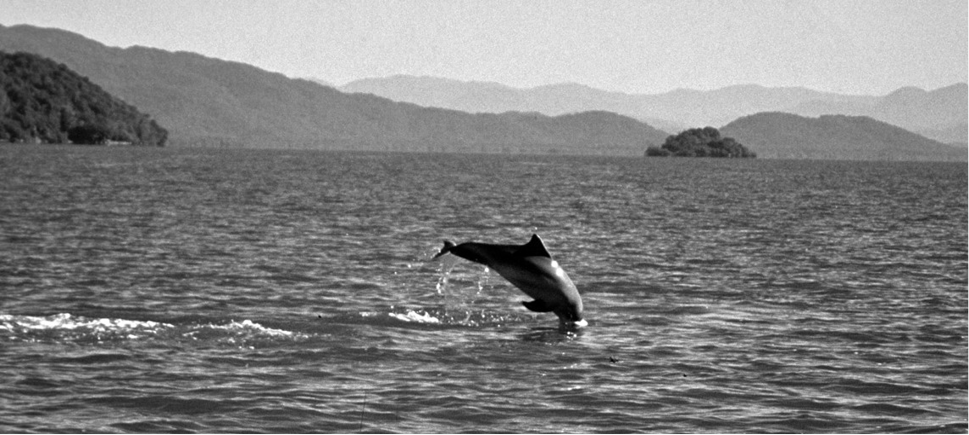
The conservation of small cetaceans in estuarine habitats is of increasing concern. For example, the recent virtual extinction of the Yangtze River Dolphin (Lipotes vexillifer) in China (Smith et al., 2008) and ‘critically endangered’ status of others, such as the Vaquita, Phocoena sinus (Rojas-Bracho et al., 2008) are evidence of rapidly declining population sizes and uncertain futures of such species worldwide. Unfortunately, conservation strategies are often lacking necessary baseline ecological data for timely intervention to occur. This is the case of the Guiana dolphin, Sotalia guianensis (Van Benédén, 1864) (Fig. 1)
a small delphinid (males are 1.7-1.75m at sexual maturity; Rosas and Monteiro, 2002) distributed along the tropical and subtropical Atlantic coast of the Americas from Honduras (Silva and Best, 1996) to Florianópolis, Brazil (27°35’S, 48°34’S; Simões-Lopes, 1988). The species is currently listed as ‘threaned’ in Brazil, but it is still considered ‘data deficient’ by the International Union for Conservation of Nature (IUCN) (Secchi, 2012). Of note, a recent study documented significant S. guianensis population decline over a period of fifteen years (Azevedo et al., 2017).
Several threats to S. guianensis populations have been identified, but vary widely throughout the species distribution (Domiciano et al., 2016). Known anthropogenic threats to Guiana dolphins include: entanglement in fishing gear (Beneditto et al., 1998), habitat degradation (Azevedo et al., 2007), port activity (Cremer et al., 2004), tourist boat traffic (Filla and Monteiro, 2009b), and pollution-derived infections (Van Bressem et al., 2009). Even in near-pristine ecosystems, pre-existing health conditions may exarcebate the susceptibility of individuals to anthropogenic impacts (Domiciano et al., 2016). Although the species is widely distributed, mtDNA sequence analyses have indicated discrete populations with restricted gene flow (Cunha et al., 2010). Photo-identification surveys have also revealed local year-round residents with high site fidelity over several years (Rossi-Santos et al., 2007; Hardt et al., 2010; Cantor et al., 2012; Batista et al., 2014). Together, these data suggests that S. guianensis populations merit regional studies regarding their ecology and behaviour. Therefore, we set out to characterize the preferred sites and behaviours of representative individuals living in a relatively well-preserved region of their distribution.
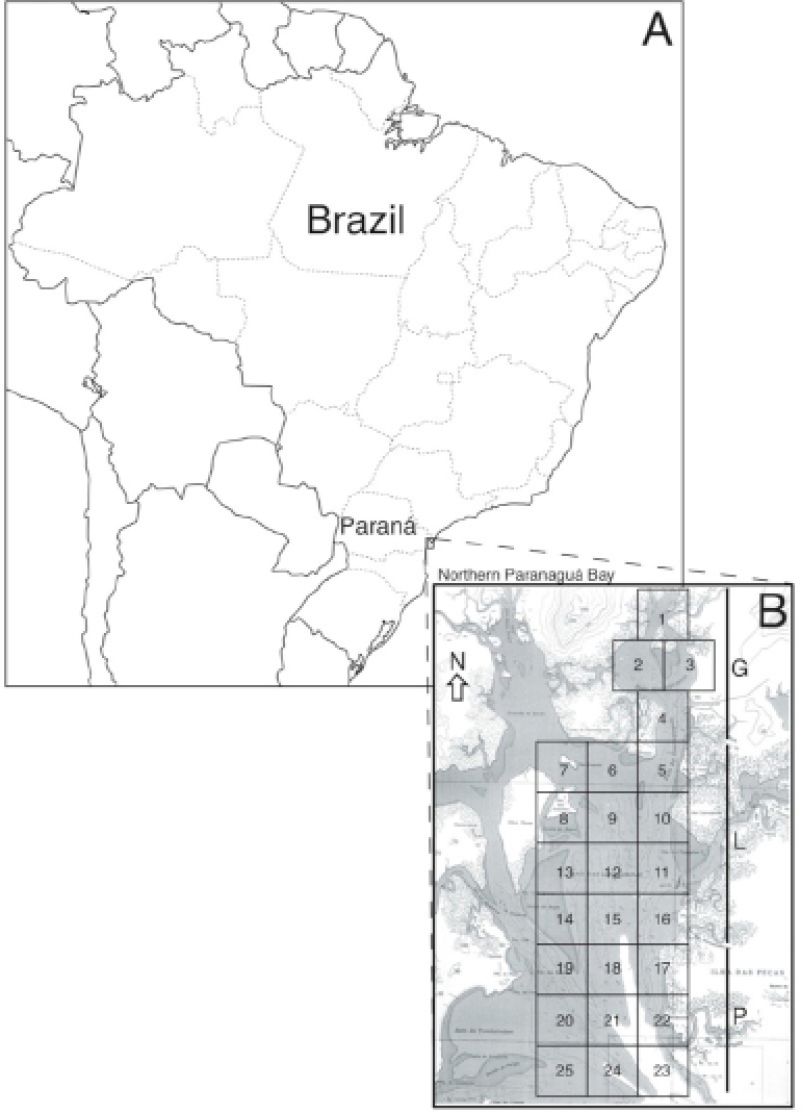
The Paranaguá Bay estuarine system (48°25’W, 25°30’S) is a large complex of bays and channels in the state of Paraná, Brazil. The seventh largest shipping port in Brazil stretches along the southern edge of this estuary, contributing a major anthropogenic threat to the integrity of dolphin habitats. In contrast, the northern border of the Paranaguá Bay estuary is delimited by a national park (Superagui National Park) and adjacent environmental protection areas (e.g., Protection Area of Guaraqueçaba; APA de Guaraqueçaba), which together safeguard nearly 20% of the remnant Atlantic rainforest in Brazil. As further protection, the region encompasses a United Nations Educational, Scientific and Cultural Organization (UNESCO) World Heritage Site. To date, published studies on the ecology of Guiana dolphins in Paranaguá Bay have focused primarily on group size and group dynamics (Filla and Monteiro, 2009a; Santos et al., 2010), yet spatial patterns of behaviour and habitat preference are poorly known.
This study describes the habitat of S. guianensis in a well-preserved portion of Paranaguá Bay, providing a fundamental evaluation of their natural behaviours. From a conservation management perspective, our overarching goal was to contribute principal baseline data for the long-term monitoring of this dolphin population. In addition, our study contributes regional data that may inform studies of other populations throughout this species’ distribution. The main findings of our study are: identification of sites with elevated S. guianensis occurrence in Paranaguá Bay; and 2) characterization of the activity patterns of dolphins within the study area, revealing spatial and temporal variability in their behaviour.
Materials and methods
Study area
Paranaguá Bay spans 612 km2 of coastline in southern Brazil (Fig. 2A). Numerous inlets, channels, and islands comprise this estuarine complex, but it mainly connects to the open ocean through a single large channel (152 km2 wide and 20 m deep). The area selected for study (hereafter, termed northern Paranaguá Bay; 25°18’S: 48°21’W) is approximately 100 km2 on the northern portion of the estuary, including Guaraqueçaba Bay, Laranjeiras Bay, and Peças Island. For sampling, these three sectors were divided into a large grid of 3.7 km2 squares (numbered 1-25) to plot dolphin sightings (Fig. 2B) and describe behaviour patterns.
Dolphin group sightings and location records
To investigate whether dolphins prefer specific sites within the study area, group sightings were recorded using a “group follow” protocol (Mann, 1999). Each sampling period was initiated with a random search for dolphin groups using pre-determined transects following channels within the study area. When first sighted, the dolphin group location within the grid was recorded. Subsequently, the group was followed and sampling of location (square number) and behaviour was continuously recorded after every 5 min of observation. The non-independence of observations is not an assumption of this method. Therefore, to avoid over-representing only a few dolphin groups, they were abandoned after one hour and a new search was initiated in the nearest channel. The group follow protocol has been widely employed in previous studies small cetaceans and the main advantage of this method is that it allows for behaviour to be recorded along with spatial location, in contrast to survey methods, which only allow for a snapshot of group size and location (Mann, 1999).
Behavioural data collection
Focused observations of group activity (Altmann, 1974) for the longest time possible (Mann, 1999), allow for behavioural analysis over broad temporal and spatial scales. Therefore, all behavioural data were collected using a combination of “focal group” and “group follow” protocols described previously (Altmann, 1974; Mann, 1999). Field work was conducted daily during the first or second week (7 consecutive days) of every month, weather permitting (Beaufort < 3). Dolphin group locations and activities were recorded by the same observer during the twelve months of study, and all surveys were conducted from the same aluminium skiff (10 m long). To avoid disturbing the dolphin subjects, the use of the outboard engine was minimized when possible. Activity patterns were categorized based on ad libitum naturalistic observations (Altmann, 1974) and categories described elsewhere (Shane, 1990; Ballance, 1992). Specific dolphin group activities were recorded as one of five categories (feeding, traveling, feeding/traveling, resting, and socializing).
Feeding was indicated by a lack of steady directional movement and non-synchronous swimming or breathing. Individuals often splashed at the surface and typically breathed in short intervals. Interaction with fish schools and seabirds were also considered evidence of feeding behaviour. Traveling was characterized by steady directional movement. When traveling, Guiana dolphin groups typically breathed synchronously. Long distance subsurface movements also occurred, as evidenced by longer breathing intervals. Feeding/traveling was defined by dolphins alternating between feeding and traveling activities within the sampling interval. Resting dolphins exhibited little or no directional movement. Socializing individuals physically interacted with one another with no signs of feeding activity.
Spatial and temporal assessments of behaviour
Spatial habitat preferences throughout the study area were examined by pooling numbers of dolphin observations per square, and then sector. The raw number of counts in each square relative to the sector and to the total is detailed in Supplementary Table SI. Similarly, temporal variability of behaviour was assessed by totalling dolphin activity records for each activity by month (12 months) or time of the day (5 classes). Accordingly, statistical analyses included frequency tests (Pearson’s χ2) performed using the built-in statistical applications within R v.2.14.0 (R Development Core Team, 2008).
Results
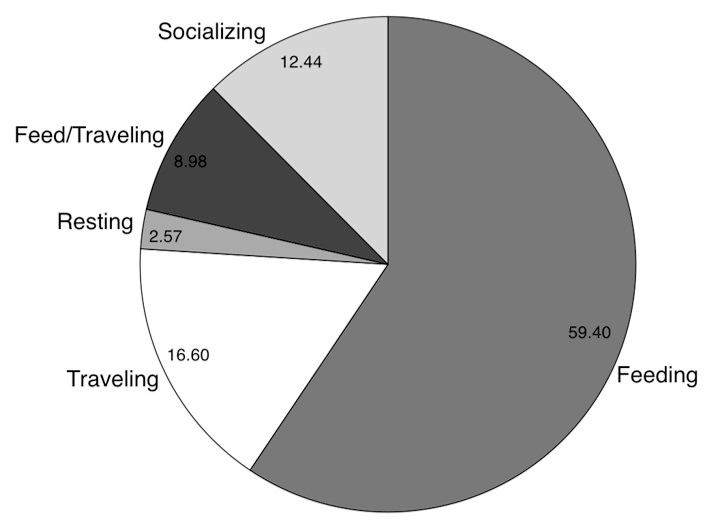
From August 1999 to July 2000, 12 week-long field expeditions were conducted in northern Paranaguá Bay, totalling more than 480 h of field effort. A total of 260 h were spent directly observing dolphins (54.1% of field hours). Observations yielded 3,150 records of dolphin location and activity (note that this number includes re-sightings of the same group). Mean group size was 8.52 (SD= 7.20, range: 1-80 individuals). Dolphin groups were most often observed feeding (59.3% of records), followed by traveling (19.1%), feeding/traveling (9.5%), resting (8.98%) and socializing (2.9%; Fig. 3).
Temporal variability of behaviour
The temporal analyses of behaviour (month-to-month comparisons) revealed significant seasonal differences in dolphin activity (global χ2 = 280.54, DF = 44 p < 0.0001, Fig. 6A). Notably, feeding and traveling activities presented an inverse pattern, with late fall and early winter months (April - July) presenting the highest numbers of feeding records (> 65% of observation time) relative to traveling. Feeding/traveling and resting activities remained constant throughout the year (Fig. 6A) possibly due to the inherent low frequency in which these activities were recorded. In contrast to the variability in behaviour regarding the months of the year, no significant differences in behaviour were observed regarding the time of day (global χ2 = 11.70, DF = 16, p = 0.764, Fig. 6B). These analyses reveal that although dolphins were consistently recorded throughout the year within the study area, their behaviour varied significantly across the year, with the most remarkable increase in feeding activity during early winter.
Discussion
The conservation of small coastal cetaceans is a global priority, and successful management practices rely on accurate ecological and biological assessments of representative individuals from both pristine and altered habitats. Many small cetacean species are found in close proximity to human populations and are therefore vulnerable to anthropogenic factors that can diminish their populations. Additionally, there is still a paucity of ecological data on some dolphins, such as S. guianensis. Considerable efforts have been undertaken to characterize Guiana dolphin habitats along the coast of South America, and together these studies indicate that S. guianensis populations from different localities display heterogeneity in terms of their basic ecology (e.g., habitat preferences and behaviour). Increased regional ecological data are urgently necessary to guide conservation management decisions that address localized threats to Guiana dolphin populations.
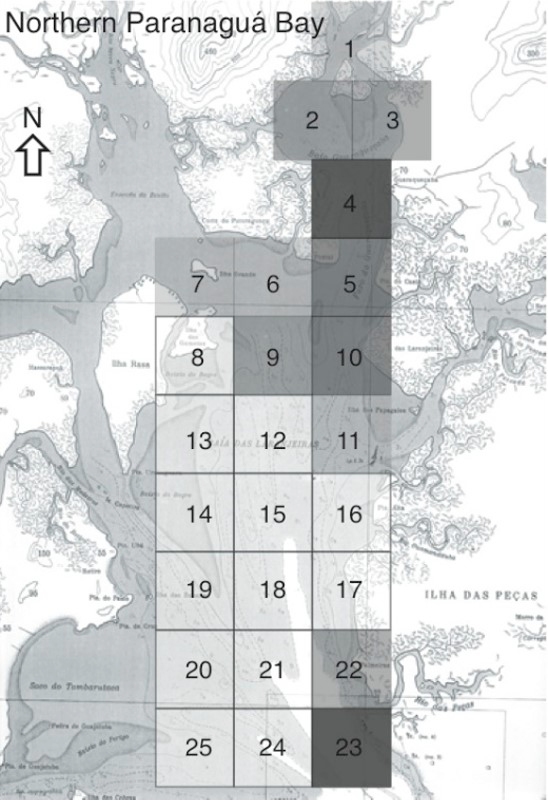
The northern portion of Paranaguá Bay represents important year-round habitat for resident Guiana dolphins in southern Brazil. The area also has importance for S. guianensis in Paraná, because the only other estuarine complex in the state (Guaratuba Bay), appears to have a much smaller population (Filla and Monteiro, 2009a). We found that Guiana dolphins are heterogeneously distributed in Paranaguá Bay, and have at least two preferred sites: one in Guaraqueçaba (G4) and another near Peças Island (P23). The spatial heterogeneity in habitat use by S. guianensis has been reported for other populations e.g., North-eastern Brazil (Batista et al., 2014), Guanabara Bay (Azevedo et al., 2007), Norte Bay (Wedekin et al., 2010) and Babitonga Bay (Cremer et al., 2004). Interestingly, in Babitonga Bay, a shift in habitat use was detected over a short period, wherein at least one intensely used site was abandoned by S. guianensis after one year; possibly the result of increased port activity during the same period (Cremer et al., 2004). Similarly, studying Guiana dolphins in Norte Bay Wedekin et al. (2010) reported an alteration in habitat use within a period of four years. These authors also highlighted major changes in prey availability, such as the collapse of cutlass fish fisheries in their study area. We did not verify the temporal stability of our findings in Paranaguá Bay; however in September of 2016, numerous S. guianensis individuals were observed in G4 and P23 suggesting that these sites are still important.
The strong preference of S. guianensis for sites G4 and P23 suggests that these two sites may concentrate their prey. For decades, marine mammal ecologists have shown that dolphin movements and behaviours are largely determined by patchy resource distribution (Defran and Weller, 1999). Both G4 and P23 consist of deep near-shore channels, where sloping margins would act as a back-drop for dolphins to concentrate schools of fish, thus increasing feeding success (Monterio-Filho, 1991). The preference of S. guianensis for certain isobaths and slopping bottom topography has been suggested in Norte Bay by Wedekin et al. (2010), although regional variations in prey type and other ecological habitat parameters reduce our ability to directly compare the Paranaguá Bay and Norte Bay populations. Additionally, sites G4 and P23 have calm waters that are protected from prevailing weather patterns, and may provide protection from some predators and allow for increased socialization. In particular, our data emphasize the importance of G4 (Guaraqueçaba Bay) as a site for socialization and a safe enough environment for mating to occur. G4 should be considered a candidate site for protection against invasive anthropogenic activity such as outboard engine boat traffic, coastal development, or bottom dregding. However, the heterogeneous patterns of habitat use and behaviour indicate that other sites should also be further evaluated for their potential to harbour important dolphin prey.
Feeding was the most frequent activity recorded in Paranaguá Bay, with animals spending more than half of their time (59.3%) engaged in this behaviour. Similar results have been observed in other locations e.g., 58% in Guanabara Bay (Azevedo et al., 2007); 45.9% in Babitonga Bay (Cremer et al., 2009). Despite being observed throughout the year, a significant seasonal variation in feeding activity was detected in Paranaguá Bay. Feeding was recorded more frequently in late fall and early winter, while other activities (e.g., traveling) were far secondary. Curiously, an increase in traveling, rather than feeding, during the winter has been reported for other S. guianensis populations in southern Brazil, such as in Babitonga Bay (Cremer, 2000) and Norte Bay (Daura-Jorge et al., 2007; Wedekin et al., 2007). At Norte Bay, S. guianensis movements increases during the cold season, which corresponds to changes in prey availability (Daura-Jorge et al., 2007). Specifically, in April and May, a major dolphin prey species (mullets) begin their migration toward the southern coast of Brazil, where cold fronts cause low temperatures that stimulate these displacements. Peak mullet captures in Rio Grande do Sul occur in the fall and gradually increase to the north, in the states of Paraná and São Paulo, during the months of June and July (Vieira, 1991). In our study area, we believe the seasonal mullet migration directly impacts dolphin activity by delivering large numbers of fish prey and thereby increasing feeding activity in early winter.
Regional ecological knowledge regarding the habitat use of coastal cetaceans, such as S. guianensis, is fundamental for the long-term conservation of vulnerable species. Here, we have obtained essential baseline data on habitat use within one of the most well-preserved estuarine areas in southern Brazil. We detected two heavily-used sites in Paranaguá Bay where Guiana dolphin feeding activity was predominant. Both locations consist of deep near-shore channels with sloped bathymetry, which may concentrate prey and facilitate energy-saving dolphin feeding strategies. The tranquil internal waters of Guaraqueçaba Bay were also heavily used by socializing dolphins. We conclude that these areas represent critical habitat for Guiana dolphins year-round in Paraná State. We therefore recommend that they are especially considered in future conservation management strategies, including potential regulations for tourist boat traffic as has been suggested for the Cananéia estuary (Filla et al., 2008). We also suggest that monitoring of the preferred sites by Guiana dolphins over time can provide invaluable insights regarding environmental changes in a preservation area of world-wide importance.
Acknowledgments
This study was supported by a CAPES- Brazil full Masters Scholarship (CAB). Additional resources were provided by the Zoology Department at the Universidade Federal do Paraná, Curitiba, Brazil. We thank ICMBio- Área de Proteção Ambiental de Guaraqueçaba and Pousada Mar and Mato for logistic support in the field. Mr. Augusto Damião Portela, and Drs. Gislaine Filla, Gláucia Dallabona and Marion Letícia Silva provided invaluable assistance during fieldwork. Drs. Emygdio Monteiro-Filho, Lena Geise and Fernando Passos contributed valuable suggestions on earlier versions of this work. The authors declare that there is no conflict of interest regarding the publication of this paper.
Supplementary material
There is supplementary material associated with this article. Access the material online at: http://dx.doi.org/10.17582/journal.pjz/2017.49.6.2235.2242
Statement of conflict of interest
Authors have declared no conflict of interest.
Figures
A Guiana dolphin (Sotalia guianensis) is observed in Paranaguá Bay estuary, southern Brazil.
Study area maps. A, The general location of Paranaguá Bay estuary in Paraná State, Brazil, B, The northern portion of Paranaguá Bay estuary, where an area of approximately 100 km2 was surveyed for Sotalia guianensis habitat use. The area was divided as a grid; squares of ~ 3.2km2 were used to track dolphin group locations. G, Guaraqueçaba Bay; L, Laranjeiras Bay; P, Peças Island. Map adapted from publicly available Nautical Chart # 1820. Diretoria de Hidrografia e Navegação, Marinha do Brasil.
Total activity budget for S. guianensis in Paranaguá Bay estuary, southern Brazil. Data based on n=3,150 group sighting records, corresponding to 260 hours of direct dolphin observation.
Habitat preferences for S. guianensis in the Paranaguá Bay estuary. Squares on the map are shaded according to the percentage of dolphin group sighting records relative to the total for the study area. Darker to light shading on squares corresponds to percentage of records according to five categories: > 10%; 5-10%; 5-1%; <1% of total dolphin sighting records.
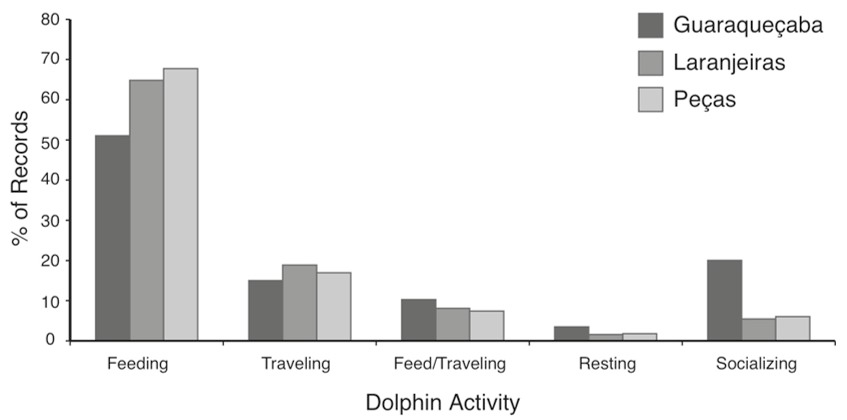
Dolphin group activity per sector (Guaraqueçaba, Laranjeiras and Peças) within Paranaguá Bay estuary. Note: socialization was significantly more frequently recorded in Guaraqueçaba Bay relative to the remainder of the study area (χ2= 13.18, DF=2, p= 0.001).
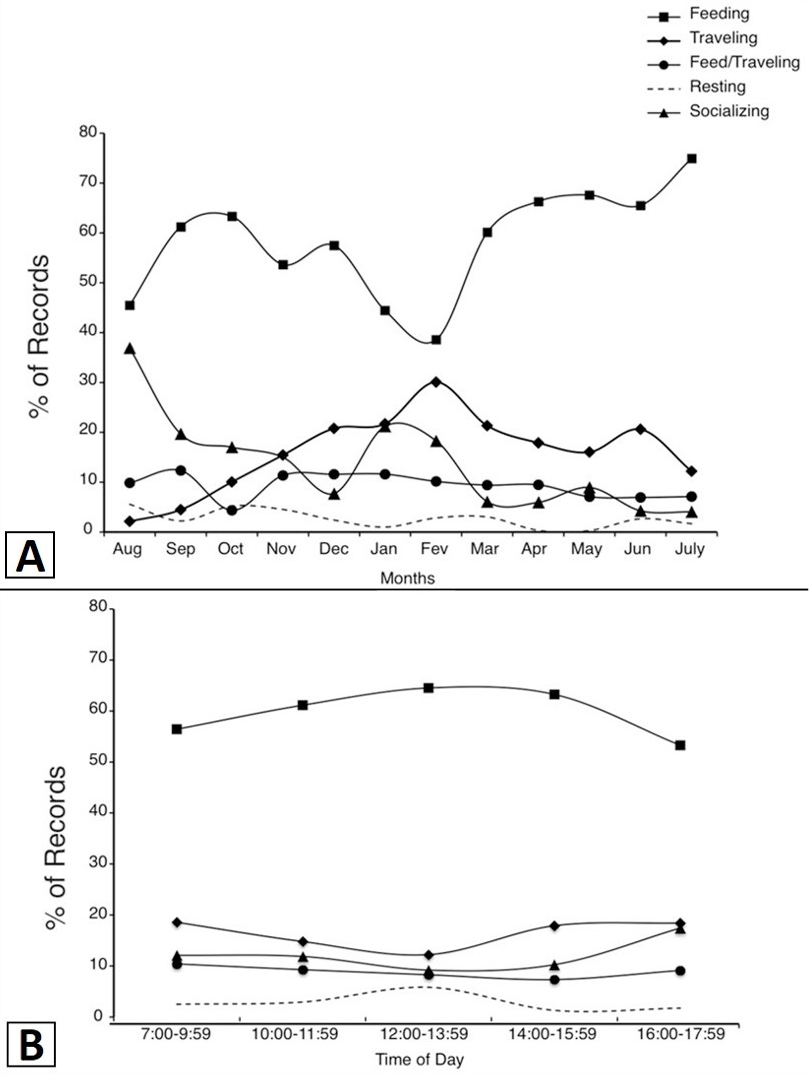
Temporal variation of S. guianensis activity in Paranaguá Bay. A, Month by month variation in dolphin activity. B, Diel variation in dolphin activity.
References
- Sotalia guianensis individuals were not distributed evenly throughout the study area. Two locations of elevated observation records were detected in squares G4 (in Guaraqueçaba Bay) and P23 (in Peças Island), which together totalled 62.1% of all sighting records (Fig. 4, Supplementary Table SI). The frequency of dolphin observations incrementally decreased in grid squares surrounding these two locations of most intense use (Fig. 4). Additional behavior patterns were observed when activity records were pooled by sector (Guaraqueçaba, Laranjeiras and Peças). Specifically, significant differences were detected between sectors for socialization (χ2= 17.65, DF= 8, p= 0.023, Fig. 5), which was most commonly recorded (>20%) in Guaraqueçaba. In summary, these results indicate a clear preference for two sites, one at Peças Island and another in Guaraqueçaba Bay, the latter used predominantly for socializing.
Services
Article usage statistics
Loading…