Research Article · Volume 11, Issue 11, 6 November 2023 · Open Access
Growth Performance, Immunity, and General Health Status of Newborn Friesian Calves Fed Milk Supplemented with Propolis, Thyme, or their Combination, as Antioxidants, During the Suckling Period
· · · · · ·
Affiliations & Notes ⌄
1Animal Production Research Institute, Agriculture Research Center, Ministry of Agriculture and Land Reclamation, Nadi El Said, Dokki, Giza 12618, Egypt
2Animal Production Department, Faculty of Agriculture, Tanta University, Egypt
3Damanhour University, Faculty of Veterinary Medicine, Department of Animal Husbandry and Animal Wealth Development, Egypt. *Correspondence | W.M. Wafa, Animal Production Research Institute, Agriculture Research Center, Ministry of Agriculture and Land Reclamation, Nadi El Said, Dokki, Giza 12618, Egypt
Aim of the resent study was to determine impacts of feeding milk supplemented with propolis thyme, or both, as antioxidants, on growth efficiency, liver function, kidney function, total antioxidant capacity, and immune response of Friesian calves from 7 to 105 days of age as an experimental period. Newborn male calves (n=20) weighing 37.92±0.63 kg were divided into 4 groups, five calves/group. The first group (G1, control) included animals without treatment. During the whole suckling period each animal in G2, G3, and G4 daily received milk supplemented with propolis (5 g), thyme oil (2 ml), or 5 g propolis plus 2 ml thyme oil, respectively. Results showed that animals in fed both propolis and thyme combination showed the highest LBW, total gain, counts and percentages of blood cells, hemoglobin, total proteins and their fractions, total lipids, total cholesterol, and glucose, and the lowest urea and creatinine levels (P<0.05). Plasma immunoglobulins (IgG, IgA, and IgM) and total antioxidant capacity increased to the maximal values, while AST and ALT activities decreased to the minimum values in G4. Feeding Friesian calves on milk supplied with propolis (5 g) plus thyme oil (2 ml) per calf during the suckling period can improve growth performance, general health status, immune response, and total antioxidant capacity. From an economical point of view, this treatment could increase profits by reducing morbidity, diarrhea cases, and mortality, and improving the performance of breeding male calves during suckling and the early post-weaning period.
Newborn calves are the foundation of replacement animals that can be an important asset for the farmer to generate income for dairy farms (Anjum et al., 2013). During the first fourteen days of newborn calf’s life, they are exposed to several stressors because they suffer from the change in environmental conditions including diet, handling stress, and low immunity which increases diarrhea infection , which may increase morbidity and mortality rates . Also, during this period calves are under different health and welfare problems, leading to increased mortality rate . Weaning of calves at an early age is practiced to reduce the cost and labor of feeding . Several researchers ; indicated a relationship between pre-weaning daily gain and productive and reproductive performances of dairy calves. In the cattle industry, increasing calf mortality is one of the most managerial problems .
Many types of natural antioxidants are used to achieve good performance and health status in raising calves such as propolis and thyme. Propolis is a sticky and semi-solid organic substance. It is a mixture of some bees wax and biochemically changing resinous substances . It has an activity against oxidation, microbes, and toxicity, and acts as immunomodulatory agent for containing flavonoids, phenolic acids, and terpenoid contents and also has a positive impact, as a flavor enhancer . Moreover, Zafarnejad et al. (2017) and Prakatur et al. (2019) reported that propolis is a feed additive, to promote the performance, the activity of the digestive enzymes and microbiota, and immunity. In sheep, raw Chinese propolis improved the performance and milk production of ewes, and the immunity of lambs . Adding 150 µL of propolis per kg LBW to milk showed a positive effect on the performance, antimicrobial, antioxidant, and immune parameters of suckling lambs . Fecal score and the duration and veterinary expenses for diarrhea in calves were improved .
Plant containing essential oils (EO) is considered as drug source and acts against microbes, inflammation, and oxidation. Thus, it is used to improve animal productivity . Thymus vulgaris (THV) has biological compounds such as pinene, thymol, and caryophyllene . Growth performance parameters and immune response of calves was affected by THV . Addition of THV in the diet improved cell-mediated, humoral immune responses, and health status of growing calves , 2022). Thymol (476 g/kg), gamma-Terpinene (309 g/kg), and para-Cymene (84 g/kg) are the main constituents of THV essential oil . Studies on the effect of propolis in comparing with THV or their combination on ruminants, particularly calves during the suckling period, are limited. In our study, we proposed that propolis, thyme, or their combination may be effective, as antioxidants to substitute antibiotics.
To reduce mortality and improve Friesian calf performance, we proposed that supplementation of the suckled milk with propolis, thyme, or their combination, as natural antioxidants, may have positive impacts on growth performance, liver and kidney function, total antioxidant capacity, and immune response from birth to weaning.
MATERIALS AND METHODS
This study was conducted in frame of a corporation between Animal Production Department, Faculty of Agriculture, Tanta University and Animal Production Research Institute (APRI), Egypt. According to the ethical standards in dealing with animals for scientific purposes were approved during the academic year 2019 – 2020 by the ethical committee of Faculty of Agriculture, Tanta University (Session 6: 13/1/2020), and were updated by the Supreme Council of Egyptian Universities (No 2020.03.21). All ethical standards (AY2019-2020/ Session 6/ 2020.01.13) are in line with international standards in dealing with animals for scientific purposes.
Animals and experimental design
A total of 20 newborn male Friesian calves were used in the present study. Within 30-60 minutes after parturition, newborn calves were suckled colostrum from their dams (1-2 kg) using feeding bottles up to three days of age, then calves were artificially suckled milk from their dams at morning and evening based on 10% of calf weight for six weeks. Avery week from birth up to weaning, 1% reduction in suckled milk (based on LBW) was achieved to calves in all groups. Starting at three weeks of age, starter, berseem hay, and rice straw were offered to calves ad libitum. Table 1 shows the chemical composition of feeds offered to calves during the experimental period. After one week of birth, the average initial live body weight was 37.92±0.63 kg.
Table 1: Chemical analysis (on DM basis) of starter, berseem hay, and rice straw fed to calves.
Item
Dry matter (%)
Chemical composition (%, on DM basis)
Organic
matter
Crud
protein
Crud
fiber
Ether extract
Nitrogen free extract
Ash
Starter
88.98
92.55
19.24
5.63
2.97
64.71
7.45
Berseem hay
87.39
87.19
13.22
27.18
0.67
46.12
12.81
Rice straw
88.25
81.87
2.68
38.72
1.32
39.15
18.13
All day times, fresh water was available for animals. During suckling period, no mortality cases were recorded, and all animals were without diseases.
After calving, newborn calves at one-week old were allocated into 4 groups (five animals/group). The control group was fed a basal diet without treatment. Daily milk amount fed to calves during the whole suckling period (weaning at 105 d) was supplemented with 5 g crud propolis/calf in G2 , 2 ml thyme oil/calf in G3 , and a combination of 5 g propolis and 2 ml thyme oil/calf in G4.
Experimental procedures
Calves live body weight
Calf’s live body weight was recorded at 7 days of age, weaning (105 days of age), and post-weaning (165 d of age), while body weight gains were calculated as a total or daily gain.
Blood sampling
Before receiving morning milk meal, the samples of blood were collected from the jugular vein puncture at weaning age (105 d) from all calves for analytical assays.
Blood samples were taken into heparinized test tubes. Each sample was divided into two portions, the first was taken as whole blood for determining the hematological parameters, while the second portion was centrifuged (3000 rpm for 20 min) to isolate blood plasma, then plasma samples were preserved (-20oC) up to different analyses.
According to Killingsworth and Savory (1972), plasma immunoglobulin (IgG, IgM, and IgA) concentrations were determined in the blood plasma of calves.
In the whole blood samples, hemoglobin level and hematocrit value were measured using Mission® Plus kit (REF C132-3031, USA). Blood cellular counts (red and white blood cells) was determined using a hemocytometer.
The concentration of total proteins, albumin, glucose, total lipids, and total cholesterol in blood plasma samples were also assayed according to Henry (1964), Doumas et al. (1971), Trinder (1969), Zöllner and Kirsch (1962), and Richmond (1973), respectively. The activity of liver enzymes, aspartate transaminase (AST) and alanine transaminase (ALT) were determined in blood plasma according to Reitman and Frankel (1957). Plasma creatinine level and urea were determined as kidney function markers. However, the concentration of globulin was determined by the difference between total proteins and albumin concentrations. Total antioxidant capacity was determined as the methods described by Koracevic et al. (2001).
Statistical analysis
SPSS Program (2010) version 15 was used to the statistical analysis of the obtained data. One-way analysis of variance was used to explore the significant effects of treatment. The significant differences were separated at a level of P<0.05 by Duncan Multiple Range test .
RESULTS and Discussion
Live body weight and growth rate
Results in Table 2 showed that live body weight (LBW) and weight gain (total and daily) of calves at weaning (105 d of age) and post weaning (165 d of age) significantly increased in all treatment groups than in control, being with maximum values (P<0.05) in calves fed the combination.
Immunity status
Table 3 revealed that the concentration of plasma immunoglobulins of newborn calves at the end of the experiment showed a significant (P<0.05) increase in all treatment groups in comparison with control one, but a more significant (P<0.05) increase was recorded in G4 compared with G2 and G3.
Table 2: Effect of treatments on live body weight and growth rate of Friesian calves at different stages.
Item
Experimental group
G1 (Control)
G2 (Propolis)
G3 (Thyme)
G4 (Combination)
Live body weight of calves (kg)
Initial
37.96±1.90
37.94±1.12
37.84±1.50
37.94±0.83
At weaning (105-d old)
78.80±1.52c
96.32±1.30b
95.12±1.27b
119.94±2.11a
Post-weaning (165-d old)
98.17±1.51c
129.92±1.27b
127.98±1.30b
178.44±2.12a
Total body weight gain (kg)
Initial to weaning
40.84±2.19c
58.38±1.73b
57.28±2.07b
82.00±1.33a
Initial to 165 d old
60.21±2.20c
91.98±1.72b
90.14±2.06b
140.50±1.34a
Average daily gain (kg/h/d)
Initial to weaning
0.38±0.02c
0.56±0.01b
0.54±0.02b
0.78±0.01a
Initial to 165 d old
0.36±0.01c
0.55±0.01b
0.55±0.02b
0.85±0.01a
a-b: Means in the same column with different superscripts differ significantly (P<0.05).
Table 3: Effect of treatment on immunoglobulins (IgG, IgM, and IgA) concentrations in the blood plasma of Friesian calves in experimental groups at 165-days of age.
Item
Experimental group
G1 (Control)
G2 (Propolis)
G3 (Thyme)
G4 (Combination)
IgG (g/L)
11.55±0.14c
13.44±0.12b
13.36±0.15b
15.05±0.16a
IgM (g/L)
1.69±0.05c
2.41±0.07b
2.37±0.08b
3.06±0.06a
IgA (g/L)
0.52±0.04c
0.68±0.03b
0.66±0.02b
0.89±0.03a
a, b, c: Means in the same column with different superscripts differ significantly (P<0.05).
Table 4: Hematological parameters in the blood of Friesian calves in the experimental groups at the end of the experiment.
Item
Experimental group
G1 (Control)
G2 (Propolis)
G3 (Thyme)
G4 (Combination)
RBCs (x106/mm3)
8.32±0.17b
8.89±0.21ab
8.83±0.22b
9.45±0.20a
WBCs (x103/mm3)
9.21±0.16c
10.31±0.17b
10.18±0.16b
11.02±0.18a
Hemoglobin (g/dl)
10.10±0.13b
10.34±0.25b
10.18±0.19b
11.60±0.18a
PCV (%)
28.97±0.27c
33.86±0.33b
33.00±0.36b
37.19±0.44a
a, b, c: Significant differences among groups at P<0.05.
Table 5: The concentration of blood biochemicals in the plasma of Friesian calves in experimental groups at the end of the experiment.
Item
Experimental group
G1 (Control)
G2 (Propolis)
G3 (Thyme)
G4 (Combination)
Protein metabolites
Total proteins (mg/dl)
5.64±0.10c
6.59±0.15b
6.47±0.14b
7.53±0.19a
Albumin (mg/dl)
2.95±0.09c
3.39±0.10b
3.33±0.09b
3.83±0.13a
Globulin (mg/dl)
2.68±0.11c
3.20±0.13b
3.13±0.14b
3.70±0.14a
Albumin: globulin ratio
1.10
1.05
1.06
1.04
Carbohydrate metabolites
Glucose (mg/dl)
43.34±1.14c
48.08±0.81b
47.03±0.86b
53.11±1.07a
Lipid profile
Total lipids (mg/dl)
487.16±5.48c
527.18±5.97b
525.01±5.58b
568.64±7.06a
Cholesterol (mg/dl)
83.10±1.16c
89.63±1.10b
87.70±1.04b
95.86±1.15a
a, b, c: Significant differences among groups at P<0.05.
Hematological parameters
Count of WBCs and PCV percent in the whole blood of calves at the end of the experimental period were significantly (P<0.05) improved by propolis (G2), thyme (G3), and their combination (G4) treatments in comparing with the control. However, only combination treatment significantly (P<0.05) improved all hematological parameters (Table 4).
The concentration of plasma metabolites
Plasma total proteins, albumin, and globulin concentrations increased (P<0.05) in treatments as compared to control group with nearly similar albumin: globulin ratio in all experimental groups. Also, glucose concentration, as a carbohydrate metabolite as well as total lipids and cholesterol levels, as lipid profile, significantly (P<0.05) increased in all treatment groups as compared to the control group. Calves in G4 showed significantly (P<0.05) the highest values of plasma metabolites as compared to those in G1, G2, and G3 (Table 5).
Markers of liver and kidney functions
As shown in Table 6, transaminases (AST and ALT) activities and kidney function in terms of plasma urea and creatinine in the blood plasma of calves significantly reduced by in G2, G3, and G4 in comparison with G1. Animals in G4 exhibited significantly (P<0.05) the best liver and kidney function markers in comparison with other treatment groups and control.
Total antioxidants capacity
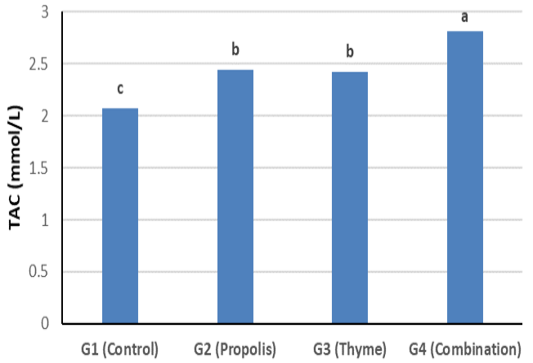
Level of total antioxidant capacity (TAC), as an antioxidant bio-marker in the blood plasma of calves at the end of the experimental period, was higher (P<0.05) in all treatment groups than in the control one, but G4 showed the highest (P<0.05) values (Figure 1).
Table 6: Enzyme activity (AST and ALT) and total antioxidant capacity in the blood plasma of Friesian calves in experimental groups at the end of the experiment.
Item
Experimental group
G1 (Control)
G2 (Propolis)
G3 (Thyme)
G4 (Combination)
Liver function
AST (IU/l)
45.11±0.95a
39.97±0.76b
39.80±0.89b
32.63±0.98c
ALT (IU/l)
21.20±0.49a
16.74±0.52b
17.00±0.55b
12.68±0.58c
AST: ALT ratio
2.13
2.39
2.34
2.57
Kidney function
Urea (mg/dl)
3.32±0.08a
2.89±0.09b
2.91±0.10b
2.52±0.10c
Creatinine (mg/dl)
1.68±0.07a
1.26±0.06b
1.32±0.05b
0.88±0.07c
a, b, c: Significant differences among groups at P<0.05.
Many medicinal herbs and plants are used as feed additives in animal feeding . In our study, each propolis or thyme treatment had beneficial effects on the growth performance during all age stages of calves, but the most positive impacts were obtained on calves treated with their combination. Total gain of Friesian calves increased (P<0.05) by 44.94, 24.4, and 23.2% in calves fed milk supplemented with a combination of propolis + thyme, propolis, and thyme, in comparison with those free-milk (control), respectively (unshown data). Similar results were reported by Wafa et al. (2022), who found that dietary supplementation with thyme or its combination with Probax significantly increased body weight and gains of weaned Friesian calves with superiority of calves treated with thyme and Probax combination. Seifzadeh et al. (2016) recorded higher final body weight during the suckling period in Holstein’s calves fed a diet with thyme than in controls. Ozkaya et al. (2017) and Froehlich (2016) found that final body weight was significantly improved by dietary thyme supplementation of Holstein and Holstein-Friesian calves during the suckling period. In general, dietary herbal extract supplementation had positive impacts on ruminal fermentation and animal productivity ; . Regarding the beneficial effects of propolis treatment, Kabiloğlu et al. (2022) found that propolis treatment improved the live body weight, gain, and feed conversion ratio of dairy calves. Also, positive effects on the body parameters of calves treated with ethanolic extract of propolis (EEP) were observed by many reports ; ; Yücel et al., 2015), or when EEP was added to milk replacer feeds because propolis had a positive impact on gut health, diarrhea incidence, and growth of newborn calves due to presence of flavonoids . The improvement in the growth performance of calves in all treatment groups may be due to the positive effects of thyme oil , propolis , or the synergic effect of their combination on nutrient digestibility. In this respect, supplementation of thyme EO in diets of calves significantly improved digestion of DM and OM . At post-weaning stage, an increase in volatile fatty acids level and protozoal count in the ruminal fluids as affected by thyme or thyme and Probax treatments of calves . On the other hand, Vakili et al. (2013) and Darabighane et al. (2016) observed non-significant differences in growth parameters in calves treated with thyme.
We investigated plasma concentrations of immunoglobulins as markers of immunity in different groups. We found beneficial effects of both propolis or thyme treatment on the immune response of calves, but the most positive impact was more pronounced by their combination in G4. Qiao et al. (2013) concluded that herbs treatment can support the immune response by improving the level of all blood immunoglobulin type. In this respect, Lakhani et al. (2019) stated that the humoral immune response of buffalo calves was enhanced by plant phytogenic. Wafa et al. (2021) indicated an improvement of blood IgG, IgM, and IgA levels in calves fed a diet containing thyme as compared to control. Froehlich (2016) and Ozkaya et al. (2017) indicated that the concentration of IgG, IgM, and IgA were improved by thyme treatment as compared to controls. In calves, thyme extract treatment had beneficial impacts on the total health scores , resisting infections, and immune-related diseases . In Holstein calves Incidence of diarrhea was reduced and animal health was improved by thyme oil . In accordance with our results on propolis treatment, Emtnan et al. (2005) found that concentrations of immunoglobulins were improved by supplementation of propolis to Baladi goats. However, Shedeed et al. (2019) observed a significant increase in IgA, a tendency to increase in IgM, and an insignificant change in IgG in ewes and lambs of Barki sheep treated with propolis as compared to controls. Increasing immunoglobulin levels in treatment groups may be related to the role of the antioxidant nutrients (natural additive) which can modulate and regulate the early activation steps in the acquired immune response . Also, this increase could be credited to B-lymphocyte stimulation, consequently, the immunoglobulins will elevate initiating and immune response through helper T-cells , which may lead to perfect immune competent calves. These impacts were due to presence of compounds such as phenol compounds and flavonoids, which have biological activity in propolis and have positive impact on immunity of calves .
Along with the positive impact of treatments on growth and immunity, the obtained hematological parameters were also enhanced, in terms of increasing WBCs count and PCV value by propolis or thyme, but their combination improved RBCs and WBCs, hemoglobin, and hematocrit values of calves. Similarly, Wafa et al. (2021) found that feeding diets with thyme increased hemoglobin concentration, count of RBCs, and PCV of weaned Friesian calves. In newborn calves administrated with thyme oil, Ebrahimi et al. (2018) showed a marked improvement in the count of WBCs. It was proven that WBCs have important role to protect Holstein calves from the infection of bacteria, fungi, and viruses . In general, Lakhani et al. (2019) indicated that thyme extract can enhance the hematological variables and health status of calves. Also, natural additive supplementation resulted in significant improvement blood cellular counts and hematocrit values . In agreement with the present results concerning the positive effects of propolis on hematological parameters, Shedeed et al. (2019) observed that propolis increased the count of WBCs and RBCs, but the differences in Hb concentration and PCV value were not significant at late pregnancy and after lambing in ewes. Also, Morsy et al. (2016) reported that the count of total leukocytes increased, but Hb and PCV showed an unchanged trend by Brazilian propolis extract for 21 days pre-lambing in ewes. In NZW buck rabbits fed on 150 mg propolis per kg weight, propolis treatment increased the total count of WBCs and RBCs . On the other hand, the dietary supplementation of propolis powder slightly increased WBCs in Hanwoo calves . The increase of WBCs count in our study was attributed to flavonoid compounds in propolis for the upregulation of expression of toll-like receptors like TLR-2 and TLR-4, and to enhancement of cytokines production such as interleukin-1, -6, and -10 .
The concentration of blood total protein is an indicator of the nutritional status in ruminants . Serum albumin is considered as marker for dietary protein level . Protein deficiency led to a decrease in humoral and cell-mediated immunity which exposed animals to infection by several diseases . Our results indicated a positive impact of all treatments on protein metabolism, by increasing concentration of TP, albumin (AL), and globulin (GL); carbohydrate metabolism, by increasing glucose (GLU) level; and lipid metabolism, by improving total lipids (TL) and cholesterol (CHO). Similar results were reported by Wafa et al. (2022) in calves fed diets containing thyme and Probax combination, in terms of increasing plasma TP, AL, and GL. Also, Seifzadeh et al. (2016) reported that dietary THV treatment increased blood total protein of Holstein calves. Feeding diet with thyme EO increased blood serum proteins of dairy calves . Several authors ; reported results on concentration of albumin and globulin in buffalo and dairy calves, respectively, similar to our results. The impact of treatments positively on TP or their fractions may indicate improving the protein anabolism by increasing CP digestibility . In accordance with increased plasma glucose concentration in calves to the maximal level by feeding diet supplemented with a combination of propolis and thyme. Similarly, feeding on thyme, Probax, or their combination increased albumin and globulin concentrations in Friesian calves , in Holstein calves , or feeding Brown Swiss calves on thyme EO . On the other hand, Vakili et al. (2013) found that feeding diet supplemented with thyme slightly elevated blood glucose concentration and did not affect blood cholesterol level of Holstein calves. Alleviation in CHO and TL in calves of treatment groups is in association with a similar rise in lipid profile by feeding calves on a diet containing thyme . Also, an increase in the blood CHO level was recorded by feeding newborn dairy calves on diet containing thyme .
Our results indicated improvement in kidney and liver functions in all treatment groups, being the best in G4 with normal values of urea, creatinine, AST, and ALT in plasma of Friesian calves . Improving kidney and liver function by treatments was also proved in the current study as much as in growth performance, immunity, and metabolism of calves. These improvements included a marked decrease in urea and creatinine levels in plasma, as kidney function markers, and decreasing marker of liver function (plasma AST and ALT) as compared to controls. Similar results were reported by Ebrahimi et al. (2018), who found that thyme alone or propolis and thyme combination treatment improved kidney function in Friesian calves, while only propolis and thyme combination showed a marked decrease in plasma activity of AST and ALT, as a good marker for liver function. Similar results were obtained by dietary thyme oil in newborn calves (but other reports concluded that kidney function in calves was not affected by thyme treatment ; . Propolis may have hepatoprotective effects or play a role in the prevention of liver injury .
When the antioxidant status of calves was examined at the end of the experimental period, all treatments significantly improved TAC in blood plasma. The EO extracted from thyme have potent antioxidant activity . Dietary supplementation of the EO of thyme containing at least 13.5% thymol increased antioxidant capacity in blood plasma and thyme had numerous beneficial effects as antimicrobial, antioxidative, carminative, and antiseptic actions . Also, the addition of phenolic thyme EO of propolis reserved significant increase in the antioxidant capacity of cow’s milk . Propolis, as an antioxidant, has a positive action on stimulating the antioxidants enzymes which decrease the free radicals, and preservation and enhancement efficiency of immune-organ functions ; . The powerful antioxidant activity of phenolic acids and flavonoids in the propolis had inhibition effects on ROS generation to the preservation of lipid peroxidation . Propolis treatment significantly reduced MDA level in sheep .
CONCLUSIONs and Recommendation
In conclusion, Friesian calves fed milk supplemented with propolis (5 g) plus thyme oil (2 ml) per calf during the suckling period can improve growth performance, general health status, immune response, and total antioxidant capacity. From an economical point of view, this treatment could increase profits by reducing morbidity, diarrhea cases, and mortality, and improving the performance of breeding male calves during suckling and the early post-weaning period.
Acknowledgements
In frame of the scientific cooperation in this study, authors thank staff members of Animal Production Research Institute and Department of Animal Production, Faculty of Agriculture, Tanta University.
Novelty Statement
Several articles studied the effect of treatment with Propolis or Thyme as feed supplementation on cattle new born performance while the novel point in our study is the effect of the combination treatment (Propolis and Thyme) on male Friesian calves performance that can raising as bulls in dairy farms.
Author’s Contribution
Suggestion, experimental design, and achievement of the experimental work were conducted by all authors. El-Nagar, H.A. and Faraag, M.S. conducted the experimental procedures and data collection. El-Hais A.M., S.E.S. Atia and Badawy, M.I. performed the analytical amd chemical analyses. Wafa, W.M. prepared data to be statistically analyzed and critically writing and revision of the manuscript to publication.
Conflict of interest
The authors have declared no conflict of interest.
Figures
Figure 1:.
Total antioxidant capacity level in blood plasma.
References
Abd-Allah M, Daghash MWH (2019). Influence of using flavomycin and propolis as feed additives on buffalo milk production, and growth performance and blood metabolites of suckling calves. Egypt. J. Nutr. Feeds, 22(1): 13-22. https://doi.org/10.21608/ejnf.2019.75835[CrossRef]
Agenas S, Heath MF, Nixon RM, Wilkinson JM, Phillips CJC (2006). Indicators of under nutrition in cattle. Anim. Welf., 15(2): 149-160. https://doi.org/10.1017/S0962728600030232[CrossRef]
Aguiar SC, Paula EM, Yoshimura EH, dos Santos WBR, Machado E, Valero MV, dos Santos GT, Zeoula LM (2014). Effects of phenolic compounds in propolis on digestive and ruminal parameters in dairy cows. Rev. Bras. Zootec., 43(4): 197-206. https://doi.org/10.1590/S1516-35982014000400006[CrossRef]
Ahmed AA, Bassuony I, Neamat A.S., El-Habiab, Aiad AM, Mohamed SA (2009). Adding natural juice of vegetables and fruitage to ruminant diets (B) nutrients utilization, microbial safety and immunity, effect of diets supplemented with lemon, onion and garlic juice fed to growing buffalo calves. World J. Agric. Sci., 5(4): 456-465.
Allam SM, El-Hosseiny HM, Abdel Gawad AM, El-Saadany SA, Zeid AMM (1999). Medicinal herbs and plants as feed additives for ruminants I. Effect of using some medicinal herbs and plants as feed additives on Zaraibi goat performance. Egypt. J. Nutr. Feeds, 2: 349-365.
Amirghofran Z, Ahmadi H, Karimi MH (2012). Immunomodulatory activity of the water extract of Thymus vulgaris, Thymus daenensis, and Zataria multiflora on dendritic cells and T cells responses. J. Immunoassay Immunochem., 33: 388-402. https://doi.org/10.1080/15321819.2012.655822[CrossRef]
Anjum MIA, Azim MA, Jabbar M, Anwar, Mirza IH (2013). Age and weight at puberty in Nili-Ravi buffalo heifers reared on three dietary energy restriction periods followed by compensatory growth. Pak. Vet. J., 32: 367-371.
Baranauskiene R, Venskutonis PR, Viskelis P, Dambrauskiene E (2003). Influence of nitrogen fertilizers on the yield and composition of thyme (Thymus vulgaris). J. Agric. Food Chem., 51: 7751-7758. https://doi.org/10.1021/jf0303316[CrossRef]
Beauchemin KA, McGinn SM, Martinez TF, McAllister TA (2007). Use of condensed tannin extract from quebracho trees to reduce methane emissions from cattle. J. Anim. Sci., 85: 1990-1996. https://doi.org/10.2527/jas.2006-686[CrossRef]
Belibasakis NG, Tsirgogianni D (1996). Effect of niacin on milk yield, milk composition and blood components of dairy cows in hot weather. Anim. Feed Sci. Technol., 64: 53-59. https://doi.org/10.1016/S0377-8401(96)01052-8[CrossRef]
Benchaar C, McAllister TA, Chouinard PY (2008). Digestion, ruminal fermentation, ciliate protozoal populations, and milk production from dairy cows fed cinnamaldehyde, quebracho condensed tannin, or yucca schidigera saponin extracts. J. Dairy Sci., 91: 4765-4777. https://doi.org/10.3168/jds.2008-1338[CrossRef]
Biricik H, Oral HH, Talug AM, Cengiz SS, Koyuncu M, Dikmen S (2016). The effects of carvacrol and/or thymol on the performance, blood and rumen parameters, and carcass traits of Merino sheep. Turk. J. Vet. Anim. Sci., 40: 651-659. https://doi.org/10.3906/vet-1601-53[CrossRef]
Boruga O, Jianu C, Misca C, Golet I, Gruia AT, Horhat FG (2014). Thymus vulgaris essential oil: chemical composition and antimicrobial activity. J. Med. Life, 7(Spec. Issue 3): 56–60.
Boskabady MH, Aslani MR, Kiani S (2006). Relaxant effect of Thymus vulgaris on guinea-pig tracheal chains and its possible mechanisms. Phytother. Res., 20: 28-33. https://doi.org/10.1002/ptr.1796[CrossRef]
Cecere BGO, da Silva AS, Molosse VL, Alba DF, Leal KW, da Rosa G, Pereira WAB, da Silva AD, Schetinger MRC, Kempka AP, Nunes A, Maraschin M, Araujo DN, Deolindo GL, Vedovatto M (2021). Addition of propolis to milk improves lactating lamb’s growth: Effect on antimicrobial, antioxidant and immune responses in animals. Small Rumin. Res., 194: 106265. https://doi.org/10.1016/j.smallrumres.2020.106265[CrossRef]
Cho WM, Choi SB, Paek BH, Ahn BS, Kim JS, Kang WS, Lee SK, Song MK (2000). Effects of dietary supplements of clay mineral on the growth performance and immunity in Hanwoo calves. J. Anim. Sci. Technol. (Kor.) 42(6): 871-880.
Daleprane JB, Abdalla DS (2013). Emerging roles of propolis: Antioxidant, cardioprotective, and antiangiogenic actions. Evid. Based Complement. Altern. Med., 2013(4): 1-8. https://doi.org/10.1155/2013/175135[CrossRef]
Darabighane B, Aghjehgheshlagh FM, Mahdavi A, Mahdavi A (2016). Effects of peppermint (Mentha piperita L.) and Thyme (Thymus vulgaris L.) essential oils on daily weight gain and health of holstein female calves. Conference: International Conference Steps to Sustainable Livestock, At Uni. of Bristol, UK.
Denli M, Cankaya S, Silici S, Okan F, Uluocak AN (2005). Effect of dietary addition of Turkish propolis on the growth performance, carcass characteristics and serum variables of quail (Coturnix coturnix Japanica). Asian-Aust. J. Anim. Sci., 18(6): 848–854. https://doi.org/10.5713/ajas.2005.848[CrossRef]
Doumas B, Wabson W, Biggs H (1971). Albumin standards and measurements of serum with bromocresol green. Clin. Chem. Acta, 31: 87. https://doi.org/10.1016/0009-8981(71)90365-2[CrossRef]
Duncan DB (1955). Multiple range and multiple F test. Biometrics, 11: 1-42. https://doi.org/10.2307/3001478[CrossRef]
Ebrahimi MA, Sobhanirad S, Bayat AR (2018). Effects of Ajwain (Trachyspermum ammi) and Thyme (Thymus vulgaris) oils on nutrients digestibility, blood parameters and growth performance of brown Swiss neonatal calves. Iran. J. App. Anim. Sci., 8: 387-395.
El-Essawy MA, Anele UY, Abdel-Wahed AM, Abdou AR, Khattab IM (2021). Effects of anise, clove and thyme essential oils supplementation on rumen fermentation, blood metabolites, milk yield, and milk composition in lactating goats. Anim. Feed Sci. Technol., 271: 114760. https://doi.org/10.1016/j.anifeedsci.2020.114760[CrossRef]
Elshama SS, Osman HH, El-kenawy AE (2015). Effect of propolis on immunotoxicity induced by phenol subchronic use in adult Albino rats. Iran. J. Pharm. Res., 14(2): 41-49.
Emtnan MH, El-Kady RI, Zaabal M, Hegazi AG (2005). Effect of some natural immune potentiates on the performance of Baladi does. J. Agric. Sci. Mansoura Univ., 30(7): 3543-3557. https://doi.org/10.21608/jappmu.2005.238006[CrossRef]
Fabris S, Bertelle M, Astafyeva O (2013). Antioxidant properties and chemical composition relationship of Europeans and Brazilians propolis. Pharmacol. Pharm., 4(1): 46-51. https://doi.org/10.4236/pp.2013.41006[CrossRef]
Froehlich AK (2016). Evaluation of essential oils (stay strong) for dairy calves. M. Sci., Biological Sciences, Dairy Science, South Dakota State Univ., U.S.A. Electronic Theses and Dissertations.
Giller K, Rilko T, Manzocchi E, Hug S, Bolt R, Kreuzer M (2020). Effects of mixed essential oils from eucalyptus, thyme, and anise on composition, coagulation properties, and antioxidant capacity of the milk of dairy cows. J. Anim. Feed Sci., 29: 3-10. https://doi.org/10.22358/jafs/118208/2020[CrossRef]
Henry JB (2001). Clinical diagnosis and management by laboratory methods. Twentieth Edition, pp. 485.
Henry R (1974). Kinetic determination of serum creatinine. Clinical Chemistry, Principles and Techniques, 2nd Ed. Harper and Row Publisher, New York, pp. 525.
Henry RJ (1964). Clinical chemistry, Harper & Row Publishers, New York. pp. 181.
Kabiloğlu A, Kocabağli N, Kekeç AI (2022). Effects of propolis extract on growth performance and health condition of dairy calves. Preprint. pp. 1-13. https://doi.org/10.21203/rs.3.rs-1676290/v1[CrossRef]
Kadhim MJ, Los A, Olszewski K, Borsuk G (2018). Propolis in livestock nutrition. Entomol. Ornithol. Herpetol., 7: 207. https://doi.org/10.4172/2161-0983.1000207[CrossRef]
Kara K, Kocaoğlu GB, Karakaş OF (2014). Propolis ve Fenolik Asitlerin Ruminant Beslemede Kullanımı. Erciyes Üniversitesi Veteriner Fakültesi Dergisi, 11: 43-53.
Karsll MA, Evci Ş (2018). The importance of cattle and calf nutrition in preventing calf losses. Lalahan Hayvancılık Araştırma Enstitüsü Dergisi, 58: 23–34.
Khattab HM, El-Basiony AZ, Hamdy SM, Marwan AA (2011). Immune response and productive performance of dairy buffaloes and their offspring supplemented with black seed oil. Iran. J. Appl. Anim. Sci., 1(4): 227-234.
Killingsworth LM, Savory J (1972). Manual nephelometric methods for immunochemical determination of immunoglobulins IgG, IgA, and IgM. Clin. Chem., 18(4): 335-339. https://doi.org/10.1093/clinchem/18.4.335[CrossRef]
Koracevic D, Koracevic G, Djordjevic V, Andrejevic S, Cosic V (2001). Method for the measurement of antioxidant activity in human fluids. J. Clin. Pathol., 54(5): 356-361. https://doi.org/10.1136/jcp.54.5.356[CrossRef]
Kumar N, Singh UB, Verma DN (1981). Effect of different levels of dietary protein and energy on growth of male buffalo calves. Indian J. Anim. Sci., 51: 513-517.
Kumar R, Dass RS (2006). Effect of niacin supplementation on growth, nutrient utilization and blood biochemical profile in male calves. Asian-Aust. J. Anim. Sci., 19(10): 1422-1428. https://doi.org/10.5713/ajas.2006.1422[CrossRef]
Kupczyński R, Adamski M, Falta D, Roman A (2012). The efficiency of propolis in post-colostral dairy calves. Arch. Tierzucht., 55(4): 315-324. https://doi.org/10.5194/aab-55-315-2012[CrossRef]
Kurek-Górecka A, Rzepecka-Stojko A, G´orecki M, Stojko J, Sosada M, Swierczek-Zieba G (2014). Structure and antioxidant activity of polyphenols derived from propolis. Molecules, 19(1): 78-101. https://doi.org/10.3390/molecules19010078[CrossRef]
Lakhani N, Kamra DN, Lakhani P, Alhussien MN (2019). Immune status and haemato-biochemical profile of buffalo calves supplemented with phytogenic feed additives rich in tannins, saponins, and essential oils. Trop. Anim. Health Prod., 51(3): 565- 573. https://doi.org/10.1007/s11250-018-1727-z[CrossRef]
Mendoza VC, Heinrichs AJ, Jones CM (2011). The effects of a prebiotic supplement (Prebio Support) on fecal and salivary IgA in neonatal dairy calves. Live Sci., 142: 222-228. https://doi.org/10.1016/j.livsci.2011.07.015[CrossRef]
Mimica-Dukić N, Orčić D, Lesjak M, Šibul F (2016). Essential oils as powerful antioxidants: Misconception or scientific fact? In: (eds. V.D. Jeliazkov and Cantrell). ACS Symposium Series Vol. 1218. Medicinal and Aromatic Crops: Production, Phytochemistry, and Utilization. American Chemical Society. Washington, DC (USA), pp. 187–208. https://doi.org/10.1021/bk-2016-1218.ch012[CrossRef]
Morsy AS, Yosra AS, Sallam SMA, Alencar SM, Abdalla AL (2016). Impact of Brazilian red propolis extract on blood metabolites, milk production, and lamb performance of Santa Inês ewes. Trop. Anim. Health Prod., 48(5): 1043-1050. https://doi.org/10.1007/s11250-016-1054-1[CrossRef]
Orsatti CL, Missima F, Pagliarone AC (2010). Propolis immunomodulatory action in vivo on Tolllike receptors 2 and 4 expressions and on pro-inflammatory cytokines production in mice. Phytother. Res., 24(8): 1141-1146. https://doi.org/10.1002/ptr.3086[CrossRef]
Ozkaya S, Erbas S, Ozkan O, Baydar H, Aksu T (2017). Effect of supplementing milk replacer with aromatic oregano (Oreganum onites L.) water on performance, immunity and general health profiles of Holstein calves. Anim. Prod. Sci., 58: 1892-1900. https://doi.org/10.1071/AN16574[CrossRef]
Patton C, Crouch S (1977). Colorimetric determination of serum urea. Anal. Chem., 49: 464-469. https://doi.org/10.1021/ac50011a034[CrossRef]
Prakatur I, Miskulin M, Pavic M, Marjanovic K, Blazicevic V, Miskulin I, Domacinovic M (2019). Intestinal morphology in broiler chickens supplemented with propolis and bee pollen. Animals (Basel), 9(6): 301. https://doi.org/10.3390/ani9060301[CrossRef]
Qiao G, Shao T, Yang X, Zhu X, Li J, Lu Y (2013). Effects of supplemental Chinese herbs on growth performance, blood antioxidant function, and immunity status in Holstein dairy heifers fed high fiber diet. Ital. J. Anim. Sci., 12: 1-20. https://doi.org/10.4081/ijas.2013.e20[CrossRef]
Quigley JD, Caldwell LA, Sinks GD, Heitmann RN (1991). Changes in blood glucose, nonesterified fatty acids, and ketones in response to weaning and feed intake in young calves. J. Dairy Sci., 74(1): 250-257. https://doi.org/10.3168/jds.S0022-0302(91)78167-8[CrossRef]
Raboisson D, Delor F, Cahuzac E, Gendre C, Sans P, Allaire G (2013). Perinatal, neonatal, and rearing period mortality of dairy calves and replacement heifers in France. J. Dairy Sci., 96: 2913-2924. https://doi.org/10.3168/jds.2012-6010[CrossRef]
Reitman A, Frankel S (1957). Colorimetric method for the determination of serum glutamicoxaloacetic and glutamic-pyruvate transaminase. Am. J. Clin. Pathol., 28: 56. https://doi.org/10.1093/ajcp/28.1.56[CrossRef]
Ribeiro MD, Pereira JC, De Queiroz AC, Cecon PR, Detmann E, Gomes AJA (2009). Performance of dairy calves fed milk, milk replacer or post-weaning concentrate with acidifiers. R. Bras. Zootec., 38: 956-963. https://doi.org/10.1590/S1516-35982009000500024[CrossRef]
Richmond N (1973). Preparation and properties of a cholesterol oxidase from serum. Clin. Chem., 19: 1350-1356. https://doi.org/10.1093/clinchem/19.12.1350[CrossRef]
Sarker MSK, Ko SY, Lee SM, Kim GM, Choi JK, Yang CJ (2010). Effect of different feed additives on growth performance and blood profiles of Korean Hanwoo calves. Asian-Aust. J. Anim. Sci., 23(1): 52-60. https://doi.org/10.5713/ajas.2010.90280[CrossRef]
Seifzadeh S, Farzad MA, Hossein A, Jamal S, Bahman N (2016). The effects of a medical plant mix and probiotic on performance and health status of suck-ling Holstein calves. Ital. J. Anim. Sci., 16(1): 44-51. https://doi.org/10.1080/1828051X.2016.1249421[CrossRef]
Sforcin JM, Orsi RO, Bankova V (2005). Effect of propolis, some isolated compounds and its source plant on antibody production. J. Ethnopharmacol., 98(3): 301-305. https://doi.org/10.1016/j.jep.2005.01.042[CrossRef]
Shedeed HA, Farrag B, Elwakeel EA, El-Hamid I, El-Rayes MA (2019). Propolis supplementation improved productivity, oxidative status, and immune response of Barki ewes and lambs. Vet. World, 12(6): 834-843. https://doi.org/10.14202/vetworld.2019.834-843[CrossRef]
Simitzis PE, Deligeorgis SG (2011). The effects of natural antioxidants dietary supplementation on the properties of farm animal products. In: Animal feed: Types, nutrition, safety. Nova Science Publishers, Inc. New York, NY, USA., pp. 155-168.
Slanzon GS, Toledo AF, Silva AP, Coelho MG, da Silva MD, Cezar AM, Bittar MM (2019). Red propolis as an additive for pre-weaned dairy calves: Effect on growth performance, health, and selected blood parameters. J. Dairy Sci., 102(10): 8952-8962. https://doi.org/10.3168/jds.2019-16646[CrossRef]
Soberon, F, Raffrenato E, Everett RW, Van Amburgh ME (2012). Early life milk replacer intake and effects on long-term productivity of dairy calves. J. Dairy Sci., 95: 783–793 https://doi.org/10.3168/jds.2011-4391.[CrossRef]
Soberon F, Van Amburgh ME (2013). The effect of nutrient intake from milk or milk replacer of pre-weaned dairy calves on lactation milk yield as adults: A meta-analysis of current data. J. Anim. Sci., 91: 706-712. https://doi.org/10.2527/jas.2012-5834[CrossRef]
SPSS, Copyright® SPSS Inc. (2010). Version 15.
Titgemeyer EC, Loest CA (2001). Amino acid nutrition: Demand and supply in forage-fed ruminants. J. Anim. Sci., 79(E. Supplement): E180-E189. https://doi.org/10.2527/jas2001.79E-SupplE180x[CrossRef]
Tolon B, Önenç A, Kaya A, Altan Ö (2002). Effects of propolis on growth of calves. 1st German congress for bee products and apitherapy. 23–24 March, Passau-Germany. pp. 71.
Trinder P (1969). Determination of blood serum glucose. Ann. Clin. Biochem., 6: 24. https://doi.org/10.1177/000456326900600108[CrossRef]
Vakili AR, Khorrami B, Mesgaran MD, Parand E (2013). The effects of thyme and cinnamon essential oils on performance, rumen fermentation and blood metabolites in holstein calves consuming high concentrate diet. Asian Austral. J. Anim. Sci., 26(7): 935-944. https://doi.org/10.5713/ajas.2012.12636[CrossRef]
Wafa WM, El-Hais AM, Abo Teba MM (2022). Effect of Probax, thyme extract, and their combination on growth performance, rumen function, and blood parameters of Friesian calves. J. Anim. Poult. Prod. Mansoura Univ., 13(6): 81-89. https://doi.org/10.21608/jappmu.2022.145076.1042[CrossRef]
Wafa WM, El-Tawab AAA, Elhofy FI, Bedawy YM (2021). Immune response, health status, blood components, and growth performance of suckling calves treated with thymus vulgaris extract. J. Anim. Health Prod., 9(3): 342-351. https://doi.org/10.17582/journal.jahp/2021/9.3.342.351[Full text][CrossRef]
Yaghoubi SMJ, Ghorbani GR, Rahmani HR, Nikkhah A (2008). Growth, weaning performance, and blood indicators of humoral immunity in Holstein calves fed flavonoids. J. Anim. Physiol. Anim. Nutr., 92: 456–462. https://doi.org/10.1111/j.1439-0396.2007.00734.x[CrossRef]
Yücel B, Onenc A, Kaya A, Altan O (2015). Effects of propolis administration on growth performance and neonatal diarrhea of calves. SOJ Dairy Vet. Sci., 1(1): 102. https://doi.org/10.15226/2381-2907/1/1/00102[CrossRef]
Zadik PM, Chapman PA, Siddons CA (1994). Immunomagnetic separation as a sensitive method for isolating Escherichia coli 0157:H7 from food samples. Epidemiol. Infect., 113: 31-39. https://doi.org/10.1017/S0950268800051438[CrossRef]
Zafarnejad K, Afzali N, Rajabzadeh M (2017). Effect of bee glue on growth performance and immune response of broiler chickens. J. Appl. Anim. Res., 45: 280–284. https://doi.org/10.1080/09712119.2016.1174130[CrossRef]
Zöllner N, Kirsch K (1962). Colorimetric method for determination of total lipids. J. Exp. Med., 135: 545-550. https://doi.org/10.1007/BF02045455[CrossRef]
Growth Performance, Immunity, and General Health Status of Newborn Friesian Calves Fed Milk Supplemented with Propolis, Thyme, or their Combination, as Antioxidants, During the Suckling Period · ResearchersLinks