The disease is first time reported in Pakistan in angora rabbits kept for research purpose.
Esteves Rabbit haemorrhagic disease (RHD) and rabbit haemorrhagic disease virus (RHDV): a review.
Rabbit hemorrhagic disease (RHD): characterization of the causative calicivirus.
Pathogenesis of acute necrotic hepatitis in rabbit hemorrhagic disease.
Selected from the article's own text.
Abstract
Umer Farooq1, Riasat Wasee Ullah1, 2*, Asma Latif 1, 2, Aamer Bin Zahur 1, Javid Iqbal Dasti 2, Hamid Irshad 1 1Animal Health Research Laboratories, Animal Sciences Institute, National Agricultural Research Centre, Park Road Islamabad, Pakistan ;2Department of Microbiology, Quaid–i–Azam University, Islamabad, Pakistan *Corresponding author: riasatwasee252@yahoo.com
ABSTRACT Laboratory animals like mice, rabbits, guinea pigs are the key experimental animals in research laboratories. This report is about the domestic angora rabbits which were kept at Animal Health Research Laboratories (AHRL), National Agricultural Research Centre (NARC) Islamabad for research purpose. Suddenly death occurred in two of rabbits. These rabbits were about ten (10) weeks of age. For proper diagnosis, necropsy was performed in two rabbits and this was diagnosed that these were died of Rabbit Hemorrhagic Disease (RHD) which is caused by a Rabbit hemorrhagic disease virus (RHDV); a member of genus Lagovirus from Calciviridaefamily. The disease is first time reported in Pakistan in angora rabbits kept for research purpose.
Animal Health Research Laboratories, Animal Sciences Institute, National Agricultural Research Centre, Park Road Islamabad, Pakistan
Department of Microbiology, Quaid–i–Azam University, Islamabad, Pakistan
*Corresponding author:riasatwasee252@yahoo.com
ARTICLE CITATION: Farooq U, Ullah RW, Latif A, Zahur AB, Dasti JI and Irshad H (2013). Gross pathological findings of rabbit hemorrhagic disease (RHD) in two (02) cases. Res. j. vet. pract. 1 (4): 39 – 40. Received: 2013–09–22, Revised: 2013–10–06, Accepted: 2013–10–07 The electronic version of this article is the complete one and can be found online at ( http://nexusacademicpublishers.com/table_contents_detail/13/107/html ) which permits unrestricted use, distribution, and reproduction in any medium, provided the original work is properly cited
Historically Rabbit Hemorrhagic Disease (RHD) was first seen in commercially bred angora rabbits in 1984 in the Jiangsu Province of China . About 140 million domestic rabbits were killed by this disease ; . Next this disease was reported by Korea which actually imports rabbit fur from china . In Europe, this disease was first reported in Italy in 1986 and from there it was spread throughout Europe and endemic in many countries . In Spain first outbreak of RHD was reported in 1988 and in Portugal in 1989 . At the same time North Africa faces several outbreaks of RHD (Morisseet al. 1991), however Mexico is the only country which successfully eradicated this disease. This success is correlated with the reduction of wild European rabbits from the country . RHD has significant economic losses in meat and fur industry of rabbits as well as ecological losses to wild type rabbits (Xu WY, 1991; . Initially this virus was considered as picorna virus (An S–H., 1988) then a parvo virus and parvo–like virus and finally it was classified in genus Lagovirusof Caliciviridae family (Meyers G, 1991; . Rabbit hemorrhagic disease virus (RHDV) has small size virionas compared to other caliciviruses which is about 35–40 nm diameter ; . The transmission of the disease is through oral, nasal, conjunctival and parenteral route. Blood feeding insects are also act as mechanical vector ; Asgari et al., 1989) Transmission of RHDV occurs through direct contact with infected population as infected rabbits sheds virus in their secretions and excretions and the faecal–oral route is assumed to be the most important transmission method (Ohlinger at al., 1993). Mechanical vectors such as blood feeding insects are also possible route of transmission, e.g flies (Diptera:Calliphoridae) (Asgari et al., 1989). The incubation period of the disease ranges between one to three days depending upon the stage of disease ; . The disease has three stages per acute, acute and sub–acute. In per acute form infected animals died without showing any clinical sings and in acute form of the disease anorexia, congestion of conjunctiva and neurological signs like excitement, opisthotonos, paralysis and ataxia may also observed in infected animals and sometime respiratory signs are also be observed. Lacrimation, ocular haemorrhages and epistaxis can also occur. In sub–acute form of the disease similar signs are observed but with mild appearance (Patton. 1989). In case of an outbreak low percentage of choronic form of RHD was observed which may show anorexia, jaundice and lethargy . Spleen and liver are the primary target sites for RDHV replication and in most of the cases acute hepatitis is seen ; .
National Institute of Health (NIH), Islamabad imported angora rabbits from Nepal for research purpose. A total of fifteen (15) angora rabbits which were brought up from National Institute of Health (NIH), Islamabad on May 1, 2013 to Animal Health Research Laboratories (AHRL) for research purpose. All rabbits were healthy and active showing no any clinical illness. On May 8, 2013 the attendant of Animal House at Animal Health Research Laboratories reported that two (02) rabbits were dead without showing any clinical signs and no any external lesions were seen by the attendant. Others healthy rabbits were immediately separated from dead animals. He kept them in freezer at –20 oC for postmortem examination. Next day postmortem was conducted by the experts at AHRL for diagnosis of the disease.
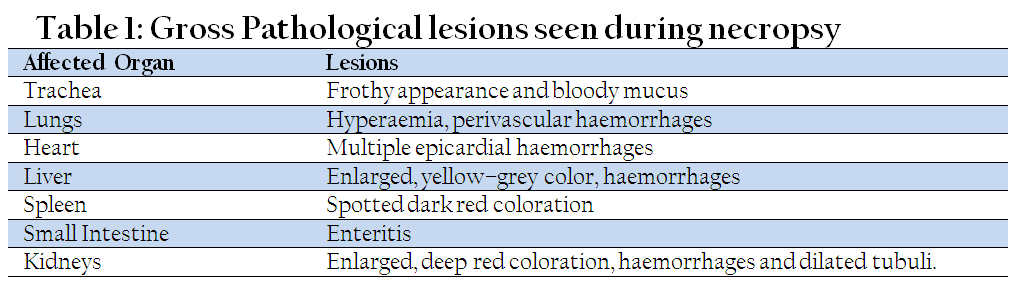
Both the legs of the rabbits were straight and head over neck, body coat was ruffled with sticky anus. The eyelids were swollen and evidence of lacrimation was also there. After general examination the rabbits were open for visceral organ examination. Trachea contained bloody mucus and frothy appearance. Lungs were hyperaemic. Heart showed many epicardial hemorrhages. Livers of both rabbits were enlarged and give yellow–grey coloration with hemorrhages. Gall bladders were filled with bile which was suggestive of anorexia and fever. Enteritis of small intestine was also observed. Both the kidneys showed yellowish red spotted dark brown coloration and enlargement. Urinary bladders were filled with bile which was suggestive of anorexia and fever. Enteritis of small intestine was also observed. Both the kidneys showed yellowish red spotted dark brown coloration and enlargement. Urinary bladders were filled with urine (Table 1).
The evidence of lacrimation on general appearance and yellow–grey coloration of liver, hemorrhages on liver and spotted dark coloration of kidneys is highly suggestive of Rabbit Hemorrhagic Disease (RHD) which is caused by a Rabbit hemorrhagic disease virus (RHDV) a member of genus Lagovirus from Calciviridaefamily.
RHDV outbreaks are still occurs on almost all continents which causes considerable mortalities in Rabbits. RHD endemic in most parts of Europe, Asia, and parts of Africa, Australia and New Zealand . This virus causes haemorrhages in different organs of the body and lead to death of the animal. For prevention and control active immunization showed less protection or short term protection from disease. While passive immunization in animals showing clinical signs is ineffective. Immunoprophylactic measures like vaccination and biosecurity are most important measures for prevention and control of the disease. The emergence of pathogenic form of RHDV is not clear yet and host parasite interaction between RHDV and European rabbits is still unknown. In order to understand the pathogenesis of the disease, efforts should be made for full genome sequence of non–pathogenic strains and sequence of pathogenic strains of RHDV .
CONFLICT OF INTEREST
Authors have no any conflict of interests
References
Alonso C, Oviedo JM, Martin–Alonso JM, Diaz E, Boga JA, Parra F (1998). Programmed cell death in the pathogenesis of rabbit hemorrhagic disease. Arch Virol, 143:321–332. http://dx.doi.org/10.1007/s007050050289 PMid:9541616[CrossRef]
Abrantes, W. Loo, JL, Pendu, PJ, (2012). Esteves Rabbit haemorrhagic disease (RHD) and rabbit haemorrhagic disease virus (RHDV): a review. Veterinary Research 2012 43:12. http://dx.doi.org/10.1186/1297-9716-43-12 PMid:22325049 PMCid:PMC3331820[CrossRef]
Anonymous (1989). Doençahemorrágica a vírus do Coelho em Portugal. Rev Port Ciênc Vet, 84:57–58, (in Portuguese).
An S–H, Kim B–H, Lee JB, Song JU, Park BK, Kwon YB, Jung JS, Lee YS (1988). Studies on Picornavirus hemorrhagic fever (tentative name) in rabbit. 1. Physico–chemical properties of the casuative virus. Res Rep Rural DevAdm, 30:55–61.
Argüello JL, Llanos A, Pérez LI (1988). Enfermedadhemorrágicadelconejo en Espa-a. Med Vet, 5:645–650, (in Spanish).
Asgari S, Hardy JR, Sinclair RG, Cooke BD (1998). Field evidence for mechanical transmission of rabbit haemorrhagic disease virus (RHDV) by flies (Diptera:Calliphoridae) among wild rabbits in Australia. Virus Res,54:123–132. http://dx.doi.org/10.1016/S0168-1702(98)00017-3[CrossRef]
Cancellotti FM, Renzi M (1991). Epidemiology and current situation of viral haemorrhagic disease of rabbits and the European brown hare syndrome in Italy. Rev Sci Tech, 10:409–422. PMid:1662099
Capucci L, Scicluna MT, Lavazza A (1991). Diagnosis of viral haemorrhagic disease of rabbits and the European brown hare syndrome. Rev Sci Tech, 10:347–370. PMid:1662098
Gregg DA, House C (1989). Necrotic hepatitis of rabbits in Mexico: a parvovirus. Vet Rec, 125:603–604. PMid:2558439
Gregg DA, House C, Meyer R, Berninger M (1991). Viral haemorrhagic disease of rabbits in Mexico: epidemiology and viral characterization. Rev Sci Tech, 10:435–451. PMid:1760584
Liu SJ, Xue HP, Pu BQ, Qian NH (1984). A new viral disease in rabbit. AnimHusb Vet Med, 16:253–255.
Marcato PS, Benazzi C, Vecchi G, Galeotti M, Della Salda L, Sarli G, Lucidi P (1991). Clinical and pathological features of viral haemorrhagic disease of rabbits and the European brown hare syndrome. Rev Sci Tech,10:371–392. PMid:1760582
Meyers G, Wirblich C, Thiel HJ (1991). Rabbit hemorrhagic disease virus– molecular cloning and nucleotide sequencing of a calicivirus genome. Virology, 184:664–676. http://dx.doi.org/10.1016/0042-6822(91)90436-F[CrossRef]
Morisse JP, Le Gall G, Boilletot E (1991). Hepatitis of viral origin in Leporidae: introduction and aetiological hypotheses. Rev Sci Tech, 10:283–295.
Moussa A, Chasey D, Lavazza A, Capucci L, Smid B, Meyers G, Rossi C, Thiel HJ, Vlasak R, Ronsholt L, NowotnyN, McCullough K, Gavier–Widen D (1992). Haemorrhagic disease of lagomorphs: evidence for a calicivirus. Vet Microbiol, 33:375–381. http://dx.doi.org/10.1016/0378-1135(92)90065-2[CrossRef]
Ohlinger VF, Haas B, Thiel HJ (1993). Rabbit hemorrhagic disease (RHD): characterization of the causative calicivirus. Vet Res, 24:103–116. PMid:8393721
Park NY, Chong CY, Kim JH, Cho SM, Cha YH, Jung BT, Kim DS, Yoon JB (1987) An outbreak of viral haemorrhagic pneumonia (tentative name) of rabbits in Korea. J Korean Vet Med Assoc, 23:603–610.
Park JH, Lee YS, Itakura C (1995). Pathogenesis of acute necrotic hepatitis in rabbit hemorrhagic disease. Lab AnimSci, 45:445–449. PMid:7474890
Patton NM (1989). Viral hemorrhagic disease. A major new disease problem of rabbits. Rabbit Res, 12:64–67.
Thouvenin E, Laurent S, Madelaine MF, Rasschaert D, Vautherot JF, Hewat EA (1997). Bivalent binding of a neutralising antibody to a calicivirus involves the torsional flexibility of the antibody hinge. J MolBiol, 270:238–246. http://dx.doi.org/10.1006/jmbi.1997.1095 PMid:9236125[CrossRef]
Valicek L, Smid B, Rodak L, Kudrna J (1990). Electron and immunoelectron microscopy of rabbit haemorrhagic disease virus (RHDV). Arch Virol, 112:271–275. http://dx.doi.org/10.1007/BF01323171 PMid:2198858[CrossRef]
Xu ZJ, Chen WX (1989). Viral haemorrhagic disease in rabbits: a review. Vet Res Commun, 13:205–212. http://dx.doi.org/10.1007/BF00142046 PMid:2551093[CrossRef]
Xu WY (1991). Viral haemorrhagic disease of rabbits in the People's Republic of China: epidemiology and virus characterisation. Rev Sci Tech, 10:393–408. PMid:1760583