
In total, more than 1.5 million fungal species exist in the world, amongst them pathogenic species can attack plants at different stages causing considerable damage amounting to millions of rupees. One of the plant pathogenic fungi is Fusarium spp. Fusarium species are very well-known soil-inhabiting fungi that cause many economically important diseases of crops.Many species are included in the Fusarium genus, which are not only pathogenic to plants but also cause different diseases in humans and livestock.Apart from diseases, one of the most dangerous characteristics of this fungus is the ability to produce dangerous secondary toxic metabolites, which are commonly known as mycotoxins. Some of the important toxins produced by different species of Fusarium are fumonisins and trichothecenes.Fusarium species are present around the world and have a very wide host range including many economically important species of crops and plants. Most of the plant diseases are caused by F. solani, F. oxysporum and F. graminearum. Fusarium species can infect grains in storage, but they are more prevalent in the field where they cause infection in crops and then may invade grains and cause infection in storage. Different methods including chemical, cultural, and biological control strategies are employed to control this fungus. In this review, mycotoxin production, characterization, identification, and different economically important diseases associated with Fusarium species as well as their control are discussed in detail.
Review · Volume 34, Issue 2, 7 April 2021 · Open Access
Fusarium spp. Mycotoxin Production, Diseases and their Management: An Overview
· ·
Affiliations & Notes ⌄
- 1Department of Bioscience, COMSATS University, Islamabad, 44000, Pakistan
- 2Social Sciences Research Institute (PARC), AARI, Jhang Road, Faisalabad, Pakistan
- 3Crop Diseases Research Institute, National Agricultural Research Centre, Park Road, Islamabad, 45500, Pakistan. , *Correspondence | Atif Jamal, Crop Diseases Research Institute, National Agricultural Research Centre, Park Road, Islamabad, 45500, Pakistan
- 4Email: atif75j@gmail.com
Article Info ⌄
- Journal:
- Pakistan Journal of Agricultural Research
- Published:
- 7 April 2021
From the article
- Fusarium is an important genus among fungi including different plant as well as human pathogenic species.
- They not only cause infection but are also responsible for different mycotoxins that are toxic for both animals and humans.
Selected from the article's own text.
Abstract
Introduction
Fusarium is an important and well-known genus known as imperfect fungi. This genus consists of important plant pathogenic filamentous fungi . Over 20 species are included in the genus Fusarium, out of which 14 are plant pathogenic . In these 14 species, Fusarium solani, Fusarium oxysporum and Fusarium chlamydosporum are the most common ones . Fusarium species are present around the world from tropical to temperate regions and even in harsh climates .The species of the genus Fusarium also produce different mycotoxins and secondary metabolites. Zearalenone and gibberellin are two important groups of metabolites that are used to enhance the growth of cattle and also as plant growth regulators respectively . Whereas, different mycotoxins like fumonisins and trichothecenes produced by Fusarium spp. can be fatal for animals and humans . If Fusarium contaminated food is consumed by animals and humans then it may cause mycotoxicosis in them . Fusarium spp. may also act as important biodegrading agents and it can sustain in the soil for up to 16 years without any host as well as in dead and decaying plant material . Fusarium species have a very broad host range. They cause economic losses in all cereal crops in North America and western Europe,cotton, wheat and barley in China, rice plants in Taiwan, Thailand and Japan, in all important crops in the tropics and worldwide in timber trees in the forest .
All species of Fusarium can produce different secondary metabolites whose functions are still unknown or not properly understood. These secondary metabolites are different toxins that cause virulence during the development of diseases in plants. When mycotoxin contaminated grains are consumed by humans and livestock it may cause great health impact . Symptoms produced by mycotoxins may vary depending upon the type as well as the concentration of mycotoxin . The mycotoxins produced by different Fusarium species are trichothecenes, fumonisins and zearalenone (Table 1). Trichothecenes are the mycotoxins produced by 24 different species of Fusarium. These 24 species that produce trichothecenes are Fusarium acuminatum, F. oxysporum, Fusarium avenaceum, F. poae, Fusarium camptoceras, F. proliferatum, F. chlamydosporium, F. sambucinum, F. compactum, F. scirpi, F. crookwellense, F. semitectum, F. culmorum, F. solani, F. equesiti, F. sporotrichioides, F. graminearum, F. subglutinans, F. moniliforme, F. tricinctum, F. nivale, F. tumidum, F. nygamai, F. venenatu ; ; ; . Zearalenone is the mycotoxins of Fusarium graminearum and some Fusarium sambucinum related species but they are not associated with the disease on wheat . Zearalenone is a beneficial mycotoxin as it is being used to increase the growth of cattle . Fumonisins mycotoxins are produced by the F. verticilloides and some other species of Fusarium like Fusarium moniliforme, F. proliferatum , Fusarium napiforme and Fusarium nygamai . They are related to ear rot in corn, but they are not needed for disease-causing in corn . Their adverse effects on the health of livestock as well as humans have been reported. They are very toxigenic for kidney and liver as well as they are also carcinogenic in nature . All the mycotoxins that are produced by different species of Fusarium and their effects are summarized in Table 1.
Control of mycotoxins produced by different Fusarium species
Mycotoxins produced by different fungal species can be detoxified by using chemicals, but it is not a commonly used method as crops subjected to these chemical treatments may become unsuitable for human consumption. However, different chemical treatments involved for the detoxification of mycotoxins are ammoniation, treatments with different acids, bases, oxidizing (e.g. ozone) or reducing (e.g. sodium bisulfite) agents and enzymatic degradation .
Awell-studied method of mycotoxin management through chemicals is the treatment of contaminated products with ammonia or ammonium hydroxide. In a study, the treatment of contaminated products with 2% ammonia caused reduction in fumonisinsup to 79% . Treatments with calcium or sodium hydroxide have shown remarkable detoxification in feeds contaminated by aflatoxins, T-2, zearalenone and diacetoxyscirpenol from 45% to 99% depending upon the nature of the toxin as well as feed moisture level ; . Sodium bisulfite treatments were proved to be effective against deoxynivalenol in only animal feed corn as well as treatments with ozone and chlorine gas were only effective in detoxification of different mycotoxins in corn but not wheat ; . Formaldehyde and ammonium hydroxide were proved to be effective in decontaminating zearalenone affecting corn and corn grits,but the products treated with formaldehyde are unstable for human consumption .
For the inactivation of mycotoxins through enzymatic treatments different products are commercially available which includes Mycofix, FUMzyme, Biomin BBSH 797, and Biomin MTV. Only a few enzymes have been discovered for the detoxification of fumonisins which includes esterases obtained from a yeast called Spinifera exophiala and amino transferase obtained from a bacterium Sphingomonas sp. Whereas, for the detoxification of different trichothecenes, UDP-glycosyltransferase was proved to be effective
Table 1: List of mycotoxins produced by Fusarium spp. along with compounds of mycotoxins, mycotoxins producing species and their effect on humans and animals.
| S. no | Name of mycotoxin | Compound of mycotoxin | Mycotoxin producing spp. | Effect of mycotoxin | Reference |
| 01. | Trichothecenes | Diacetoxyscirpenol | F. acuminatum, F. oxysporum, F. avenaceum, F. poae, F. camptoceras, F. proliferatum, F. chlamydosporium, F. sambucinum, F. compactum, F. scirpi, F. crookwellense, F. semitectum, F. culmorum, F. solani, F. equesiti, F. sporotrichioides, F. graminearum, F. subglutinans, F. moniliforme, F. tricinctum, F. nivale, F. tumidum, F. nygamai,F. venenatu | Chronic and fatal toxicosis in human and animals such as Alimentary toxic Aleukia, Akakabi-byo (red mold disease) and Swine feed refusal | ; ; ; |
| T-2 toxin | |||||
| Nivalenol | |||||
| Deoxynivalenol | |||||
| HT-2 toxin | |||||
| 02. | Fumonisins | Fumonisins B1 | F. verticillioides, F. proliferatum, F. napiforme, F. dlamini and F. nygamai | Leukoencephalomalacia in horses, esophageal cancer and birth defects in humans | ; |
| Fumonisins B2 | |||||
| Fumonisins B3 | |||||
| 03. | Zearalenone | - | F. gramineraum, F. culmorum, F. cerealis, F. equiseti, F. verticillioides and F. incarnatum | Estrogenic syndromes in swine and used to increase the growth of cattle | ; ; |
| 04. | Beauvercin and Enniatins | - | F. avenaceum, F. trincinctum, F. sporotrichioides, F. langsethiae, F. sambucinum, F. verticilliode, F. sporotrichioides, F. proliferatum and F. subglutinans | No effects | ; ; |
| 05. | Butenolide | - | F. graminearum | Fescue foot in cattle and toxicity in mice | |
| 06. | Equisetin | - | F. semitectum and F. equiseti | Toxic to mice, effect Human immunodeficiency virus and gram-positive bacteria | |
| 07. | Fusarins | - | F. verticilliodes and F. graminearum | Cause mutation | |
| 08. | Fusaproliferin | - | F. proliferatum and F. subglutinans | Cause toxicity in Artemia Salina, L,6,10 IARC/LCL 171 human B lymphocytes and SF-9 insect cells as well as it has pathogenic effects on embryos of chicken | |
| 09. | Moniliformin | - | F. avenaceum, F. tricinctum, F. proliferatum, F. subglutinans, and F. verticillioides | Cause interruption of gluconeogenesis and inhibit glutathione peroxidase and reductase | ; |
while for the degradation of zearalenone different enzymes including laccases were reported to be effective ; .
Biological detoxification of mycotoxins includes the use of different microorganisms or the use of different enzymes obtained from microorganisms. In some cases, there are reports of degraded products that are still toxic but, in some cases, there is the complete degradation of mycotoxins using mycotoxin-detoxifying microorganisms. Reduction in the level of deoxynivalenol up to 54%-56% has been seen in the feed when it is incubated with intestinal microflora of chickens . For the detoxification of each of the common mycotoxins, at least one specific microorganism has been discovered . Many microorganisms identified as mycotoxin degrading agents are bacteria especially Bacillus species.
The life cycle of Fusarium spp.
Fusarium spp. follow both asexual and sexual life cycles. During both sexual and asexual stages, mycelial structures that are haploid are being established. Few species of Fusarium produce sexual (meiotic) spores viz ascospores and three types of asexual (mitotic) spores viz. microconidia, macrocondia and chlamydospores that are produced from conidiophores, from sporodochium and within or on hyphae, respectively. Both stages produce spores that are airborne in nature and hence may cause infection and mycotoxin contamination in plants . The generalized life cycle of Fusarium spp. is depicted in Figure 1. Not all species of Fusarium produce all kinds of spores and the sexual cycle of only less than 20% of Fusarium spp. is known .
Sexual state of Fusarium spp.
Teleomorph, which is the sexual state, is known of few Fusarium species. All sexual states of known Fusarium species are part of Ascomycota but included in different genera viz. Genus Gibberella and Genus Nectria etc. The teleomorphic species of Fusarium can be both heterothallic and homothallic. During meiosis, the chromosomes of few of these species was seen under light microscope but due to the small chromosome size of Fusarium species, the accurate number of chromosomes or karyotyping is not determined therefore, for this purpose pulsed field gel electrophoresis (PFGE) has been used . All the known perfect states of Fusarium species are given in Table 2.
Morphological and microscopic characteristic of Fusarium spp.
Fusarium spp. can grow on many media. When different Fusarium spp. are grown on potato dextrose agar, they may show white, lavender, pink, salmon, or gray-colored velvety to fuzzy cottony growth. Hyphae of Fusarium species is hyaline and septate, and it varies from 3 to 8μm in diameter. The species of Fusarium produce both macro as well as microconidia. Macroconidia produced by different Fusarium species are hyaline, multicellular, septate, and sickle-shaped which may appear in form of clusters while the microconidia are hyaline, unicellular, and ovoid to straight or slightly curved in shape. Sometimes chlamydoconidium are also produced by Fusarium species which may present as a single spore or in the shape of clusters or chains ; .
Molecular identification of Fusarium spp.
Different molecular techniques which include Random Amplified Polymorphic DNA (RAPD) analysis, specific diagnostic PCR primers and DNA sequencing are being used to identify Fusarium species. The polymerase chain reaction (PCR) is considered
Table 2: Asexual state of Fusarium species with their known sexual state.
| S. No | Asexual state of Fusarium species (Anamorph) | Sexual/Perfect state of Fusarium species (Teleomorph) | Reference |
| 01. | Fusarium graminearum | Gibberellazeae | |
| 02. | Fusarium moniliforme | Gibberellafujikuroi | |
| 03. | Fusarium solani | Nectriahaematococca | |
| 04. | Fusarium roseum var. avenaceum | Gibberellaavenacea | |
| 05. | Fusarium tumidum | Gibberellatumida | |
| 06. | Fusarium sacchari | Gibberellasacchari | |
| 07. | Fusarium sambucinum | Gibberellapulicaris | |
| 08. | Fusarium verticillioides | Gibberella moniliformis | |
| 09. | Fusarium acuminatum | Gibberella acuminata | |
| 10. | Fusarium Lateritium | GibberellaBaccata | |
| 11. | Fusarium circinatum, | Gibberellacircinata | |
| 12. | Fusarium pseudograminearum | Gibberellacoronicola | |
| 13. | Fusarium heterosporum | Gibberellagordonii | |
| 14. | Fusarium udum | Gibberella indica | |
| 15. | Fusarium gibbosum | Gibberellaintricans | |
| 16. | Fusarium proliferatum | Gibberella intermedia | |
| 17. | Fusarium xylarioides | Gibberellaxylarioides |
Table 3: Molecular identification of Fusarium spp. using specific primer sets.
| S. no | Prim ers | Fusarium spp. | Amplification (size bp) | Sequence | Reference |
| 01. | ITS 1 and ITS4 | Universal fungal primers | 550-570 bp | ITS1(5′TCC GTA GGT GAA CCT GCG G 3′) ITS4 (5′TCC TCC GCT TAT TGA TAT GC 3′) | ; |
| 02. | ITS- Fu-f & ITS-Fu-r | F. oxysporum f. sp. Vasin fectum, F. oxysporum, F. moniliforme, F. solani | 398 bp | ITS-Fu-f(5`-CAACTCCCA AACCCCTGTGA-3`) ITS-Fu-r(5`-GCGACGATT ACCAGTAACGA-3`) | |
| 03. | ITS5 & as7 | F. proliferatum, F. verticellioides, F. subglutinans, F. nygamai, F. oxysporum, F. compactum, F. sporotrichioides, F. tricinctum, F. graminearum, F. poae, F. camptoceras, F. culmorum, F. pseudonygamai, F. avenaceum, F. thapsinum, F. acuminatum, F. babinda, F. chlamy dosporum, F. dlamini, F. heterosporum, F.cf. langsethiae, F. pseudogr aminearum and F. xylarioides | 930 bp | ITS5(5'GGAAGTAAAAGT CGTAACAAGG3’) as 7 (5'CTTCCCTTTCAACAATTTC AC3') | |
| 04. | Fg16F & Fg16R | Fusarium gramineraum | 420-520 bp | Fg16F(CTCCGGATATGT TGCGTCAA) Fg16R(GGTAGGTATCCG ACATGGCAA) | |
| 05. | OPT 18F & OPT 18R | F. culmorum | 470 bp | OPT18F (F-GAT GCC AGA CCA AGA CGA R-AG) OPT18R (GAT GCC AGA CGC ACT AAG AT) | |
| 06. | FAC-F & FAC-R | F. acuminatum | 600 bp | FAC-F (GGG ATA TCG GGC CTC A) FAC-R (GGG ATA TCG GC A AGA TCG) | |
| 07. | FEF & FER | F. equiseti | 400 bp | FEF (CAT ACC TAT ACG T TG CCT CG) FER (TTA CCA GTA ACG A GG TGT ATG) | |
| 08 | Fp82F & Fp82R | F. poae | 220 bp | Fp 82F(CAAGCAAACAGG CTCTTCACC) Fp 82R(TGTTCCACCTCAG TGACAGGT) | |
| 09. | SUBF & SUBR | F. subglutinans | 630 bp | SUBF(CTGTCGCTAACCTC TTTATCCA) SUBR(CAGTATGGACGTTG GTATTATATCT) | |
| 10. | VERF & VERR | F. proliferatum | 420 bp | VERF(TGTCAGTAACTCGA CGTTGTTG) VERR (CTTCCTGCGATGTTTCTCC) |
as the most reliable and rapid technique for the identification of different Fusarium species . Different primer sets have been designed for the identification of Fusarium species (Table 3).
Pathogenicity factors of Fusarium spp.
Fusarium spp. uses different cellular signaling pathways and different toxins or enzymes which may include MAPKs, Ras proteins, G-proteins, Velvet complex, cAMP pathways and cell wall degrading enzymes to enter their hosts and cause infection. These pathogenicity factors maybe generally produced by different species of Fusarium or they may be host-specific .
Diseases caused by Fusarium spp.
Species of Fusarium cause many diseases like root rots, seedling blight (Bakker et al., 2016), vascular wilts , infection in reproductive tissues as well as in developing seeds and diseases in storage . The Fusarium species have a wide host range. They can cause diseases in different cereal crops like maize, rice, wheat, barley, rye, oat and malt, etc. as well as in other vegetables and fruit crops like melons, pepper, potato, tomatoes and banana, etc. . Most of the plant diseases are caused by Fusarium solani (50%) and by Fusarium oxysporum (20%) . A comprehensive table has been made which shows all the diseases caused by Fusarium spp. in different plants (Table 4).
Disease symptoms
Fusarium spp. produces different types of symptoms on hosts. Some of the common symptoms produced by this fungus are described below.
Vascular wilt diseases
Wilt diseases are mostly caused by different species of Fusarium. Mostly all wilts show common symptoms like the infected parts of the plant lose their turgidity, their color changes to light green or yellowish green then to brown and they wilt and finally die. Wilting is due to the blockage in xylem tissue of plants by the spores, mycelium, or polysaccharides of fungus which results in the less flow of water in tissues of plants. The fungus also produces different mycotoxins like fusaric acid and lycomarasmin in vessels that flow from vessels to the leaves. In leaves, they affect the process of photosynthesis by reducing the production of chlorophyll .
Rot diseases
Rots may affect the roots, foot, or stem of plants. Rots maybe caused by one or more than one pathogen . The plant parts which are rotted may seem like water soaked and the color of the infected area turn brownish and finally black. Plant stops growing and roots, as well as stems, die due to rotting . In the case of cereals, the rotting of the stalk happens which results in the
Table 4: List of diseases caused by Fusarium spp. on different hosts.
| S. no | Pathogen spp. | Disease caused | Host | Reference |
| 01. | Fusarium sacchari | Sugarcane wilt | Sugarcane | |
| 02. | Fusarium moniliforme | Pokkah Boeng | Sugarcane | |
| 03. | Fusarium fujikuroi | Bakane | Rice | |
| 04. | Fusarium decemcellulare | Green point gall | Cacao | |
| 05. | Fusarium manginifera | Flowering malformation | Mango | |
| 06. | Fusarium oxysporumf.sp. elaeidis | Fusarium wilt | Oil palm | |
| 07. | Fusarium oxysporum f. sp. Lycopersici | Fusarium wilt | Tomato | |
| 08. | Fusarium oxysporum f. sp. Cubense | Panama disease | Banana | |
| Fusarium wilt | Abaca | |||
| 09. | Fusarium pallidoroseum | Crown rot | Banana | |
| 10. | Fusarium graminearum | Fusarium head blight | Wheat, Corn, Barley | |
| 11. | Fusarium solani | Papaya internal fruit rot | Papaya | |
| Root rot | Cassava | |||
| Canker | Passion fruit | |||
| Slow decline | Pepper | |||
| 12. | Fusarium oxysporum f. sp. Ciceris | Fusarium Wilt | Chickpea | |
| 13. | Fusarium moniliforme | Fusarium ear rot of corn | Corn | |
| 14. | Fusarium decemcellulare | Dieback of mango | Mango | |
| 15. | Fusarium oxysporum f. sp. Angsanae | Wilt | Angsana | |
| 16. | Fusarium xylarioides | Wilt | Coffee | |
| 17. | Fusarium oxysporum f. sp. Vasinfectum | Fusarium wilt | Cotton | |
| 18. | Fusarium oxysporum f. sp. Passiflorae | Fusarium wilt | Passion fruit | |
| 19. | Fusarium circinatum | Pitch canker | Pine | |
| 20. | Fusarium guttiforme | Fusariosis | Pineapple | |
| 21. | Fusarium oxysporum f. sp. Rosellae | Fusarium wilt | Rosella | |
| 22. | Fusarium oxysporum f. sp. Vanilla | Stem and root rot | Vanilla | |
| 23. | Fusarium solani f. sp. Eumartii | Foot rot | Tomato, Potato, eggplant & pepper | |
| 24. | Fusarium oxysporum f. sp. phaseoli | Fusarium wilt or yellows | Beans |
softening of internodes and change of outer color into brown while the inner color changes into pink or reddish. Roots are also affected which results in the discoloration of leaves, breaking of the stalk and premature death while in case of maize ear rot, pink or red mould may appear on ears. In early infection by ear rot, complete rotting of ears happens which leads to the development of pinkish mould between ears and husk .
Seedling blight diseases
The blight of seedlings mostly caused on corn and small grains as dark brown lesions that resemble brown rot and blight in both at pre- and post-emergence stage. The seedings may not develop properly, chlorosis will occur which finally results in the death of seedling .
Head blight or Scab diseases
Scab appears on spikelet as water-soaked lesions which later decolorize. During warm and humid conditions, the head fully gets infected through mycelia and conidia and the kernels get dry and shriveled. Mycelium of fungus overgrows and appears as white, pink, or brown growth on infected kernels .
Dry rot diseases
Dry rot may infect bulbs, corms, and tubers on both pre- and post-harvest stages. The most common hosts of dry rot diseases are onion, lily, gladiolus, and potatoes. The injuries caused during harvesting are the main way of pathogen invasion. Brown colored small lesions will form on tubers which increase in size and later wrinkles will form. Tubers become hard and mummified .
Management of diseases caused by Fusarium species
cultural control
Cultural control practices help to reduce the primary inoculum which is responsible for the development of secondary infection. Diseases in plants caused by Fusarium spp. can be controlled by achieving low plant density, using proper phosphate, potassium, and nitrogen fertilizers, and using resistant varieties of plants. Rotation of crops, tillage and proper seedbed preparation can also reduce the primary inoculum present in crop residues. The first-ever method used to control the plant diseases was crop rotation . But it is not useful in the case of Fusarium spp. which are not specialized because they have a wide host range . Losses caused by Fusarium spp. can be decreased by crop rotation with resistant or non-host crops, attaining suitable soil drainage and by using healthy and treated stock . Disease development can also be controlled by changing the date of sowing because it is affiliated with the epidemic development. Crops like chickpea have been sown in southern Spain in early winters instead of early springs which helped in slowing the epidemics of Fusarium wilt which resulted in less disease development . Sowing the crops in early winter instead of early spring resulted in more soil moisture and less temperature which are not favorable for Fusarium wilt thus it affects the disease development . Primary inoculum of Fusarium can also be decreased by flooding fields for a large period or dry fallowing because it results in a low oxygen level which is not favorable for pathogen development . Infection of Fusarium in seeds can be controlled by decreasing the temperature and moisture in storage for several months because it decreases the activity of Fusarium graminearum in grains . By achieving the temperature below 10oC, growth and mycotoxin production can be lowered in F.graminearum, F. moniliforme and F. proliferatum ; . Food preservatives like sorbic acid, acetic acid, formic acid and propionic acid, etc. can be used to decrease the mycelial growth and production of spores and mycotoxins by different Fusarium spp. like F. proliferatum and F. oxysporum in food.
Chemical control
The use of chemical control strategies such as fungicide seed treatment and the application of fungicides on crops along with cultural control strategies can be effective to control diseases. Studies have been done to check the effect of treatments on seeds which helped in better understanding of different chemical treatment effects on viability, germination, emergence and vigor of seeds as well as the weight of roots ; . Rots caused by Fusarium spp. can be controlled by applying benomyl sprays on plants or by treating propagative plant materials with benomyl. Benzimidazoles and Benomyl works very well against the infections caused by Fusarium species. Benzimidazoles are very effective against the F. avenaceum, F. culmorum, F. equiseti and F. solani, but it is not effective against the F. sambucinum which causes tubers in potatoes because it is highly resistant to benzimidazole and its derivatives . While prochloraz and tebuconazole are effective against F. culmorum and F. poae which are the causal agents of ear blight on wheat . In storage conditions, diseases on crops can be managed by applying fungicides at the post-harvest stage. For example, a pathogen causing dry rot of potato tubers only enters its host through physical injuries. After it enters its host, it develops inside the host and causes infection but its development inside the host can be controlled by treating the potatoes with thiabendazole at the post-harvest stage . When plants are treated with benzimidazole then on the surface of plants they convert into methyl benzimidazole carbamate (MBC, carbendazim) which acts as a systemic fungicide and are fungistatic in nature . Organomercury fungicides act both as eradicants and protectants and they are used to control Fusarium diseases in cereal grains ; . In China, bakanae disease of rice has been successfully managed by treating seeds with formalin and organic mercury (Cook, 1967). But formalin and organic mercury-based fungicides have toxic effects on plants. Another safe method to control Fusarium diseases is by treating the soil with fumigants like methyl bromide before the sowing of crops. This fumigant enters in the pores of soil, spread thoroughly and has no toxic effect . Soil is treated with both volatile fumigant methyl bromide and insecticide chloropicrin together. Metalaxyl, diazoben, pentachloronitrobenzene (PCNB), ethazol, captan and chloroneb are the most common organic fungicides which are used to treat the soil. They are more effective, safe but are expensive than sulfur-based and copper-based fungicides. Captan which act as a protectant, reacts with sulfhydryl groups and stops the activity of enzyme which contains thiol . Many Fusarium spp. develop resistance against fungicides and fungicide may not remain effective against those isolates which will ultimately increase the diseases caused by Fusarium . Therefore, along with chemical control we must use other control measures like use of proper cultivation techniques, proper treatment of seeds and usage of clean and healthy seed and propagating stock etc. .
Biological control
Fusarium against Fusarium: Some species of pathogens contain virulent, avirulent or hypovirulent strains. These two avirulent or hypovirulent strains can be used against the virulent strain. These virulent or hypovirulent strains can protect the crop against its virulent strain . The avirulent strains increase the resistance of host plants against its pathogen by competing with the virulent strains. Some strains of Fusarium also produce anti-fungal compounds like alpha-pyrones produced by F. semitectum which play an important role in the protection of plants . For example, Wilts caused by Fusarium oxysporum in different crops was managed by using avirulent strains of the same fungus .
Fungi against Fusarium: Mycorrhizal association with the roots have successfully managed the disease caused by F. oxysporum in Douhla fire seedlings and F. solani in soybean same as in the case of ectomycorrhizal and endomycorrhizal associations which increases the plant health resulted in less development of pathogens like F. oxysporum, F. solani, F. culmorum and F. graminearum in their respective hosts . The Trichoderma is also one of the successful bio-control agents of Fusarium. It affects the growth of Fusarium by causing parasitism . Trichoderma spp. effects and degrade the chitin which is the main constituent of the cell wall of fungus . Trichoderma viridae successfully controlled the diseases caused by F. moniliforme as well as reduced its mycotoxin production by 85% . F. oxysporum f. sp. lycopersici which causes wilt was controlled in tomatoes by 30% using Penicillium purpurogenum as a bio-control agent .
Bacteria against Fusarium: Rots and damping-off diseases caused by Fusarium have been successfully managed by using Bacillus cereus which is a soil-borne bacteria whereas, Pseudomonads are being successfully used against F. oxysporum because they produced antibiotics such as N-butylbenzene sulfonamide which inhibits the activity of F. oxysporum . Pseudomonads especially P. fluorescens and P. putida are abundantly present in soil rhizosphere. They make soil suppressive against the wilts causing Fusarium by producing siderophores . P. putida promotes the production of phenolic compounds in cucumber which are antifungal in nature. This helps in the increase of resistance against the pathogen . The health of potato plants has been increased by the induction of Pseudomonas which promotes siderophores that are hydroxamate type which resulted in the production of hydrocyanic acid and indole acetic acid . Salicylic acid is an important signaling molecule in plant defense systems which plays an important role in the induction of resistant mechanisms in plants . If the activation of salicylic acid is affected, then it increases the susceptibility level of the host against its pathogens . Rhizobacteria increase the plant health by inducing ISR in plants through the production of compounds like indole-3-acetic acid and cytokinin along with the reduction of ethylene .
Mycoviruses against Fusarium: Studies have shown that mycoviruses cause a reduction in the virulence of fungi known as hypovirulence therefore they can be used as bio-control agents . Different mycoviruses have been discovered from different Fusarium species. Fusarium graminearum virus 1 (FgV1)/ Fusarium graminearum virus DK21 (FgV-DK21), Fusarium graminearum virus 2 (FgV2), Fusarium graminearum virus China 9 (FgV-ch9), Fusarium graminearum hypovirus 1 (FgHV1), Fusarium graminearum hypovirus 2 (FgHV2)and Fusarium graminearum mycotymovirus 1 (FgMTV1) have been discovered from different isolates of Fusarium graminearum and they affect them by causing hypovirulence, less mycotoxin production, altered growth and irregular morphology , 2004; ; , 2015; ; same as in case of Fusarium boothi large flexivirus 1 (FbLFV1), Fusarium virguliforme virus 1, Fusarium virguliforme virus 2 (FvV1 and FvV2), Fusarium circinatum mitovirus 1, Fusarium circinatum mitovirus 2-1 and Fusarium circinatum mitovirus 2-2 (FcMV1, FcMV2-1 and FcMV2-2) having same effects on Fusarium boothi, Fusarium virguliforme and Fusarium circinatum respectively ; ; .
Conclusions and Recommendations
Fusarium is an important genus among fungi including different plant as well as human pathogenic species. They not only cause infection but are also responsible for different mycotoxins that are toxic for both animals and humans. There is a dire need to control this menace so that losses can be minimized and to this end different control strategies can be employed to manage and control this fungus.
Novelty Statement
An up to date comprehensive review about Fusarium spp. For the first time in this review, mycotoxins and diseases caused by Fusarium spp. are discussed. All the possible control strategies for controlling this pathogen are discussed with special reference to biological control, an environmentally safe method. All the information is tabulated for the ease of students and researchers.
Author’s Contribution
Saba Shabeer: Data collection, draft-ing the article, revision of the article.
Riffat Tahira: Revision of the article.
Atif Jamal: Conception of the work, revision of the article and final approval.
Conflict of interest
The authors have declared no conflict of interest.
Figures
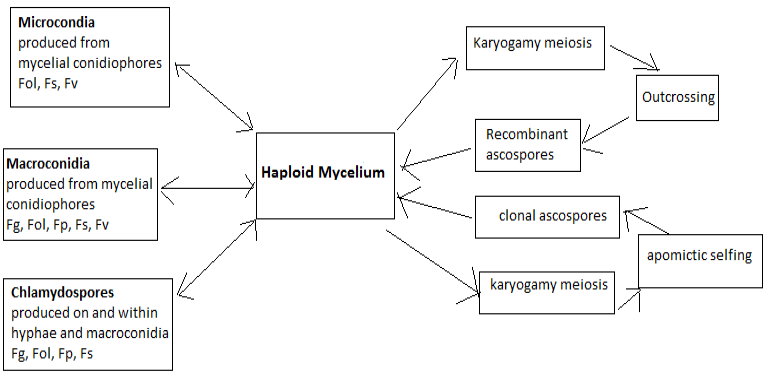
The General life cycle of Fusarium spp. plasmogamy and karyogamy results in the production of recombinant and clonal meiotic (sexual) spores in the outcrossed and selfed perithecium which in turn forms haploid mycelium. This haploid mycelium can produce three different types of spores that are mitotic in nature viz: micro and macro conidia which can colonize the host and chlamydospores which overwinters and whenever the conditions are favorable, they develop into perithecium and again starts the cycle. Abbreviations: Fg, Fol, Fusarium oxysporum f. sp. lycopersici; Fp, Fusarium pseudograminearum; Fs, Fusarium solani f. sp. pisi; Fv, Fusarium verticillioides(redrawn from Dweba et al., 2017; Ma et al., 2013).
References
- Abd-Elsalam, K.A., I.N. Aly, M.A. Abdel-Satar, M.S. Khalil and J.A. Verreet. 2003. PCR identification of Fusarium genus based on nuclear ribosomal-DNA sequence data. Afr. J. Biotechnol., 4: 82-88. https://doi.org/10.5897/AJB2003.000-1016[CrossRef]
- Afanide, B., S.A. Mabadeje and S.H.Z. Naqvi. 1976. Gibberella baccata, the perfect state of Fusarium lateritium in Nigeria. Mycologia, 5: 1108-1111. https://doi.org/10.1080/00275514.1976.12019994[CrossRef]
- Agrios, G.N., 1997. Plant pathology, 4th edition, Academic Press, San Diego, CA.
- Alabouvette, C., B. Schippers, P. Lemanceau and P.A.H.M. Bakker. 1998. Biological control of Fusarium wilts. In: Plant-microbe interactions and biological control. G.J. Boland and L.D. Kuykendall (eds.). Marcel Dekker Inc., New York. pp. 15-36.
- Alvarez, A.M. and W.T. Nishijima. 1987. Postharvest diseases of papaya. Plant Dis., 8: 681-686. https://doi.org/10.1094/PD-71-0681[CrossRef]
- Aoki, T. and K. O’Donnell. 1999. Morphological characterization of Gibberellacoronicola sp. nov., obtained through mating experiments of Fusarium pseudograminearum. Mycoscience, 6: 443-453. https://doi.org/10.1007/BF02461021[CrossRef]
- Bakker, M.G., D.W. Brown, A.C. Kelly, H.S. Kim, C.P. Kurtzman, S.P. Mccormick, K.L. O’Donnell, R.H. Proctor, M.M. Vaughan and T.J. Ward. 2018. Fusarium mycotoxins: A trans-disciplinary overview. Can. J. Plant Pathol., 2: 161-171. https://doi.org/10.1080/07060661.2018.1433720[CrossRef]
- Bandyopadhyay, R., M. Mwangi, S.O. Aigbe and J.F. Leslie. 2006. Fusarium species from the cassava root rot complex in West Africa. Phytopathology, 6: 673-676. https://doi.org/10.1094/PHYTO-96-0673[CrossRef]
- Ben Yephet, Y., N. Dudai, C. Chaimovitsh and D. Havkin-Frenkel. 2003. Control of vanilla root rot disease caused by Fusarium. Abstract of poster presented at first international congress on the future of the vanilla business, vanilla.
- Bennett, J.W. and M. Klich. 2003. Mycotoxins. Clin. Microbiol. Rev., 16: 497-516. https://doi.org/10.1128/CMR.16.3.497-516.2003[CrossRef]
- Ben-Yephet, Y., M. Reuven, Y. Szmulewich and Y. Mor. 1994. Effect of methyl bromide on the control of Fusariumoxysporum f. sp. dianthi propagules in carnation greenhouse soil and on inoculum increase after one growth cycle of carnation. Crop Prot., 5: 357-361. https://doi.org/10.1016/0261-2194(94)90050-7[CrossRef]
- Broadhurst, P.G. and P.R. Johnston. 1994. Gibberellatumida sp. nov. teleomorph of Fusarium tumidum from gorse in New Zealand. Mycol. Res., 7: 729-732. https://doi.org/10.1016/S0953-7562(09)81045-9[CrossRef]
- Buchenauer, H., 1998. Biological control of soil-borne diseases by rhizobacteria/ Biologische Bekämpfung vonbodenbürtigen Krankheitendurch Rhizobakterien. Zeitschriftfür P flanzenkrankheitenund P flanzenschut. J. Plant Dis. Prot., pp. 329-348.
- Bullerman, L.B., 2003. Spoilage, Fungi in food.An overview. pp. 5511-5522. https://doi.org/10.1016/B0-12-227055-X/01129-9[CrossRef]
- Bullerman, L.B., 2007. Fusaria and toxigenic molds other than aspergilli and penicillia. In: Food microbiology: Fundamentals and frontiers, 3rd Edition. Am. Soc. Microbial., Washington, DC. pp. 563-578. https://doi.org/10.1128/9781555815912.ch26[CrossRef]
- Chang, Y.C. and S.K. Sun. 1975. The perfect stage of Fusarium moniliforme. J. Agric. Res. China, 24: 11-19.
- Charmley, L.L. and D.B. Prelusky. 1994. Decontamination of Fusarium mycotoxins. In: Mycotoxins in grain: Compounds other than aflatoxin., 421-435.
- Chen, L.Y., X.L. Tian and B. Yang. 1990. A study on the inhibition of rat myocardium glutathione peroxidase and glutathione reductase by moniliformin. Mycopathologia, 2: 119-124. https://doi.org/10.1007/BF00447001[CrossRef]
- Chu, Y.M., J.J. Jeon, S.J. Yea, Y.H. Kim, S.H. Yun, Y.W. Lee and K.H. Kim. 2002. Double-stranded RNA mycovirus from Fusarium graminearum. Appl. Environ. Microbiol., 5: 2529-2534. https://doi.org/10.1128/AEM.68.5.2529-2534.2002[CrossRef]
- Chu, Y.M., W.S. Lim, S.J. Yea, J.D. Cho, Y.W. Lee and K.H. Kim. 2004. Complexity of dsRNA mycovirus isolated from Fusarium graminearum. Virus genes, 1: 135-143. https://doi.org/10.1023/B:VIRU.0000012270.67302.35[CrossRef]
- Cook, R.J., 1967. Gibberellaavenacea sp. n., perfect stage of Fusarium roseum f. sp. Cerealis Avenaceum. Phytopathology, 7: 732-736.
- Crowhurst, R.N., F.Y. King, B.T. Hawthorne, F.R. Sanderson and Y. Choi-Pheng. 1995. RAPD characterization of Fusarium oxysporum associated with wilt of angsana (Pterocarpus indicus) in Singapore. Mycol. Res., 1: 14-18. https://doi.org/10.1016/S0953-7562(09)80310-9[CrossRef]
- Darissa, O., G. Adam and W. Schäfer. 2012. A dsRNA mycovirus causes hypovirulence of Fusarium graminearum to wheat and maize. Eur. J. Plant Pathol., 1: 181-189. https://doi.org/10.1007/s10658-012-9977-5[CrossRef]
- Davis, R., F. Kegel, W. Sills and J. Farrai. 1989. Fusarium ear rot of corn. California Agric., 6: 4-5.
- De Hoog, G.S., J. Guarro, J. Gene and M.J. Figueras. 2000. Atlas of clinical fungi. Centraalbureauvoor Schimmelcultures, Utrecht, The Netherlands, pp. 276-282.
- de Vega-Bartol, J.J., R. Martín-Dominguez, B. Ramos, M.A. García-Sánchez and J.M. Díaz-Mínguez. 2011. New virulence groups in Fusarium oxysporum f. sp. phaseoli: the expression of the gene coding for the transcription factor ftf1 correlates with virulence. Phytopathology, 4: 470-479. https://doi.org/10.1094/PHYTO-09-10-0252[CrossRef]
- Delaney, T.P., S. Uknes, B. Vernooij, L. Friedrich, K. Weymann, D. Negrotto, T. Gaffney, M. Gut-Rella, H. Kessmann, E. Ward and J. Ryals. 1994. A central role of salicylic acid in plant disease resistance. Science, 5188: 1247-1250. https://doi.org/10.1126/science.266.5188.1247[CrossRef]
- Desjardins, A.E. and R.D. Plattner. 2000. Fumonisin B1-nonproducing strains of Fusarium verticillioides cause maize (Zea mays) ear infection and ear rot. J. Agric. Food Chem., 11: 5773-5780. https://doi.org/10.1021/jf000619k[CrossRef]
- Desjardins, A.E., 2006. Fusarium mycotoxins: chemistry, genetics, and biology. Am. Phytopathol. Soc. (APS Press), USA.
- Dita, M.A., P.V.I. Luis and M.D.L.P. Einar. 2014. Technical Manual Prevention and diagnostic of Fusarium Wilt (Panama disease) of banana caused by Fusarium oxysporum f. sp. Cubense. Trop. Race, 4 (TR4).
- Doohan, F.M., D.W. Parry and P. Nicholson. 1999. Fusarium ear blight of wheat: the use of quantitative PCR and visual disease assessment in studies of disease control. Plant Patho., United Kingdom. Available at: http://agris.fao.org/agris-search/search.do?recordID=GB1999007777, https://doi.org/10.1046/j.1365-3059.1999.00342.x[CrossRef]
- Dutkiewicz, J., B. Mackiewicz, M.K. Lemieszek, M. Golec and J. Milanowski. 2016. Pantoeaagglomerans: A mysterious bacterium of evil and good. Part IV. Beneficial effects. Annals of Agricultural and Environmental Medicine. https://doi.org/10.5604/12321966.1203879[CrossRef]
- Dweba, C.C., S. Figlan, H.A. Shimelis, T.E. Motaung, S. Sydenham, L. Mwadzingeni and T.J. Tsilo. 2017. Fusarium head blight of wheat: Pathogenesis and control strategies. Crop Prot., 91: 114-122. https://doi.org/10.1016/j.cropro.2016.10.002[CrossRef]
- Early, R., 2009. Pathogen control in primary production: crop foods. In: Foodborne Pathogens. 2nd Edition, Woodhead Publishing, UK. pp. 205-279. https://doi.org/10.1533/9781845696337.1.205[CrossRef]
- Elmer, W.H., 1996. Fusarium fruit rot of pumpkin in Connecticut. Plant Dis., 2: 131-135. https://doi.org/10.1094/PD-80-0131[CrossRef]
- Evidente, A., C. Amalfitano, R. Pengue and C. Altomare. 1999. High performance liquid chromatography for the analysis of fusapyrone and deoxyfusapyrone, two antifungal α‐pyrones from Fusarium semitectum. Natl. Toxins, 4: 133-137. https://doi.org/10.1002/(SICI)1522-7189(199907/08)7:4<133::AID-NT60>3.0.CO;2-I[CrossRef]
- Ferrer, C., F. Colom, S. Frasés, E. Mulet, J.L. Abad and J.L. Alió. 2001. Detection and identification of fungal pathogens by PCR and by ITS2 and 5.8 S ribosomal DNA typing in ocular infections. J. Clin. Microbiol., 8: 2873-2879. https://doi.org/10.1128/JCM.39.8.2873-2879.2001[CrossRef]
- Flood, J., 2006. A review of Fusarium wilt of oil palm caused by Fusarium oxysporum f. sp. elaeidis. Phytopathology, 6: 660-662. https://doi.org/10.1094/PHYTO-96-0660[CrossRef]
- Fravel, D.R. and C.A. Engelkes,1994. Biological management. In: Epidemiology and management of root diseases. Springer, Berlin, Heidelberg. pp. 293-308. https://doi.org/10.1007/978-3-642-85063-9_10[CrossRef]
- Gachango, E., L.E. Hanson, A. Rojas, J.J. Hao and W.W. Kirk. 2012. Fusarium spp. causing dry rot of seed potato tubers in Michigan and their sensitivity to fungicides. Plant Dis., 12: 1767-1774. https://doi.org/10.1094/PDIS-11-11-0932-RE[CrossRef]
- Geiser, D.M., M.L. Ivey, G. Hakiza, J.H. Juba and S.A. Miller. 2005. Gibberellaxylarioides (anamorph: Fusarium xylarioides), a causative agent of coffee wilt disease in Africa, is a previously unrecognized member of the G. fujikuroi species complex. Mycologia, 1: 191-201. https://doi.org/10.3852/mycologia.97.1.191[CrossRef]
- Gilbert, J. and A. Tekauz. 1995. Effects of fusarium head blight and seed treatment on germination, emergence, and seedling vigour of spring wheat. Can. J. Plant Pathol., 3: 252-259. https://doi.org/10.1080/07060669509500687[CrossRef]
- Gilbert, J., A. Tekauz and S.M. Woods. 1997. Effect of storage on viability of Fusarium head blight-affected spring wheat seed. Plant Dis., 81: 159-162. https://doi.org/10.1094/PDIS.1997.81.2.159[CrossRef]
- Gordon, T.R., 2006. Pitch canker disease of pines. Phytopathology, 6: 657-659. https://doi.org/10.1094/PHYTO-96-0657[CrossRef]
- Gordon, T.R., S.C. Kirkpatrick, B.J. Aegerter, D.L. Wood and A.J. Storer. 2006. Susceptibility of Douglas fir (Pseudotsugamenziesii) to pitch canker, caused by Gibberellacircinata (anamorph= Fusarium circinatum). Plant Pathol., 2: 231-237. https://doi.org/10.1111/j.1365-3059.2006.01351.x[CrossRef]
- Gupta, C.P., A. Sharma, R.C. Dubey and D.K. Maheshwari. 1999. Pseudomonas aeruginosa (GRC~ 1) as a strong antagonist of Macrophominaphaseolina and Fusarium oxysporum. Cytobios-Cambridge, pp. 183-189.
- Häni, F., 1981. ZurBiologie und Bekämpfung von FusariosenbeiWeizen und Roggen. J. Phytopathol., 1: 44-87. https://doi.org/10.1111/j.1439-0434.1981.tb03289.x[CrossRef]
- Hansen, A.J., 1966. Fusaria as agents of cacao green point cushion gall in the Caribbean and in Latin America. Plant Dis. Rep., 50: 229-233.
- Holliday, P., 1980. Fungus diseases of tropical crops cambridge. pp. 147.
- Jurgenson, J.E., K.A. Zeller and J.F. Leslie. 2002. Expanded genetic map of Gibberella moniliformis (Fusarium verticillioides). Appl. Environ. Microbiol., 4: 1972-1979. https://doi.org/10.1128/AEM.68.4.1972-1979.2002[CrossRef]
- Kachuei, R., M.H. Yadegari, N. Safaie, A. Ghiasian, F. Noorbakhsh, V. Piranfar and S. Rezaie. 2015. PCR-RFLP patterns for the differentiation of the Fusarium species in virtue of ITS rDNA. Curr. Med. Mycol., 1: 4. https://doi.org/10.18869/acadpub.cmm.1.1.4[CrossRef]
- Karlovsky, P., M. Suman, F. Berthiller, J. De Meester, G. Eisenbrand, I. Perrin, I.P. Oswald, G. Speijers, A. Chiodini, T. Recker and P. Dussort. 2016. Impact of food processing and detoxification treatments on mycotoxin contamination. Mycotoxin Res., 4: 179-205. https://doi.org/10.1007/s12550-016-0257-7[CrossRef]
- Kawchuk, L.M., J.D. Holley, D.R. Lynch and R.M. Clear. 1994. Resistance to thiabendazole and thiophanate-methyl in Canadian isolates ofFusarium sambucinum and Helminthosporiumsolani. Am. Potato J., 3: 185-192. https://doi.org/10.1007/BF02849053[CrossRef]
- Kazan, K., D.M. Gardiner and J.M. Manners. 2012. On the trail of a serial killer: Recent advances in Fusarium graminearum pathogenomics and host resistance. Mol. Plant Pathol., 4: 399-413. https://doi.org/10.1111/j.1364-3703.2011.00762.x[CrossRef]
- Keller, S.E. and T.M. Sullivan. 1996. Liquid culture methods for the production offumonisin. In: Fumonisins in Food. Springer, Boston, MA. pp. 205-212. https://doi.org/10.1007/978-1-4899-1379-1_18[CrossRef]
- Khan, M.K., A. Pandey, T. Athar, S. Choudhary, R. Deval, S. Gezgin and M.R. Omay. 2020. Fusarium head blight in wheat: contemporary status and molecular approaches. Biotech, 4: 1-17. https://doi.org/10.1007/s13205-020-2158-x[CrossRef]
- Kim, K.K., J.G. Kang, S.S. Moon and K.Y. Kang. 2000. Isolation and identification of antifungal N-butylbenzenesulphonamide produced by Pseudomonas sp. AB2. J. Antibiotics, 2: 131-136. https://doi.org/10.7164/antibiotics.53.131[CrossRef]
- Knights, E.J., 2004. Chickpea overview. In: Encyclopedia of grain science, C.W. Wrigley, H. Corke and C.E. Walker (ed). Academic press. 1: 280–287. https://doi.org/10.1016/B0-12-765490-9/00034-3[CrossRef]
- Kosmidis, C. and D.W. Denning. 2017. Opportunistic and systemic fungi. In: Infectious diseases, Elsevier, pp. 1681-1709. https://doi.org/10.1016/B978-0-7020-6285-8.00189-1[CrossRef]
- Krauss, U. and A. Johanson. 2000. Recent advances in the control of crown rot of banana in the Windward Islands. Crop Protection, 3: 151-159. https://doi.org/10.1016/S0261-2194(99)00097-6[CrossRef]
- Larena, I., and P. Melgarejo. 1996. Biological Control of Monilinialaxa and Fusarium oxysporum f. sp. Lycopersiciby a Lytic Enzyme-Producing Penicillium purpurogenum. Biol. Contr., 3: 361-367. https://doi.org/10.1006/bcon.1996.0046[CrossRef]
- Leslie, J.F., B.A. Summerell, S. Bullock and F.J. Doe. 2005. Description of Gibberellasacchari and neotypification of its anamorph Fusarium sacchari. Mycologia, 3: 718-724. https://doi.org/10.3852/mycologia.97.3.718[CrossRef]
- Li, P., H. Zhang, X. Chen, D. Qiu and L. Guo. 2015. Molecular characterization of a novel hypovirus from the plant pathogenic fungus Fusarium graminearum. Virology, 481: 151-160. https://doi.org/10.1016/j.virol.2015.02.047[CrossRef]
- Li, P., Y. Lin, H. Zhang, S. Wang, D. Qiu and L. Guo, 2016. Molecular characterization of a novel mycovirus of the family Tymoviridae isolated from the plant pathogenic fungus Fusarium graminearum. Virology, 489: 86-94. https://doi.org/10.1016/j.virol.2015.12.004[CrossRef]
- Liew, E.C.Y., F. Rondonuwu, A. Pinaria, D.T. Sembel, B.A. Summerell and L.W. Burgess. 2004. Fusarium stem rot of vanilla in North Sulawesi. In: Phytopathology, Vol. 94, pp: S61-S61. 3340. Pilot Knob Road, St Paul, Mn 55121 Usa: Am. Phytopathol. Soc.,
- Logrieco, A., A. Moretti, G. Castella, M. Kostecki, P. Golinski, A. Ritieni and J. Chelkowski. 1998. Beauvericin Production by Fusarium Species. Appl. Environ. Microbiol., 8: 3084-3088. https://doi.org/10.1128/AEM.64.8.3084-3088.1998[CrossRef]
- Loi, M., F. Fanelli, V. Liuzzi, A. Logrieco and G. Mulè, 2017. Mycotoxin biotransformation by native and commercial enzymes: Present and future perspectives. Toxins, 4: 111. https://doi.org/10.3390/toxins9040111[CrossRef]
- Ma, L.J., D.M. Geiser, R.H. Proctor, A.P. Rooney, K. O’Donnell, F. Trail, D.M. Gardiner, J.M. Manners and K. Kazan. 2013. Fusarium pathogenomics. Annu. Rev. Microbiol., 67: 399-416. https://doi.org/10.1146/annurev-micro-092412-155650[CrossRef]
- Manners, J.G., 1993. Principles of plant pathology. Cambridge University Press, Cambridge.
- Manocha, M.S. and V. Govindsamy. 1998. Chitinolytic enzymes of fungi and their involvement in biocontrol of plant pathogens. Plant–Microbe Interact. Biol. Control.
- Marasas, W.F.O., R.C. Ploetz, M.J. Wingfield, B.D. Wingfield and E.T. Steenkamp. 2006. Mango malformation disease and the associated Fusarium species. Phytopathology, 6: 667-672. https://doi.org/10.1094/PHYTO-96-0667[CrossRef]
- Marin, S., A.J. Ramos, G. Cano-Sancho and V. Sanchis, 2013. Mycotoxins: Occurrence, toxicology, and exposure assessment. Food and Chem. Toxicol., 60: 218-237. https://doi.org/10.1016/j.fct.2013.07.047[CrossRef]
- Marin, S., V. Sanchis, D. Sanz, I. Castel, A.J. Ramos, R. Canela and N. Magan. 1999. Control of growth and fumonisin B1 production by Fusarium verticillioides and Fusarium proliferatum isolates in moist maize with propionate preservatives. Food Additives Contam., 12: 555-563. https://doi.org/10.1080/026520399283696[CrossRef]
- Marvelli, R.A., H.A. Hobbs, S. Li, N.K. McCoppin, L.L. Domier, G.L. Hartman and D.M. Eastburn. 2014. Identification of novel double-stranded RNA mycoviruses of Fusarium virguliforme and evidence of their effects on virulence. Arch. Virol., 2: 349-352. https://doi.org/10.1007/s00705-013-1760-1[CrossRef]
- Mauch-Mani, B. and J.P. Métraux. 1998. Salicylic acid and systemic acquired resistance to pathogen attack. Ann. Bot., 5: 535-540. https://doi.org/10.1006/anbo.1998.0726[CrossRef]
- McMullen, M., R. Jones and D. Gallenberg. 1997. Scab of wheat and barley: A re-emerging disease of devastating impact. Plant Dis., 12: 1340-1348. https://doi.org/10.1094/PDIS.1997.81.12.1340[CrossRef]
- Michielse, C.B. and M. Rep. 2009. Pathogen profile update: Fusarium oxysporum. Mol. Plant Pathol., 3: 311-324. https://doi.org/10.1111/j.1364-3703.2009.00538.x[CrossRef]
- Mishra, P.K., R.T. Fox and A. Culham. 2003. Development of a PCR-based assay for rapid and reliable identification of pathogenic Fusaria. FEMS Microbiol. Lett., 2: 329-332. https://doi.org/10.1111/j.1574-6968.2003.tb11537.x[CrossRef]
- Mizutani, Y., A. Abraham, K. Uesaka, H. Kondo, H. Suga, N. Suzuki and S. Chiba, 2018. Novel Mitoviruses and a Unique Tymo-Like Virus in Hypovirulent and Virulent Strains of the Fusarium Head Blight Fungus, Fusarium boothii. Viruses, 11: 584. https://doi.org/10.3390/v10110584[CrossRef]
- Mulè, G., A. Logrieco, G. Stea and A. Bottalico. 1997. Clustering of trichothecene-producing Fusarium strains determined from 28S ribosomal DNA sequences. Appl. Environ. Microbiol., 5: 1843-1846. https://doi.org/10.1128/AEM.63.5.1843-1846.1997[CrossRef]
- Mulè, G., A. Susca, G. Stea and A. Moretti, 2004. A species-specific PCR assay based on the calmodulin partial gene for identification of Fusarium verticillioides, F. proliferatum and F. subglutinans. Eur. J. Plant Pathol., 5-6: 495-502. https://doi.org/10.1023/B:EJPP.0000032389.84048.71[CrossRef]
- Munkvold, G.P., 2017. Fusarium species and their associated mycotoxins. In: Mycotoxigenic Fungi. Humana Press, New York, NY. pp. 51-106. https://doi.org/10.1007/978-1-4939-6707-0_4[CrossRef]
- Munkvold, G.P., S. Arias, I. Taschl and C. Gruber-Dorninger, 2019. Mycotoxins in corn: occurrence, impacts, and management. In: Corn. AACC International Press. pp. 235-287. https://doi.org/10.1016/B978-0-12-811971-6.00009-7[CrossRef]
- Muñoz-Adalia, E.J., J.A. Flores-Pacheco, P. Martínez-Álvarez, J. Martín-García, M. Fernández and J.J. Diez. 2016. Effect of mycoviruses on the virulence of Fusarium circinatum and laccase activity. Physiol. Mol. Plant Pathol., 94: 8-15. https://doi.org/10.1016/j.pmpp.2016.03.002[CrossRef]
- Navas-Cortés, J.A., B. Hau and R.M. Jiménez-Díaz. 1998. Effect of sowing date, host cultivar, and race of Fusarium oxysporum f. sp. ciceris on development of Fusarium wilt of chickpea. Phytopathology, 12: 1338-1346. https://doi.org/10.1094/PHYTO.1998.88.12.1338[CrossRef]
- Nelson, P.E., R.D. Plattner, D.D. Shackelford and A.E. Desjardins, 1992. Fumonisin B1 production by Fusarium species other than F. moniliforme in section Liseola and by some related species. Appl. Environ. Microbiol., 3: 984-989. https://doi.org/10.1128/AEM.58.3.984-989.1992[CrossRef]
- Nicholson, P., D.R. Simpson, G. Weston, H.N. Rezanoor, A.K. Lees, D.W. Parry and D. Joyce, 1998. Detection and quantification of Fusarium culmorumandFusarium graminearumin cereals using PCR assays. Physiol. Mol. Plant Pathol., 1: 17-37. https://doi.org/10.1006/pmpp.1998.0170[CrossRef]
- Nucci, M. and E.J. Anaissie. 2009. Hyalohyphomycosis. In: Clinical mycology. Churchill Livingstone. pp. 309-327. https://doi.org/10.1016/B978-1-4160-5680-5.00013-X[CrossRef]
- Nuss, D.L., 2005. Hypovirulence: Mycoviruses at the fungal–plant interface. Nat. Rev. Microbiol., 8: 632. https://doi.org/10.1038/nrmicro1206[CrossRef]
- O’Donnell, K., 1992. Ribosomal DNA internal transcribed spacers are highly divergent in the phytopathogenic ascomycete Fusarium sambucinum (Gibberellapulicaris). Curr. Genet., 3: 213-220. https://doi.org/10.1007/BF00351728[CrossRef]
- Ogawa, K., N. Yoshida, W. Gesnara, C.A. Omumasaba and C. Chamuswarng. 2000. Hybridization and breeding of the benomyl resistant mutant, Trichoderma harzianum antagonized to phytopathogenic fungi by protoplast fusion. Biosci. Biotechnol. Biochem., 4: 833-836. https://doi.org/10.1271/bbb.64.833[CrossRef]
- Oliveira, D.P. and J.L. Pereira. 1983. Importanciapatologicarelativa de Fusarium e Phytophthora nacultura da pimenta-do-reinona Bahia, Brasil. Revista Theobroma.
- Ongena, M.A.R.C., F. Daayf, P. Jacques, P. Thonart, N. Benhamou, T.C. Paulitz and R.R. Bélanger. 2000. Systemic induction of phytoalexins in cucumber in response to treatments with fluorescent pseudomonads. Plant Pathol., 4: 523-530. https://doi.org/10.1046/j.1365-3059.2000.00468.x[CrossRef]
- Ooi, K.H. and B. Salleh. 1999. Vegetative compatibility groups of Fusarium oxysporum, the causal organism of vascular wilt on roselle in Malaysia. Biotropia Southeast Asian J. Trop. Biol.,
- Parry, D.W. and P. Nicholson. 1996. Development of a PCR assay to detect Fusarium poae in wheat. Plant Pathol., 2: 383-391. https://doi.org/10.1046/j.1365-3059.1996.d01-133.x[CrossRef]
- Pirrung, M.C., S.K. Nauhaus and B. Singh. 1996. Cofactor-directed, time-dependent inhibition of thiamine enzymes by the fungal toxin moniliformin. J. Org. Chem., 8: 2592-2593. https://doi.org/10.1021/jo950451f[CrossRef]
- Pitt, J.I. and A.D. Hocking. 1997. Aspergillus and related teleomorphs. In: Fungi and food spoilage. Springer, Boston, MA, pp. 339-416. https://doi.org/10.1007/978-1-4615-6391-4_8[CrossRef]
- Ploetz, R.C., 2003. Diseases of tropical fruit crops. CABI publishers, Cambridge, USA. https://doi.org/10.1079/9780851993904.0000[CrossRef]
- Ploetz, R.C., 2006. Fusarium wilt of banana is caused by several pathogens referred to as Fusarium oxysporum f. sp. cubense. Phytopathology, 6: 653-656. https://doi.org/10.1094/PHYTO-96-0653[CrossRef]
- Poppenberger, B., F. Berthiller, D. Lucyshyn, T. Sieberer, R. Schuhmacher, R. Krska, K. Kuchler, J. Glossl, C. Luschnig and G. Adam. 2003. Detoxification of the Fusarium mycotoxin deoxynivalenol by a UDP-glucosyltransferase from Arabidopsis thaliana. J. Biol. Chem., 48: 47905-47914. https://doi.org/10.1074/jbc.M307552200[CrossRef]
- Pusateri, A.E. and D.C. Kenison. 1993. Measurement of zeranol in plasma from three blood vessels in steers implanted with zeranol. J. Anim. Sci., 2: 415-419. https://doi.org/10.2527/1993.712415x[CrossRef]
- Qi, Y.X., J.J. Pu, X. Zhang, H. Zhang, Y. Lu, Q.F. Yu, H.Q. Zhang and Y.X. Xie. 2013. First report of dieback of mango caused by Fusarium decemcellulare in China. J. Phytopathol., 10: 735-738. https://doi.org/10.1111/jph.12117[CrossRef]
- Rai, B. and R.S. Upadhyay. 1982. Gibberella indica: The perfect state of Fusariumudum. Mycologia, 2: 343-346. https://doi.org/10.1080/00275514.1982.12021513[CrossRef]
- Rheeder, J.P., W.F. Marasas and H.F. Vismer. 2002. Production of fumonisin analogs by Fusarium species. Appl. Environ. Microbiol., 5: 2101-2105. https://doi.org/10.1128/AEM.68.5.2101-2105.2002[CrossRef]
- Romberg, M.K. and R.M. Davis. 2007. Host range and phylogeny of Fusarium solani f. sp. eumartii from potato and tomato in California. Plant Dis., 5: 585-592. https://doi.org/10.1094/PDIS-91-5-0585[CrossRef]
- Rutherford, M.A., 2006. Current knowledge of coffee wilt disease, a major constraint to coffee production in Africa. Phytopathology, 6: 663-666. https://doi.org/10.1094/PHYTO-96-0663[CrossRef]
- Ryu, D. and L.B. Bullerman. 1999. Effect of cycling temperatures on the production of deoxynivalenol and zearalenone by Fusarium graminearum NRRL 5883. J. Food Prot., 12: 1451-1455. https://doi.org/10.4315/0362-028X-62.12.1451[CrossRef]
- Ryu, D., C. Munimbazi and L.B. Bullerman. 1999. Fumonisin B1 production by Fusarium moniliforme and Fusarium proliferatum as affected by cycling temperatures. J. Food Prot., 12: 1456-1460. https://doi.org/10.4315/0362-028X-62.12.1456[CrossRef]
- Salvalaggio, A.E. and A.D.C. Ridao. 2013. First report of Fusarium proliferatum causing rot on garlic and onion in Argentina. Plant Dis., 4: 556-556. https://doi.org/10.1094/PDIS-05-12-0507-PDN[CrossRef]
- Schilling, A.G., E.M. Moller and H.H. Geiger. 1996. Polymerase chain reaction-based assays for species-specific detection of Fusarium culmorum, F. graminearum, and F. avenaceum. Phytopathology, 5: 515-522. https://doi.org/10.1094/Phyto-86-515[CrossRef]
- Schönbeck, F., G. Grunewaldt-Stöcker and H. von Alten. 1994. Mycorrhizae. In: Epidemiology and management of root diseases. Springer, Berlin, Heidelberg, pp. 65-81. https://doi.org/10.1007/978-3-642-85063-9_3[CrossRef]
- Secor, G.A. and N.C. Gudmestad. 1999. Managing fungal diseases of potato. Can. J. Plant Pathol., 3: 213-221. https://doi.org/10.1080/07060669909501184[CrossRef]
- Sheraliev, A.S. and K.V. Bukharov. 2001. Fusarium species infecting agricultural and weed plants in Uzbekistan. Mikologiyai Fitopatologiya, 2: 44-47.
- Sneh, B., 1998. Use of non-pathogenic or hypovirulent fungal strains to protect plants against closely related fungal pathogens. Biotechnol. Adv., 1: 1-32. https://doi.org/10.1016/S0734-9750(97)00044-X[CrossRef]
- Stockmann-Juvala, H. and K. Savolainen. 2008. A review of the toxic effects and mechanisms of action of fumonisin B1. Hum. exp. Toxicol., 11: 799-809. https://doi.org/10.1177/0960327108099525[CrossRef]
- Suga, H. and M. Hyakumachi, 2004. Genomics of phytopathogenic Fusarium. In: Applied Mycology and Biotechnology. Elsevier, pp: 161-189. https://doi.org/10.1016/S1874-5334(04)80009-1[CrossRef]
- Summerell, B.A., B. Salleh and J.F. Leslie, 2003. A utilitarian approach to Fusarium identification. Plant Dis., 2: 117-128. https://doi.org/10.1094/PDIS.2003.87.2.117[CrossRef]
- Sumner, D.R., 1994. Cultural management. In: Epidemiology and Management of Root Diseases. Springer, Berlin, Heidelberg. pp: 309-333. https://doi.org/10.1007/978-3-642-85063-9_11[CrossRef]
- Sweeney, M.J. and A.D. Dobson. 1998. Mycotoxin production by Aspergillus, Fusarium and Penicillium species. Int. J. Food Microbiol., 3: 141-158. https://doi.org/10.1016/S0168-1605(98)00112-3[CrossRef]
- Thiel, P.G., W.F. Marasas, E.W. Sydenham, G.S. Shephard, W.C. Gelderblom and J.J. Nieuwenhuis. 1991. Survey of fumonisin production by Fusarium species. Appl. Environ. Microbiol., 4: 1089-1093. https://doi.org/10.1128/AEM.57.4.1089-1093.1991[CrossRef]
- Thrane, U., 2001. Development in the taxonomy of Fusarium species based on secondary metabolites. In: Fusarium: Paul E. Nelson Memorial Symposium. APS Press. pp. 29-49.
- Tzatzarakis, M., A.M. Tsatsakis, A. Liakou and D.J. Vakalounakis. 2000. Effect of common food preservatives on mycelial growth and spore germination of Fusarium oxysporum. J. Environ. Sci. Hlth Part B., 4: 527-537. https://doi.org/10.1080/03601230009373288[CrossRef]
- Ventura, J.A., 1994. Pineapple fusariosis: Characterization of the pathogen, epidemiology of disease, resistance and micropropagation of host in vitro. Doctoral dissertation, Ph. D. thesis, Federal University of Viçosa. Viçosa, Minas Gerais.
- Vishwakarma, S., P. Kumar, A. Nigam, A. Singh and A. Kumar. 2013. Pokkahboeng: An emerging disease of sugarcane. J. Plant Pathol. Microbiol., 170: 2.
- Viswanathan, R., M. Poongothai and P. Malathi. 2011. Pathogenic and molecular confirmation of Fusarium sacchari causing wilt in sugarcane. Sugar Tech., 1: 68-76. https://doi.org/10.1007/s12355-011-0066-4[CrossRef]
- Voigt, K., 2002. Management of Fusarium Diseases. In: Agricultural applications. Springer, Berlin, Heidelberg, pp. 217-242. https://doi.org/10.1007/978-3-662-03059-2_12[CrossRef]
- Waite, B.H., 1954. Vascular disease of abaca or Manila hemp in Central America. Plant Dis. Rep., 38: 575-578.
- Walker, J.C., 1971. Fusarium wilt of tomato, APS Publisher, Madison, USA.
- Waller, J.M. and D. Brayford. 1990. Fusarium diseases in the tropics. Int. J. Pest Manage., 3: 181-194. https://doi.org/10.1080/09670879009371470[CrossRef]
- Wang, S., H. Kondo, L. Liu, L. Guo and D. Qiu, 2013. A novel virus in the family Hypoviridae from the plant pathogenic fungus Fusarium graminearum. Virus Res., 1-2: 69-77. https://doi.org/10.1016/j.virusres.2013.03.002[CrossRef]
- Williams, K.J., J.I. Dennis, C. Smyl and H. Wallwork, 2002. The application of species-specific assays based on the polymerase chain reaction to analyse Fusarium crown rot of durum wheat. Aust. Plant Pathol., 2: 119-127. https://doi.org/10.1071/AP01079[CrossRef]
- Windels, C.E., 1991. Current status of Fusarium taxonomy. Phytopathology, 9: 1048-1051.
- Wulff, E.G., J.L. Sørensen, M. Lübeck, K.F. Nielsen, U. Thrane and J. Torp. 2010. Fusarium spp. associated with rice Bakanae: ecology, genetic diversity, pathogenicity and toxigenicity. Environ. Microbiol., 3: 649-657. https://doi.org/10.1111/j.1462-2920.2009.02105.x[CrossRef]
- Yates, I.E., F. Meredith, W. Smart, C.W. Bacon and A.J. Jaworski. 1999. Trichoderma viride suppresses fumonisin B1 production by Fusarium moniliforme. J. Food Prot., 11: 1326-1332. https://doi.org/10.4315/0362-028X-62.11.1326[CrossRef]
- Young, J.C., 1986. Reduction in levels of deoxynivalenol in contaminated corn by chemical and physical treatment. J. Agric. Food Chem., 3: 465-467. https://doi.org/10.1021/jf00069a022[CrossRef]
- Young, J.C., L.M. Subryan, D. Potts, M.E. McLaren and F.H. Gobran. 1986. Reduction in levels of deoxynivalenol in contaminated wheat by chemical and physical treatment. J. Agric. Food Chem., 3: 461-465. https://doi.org/10.1021/jf00069a021[CrossRef]
- Yu, J., R.H. Proctor, D.W. Brown, K. Abe, K. Gomi, M. Machida, F. Hasegawa, W.C. Nierman, D. Bhatnagar and T.E. Cleveland. 2004. Genomics of economically significant Aspergillus and Fusarium species. Appl. Mycol. Biotechnol., 4: 249-283. https://doi.org/10.1016/S1874-5334(04)80013-3[CrossRef]
- Yu, J.S., K.M. Lee, M.I. Son and K.H. Kim. 2011. Molecular characterization of Fusarium graminearum virus 2 isolated from Fusarium graminearum strain 98-8-60. Plant Pathol. J., 3: 285-290. https://doi.org/10.5423/PPJ.2011.27.3.285[CrossRef]
- Zhu, Y., Y.I. Hassan, C. Watts and T. Zhou. 2016. Innovative technologies for the mitigation of mycotoxins in animal feed and ingredients. A review of recent patents. Anim. Feed Sci. Technol., 216: 19-29. https://doi.org/10.1016/j.anifeedsci.2016.03.030[CrossRef]
Services
Article usage statistics
Loading…