Short Communication · Volume 11, Issue 5, 25 March 2023 · Open Access
First Successful Pregnancy Following Intravagina Insemination Using Frozen Semen in Kintamani Dog
· · · · ·
Affiliations & Notes ⌄
1Laboratory of Veterinary Physiology, Faculty of Veterinary Medicine, Udayana University, Bali, Indonesia
2Laboratory of Veterinary Clinical Diagnostic, Clinical Pathology and Radiology, Faculty of Veterinary Medicine, Udayana University, Bali, Indonesia
3Faculty of Veterinary Medicine, Udayana University, Bali, Indonesia
4Veterinary Genetics and Reproduction Technology Laboratory, Faculty of Veterinary Medicine, Udayana University, Bali, Indonesia. *Correspondence | I Ketut Puja, Veterinary Genetics and Reproduction Technology Laboratory, Faculty of Veterinary Medicine, Udayana University, Bali, Indonesia
The results of the post-thawing frozen semen examination showed good results with motility of 40.00±4.38.
That factor was identified which significantly affected bitches of various breeds inseminated with fresh or frozen-thawed semen.
These results of this study are in contrast with the results of other researchers that intravaginal insemination using frozen semen, results in low conception.
From these results, it can be concluded that the results of freezing the semen of Kintamani dogs can fertilize female dog eggs.
Selected from the article's own text.
Abstract
The Kintamani dog is a native Balinese dog that has been designated as a temporary category breed (breeds recognized on a provisional basis) by the Federation Cynologique Internationale since 2019. To become a definitive breed, it takes ten years to improve its quality and population size. If this was not achieved, the Kintamani dog was removed from the breed category. Therefore, efforts must be made in the future to increase the population and genetic quality of Kintamani dogs. This study aimed to provide frozen semen of Kintamani dogs for rapid improvement of the quality and population of Kintamani dogs with the specific target of evaluating the fertilization capacity of frozen semen of Kintamani dogs using the artificial insemination method. Eight bitches were used in this experiment. The dog was in good health. The time of artificial insemination was performed 11 days after the onset of proestrus. Bitches are inseminated intravaginally. Pregnancy was confirmed by ultrasound 25 days post-AI. To our knowledge, this is the first successful case of AI in a Kintamani dog. From these results, it can be concluded that freezing the semen of Kintamani dogs could fertilize female dog eggs.
The Kintamani dog is a purebred Balinese dog that February 20, 2019, was recognised as a world breed by the Federation Cynologique Internationale (FCI) in a temporary category (temporarily recognized breed) . To make the Kintamani dog as definitive breed, according to FCI rules, the population must be increased and the quality are maintained within 10 years. If not, the Kintamani dog will be excluded from the FCI purebred dog category. Therefore, within the next 10 years, efforts must be made to increase the genetic quality also population of the Kintamani dogs.
It appeared that the Kintamani dog estrus cycle occurred throughout the year, where a large proportion of the animal showed increased activity of estrus cycle during March. The average of puberty was 7.5 months. The average length of proestrus was 10 days with range of 9 to 13 days. Meanwhile, the average length of estrus was 10 days with a range of 9-13 days . A predominance of superficial cells characterizes the onset of estrus and their nucleus disappears and is accompanied by a peak of fully cornified cells .
To increase the genetic quality and population, the application of reproductive technology in the form of artificial insemination is the choice. Artificial insemination is a reproductive technology designed to facilitate genetic improvement in animals . To date, this insemination technology has not been applied to increase the genetics and population of Kintamani dogs. This is because of the unavailability of frozen dog semen in the market.
Artificial insemination involves assisted placement of semen in the female reproductive tract , which allows the merging of female and male gamete cells ; . Nowadays, there are several reports of artificial insemination leading to successful conception. Pregnancy rates in artificial insemination are an indication of the quality of the sperm used .
The successfully of frozen Kintamani dog semen was stored using coconut water and citric egg yolk extender , 2019). In 2021, Kintamani dog semen was successfully frozen with two types of diluents, namely egg yolk and coconut water, based on a two-level dilution method . Although the quality of frozen semen is considered ideal for artificial insemination, its fertility has not been tested. Therefore, further research is needed to evaluate the fertilization capacity of frozen semen from Kintamani dogs using frozen semen following intravaginal insemination.
MATERIALs AND METHODS
Experimental animals
For semen collection, three adult Kintamani dogs age range of two–three years were used. The dogs used in this study were healthy dogs. Eight bitches of Kintamani breed aged from 2 to 3 years with average body weight was 14 kg. Dogs and bitches were privately owned in Asubali Kennel. Dogs were housed in cages measuring 2×4 m2, fed a mix of commercial feed and meat, and given drinking water ad libitum. The bitches were used appeared to have regular estrus cycles and has experienced pregnancy
Frozen semen preparation
Frozen semen that will be used for insemination has been prepared during the 2021 study. The sequence used for preparing frozen semen is as follows:
The collected semen was centrifuged at 700 g for 6 minutes. The supernatant was discarded, and the cells that had accumulated at the bottom of the tube were diluted in a 2:1 initial dilution (two parts of semen and one part of diluent) without glycerol. The first diluted semen then added to a second dilution with the same volume of previously cooled (3:1; one cold diluent added to the initial mix) containing 14% glycerol., resulting in a final glycerol concentration of 7 %.
The sample was then placed into a 0.25 ml straw and cooled at 5°C for 3 hours. The samples were frozen horizontally on racks by placing them 6 cm above the liquid nitrogen surface for 15 min and then dipping them into liquid nitrogen.
Once frozen, the straws were stored in liquid N2 containers (-196°C). To determine the success of semen freezing, the progressive motility, total motility, and DNA integrity of frozen semen were evaluated. When it meets these requirements, it is ready to be used for artificial insemination.
Methods of insemination
Intravaginal insemination was performed 11 days after the onset of proestrus. To ensure that the bitches are in a state of proestrus, observations are made three times a week to observe the presence of vulvar swelling and serosanguineous discharge from the vaginal. Estrus was observed daily by vaginal swab examination. The intravaginal approach involves inserting a syringe and a long plastic (insemination) catheter into the vagina directly in front of the cervix. A catheter was inserted into the vulva and advanced as far into the vagina as possible. The bitch was held at a 45° angle with the hind limb in the air while the semen was injected. The syringe was withdrawn, and the bitch was lifted for 15-20 minutes to let gravity to assist sperm transportation to the uterus.
Pregnancy diagnosis
Pregnancy was determined by ultrasound examination. Ultrasound examination is performing 25 days after insemination using an ultrasonographic imaging diagnostic system (SONODOP, China) with a 7.5 Mhz micro convex transducer.
RESULTS AND DISCUSSION
All bitches had clinically normal reproductive tracts and the estrous periods during which insemination occurred, appeared normal. Three adult Kintamani dogs were the source of semen. The quality of the semen used was good. The percentage of motility and live spermatozoa was 90.5 and 93.25%. The results of the post-thawing frozen semen examination showed good results with motility of 40.00±4.38.
In this study, the onset of the proestrus phase in Kintamani Bali bitch was marked by the appearance of serosanguinous secretions on the vulva for a duration of 8 days. While the estrus phase begins on day 9 after beginning vaginal discharge. This is confirmed by the appearance by a predominance of superficial cells and their nucleus disappears and is accompanied by a peak of fully cornified cells.
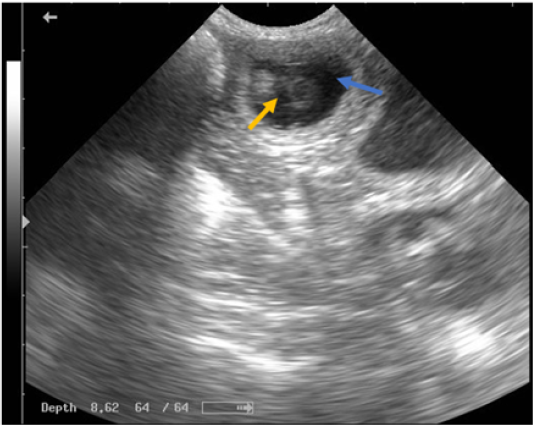
Pregnancy was examined using ultrasonography. The pregnancy determined by the presence of gestational sac 25 days after insemination. From the 8 bitches that were inseminated, 2 bitches (25%) detected showed gestational sacs (Figure 1). Total 6 puppies were born (4 female and 2 male). The results of this study were a lower conception rate than those reported by Farstad and Berg (1989), insemination with frozen semen resulted in a conception rate of 67%. In this study, the methods used for detecting the fertile period of the bitch, were a clinical sign. The very striking difference in pregnancy is probably because the timing of insemination is not accurate. Estimating the correct time of ovulation, and subsequently, insemination, are important factors to get successful pregnancy and an adequate number of offspring per litter. The fertilization phase, or the time when the egg can be fertilized, lasts 2-5 days following ovulation. As a result, mating should take place just before or during this period . To determine the best time for insemination, can be detected using vaginal cytology or through progesterone levels . It is known that the optimal days for mating bitches differ in dogs of one breed .
In general, the effectiveness of AI using frozen sperm depends on sperm quality, thawing, insemination timing, insemination procedures, and other parameters. That factor was identified which significantly affected bitches of various breeds inseminated with fresh or frozen-thawed semen. Conception rate was affected by the breed of the bitch, age of the bitch, semen type (fresh or frozen-thawed), and sperm motility . The quality of the semen used in this study was good with a motility percentage of 40%. Semen quality is an important factor to obtain a good result in insemination . Semen quality has a positive correlation with the rate of pregnant bitches inseminated (da Cunha et al., 2017).
Several AI procedures are available, depending on the kind of sperm utilized and the time of year: Deep vaginal insemination and intrauterine insemination, either non-surgical or surgical transcervical insemination, laparotomy or laparoscopy . Some authors were a success with Transcervical procedures ; ; , intravaginal , intrauterine semen deposition techniques . It has been reported successful pregnancies using AI with frozen semen through intravaginal insemination of bitches . With AI using frozen semen deposited into the vagina, a 52-60% success rate . These results of this study are in contrast with the results of other researchers that intravaginal insemination using frozen semen, results in low conception. In this study, the semen used was not checked for the integrity of the acrosome. The acrosome is an important part of the spermatozoon and a very important role in the process of fertilization . The low fertility rate in this study was probably due to poor acrosome integrity.
Conclusions and Recommendations
The results of this study showed a conception rate of 25%. This is the first successful case of AI in a Kintamani dog. From these results, it can be concluded that the results of freezing the semen of Kintamani dogs can fertilize female dog eggs.
Acknowledgment
We would express our gratitude to Asubali Kennel, Gianyar for helping me provide the sample. This research was supported by the DIPA PNBP Udayana University under grant number B/78.237/UN14.4.4.A/PT.01.03/2022.
Novelty Statement
This is the first report of successfully AI in Kintamani Dog.
Author’s Contribution
IKP and INS designed experiment, data analysis, and wrote the manuscript, AAGOD and IWNFG collected data on pregnancy and data analysis, and DFH and LGS helping collecting data. All authors reviewed the final draft of manuscript.
Conflict of interest
The authors have declared no conflict of interest.
Figures
Figure 1:.
Ultrasonography Imaging of gestational sac on pregnancy bitch. On day 25, the gestational sac (anechoic) [blue arrow] contained an embryo (hypoechoic) [orange arrow].
References
da Cunha ICN, de Ascençao Rocha A, Quirino CR, Gimenes ALL (2017). The efficacy of in vitro sperm tests in predicting pregnancy success after artificial insemination in the bitch. Andrology (Los Angel) 6: 190. https://doi.org/10.4172/2167-0250.1000190[CrossRef]
Dutta J, Dutta J (2020). Artificial insemination in canines: A review. Int. J. Curr. Microbiol. Appl. Sci., 9(8): 2417-2421. https://doi.org/10.20546/ijcmas.2020.908.276[CrossRef]
England GCW, Rijsselaere T, Campbell A, Moxon R, Freeman SL (2021). Normal and abnormal response to sperm deposition in female dogs: A review and new hypotheses for endometritis, Theriogenology, 159: 76-183. https://doi.org/10.1016/j.theriogenology.2020.10.013[CrossRef]
Farstad W, Berg K A (1989). Factors influencing the success rate of artificial insemination with frozen semen in the dog. J. Reprod. Fert. Suppl., 39: 289–292.
Hahn SE, Jo YK, Jin YK, Jang G (2017). Timing of fertile period for successful pregnancy in American Bully dogs, Theriogenology, 104: 49-54. https://doi.org/10.1016/j.theriogenology.2017.07.034[CrossRef]
Hollinshead FK, Hanlon DW (2017). Factors affecting the reproductive performance of bitches: A prospective cohort study involving 1203 inseminations with fresh and frozen semen. Theriogenology, 101: 62e72. https://doi.org/10.1016/j.theriogenology.2017.06.021[CrossRef]
Jain P, Kumar A, Deshmukh P, Sharma R (2015). Artificial insemination in dogs: A promising tool for dog breeders and owners. Indo-Am. J. Agric. Vet. Sci., 3(2): 11-17.
Lojkić M, Maćešić N, Karadjole T, Špoljarić B, Vince S, Bačić G, Getz I, Prvanović Babić N, Folnožić I, Butković I, Šavorić J, Dobos A, Jakovljević G, Samardžija M (2022). A retrospective study of the relationship between canine age, semen quality, chilled semen transit time and season and whelping rate and litter size. Vet. Arhiv., 92(3): 301-310.
Martínez-Mojica M, Guzmán A, Rosales-Torres AM, Herrera-Barragán JA, Castillo-Juárez H, Hernández-Coronado CG (2023). Pregnancy success in bitches-evaluation of interactions between artificial insemination method, serum progesterone concentration and vaginal cytology parameters. Acta Sci. Vet., 51: 1902. https://doi.org/10.22456/1679-9216.127693[CrossRef]
Mason SJ (2016). A retrospective clinical study of endoscopic-assisted transcervical insemination in the bitch with frozen–thawed dog semen. Reprod. Domest. Anim., 51(Suppl. 3): 1–6. https://doi.org/10.1111/rda.12864[CrossRef]
Mason SJ (2018). Current review of artificial insemination in dogs. Vet. Clin. N. Am. Small Anim. Pract., 48(4): 567-580. https://doi.org/10.1016/j.cvsm.2018.02.005[CrossRef]
Mentari SNNL, Trilaksana IGNB, Puja IK. (2022). Vaginal cytology and receptivity to mating behaviour of Kintamani bitch during the proestrus to estrus phase. International Journal of Veterinary Sciences and Animal Husbandry 2022; 7(3): 38-41. https://doi.org/10.22271/veterinary.2022.v7.i3a.420[CrossRef]
Murphy EM, Murphy C, O’Meara C, Dunne G, Eivers B, Lonergan P, Fair S (2017). A comparison of semen diluents on the in vitro and in vivo fertility of liquid bull semen. J. Dairy Sci., 100: 1541–1554. https://doi.org/10.3168/jds.2016-11646[CrossRef]
Nesa NLMS, Trilaksana IGNB, Puja IK (2022). Vaginal cytology and receptivity to mating behaviour of Kintamani bitch during the proestrus to estrus phase. Int. J. Vet. Sci. Anim. Husband., 7(3): 38-41. https://doi.org/10.22271/veterinary.2022.v7.i3a.420[CrossRef]
Nothling JO, Gerstenberg C, Volkmann DH (1995). Success with intravaginal insemination of frozen-thawed dog semen. A retrospective study. J. S. Afr. Vet. Assoc., 66(2): 49-55.
Patel GK, Haque N, Madhavatar M, Chaudhari AK, Patel DK, Bhalakiya N, Jamnesha N, Patel P, Kumar R (2017). Artificial insemination: A tool to improve livestock productivity. J. Pharmacogn. Phytochem., SP1: 307-313.
Payan-Carreira R, Miranda S, Niżañski W (2011). Artificial insemination in dogs. In: Artificial insemination in farm animals (Manafi, M., Ed.), InTech Open. Available at: http://www.intechopen.com/books/artificial-inseminationin-farm-animals/artificial-insemination-in-dogs. https://doi.org/10.5772/20630[CrossRef]
Puja IK (2003). The repoductive patterns of Kintamani bitch. J. Vet., 4(3): 109-112.
Puja IK, Sawitri NM, Maharani NM, Heryani LGSS, Dharmayudha AAGO, Gunawan IWNF (2019). Preservation of semen from Kintamani Bali dogs by freezing methods. J. Adv. Vet. Anim. Res., 6(2): 158–162. https://doi.org/10.5455/javar.2019.f326[CrossRef]
Puja IK, Sawitri NM, Maharani, Maharani N, Gunawan IWNF, Heryani LGSS (2018). A Comparative study on the effect of coconut water-based extenders on the quality of Kintamani dog semen preserved at 4oC. Adv. Anim. Vet. Sci., 6(5): 192-196. https://doi.org/10.17582/journal.aavs/2018/6.5.192.196[Full text][CrossRef]
Romagnoli S, Lopate C (2014). Transcervical Artificial Insemination in Dogs and Cats: Review of the Technique and Practical Aspects. Reproduction in Domestic Animals. 49 Suppl 4. 56-63. https://doi.org/10.1111/rda.12395[CrossRef]
Santos IW, Binsfeld LC, Weiss RR, Kozicki LE, Rochadelli R, Resende MV. Hossepian De Lima VFM (2007). Cryopreservation of dog spermatozoa: Effect of bovine serum albumin on acrosomal integrity and pregnancy rates after artificial insemination. Arch. Vet. Sci., 11(2): 47-54. https://doi.org/10.5380/avs.v12i2.9909[CrossRef]
Skliarov PM, Holubiev OV, Mylostyvyi RV (2022). Roman Determining the optimal insemination time of bitches. FAVE Sección Ciencias Vet., 21: e0005. https://doi.org/10.14409/favecv.2022.0.e0005[CrossRef]
Sulabda IN, Dharmayudha AAGO, Puja IK (2022). Comparative analysis of one-step and two-step dilution on quality of frozen semen in Kintamani dogs. World’s Vet. J., 12(3): 284-289. https://doi.org/10.54203/scil.2022.wvj35[CrossRef]
Utomo BGR, Puja IK, Gunawan IWNF (2023). Dynamic of vaginal pH and ovary ultrasound imaging of Kintamani Bali bitch during proestrus to estrus phase. Int. J. Vet. Sci., 12(2): 242-247. https://doi.org/10.47278/journal.ijvs/2022.171[CrossRef]