
The present paper is the first ever report on occurrence of enamel hypoplasia in extinct tragulids. The dental defect, enamel hypoplasia is caused by suppressed function of enamel forming cells called ameloblasts. It is used as a reliable stress marker in different extinct mammalian taxa to trace out the level of ecological stress faced by these animals during their life histories. We have studied this defect in three extinct Siwalik tragulid species including; Dorcabune anthracotherioides, Dorcatherium majus and Dorcatherium minus. To assess habitat stability for the Neogene tragulids, dental remains from the middle Miocene-early Pliocene, ca. 13.5-4.0 Ma outcrops of the Siwalik of Pakistan were analyzed for the occurrence of linear enamel hypoplasia. According to our results there was a lower occurrence of enamel hypoplasia (13%) in the tragulid fossils from the middle Miocene outcrops (13.5-11.2 Ma) as compared to the late Miocene to the early Pliocene (11.2-4.0 Ma) tragulid remains (48%) which is statistically significant (p<0.05). The middle Miocene in the Siwaliks is hypothesized to have had warm and humid climatic conditions with dominance of dense forests whereas in the late Miocene to the early Pliocene there was a shift in the ecological conditions, with grasslands expanding at the expense of forests and woodlands and the climate gradually becoming less warm and humid. The current enamel hypoplasia results indicate that warm and humid dense forests were the preferred habitats for extinct tragulids present during the middle Miocene in the Siwaliks.
Research Article · Volume 52, Issue 2, 18 January 2020 · Open Access
First Report of Enamel Hypoplasia in Extinct Tragulids: A Marker Bearing on Habitat Change
· · · · ·
Affiliations & Notes ⌄
- 1Department of Zoology, University of Okara, Punjab, Pakistan 2Department of Zoology, University of the Punjab, Quaid-i-Azam Campus, Lahore-54590, Pakistan , * Corresponding author: majid.zool@pu.edu.pk
Article Info ⌄
- Journal:
- Pakistan Journal of Zoology
- Published:
- 18 January 2020

From the article
- In the analyzed dental remains of tragulids 13% of the specimens of the middle Miocene epoch have occurrence of LEH whereas for the tragulid fossils of late Miocene-early Pliocene age this value is 48% (Fig. 4, Table IV).
- The current LEH analysis indicates that overall 26% Siwalik tragulid molars out of the total analyzed material has occurrence of EH (Table IV).
- The results indicate that the middle Miocene habitats were preferred for the extinct tragulids but the exact reason for this preference could not be traced out at the moment.
- This study can be a road map for future research on mammals as no significant data is available on EH occurrence in living tragulids nor are data known on the LEH based ecological comparison of extinct tragulids with other members of their community i.e., bovids.
Selected from the article's own text.
Abstract
INTRODUCTION
Enamel hypoplasia (EH) is a type of tooth anomaly characterized by thinning of enamel and disruption of crystallite deposition. Ameloblasts (enamel forming cells) are highly sensitive so their formation can be depleted by the stresses faced by an animal during its tooth development. The enamel is the hardest tissue of the body with no remolding in it so marks of EH once formed on tooth enamel will persist forever even if the affected tooth had been fossilized ; . Keeping in view all these facts EH has been used by different researchers as a credible stress marker for different extinct mammalian groups i.e. Pleistocene hominids , Pleistocene Neanderthals , early Miocene primates , early Pliocene grazers and browsers , Pliocene giraffids , Miocene rhinocerotids ; , Siwalik rhinocerotids , Siwalik giraffids . There is no report about occurrence of EH in any extinct tragulid species from the Neogene or Quaternary deposits globally even though these are ecologically significant ungulates. This study provides the baseline data on occurrence of enamel hypoplasia in extinct tragulids.
There are three broader categories of EH according to FDI (Federation Dentaire International, 1982) that are Pits, Grooves and Areas missing enamel. Areas missing enamel can further be categorized into semicircular enamel hypoplasia (SEH) and linear enamel hypoplasia (LEH). There can be different etiologies for these types of EH i.e. birth trauma, metabolic and nutritional disorders, infections, exposures to toxic chemicals , rickets , low birth weight , poor health status of the mother , nutritional conditions of an area (El Najjar et al., 1978; , general physiological stress , weaning stress , post weaning stress , nutritional and/or environmental stress . In the types of enamel hypoplasia, LEH is the most common type and its marks can macroscopically be observed on the enamel of living as well as fossilized dental remains. The physiological, nutritional and/or environmental stresses are probable precursors for LEH . According to Franz-Odendaal et al. (2004), LEH can provide a unique perspective into vegetational and environmental conditions present during growing year of an extinct animal’s life. This shows that LEH can be a credible proxy for ecological studies of extinct tragulids so the aim of this study is to assess habitat stability for the Neogene Siwalik tragulids by using LEH as a proxy. The dental remains used for this analysis were recovered from the Siwalik outcrops of Pakistan.
MATERIALS AND METHODS
Geological setting
The multi-storied interbedded layers of sandstone characterize the Siwalik group of Potwar Plateau. The tragulid material used in this LEH analysis has been recovered from the Siwalik deposits having a chronological range of ca. 13.5-4.0 Ma (Fig. 1 and 2). The Chinji Formation marks the middle Miocene of the Siwaliks of Pakistan. The boundary between Chinji and Nagri formations is identified at the upper part of Chron 5r, dated around 11 Ma ; updated in . When we move from North to South in the Siwaliks, we find that the Nagri lithofacies at the lower boundary are time-transgressive. The upper boundary of the Nagri Formation is time-transgressive and gradational with the overlying Dhok Pathan Formation. The upper boundary of the Dhok Pathan Formation may be assigned an age of 5.1 Myr on the basis of stratotypes studied by Opdyke et al. (1979), Johnson et al. (1982) and Barry et al. (2002). Pilgrim (1913) identified the Dhok Pathan type locality on the basis of lithological characters and associated the fauna of the locality with the Dhok Pathan Formation. Tauxe and Opdyke (1982) identified that this section dates to around 8 Ma, but at some other study sections Dhok Pathan rocks (e.g. in Bhandar section) may be as younger as 5.8-5.3 Ma. These estimations are based on the main stratotype and certain reference sections as described by Opdyke et al. (1979); Tauxe and Opdyke (1982) and Johnson et al. (1982).
Fossil collection and identification
The new tragulid remains reported in this study were collected from the fossiliferous localities of different strata of the Siwaliks of Pakistan (Figs. 1 and 2). The tragulid remains already present at Dr. Abu Bakr Fossil Display and Research Center, University of the Punjab, Lahore, Pakistan are also included in the study. The outcrops from where this already available tragulid material is recovered are given in Figures 1 and 2. The specimen under study were thoroughly washed and cleaned for linear enamel hypoplasia analysis. The species identification of the included tragulid remains is based on the dental morphometric features of the Siwalik tragulids given in Farooq et al. (2007a, 2007b, 2007c, 2008).
Table I. Occurrence of enamel hypoplasia in the studied samples of Dorcabune anthracotherioides from the Siwaliks of Pakistan.
| Studied siwalik intervals | Specimen | Age (Ma) | Enamel hypoplasia | ||
| Dentition type | Cusp | High from the neck | |||
| Middle miocene (13.5-11.2 Ma) | PUPC 13/03 | 13.3 | M2 | Metacone | One LEH at 06 mm above the neck |
| Late miocene-early pliocene (11.2-4.0 Ma) | T1 (m2-m3) | 6.5 | m3 | Protoconid | One LEH at 11 mm above the neck |
| T2 (m2-m3) | 6.8 | m3 | Metaconid and entoconid | One LEH at 10 mm above the neck | |
| PUPC 84/66 | 7.8 | m2 | Metaconid | One LEH at 08 mm above the neck | |
| PUPC 86/40 | 7.2 | M1 | Protocone | Two LEH at 06 and 07 mm above the neck | |
Table II. Occurrence of enamel hypoplasia in the studied samples of Dorcatherium majus from the Siwaliks of Pakistan.
| Studied siwalik intervals | Specimen | Age (Ma) | Enamel hypoplasia | ||
| Dentition type | Cusp | High from the neck | |||
| Middle Miocene (13.5-11.2 Ma) | PUPC 69/268 | 11.7 | M3 | Metacone | One LEH at 10 mm above the neck |
| T8 | 11.3 | M1 | Paracone | Two LEH at 06 and 09 mm above the neck | |
| PUPC 13/111 | 13.3 | M2 | Hypocone | One LEH at 03 mm above the neck | |
| Late Miocene-early Pliocene (11.2-4.0 Ma) | T7 (M1-M2) | 8.6 | M1 | Paracone and metacone | One LEH at 05 mm above the neck |
| PUPC 05/788 | 5.7 | m1 | Hypoconid | One LEH at 08 mm above the neck | |
| PUPC 69/268 | 4.4 | M3 | Metacone | One LEH at 10 mm above the neck | |
| T10 | 7.8 | M1 | Paracone and metacone | One LEH at 06 mm above the neck | |
Table III. Occurrence of enamel hypoplasia in the studied samples of Dorcatherium minus from the Siwaliks of Pakistan.
| Studied siwalik intervals | Specimen | Age (Ma) | Enamel hypoplasia | ||
| Dentition type | Cusp | High from the neck | |||
| Middle Miocene (13.5-11.2 Ma) | PUPC 68/107 | 11.7 | m1 | Protoconid | One LEH at 03 mm above the neck |
| PUPC 69/178 (m1-m2) | 13.3 | m1 | Metaconid and entoconid | One LEH at 02 mm above the neck | |
| m2 | Metaconid and entoconid | One LEH at 05 mm above the neck | |||
| Late Miocene-early Pliocene (11.2-4.0 Ma) | PUPC 10/62 (M1-M3) | 6.9 | M2 | Paracone | One LEH at 03 mm above the neck |
| M3 | Metacone | Two LEH at 04 and 05 mm above the neck | |||
| PUPC 69/205 | 7.2 | M2 | Paracone | One LEH at 06 mm above the neck | |
| T14 | 7.2 | m3 | Metaconid | One LEH at 04 mm above the neck | |
| PUPC 11/60 (m2-m3) | 4.2 | m2 | Metaconid | One LEH at 03 mm above the neck | |
| PUPC 04/02 | 7.8 | m1 | Metaconid and entoconid | One LEH at 06 mm above the neck | |
Selection of material for study
In the six reported valid Siwalik tragulid species the three species; Dorcatherium minimus, Dorcatherium nagrii and Dorcabune nagrii that had the chronological ages of 14.2-11.2 Ma, 14.2-10.0 Ma and 11.2-3.3 Ma in the Siwaliks respectively ; ; were excluded from the study. In order to extract a more reliable and precise LEH based information about the habitat preference of Neogene tragulids only three tragulid species named as Dorcabune anthracotherioides, Dorcatherium majus and Dorcatherium minus (chronological age 14.2-3.3 Ma according to that had their existence throughout the middle Miocene-early Pliocene epoch in the Siwaliks; were selected for the study.
Table IV. Statistical results of Chi square test for difference in occurrence of enamel hypoplasia between the middle Miocene and the late Miocene-early Pliocene Siwalik tragulids.
| Species | Tragulid molars having enamel hypoplasia | |
| Middle Miocene** (13.5-11.2 Ma) | Late Miocene-early Pliocene** (11.2-4.0 Ma) | |
| Dorcabune anthracotherioides | 01/08 (13%) | 04/07 (57%) |
| Dorcatherium majus | 03/19 (16%) | 04/07 (57%) |
| Dorcatherium minus | 02/18 (11%) | 05/13 (38%) |
| Statistical results for occurrence of EH between the middle Miocene and the late Miocene-early Pliocene Siwalik tragulids | 06/45 (13%) | 13/27 (48%) |
| χ2 = 10.5295, df = 1, p = 0.001175 | ||
| Overall Percentage of EH in the analysed Siwalik tragulid molars | Total Analysed Molars= 72; Molars having EH=19; Percentage for occurrence= 26% | |
*Numerator is indicating the molars having LEH and denominator is indicating the total analyzed molars, **The chronological ages given in this table are based on the overall ages of the middle Miocene and the late Miocene-early Pliocene Siwalik fossiliferous localities included in this study and are given in Fig. 1.
Nearly 102 fossils of the three selected Siwalik tragulid species were scrutinized for LEH analysis based on criteria given by Mead (1999) and Franz-Odendaal et al. (2004). The highly fragmented, weathered, cemented and worn down to the cervix teeth were excluded and 72 well preserved tragulid molars were selected for LEH analysis. The numbers of studied molars are given in Table IV. The development of molars in mammals begins prenatally and the first molars are affected by the quality of mother’s milk. First molars may show weaning EH. Nutrition during later development depends on foraging and has a direct interaction with the vegetation and other ecological conditions of an ecosystem. Therefore, molar hypoplasia, especially second and third molars, may reflect nutritional stress. Keeping in view this fact, only molars were selected for this ecological study of extinct tragulids.
Enamel hypoplasia analysis
The tragulid remains were observed carefully for LEH analysis under 10 X hand lens. If a mark of LEH observed; its presence was confirmed by observing the same mark at different orientations of the specimen. Further the existence of LEH mark/s was checked under both artificial light of 50-watts lamp as well as sunlight. There were two to three repetitions of this procedure to increase the reliability of the results. The measurements for height of LEH on the tooth crown from the root crown junction were taken in mm by using student manual Vernier Caliper having a least count of 0.1 mm. The classification and methodology for current LEH analysis is based on the work of Franz-Odendaal et al. (2004) and Roohi et al. (2015).
The photographic results of EH given in different publications i.e. Mead (1999), Franz-Odendaal et al. (2004), Lacruz et al. (2005), Teegen and Kyselý (2016) and Lyman (2018) were used to differentiate the observed marks of LEH on tragulid remains from the other possible observable irregularities on the surface of a tooth enamel.
It is an observation based analysis so to ensure the authentication of the results the LEH analysis was carried out by two independent raters. The Cohen’s (1960) kappa statistical test was applied to access the level of agreement between the two raters (Table V). The Cohen’s kappa test is available on line, https://idostatistics.com/cohen-kappa-free-calculator.
Table V. Cohen’s Kappa results for agreement of rater observation on LEH occurrence in the Siwalik tragulids.
| EH results by two raters | Rater 01 | |||
| EH Present | EH Absent | |||
| Rater 02 | EH Present | 19 | 03 | |
| EH Absent | 04 | 46 | ||
| Cohen’s Kappa results | No. of cases= 72, Cohen’s k= 0.774, %age of agreement= 90.278 | |||
| Inference: Substantial agreement | ||||
Statistical analysis
The inference for trend of ecological stress faced by the Siwalik tragulids was drawn by applying Chi square test on LEH results with the help of IBM SPSS Statistics-20 software. The level of significance was taken as 0.05. The Chi square test is selected in this study as it is already in use for interpretation of EH results in different publications i.e. Goodman et al. (1980), Guatelli-Steinberg and Skinner (2000), Slayton et al. (2001), but these references are for living or archeological specimens. The current statistical analysis of LEH in extinct tragulids is an innovative approach in the field of paleontology. The validity of the statistical results was checked online using the link http://turner.faculty.swau.edu/mathematics/math241/materials/contablecalc/
RESULTS
The results illustrate that like many other mammals the extinct tragulids had suffered with EH during their life histories (Fig. 3). In the analyzed dental remains of tragulids 13% of the specimens of the middle Miocene epoch have occurrence of LEH whereas for the tragulid fossils of late Miocene-early Pliocene age this value is 48% (Fig. 4, Table IV). The results for occurrence of LEH in the included tragulid species are given in Tables I, II and III. The comparative trend for LEH between the Siwalik tragulids of middle Miocene and late Miocene-early Pliocene epoch are presented in Table IV.
DISCUSSION
The current LEH analysis indicates that overall 26% Siwalik tragulid molars out of the total analyzed material has occurrence of EH (Table IV). The result shows that the Siwalik tragulids of the middle Miocene habitat had significantly lower occurrence of EH (p<0.05) as compared to tragulids that were present in the late Miocene-early Pliocene habitats (Table IV). The limitations of food resources to some extent and interspecific competition might be the stressors responsible for observed 13% occurrence of EH in tragulid molars of the middle Miocene time period (Fig. 4, Table IV), even then the middle Miocene habitat was comparatively much favorable for the Siwalik tragulids (based on their lower EH occurrence) as compared to the tragulids of the late Miocene-early Pliocene habitats as the observed occurrence of EH in tragulid molars of this time period is 48% (Fig. 4, Table IV).
The middle Miocene Siwalik palaeoclimate is characterized by warm and humid conditions with dominance of dense forests . Such conditions supported the browsing habit as deduced from the dental brachydonty of the faunal elements of middle Miocene time spans. The Siwalik tragulids had brachydont dentition that indicates a browsing nature for these animals thus one main reason of tragulid success in middle Miocene habitat might be the vegetation pattern of the middle Miocene Siwaliks. As the climate became less humid and seasonality played its role in the late Miocene with emergence of C4 grasslands, the grasslands started expanding at the expense of forests and woodlands which ultimately stressed the fauna of latest Miocene to early Pliocene time spans, resulting in the greatest faunal turnover in the latest Miocene ; ; ; ; ; . Possibly due to late Miocene-early Pliocene arid climatic conditions under which C4 grasslands expanded, the tragulids of these habitats had faced comparatively high degree of stress due to climatic and dietary changes.
The global warming event of the early middle Miocene period caused an increase in temperature on the other hand late Miocene-Pliocene was the time of lower temperature and seasonal precipitation. Quade et al. (1992) reported cooling temperature in the Siwaliks during Plio-Pleistocene epoch. So the warm climatic conditions might be another possible reason for the preference of middle Miocene habitat by the Siwalik tragulids. Open vegetation ecosystem increased after 7 Ma , which increased predatory stress for tragulids. This might add up another reason for preference of the middle Miocene on the late Miocene-early Pliocene habitats by the Siwalik tragulids.
Along with the above given probable reasons population density of middle Miocene tragulids is another evidence for compatibility of the Siwalik tragulids to the middle Miocene habitat. In the Siwaliks 30-60% of the small ruminant species were tragulids before 9 Ma but this value declined to only 04% at the end of late Miocene .
The current LEH results are unable to trace out the exact reason of the ecological preferences for extinct tragulids but these results clearly indicate that for the Siwalik tragulids the middle Miocene ecological conditions were more favorable as compared to late Miocene-early Pliocene. Rössner (2007) has described that the living tragulids also prefer to live in tropical ecosystem. In our view the vegetational pattern might be the key precursor for the middle Miocene habitat preference by the Siwalik tragulids.
CONCLUSION
The current study is the first ever report on EH in extinct tragulids so it adds up new information in the literature of palaeontology and paleopathology. The results indicate that the middle Miocene habitats were preferred for the extinct tragulids but the exact reason for this preference could not be traced out at the moment. Further studies by using other ecological proxies may resolve this mystery. The study can provide important data for conservation of living tragulids. This study can be a road map for future research on mammals as no significant data is available on EH occurrence in living tragulids nor are data known on the LEH based ecological comparison of extinct tragulids with other members of their community i.e., bovids.
ACKNOWLEDGEMENTS
The authors of this article are very much thankful to John Luckas (Professor Emeritus, University of Oregon, USA) and R. Lee Lyman (Professor, University of Missouri, Columbia, Missouri) whose comments on earlier version of this article proved to be highly significant in improving this article. Furthermore, this study is also selected after peer review by the experts and editors for an oral presentation in 2nd Conference of the Arabian Journal of Geosciences, Springer 2019. The authors are also very much thankful to the anonymous reviewers and editors of the conference for their remarkable suggestions. The financial support for this study has been provided by HEC under the indigenous scholarship for Amtur Rafeh, PIN NO: 112-33857-2BM1-187.
Statement of conflict of interest
We declare no conflict of interest in this study.
Figures
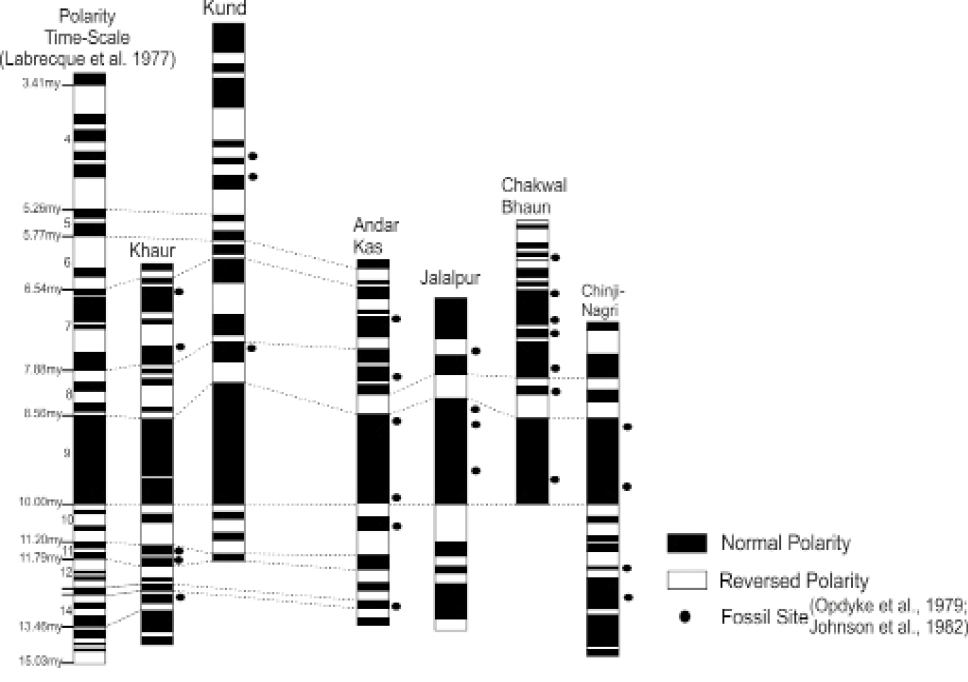
The stratigraphy of the localities of the Siwaliks of Pakistan from where the tragulid material included in this study has been recovered. Reference sections are taken from Opdyke et al. (1979); Tauxe and Opdyke (1982) and Johnson et al. (1982).
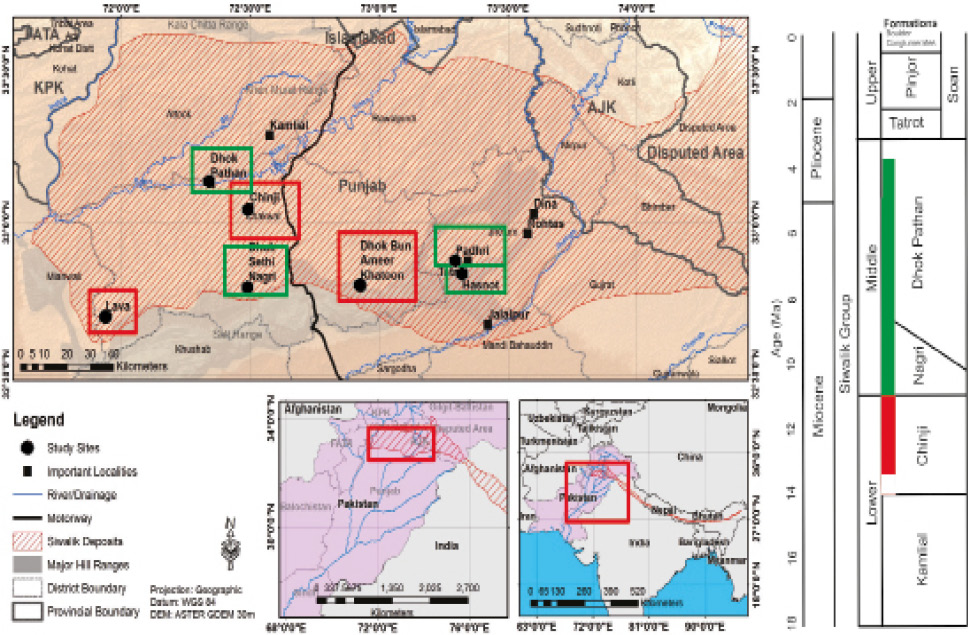
The map of the Siwaliks of Pakistan along with the middle Miocene (highlighted by red color outlines) and the late Miocene-early Pliocene (highlighted by green color outlines) highly fossiliferous localities from where most of the tragulid material included in this LEH analysis has been collected. Boundary dates are according to Barry et al. (2002) and Dennell et al. (2006).
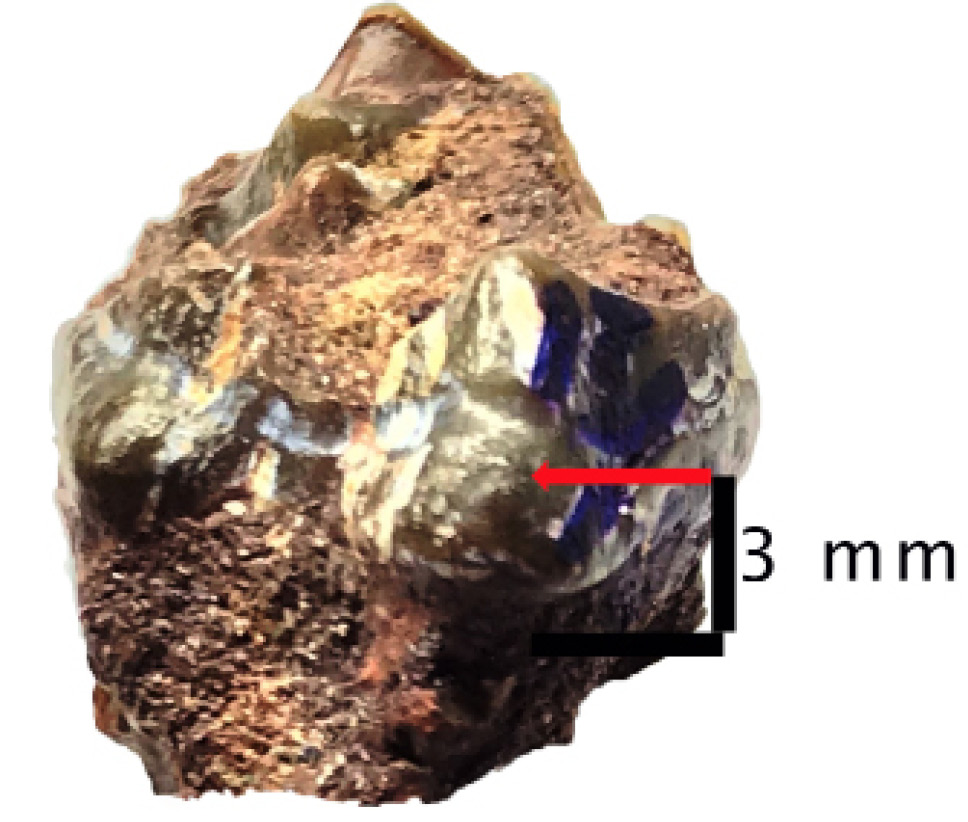
The photographic representation of a selected molar among the Siwalik tragulid molars having linear enamel hypoplasia. The mark of LEH is indicated by red arrow. The 3mm is the height of the observed LEH mark from the root crown junction.
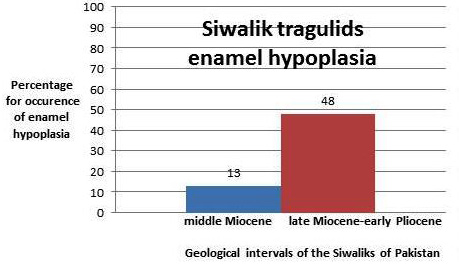
Graphical representation of the comparative occurrence of enamel hypoplasia in the Siwalik tragulids of middle Miocene and late Miocene-Pliocene epoch.
References
- Ahmad, R.M., Khan, A.M., Roohi, G. and Akhtar, M., 2018. Study enamel hypoplasia in giraffids to compare stress episodes in geological history of the Siwaliks of Pakistan. Pakistan J. Zool., 50: 149-158. https://doi.org/10.17582/journal.pjz/2018.50.1.149.158[CrossRef]
- Armelagos, G.J., Goodman, A.H., Harper, K.N. and Blakey, M.L., 2009. Enamel hypoplasia and early mortality: Bioarcheological support for the Barker hypothesis. Evolut. Anthropol. Issues News Rev., 18: 261-271. https://doi.org/10.1002/evan.20239[CrossRef]
- Barry, J.C., Lindsay, E.H. and Jacobs, L.L., 1982. A Biostratigraphic Zonation of the Middle and Upper Siwaliks of the Potwar Plateau of northern Pakistan. Palaeogeogr. Palaeoclimatol. Palaeoecol., 37: 95-130. https://doi.org/10.1016/0031-0182(82)90059-1[CrossRef]
- Barry, J.C., Behrensmeyer, A.K., Badgley, C.E., Flynn, L.J., Peltonen, H.A.N.N.E.L.E., Cheema, I.U., Pilbeam, D.A.V.I.D., Lindsay, E.H., Raza, S.M., Rajpar, A.R. and Morgan, M.E., 2013. The Neogene Siwaliks of the Potwar Plateau, Pakistan. In: Fossil mammals of Asia: Neogene biostratigraphy and chronology. Columbia University Press, New York, pp. 373-399. https://doi.org/10.7312/columbia/9780231150125.003.0015[CrossRef]
- Barry, J.C., 2013. The fossil tragulids of the Siwalik Formations of Southern Asia. Zitteliana, 32: 52-61.
- Barry, J.C., Morgan, M.E., Flynn, L.J., Pilbeam, D., Behrensmeyer, A.K., Raza, M.S., Khan, I.A., Badgley, C., Hicks, J. and Kelley, J., 2002. Faunal and environmental change in the late Miocene Siwaliks of Northern Pakistan. Paleobiol. Mem., 28: 1-72. https://doi.org/10.1666/0094-8373(2002)28[1:FAECIT]2.0.CO;2[CrossRef]
- Bibi, F., 2007. Origin, paleoecology, and paleobiogeography of early Bovini. Palaeogeogr. Palaeoclimatol. Palaeoecol., 248: 60-72. https://doi.org/10.1016/j.palaeo.2006.11.009[CrossRef]
- Böhmer, C. and Rössner, G.E., 2018. Dental paleopathology in fossil rhinoceroses: Etiology and implications. J. Zool., 304: 3-12. https://doi.org/10.1111/jzo.12518[CrossRef]
- Barndt, J., Johnson, N.M., Johnson, G.D., Opdyke, N.D., Lindsey, E.H., Pilbeam, D. and Tahirkheli, R.A.K., 1978. The magnetic polarity stratigraphy and age of the Siwalik Group near Dhok Pathan Village, Potwar Plateau, Pakistan. Earth Planet. Sci. Lett., 41: 355-364. https://doi.org/10.1016/0012-821X(78)90190-5[CrossRef]
- Cerling, T.E., Wang, Y. and Quade, J., 1993. Expansion of C4 ecosystems as an indicator of global ecological change in the late Miocene. Nature, 361: 344. https://doi.org/10.1038/361344a0[CrossRef]
- Cohen, J.A., 1960. Coefficient of agreement for nominal scales. Duc. Psychol. Meas., 20: 37-46. https://doi.org/10.1177/001316446002000104[CrossRef]
- Dennell, R., Coard, R. and Turner, A., 2006. The biostratigraphy and magnetic polarity zonation of the Pabbi Hills, northern Pakistan: an upper Siwalik (Pinjor stage) upper Pliocene–Lower Pleistocene fluvial sequence. Palaeogeogr. Palaeoclimatol. Palaeoecol., 234: 168-185. https://doi.org/10.1016/j.palaeo.2005.10.008[CrossRef]
- El-Najjar, M.Y., Desanti, M.V. and Ozebek, L., 1978. Prevalence and possible etiology of dental enamel hypoplasia. Am. J. Phys. Anthropol., 48:185-192. https://doi.org/10.1002/ajpa.1330480210[CrossRef]
- Farooq, U., Khan, M.A., Akhtar, M. and Khan, A.M., 2007a. Dorcabune anthracotherioides (Artiodactyla, Ruminantia, Tragulidae) from Hasnot, the Middle Siwaliks, Pakistan. Pakistan J. Zool., 39: 353-360.
- Farooq, U., Khan, M.A., Akhtar, M. and Khan, A.M., 2007b. Study of Dorcatherium majus upper dentition from the Lower and Upper Siwaliks of Pakistan. J. appl. Sci., 7: 1299-1303. https://doi.org/10.3923/js.2007.1299.1303[CrossRef]
- Farooq, U., Khan, M. A., Akhtar, M., Khan, A. M. and Ali, Z., 2007c. Dorcatherium minus from the Siwaliks, Pakistan. J. Anim. Pl. Sci., 17: 86-89.
- Farooq, U., Khan, M.A., Akhtar, M. and Khan, A.M., 2008. Lower dentition of Dorcatherium majus (Tragulidae, Mammalia) in the Lower and Middle Siwaliks (Miocene) of Pakistan. Turk. J. Zool., 32: 91-98.
- Federation Dentaire International. 1982. An epidemiological index of developmental defects of dental enamel (DDE). Int. Dent. J., 32: 159–167.
- Flynn, L.J., Pilbeam, D., Barry, J.C., Morgan, M.E. and Raza, S.M., 2016. Siwalik synopsis: A long stratigraphic sequence for the later Cenozoic of South Asia. C. R. Palevol., 15: 877-887. https://doi.org/10.1016/j.crpv.2015.09.015[CrossRef]
- Franz-Odendaal, T., Chinsamy, A. and Lee-Thorp, J., 2004. High prevalence of enamel hypoplasia in an early Pliocene giraffid (Sivatherium hendeyi) from South Africa. J. Vert. Paleontol., 24: 235-244. https://doi.org/10.1671/19[CrossRef]
- Franz-Odendaal, T.A., Lee-Thorp, J.A. and Chinsamy, A., 2003. Insights from stable light isotopes on enamel defects and weaning in Pliocene herbivores. J. Biosci., 28: 765-773. https://doi.org/10.1007/BF02708437[CrossRef]
- Gaur, R., 1992. On Dorcatherium nagrii (Tragulidae, Mammalia) with a review of Siwalik tragulids. Riv. Ital. Paleontol. Stratigr., 98: 353-370.
- Goodman, A.H. and Rose, J.C., 1990. Assessment of systemic physiological perturbations from dental enamel hypoplasias and associated histological structures. Yearb. Phys. Anthropol., 33: 59–110. https://doi.org/10.1002/ajpa.1330330506[CrossRef]
- Goodman, A.H., Armelagos., G.J. and Rose, J.C., 1980. Enamel hypoplasias as indicators of stress in three prehistoric populations from Illinois. Hum. Biol., 52: 515-528.
- Guatelli-Steinberg, D. and Skinner, M., 2000. Prevalence and etiology of linear enamel hypoplasia in monkeys and apes from Asia and Africa. Folia Primatol., 71: 115-132. https://doi.org/10.1159/000021740[CrossRef]
- Guatelli-Steinberg, D., Larsen, C.S. and Hutchinson, D.L., 2004. Prevalence and the duration of linear enamel hypoplasia: a comparative study of Neandertals and Inuit foragers. J. Hum. Evol., 47: 65-84. https://doi.org/10.1016/j.jhevol.2004.05.004[CrossRef]
- Heissig, K., 2003. Change and continuity in rhinoceros faunas of Western Eurasia from the Middle to the Upper Miocene. EEDEN, Stará Lesná, pp. 35–37.
- Johnson, N.M., Opdyke, N.D., Johnson, G.D., Lindsay, E.H. and Tahirkheli, R.A.K., 1982. Magnetic polarity stratigraphy and ages of Siwalik group rocks of the Potwar Plateau, Pakistan. Palaeogeogr. Palaeoclimatol. Palaeoecol. 37: 17-42. https://doi.org/10.1016/0031-0182(82)90056-6[CrossRef]
- Khan, M.A., Akhtar, M. and Iliopoulos, G., 2012. Tragulids (Artiodactyla, Ruminantia, Tragulidae) from the Middle Siwaliks of Hasnot (Late Miocene), Pakistan. Riv. Ital. Paleontol. Stratigr., 118: 325-341.
- Lacruz, R.S., Rozzi, F.R. and Bromage, T.G., 2005. Dental enamel hypoplasia, age at death, and weaning in the Taung child. Afr. J. Sci., 101: 567-569.
- Lukacs, J.R., 2001. Enamel hypoplasia in the deciduous teeth of early Miocene catarrhines: evidence of perinatal physiological stress. J. Hum. Evol., 40: 319-329. https://doi.org/10.1006/jhev.2000.0458[CrossRef]
- Lyman, R.L., 2018. Dental enamel hypoplasias in Holocene bighorn sheep (Ovis canadensis) in eastern Washington state, USA. Canadian J. Zool., 96: 460-465. https://doi.org/10.1139/cjz-2017-0230[CrossRef]
- Mead, A.J., 1999. Enamel hypoplasia in Miocene rhinoceroses (Teleoceras) from Nebraska: evidence of severe physiological stress. J. Verteb. Palaeontol., 19: 391-397. https://doi.org/10.1080/02724634.1999.10011150[CrossRef]
- Meijaard, E. and Groves, C.P., 2004. A taxonomic revision of the Tragulus mouse-deer (Artiodactyla). Zool. J. Linn. Soc., 140: 63-102. https://doi.org/10.1111/j.1096-3642.2004.00091.x[CrossRef]
- Moggi-Cecchi, J., Pacciani, E. and Pinto-Cisternas, J., 1994. Enamel hypoplasia and age at weaning in 19th - century Florence, Italy. Am. J. Physiol. Anthropol., 93: 299-306. https://doi.org/10.1002/ajpa.1330930303[CrossRef]
- Molnar, S. and Molnar, I.M., 1985. The incidence of enamel hypoplasia among the Krapina Neandertals. Am. Anthropol., 87: 536-549. https://doi.org/10.1525/aa.1985.87.3.02a00020[CrossRef]
- Nelson, S.V., 2005. Paleoseasonality inferred from equid teeth and intra-tooth isotopic variability. Palaeogeogr. Palaeoclimatol. Palaeoecol., 222: 122-144. https://doi.org/10.1016/j.palaeo.2005.03.012[CrossRef]
- Nikiforuk, G. and Fraser, D., 1981. The etiology of enamel hypoplasia: a unifying concept. J. Pediat., 98: 888-893. https://doi.org/10.1016/S0022-3476(81)80580-X[CrossRef]
- Ogilvie, M.D., Curran, B.K. and Trinkaus, E., 1989. Incidence and patterning of dental enamel hypoplasia among the Neandertals. Am. J. Physiol. Anthropol., 79: 25-41. https://doi.org/10.1002/ajpa.1330790104[CrossRef]
- Opdyke, N.D., Johnson, G.D., Johnson, N.M, Tahirkheli, R.A.K. and Mirza, M.A., 1979. Magnetic polarity stratigraphy and vertebrate palaeontology of the Upper Siwaliks subgroup of Northern Pakistan. Palaeogeogr. Palaeoclimatol. Palaeoecol., 27: 1-34. https://doi.org/10.1016/0031-0182(79)90091-9[CrossRef]
- Pilgrim, G.E., 1913. The correlation of the Siwaliks with mammal horizons of Europe. Rec. Geol. Surv. India., 43: 264-326.
- Quade, J., Cerling, T.E., Barry, J.C., Morgan, M.E., Pilbeam, D.R., Chivas, A.R., Lee-Thorp, J.A. and van der Merwe, N.J., 1992. A 16-Ma record of paleodiet using carbon and oxygen isotopes in fossil teeth from Pakistan. Chem. Geol., 94: 183-192. https://doi.org/10.1016/S0009-2541(10)80003-8[CrossRef]
- Roohi, G., Raza, S.M., Khan, A.M., Ahmad, R.M. and Akhtar, M., 2015. Enamel hypoplasia in Siwalik Rhinocerotids and its Correlation with Neogene Climate. Pakistan J. Zool., 47:1433-1443.
- Rössner, G.E., 2007. Family Tragulidae - Prothero. In: The evolution of artiodactyls (ed. D.R. Foss). The Johns Hopkins University Press, Baltimore. pp. 213–220.
- Seow, W.K., 1991. Enamel hypoplasia in the primary dentition: a review. asdc J. Dent. Child., 58: 441-452.
- Slayton, R.L., Warren, J.J., Kanellis, M.J., Levy, S.M. and Islam, M., 2001. Prevalence of enamel hypoplasia and isolated opacities in the primary dentition. Pediatr. Dent., 23: 32-43.
- Tauxe, L. and Opdyke, N.D., 1982. A Time framework based on the magnetostratigraphy for the Siwalik Sediments of the Khaur Area, Northern Pakistan. Palaeogeogr. Palaeoclimatol. Palaeoecol., 37: 43-61. https://doi.org/10.1016/0031-0182(82)90057-8[CrossRef]
- Teegen, W.R. and Kyselý R. 2016. A rare severe enamel defect on an upper pig molar from an early medieval stronghold in Prague (Czech Republic). Vet. Arh., 86: 273-785.
- Trinkaus, E., 2018. An abundance of developmental anomalies and abnormalities in Pleistocene people. Proc. natl. Acad. Sci., 115: 11941-11946. https://doi.org/10.1073/pnas.1814989115[CrossRef]
- West, R.M., 1980. A minute new species of Dorcatherium (Tragulidae, Mammalia) from the Chinji Formation near Daud Khel, Mianwali district, Pakistan. Contrib. Biol. Geol. Mus. Publ. 3: 1-6.
- You, Y., Huber, M., Müller, R.D., Poulsen, C.J. and Ribbe, J., 2009. Simulation of the middle Miocene climate optimum. Geophys. Res. Lett., 36: L04702. https://doi.org/10.1029/2008GL036571[CrossRef]
Cited by 1 article
In journals published by ResearchersLinks.
Services
Article usage statistics
Loading…