Research Article · Volume 13, Issue 4, 2 December 2025 · Open Access
Field-Based Prevalence of Peste Des Petits Ruminants in Goats in Kasur District, Punjab, Pakistan
· · · · ·
Affiliations & Notes ⌄
1Department of Veterinary Medicine Faculty of Animal Husbandry and Veterinary Sciences Sindh Agriculture University, Tandojam, Pakistan
2Livestock and Dairy Development Department Balochistan Quetta
3Department of Veterinary Microbiology Faculty of Animal Husbandry and Veterinary Sciences Sindh Agriculture University, Tandojam, Pakistan
4Saadat International Pvt. Lahore Pakistan. *Correspondence | Abdul Kabir, Department of Veterinary Microbiology Faculty of Animal Husbandry and Veterinary Sciences Sindh Agriculture University, Tandojam, Pakistan
The breed-wise prevalence in this study (χ² = 52.47, p < 0.001) demonstrated significant variation among goat breeds, with Teddi (86.7 %) and Tappri (75.0 %) showing exceptionally high prevalence, while Beetal (10.7 %) and Pateri (16.7 %) showed lower values.
Age-wise, the highest prevalence was in goats aged 7–18 months (39.8 %), followed by 18 months (11.9 %).
The particularly high prevalence in indigenous breeds like Teddi and Tappri suggests that vaccination and management strategies need to be breed-specific, addressing local husbandry practices and genetic vulnerability.
In summary, this study indicates that PPR remains endemic in goats of Kasur district, with clear breed and age differentials in susceptibility.
Selected from the article's own text.
Abstract
Peste des Petits Ruminants (PPR) is a highly contagious viral disease of small ruminants with major implications for livestock productivity and rural livelihoods. This cross-sectional, field-based study investigated the prevalence of PPR in goats in Kasur district, Punjab, Pakistan. A total of 165 goats of different breeds, ages, and sexes were clinically examined, and prevalence was analyzed across demographic categories. The overall prevalence of PPR was 29.7% (95% CI: 22.6–37.6). Breed-wise analysis revealed significant variation (χ² = 52.47, p < 0.001), with the highest prevalence recorded in Teddi (86.7%) and Tappri (75.0%) goats, followed by Gulabi (60.0%) and Cross breeds (43.8%), whereas Beetal (10.7%), Pateri (16.7%), and Makhi Cheeni (18.2%) had lower rates. Age-wise distribution was significantly associated with infection (χ² = 11.48, p = 0.003), with goats aged 7–18 months being most affected (39.8%), followed by <6 months (23.3%), and >18 months (11.9%). Sex-wise prevalence was higher in males (33.3%) than females (25.9%), though the difference was not statistically significant (χ² = 0.76, p = 0.38). Clinical examination was used for diagnosis, without laboratory confirmation, which should be considered when interpreting the results. These findings highlight the substantial burden of PPR in specific goat breeds and younger age groups, underscoring the need for targeted vaccination and strategic control measures in endemic areas of Kasur.
Keywords | PPR, Small Ruminants, Prevalence, Kasur District, Risk Factors
INTRODUCTION
Peste des Petits Ruminants virus (PPRV) is a highly contagious transboundary pathogen of small ruminants, with goats being more severely affected than sheep , 2020). PPRV is an enveloped, single-stranded, negative-sense RNA virus belonging to the genus Morbillivirus in the family Paramyxoviridae . Globally, four distinct genetic lineages (I–IV) have been identified, with lineage IV predominating in Asia, including Pakistan ; . Although sheep and goats are the primary hosts, spillover infections have occasionally been reported in cattle, buffalo, and camels .
Commonly referred to as goat plague, kata, or pseudo-rinderpest, PPR is characterized by high morbidity and mortality, with outbreaks sometimes affecting up to 90% of animals in a herd and causing 30–70% mortality . Clinically, PPR manifests as peracute, acute, or subacute forms, presenting with high fever, ocular and nasal discharges, necrotic stomatitis, pneumonia, diarrhea, and significant mortality among young animals ; Radostitis et al., 2007; ; .
Transmission occurs primarily via direct contact with infected secretions and indirectly through contaminated feed, water, and fomites ; . First described in Côte d’Ivoire in 1942, PPR has now spread across Africa, the Middle East, and Asia and is endemic in more than 70 countries worldwide. In Pakistan, the disease was first reported in 1991 and confirmed in 1994 ; ; ; . Despite its endemic status, limited epidemiological data are available from Kasur district, Punjab, underscoring the need for region-specific investigations.
MATERIALS AND METHODS
Study area and duration
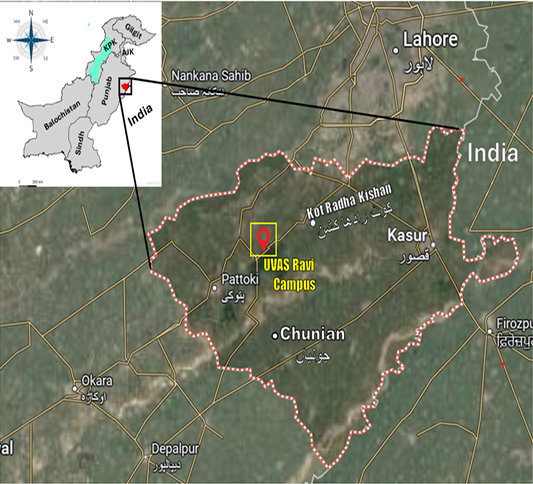
The study was conducted at the Veterinary Teaching Hospital, University of Veterinary and Animal Sciences (UVAS), Ravi Campus Pattoki, District Kasur, Punjab, Pakistan. Kasur is located about 50 km South of Lahore and shares borders with India to the east and southeast, Okara to the southwest, Sheikhupura to the northwest, and Lahore to the north (Figure 1). The district comprises four tehsils: Kasur, Chunian, Pattoki, and Kot Radha Kishan. The study period extended over six weeks, from 10 August to 25 September 2024.
Study population and sampling
A total of 165 goats were randomly selected from routine cases presented to the teaching hospital, regardless of breed, sex, age, or health status. Owner-provided information regarding animal history and management practices was recorded using a structured questionnaire and cross-verified with hospital records to ensure consistency.
Clinical examination
Each goat underwent a systematic clinical examination to assess signs of Peste des Petits Ruminants(PPR) Table 1.
Clinical diagnosis
Diagnosis of PPR was based on history, owner-reported complaints, and observed clinical signs, including inspection, auscultation, and respiratory assessment. Laboratory confirmation was not performed; therefore, findings are limited to clinically suspected cases.
RESULTS
General prevalence
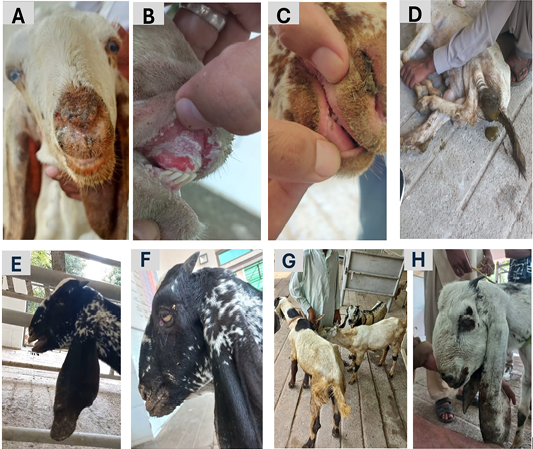
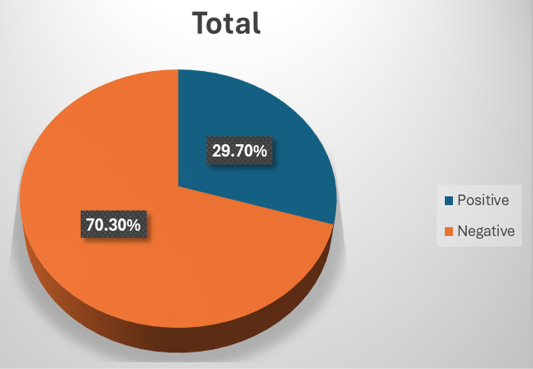
In this study total 165 goats was examined, 49 goats were clinically diagnosed positive for PPR infection through the clinical signs like fever (105-107°F), severe diarrhea, oral lesions, respiratory distress, oculo-nasal discharge, dull and dehydration as shown in Figure 2, and other 116 goats were observed negative for PPR infection, so the general prevalence of PPR in District Kasur is 29.70% (49/165) (Figure 3).
Table 1: Clinical parameters were organized in a table for clarity and conciseness.
Parameter
Method
Definition/Notes
Rectal temperature
Mercury thermometer
Fever defined as ≥40 °C (104 °F) (Incorporates reviewer comment: temperature units standardized)
Out of 165 goats examined, prevalence of Peste des Petits Ruminants (PPR) varied significantly across breeds (χ² = 52.47, p < 0.001). The highest prevalence was observed in Teddi (86.7%) and Tappri (75.0%) breeds, followed by Cross (43.8%) and Gulabi (60.0%). In contrast, Beetal (10.7%), Pateri (16.7%), and Makhi Cheeni (18.2%) showed relatively lower prevalence rates (Table 2).
Age-wise prevalence
PPR prevalence was significantly associated with age (χ²= 11.48, p= 0.003). The highest prevalence occurred in goats aged 7–18 months (39.8%), followed by <6 months (23.3%), while adults >18 months showed the lowest prevalence (11.9%) (Table 3).
Sex-wise prevalence
No statistically significant difference in PPR prevalence was observed between male (33.3%) and female (25.9%) goats (χ² = 0.76, p = 0.38) (Table 4).
Table 2: Breed-wise prevalence of PPR in goats from Kasur district, Punjab.
Breed
Examined
Affected
Prevalence % (95% CI)
χ²
p-value
Beetal
56
6
10.7 (4.4–21.0)
52.47
<0.001
Makhi Cheeni
55
10
18.2 (9.1–30.9)
Gulabi
5
3
60.0 (14.7–94.7)
Tappri
12
9
75.0 (42.8–94.5)
Teddi
15
13
86.7 (59.5–98.3)
Pateri
6
1
16.7 (0.4–64.1)
Cross
16
7
43.8 (19.8–70.1)
Total
165
49
29.7 (22.6–37.6)
Table 3: Age-wise prevalence of PPR in goats.
Age group
Examined
Affected
Prevalence % (95% CI)
χ²
p-value
<6 months
30
7
23.3 (9.9–42.3)
11.48
0.003
7–18 months
93
37
39.8 (29.8–50.5)
>18 months
42
5
11.9 (4.0–25.6)
Total
165
49
29.7 (22.6–37.6)
Table 4: Sex-wise prevalence of PPR in goats.
Sex
Examined
Affected
Prevalence % (95% CI)
χ²
p-value
Male
84
28
33.3 (23.6–44.2)
0.76
0.38
Female
81
21
25.9 (16.8–36.8)
Total
165
49
29.7 (22.6–37.6)
DISCUSSION
The breed-wise prevalence in this study (χ² = 52.47, p < 0.001) demonstrated significant variation among goat breeds, with Teddi (86.7 %) and Tappri (75.0 %) showing exceptionally high prevalence, while Beetal (10.7 %) and Pateri (16.7 %) showed lower values. Such disparity may reflect breed-specific susceptibility, management, or husbandry practices. Similar differential prevalence among breeds has been reported elsewhere, indicating that local breed adaptation, immune competence, and biosecurity measures may influence infection rates . Our overall prevalence (29.7 %) is lower than some national pooled estimates in Pakistan, where a meta-analysis estimated pooled prevalence at ~51 % over 2004–2023 but aligns with observations that PPR prevalence can vary widely by region and sampling method .
Age-wise, the highest prevalence was in goats aged 7–18 months (39.8 %), followed by <6 months (23.3 %) and >18 months (11.9 %). This pattern is consistent with many studies showing that younger and growing animals are more vulnerable due to declining maternal antibodies and increased exposure as they join grazing herds . In Pakistan, prior studies also noted that PPR infection is more frequent in animals under two years of age .
Regarding sex, although male goats had a slightly higher prevalence (33.3 %) than females (25.9 %), the difference was not statistically significant (χ² = 0.76, p = 0.38). This lack of sex-based disparity is in agreement with findings from similar epidemiological surveys, which often show no clear gender predisposition for PPR .
The observed breed and age associations highlight potential targets for control. The particularly high prevalence in indigenous breeds like Teddi and Tappri suggests that vaccination and management strategies need to be breed-specific, addressing local husbandry practices and genetic vulnerability. Young goats (7-18 months) appear to be a critical risk group and may benefit most from timely immunization and enhanced monitoring.
Other factors likely also contribute to variability in prevalence: animal movement, agro-climatic conditions, vaccination coverage, and biosecurity practices. The national serosurveillance across Pakistan found that differences in sero-positivity among provinces were attributed partly to animal movement and ecological differences .
Limitations of this study include reliance on clinical diagnosis without laboratory confirmation, which may under- or overestimate true prevalence. Also, sample sizes for some breeds (e.g. Gulabi, Pateri) were small, leading to wide confidence intervals. Future studies should incorporate serological or molecular confirmation and consider multivariable risk modeling (e.g. logistic regression) to adjust for confounders.
In summary, this study indicates that PPR remains endemic in goats of Kasur district, with clear breed and age differentials in susceptibility. Effective control will require targeted vaccination, improved surveillance, and strengthening of biosecurity practices tailored to high-risk breeds and age groups.
ACKNOWLEDGEMENTS
The authors gratefully acknowledge the support and assistance provided during sample collections by the Veterinary Teaching Hospital, University of Veterinary and Animal Sciences (UVAS), Ravi Campus, Pattoki, District Kasur, Punjab, Pakistan.
NOVELTY STATEMENT
This study presents the first field-based clinical assessment of PPR in goats from Kasur district, revealing significant breed- and age-related differences in disease prevalence. Teddi and Tappri goats, along with young animals (7–18 months), were most affected. These findings provide novel insights to guide targeted vaccination and control strategies in endemic areas of Punjab.
AUTHOR’s CONTRUBATION
AK conceived and supervised the study, analyzed data, and finalized the manuscript.
MK conducted fieldwork and data collection.
ZUA and HZ assisted in data analysis.
AHM contributed to study design and supervision.
MS helped revise the manuscript.
All authors read and approved the final version of the manuscript.
Generative AI and AI-assisted technology statement
The authors declare that no generative AI or AI-assisted technologies were used in the design, execution, or interpretation of this research study. AI tools were not used to create, analyze, or modify any part of the manuscript. All content and intellectual input are solely the work of the authors
Conflict of interest
The authors have declared no conflict of interest.
Figures
Figure 1:.
The location and geographic position of district Kasur in Pakistan, four tehsils of Kasur and location of University of Veterinary and Animal sciences Ravi campus in Pattoki.
Figure 2:.
PPR infected goats represented: A, Serous oculo-nasal discharge; B, cheesy material on oral membrane; C, Oral lesions; D, Severe dirrhea; E, Difficult breathing; F, Dehydration; G, Dull and depression; H, Emaciated.
Figure 3:.
General prevalence of PPR, Red color indicates the Positive cases, while blue color indcates the Negative cases.
References
Abdollahpour G, Raoofi A, Najafi J, Sasani F, Sakhaie E (2006). Clinical and para-clinical findings of a recent outbreaks of peste des petits ruminants in Iran. J. Vet. Med. B Infect. Dis. Vet. Publ. Hlth., 53: 14-16. https://doi.org/10.1111/j.1439-0450.2006.01013.x[CrossRef]
Abraham G, Sintayehu A, Libeau G, Albina E, Roger F, Laekemariam Y, Awoke KM (2005). Antibody seroprevalences against peste des petits ruminants (PPR) virus in camels, cattle, goats and sheep in Ethiopia. Prev. Vet. Med., 70(1-2): 51-57. https://doi.org/10.1016/j.prevetmed.2005.02.011[CrossRef]
Abubakar M, Irfan M (2014). An overview of treatment options to combat peste des petits ruminants in endemic situations. Res. J. Vet. Pract., 2(15): 4-7. https://doi.org/10.14737/journal.rjvp/2014/2.1s.4.7[Full text][CrossRef]
Abubakar M, Mahapatra M, Muniraju M, Arshed MJ, Khan EUH, Banyard AC, Parida S (2017). Serological detection of antibodies to peste des petits ruminants virus in large ruminants. Transbound. Emerg. Dis., 64(2): 513-519. https://doi.org/10.1111/tbed.12392[CrossRef]
Abubakar M, Manzoor S, Ali Q (2015). Evaluating the role of vaccine to combat peste des petits ruminants outbreaks in endemic disease situation. J. Anim. Sci. Technol., 57(1): 2. https://doi.org/10.1186/s40781-014-0036-y[CrossRef]
Fentahun T, Woldie M (2012). Review on peste des petits ruminants (PPR). Eur. J. Appl. Sci., 4(4): 160-167.
Jalees MM, Hussain I, Arshad M, Muhammad G, Khan QM, Mahmood MS (2013). Occurrence of peste des petits ruminants in five districts of Punjab, Pakistan. Pak. Vet. J., 33(2): 165–169.
Kabir A, Abro DHKS, Kalhoro MS, Yousafzai HA, Shams S, Khan IU, Lund AK (2019). Peste des petits ruminants: A review. Pure Appl. Biol., 8(2): 1214-1222. https://doi.org/10.19045/bspab.2019.80063[CrossRef]
Kabir A, Mirani AH, Kashif J, Manzoor S, Iqbal A, Khan IU, Abubakar M (2020). Serological detection and confirmation of PPR among sheep and goat kept under different production systems. Pak. J. Zool., 52(3): 1137. https://doi.org/10.17582/journal.pjz/20171015061013[Full text][CrossRef]
Mdetele DP, Komba E, Seth MD, Misinzo G, Kock R, Jones BA (2021). Review of peste des petits ruminants occurrence and spread in Tanzania. Animals, 11(6): 1698. https://doi.org/10.3390/ani11061698[CrossRef]
Nour HSH (2020). Challenges and opportunities for global eradication of peste des petits ruminants (PPR). J. Trop. Dis., 8: 349.
Radostits OM, Gay CC, Hinchcliff KW, Constable PD (2007). A textbook of diseases of cattle, horses, sheep, pigs and goats. Saunders Elsevier, Edinburgh, London, New York, Oxford, Philadelphia, St Louis, Sydney, Toronto, pp. 1223-1230.
Shaila MS, Shamaki D, Forsyth MA, Diallo A, Goatley L, Kitching RP, Barrett T (1996). Geographic distribution and epidemiology of peste des petits ruminants viruses. Virus Res., 43(2): 149-153. https://doi.org/10.1016/0168-1702(96)01312-3[CrossRef]
Singh RK, Balamurugan V, Bhanuprakash V, Sen A, Saravanan P, Yadav MP (2009). Possible control and eradication of peste des petits ruminants from India: Technical aspects. Vet. Ital, 45(3): 449-462.
Ullah M, Li Y, Munib K, Zhang Z (2022). Regional epidemiology and associated risk factors of PPR. Authorea Preprints. https://doi.org/10.22541/au.164864676.60121644/v1[CrossRef]
Wendimu TG, Dinbiso TD, Lobago DS, Marami LM (2024). Seroprevalence and associated risk factors of peste des petits ruminants in sheep and goats in three districts of the Central Oromia Region, Ethiopia. Front. Vet. Sci., 11: 1402342. https://doi.org/10.3389/fvets.2024.1402342[CrossRef]
Zafar S, Sarfraz MS, Ali S, Saeed L, Mahmood MS, Khan AU, Anwar MN (2024). Recapitulation of peste des petits ruminants (PPR) prevalence in small ruminant populations of Pakistan from 2004 to 2023: A systematic review and meta-analysis. Vet. Sci., 11(6): 280. https://doi.org/10.3390/vetsci11060280[CrossRef]
Zahur AB, Irshad H, Hussain M, Anjum R, Khan MQ (2006). Transboundary animal diseases in Pakistan. J. Vet. Med. B Infect. Dis. Vet. Publ. Health, 53: 19-22. https://doi.org/10.1111/j.1439-0450.2006.01015.x[CrossRef]
Zakian A, Nouri M, Faramarzian K, Tehrani Sharif M, Rezaie A, Mokhber Dezfouli M (2016). Comprehensive review on peste des petits ruminants (PPR) disease in ruminants and camels: With emphasis on clinical signs and histopathological finding. J. Vet. Sci. Med. Diagn., 5(4): 2. https://doi.org/10.4172/2325-9590.1000207[CrossRef]