
Milk, rich in proteins, vitamins, and minerals like calcium, is a key nutritional source but prone to contamination by pathogens, especially in regions lacking robust pasteurization. Multidrug-resistant bacteria, driven by antibiotic overuse, heighten health risks. This study evaluates Azadirachta indica (Neem) and Avicennia marina (Mangrove) extracts against milk-borne pathogens Staphylococcus aureus, Escherichia coli, and Enterobacter aerogenes to address antimicrobial resistance (AMR). Extraction from 50 g dried plant material using methanol, chloroform, and hexane yielded 2.56–8.74%, with methanol extracts most efficient (8.74% for A. indica, 4.38% for A. marina). Using the disc diffusion method, A. indica methanol extract (M1) showed superior antibacterial activity, with zones of inhibition of 38 mm (S. aureus) and 35 mm (E. aerogenes) at 400 mg/mL, outperforming ciprofloxacin (7 mm) and levofloxacin (14 mm) at 500 mg/ml. Minimum inhibitory concentrations (MICs) confirmed M1’s potency (12.5 mg/ml for S. aureus, 25.0 mg/mL for E. aerogenes), linked to azadirachtin and flavonoids. A. marina chloroform extract (C2) was effective against S. aureus (MIC: 25.0 mg/ml) but less so at higher concentrations, possibly due to phytochemical antagonism. Both plants showed minimal activity against MDR E. coli, indicating Gram-negative resistance. Methanol’s efficacy in extracting bioactive compounds supports its use. These results advocate A. indica and A. marina extracts as sustainable, multi-target alternatives to combat antimicrobial resistance in dairy safety.
Research Article · Volume 43, 11 December 2025 · Open Access
Evaluation of Synthetic Drugs vs. Plant Extracts as Sustainable Antibacterial Agents against Milk-Borne Pathogens: A Greener Approach to Antibacterial Activity
· ·
Affiliations & Notes ⌄
- 1Department of Zoology, Jinnah University for Women, Karachi 2Centre of Excellence in Marine Biology University of Karachi, Karachi-75270 * Corresponding author: afshan968@hotmail.com, afshan.yasmeen@juw.edu.pk
Article Info ⌄
- Journal:
- South Asian Journal of Zoology
- Published:
- 11 December 2025
From the article
- The study revealed that A. indica and A. marina exibit significant antibacterial activity, especially in methanol and chloroform extracts.
- The methanol extract of A. indica showed the strongest inhibition against S. aureus and E. aerogenes, attributed to its efficient extraction of bioactive compounds such as flavonoids and alkaloids.
- A. marina extracts were selectively active against S. aureus but less effective against Gram-negative bacteria due to membrane barriers.
Selected from the article's own text.
Abstract
Introduction
Milk, a staple in human nutrition due to its rich composition of proteins, lipids, vitamins, and minerals, is susceptible to contamination by pathogenic microorganisms during production, handling, and storage, thereby posing substantial risks to public health . Milk-borne pathogens, such as Escherichia coli, Salmonella spp., Staphylococcus aureus, and Listeria monocytogenes, are frequently implicated in foodborne outbreaks, with raw or unpasteurized milk serving as a primary reservoir for these bacteria . The isolation and identification of such microorganisms from milk samples are essential steps in epidemiological surveillance and quality control, typically involving culture-based techniques, biochemical assays, and molecular methods like polymerase chain reaction (PCR) to detect virulence and resistance determinants .
The escalating challenge of antimicrobial resistance (AMR) among milk-associated pathogens exacerbates the public health threat, as evidenced by the detection of resistance genes conferring tolerance to beta-lactams, aminoglycosides, and tetracyclines in retail milk products . This resistance is often linked to the overuse of synthetic antibiotics in dairy farming for mastitis treatment and growth promotion, leading to the selection and dissemination of multidrug-resistant strains through the food chain . Consequently, conventional synthetic drugs, while historically effective, are increasingly inadequate, necessitating the exploration of alternative antimicrobial agents that minimize ecological impact and resistance development.
Plant extracts, derived from medicinal herbs rich in phytochemicals such as alkaloids, flavonoids, and terpenoids, represent a greener paradigm in antibacterial therapy, exhibiting broad-spectrum activity against bacterial pathogens through mechanisms including cell membrane disruption, efflux pump inhibition, and biofilm interference ; . Azadirachta indica (neem), thriving in arid and saline environments, contains potent phytochemicals like azadirachtin, nimbin, and quercetin, which exhibit antibacterial, antifungal, and anti-inflammatory properties, attributed to their ability to disrupt bacterial cell walls and inhibit protein synthesis ; . Similarly, Avicennia marina (grey mangrove), adapted to harsh coastal and saline conditions, produces tannins, flavonoids, and triterpenoids, which confer antimicrobial activity by altering membrane permeability and inhibiting enzymatic functions . The resilience of both plants to extreme conditions enhances their phytochemical diversity, making them ideal candidates for extracting robust antimicrobial compounds.
Comparative evaluations have demonstrated that these natural compounds can rival or surpass synthetic antibiotics in efficacy, particularly against resistant isolates, while offering advantages in sustainability, reduced toxicity, and lower propensity for inducing resistance ; . For instance, extracts from plants like Aloe vera, Curcuma longa, and Ocimum basilicum have shown potent inhibitory effects on food spoilage and pathogenic bacteria, positioning them as viable alternatives in food preservation and therapeutic applications .
The present study addresses this gap by a comparative assessment of synthetic antibiotics versus selected plant extracts against bacterial strain isolated from milk sample. This approach not only elucidates the microbial burden in milk but also advocates for eco-friendly strategies to combat AMR, aligning with global efforts toward sustainable antimicrobial stewardship.
Materials and Methods
Plants extraction preparation
Plant material of two plant species included in this study was collected. A. indica (neem) leaves were collected from the premises of Jinnah University for Women, Karachi, Pakistan and Avicennia marina (grey mangrove) leaves were collected from sandpit backwaters. Plant samples were washed, sterilized, rinsed with distilled water, and shade-dried. Dried material was ground into fine powder and sieved through a 100-mesh screen for extraction. Three different solvents (methanol, hexane and chloroform) were used for extraction separately for each plant. 50g of fine powder was soaked in 200 ml methanol, hexane and chloroform separately with stirring 24 h, filter through whatman filter paper no. 41 to obtain filtrate. The residues were re-extracted with same solvents separately for 24 h. Combine both the filtrates of same solvents and evaporated to dry under reduced pressure using rotatory evaporator. Total three extracts were prepared from A. indica (neem) leaves, including methanol extract (M1), hexane extract (H1) and chloroform extract (C1) while another three extracts were prepared from Avicennia marina (grey mangrove) leaves, methanol extract (M2), hexane extract (H2) and chloroform extract (C2). Extract yields were weighed, stored in clean glass vials at 5°C, and percentage yields calculated using the formula: extract yield % (R/S) × 100, where R is the weight of extracted plant residue and S is the weight of the raw plant sample.
Bacterial strains
The antimicrobial efficacy of each plant extract was assessed against three bacterial strains associated with foodborne illnesses. Three bacterial strains were used for antibacterial activity one strain of Gram positive MRSA (Staphylococcus aureus JUW-IB2323) and two strains Gram negative (Enterobacter aerogenes (JUW-IB2442)) and Escherichia coli (JUW-IB2552)) clinical isolates obtained from cow milk at the Department of Zoology, Jinnah University for Women.
Disc diffusion assay
Initial antibacterial activity was screened using the disc diffusion method. Different concentrations (200mg/ml, 300mg/ml and 400mg/ml) of both plant extracts were prepared in 10% DMSO. The bacterial colonies were dissolved in normal saline, and suspensions were standardized to a 0.5 McFarland turbidity, equivalent to ~1.5 × 10^8 CFU/ml (Macfarland standards: 9.95 ml of 10% H2SO4 in destilled water +0.05 ml of 1 % BaCl2 in distilled water) and spread on Mueller-Hinton agar plates. Sterile Whatman No. 1 filter paper discs were soaked with 10 μl of varying plant extract concentrations, 10% DMSO (solvent control), and placed on inoculated plates with ciprofloxacin (500 mg/ml) of (10 μl) used as the positive control for the above Gram negative bacteria and levofloxinoxin 500mg/ml of (10 μl) as the positive control for Gram positive MRSA pathogenic bacteria. The plates were incubated at 35°C ± 2°C for 24 h. Inhibition zone diameters were measured with a vernier caliper to assess the antibacterial activity of the extracts.
Determination of minimum inhibitory concentration (MICs) of the effective plant extract
The MIC of A. indica methanol (M1) and chloroform (C1) extracts, effective against Staphylococcus aureus and Enterobacter aerogenes, was evaluated using the broth microdilution method according to Clinical and Laboratory Standards Institute (CLSI) protocols (CLSI, 2018). Overnight cultures in Mueller-Hinton broth (MHB) were adjusted to a 0.5 McFarland standard (~1.5 × 10^8 CFU/ml) at 630 nm and diluted to ~1.5 × 10^6 CFU/ml. Stock solutions of M1 and C1 (400 mg/ml in 10% DMSO) were serially diluted two-fold in MHB within 96-well microtiter plates (400–0.781 mg/ml). Each well contained 100 μl extract and 100 μl inoculum, yielding final concentrations of 200–0.391 mg/ml. Positive (bacteria in MHB), negative (MHB alone), and solvent (10% DMSO) controls were included, with ciprofloxacin (500 mg/ml) as the reference. Plates were incubated at 37°C for 24 h. MIC was the lowest concentration preventing visible turbidity. Non-turbid wells were subcultured (10 μl) on Mueller-Hinton agar to determine the minimum bactericidal concentration (MBC), defined as no colony growth after 24 hours at 37°C. Experiments were conducted in triplicate, with MIC values reported as the mean.
Results and Discussion
Plant extract yield
The ethnobotanical data of Azadirachta indica (neem) and A. marina (mangrove) using three solvents (methanol, chloroform, and hexane) are presented in Table I. Extraction was performed using 50g of dried plant material for each plant, with yields calculated as the percentage dried extract residue. The extract yields ranged from 2.56 to 8.74% across the solvents. For A. indica, methanol extraction yielded the highest residue (8.74%), followed by chloroform and hexane. For A. marina, methanol extraction also produced the highest yield (4.38%), followed by chloroform and hexane extract, respectively. Yields are reported as mean ± standard deviation from triplicate extractions. Methanol consistently provided the highest extraction efficiency for both plants, likely due to its polarity, which effectively solubilizes bioactive compounds such as flavonoids and alkaloids .
Antibacterial assays
The antibacterial efficacy of organic extracts from A. indica (neem) and Avicennia marina (grey mangrove) was evaluated using the disc diffusion method, a standard technique for assessing zone of inhibition (ZOI) as an indicator of antimicrobial potency. Extracts were prepared in methanol (M1 for A. indica, M2 for A. marina), chloroform (C1 and C2), and hexane (H1 and H2) at concentrations of 200, 300, and 400 mg/mL, and tested against Enterobacter aerogenes, Escherichia coli, and Staphylococcus aureus. Standard antibiotics (ciprofloxacin [S] and levofloxacin [L] at 500 mg/mL) and DMSO (control) were included for comparison. Data are presented in Tables II, III, IV, with ZOI values reported as mean ± standard deviation (mm).
Table I. Extract yields (%) leaves of selected plant species.
| Plant species | Extraction solvent | Extract yield (%) |
| Azadirachta indica | Methanol (M1) | 8.74 |
| Hexane (H1) | 3.54 | |
| Chloroform (C1) | 4.26 | |
| Avicennia marina | Methanol (M2) | 4.38 |
| Hexane (H2) | 2.56 | |
| Chloroform (C2) | 3.75 |
Table II. Antibacterial activity of A. indica and A. marina against Enterobacter aerogenes.
| Plant species | Extracts | Zone of inhibition (mm) at concentration | ||
| 200 mg/ml | 300 mg/ml | 400 mg/ml | ||
| Azadirachta indica (Neem tree) | M1 | 16± 0.1 | 25± 0.04 | 35± 0.2 |
| C1 | 07± 0.2 | 2± 0.5 | 25± 0.2 | |
| H1 | 1± 0.3 | 14± 0.03 | 21± 0.2 | |
| Avicenia marina (Mangrove plant) | M2 | 03± 0.01 | 04± 0.2 | 05± 0.2 |
| C2 | 04± 0.04 | 02± 0.3 | 04± 0.2 | |
| H2 | 02± 0.3 | 03± 0.3 | 05± 0.1 | |
| Standard | S 500mg/ml | 16± 0.5 | ||
| L 500mg/ml | 06± 0.1 | |||
| DMSO | Control | 0 | ||
S, Ciprofloxacin; L, Levofloxacin.
The methanol extract of A. indica (M1) exhibited significant concentration dependent inhibitory activity against E. aerogenes and S. aureus, with ZOI increasing concentration-dependently (16–35 mm for E. aerogenes; 26–38 mm for S. aureus), surpassing the standard drugs at 500mg/ml concentrations. A. indica methanol extract (M1) exhibited the lowest MIC (12.5 mg/ml) and MBC (25.0 mg/ml) against S. aureus, indicating superior potency, likely due to bioactive compounds like azadirachtin and flavonoids . For E. aerogenes, M1 showed an MIC of 25.0 mg/mL and MBC of 50.0 mg/ml (Table V). This aligns with studies demonstrating that A. indica contains bioactive compounds such as azadirachtin, nimbin, and flavonoids, which disrupt bacterial cell membranes and inhibit enzymatic activity ; .
Table III. Antibacterial activity of A. indica and A. marina against Escherichia coli.
| Plant species | Extracts | Zone of inhibition (mm) at concentration | ||
| 200 mg/ml | 300 mg/ml | 400 mg/ml | ||
| Azadirachta indica (neem tree) | M1 | 01± 0.2 | 01± 0.02 | 02± 0.1 |
| C1 | 00± 0.3 | 00± 0.02 | 01± 0.1 | |
| H1 | 00± 0.1 | 00± 0.2 | 01± 0.1 | |
| Avicenia marina (mangrove plant) | M2 | 00± 0.00 | 01± 0.1 | 00± 0.0 |
| C2 | 01± 0.2 | 01± 0.1 | 01± 0.1 | |
| H2 | 00± 0.02 | 01± 0.2 | 01± 0.2 | |
| Standard | S 500mg/ml | 05± 0.4 | ||
| L 500mg/ml | 17± 0.1 | |||
| DMSO | Control | 0 | ||
S, Ciprofloxacin; L, Levofloxacin.
Table IV. Antibacterial activity of A. indica and A. marina against Staphylococcus aureus.
| Plant species | Extracts | Zone of inhibition (mm) at concentration | ||
| 200 mg/ml | 300 mg/ml | 400 mg/ml | ||
| Azadirachta indica (neem tree) | M1 | 26± 0.1 | 30± 0.1 | 38± 0.2 |
| C1 | 23± 0.2 | 23± 0.04 | 29± 0.2 | |
| H1 | 16± 0.3 | 19± 0.4 | 25± 0.2 | |
| Avicenia marina (mangrove) | M2 | 18± 0.3 | 15± 0.1 | 17± 0.2 |
| C2 | 18± 0.4 | 22± 0.2 | 07± 0.2 | |
| H2 | 05± 0.3 | 05± 0.4 | 15± 0.3 | |
| Standard | S 500mg/ml | 07± 0.1 | ||
| L 500mg/ml | 14± 0.1 | |||
| DMSO | Control | 0 | ||
S, Ciprofloxacin; L, Levofloxacin.
The chloroform extract (C1) demonstrated high efficacy against S. aureus (23–29 mm) particullarly at 200 mg/ml, consistent with reports that chloroform enhances extraction of lipophilic antimicrobials . The chloroform extract (C1) required higher concentrations (MIC: 25.0–50.0 mg/ml; MBC: 50.0–100.0 mg/ml) (Table V), aligning with studies noting methanol’s efficacy in extracting polar antimicrobials .
Hexane extract (H1) was notably active against S. aureus (16–25 mm) at lower concentrations and E. aerogenes (1–21 mm) at higher ones (Table II), corroborating findings that non-polar solvents extract terpenoids with antibacterial properties . However, all A. indica extracts displayed minimal activity against E. coli (0–2 mm), likely due to the outer membrane barrier and efflux pumps in Gram-negative bacteria, which limit penetration of phytochemicals . Organic solvents, particularly methanol and chloroform, enhanced extraction efficiency for bioactive compounds compared to aqueous methods, likely due to better solubility of lipophilic antimicrobials .
Table V. MIC’s of the most effective plant extract against S. aureus and E. aerogenes.
| Plant species | Extracts | Bacterial Strain | MIC (mg/mL) | MBC (mg/mL) |
| Azadirachta indica | M1 | S. aureus | 12.5 ± 0.2 | 25.0 ± 0.3 |
| E. aerogenes | 25.0 ± 0.3 | 50.0 ± 0.4 | ||
| C1 | S. aureus | 25.0 ± 0.3 | 50.0 ± 0.4 | |
| E. aerogenes | 50.0 ± 0.4 | 100.0 ± 0.5 | ||
| Avicennia marina | M2 | S. aureus | 50.0 ± 0.4 | 100.0 ± 0.5 |
| E. aerogenes | 200.0 ± 0.6 | 400.0 ± 0.7 | ||
| C2 | S. aureus | 25.0 ± 0.3 | 50.0 ± 0.4 | |
| E. aerogenes | 100.0 ± 0.5 | 200.0 ± 0.6 |
For A. marina extracts, chloroform (C2) and methanol (M2) showed selective inhibition against S. aureus. Methanol (M2) and chloroform (C2) extracts showed ZOI of 15–18 mm and 7–22 mm, respectively, at lower concentrations (Table IV). Chloroform extract (C2) showed notable MIC activity against S. aureus (MIC: 25.0 mg/ml; MBC: 50.0 mg/ml), while methanol (M2) less potent (MIC: 50.0–200.0 mg/ml; MBC: 100.0–400.0 mg/ml) (Table V). For E. aerogenes, all A. marina extracts had higher MICs (100.0–200.0 mg/ml), reflecting Gram-negative resistance due to outer membrane barriers . However, the efficacy declined at high concentration 400 mg/ml against S. aureus. (e.g., C2: 7 mm). The reduction may result from antagonistic interactions among bioactive compounds, precipitation of active compounds, or microbial defense mechanisms such as efflux pumps and biofilm formation as reported in high-concentration scenarios ; . High concentrations may lead to aggregation of phenolics or flavonoids, reducing bioavailability and promoting oxidative degradation. Both extracts were inactive against MDR E. coli and E. aerogenes (Fig. 1A, B). Hexane extract (H2) was less effective (5–15 mm against S. aureus) with negligible activity against E. aerogenes and E. coli. These findings are consistent with studies indicating that A. marina contains tannins and terpenoids with selective efficacy against Gram-positive bacteria due to their simpler cell wall structure . The lack of activity against E. coli and E. aerogenes aligns with literature highlighting Gram-negative resistance to plant extracts due to lipopolysaccharides and efflux systems (Fig. 1C).
The superior performance of A. indica extracts, particularly M1, against S. aureus (38 mm at 400 mg/mL vs. ciprofloxacin 7 mm and levofloxacin 14mm) and E. aerogenes (35 mm vs. ciprofloxacin 16 mm and levofloxacin 6mm) (Fig. 1A) underscores the potential of plant-based efficacy at low concentrations suggests potential as eco-friendly alternatives . DMSO controls showed no activity, confirming extract-specific effects. Bactericidal activity supports therapeutic potential . These results corroborate studies showing that plant extracts target multiple bacterial pathways (e.g., membrane disruption, enzyme inhibition), reducing the likelihood of resistance compared to single-target antibiotics ; . The limited efficacy against MDR E. coli reflects the challenge of overcoming Gram-negative resistance, as noted in prior research ; . The observed decline in A. marina activity at higher concentrations supports reports of concentration-dependent antagonism or compound precipitation, which may reduce bioavailability .
Organic solvents (methanol, chloroform) outperformed hexane in extracting bioactive compounds, consistent with findings that polar solvents efficiently extract phenolics and flavonoids with antimicrobial properties . The synergistic potential of combining A. indica extracts with antibiotics, as suggested by enhanced efficacy at lower doses, aligns with studies demonstrating reduced antibiotic doses and resistance when paired with phytochemicals . Environmentally, plant-based drugs provide sustainable options with lower ecological footprints through renewable cultivation, contrasting chemical-intensive antibiotic synthesis . However, challenges such as variability in extract potency due to cultivation or extraction methods necessitate standardization, as emphasized in prior studies. These findings advocate plant extracts as greener adjuncts or alternatives in antimicrobial stewardship .
Conclusion
The study revealed that A. indica and A. marina exibit significant antibacterial activity, especially in methanol and chloroform extracts. The methanol extract of A. indica showed the strongest inhibition against S. aureus and E. aerogenes, attributed to its efficient extraction of bioactive compounds such as flavonoids and alkaloids. A. marina extracts were selectively active against S. aureus but less effective against Gram-negative bacteria due to membrane barriers. Overall, methanol proved the most effective solvent. These findings highlight A. indica as a promising ecofriendly antimicrobial source and support further studies on bioactive compounds isolation and synergistic application with antibiotics.
Declarations
Acknowledgement
The authors gratefully acknowledge Jinnah University for Women to conduct this research
Funding
The study received no external funding.
Ethical statement
This study was conducted in accordance with Ethical research standards, ensuring integrity, transparency, and responsible data handling.
Generative AI and AI-assisted technology statement
The data presented in this article are original and research work performs solely by the authors, without the use of AI or automated data generation tools.
Statemenet of conflict of interest
The authors have declared no conflict of interest.
Figures
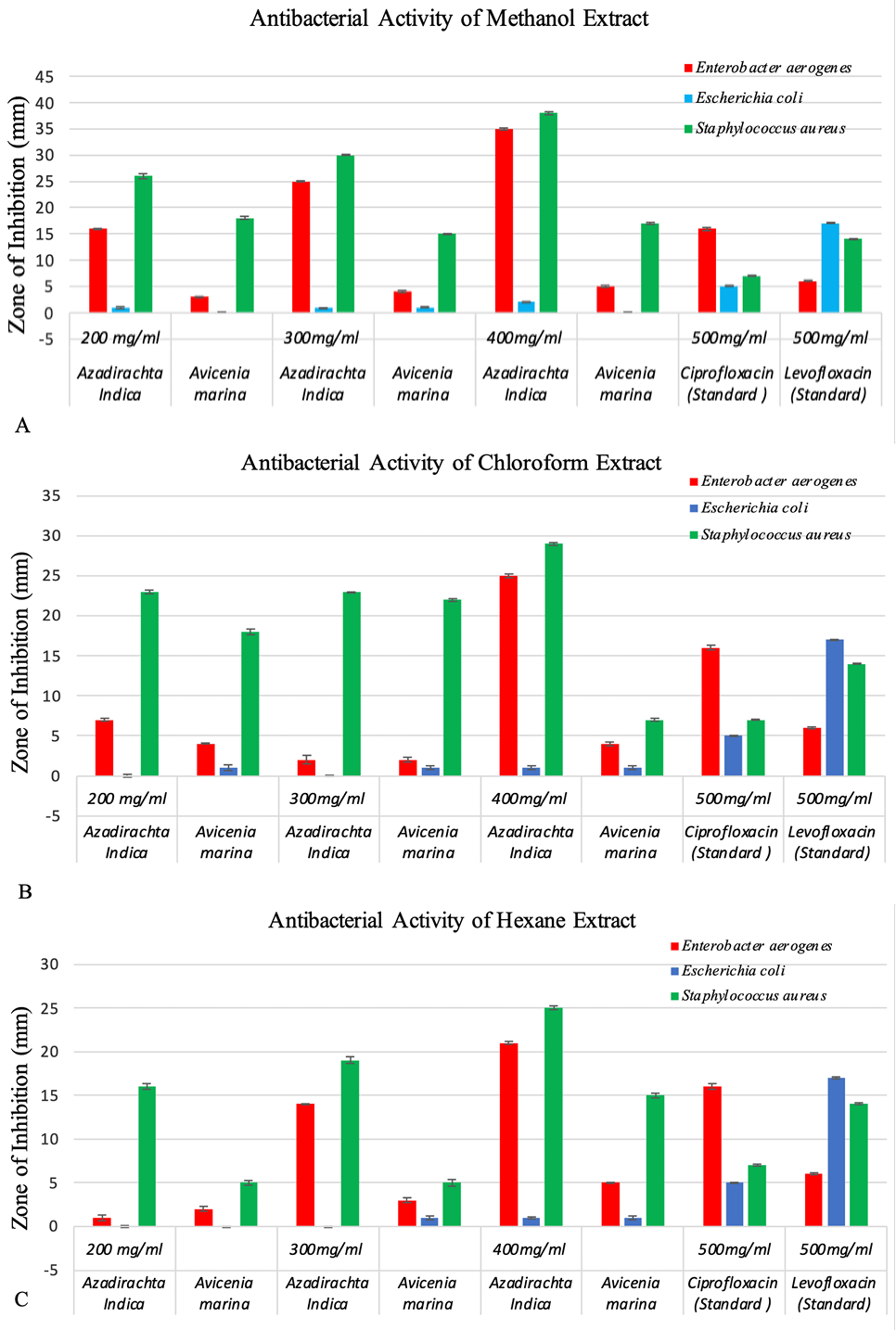
Comparative antibacterial activity of A. indica and A. marina methanol (A), chloroform (B), and hexane (C) extracts.
References
- Alzohairy, M.A., 2016. Therapeutics role of Azadirachta indica (Neem) and their active constituents in disease prevention and treatment. Evid. Based Complement. Altern. Med., 2016: 7382506. https://doi.org/10.1155/2016/7382506[CrossRef]
- Amagliani, G., Brandi, G. and Schiavano, G.F., 2012. Incidence and role of Salmonella in seafood safety. Fd. Res. Int., 45: 780-788. https://doi.org/10.1016/j.foodres.2011.06.022[CrossRef]
- Biswas, K., Chattopadhyay, I., Banerjee, R.K. and Bandyopadhyay, U., 2002. Biological activities and medicinal properties of neem (Azadirachta indica). Curr. Sci., 82: 1336–1345.
- Claeys, W.L., Cardoen, S., Daube, G., De Block, J., Dewettinck, K., Dierick, K. and Herman, L., 2013. Raw or heated cow milk consumption: Review of risks and benefits. Fd. Contr., 31: 251-262. https://doi.org/10.1016/j.foodcont.2012.09.035[CrossRef]
- Clinical and Laboratory Standards Institute, 2018. Methods for dilution antimicrobial susceptibility tests for bacteria that grow aerobically. 11th Edition CLSI Standard M07. Clinical and Laboratory Institute, Wayne, PA.
- Cowan, M.M., 1999. Plant products as antimicrobial agents. Clin. Microbiol. Rev., 12: 564-582. https://doi.org/10.1128/CMR.12.4.564[CrossRef]
- Gyawali, R. and Ibrahim, S.A., 2014. Natural products as antimicrobial agents. Fd. Contr., 46: 412-429. https://doi.org/10.1016/j.foodcont.2014.05.047[CrossRef]
- Hemaiswarya, S., Kruthiventi, A.K. and Doble, M., 2008. Synergism between natural products and antibiotics against infectious diseases. Phytomedicine, 15: 639–652. https://doi.org/10.1016/j.phymed.2008.06.008[CrossRef]
- Li, X.Z., Plésiat, P. and Nikaido, H., 2015. The challenge of efflux-mediated antibiotic resistance in Gram-negative bacteria. Clin. Microbiol. Rev., 28: 337–418. https://doi.org/10.1128/CMR.00117-14[CrossRef]
- Mostafa, A.A., Al-Askar, A.A., Almaary, K.S., Dawoud, T.M., Sholkamy, E.N. and Bakri, M.M., 2018. Antimicrobial activity of some plant extracts against bacterial strains associated with foodborne disease. Molecules, 23: 457. https://doi.org/10.1016/j.sjbs.2017.02.004[CrossRef]
- Nayak, B., Janaki, T. and Ganesan, T., 2014. Antimicrobial activity of Avicennia marina (Forsk) Vierh from Back water area of Puducherry, India. Int. J. Chem. Tech. Res. Coden, 6: 4667–4670.
- Ncube, N.S., Afolayan, A.J. and Okoh, A.I., 2008. Assessment techniques of antimicrobial properties of natural compounds of plant origin: Current methods and future trends. Afr. J. Biotechnol., 7: 1797-1806. https://doi.org/10.5897/AJB07.613[CrossRef]
- Nikaido, H., 2003. Molecular basis of bacterial outer membrane permeability revisited. Microbiol. Mol. Biol. Rev., 67: 593–656. https://doi.org/10.1128/MMBR.67.4.593-656.2003[CrossRef]
- Oliver, S.P., Jayarao, B.M. and Almeida, R.A., 2005. Foodborne pathogens in milk and the dairy farm environment: Food safety and public health implications. Foodb. Pathog. Dis., 2: 115-129. https://doi.org/10.1089/fpd.2005.2.115[CrossRef]
- Oliver, S.P., Murinda, S.E. and Jayarao, B.M., 2011. Impact of antibiotic use in adult dairy cows on antimicrobial resistance of veterinary and human pathogens: A comprehensive review. Foodb. Pathog. Dis., 8: 337-355. https://doi.org/10.1089/fpd.2010.0730[CrossRef]
- Pankey, G.A. and Sabath, L.D., 2004. Clinical relevance of bacteriostatic versus bactericidal mechanisms of action in the treatment of Gram-positive bacterial infections. Clin. Infect. Dis., 38: 864–870. https://doi.org/10.1086/381972[CrossRef]
- Savoia, D., 2012. Plant-derived antimicrobial compounds: Alternatives to antibiotics. Future Microbiol., 7: 979-990. https://doi.org/10.2217/fmb.12.68[CrossRef]
- Sultana, B., Anwar, F. and Przybylski, R., 2007. Antioxidant activity of phenolic components present in barks of Azadirachta indica, Terminalia arjuna, Acacia nilotica, and Eugenia jambolana Lam. trees. Fd. Chem., 104: 1106–1114. 1114.https://doi.org/10.1016/j.foodchem.2007.01.019[CrossRef]
- Tegos, G., Stermitz, F.R., Lomovskaya, O. and Lewis, K., 2002. Multidrug pump inhibitors uncover remarkable activity of plant antimicrobials. Antimicrob. Agents Chemother., 46: 3133–3141. https://doi.org/10.1128/AAC.46.10.3133-3141.2002[CrossRef]
- Tuney, I., Çadirci, B.H., Ünal, D. and Sukatar, A., 2006. Antimicrobial activities of the extracts of marine algae from the coast of Urla (Izmir, Turkey). Turk. J. Biol., 30: 171–175. https://dergipark.org.tr/en/pub/tbtkbiology/issue/11759/140258
- Vadlapudi, V., Naidu, K.C. and Chandrasekhar, K., 2010. Antimicrobial activity of Avicennia marina (Forsk.) Vierh. from Kakinada coast. J. Pharma. Res., 3: 2950–2952. https://www.journalijpr.com/index.php/JPR/article/view/3473
- Verraes, C., Van Boxstael, S., Van Meervenne, E., Van Coillie, E., Butaye, P., Catry, B. and Herman, L., 2014. Antimicrobial resistance in the food chain: A review. Int. J. Environ. Res. Publ. Hlth., 11: 5901-5926.
- Zhang, Q.W., Lin, L.G. and Ye, W.C., 2018. Techniques for extraction and isolation of natural products: A comprehensive review. Chinese Med., 13. https://doi.org/10.1186/s13020-018-0177-x[CrossRef]
Services
Article usage statistics
Loading…