
Plant-derived insecticides have been focused for biorational pest management because these are relatively quickly biodegradable, cost-effective, less persistent and exhibit low mammalian toxicity than synthetic pesticides. This study assessed the toxicity potential of seven local plant species (i.e. parthenium Parthenium hysterophorus L., eucalyptus Eucalyptus camaldulensis Dehnh., milkweed Calotropis gigantean (L.) Dryand., bakain Melia azedarach L., neem Azadirachta indica A. Juss., tobacco Nicotiana tabacum L. and thorn apple Datura stramonium L.) against wheat aphid (Schizaphis graminum Rondani) under laboratory and field conditions. Using foliar spray method, toxicity bioassay was conducted with three different concentrations (i.e. 250, 500 and 1000 ppm) of methanolic plant extracts under controlled laboratory conditions, while three different concentrations (25, 50 and 75 g/L) of each botanical extract was tested in the field trial. Results showed a significant mortality and suppression of S. graminum individuals at 72 h after treatment in the laboratory and at 10th day post-treatment in the field. In laboratory bioassay, maximum aphid mortality was caused by the extracts of D. stramonium (92%), A. indica (84%), N. tabacum (78%) and M. azedarach (70%) at 72 h post-treatment at their highest concentration (1000 ppm). Results of field trial showed significant aphid mortality by D. stramonium (78%), A. indica (72%), N. tabacum (68%) and M. azedarach (62%) extracts noted for their highest concentration (75 g/L) at 10th day after treatment. Based on overall results of the study, the extracts of D. stramonium, A. indica, N. tabacum and M. azedarach are recommended to be considered for biorational management of S. graminum.
Research Article · Volume 39, Issue 1, 6 March 2023 · Open Access
Evaluation of Some Selected Local Phytoextracts Against Wheat Aphid Schizaphis graminum Rondani (Hemiptera: Aphididae) under Laboratory and Field Conditions
· · · · · · ·
Affiliations & Notes ⌄
- 1Pest Warning and Quality Control of Pesticides, Punjab Agriculture Department, Government of the Punjab, Sargodha 40100, Pakistan
- 2Centre for Agriculture and Bioscience International (CABI), Rawalpindi 46000, Punjab, Pakistan
- 3Department of Entomology, University of Sargodha, Sargodha 40100, Punjab, Pakistan
- 4Department of Plant Pathology, Pir Mehr Ali Shah Arid Agriculture University Rawalpindi (PMAS-AAUR), Rawalpindi 46000, Punjab, Pakistan
- 5Institute of Soil and Environmental Sciences, PMAS-Arid Agriculture University, Rawalpindi, Pakistan. *Correspondence | Talha Nazir, Centre for Agriculture and Bioscience International (CABI), Rawalpindi 46000, Punjab, Pakistan
- 6Email: talha23december@gmail.com
Article Info ⌄
- Journal:
- Sarhad Journal of Agriculture
- Published:
- 6 March 2023
Abstract
Introduction
Wheat (Triticum aestivum L.) is the most economical and nutritious staple food around the world . It is consumed by more than 35% world human population . About 70% of the total population of Pakistan consume wheat grains, therefore it is imperative to improve its yield to feed growing population (FAO, 2019). Pakistan’s average wheat yield is much less as compared to other wheat producing countries for which multiple factors are involved including inappropriate sowing schedule, insect pest and weed infestations, use of low yielding varieties and inappropriate use of fertilizers and irrigation water ; ; ; .
Wheat crop in Pakistan is attacked and damaged by several insect pests but among these pests aphids (Hemiptera: Aphididae) are responsible for the foremost economic damage not only by their direct feeding on wheat plants but also by vectoring different plant diseases ; . In Pakistan, the most abundant and prevailing species of wheat aphids include Sitobion avenae Fabricius, Rhopalosiphum padi Linnaeus and Schizaphis graminum Rondani ; ; . These aphid species result in 35–40% yield reduction by their direct feeding on plant sap and from 20 to 80% yield reduction indirectly by transmitting some fungal and viral diseases ; . Up to 30% yield loss has been noted in an untreated experimental wheat field by S. graminum infestation .
In Pakistan, different types of synthetic pesticides are being employed for the management of aphid infestations on wheat and other crops . Anyhow many species of the aphids got resistant to several of these synthetic insecticides ; . In case of wheat crop, only a small range of registered synthetic insecticides exist for aphid control which is ultimately resulting in lesser production of wheat . It is also predicted that ongoing climate changes are also favourable for aphid infestations on wheat crop which could reduce wheat production and impact negatively the world economy ; Van der Putten et al., 2010; . All these facts mentioned demand an alternative management strategy against wheat aphids to ensure future food security through sustainable wheat production. Moreover, excessive use of synthetic chemical insecticides has imparted adverse effects on human and animal health as well as on the environment ; ; ; ; .
Plant-derived pesticides, such as botanical extracts and essential oils, have been a promising biorational strategy for the management of insect pests . Botanical pesticides have some advantages over their synthetic counterparts such as these pesticides usually exhibit less mammalian toxicity and environmental persistency and are more environment-friendly than synthetic insecticides ; . Botanical pesticides exert lethal and sublethal effects on insect pests including mortality, repellency, ovipositioning deterrence, ovicidal effects, and reduced fertility and longevity . Extracts of many plant species have been evaluated and demonstrated effective against many insect pests including aphids ; . To this end, this research work was intended to comparatively evaluate the toxicity potential of methanolic extracts of seven indigenous plant species against S. graminum aphids on wheat plants both under laboratory and field conditions.
Materials and Methods
Insect culture
Collection for mass rearing of wheat aphids (S. graminum) was made from wheat (variety Faisalabad-2008) field (32°08’21’’N; 72°40’11’’E) near Tehsil Sillanwali, District Sargodha, Punjab, Pakistan. Alate and apterous morphs of S. graminum are usually 1.2 to 2.0 mm long pale green to yellowish green individuals with a median dark green longitudinal line on abdominal notum (Figure 1). This aphid population was reared in the laboratory conditions at 25±2°C of temperature and 55–65% relative humidity under photoperiod of 16:8 L:D hours on the plants of same wheat variety grown in pots at College of Agriculture, University of Sargodha, Sargodha, Punjab, Pakistan. During rearing, old infested plants were replaced with new ones at weekly intervals.
Plants extracts
Seven plant species belonging to five botanical families (Table 1) were selected for the study and their fresh leaves were collected in August 2020 from Sargodha, Punjab, Pakistan. This selection of plant species was made on the basis of their wide availability in district Sargodha and on their literature-based insecticidal properties. For each plant species, one kilogram of healthy leaves was collected, shade-dried and grounded into powder using mortar and pestle in liquid nitrogen. The extraction of plant samples was done following procedure described by Khan et al. (2017). From each sample, five grams of powdered leaves were extracted with 100 mL of 95% methanol by keeping for 2 days in a thermostat water shaker at 35°C temperature. Then, these extracts were cooled down to room temperature (25°C) and were centrifuged for 15 min at 7000 rpm. Then the supernatant was acquired by using Whatman filter paper No. 1 with three repetitions for getting pure supernatant. Later on, this supernatant was passed by a Buchner funnel in the rotary evaporator at 30°C temperature. The process of evaporation of excessive solvent was completed by adjusting the volume of each plant extract to about 100 mL, and got each plant extract in resultant pellet. Each pellet (plant extract) was then mixed in a 1.0% aqueous solution of dimethyl sulfoxide (DMSO) with a final concentration of 50 mg/mL. The final products of all plant extracts were kept at 4°C temperature in air-tight dark glass vials to be used for bioassays.
Laboratory bioassay
The bioassay was carried out against S. graminum under laboratory conditions to assess the efficacy of above mentioned plant extracts. Three different concentrations of each plant extract (i.e. 250, 500 and 1000 ppm) and one control were used as treatment. Seven-day old potted wheat (T. aestivum; variety Faisalabad-2008) plants were used for bioassay. After infesting wheat plants with the test insects, each wheat plant was sprayed with approximately 4 mL of each plant extract concentration using a manual atomizer. Plant extracts were sprayed directly on wheat plants. For the determination of insecticidal efficacy of these plant extracts, data regarding aphid mortality was taken with the help of a 3X magnifying hand lens after 24, 48 and 72 h post-treatment. For all treatments, five replications were maintained. Bioassay was conducted at controlled conditions (i.e. at 25±2°C temperature, 50-60% relative humidity and 16:8 h light: dark photoperiod).
Field experiment
For evaluating the efficacy of these plant extracts against S. graminum, a field trial was conducted at tehsil Sillanwali (Sargodha, Punjab, Pakistan) during the Rabi Season 2020-2021. Three concentrations (i.e. 25, 50 and 75 g/L) of all plant extracts were used along with one control plot. Wheat variety Faisalabad-2008 was sown for the application of these above-mentioned treatments. Plot size was 45 × 100 feet. For each plot, approximately 15 litre solution of each plant extract was sprayed using a Knapsack sprayer which was calibrated before use. Control plots were sprayed with water only. The data for aphid population reduction was noted after 4, 7 and 10 days post-application. For each treatment, three replications/blocks were maintained for each treatment. Uniform agronomic practices were adopted for all experimental plants.
Table 1: Plant species used in the study.
| S. No. | Vernacular name | Scientific Name | Family |
| 1 | Gajar booti | Parthenium hysterophorus L. | Asteraceae |
| 2 | Sofeda | Eucalyptus camaldulensis Dehnh. | Myrtaceae |
| 3 | Akk | Calotropis gigantean (L.) Dryand. | Apocynaceae |
| 4 | Bakain | Melia azedarach L. | Meliaceae |
| 5 | Tobacco | Nicotiana tabacum L. | Solanaceae |
| 6 | Neem | Azadirachta indica A. Juss. | Meliaceae |
| 7 | Stinkweed | Datura stramonium L. | Solanaceae |
Table 2: Factorial analysis of variance (ANOVA) comparison of the mortality of S. graminum individuals bioassayed against different plant extracts (See Figure 1).
| Source | DF | SS | MS | F-value | *p-value |
| Concentration | 3 | 1000.52 | 333.507 | 886.54 | ≤ 0.001 |
| Time | 2 | 889.16 | 444.581 | 1181.80 | ≤ 0.001 |
| Treatment | 6 | 122.06 | 20.343 | 54.08 | ≤ 0.001 |
| Concentration × Time | 6 | 424.06 | 70.676 | 187.87 | ≤ 0.001 |
| Concentration × Treatment | 18 | 50.10 | 2.783 | 7.40 | ≤ 0.001 |
| Time × Treatment | 12 | 36.17 | 3.014 | 8.01 | ≤ 0.001 |
| Concentration × Time × Treatment | 36 | 19.28 | 0.535 | 1.42 | 0.0599 |
| Error | 336 | 126.40 | 0.376 | ||
| Total | 419 | 2667.74 | |||
| CV/GM | 23.70/2.588 |
* p ≤ 0.001 (highly significant) and p < 0.05 (significant); three-way factorial analysis of variance (ANOVA) at α = 0.05. DF: Degree of freedom, SS: Sum of squares, MS: Mean sum of squares, F: F-statistic, CV: Coefficient of variation, GM: Grand mean.
Statistical analysis
Statistix® Software (V. 8.1; Analytical Software, Tallahassee, FL, USA) was used for the statistical interpretation of data. Three to five independent replications were run for all determinations and bioassays. Mean values of data are presented in figures along with standard error values. Factorial analysis of variance (ANOVA) was applied and the treatment means were further compared by Fisher’s least significant difference (LSD) post-hoc test at 5% standard probability level.
Results and Discussion
Insecticidal effect of plant extracts on S. graminum under laboratory conditions
Results of laboratory bioassay revealed that all seven extracts showed a substantial mortality of S. graminum (F = 54.08, p < 0.001; Table 2). Moreover, a significant impact of plant extract concentrations, exposure time intervals and of their interaction has been shown by factorial ANOVA on the mean S. graminum mortality (F= 886.54, p < 0.001, F= 1181.80, p < 0.001 and F= 187.87, p < 0.001, respectively; Table 2). Plant extracts of D. stramonium caused substantial mortality of S. graminum for all concentrations. Nonetheless, maximum mortality (92%) was noted at 72 h post-treatment at 1000 ppm concentration, while minimum mortality (46%) was noted at the lowest concentration of D. stramonium (i.e., 250 ppm) (Figure 2). The toxicity of A. indica extract against S. graminum revealed a related trend as in D. stramonium. Maximum mean mortality (84%) of S. graminum was noted at 72 h post-treatment through the concentration of 1000 ppm, whereas the minimum mortality (44%) was noted by 250 ppm concentration (Figure 2). Maximum aphid mortality was noted at 72 h post-treatment by 1000 ppm concentration of the extracts of M. azedarach (70%), C. gigantean (66%), E. camaldulensis (60%) and P. hysterophorus (54%) and minimum mortality (36, 34, 26 and 22%) was noted at the lowest concentration (i.e. 250 ppm) after 72 h of treatment. In untreated (control) Petri dishes, mean S. graminum mortality remained about 5%.
Efficacy of plant extracts against S. graminum under field conditions
Results of the field trial exhibited that all tested plant extracts showed considerable mortality of S. graminum individuals (F = 96.03, p < 0.001; Table 3). Moreover, factorial ANOVA showed a significant impact of all plant extract concentrations (F = 585.02, p < 0.001), time intervals (F = 753.76, p < 0.001) and of their interaction (F = 120.64, p < 0.001) on mean aphid mortality (Table 3). Maximum mortality of S. graminum was noted by D. stramonium (78%) at the highest concentration of 75 g/L on 10th day post-treatment, while the lowest concentration (25 g/L) of D. stramonium caused minimum aphid mortality (52%) at 10th day post-treatment (Figure 3). Whereas maximum mortality of aphids was witnessed in A. indica (72%), N. tabacum (68%), M. azedarach (62%), C. gigantean (54%), E. camaldulensis (48%) and P. hysterophorus (40%) at their highest concentrations and the minimum mortality was noted by A. indica (44%), N. tabacum (36%), M. azedarach (28%), C. gigantean (22%), E. camaldulensis (18%) and P. hysterophorus (14%) at the lowest concentration (25 g/L) on 10th day post-treatment (Figure 3). Mean percent mortality of S. graminum was recorded by D. stramonium (66%), A. indica (64%), N. tabacum (54%), M. azedarach (50%), C. gigantean (42%), E. camaldulensis (34%) and P. hysterophorus (26%) by the higher concentration (75 g/L) and mean percent mortality of S. graminum was recorded in D. stramonium (50%), A. indica (46%), N. tabacum (38%), M. azedarach (34%), C. gigantean (30%), E. camaldulensis (24%) and P. hysterophorus (16%) at 50 g/L concentration on 7th day post-treatment (Figure 3). Mean mortality of S. graminum in the untreated (control) plots was about 6% after 10th day post-treatment.
Over the last few decades, cereal aphids (S. avenae, S. graminum and R. padi) have been very common wheat crop pests and pose a major threat to wheat production in Pakistan . The use of eco-friendly insecticides is also a part of an integrated management strategy against wheat aphids for the reduction of economic losses . For quick and efficient minimization of yield losses, several synthetic pesticides have been found effective . But the chances for accumulation of toxic residual compounds in wheat grain make it a less desirable remedy for the management of wheat aphid, which is our staple food.
The development of biorational control methods such plant extracts have been a vital aspect of plant protection research. The application of botanical extracts and plant essential oils exhibit potential to control aphids ; . The current research work demonstrated in-vitro and in-situ efficacy of seven local plant extracts against S. graminum. Results of the study have revealed that all plant extracts tested might be effective biopesticides for aphid management. Results of this work are corroborated by those of some previous studies demonstrating the efficacy of various plant extracts against wheat aphid S. graminum and some other species of aphid ; .
Table 3: Factorial analysis of variance (ANOVA) comparison of mortality of S. graminum treated with different concentrations of plant extracts (See Figure 2).
| Source | DF | SS | MS | F-value | *P-value |
| Concentration | 3 | 635.17 | 211.723 | 585.02 | ≤ 0.001 |
| Time | 2 | 545.58 | 272.788 | 753.76 | ≤ 0.001 |
| Treatment | 6 | 208.52 | 34.754 | 96.03 | ≤ 0.001 |
| Concentration × Time | 6 | 261.97 | 43.661 | 120.64 | ≤ 0.001 |
| Concentration × Treatment | 18 | 72.85 | 4.047 | 11.18 | ≤ 0.001 |
| Time × Treatment | 12 | 38.39 | 3.199 | 8.84 | ≤ 0.001 |
| Concentration × Time × Treatment | 36 | 18.07 | 0.502 | 1.39 | 0.0748 |
| Error | 336 | 121.60 | 0.362 | ||
| Total | 419 | 1902.14 | |||
| CV/GM | 25.55/2.3548 |
In laboratory bioassay, resulted mortality of S. graminum was found time- and dose-dependent as it increased along with the concentrations of the plant extracts and along with the exposure time. Extracts of D. stramonium, A. indica, N. tabacum, M. azedarach, C. gigantean, E. camaldulensis and P. hysterophorus caused 92, 84, 78, 70, 66, 60 and 54% and 78, 72, 68, 62, 54, 48 and 40% mortality at 72 h and 10 days post treatment applications in laboratory and field experiments, respectively. These findings validate the conclusions of Roy et al. (2005) who reported maximum mortality (100%) by some botanical insecticides against S. graminum. Plant extracts are found to be a favourable alternative to conventional synthetic insecticides for the effectiveness against a wide range of agricultural insect pests. The results of a current research study are also in accordance with the results of Sohail et al. (2012) for suppressing the population of aphids with an application of plant extracts. Several experimental studies have reported the effectiveness of A. indica formulation against aphids ; ; . Our results are also in line with Esparza-Díaz et al. (2010) who have reported the effectiveness of A. indica (aqueous extract) with good insecticidal properties against A. gossypii after a time period of 72 h post-treatment. Formulations of A. indica show not only contact and systemic actions but also work as a growth inhibitor, toxicological repellent, sterilant and antifeedant against various insects .
However, the results of our findings are also different from some other similar studies. This could be because of the differential response of the targeted insect pest species against a specific plant extract and the varied toxicity of the plant extracts. Earlier studies have shown that plant extracts of many medicinal plant species have different levels of efficacy against different pest species. Likewise, the determination of the toxicity of seven different phytoextracts against four different insect pests revealed that aphids were highly susceptible to all plant extracts which were tested in the study causing 100 % aphid mortality after 24 h of application .
In another study, plant extracts from Asteraceae family were tested against cabbage aphid Brevicoryne brassicae and were found non-toxic to predatory beetle Coccinella undecimpunctata and C. carnea . Similarly, while using plant extracts of nine Ghanaian plants, it was observed that aphid B. brassicae was effectively controlled with plant extracts as done by the conventional pesticides e.g. emamectin benzoate, and these plant extracts were proven less harmful to ladybird beetles . According to another research, it is also believed that products based on plants give effective efficacy against insect pests but they also harm some non-target and beneficial insects including natural enemies and pollinators ; . Furthermore, some field studies showed that plant extracts were effective against aphids but were harmless to natural enemies of aphids .
It is well-known that anti-insect and toxicological properties of plant-based pesticides are due to the existence of some secondary plant metabolites for example alkaloids, flavonoids, terpenoids and quinines . According to an estimation, approximately about 9,000 different flavonoid compounds are present in plants. These compounds play several vital functions in plants such as they reduce digestibility, decrease nutritional value and work as toxins or anti-feeding agents for insects . The flavonoids are usually cytotoxic and effect on the growth, development and behaviour of phytophagous insect pests .
Conclusions and Recommendations
This study in brief has demonstrated the insecticidal efficacy of seven local plant extracts, particularly of A. indica, D. stramonium and N. tabacum against wheat aphid S. graminum causing 54–92% and 40–78% mortality under laboratory and field conditions, respectively. Therefore, in view of the aforementioned concerns of synthetic insecticides, these plant extracts are recommended to be incorporated in future integrated management of wheat aphid S. graminum as biorational pest control tools.
Acknowledgments
The authors thank Dr. Dewen Qiu (Deputy Director of the Institute of Plant Protection, Chinese Academy of Agricultural Sciences, Beijing) for his technical advice during research work.
Novelty Statement
This study demonstrated the comparative toxicity potential of methanolic extracts of seven local plant species against cereal aphid Schizaphis graminum and has showed the effectiveness of neem (A. indica), thorn apple (D. stramonium) and tobacco (N. tabacum) extracts against aphids both under laboratory and field conditions.
Author’s Contribution
SH performed experiments and prepared first draft. MT helped in data collection in laboratory and field. TA conducted the field study and collected data. TN performed statistical analyses and prepared results. MZM conceived the research idea and technically proofread the draft. TA helped in conduction of field experiment. MA helped in conduction and data collection f of laboratory bioassay. ZA performed statistical analyses and prepared results.
List of abbreviations
Kg: kilogram; L:D: light and dark; mL: millilitre; Rpm: revolutions per minute; mg: milligram; DMSO: dimethyl sulfoxide; ppm: parts per million; h: hours; DAT: days after treatment; CV: coefficient of variation; DF: degree of freedom; F: F-statistic; GM: grand mean; MS: mean sum of squares; SS: sum of squares.
Funding
This research was funded by the Pest Warning and Quality Control of Pesticides, Punjab Agriculture Department, Government of the Punjab, Pakistan.
Conflict of interest
The authors have declared no conflict of interest.
Figures
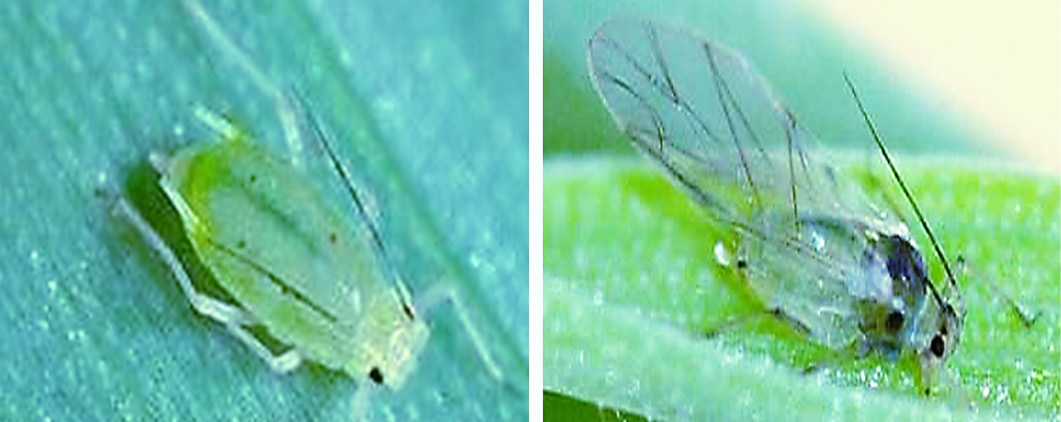
Apterous and alate morphs of wheat aphid Schizaphis graminum (Rondani, 1852).
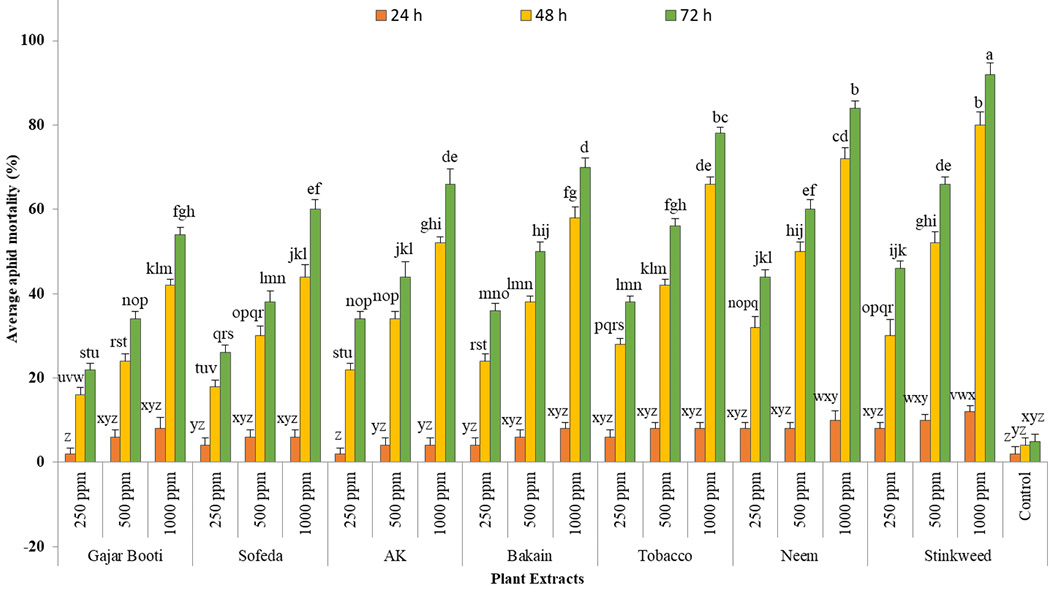
Percent mortality (mean ± SE; n = 5) of S. graminum by methanolic plant extracts recorded at different time intervals. Treatment columns bearing different lowercase letters are significantly different from other treatments (factorial ANOVA followed by LSD test at α = 0.05) (See Table 2).
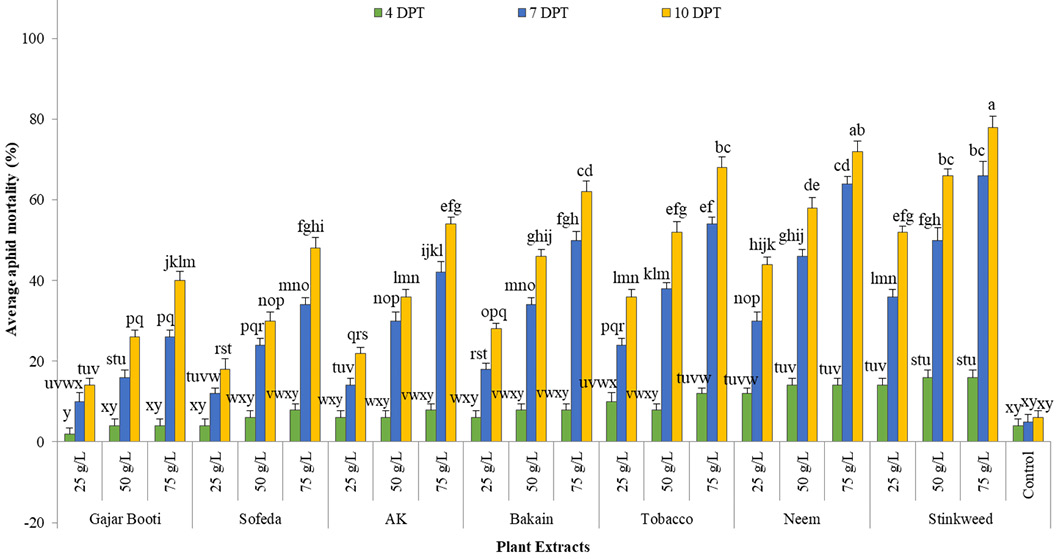
Percent mortality (mean ± SE; n = 5) of S. graminum by different plant extracts recorded at difference time intervals. DAT = days after treatment. Treatment columns bearing different lowercase letters are significantly different from other treatments (factorial ANOVA followed by LSD test at α = 0.05) (See Table 3).
References
- Abdel-Rahman, R.S., T.A. Mohamed, M.E.F. Hegazy and K.A. Abdelshafeek. 2019. Laboratory and field evaluation of certain wild plant extracts against Aphis fabae Scop.(Homoptera: Aphididae) and its predators. Bull. Natl. Res. Cent., 43: 1–5. https://doi.org/10.1186/s42269-019-0084-z[CrossRef]
- Ahmad, T., W.H. Muhammad, M. Jamil and J. Iqbal. 2016. Population dynamics of aphids (Hemiptera: Aphididae) on wheat varieties (Triticum aestivum L.) as affected by abiotic conditions in Bahawalpur, Pakistan. Pak. J. Zool., 48: 1039–1044.
- Ali, S., S. Khalid, S. Ali, K. Akhtar, M.S. Khan, A. Ali, A. Sarmad, S. Hussain, S. Fahad and F. Khan. 2015. Preferential influence of wheat genotypes on the distribution pattern and population dynamics of cereal aphids and their natural enemies in Peshawar valley. Pak. J. Zool., 47: 223–233.
- Amoabeng, B.W., G.M. Gurr, C.W. Gitau, H.I. Nicol, L. Munyakazi and P.C. Stevenson. 2013. Tri-trophic insecticidal effects of African plants against cabbage pests. PLoS One, 8: e78651. https://doi.org/10.1371/journal.pone.0078651[CrossRef]
- Bedini, S., S. Guarino, M.C. Echeverria, G. Flamini, R. Ascrizzi, A. Loni and B. Conti. 2020. Allium sativum, Rosmarinus officinalis, and Salvia officinalis essential oils: A spiced shield against blowflies. Insects, 11: 143. https://doi.org/10.3390/insects11030143[CrossRef]
- Bezemer, T.M., T.H. Jones and K.J. Knight. 1998. Long-term effects of elevated CO2 and temperature on populations of the peach potato aphid Myzus persicae and its parasitoid Aphidius matricariae. Oecologia, 116: 128–135. https://doi.org/10.1007/s004420050571[CrossRef]
- Bukvayová, N., M. Henselová, V. Vajcíková and T. Kormanová. 2006. Occurrence of dwarf virus of winter wheat and barley in several regions of Slovakia during the growing seasons 2001-2004. Plant Soil Environ., 52: 392. https://doi.org/10.17221/3457-PSE[CrossRef]
- Carvalho, F.P., 2006. Agriculture, pesticides, food security and food safety. Environ. Sci. Policy, 9: 685–692. https://doi.org/10.1016/j.envsci.2006.08.002[CrossRef]
- Czaja, K., K. Góralczyk, P. Struciński, A. Hernik, W. Korcz, M. Minorczyk and J.K. Ludwicki. 2015. Biopesticides–towards increased consumer safety in the European Union. Pest Manag. Sci., 71: 3–6. https://doi.org/10.1002/ps.3829[CrossRef]
- da Silva, E.M., A.R. Roel, K.R.A. Porto, M.E. Falco and R. Matias. 2017. Insecticidal effect of the ethanol extract of Baccharis dracunculifolia (Asterales: Asteraceae). Rev. Biol. Trop., 65: 517–523. https://doi.org/10.15517/rbt.v65i2.25712[CrossRef]
- Duman, M. and C. Mutlu. 2019. Efficacy of different sampling methods in pest monitoring of direct seeded rice at different growth stages. Appl. Ecol. Environ. Res., 17: 10207–10220. https://doi.org/10.15666/aeer/1704_1020710220[CrossRef]
- Esparza-Díaz, G., J. López-Collado, J.A. Villanueva-Jiménez, F. Osorio-Acosta, G. Otero-Colina and E. Camacho-Díaz. 2010. Azadirachtin concentration, insecticide efficacy and phytotoxicity of four neem Azadirachta indica A. Juss. extracts. Agrociencia, 44: 821–833.
- FAO, 2019. Food and agricultural commodities production: Countries by commodity.
- Farag, N.A. and I.A. Ismasil. 1999. The comparative effect of certain insecticides and Plant extracts on the cabbage aphid, Brevicoryne brassicae L. and its natural enemies. Egypt. J. German Soc. Zool., 30: 281–290.
- Farooq, Z., S. Fareed, H. Karar, M. Rubab and S.F.H. Shah. 2016. Efficacy of some botanical extracts against wheat aphids Sitobion avenae (Homoptera: Aphididae) and their impact on predators population. J. Agric. Res., 54: 697–706.
- Foster, S.P., V.L. Paul, R. Slater, A. Warren, I. Denholm, L.M. Field and M.S. Williamson. 2014. A mutation (L1014F) in the voltage‐gated sodium channel of the grain aphid, Sitobion avenae, is associated with resistance to pyrethroid insecticides. Pest Manage. Sci., 70: 1249–1253. https://doi.org/10.1002/ps.3683[CrossRef]
- Gahukar, R.T., 2000. Use of neem products/pesticides in cotton pest management. Int. J. Pest Manag., 46: 149–160. https://doi.org/10.1080/096708700227516[CrossRef]
- Hafeez, F., M. Abbas, K. Zia, S. Ali, M. Farooq, M. Arshad and M.J. Ansari. 2021. Prevalence and management of aphids (Hemiptera: Aphididae) in different wheat genotypes and their impact on yield and related traits. PLoS One, 16: e0257952. https://doi.org/10.1371/journal.pone.0257952[CrossRef]
- Iqbal, M.F., M.H. Kahloon, M.R. Nawaz and M.I. Javaid. 2011. Effectiveness of some botanical extracts on wheat aphids. J. Anim. Plant Sci., 21: 114–115.
- Isman, M.B., 2020. Botanical insecticides in the twenty-first century fulfilling their promise? Annu. Rev. Entomol., 65: 233-249. https://doi.org/10.1146/annurev-ento-011019-025010[CrossRef]
- John, F., N.A. Saeed, S. Nadeem and M. Hamed. 2017. Integration of planting time and insecticide to manage aphid infestations in wheat for better crop productivity. Pak. J. Zool., 49: 1343–1351. https://doi.org/10.17582/journal.pjz/2017.49.4.1343.1351[CrossRef]
- Khakwani, A.A., M.D. Dennett, M. Munir and M. Abid. 2012. Growth and yield response of wheat varieties to water stress at booting and anthesis stages of development. Pak. J. Bot., 44: 879–886.
- Khan, A.M., A.A. Khan, M. Afzal and M.S. Iqbal. 2012. Wheat crop yield losses caused by the aphids infestation. J. Biofertil. Biopestic., 3: 2–7.
- Khan, M.R., F.M. Anjum, T. Zahoor and H. Nawaz. 2009. Biochemical and technological characterization of Pakistani spring wheats. Pak. J. Agric. Sci., 46: 271–279.
- Khan, S., C.N.T. Taning, E. Bonneure, S. Mangelinckx, G. Smagghe and M.M. Shah. 2017. Insecticidal activity of plant-derived extracts against different economically important pest insects. Phytoparasitica, 45: 113–124. https://doi.org/10.1007/s12600-017-0569-y[CrossRef]
- Mamay, M. and C. Mutlu. 2019. Optimizing container size and rearing density for rapid and economic mass rearing of Oenopia conglobata (Linnaeus, 1758)(Coleoptera: Coccinellidae). Turk. J. Entomol., 43: 395–408. https://doi.org/10.16970/entoted.562724[CrossRef]
- Melesse, T. and S.K. Singh. 2012. Effect of climatic factors on pea aphid, Acyrthosiphon pisum Harris (Homoptera: Aphididae) population and its Management through planting dates and biopesticides in field pea (Pisum sativum L.). J. Agric. Technol., 8: 125–132.
- Memon, R.A., G.R. Bhatti, S. Khalid, A. Mallah and S. Ahmed. 2013. Illustrated weed flora of wheat crop of Khairpur District, Sindh. Pak. J. Bot., 45: 39–47.
- Mierziak, J., K. Kostyn and A. Kulma. 2014. Flavonoids as important molecules of plant interactions with the environment. Molecules, 19: 16240–16265. https://doi.org/10.3390/molecules191016240[CrossRef]
- Mutlu, Ç., V. Karaca, A. Tonğa, Ş. Erol and M. Mamay. 2019. Infestation and damage caused by Wheat stem sawflies (Hymenoptera: Cephidae) to some wheat cultivars in Southeast Anatolia Region, Turkey. J. Kans. Entomol. Soc., 92: 359–375. https://doi.org/10.2317/0022-8567-92.1.359[CrossRef]
- Nazir, T., S. Khan and D. Qiu. 2019. Biological control of insect pest. In pests-insects, management, control. Intech Open. https://doi.org/10.5772/intechopen.81431[CrossRef]
- Nong, X., F.Z. Chen, Y.J. Yang, Z. Liang, B.L. Huang, Y. Li and H. Yu. 2015. Aphicidal activity of an ageraphorone extract from Eupatorium adenophorum against Pseudoregma bambucicola (Homoptera: Aphididae, Takahashi). J. Insect Sci., 15: 81. https://doi.org/10.1093/jisesa/iev060[CrossRef]
- Riaz, M.F., A.B.M. Raza, M.Z. Majeed and T. Nazir. 2022. Diversity and species distribution of Aphids (Hemiptera: Aphididae) in district Sargodha (Punjab, Pakistan). Sarhad J. Agric., 38(2): 540–547. https://doi.org/10.17582/journal.sja/2022/38.2.540.547[Full text][CrossRef]
- Roy, B., R. Amin, M.N. Uddin, A. Islam, M.J. Islam and B.C. Halder. 2005. Leaf extracts of Shiyalmutra (Blumea lacera Dc.) as botanical pesticides against lesser grain borer and rice weevil. J. Biol. Sci., 5: 201–204. https://doi.org/10.3923/jbs.2005.201.204[CrossRef]
- Sallam, A.A., C. Volkmar and N.E. El-Wakeil. 2009. Effectiveness of different bio-rational insecticides applied on wheat plants to control cereal aphids. J. Plant Dis. Prot., 116: 283–287. https://doi.org/10.1007/BF03356325[CrossRef]
- Shafique, M.A., K.S. Ahmed, N. Haider, R.R. Khan and M.Z. Majeed. 2016. Field evaluation of different insecticides against wheat aphid (Schizaphis graminum Rondani) and comparative yield assessment for different wheat cultivars. Acad. J. Entomol., 9(1): 1-7.
- Shah, A.K., H.N. Farmanullah, A.U.R. Saljoqi, Y. Hayat and S. Sattar. 2006. Distribution pattern of the cereals aphids in the wheat growing areas of the province Khyber Pukhtunkhwa of Pakistan. Sarhad J. Agric., 22: 655–959.
- Shahzad, M.W., M. Razaq, A. Hussain, M. Yaseen, M. Afzal and M.K. Mehmood. 2013. Yield and yield components of wheat (Triticum aestivum L.) affected by aphid feeding and sowing time at Multan, Pakistan. Pak. J. Bot., 45: 2005–2011.
- Simmonds, M.S.J. 2003. Flavonoid insect interactions: recent advances in our knowledge. Phytochemistry, 64: 21–30. https://doi.org/10.1016/S0031-9422(03)00293-0[CrossRef]
- Simon, A.L., J.C. Caulfield, K.E. Hammond-Kosack, L.M. Field and G.I. Aradottir. 2021. Identifying aphid resistance in the ancestral wheat Triticum monococcum under field conditions. Sci. Rep., 11: 1–12. https://doi.org/10.1038/s41598-021-92883-9[CrossRef]
- Sohail, A., F.S. Hamid, A. Waheed, N. Ahmed, N. Aslam, Q. Zaman and S. Islam. 2012. Efficacy of different botanical materials against aphid Toxoptera aurantii on tea (Camellia sinensis L.) cuttings under high shade nursery. J. Mater. Environ. Sci., 3: 1065–1070.
- Tang, Y.Q., A.A. Weathersbee and R.T. Mayer. 2002. Effect of neem seed extract on the brown citrus aphid (Homoptera: Aphididae) and its parasitoid Lysiphlebus testaceipes (Hymenoptera: Aphidiidae). Environ. Entomol., 31: 172–176. https://doi.org/10.1603/0046-225X-31.1.172[CrossRef]
- Teke, M.A. and Ç. Mutlu. 2021. Insecticidal and behavioral effects of some plant essential oils against Sitophilus granarius L. and Tribolium castaneum (Herbst). J. Plant Dis. Prot., 128: 109–119. https://doi.org/10.1007/s41348-020-00377-z[CrossRef]
- Van der Putten, W.H., M. Macel and M.E. Visser. 2010. Predicting species distribution and abundance responses to climate change: why it is essential to include biotic interactions across trophic levels. Philos. Trans. R. Soc. B Biol. Sci., 365: 2025–2034. https://doi.org/10.1098/rstb.2010.0037[CrossRef]
- Vivekanandhan, P., S. Senthil-Nathan and M.S. Shivakumar. 2018. Larvicidal, pupicidal and adult smoke toxic effects of Acanthospermum hispidum (DC) leaf crude extracts against mosquito vectors. Physiol. Mol. Plant Pathol., 101: 156–162. https://doi.org/10.1016/j.pmpp.2017.05.005[CrossRef]
- Yahya, M., N.A. Saeed, S. Nadeem, M. Hamed and S. Shokatt. 2017. Role of wheat varieties and insecticide applications against aphids for better wheat crop harvest. Pak. J. Zool., 49: 2217–222. https://doi.org/10.17582/journal.pjz/2017.49.6.2217.2225.[CrossRef]
Services
Article usage statistics
Loading…