
Stigmaeopsis inthanonsis Saito, Kongchuensin and Sahara has been reported recently from Miscanthus spp. in Thailand. Like many other species of the genus Stigmaeopsis, S. inthanonsis has characteristics of nest weaving behavior on the host plant surface. Waste management behaviour of many Stigmaeopsis species are well described by many scientists but waste management behaviour of S. inthanonsis is still unknown. Here, we studied nest relocation and waste management behaviour of S. inthanonsis. Results showed that fecal piles, dead bodies and exuviae are the waste materials of S. inthanonsis nests. The defecation behaviour showed that S. inthanonsis deposited the less fecal pellets at the entrance of nest and more fecal pellets near their original feces using both tactile cues and excrement cues. More than 80% S. inthanonsis used excrement cues during defecation. Nest relocation patterns showed that S. inthanonsis could relocate when nest was completely damaged. Relocation pattern was different among immature-stages and adults. Nymphs and larvae relocated nest when there was abundance of exuviae whereas adults did not relocate. Adults could extend their original nest when it was filled with exuviae. Alive individuals lived with dead individuals and they did not remove the dead ones from nests. These findings highlight the hygienic challenges, adaptation of social living organisms, and demonstrated how sanitary behaviour can result from a combination of evolutionary history. Nest relocation findings suggest that larvae, nymphs and adults adjust relocation patterns based on conditions they faced.
Research Article · Volume 55, Issue 3, 19 April 2023 · Open Access
Ethology of Waste Management and Nest Relocation of Stigmaeopsis inthanonsis (Acari: Tetranychidae)
· · · · ·
Affiliations & Notes ⌄
- 1Institute of Entomology, Guizhou University, Provincial Key Laboratory for Agricultural Pest Management of Mountainous Regions, and Scientific Observing and Experimental Station of Crop Pest in Guiyang, Ministry of Agriculture and Rural Affairs, P. R. China, Guiyang 550025, P. R. China. * Corresponding author: daochaojin@126.com, yitianci@msn.com
Article Info ⌄
- Journal:
- Pakistan Journal of Zoology
- Published:
- 19 April 2023

From the article
- Our results showed that excrement cues play an important role in the defecation behaviour of S. inthanonsis.
- Nest relocation is variable between the immatures and adults.
- Further studies are need to carry out to know how much distance they covered during relocation, either they like to relocate closer nests or little far nests?
- What is the effect of relocation on the feces pattern and S. inthanonsis survival?
Selected from the article's own text.
Abstract
Introduction
Nest sanitation is defined as the removal of unwanted object that is not an intact and viable egg or young from the nest . A living style in human beings and insect pest societies is that the more population, the more challenges in waste disposal . Wastes are unpleasant and facilitate the disease infections ; . The waste of leaf-cutting ants, Acromyrmex echinator, is very harmful to themselves because it concentrates fungi Escovopsis, which is pathogenic to Acromyrmex . Waste management is very important not only for the hygiene but also for the survival of organisms. There is strong relationship between waste materials and infections, as the contact with waste materials increases the mortality rate, and study on the waste management would enlighten the understanding of the maintenance of societies ; ; ; . However, feces and waste materials are not necessarily harmful for many mites and insect’s species. Many insect species lived near to feces and suffer no harmful and illness affects .
To prevent disease infections and spreads of pathogens, social organisms have waste management adaptive nature, including the location of excrement and waste handling by colony members ; ; . Different social organisms have different systems of dealing with waste materials. For example, young honeybee voids fecal matter during the defecation flights and social spider mites excrete excrement inside the nest entrance ; . Few leaf-cutting ants dump waste outside the nest after formation of refuse piles on the soil surface and few others species excrete waste inside the nest in specialized refuse chambers (Bot et al., 2001; . Labor of leaf-cutting ants play major role in the nest sanitation, only specialized members enter the refuse chamber for sanitation ; ; . Waste management by ant colonies depended on the pathogenicity level of the waste materials and presence of vulnerable ant individuals .
Nest relocation is common in social insects ; . There are four types of nest relocations such as (1) legionary nomads (a condition which colonies do not inhabit established nest structures and move at a high frequency to gain access to prey), (2) unstable nesting (relocation due to ephemeral nesting environment), (3) intrinsic nest relocation (relocation due to discrete nesting environment) and (4) adventitious nest relocation (relocation due to complete damage of nest) . Some species move as part of their life, but the majority move due to unfavorable biotic and abiotic factors, including microclimate fluctuation ; ; , physical disturbance ; , intra and interspecific competition ; ; , resource scarcity ; , and predator or parasite pressure ; ; . The members of social animal may face death due to unfavorable biotic and abiotic factors. Species from different taxa recognize and treat corpses with specific behavior to reduce potential deleterious health effect. Initially, Corpse removal (necrophoresis) was coined by Wilson et al. (1958). Social insects removed dead colony members from their nests ; and this behaviour is prevalent in honey bees and ants ; ; . One alive worker can carry one dead individual at a time; therefore, it is considered not a labor-intensive job, and it is expected to be an efficient solution when the number of corpses is low. This behaviour provides fitness benefits to the colony through keeping the nest a sanitary environment .
Spider mites of the genus Stigmaeopsis Banks (Acari: Tetranychidae) construct and live in colony under tunnel-like silk woven nests formed on the abaxial side of the leaf surface ; . All species of this genus have well developed waste-management adaptive nature, all nest members excrete their excrement at specific sites but these excrement sites and the rules underlying the waste management are different among species . S. inthanonsis is a newly described species recently from grasses Miscanthus spp. in Thailand by Saito et al. (2019), which we also found on bamboo Sasa senanensis (Franchet et Savatier) Rehder and grass Miscanthus sinensis Andersson in Guiyang, China, but its management behaviour of nest waste material and waste is still unknown. Similar to other Stigmaeopsis species S. inthanonsis develop and live in the nest on the abaxial side of bamboo leaves and are ideal mite specie for studying the nature of waste management for few reasons. First, females construct small nest and in which they lay eggs that are easily observable. Second, nest colonies have large number of larvae, nymphs and adults that constantly live with each other. Overall objective of this study was to determine number of waste materials inside the nest and methods to cope with these waste materials in this species.
Materials and methods
Collection and maintaining Stigmaeopsis inthanonsis culture
S. inthanonsis population was initially obtained from bamboo plants, Sasa senanensis (Franchet et Savatier) Rehder (Poaceae) at the West Campus of Guizhou University. The mite population was maintained on bamboo leaves in the rearing chamber at 25 ± 2°C, 70 ± 5% RH, and 12:12 L: D photoperiod in the laboratory.
Determining the precise deposition pattern of waste material pattern of S. inthanonsis
To find the precise deposition pattern of waste materials of S. inthanonsis, a preliminary experiment was conducted in small experimental units/ leaf arenas in a climate control chamber at 25 ± 2 °C, 70 ± 5% RH, and L12:D12 photoperiod. The leaf arena was comprised of a fresh medium aged bamboo leaf surrounded by water-soaked cotton swab in a petri dish, ten each of adult males and females, collected from the mite culture, were introduced in each leaf arena in petri dish. As mites constructed the nest, the arenas along with petri dishes were taken out the rearing chamber for recording data under a stereomicroscope (Nikon SMZ 645, Japan) after every 24 h and were returned to the rearing chamber each time after taking data. The deposition, distribution and management pattern of the waste materials in the nest were observed under the stereomicroscope. There was three experimental units. In each experimental unit, there were ten treatments (petri dishes). There was total thirty treatments.
After determining the precise deposition place of waste materials in the nest, two following manipulation experiments were conducted to know that mites (adults, nymphs and larvae) use either tactile cues to excrete the excrement (hypothesis -1) or they depend upon olfactory stimuli from deposited feces (hypothesis -2).
Determining the effect of the same nest feces on the defecation behavior of S. inthanonsis
The nests containing all colony members (larvae, nymphs, adults) (from the preliminary experiment) were selected for this experiment to find out whether S. inthanonsis use tactile stimuli or excrement odor cues to deposit excrements at defecation site (Nest not containing all colony members was removed from the leaf arenas). There were four treatments each with three replications: T1 in which all the excrements deposited at original place near the entrance of the nest were moved to a new place just interior to the original place. T2 in which all the excrements at original place were moved to center of nest. T3 in which all the excrements deposited at original place near the entrance of the nest were moved to a new place just at the end of nest after opening new entrance at the end of nest. In T4 the original excrements were not removed. The observations were taken after every 24 h for five days to find the newly deposited excrement place under the stereomicroscope. Number of feces were counted at the nest entrance and near the feces to observe either S. inthanonsis used tactile stimuli or excrement odor cues to deposit excrements at defecation site.
Determining the effect of the other nest feces on the defecation behavior of S. inthanonsis
Nests containing all colony members (larvae, nymphs, adults) were selected to study the effect of other nest feces on the defecation behaviour of S. inthanonsis. The excrements of other nests were manually deposited after making artificial entrance in the nest just opposite to the original nest entrance by the following way:
Treatment 1 (T1): All the excrements deposited at their original place were removed and the excrements of other nest were placed on the new entrance (artificially made) opposite to the original entrance of the nest.
Treatment 2 (T2): All the excrements deposited at the original site were keep at the original place and the excrements of other nest were placed on the new entrance (artificially made) opposite to the original entrance of the nest.
Treatment 3 (T3): The excrements deposited at the original place were moved to the new entrance (artificially made) opposite to the original entrance of the nest and the excrements of other nest were placed near the original entrance.
Treatment 4 (T4): The excrements deposited at the original place were not removed. This treatment (T4) was considered as control treatment for this experiment.
The observations were taken after every 24 h for five days to find the newly deposited excrement place under the stereomicroscope. Number of feces were counted at the nest entrance and near the feces to observe either S. inthanonsis used tactile stimuli or excrement odor cues to deposit excrements at defecation site. There were five treatments each with three replications.
The colony relocation behaviour of S. inthanonsis
All movable stages (larvae, nymphs and adults) of S. inthanonsis were reared on the leaf arenas comprised of the bamboo leaves (S. senanensis) in the petri dishes at 25 ± 1°C, 65–75% RH, and 12:12 h light: Dark cycle. Mites were allowed to reproduce and built the nests. Two treatments and a control treatment were made to study the colony relocation. In 1st Treatment, some nests with larvae, nymphs and adults were cleaned from exuviae and other waste materials. In 2nd treatment, the nests (with larvae, nymphs and adults) were either filled with exuviae or removed their covers to motivate the mites inside the nests to move out. If the colony members (larvae, nymphs and adults of both sexes) were displacing from the nests which were filled with exuviae, then relocation was considered. If the colony members were not displaced from the nest which was filled with exuviae, and expanded the same nest, then relocation was not considered. In control treatments larvae, nest was neither cleaned nor filled with exuviae which motivated the mites to displace from the nest. Only the alive individuals were observed. Dead individuals, if there were, were not considered.
Corpse management behaviour of S. inthanonsis
This experiment was designed to investigate that how S. inthanonsis manage dead individuals in the colony/ nest. The nests containing all colony members (larvae, nymphs and adults of both sexes) were taken from the stock culture (maintained on the bamboo leaves). The mites of all colony members in the nests were reared on a leaf arena comprised of bamboo leaves in the petri dishes at 15 ± 1°C, 65–75% RH, and 12:12 h light: dark cycle. The colony members were killed randomly with the help of sharp needle in the nests by three ways:
Treatment 1 (T1): 30% colony members were killed and 70% colony members were kept alive.
Treatment 2 (T2): 50% colony members were killed and 50 % were kept alive.
Treatment 3 (T3), 70 % colony members were killed and 30% colony members were kept alive.
The proportionate number of all colony members (larvae, nymphs and adults) were killed. Each treatment was replicated ten times. Observation was made daily for fifteen days to observe the corpse management behaviour of S. inthanonsis. It was hypothesized that replacement of dead individuals with alive individuals in the nests reflects the corpse management behavior of the S. inthanonsis (hypothesis 1). The presence of dead individuals with alive colony members will reveal that S. inthanonsis do not have corpse management behaviour (hypothesis 2). This experiment was conducted at 15 °C during the December and January because S. inthanonsis start dying at 25 °C during these months due to diapause initiation.
Statistical analysis
Differences between the effect of excrement cues and tactile cues on the defecation behaviour of S. inthanonsis and effect of only excrement cues on defecation behavior was tested with Friedman test. One way analysis of variance (ANOVA) was carried out to compare relocations of adults, larvae and whole colony followed by post hoc Tukey tests. Significantly different means were separated by Tukey’s HSD test (P < 0.05). All statistical analyses were run in SPSS software (SPSS Inc., 2007).
Results and Discussion
Deposition pattern of waste material
In all treatments, there were three kinds of waste materials, excrements, dead individuals and exuviae in S. inthanonsis nests. Colony member’s excrements were concentrated at the nest entrance whereas dead bodies and exuviae were present randomly in the nest. Observation on waste management of Stigmaeopsis mite species are very important for sanitation purposes as they live in the colony form in the nests . Defecation sites varied among Stigmaeopsis species. S. miscanthi defecate near the nest entrances . S. longus females defecate only one site of nest, whereas S. takahashii and S. saharai defecate at two sites of nest . S. nanjingensis and S. miscanthi defaecate inside the nest, while S. celarius, S. temporalis, S. longus, S. saharai, S. tenuinidus, S. takahashii and S. tegmentalis defaecate outside their nests .
Effect of the same nest feces on the defecation behavior
Stigmaeopsis species used excrement cues or tactile stimuli to excrete their excrements , but this phenomenon was unknown in S. inthanonsis. In the present experiment, we find that the defecating excrement of S. inthanonsis is significantly different (N = 30, t-test, df=28, t=-41.43, P <0.001) in using the cues under different circumstances, 81% of the individuals used excrement cues to defecate excrements and 19% used tactile stimuli when excrements was deposited interior to the nest entrance; while 88% used excrement cues and 12% used tactile stimuli (N = 30, t-test, df=28, t=36.92, P <0.001) when excrements was deposited at the middle of nest; and 98% used excrement cues and only 2% used tactile stimuli (N = 30, t-test, df=28, t=-163.01, P <0.001) when excrements was deposited at the end of nest after opening new entrance. In the control treatment, relocation of excrements did not alter the defecation behavior of S. inthanonsis. More than 80% of the members used excrement cues to defecate excrement. From our findings, we could suggest that excrement cues had a higher effect on S. inthanonsis defecation behavior. Similar defecation behaviour was recorded in S. longus and S. miscanthi, as they used excrement cues of fecal piles, though S. longus was less affected from excrement cues than S. miscanthi ; Sato and Saito, 2006). Contrarily, S. takahashii and S. saharai used tactile stimuli for excreting fecal piles and did not respond to the relocation of fecal piles. They always excrete near the nest opening, which they distinguish by tactile stimuli (Sato and Saito, 2006).
Effect of the other nest feces on the defecation behavior
Data about relocation of nest feces showed that 95% of S. inthanonsis mites (N = 30, t-test, df=28, t=96.26, P <0.001) used tactile cues and 5% used excrement cues to excrete excrement when excrements of other nest were placed on the new entrance (artificially made) opposite to the original entrance of the nest; 12% of S. inthanonsis (N = 30, t-test, df=28, t=-68.56, P <0.001) used tactile cues and 88% used excrement cues to excrete excrement when excrements of other nest were placed near the original entrance; and all S. inthanonsis (100%) used tactile stimuli to excrete excrement when all excrements deposited at the original site and the excrements of other nest were placed on the new entrance (artificially made), opposite to the original nest entrance. S. takahashii and S. longus, which excrete excrement on the both side of nests, and S. miscanthi which defecate on original site after manipulation of fecal pellets (Sato and Saito, 2006). Moreover, S. inthanonsis construct large nests by expanding their original nests, and all members live in large group forms. Nest members defend the young individuals, allowing increases in the number of nest members (Saito, 1986; .
Colony relocation behaviour
Larvae and nymphs of S. inthanonsis significantly (F1, 34 = 21.83, P < 0.001) relocated whereas adults were not relocated (F1,34 = 1.545, P=.222) when nest was filled with exuviae. Relocation percentage of the larvae and nymphs was 90% when compared with control that was 25% (Fig. 1A). Adult’s relocation percentage was only 1.66% when compared with control that has 0.55% relocation (Fig. 1B). Adults extend their original nest whereas larvae relocate the nest. In colony relocation experiment, all colony members (larvae, nymphs and adults) significantly relocated when nest was removed from the upper side
(F1, 24= 729.05, P < 0.001). All colonies of S. inthanonsis were relocated as compare to control (Fig. 1C). From these findings, we can suggest that S. inthanonsis adults have the ability to build nests while the larvae and nymphs not. When we removed nest cover, all colony members (larvae, nymphs and adults) were relocated in the new nests. However, female adults near to oviposition period left the colony and constructed new nest for egg laying. During relocation, we observed that alive individuals moved alone. They did not carry the dead individuals, which always present in the nest. Differences in nest relocation behavior may be driven by S. inthanonsis life stages, adults may have but young ones do not have ability to construct nest. Although higher density of young ones might result less relocation and less resource availability, nest relocation benefits must be weighed against its costs. Relocation may be risky and energetically taxing for the creation, and the time (days) spent on relocating could also lost foraging . In insects, nest relocations mainly occur due to microclimatic conditions and sudden disturbance . In mammals and birds, nest relocations occur to avoid from parasite attacks . So far, avoidance from parasite attacks was only demonstrated in polistine wasp Mischocyttarus labiatus and red wood ants Formica rufa, benefiting from avoiding parasite attacks in accordance with the parasitic load hypothesis was proposed by McGlynn et al. (2004).
Corpse management behaviour of S. inthanonsis
In the all treatments, we observed that alive individuals did not remove dead individuals from their colony and alive individuals lived with dead individuals. we can suggest that like many social insects, this social mite had no corpse management behaviour. Removing of dead individuals are common in the eusocial and social insects. Honey bee Apis mellifera workers remove diseased larvae and dead adults from the nests , termite Reticulitermes fukienensi workers are efficient in burying dead individuals and common red ant, Myrmica rubra, workers remove dead nest mates within short period of time. As eusocial insects, when the alive ants relocate their nest, the dead ants are also carried by workers from the old nest to the new one . Possible explanation is that the ants has strong jaws to capture and carry dead bodies with the help of these jaws during relocation but S. inthanonsis is lack of strong jaws.
Conclusion
Our results showed that excrement cues play an important role in the defecation behaviour of S. inthanonsis. Nest relocation is variable between the immatures and adults. corpse removal behaviour is not present in this social mite. Further studies are need to carry out to know how much distance they covered during relocation, either they like to relocate closer nests or little far nests? What is the effect of relocation on the feces pattern and S. inthanonsis survival?
Statement of conflict of interest
The authors have declared no conflict of interest.
Figures
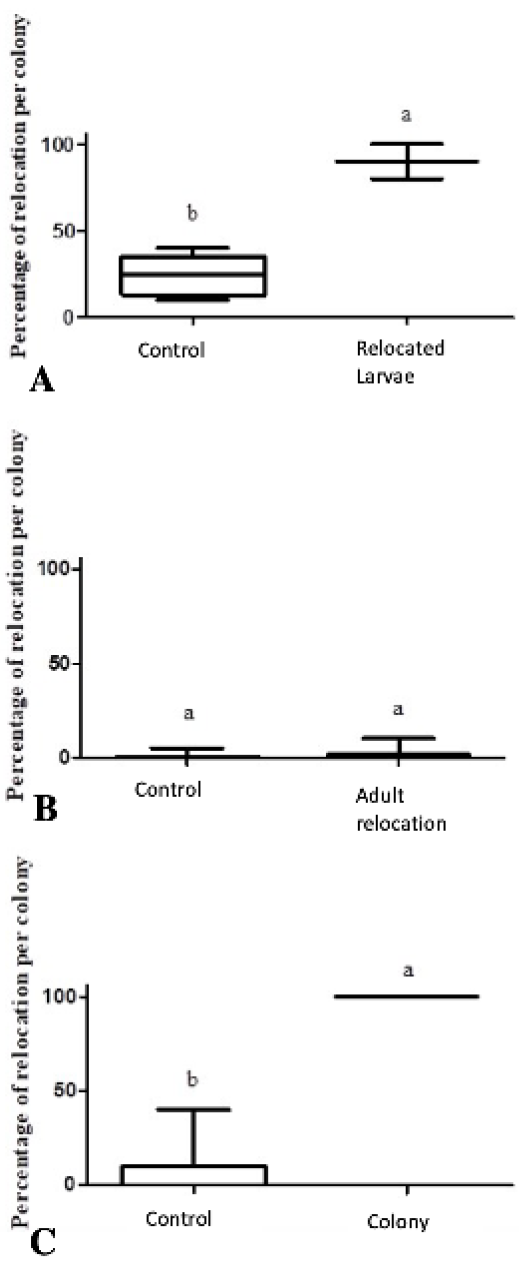
Percentage of larvae relocation (A), adult relocation (B), and colony relocation (C). Percent relocation are shown as the mean ± SE. Different letters indicate significant differences among relocated colony larvae and nymph and adult colonies.
References
- Arathi, H.S., Burns, I., and Spivak, M., 2000. Ethology of hygienic behaviour in the honey bee Apis mellifera L. (Hymenoptera: Apidae): Behavioural repertoire of hygienic bees. Ethology, 106: 365-379. https://doi.org/10.1046/j.1439-0310.2000.00556.x[CrossRef]
- Ballari, S., Farji-Brener, A.G., and Tadey, M., 2007. Waste management in the leaf-cutting ant Acromyrmex lobicornis: division of labour, aggressive behaviour, and location of external refuse dumps. J. Insect Behav., 20: 87-98. https://doi.org/10.1007/s10905-006-9065-9[CrossRef]
- Borror, D., Triplehorn, C. and Johnson, N., 1989. An introduction to the study of insects. Saunders Collage. Harcourt Brace College, Estados Unidos.
- Bot, A.N., Currie, C.R., Hart, A.G., and Boomsma, J.J., 2001. Waste management in leaf-cutting ants. Ethol. Ecol. Evol., 13: 225-237. https://doi.org/10.1080/08927014.2001.9522772[CrossRef]
- Brown, M.J.F., 1999. Nest relocation and encounters between colonies of the seed-harvesting ant Messor andrei. Insect. Soc., 46: 66–70. https://doi.org/10.1007/s000400050114[CrossRef]
- Burnstein, D.E., 1990. Progressivism and urban crisis: The New York city garbage workers’ strike of 1907. J. Urban Hist., 16: 386-423. https://doi.org/10.1177/009614429001600404[CrossRef]
- Choe, D.H., Millar, J.G., and Rust, M.K., 2009. Chemical signals associated with life inhibit necrophoresis in Argentine ants. Proc. natl. Acad. Sci., 106: 8251-8255. https://doi.org/10.1073/pnas.0901270106[CrossRef]
- Crosland, M.W.J., Lok, C.M., Wong, T.C., Shakarad, M., and Traniello, J.F.A., 1997. Division of labour in a lower termite: the majority of tasks are performed by older workers. Anim. Behav., 54: 999-1012. https://doi.org/10.1006/anbe.1997.0509[CrossRef]
- Dahbi, A., Retana, J., Lenoir, A., and Cerdá, X., 2008. Nest-moving by the polydomous and Cataglyphis iberica. J. Ethol., 26: 119-126. https://doi.org/10.1007/s10164-007-0041-4[CrossRef]
- Diez, L., Lejeune, P., and Detrain, C. 2014. Keep the nest clean: survival advantages of corpse removal in ants. Biol. Lett., 10: 20140306. https://doi.org/10.1098/rsbl.2014.0306[CrossRef]
- Droual, R., 1984. Anti-predator behaviour in the ant Pheidole desertorum: The importance of multiple nests. Anim. Behav., 32: 1054-1058. https://doi.org/10.1016/S0003-3472(84)80221-3[CrossRef]
- Farji-Brener, A.G., and Medina, C.A., 2000. The importance of where to dump the refuse: Seed banks and fine roots in nests of the leaf cutting ants Atta cephalotes and A. colombica 1. Biotropica, 32: 120-126. https://doi.org/10.1111/j.1744-7429.2000.tb00454.x[CrossRef]
- Franks, N.R., Dornhaus, A., Fitzsimmons, J.P., and Stevens, M., 2003. Speed versus accuracy in collective decision making. Proc. R. Soc. B., 270: 2457-2463. https://doi.org/10.1098/rspb.2003.2527[CrossRef]
- Goguen, C.B., and Mathews, N.E., 1996. Nest desertion by blue-gray gnatcatchers in association with brown-headed cowbird parasitism. Anim. Behav., 52: 613-619. https://doi.org/10.1006/anbe.1996.0202[CrossRef]
- Gordon, D.M., 1992. Nest relocation in harvester ants. Ann. entomol. Soc. Am., 85: 44-47. https://doi.org/10.1093/aesa/85.1.44[CrossRef]
- Guigueno, M.F., and Sealy, S.G., 2012. Nest sanitation in passerine birds: implications for egg rejection in hosts of brood parasites. J. Ornithol., 153: 35-52. https://doi.org/10.1007/s10336-011-0731-0[CrossRef]
- Hart, A.G., and Ratnieks, F.L., 2001. Task partitioning, division of labour and nest compartmentalisation collectively isolate hazardous waste in the leaf cutting ant Atta cephalotes. Behav. Ecol. Sociobiol., 49: 387-392. https://doi.org/10.1007/s002650000312[CrossRef]
- Hart, A.G., and Ratnieks, F.L., 2002. Waste management in the leaf-cutting ant Atta colombica. Behav. Ecol., 13: 224-231. https://doi.org/10.1093/beheco/13.2.224[CrossRef]
- Haskins, C.P., and Haskins, E.F., 1974. Notes on necrophoric behavior in the archaic ant Myrmecia vindex (Formicidae: Myrmeciinae). Psyche, 81: 258-267. https://doi.org/10.1155/1974/80395[CrossRef]
- Heller, N.E., and Gordon, D.M., 2006. Seasonal spatial dynamics and causes of nest movement in colonies of the invasive Argentine ant (Linepithema humile). Ecol. Ent., 31: 499-510. https://doi.org/10.1111/j.1365-2311.2006.00806.x[CrossRef]
- Julian, G.E., and Cahan, S., 1999. Undertaking specialization in the desert leaf-cutter ant Acromyrmex versicolor. Anim. Behav., 58: 437-442. https://doi.org/10.1006/anbe.1999.1184[CrossRef]
- Lacerda, F.G., Della Lucia, T.M., DeSouza, O., de Souza, L.M., and de Souza, D.J., 2013. Task performance of midden workers of Atta sexdens rubropilosa Forel (Hymenoptera: Formicidae). J. Insect Behav., 26: 873-880. https://doi.org/10.1007/s10905-013-9403-7[CrossRef]
- Litte, M., 1981. Social biology of the polistine wasp Mischocyttarus labiatus: Survival in a Colombian rain forest. Smithsonian Contributions to Zoology. https://doi.org/10.5479/si.00810282.327[CrossRef]
- McGlynn, T.P., 2006. Ants on the move: Resource limitation of a litter nesting ant community in costa rica 1. Biotrop. J. Biol. Conserv., 38: 419-427. https://doi.org/10.1111/j.1744-7429.2006.00153.x[CrossRef]
- McGlynn, T.P., 2012. The ecology of nest movement in social insects. Annu. Rev. Ent., 57: 291–308. https://doi.org/10.1146/annurev-ento-120710-100708[CrossRef]
- McGlynn, T.P., Carr, R.A., Carson, J.H., and Buma, J., 2004. Frequent nest relocation in the ant Aphaenogaster araneoides: resources, competition, and natural enemies. Oikos, 106: 611-621. https://doi.org/10.1111/j.0030-1299.2004.13135.x[CrossRef]
- McGlynn, T.P., Dunn, T., Wayman, E., and Romero, A. 2010. A thermophile in the shade: Light-directed nest relocation in the costa Rican ant Ectatomma ruidum. J. trop. Ecol., 26: 559-562. https://doi.org/10.1017/S0266467410000313[CrossRef]
- Meadows, D.H., 1972. The limits to growth: A report for the Club of Rome’s project on the predicament of mankind. Universe Books, New York. https://doi.org/10.1349/ddlp.1[CrossRef]
- Michener, C.D., 1974. The social behavior of the bees: A comparative study. Harvard University Press. pp. 422.
- Möglich, M., 1978. Social organization of nest emigration in Leptothorax (Hym., Form.). Insect. Soc., 25: 205-225. https://doi.org/10.1007/BF02224742[CrossRef]
- Mori, K., and Saito, Y., 2005. Variation in social behavior within a spider mite genus, Stigmaeopsis (Acari: Tetranychidae). Behav. Ecol., 16: 232-238. https://doi.org/10.1093/beheco/arh157[CrossRef]
- Nicolopoulou-Stamati, P., Hens, L., and Howard, C.V., 2000. Health impacts of waste management policies. Springer Netherlands, Dordrecht, The Netherlands. https://doi.org/10.1007/978-94-015-9550-6[CrossRef]
- Noirot, C., 1970. The nests of termites. In: Biology of termites, vol. 2 (eds. K. Krishna and F.M. Weesner). Academic press, New York. pp. 73–125.
- Pereira, H., Jossart, M., and Detrain, C., 2020. Waste management by ants: The enhancing role of larvae. Anim. Behav., 168: 187-198. https://doi.org/10.1016/j.anbehav.2020.08.017[CrossRef]
- Poulsen, M., Bot, A.N., Nielsen, M.G., and Boomsma, J.J., 2002. Experimental evidence for the costs and hygienic significance of the antibiotic metapleural gland secretion in leaf-cutting ants. Behav. Ecol. Sociobiol., 52: 151-157. https://doi.org/10.1007/s00265-002-0489-8[CrossRef]
- Pratt, S.C., 2019. Nest site choice in social insects. In: Encyclopedia of animal behavior (ed. J.C. Choe). 2nd ed. Acad. Press: Oxford, U.K., 4: 766–774. https://doi.org/10.1016/B978-0-12-809633-8.01262-0[CrossRef]
- Saitō, Y., 1986. Prey kills predator: Counter-attack success of a spider mite against its specific phytoseiid predator. Exp. appl. Acarol., 2: 47-62. https://doi.org/10.1007/BF01193354[CrossRef]
- Saito, Y., 1997. 21 Sociality and kin selection in Acari. The evolution of social behavior in insects and arachnids. Cambridge University Press, Cambridge, pp. 443–457. https://doi.org/10.1017/CBO9780511721953.022[CrossRef]
- Saito, Y., Mori, K., Sakagami, T., and Lin, J., 2004. Reinstatement of the genus Stigmaeopsis Banks, with descriptions of two new species (Acari, Tetranychidae). Annls entomol. Soc. Am., 97: 635-646. https://doi.org/10.1603/0013-8746(2004)097[0635:ROTGSB]2.0.CO;2[CrossRef]
- Saito, Y., Sato, Y., Kongchuensin, M., Chao, J.T., and Sahara, K., 2019. New Stigmaeopsis species on Miscanthus grasses in Taiwan and Thailand (Acari, Tetranychidae). Syst. appl Acarol., 24: 675-682. https://doi.org/10.11158/saa.24.4.12[CrossRef]
- Sato, Y., and Saito, Y., 2006. Nest sanitation in social spider mites: Interspecific differences in defecation behavior. Ethology, 112: 664-669. https://doi.org/10.1111/j.1439-0310.2005.01184.x[CrossRef]
- Sato, Y., and Saito, Y., 2008. Evolutionary view of waste-management behavior using volatile chemical cues in social spider mites. J. Ethol., 26: 267-272. https://doi.org/10.1007/s10164-007-0069-5[CrossRef]
- Sato, Y., Saito, Y., and Sakagami, T., 2003. Rules for nest sanitation in a social spider mite, Schizotetranychus miscanthi Saito (Acari: Tetranychidae). Ethology, 109: 713-724. https://doi.org/10.1046/j.1439-0310.2003.00905.x[CrossRef]
- Smallwood, J., 1982. The effect of shade and competition on emigration rate in the ant Aphaenogaster Rudis. Ecol., 63: 124-134. https://doi.org/10.2307/1937038[CrossRef]
- Smallwood, J., and Culver, D.C., 1979. Colony movements of some North American ants. J. Anim. Ecol., 48: 373-382. https://doi.org/10.2307/4167[CrossRef]
- SPSS, 2007. Statistical package for the social sciences. SPSS Inc., Chicago.
- Tay, J.W., and Lee, C.Y., 2015. Induced disturbances cause Monomorium Pharaonis (Hymenoptera: Formicidae) nest relocation. J. econ. Ent., 108: 1237-1242. https://doi.org/10.1093/jee/tov079[CrossRef]
- Tschinkel, W.R., 2014. Nest relocation and excavation in the Florida harvester ant, Pogonomyrmex badius. PLoS One, 9: e112981. https://doi.org/10.1371/journal.pone.0112981[CrossRef]
- Vencl, F.V., Morton, T.C., Mumma, R.O., and Schultz, J.C., 1999. Shield defense of a larval tortoise beetle. J. chem. Ecol., 25: 549-566. https://doi.org/10.1023/A:1020905920952[CrossRef]
- Visscher, P.K., 1983. The honey bee way of death: Necrophoric behaviour in Apis mellifera colonies. Anim. Behav., 31: 1070-1076. https://doi.org/10.1016/S0003-3472(83)80014-1[CrossRef]
- Wang, Q., Song, W., Zhang, J., and Lo, S., 2018. Bi-directional movement characteristics of Camponotus Japonicus ants during nest relocation. J. exp. Biol., 221: jeb181669. https://doi.org/10.1242/jeb.181669[CrossRef]
- Weber, N.A., 1972. Gardening ants: The attines. Mem. Am. Phil. Soc., vol. 92. American Philosophical Society, Philadelphia.
- Weiss, M.R., 2006. Defecation behavior and ecology of insects. Annu. Rev. Ent., 51: 635-661. https://doi.org/10.1146/annurev.ento.49.061802.123212[CrossRef]
- Wilson, E.O., Durlach, N.I., and Roth, L.M., 1958. Chemical releaser of necrophoric behavior in ants. Psyche, 65: 108–114. https://doi.org/10.1155/1958/69391[CrossRef]
Services
Article usage statistics
Loading…