Plant Height
It is evident from Table I that the differences in the mean values due to gamma radiation doses were non significant. The data revealed that the range of mean values for radiation doses were 51.7 to 63.6 for plant height. The differences recorded in mean values due to varieties for plant height were observed as non–significant and the values were in the range of 57.9 for Puhja to 58.7 for Nutech. The effect of interaction between doses of gamma rays and varieties was also noted as non–significant. The value recorded in Table I for interaction ranged from 49.8 to 66.9 and 45.5 to 77.5 for Puhja and Nutech respectively. The increase in the men value due to 25 krad dose was recorded as 15.5% for Puhja as compared to its control. Similarly an increase in the mean value due to10 krad dose was calculated as 70.3% for Nutech as compared to its control. So far as the competition of Puhja and Nutech varieties against different doses of radiation is concerned, Nutech variety responded well of all and reached at the climax at 10 krad dose as shown (figure Ia and Ib). However Puhja variety responded negatively at 10 Krad doses of gamma radiation and thus lying at the bottom. The findings of Hegazi and N. Hamideldin (2010), Borzouei et al., (2010), Ellyfa Kon et al., (2007) and Norfadzrin et al., (2007) contradict with the present result of Plant height. This type of controversy might be due either to differences in genetic materials or agro climatic conditions under which the experiment was performed.
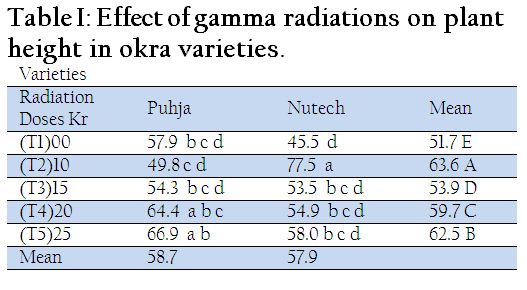
Table I: Effect of gamma radiations on plant height in okra varieties
Any two means sharing the same letters are not significantly different according to Duncan’s New Multiple Range Test. Capital letters indicate significance at 5% probability level.
Number of Leaves Plant–1
It is evident from Table II that the difference in the mean values due to gamma doses was non–significant. The data revealed that the range of mean values for radiation doses was 31.6 to 44.5 for the number of leaves per plant .The differences recorded in mean values due to varieties for number of leaves per plant were observed as significant and values were in the range of 34.5 for Nutech and 41.4 for Puhja. It was observed that increase in mean values of Puhja for number of leaves per plant was 6.9 as compared to the mean value of Nutech for the number of leaves per plant. The effect of interaction between doses of gamma rays and varieties were non– significant Table II. The values recorded for interaction ranged from 30.5 to 47.5 and from 26.9 to 41.6 for Puhja and likewise in case of Nutech. The increase in the mean values due to 10 krad was calculated as 1.9% and 8.9% for Puhja and Nutech respectively as compared to their respective controls.
So far as the competition of Puhja and Nutech is concerned Puhja variety responded well of all and reached to the climax at 20 krad dose of gamma rays as shown in the figure II a and II b. However it responded negatively at all other doses of gamma rays. Nutech variety responded well at 20 Kr doses of gamma rays only. It respond most negatively and lying at the bottom on 15 kR dose of gamma rays. Thus Puhja surpass all the varieties. The findings of Abdul Majeed and Zahir Muhammad (2010) have showed highly significant reduction by gamma rays dose in number of leaves per plant.
These findings contradict with present findings. It may be due either to differences in the genetic materials used or agro climatic conditions under which the experiment was conducted.
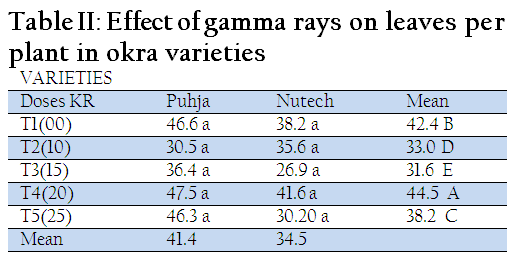
Table II: Effect of gamma rays on leaves per plant in okra varieties
Any two means sharing same letters are not significantly different according to Duncan’s New Multiple Range Test. Capital letters indicate significance at 5%probability level.
Number of Pods Plant–1
It is evident from Table III that the difference in the mean values due to gamma doses was non–significant. The data revealed that the range of mean values for radiation doses was 6.6 to 10.2 in case of number of pods per plant. The differences recorded in mean values due to varieties for number of pods per plant were also noted as non significant and values were in the range of 8.3 for Puhja and 8.3 for Nutech. The effect of interaction between doses of gamma rays and varieties were highly significant Table III. The mean values for number of pods per plant ranged between 4.25 to 11.5 for Puhja and 4.2 to 11.7 for Nutech in response to variance radiation doses. The decrease in the mean values due to 15 krad dose was calculated as 170.5% and increase in the mean values due to 20krad dose was computed as 30% for Puhja and Nutech respectively as compared to their respective controls Table III.
So far as the competition of puhja and Nutech varieties against different doses of radiation is concerned, Nutech variety responded well of all at 20 krad doses of gamma rays and reached at the climax as shown in the figures 3a and 3b. Nutech have also responded negatively of all at 15 krad dose and lying at the bottom. In case of Puhja response is well at 15 krad dose of gamma rays and reached to the highest. According to Arulbalachandran et al., (2010) a wide range of variation was recorded at 60 krad gamma rays for number of pods per plant. These results are not in agreement with the present findings. Similarly according to Sophia john et al., (2001) a wide range of variation was recorded at 20 krad gamma rays dose for number of fruits per plant. These findings are also not in agreement with the present findings. The differences in data might reflect the differences in germplasm used along with the agronomical practices under which the experiment was conducted.
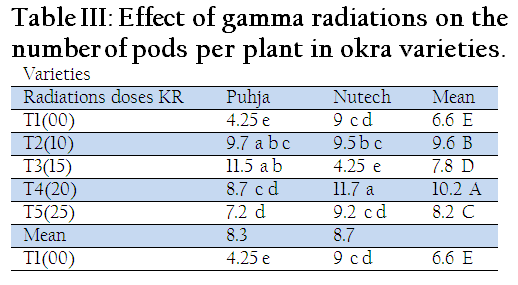
Table III: Effect of gamma radiations on the number of pods per plant in okra varieties
Any two means sharing same letters are not significantly different according to Duncan; s New Multiple Range Test. Capital letters indicate significance at 5% probability level.
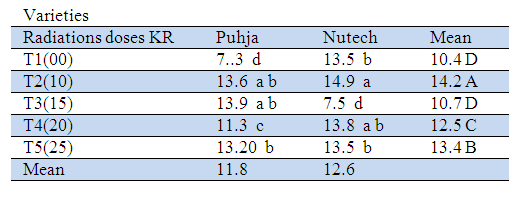
Table IV:
Length of the Pod
It is evident from Table IV that the mean values due to gamma rays doses for length of pod was significant. The mean values for gamma radiation doses were 10.4 to 14.2 for length of the pod. The lowest length of the pod (10.4) was recorded for control and the highest length of pod (14.2) was recorded for 10 Krad dose. The differences found in values due to varietals effect were non–significant and the values recorded for length of pods due to varieties were 11.8 and 12.6 for Puhja and Nutech respectively. Effect of interaction between varieties and gamma rays doses Table IV were highly significant. The values for length of pod ranged between 7.3 to 13.9 for Puhja and 7.5 to 14.9 for Nutech in response to various radiation doses. Increase in the values due to 15 krad dose was recorded as 90.4% for Puhja as compared to the control. Similarly an increase in the value due 10 krad dose was calculated as 10.3% for Nutech as compared to its respective control. Also a decrease in the value due to 15 k rad dose was calculated as 44.4% as compared to its respective control Table IV.
So far as the competition of Puhja and Nutech varieties against different doses of gamma radiations is concerned Puhja variety responded well and reached to the climax at 15 krad dose as shown in the figures IVa and IVb. In case of Nutech response is well of all at 10 krad dose and lying at the climax. However Nutech have responded negatively at 15 krad dose of gamma rays and thus lying at the bottom. These results are in agreement to those reported by Sophia john et al., (2001) who advocated that there was significant change in length of fruits due to higher radiation doses. The present findings are also in close agreement with those found by Mishra et al., (2007) in which some of the gamma doses had significantly increased the length of the pod as compared to control.
Table IV: Effect of gamma radiations on length of the pods in okra varieties. Any two means sharing same letters are not significantly different according to the Duncan’s New Multiple Range Test. Capital letters indicate significance at 5% probability.
Seeds Plant–1
It is evident from the Table V that the difference in the mean values due to gamma rays were non significant. The data revealed that the range of mean values for radiation doses was 178.5 to 414.3 for number of seeds per plant. The lowest number of seeds per plant (178.5) was recorded for control and highest number of seeds per plant (414.3) was recorded for 10 krad. The differences recorded in mean values due to varieties for number of seeds per plant. The values recorded for interaction ranged from 64 to 454.2 and 212.5 to 416.2 Puhja and Nutech respectively. The increase in the mean values due to 10k R dose was computed as 609.6% for Puhja as compared to its control. The increase in the mean values due to 20 krad dose was computed as 42 % as compared to its respective control.
So far as the competition of Puhja and Nutech variety against different doses of gamma radiation is concerned Puhja variety have responded well of all and reached to the climax at 10 krad dose as shown in the figures 4.5a and 4.5b. However its response is lowest at 20 krad dose of gamma rays and reached to the bottom. In case of Nutech the response is highest at 20 krad dose of gamma rays but its response is more negative at 15 krad dose of gamma radiations. The results put forward by Arulbalachandran et al., (2010) contradict with present results. This type of controversy might be due to different agro climatic conditions and topographic effects on which the experiment was performed. It may be also due to difference in genetic materials.
Table V Effect of gamma radiations on number of seeds per plant in okra varieties
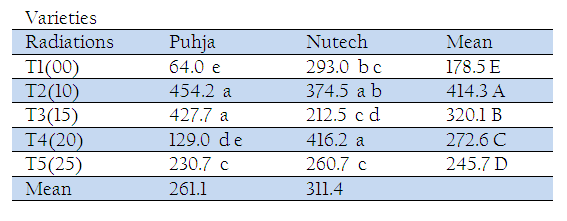
Table V:
Any two means sharing same letters are not significantly different according to Duncan’s New Multiple Range Test. Capital letters indicate significance at 5% probability.