Segmented regression effectively characterized the hatching egg production curve and accurately identified the biological breakpoint at 55.2 weeks of age in broiler breeder flocks.
Hatching egg production declined by an average of 1.45% per week beyond this point, accompanied by a substantial reduction in feed utilization efficiency.
Economic analysis indicated that maintaining flocks beyond approximately 60 weeks provided limited additional economic return.
Therefore, flock replacement at around 60 weeks is recommended to maximize production efficiency and profitability.
Selected from the article's own text.
Abstract
Hatching eggs represent the primary output of broiler breeder flocks and constitute the foundation of hatchery productivity. As breeder flocks age, hatching egg production gradually declines, reducing biological performance and economic efficiency. Therefore, accurately identifying the onset of production decline is essential for determining the optimal economic culling time. This study aimed to estimate the hatching egg production curve and identify the economic decline threshold in broiler breeder flocks using segmented linear regression analysis. Daily production records collected from a commercial broiler breeder farm over 49 consecutive weeks (20–69 weeks of age) were analyzed and compared with a conventional quadratic regression model. The segmented regression model identified a significant breakpoint at 55.2 weeks of age (95% CI: 53.6–56.8 weeks; P < 0.05), after which hatching egg production declined at an average rate of 1.45% per week. Peak production reached 85.6% at 33 weeks of age. Feed consumption per hatching egg increased markedly from 207 g/egg at week 30 to 362 g/egg at week 69, representing a 75% increase in feed required per marketable hatching egg. The segmented regression model provided a better fit to the production data than the quadratic model (R² = 0.91 vs. 0.87). Economic analysis indicated that marginal economic efficiency approached zero at approximately 60.5 weeks of age, suggesting that extending production beyond this point provides minimal economic return. Based on these findings, culling broiler breeder flocks at approximately 60 weeks of age is recommended to maximize production efficiency and economic profitability. The results demonstrate that segmented regression is an effective analytical approach for identifying biological and economic turning points in broiler breeder production and can support evidence-based flock management decisions.
Broiler breeder flocks represent a fundamental biological and economic component of the poultry industry, as the productivity of hatcheries and the sustainability of broiler production are largely dependent on the quantity and quality of hatching eggs produced throughout the laying cycle. In breeder hens, egg production follows a distinct age-related pattern, characterized by a rapid increase after sexual maturity, attainment of a production peak, and a subsequent decline as flock age progresses. This decline may adversely affect not only hatching egg production but also hatchability, feed utilization efficiency, flock profitability, and the overall economic sustainability of breeder enterprises. Therefore, accurately determining the appropriate age for flock replacement is a critical management decision in commercial broiler breeder production systems, particularly because extending the productive life of a flock may increase production costs while reducing biological and economic efficiency ; . Age-related changes in productive performance are commonly accompanied by alterations in metabolic and endocrine functions. Recent evidence has shown that dietary nutritional strategies can improve serum biochemical indices and endocrine status in older laying hens, highlighting the importance of physiological monitoring and nutritional management for maintaining productivity as birds advance in age .
The productive lifespan of broiler breeder hens is influenced by a complex interaction of physiological, nutritional, genetic, environmental, and management factors. Environmental conditions, particularly heat stress, can accelerate production losses by reducing feed intake and impairing reproductive physiology, egg production, and egg quality in poultry . In addition to production and environmental indicators, serum biochemical analyses provide valuable information regarding the physiological status, metabolic activity, and health of poultry flocks. Accurate laboratory evaluation depends not only on the analytical method employed but also on appropriate sample collection and handling procedures. Recent studies demonstrated that blood collection sites and sample preservation conditions can influence the reliability of several biochemical measurements, while automated analytical systems generally provide greater accuracy, consistency, and efficiency than conventional laboratory techniques for routine evaluation of broiler chickens ; . Accurate characterization of egg production curves has become increasingly important for optimizing breeder flock management and supporting evidence-based decision-making. Mathematical modeling provides an objective framework for describing production dynamics throughout the laying period and identifying critical biological transitions that are not readily detected using conventional descriptive methods. Among the available statistical approaches, segmented linear regression has emerged as a powerful analytical technique because it identifies breakpoints where the rate of production changes significantly. Compared with conventional linear or polynomial regression models, segmented regression offers greater biological interpretability and has been successfully applied to identify threshold responses in agricultural, ecological, and biological systems ; ; .
From an economic perspective, declining egg production is typically accompanied by reduced feed efficiency and progressively increasing production costs. Although breeder management manuals published by breeding companies provide standard production targets and management recommendations, actual flock performance frequently differs because of variations in genetics, nutrition, environmental conditions, health status, and farm management practices ; . Recent evidence indicates that advanced nutritional strategies, particularly those incorporating functional and nano-biological feed additives, can improve productive performance, physiological status, nutrient utilization, and intestinal health in poultry. These nutritional approaches have shown promising benefits in both laying hens and broiler chickens, highlighting their potential to support production efficiency and flock health under commercial production conditions ; . Therefore, determining the economically optimal culling age requires flock-specific evaluation based on actual production records rather than exclusive reliance on generalized breeder standards. Recent advances in predictive modeling and machine-learning approaches have further demonstrated the value of production curve analysis for estimating productive longevity and identifying biologically meaningful turning points in broiler breeder flocks .
Despite considerable progress in modeling poultry production curves, relatively limited information is available regarding the integration of segmented regression analysis with feed efficiency indicators to determine the biological breakpoint and the corresponding economic culling threshold in commercial broiler breeder flocks. Addressing this knowledge gap could improve production planning and enhance economic decision-making in breeder enterprises. Therefore, the objectives of the present study were to estimate the hatching egg production curve using segmented linear regression analysis, identify the biological breakpoint at which hatching egg production begins to decline rapidly, quantify weekly feed consumption per hatching egg, determine the economic culling threshold based on production efficiency, compare the predictive performance of segmented and quadratic regression models, and evaluate the effects of flock age, ambient temperature, and feed consumption on the rate of production decline beyond the identified breakpoint.
Materials and Methods
Data source and study design
A descriptive summary of the variables included in the present study is provided in Table 1. The table presents the main production, management, and environmental variables used in the subsequent statistical analyses and production curve modeling, providing an overview of the characteristics of the dataset throughout the production period.
This study was conducted using production records from a commercial broiler breeder flock throughout the laying period, following the production and management characteristics described for broiler breeder flocks in recent research . The records comprised daily production and management observations covering 20 to 69 weeks of age. Recorded variables included total egg production, hatching egg production, hen-day egg production (HD %), daily feed consumption, ambient temperature, and egg defect rates. At the onset of production, the flock consisted of 15,945 female and 1,560 male breeders. To reduce the influence of daily biological variation and random management-related fluctuations, daily observations were aggregated into weekly averages prior to statistical analysis. Weekly hatching egg production percentage (HE %) was used as the primary response variable for production curve modeling.
Productive and feed efficiency indicators
Productive performance and feed utilization efficiency were evaluated using weekly production records. The following indicators were calculated:
Hatching egg production percentage (HE %).
Feed consumption per hatching egg (g/egg).
Feed consumption per total egg produced (g/egg).
Because egg production during the onset of lay is characterized by rapid physiological adaptation and considerable day-to-day variation, observations collected during weeks 20–22 were excluded from breakpoint analysis. This approach minimized potential bias and allowed more accurate characterization of the mature production phase.
Production curve modeling
The hatching egg production curve was modeled using segmented linear regression to identify the biological breakpoint at which egg production shifted from a relatively stable phase to a period of accelerated decline. Breakpoint estimation was performed using the iterative algorithm described by Muggeo (2008), which has been widely applied for detecting structural changes in biological datasets.
To evaluate model performance, segmented regression was compared with a conventional quadratic regression model. Goodness-of-fit was assessed using the coefficient of determination (R²), Akaike’s Information Criterion (AIC), and Bayesian Information Criterion (BIC), with lower AIC and BIC values indicating superior model performance ; .
Economic threshold analysis
An economic evaluation was performed to determine the practical culling threshold based on changes in hatching egg production and feed utilization efficiency throughout the laying cycle. Weekly income generated from marketable hatching eggs was compared with feed costs and fixed production expenses to estimate weekly profitability. The economic culling threshold was defined as the age beyond which maintaining the flock no longer resulted in a meaningful economic return, indicating diminishing marginal profitability .
Table 1: Descriptive statistics of the variables included in the production curve analysis.
Variable
Mean
Median
SD
Minimum
Maximum
Hatching egg production (HE, %)
83.2
85.1
10.8
47.2
94.8
Hen-day egg production (HD, %)
84.6
86.2
10.2
49.2
95.6
Total weekly egg production (eggs)
72,450
74,200
12,450
45,070
89,260
Weekly hatching egg production (eggs)
68,200
70,100
11,200
40,560
83,438
Weekly feed consumption (kg)
7,150
7,200
1,050
5,800
8,140
Female feed intake (g/bird/day)
158.4
158.0
4.2
150.0
168.0
Egg weight (g)
67.2
67.5
2.1
63.2
70.1
Ambient temperature (°F)
87.4
88.0
4.8
78.0
98.0
Summarizes the descriptive statistics of the variables included in the analysis. Weekly hatching egg production averaged 83.2%, whereas hen-day egg production averaged 84.6%. Feed intake, egg weight, and ambient temperature showed relatively low variability throughout the production cycle, providing a reliable dataset for subsequent production curve modeling and breakpoint estimation.
Table 2: Key parameters of the hatching egg production curve and segmented regression model.
Parameter
Estimate
Interpretation
Peak hatching egg production (%)
85.6
Maximum production reached at 33 weeks of age
Peak production age (weeks)
33.0
Age at maximum production
Estimated breakpoint (weeks)
55.2
Biological onset of accelerated production decline
95% Confidence interval
53.6–56.8
Confidence interval for the breakpoint estimate
Production decline after breakpoint
1.45% per week
Weekly reduction in hatching egg production
Model significance
P < 0.001
Significant segmented regression model
Segmented regression (R²)
0.91
Model goodness-of-fit
Quadratic regression (R²)
0.87
Goodness-of-fit of comparison model
Difference in AIC
−12.8
Segmented model outperformed the quadratic model
Correlation analysis
Pearson correlation analysis was performed to evaluate the relationships among flock age, ambient temperature, and daily feed consumption, hatching egg production percentage, and feed consumption per hatching egg. These analyses were conducted to identify the biological and environmental factors associated with the rate of production decline after the estimated breakpoint.
Statistical analysis
Statistical analyses were performed using R software (Version 4.2.1; R Core Team, 2022). Segmented regression models were fitted using the segmented package following the iterative procedure proposed by Muggeo (2008). Quadratic regression analysis was conducted to compare model performance with the segmented approach. Pearson correlation coefficients were calculated to evaluate relationships among production and environmental variables. Model adequacy was assessed using the coefficient of determination (R²), Akaike’s Information Criterion (AIC), Bayesian Information Criterion (BIC), and likelihood ratio tests where appropriate. Statistical significance was declared at P < 0.05.
Results and Discussion
Hatching egg production dynamics and breakpoint identification
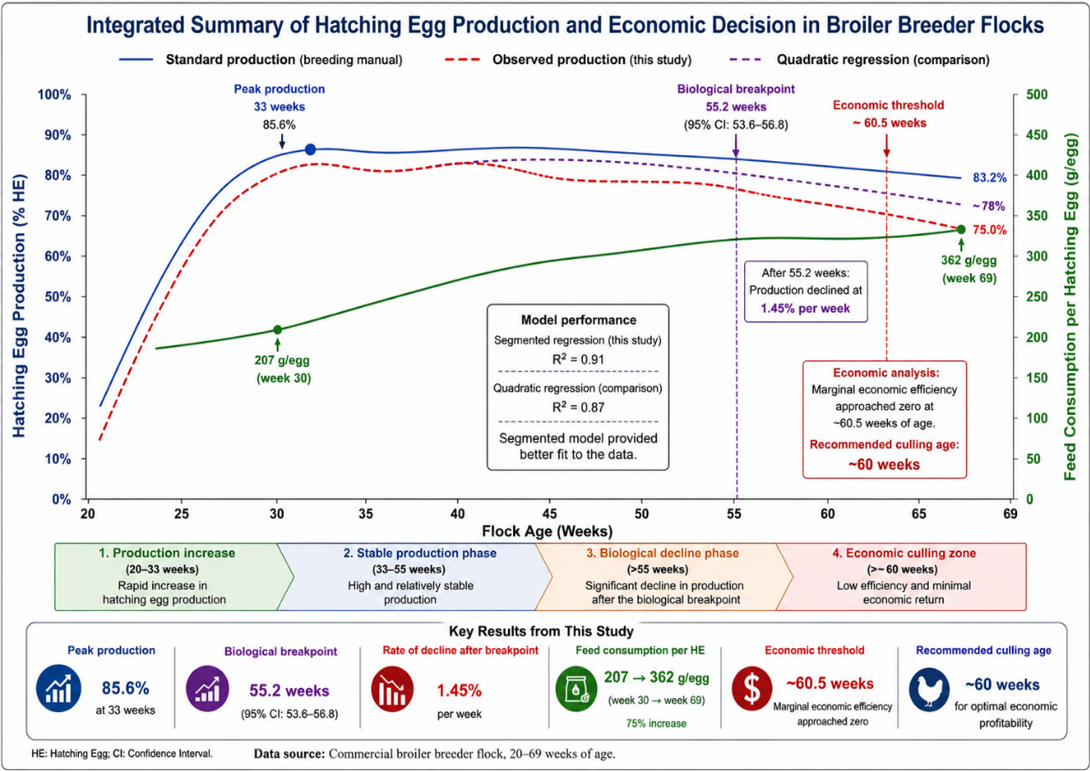
The segmented regression analysis accurately characterized the biological pattern of hatching egg production throughout the laying cycle (Table 2). Hatching egg production increased rapidly after the onset of lay, reaching a maximum of 85.6% at 33 weeks of age. Thereafter, production remained relatively stable until approximately 55.2 weeks, when a statistically significant breakpoint (95% CI: 53.6–56.8 weeks; P < 0.05) indicated the onset of accelerated production decline. Beyond this point, hatching egg production decreased by an average of 1.45% per week, reflecting progressive reproductive aging. Furthermore, the segmented regression model demonstrated superior goodness-of-fit (R²= 0.91) compared with the conventional quadratic regression model (R²= 0.87), indicating that segmented regression more accurately captured the biological transition between stable production and age-related decline.
The identified production pattern agrees with previous reports describing the typical laying curve of broiler breeder hens, in which production increases rapidly after sexual maturity, reaches a peak during early lay, and subsequently declines because of age-related reductions in ovarian activity, endocrine function, and nutrient utilization ; . Similar applications of segmented regression have demonstrated that breakpoint analysis provides biologically meaningful estimates of structural changes in animal production systems and often outperforms conventional polynomial models ; . Consequently, the estimated breakpoint at 55.2 weeks represents a practical biological indicator for monitoring breeder flock performance and anticipating subsequent productivity losses.
Feed utilization efficiency and economic implications
Feed utilization efficiency deteriorated progressively as flock age advanced (Table 3). Feed consumption per hatching egg increased from 207 g/egg at 30 weeks of age to 362 g/egg at 69 weeks, representing a 75% increase in feed required to produce each marketable hatching egg. This deterioration reflects the combined effects of declining egg production and increasing maintenance requirements in aging breeder hens. Economic analysis further indicated that marginal economic returns declined substantially after approximately 60.5 weeks of age, supporting a recommended flock replacement age of around 60 weeks.
These findings are consistent with breeder management recommendations indicating that economic performance depends not only on egg production but also on feed efficiency and production costs ; . As breeder hens age, maintenance energy requirements increase while productive efficiency declines, leading to progressively higher feed costs per hatching egg. Therefore, extending the laying cycle beyond the identified economic threshold is unlikely to provide sufficient financial benefit under typical commercial production conditions. In addition to optimizing feed efficiency, maintaining the health and immune competence of breeder flocks is essential for sustaining productive performance throughout the laying cycle.
Table 3: Feed utilization efficiency and economic threshold during the laying cycle.
Variable
Value
Feed consumption per hatching egg (Week 30)
207 g/egg
Feed consumption per hatching egg (Week 69)
362 g/egg
Relative increase
75%
Marginal economic efficiency threshold
60.5 weeks
Recommended culling age
60 weeks
Integrated interpretation of biological and economic findings
Table ٤ and Figure ١ provide an integrated overview of the biological and economic progression of broiler breeder performance throughout the laying cycle. Peak production occurred at approximately ٣٣ weeks of age, followed by a relatively stable production phase before the biological breakpoint at ٥٥.٢ weeks. After this transition, reproductive performance declined steadily, accompanied by reduced feed utilization efficiency and increasing production costs. Collectively, these responses culminated in an economic decision threshold at approximately ٦٠ weeks, beyond which continued flock retention was no longer economically justified.
The conceptual framework presented in Figure ١ illustrates how biological aging influences productive performance and economic sustainability simultaneously. Rather than relying solely on chronological age, the integration of production dynamics, breakpoint analysis, and feed utilization efficiency provides a more objective framework for flock management decisions. Effective flock management should also incorporate sustainable environmental and biosecurity practices to improve overall production efficiency. Integrating waste valorization technologies, including the conversion of poultry manure and organic food waste into natural antibacterial agents and disinfectants, may contribute to improved farm sanitation, reduced environmental contamination, and enhanced sustainability of commercial poultry production systems. Such integrated management approaches complement production-based decision-making by supporting healthier production environments and more efficient resource utilization (Al-Salhi et al., ٢٠٢٥a; Naser et al., ٢٠٢٥). Similar integrated analytical approaches have recently been recommended for precision poultry production, as they enhance decision-making by combining biological performance with economic evaluation (Ji et al., ٢٠٢٥; Oluwagbenga and Fraley, ٢٠٢٣). Consequently, segmented regression combined with feed efficiency indicators offers a practical and evidence-based tool for optimizing flock replacement strategies in commercial broiler breeder operations. These findings also support the growing transition toward sustainable poultry production systems, where data-driven decision-making, efficient resource utilization, and adaptive management strategies are integrated to improve productivity, resilience, and long-term sustainability under commercial production conditions (Al-Maamouri et al., ٢٠٢٦). Beyond production modeling, sustainable poultry farming increasingly relies on integrating environmental management with technological innovations. Biological treatment of poultry waste, smart environmental monitoring systems, and sustainable resource utilization can improve farm biosecurity, reduce environmental impacts, and support long-term production sustainability, complementing data-driven management strategies in modern poultry production (Al-Salhi et al., ٢٠٢٥b, ٢٠٢٦b; Alabresm et al., ٢٠٢٦). In addition to nutrition and environmental management, maintaining high drinking water quality is an essential component of successful poultry production. Adequate water quality supports bird health, feed utilization, and productive performance, whereas microbial or chemical contamination may adversely affect flock productivity. Household and farm water purification systems can therefore play an important role in improving water quality and supporting sustainable poultry management (Mohammed et al., ٢٠٢٦).
Table 4: Summary of the principal biological and economic findings.
Finding
Result
Practical implication
Production peak
33 weeks
Maximum biological productivity
Biological breakpoint
55.2 weeks
Beginning of rapid production decline
Production decline
1.45% per week
Progressive reproductive aging
Feed efficiency
Declined markedly with age
Increased production cost
Best statistical model
Segmented regression
Better fit than quadratic regression
Economic threshold
60.5 weeks
Minimal additional economic return
Recommended flock culling
60 weeks
Maximizes profitability
Conclusions
Segmented regression effectively characterized the hatching egg production curve and accurately identified the biological breakpoint at 55.2 weeks of age in broiler breeder flocks. Hatching egg production declined by an average of 1.45% per week beyond this point, accompanied by a substantial reduction in feed utilization efficiency. Economic analysis indicated that maintaining flocks beyond approximately 60 weeks provided limited additional economic return. Therefore, flock replacement at around 60 weeks is recommended to maximize production efficiency and profitability. These findings demonstrate that segmented regression is a valuable decision-support tool for optimizing commercial broiler breeder management.
Acknowledgement
The authors gratefully acknowledge the support and facilities provided by the University of Thi-Qar, Al-Iraqia University, Al-Qasim Green University, Middle Technical University, University of Wasit, and Al-Israa University, Iraq, which contributed to the completion of this study. The authors also sincerely appreciate the cooperation and support of all individuals who contributed to the provision of the production data and technical assistance necessary for conducting this research.
Novelty Statement
This study integrates segmented regression, feed efficiency, and economic analysis to identify the biological breakpoint and economic decline threshold in commercial broiler breeder flocks, providing a practical data-driven approach for determining the optimal flock replacement age.
Author’s Contribution
Ibrahim M. Katea, Walaa Z. Shnain, Hawraa F. Hassan, and Mohammed S. Eukaal: Investigation and data collection. Mohammed A. Alrubaee: Writing – original draft. Ahmed F. Kadhim and Sahar M. Iedan: Methodology and statistical analysis. Afrah Al-Rikabi: Correspondence with the journal and publisher, supervision, and manuscript coordination.
All authors reviewed and approved the final manuscript.
Generative AI and AI assisted technology statement
The authors declare that no generative AI and AI assisted technology was used in the creation of this manuscript.
Conflict of interest
The authors have declared no conflict of interest.
Figures
Figure 1:.
Hatching egg production and economic thresholds in broiler breeder flocks
References
Abaas NM, Hussein HS, Shakeer ZA, Kamel SS (2026). Effect of functional feeding strategies based on nano-biological additives on the productive performance of laying hens. Sarhad J. Agric., 42(2): 878–885. https://doi.org/10.17582/journal.sja/2026/42.2.878.885[Full text][CrossRef]
Alabresm A, Madan ZA, Saleh SM, Al-Imara EA, Al-Buzayd HY, Aziz NM, Lead JR (2026). Sustainable and eco-friendly method for oil recovery from refinery sludge using froth flotation and biosurfactants. Environ. Asia, 19(2): 47.
Al-Maamouri TA, Alameer KKA, Hamzah ZR, Awadh GE, Misjel NR (2026). Sustainable poultry production systems: Integrating innovation, resilience, and future challenges. J. Anim. Health Prod., 14(3): 1019–1025. https://doi.org/10.17582/journal.jahp/2025/14.3.1019.1025[Full text][CrossRef]
AlMaamouri TA, Hussein HS, Altabtabaai TA, Kamel SS (2026). Impact of nano-biological synbiotic on performance, physiological traits, and gut microbiota of broiler chickens. Sarhad J. Agric., 42(3): 1285–1296. https://doi.org/10.17582/journal.sja/2025/42.3.1285.1296[Full text][CrossRef]
Alsalhi A (2026). Formulation and evaluation of a natural dietary supplement from quail egg and arugula leaves. Innov. Food Technol., 13(3): 263–270.
Al-Salhi AA, Al-Shatty SM, Al-Imara EA (2025a). Production of antibacterial from poultry manure and Ziziphus spina-christi leaves. IOP Conf. Ser. Earth Environ. Sci., 1549(1): 012051. https://doi.org/10.1088/1755-1315/1549/1/012051[CrossRef]
Al-Salhi A, Al-Shatty S, Al-Imara E, Al-Rikabi A (2025b). Manufacturing a bacterial starter and a digital bio-fermenter to treat poultry manure and produce methane gas (CH₄). An-Najah Univ. J. Res. A Nat. Sci., 40(2): 159–164. https://doi.org/10.35552/anujr.a.39.3.2696[CrossRef]
Al-Salhi AA (2025). Effect of blood collection site and samples freezing cycles on the biochemical parameters of poultry blood serum. J. Anim. Health Prod., 13(4): 1299–1304. https://doi.org/10.17582/journal.jahp/2025/13.4.1299.1304[Full text][CrossRef]
Al-Salhi AA, Al-Shareefi AL, Shanshool NJ, Kamel SS (2026a). Comparative study of biochemical accuracy, reliability and relevancy between traditional and automated methods for blood analyses in broiler chickens. Sarhad J. Agric., 42(3): 1088–1096. https://doi.org/10.17582/journal.sja/2026/42.3.1088.1096[Full text][CrossRef]
Al-Salhi AA, Naser MJ, Majeed HA (2026b). Design, fabrication and evaluation of a portable smart alarm device for monitoring environmental conditions affecting respiratory health in poultry. Sarhad J. Agric., 42(2): 760–768. https://doi.org/10.17582/journal.sja/2026/42.2.760.768[Full text][CrossRef]
Aviagen (2022). Ross 308 Parent Stock: Performance Objectives. Aviagen Ltd., Huntsville, AL, USA.
Bell DD, Weaver WD (2002). Commercial Chicken Meat and Egg Production. 5th Ed. Springer Science and Business Media. https://doi.org/10.1007/978-1-4615-0811-3[CrossRef]
Cobb-Vantress (2020). Cobb broiler breeder management guide. Cobb-Vantress Inc., Siloam Springs, AR, USA.
Hopper AJ, Brown AM. (2025). Threshold detection by fitting segmented regression models in Microsoft Excel. Methods X, 15: 103573. https://doi.org/10.1016/j.mex.2025.103573[CrossRef]
Ji H, Xu Y, Teng G (2025). Predicting egg production rate and egg weight of broiler breeders based on machine learning and Shapley additive explanations. Poult. Sci., 104(1): 104458. https://doi.org/10.1016/j.psj.2024.104458[CrossRef]
Mohammed HA, Ali NAHM, Hussein KA, Sharif AH (2026). Evaluation of microbial and chemical contamination in drinking water and the role of household purification systems in improving water quality. Sarhad J. Agric., 42(3): 1197–1210. https://doi.org/10.17582/journal.sja/2026/42.3.1197.1210[Full text][CrossRef]
Muggeo VMR (2008). Segmented: An R package to fit regression models with broken-line relationships. R News, 8(1): 20–25.
Naser MJ, Alhafadhi AH, Ajil AS, Al-Salhi AA, Al-Shatty SM (2025). Manufacturing a multi-use natural cleaner and disinfectant from restaurant waste and chemically evaluating its efficiency. IOP Conf. Ser. Earth Environ. Sci., 1549(1): 012038. https://doi.org/10.1088/1755-1315/1549/1/012038[CrossRef]
Noetzold TL, Obi EA, Fancher B, Silva M, Thomson A, Zuidhof MJ (2024). Body weight optimization of broiler breeder hens. 1. Pullet growth, feed efficiency, carcass composition, and sexual maturation. Poult. Sci., 103(12): 104414. https://doi.org/10.1016/j.psj.2024.104414[CrossRef]
Oluwagbenga EM, Fraley GS (2023). Heat stress and poultry production: A comprehensive review. Poult. Sci., 102(12): 103141. https://doi.org/10.1016/j.psj.2023.103141[CrossRef]
R Core Team (2022). R: A language and environment for statistical computing. R Foundation for Statistical Computing, Vienna, Austria.
Robinson FE, Renema RA, O’Dea EE and Wilson JL (2009). Reproductive performance and management of broiler breeder hens.
Toms JD and Lesperance ML (2003). Piecewise regression: A tool for identifying ecological thresholds. Ecology, 84(8): 2034–2041. https://doi.org/10.1890/02-0472[CrossRef]
Yasser HE, Abdul-Lateef Ali N, Al-Salhi A (2026). Effects of dietary gum Arabic supplementation on serum biochemical indices and endocrine profile of older laying hens. J. Poult. Sci. Avian Dis., 4(4). https://jpsad.com/index.php/jpsad/article/view/216