Our results revealed that Moniezia expansa was found in animals in all zones of the West region of Kazakhstan.
The prevalence of infestation caused by M. expansa, was 16.2 % in the steppe zone, 14.3 % in the semi-desert zone, and 12.3 % in the desert zone (Figure 1). E. granulosus (larvae) were detected in animals in all zones where the prevalence of infestation was 40.3 % in the steppe zone, 35.6 % in the semi-desert zone, and 31.6 % in the desert zone (Figure 1) The average prevalence of infestation caused by Strongylata was 34.5 % in the steppe zone, 23.3 % in the semi-desert zone, and 18.2 % in the desert zone. In particular, the average rate of animals’ infestation in the region was 35.01 % caused by nematodes of genus Nematodirus, and the highest prevalence was noted in the steppe zone (38.5 %). Infestation percentage for Cattle was 60.5 % by Ostertagia spp., 55.1% by Cooperia spp., 22.4% by Haemonchus spp., and 22.6% by Trichostrongylus spp.
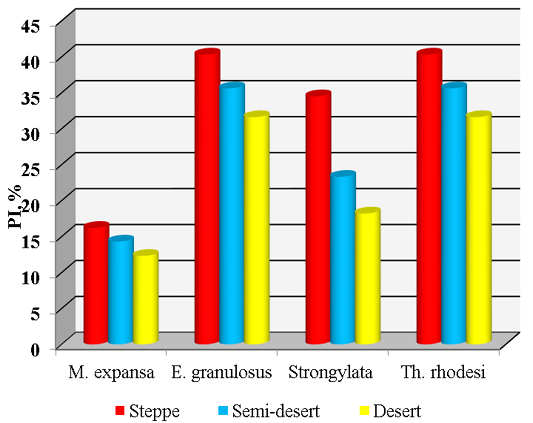
Figure 1: Prevalence of cattle infestation by the most common species of helminths.
In the steppe and the semi-desert zones, the rate of cattle infestation by Strongylata in the digestive tract was higher than in the desert zone (Figure 2).
Thelazia rhodesi was found in animals in all zones of the West region of Kazakhstan. The average prevalence of infestation caused by T. rhodesi was 40.3 % in the steppe zone, 35.6 % in the semi-desert zone, and 31.6 % in the desert zone.
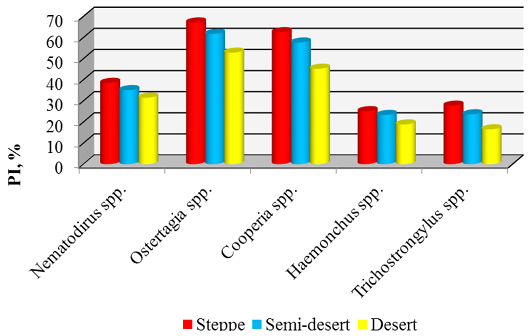
Figure 2: Prevalence of cattle infestation by Strongylata.
The average rate of cattle infestation with helminths (bions per animal) in the steppe, the semi-desert, and desert zones of the West region of Kazakhstan was 164.5 ± 13.7 for M. expansa, 117.9 ± 9.8 for Nematodirus spp.; 85.1 ± 7.0 for Ostertagia spp., 80.4 ± 6.7 for Cooperia spp., 129.5 ± 10.7 for Haemonchus spp., 120.1 ± 10.0 for Trichostrongylus spp., and 13.3 ± 1.1 for Th. rhodesi (Tables 2 and 3).
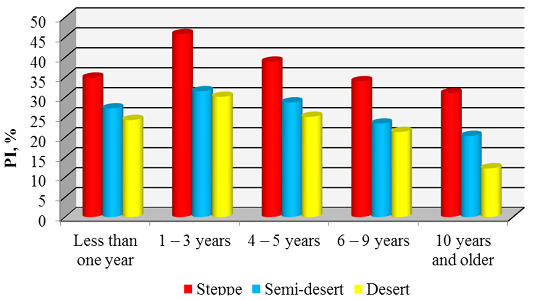
Figure 3: The age dynamics of cattle infestation by Strongylata in the digestive tract.
The seasonal dynamics of cattle infestation by main species of helminths were studied. For this purpose, helminth ovo- and larvoscopic methods were used for studying samples of feces from cattle in the steppe, the semi-desert, and the desert zone of the West Kazakhstan region. The studies were performed quarterly (in the winter, in the spring, in the summer, and the autumn).
Monieziasis the prevalence of cattle infestation by M. expansa in various seasons was the following: in the autumn and the winter, the highest infestation of cattle was observed 17.5 % and 16.2 %, respectively (Table 4). In the spring, cattle infestation decreased to 10.9 % due to the self-liberation of animals, since M. expansa life duration is short. In the summer, cattle infestation increased to 12.4 %. The prevalence of infestation in all seasons changed, and on average, it was 14.9 %. The highest prevalence of infestation was noted in the steppe zone 16.2 %, and the lowest one in
Table 2: Intensity of cattle infestation with the most common types of helminths in various zones of the West Kazakhstan region.
Table 3: Intensity of cattle infestation by Strongylata in the intestinal tract by genera in various areas of the West Kazakhstan region.
the desert zone 12.3 %. Throughout the year the animals were infected by M. expansa.
Table 4: The seasonal dynamics of the prevalence of cattle infestation by M. expansa in various zones of the West region of Kazakhstan.
The intensity of infestation by M. expansa increased in the summer and the autumn and decreased in the winter. The number of eggs of M. expansa in 1 g of feces in the autumn was 181.3 ± 15.1, and in the winter 148.7 ± 12.3 bions per animal. The average number of eggs of M. expansa in 1 g cattle feces over the year amounted to 164.6 ± 13.7 bions per animal (Table 5). By the results of seasonal helminthovoscopic study of the feces, a conclusion can be made that the cattle were infected with M. expansa throughout the year. Eggs of M. expansa could be found in the feces in any season.
Strongylatoses of the digestive tract. Quantitative studies of cattle feces were made four times a year in three zones of the West Kazakhstan region. They showed that the animals’ infestation by Strongylata in the digestive tract varied considerably throughout the year. The prevalence of cattle infestation in various seasons was the following: in the spring, before the grazing, the lowest infestation rate was noted 22.4 %. In the autumn, at the end of the grazing season, the highest cattle infestation of 35.1 % was noted. In the winter, the prevalence of infestation reduced to 17.6 %. On average during the year, the prevalence of infestation was 25.2 % (Table 6). The highest prevalence of infestation was noted in the steppe zone 34.5 %, and the lowest one in the desert zone 18.2 %.
Table 5: The seasonal dynamics of the intensity of cattle infestation by M. expansa in various zones of the West Kazakhstan region.
Table 6: Seasonal dynamics of the prevalence of cattle infestation by Strongylata in the intestinal tract in various areas of the West Kazakhstan region.
The intensity of cattle infestation by Strongylata in the digestive tract increased in the summer and autumn period, and decreased in the winter. The number of Strongylata eggs in 1 g of feces in the autumn was 107.5 ± 8.95, and in the winter 21.3 ± 1.9 bions per animal. The average number of Strongylata eggs in 1 g cattle feces over the year amounted to 71.0 ± 5.9 bions per animal (Table 7).
The results showed that cattle were infected by Strongylata in the digestive tract throughout the year. Eggs of Strongylata could be found in the feces of animals in any season. The highest intensity of infestation was noted in the steppe zone 76.5 ± 6.3 %, and the lowest one in the desert zone 66.2 ± 5.5 %.
Thelaziosis. Helminthological examination of cattle in three zones of the West Kazakhstan region showed that infestation of animals by Th. rhodesi varied considerably throughout the year. The prevalence of cattle infestation in various seasons was the following: in the winter and the spring, the lowest infestation of 2.4 % and 6.9 %, respectively, was noted. In the summer and the autumn, the highest cattle infestation rate was noted 50.7 % and 81.4 %, respectively. On average during the year, the prevalence of infestation was 35.3 %. The highest prevalence of infestation was noted in the steppe zone 38.6 %, and the lowest one in the desert zone 33.2 % (Table 8).
Table 7: Seasonal dynamics of the intensity of cattle infestation by Strongylata in the intestinal tract in various areas of the West Kazakhstan region.
Table 8: Seasonal dynamics of the prevalence of cattle infestation by Thelazia rhodesi in various areas of the West Kazakhstan region.
Table 9: Seasonal dynamics of the intensity of cattle infestation by Thelazia rhodesi in various areas of the West Kazakhstan region.
The intensity of infestation by Th. rhodesi increased in the summer and the autumn and decreased in the winter and the spring. The average number of Th. rhodesi in the cattle changed throughout the year; in the winter in was 2.3 ± 0.19 bions per animal, while in the autumn it was 45.6 ± 3.8 bions per animal. In the spring and the summer, the number of Th. rhodesi decreased significantly to 1.28 ± 0.13 and 4.4 ± 0.36 bions per animal, respectively. The average number of Th. rhodesi in cattle over the year amounted to 16.3 ± 1.3 bions per animal. The highest intensity of infestation was noted in the steppe zone 14.5 ± 1.2 bions per animal, and the lowest one in the desert zone 12.1 ± 1.0 bions per animal (Table 9).
The age dynamics of animals’ infestation rate were studied in all seasons. Based on the results of quantitative helminth ovo- and larvoscopic study of the samples of feces and the helminthological dissection of parenchymal organs from cattle, infestation rate of various age groups was studied less than year-old, 1-3 years old, 4-5 years old, 6-9 years old, and 10 years and older.
Monieziasis. Helminthovoscopic studies of the feces from cattle showed that the prevalence of infestation by M. expansa reduced with the age of the animals. In young cattle less than one year of age, it was 28.1 %, at the age of 1–3 years 24.0 %, in cattle at the age of 4–5 years 21.3 %, at the age of 6–9 years 4.3 %, and at the age of 10 years and older 0 % (Table 10).
Strongylata in the digestive tract. Helminthovoscopic studies of the feces of cattle showed that the prevalence of infestation by Strongylata in the digestive tract of the animal reduced.
In young cattle less than one year of age, it was 28.8 %, at the age of 1–3 years 35.8 %, in cattle at the age of 4–5 years 30.9 %, at the age of 6–9 years 26.2 %, and at the age of 10 years and older 21.1 % (Table 11).
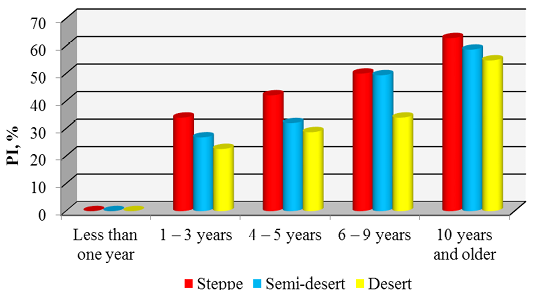
Larval echinococcosis. Total of 1,019 animals were examined (Table 12). The average prevalence of infestation by echinococcosis was 33.2 %. Young animals under one year of age were free from infestation. In the cattle at the age of 1–3 years, the average infestation rate was 27.8 %, in the cattle at the age of 4–5 years 34.2 %, at the age of 6–9 years 44.5 %, and at the age of 10 years and older 58.8 %.
Table 10: The age dynamics of cattle infestation by Moniezia in the West Kazakhstan region.