Research Article · Volume 55, Issue 2, 19 December 2022 · Open Access
Epitopes Determination for OMICRON: The COVID-19 New Variant
· · · · ·
Affiliations & Notes ⌄
1Department of Computer Science and Bioinformatics, Khushal Khan Khattak University, Karak, Khyber-Pakhtunkhwa, Pakistan. 2Department of Zoology, Faculty of Biological Sciences, Kohat University of Science and Technology, Kohat, 26000, Khyber-Pakhtunkhwa, Pakistan. Saba Rehman and Faisal Salih Hayat contributed equally to this manuscript. * Corresponding author: siddiqbiotec88@gmail.com, siddiqur.rahman@kkkuk.edu.pk, noorqu@gmail.com, noorulhaq@kkkuk.edu.pk
In the present study, both drug and vaccine designing were applied to identify the drug and vaccine candidate peptides.
This approach can help to design the drug and epitope in a short time and at low cost.
The suggested drug inhibitors and vaccine candidates from this study will help to develop an anti-viral vaccine that may be helpful to control this global threat.
Selected from the article's own text.
Abstract
Severe acute respiratory syndrome coronavirus 2 (SARS-CoV-2) has rapidly evolved in the last couple of years. This has created major havoc and concern because it has affected millions of people around the world. The new variants of covid-19 are classified into two types, VOI (variant of interest) and VOC (variant of concern). The major variants of concern (VOCs) have shared mutations in severe acute respiratory syndrome coronavirus 2 (SARS-CoV-2). The spike proteins of the novel coronavirus located mostly on the S1 unit result in a higher transmissibility rate and affect the viral virulence and clinical outcome. The spike protein and other non-structural protein mutations in VOCs may lead to escape the approved vaccinations. Here the VOC mutations i.e., OMICRON VARIANT have been discussed in detail, and the therapeutic strategies to enhance the host immune responses have been proposed. Additionally, a computational approach is proposed to design the drug and vaccine for the variant. The protein structure for the OMICRON variant has been predicted through bioinformatics tools and several databases have been used to identify suitable natural inhibitors. The OMICRON variant was analyzed to identify suitable vaccine candidates by identifying B-Cell epitopes. To design a drug, REPAGLINIDE and ENT-NATEGLINIDE were identified as natural inhibitors based on docking score. To design a vaccine the B-cell epitope i.e., CLIGAEYVNNSYECD was found to the highest antigenicity score. The present study identifies natural inhibitors and potential antigenic Epitopes which may be used as effective drug and vaccine candidates to suppress the novel coronavirus.
Introduction
There may be hundreds of viruses belonging to Coronavirus family but there are six viruses i.e., 229E, NL63, OC43, HKU1, SARS-CoV and MERS-CoV that have been reported which causes mild to severe respiratory tract infection in humans . At the end of 2002, severe acute respiratory syndrome coronavirus (SARS-CoV) was reported. Later on, around the end of 2012, Middle east respiratory syndrome (MERS-CoV) was reported which emerged from an animal reservoirs in the human population and caused severe respiratory illness with high mortality rates ; . A novel coronavirus i.e., severe acute respiratory syndrome coronavirus-2 (SARS-CoV2) causes an infectious disease called coronavirus disease (COVID-19) and emerged in late 2019 . It has been reported in Wuhan; a city in China and was identified in December 2019. COVID-19 causes dry cough, sore throat, fever and loss of taste and smell but more rare complications like heart injury have also been reported to be caused by the virus . On 11th March 2020, The World Health Organization (WHO) declared the severe acute respiratory syndrome corona virus 2 (SARS-CoV2), as a pandemic that quickly spread around the world ; . The family of Coronavirus is made up of four genera based on their genetic properties, including alpha beta, gamma, and delta coronavirus .
The coronaviruses are single-stranded positive-sense RNA (+ssRNA) viruses, which mainly causes respiratory and central nervous system disease in humans and animals . Human coronaviruses namely HCoV-OC43, HCoV-229E, HCoV-NL63 and HCoV-HKU1 circulate in humans, causing mild respiratory diseases . Nevertheless, the SARS-CoV outbreak in 2002, and the MERS-CoV outbreak in 2012 demonstrated that coronaviruses would cross the barrier to species, and emerge as highly pathogenic viruses ; . Along with humans, cattle, pigs, horses, camels, dogs, cats, birds, bats, rabbits, ferrets, mink, snakes, and other animal species are susceptible to coronavirus infection . Like all coronaviruses, 2019-nCoV consists of a minimum of three viral proteins namely spike protein (S) (a type of glycoprotein), a membrane protein (M) that spans the membrane, and an envelope protein (E); a highly hydrophobic protein that covers the entire structure of the coronavirus. The spike (S) glycoprotein in the coronavirus recognizes the host cell receptors, and causes an important role in viral infection .
On November 24, 2021, a new SARS-CoV-2 variant (B.1.1.529) was identified in South Africa. The first case attributed to B.1.1.529 was reported on December 1, 2021, in the United States by a person who had returned from South Africa. On December 2, 2021, a second case was reported in a person with no international travel history, who also attended a convention in the days preceding symptom onset. Omicron variants have also been detected in travel-related cases in several European countries, as well as Australia, Canada, Brazil, Hong Kong, Japan, Israel, Nigeria, Norway, Sweden, and the United Kingdom. A few countries, including the United States, have reported cases of people with no history of visiting southern Africa.
The United Kingdom Health Security Agency designated B.1.1.529 on November 25, 2021, as a Variant Under Monitoring (VUI-21-NOV-01) . Technical Advisory Team assessed B.1.1.529 on November 26, 2021, to determine the SARS-CoV-2 virus evolution . TAG-VE advised WHO that this alternate should be selected as the Variant of Concern (VOC) and WHO named B.1.1.529 as the VOC as Omicron . The WHO classification as VOC was based on epidemiological data showing an increase in disease in South Africa in November 2021 and associated with the discovery of Omicron.
Omicron has many spike protein modifications. One among these modifications is known in some organisms to be associated with reduced therapeutic potential for monoclonal antibodies or reduced convalescent neutrality and vaccine resistance. The European Center for Disease Prevention and Control also classified these variants as VOCs because of the escape of the immune system, and the strong stretch of infection as compared to the Delta variant . The SARS-CoV-2 Interagency Group (SIG) established by the U.S. Department of Health and Human Services is responsible for variant classifications in the United States. The SIG meets regularly to assess the risks posed by the SARS-CoV-2 divergence circulating in the United States and around the world, and to make recommendations regarding classification. The decision made by SIG on November 30, 2021, to classify the Omicron variant as a VOC was based on a number of factors including the cases attributed to Omicron in many countries and the countries without travel history, transmission, and replacement of Delta as the predominant variant in South Africa. In the spike protein, the number and position of substitutions, and data available for other variants with fewer substitutions in the spike protein indicate a reduction in neutralization by a vaccine, convalescent sera, and specific monoclonal antibody treatments. There are two variants of VOC classified by the United States: Omicron and Delta. On December 2, 2021, two confirmed cases related to Omicron variants were detected in the United States, and other possible Omicron cases are being investigated. Delta continues to be the predominant circulating variant. On August 26, 2021, CDC published information on “What We Know about the Delta Variant”. Importantly, almost all selected categories such as Delta remain vulnerable to monoclonal antibody treatment, and vaccines continue to be highly effective against severe illness, hospitalization and death among people infected with the Delta variant.
Omicron (B.1.1.529) Characteristics
WHO Label: Omicron
Pango Lineage: B.1.1.529
Nextstrain clade: 21K
The spike protein of the Omicron variant is characterized by at least 30 amino acid substitutions, three small deletions and one small insertion. Notably, 15 of the 30 amino acid substitutions are in the receptor binding domain (RBD). In other genomic regions, there are also several changes and deletions.
Currently, it is not known how the Omicron variant can spread from person to person. The replacement of Delta with Omicron as the predominant variant in South Africa raises concern that the Omicron variant may be more transmissible than Delta. But due to the low number of cases in South Africa when Omicron emerged, it is unclear if this variant is more transmissible than the Delta variant. Further, the relatively small number of cases documented to date makes it difficult to estimate transmissibility. Analysis of the changes in the spike protein indicates that the Omicron variant is likely to have increased transmission as compared to the original SARS-CoV-2 virus, but it is difficult to infer if it is more transmissible than Delta.
N501Y increases binding to ACE2 receptor which may increase transmission, and the combination of N501Y and Q498R may increase binding affinity even more. However, other substitutions in the Omicron spike protein are expected to decrease binding to ACE2. As such, receptor binding affinity needs to be assessed using the full spectrum of spike protein substitutions found in the Omicron variant. H655Y is proximal to the furin cleavage site and may increase spike cleavage, which can aid transmission. While N679K is proximal and adds to the polybasic nature of the furin cleavage site, which may also increase spike cleavage and could aid transmission. Additionally, P681H has been shown to enhance spike cleavage that can aid transmission. This mutation is found in Alpha and an alternate mutation at this position (P681R) is found in Delta.
Currently, it is not yet clear whether infection with Omicron variant causes more severe disease compared to infections with other variants, including Delta due to the small number of cases attributed to the Omicron variant, assessment of disease severity is difficult. Preliminary information from South Africa indicates that there are no unusual symptoms associated with Omicron variant infection and as with other variants, some patients are asymptomatic .
Materials and Methods
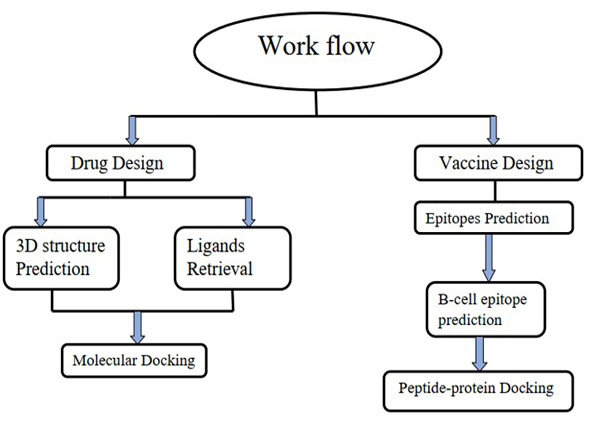
The workflow of computational drug and vaccine design for covid-19 (omicron variant) protein is summarized in Figure 1.
The 3D structure for spike protein of COVID-19 variant (B.1.1.529) was predicted through I-TASSER server which is freely available as both an online server and a stand-alone package at https://seq2fun.dcmb.med.umich.edu//I-TASSER/ with the principle of homology modeling ; Yang and Zhang, 2015).
Ligand retrieval
The ligand molecules were retrieved from PUBCHEM Database in SDF format. The ligands were converted to PDB format for further molecular docking process .
Molecular docking of spike protein variant (B.1.1.529)
The molecular docking was carried out through an online docking tool: PATCHDOCK. The ligand Repaglinide PUBCHEM (ID 65981) and ENT-Neglinide PUBCHEM (ID 60026) were docked with the 3D predicted structure of spike protein of COVID-19 variant (B.1.1.529) .
Vaccine design
The B-cell Epitopes were predicted through online server: IEDB (Immune-Epitope Database and Analysis Resource) , and were identified on the basis of antigenicity, hydrophilicity, accessibility of the surface and flexibility. The predicted Epitopes will be able to find the potential antigen and will initiate an immune response with B lymphocytes.
Non-allergenicity and non-toxicity of B-cell epitopes
ALLERCATPRO server was used to find the allergenicity of the Epitopes , while TOXINPRED was used to find the toxicity of the predicted Epitopes .
Protein-peptide docking
B-cell Epitope peptides were modeled using PEPFOLD server and docked with HLA-B7 allele . The 3D structure of HLA-B7 (PDB ID 6UJ7) allele was retrieved from PDB server. The modeled peptides were docked with HLA-B7 allele by using HPEPDOCK server.
Results and Discussion
Sequence retrieval
The protein sequence was retrieved from the Uniprot database, and the omicron variant (B.1.1.529) information was retrieved using the link: https://www.who.int/news/item/26-11-2021-classification-of-omicron-(b.1.1.529)-sars-cov-2-variant-of-concern. There are 30 amino acids substitutions, three small deletions and one small insertion. Fifteen amino acid substitutions are in the receptor binding domain. The mutation: A67V, del69-70, T95I, del142-144, Y145D, del211, L212I, ins214EPE, G339D, S371L, S373P, S375F, K417N, N440K, G446S, S477N, T478K, E484A, Q493R, G496S, Q498R, N501Y, Y505H, T547K, D614G, H655Y, N679K, P681H, N764K, D796Y, N856K, Q954H, N969K, L981F in which G339D, S371L, S373P, S375F, K417N, N440K, G446S, S477N, T478K, E484A, Q493R, G496S, Q498R, N501Y and Y505H are the key mutations present in the receptor binding domain . The physiochemical properties were calculated by PROTPARAM, and the results showed strong characteristics of the COVID-19 variant (B.1.1.529) OMICRON for a drug target, and vaccine candidate having 141230.99 kDa molecular weight containing 1269 amino acids. The target protein of OMICRON (B.1.1.529) has a theoretical isoelectric point of 7.14 which suggests its neutral existence. Among 1269 residues, 111 amino acids each were found to be negatively and positively charged. The estimated instability-index (II) was 34.56 determined through PROTPARAM , and thus grouped the target protein as stable.
Drug design
3D structure prediction
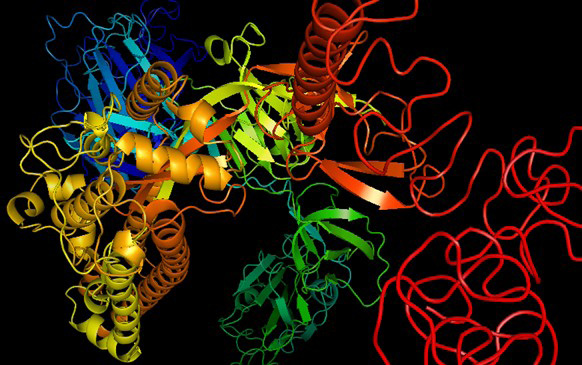
The 3D structure for COVID-19 variant (B.1.1.529) OMICRON was predicted through I-TASSER software with the principle of homology modeling ; ; , and visualized through PYMOL (Fig. 2). The 3D structure was selected among five models on the basis of high C-score of 0.23. The 3D structure analysis revealed that the structure contains eighteen alpha helixes, thirty beta pleated sheets and a greater number of random coils.
Ligand retrieval
The potential inhibitors (ligand molecules) i.e., REPAGLINIDE (PUBCHEM ID 65981) and ENT-NATEGLINIDE (PUBCHEMID 60026) for COVID-19 variant (B.1.1.529) OMICRON were retrieved from PUBCHEM database . These inhibitors inhibit vital replication, and thus it is considered an attractive target for anti-viral drugs (Li et al., 2021).
Molecular docking
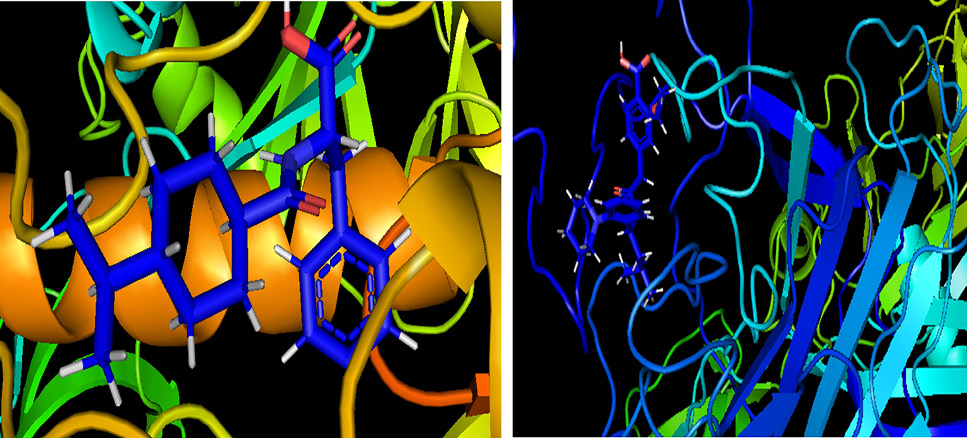
The molecular docking of COVID-19 variant (B.1.1.529) OMICRON with ligand molecules was performed through PATCHDOCK as shown in Figure 3. Both the interactions were visualized through PYMOL which revealed that the residues PHE830 and ASP864 show interactions with the ligand REPAGLINIDE (PUBCHEM ID 65981) having a bond length of 2.64 while GLY254 and ASP140 have bond length of 3.23 was involved in interactions with ligand ENT-NATEGLINIDE (PUBCHEMID 60026).
Vaccine design
Antigenic prediction
The protein sequence of COVID-19 variant: OMICRON (B.1.1.529) was evaluated for antigenicity through the online tool: VaxiJen 2.0 with a threshold setting for a virus as >0.5 . The antigenic prediction for the variant was 0.4802 showing that it is antigenic.
B-cell epitopes prediction
The COVID-19 variant: OMICRON (B.1.1.529) was used to predict the B-cell Epitopes using the ABCPred tool . More than fifty B-cell Epitopes were predicted, and the top six were selected as the best Epitopes based on the antigenicity by using the VexiJen tool. The predicted Epitope: CLIGAEYVNNSYECD showed a high antigenicity score of 0.9842 between the positions 645 to 660 as shown in Table I.
Table I. B-cell Epitopes: The predicted epitope, CLIGAEYVNNSYECD showed a high antigenicity score of 0.9842
S. No
Epitope Sequence
Vexijen score
1
AGTITSGWTFGAGAAL
0.2868
2
CLIGAEYVNNSYECD
0.9842
3
GVSVITPGTNTSNQVA
0.4651
4
GWTAGAAAYYVGYLQP
0.6210
5
PQIITTDNTFVSGNCD
0.2404
6
LRSYSFRPTYGVGHQP
0.4532
Profiling feature of B-cell epitopes
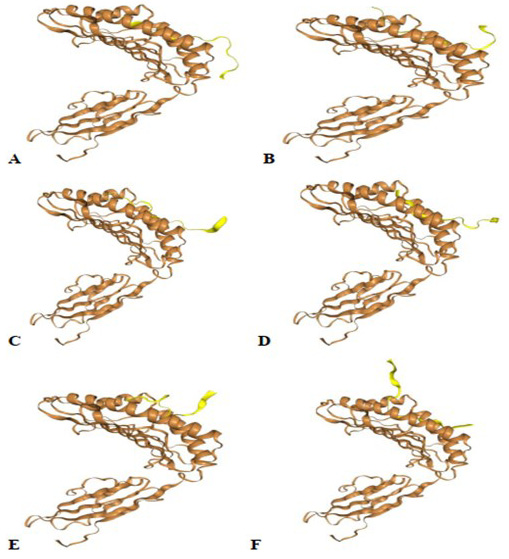
The selected B-cell Epitopes were checked for hydrophilicity, hydrophobicity, and toxicity by the TOXPRED tool as shown in Table II. Based on the results of protein-peptide docking (Fig. 4A-F), CLIGAEYVNNSYECD was concluded as the best.
The predicted B-cell Epitopes were checked for allergenicity and toxicity. Based on the docking score peptide, GWTAGAAAYYVGYLQP has been concluded as the best probable B-cell Epitope and can be considered as a vaccine candidate.
Table II. Toxicity, hydrophilicity, hydrophobicity, and physiochemical properties of the selected peptides.
Peptide sequence
Toxicity
Hydrophilicity
Hydrophobicity
Charge
Mol wt
AGTITSGWTFGAGAAL
Non toxin
-0.78
0.19
0.0
1480.87
CLIGAEYVNNSYECD
Toxin
-0.17
-0.08
-3.00
1693.04
GVSVITPGTNTSNQVA
Non toxin
-0.43
-0.01
0.0
1544.92
GWTAGAAAYYVGYLQ
Non toxin
-0.99
0.13
0.0
1688.10
PQIITTDNTFVSGNCD
Non toxin
-0.18
-0.09
-2.0
1725.09
LRSYSFRPTYGVGHQP
Non toxin
-0.28
-0.21
2.5
1865.31
Table III. Protein-peptide docking of the selected best peptides of B-cell epitopes with crystal structure of HLA-B7 (PDB ID: 6UJ7) protein.
Peptide
PDB ID
Docking score
PQIITTDNTFVSGNCD
6UJ7
-232.365
CLIGAEYVNNSYECD
6UJ7
-226.353
GVSVITPGTNTSNQVA
6UJ7
-204.770
GWTAGAAAYYVGYLQP
6UJ7
-279.097
LRSYSFRPTYGVGHQP
6UJ7
-257.742
AGTITSGWTFGAGAAL
6UJ7
-272.791
Conclusion
In the present study, both drug and vaccine designing were applied to identify the drug and vaccine candidate peptides. This approach can help to design the drug and epitope in a short time and at low cost. The suggested drug inhibitors and vaccine candidates from this study will help to develop an anti-viral vaccine that may be helpful to control this global threat.
Acknowledgment
We would like to thank the members of the Department of Computer science and Bioinformatics, Khushal Khan Khattak University, Karak for their useful input.
Informed consent
Informed consent was obtained from all individual participants included in the study.
Ethical approval
This article does not contain any studies with human participants or animals performed by any of the authors.
Statement of conflict of interest
The authors have declared no conflict of interest.
Figures
Fig. 1..
The workflow of drug and vaccine design for COVID-19 omicron variant.
Fig. 2..
3D structure of COVID-19 variant OMICRON (B.1.1.529). The 3D structure analysis revealed that the structure contains 18 alpha helixes, 13 beta pleated sheets and greater number of the random coils whose theoretical isoelectric point is 7.14.
Fig. 3..
The protein (omicron variant) docked with ligand molecules. The residues PHE830 and ASP864 show interactions with the ligand REPAGLINIDE (PUBCHEM ID 65981) having bond length of 2.64 while GLY254 and ASP140 having bond length 3.23 was involved in interactions with ligand ENT-NATEGLINIDE (PUBCHEMID 60026).
Ahmad, S.U., Abrar, M., Zafar, I., Ali, Y., Alanazi, A.M., Malik, A., Ahmad, A., Rather, M.A. and Khan, A.A., 2022. A comprehensive genomic study, mutation screening, phylogenetic and statistical analysis of SARS-CoV-2 and its variant omicron among different countries. J. Infect. Publ. Hlth., 5: 878–891. https://doi.org/10.1016/j.jiph.2022.07.002[CrossRef]
Ashik, A.I., Hasan, M., Tasnim, A.T., Chowdhury, M.B., Hossain, T. and Ahmed, S., 2020. An immunoinformatics study on the spike protein of SARS-CoV-2 revealing potential epitopes as vaccine candidates. Heliyon, 6: e04865. https://doi.org/10.1016/j.heliyon.2020.e04865[CrossRef]
Doytchinova, I.A., and Flower, D.R., 2008. Bioinformatic approach for identifying parasite and fungal candidate subunit vaccines. Open Vaccine J., 1: 22-26. https://doi.org/10.2174/1875035400801010022[CrossRef]
Du Toit, A., 2020. Outbreak of a novel coronavirus. Nat. Rev. Microbiol., 18: 123. https://doi.org/10.1038/s41579-020-0332-0[CrossRef]
Duhovny, D., Nussinov, R. and Wolfson, H.J., 2002. Efficient unbound docking of rigid molecules. In: Algorithms in bioinformatics (eds. R. Guigó and D. Gusfield). WABI, Lecture Notes in Computer Science. Springer, Berlin, Heidelberg. 2452. https://doi.org/10.1007/3-540-45784-4_14[CrossRef]
Fung, S.Y., Yuen, K.S., Ye, Z.W., Chan, C.P. and Jin, D.Y., 2020. A tug-of-war between severe acute respiratory syndrome coronavirus 2 and host antiviral defence: lessons from other pathogenic viruses. Emerg. Microbes Infect. 9: 558-570. https://doi.org/10.1080/22221751.2020.1736644[CrossRef]
Gasteiger, E., Hoogland, C., Gattiker, A., Wilkins, M.R., Appel, R.D. and Bairoch, A., 2005. Protein identification and analysis tools on the ExPASy server. In: The proteomics protocols handbook (ed. J.M. Walker). Springer Protocols Handbooks. Humana Press. https://doi.org/10.1385/1-59259-890-0:571[CrossRef]
Gupta, S., Kapoor, P., Chaudhary, K., Gautam, A. and Kumar, R., 2013. Open source drug discovery consortium. In silico approach for predicting toxicity of peptides and proteins. PLoS One, 8: e73957. https://doi.org/10.1371/journal.pone.0073957[CrossRef]
Ji, W., Wang, W., Zhao, X., Zai, J. and Li, X., 2020. Cross-species transmission of the newly identified coronavirus 2019-nCoV. J. med. Virol., 92: 433-440. https://doi.org/10.1002/jmv.25682[CrossRef]
Hakami, A.R., 2022. Targeting the RBD of omicron variant (B.1.1.529) with medicinal phytocompounds to abrogate the binding of spike glycoprotein with the hACE2 using computational molecular search and simulation approach. Biology (Basel), 11: 258. https://doi.org/10.3390/biology11020258[CrossRef]
Kim, S., Chen, J., Cheng, T., Gindulyte, A., He, J., He, S., Li, Q., Shoemaker, B.A., Thiessen, P.A. and Yu, B., 2021. PubChem in 2021: New data content and improved web interfaces. Nucl. Acids Res., 8: D1388-D1395. https://doi.org/10.1093/nar/gkaa971[CrossRef]
Kumar, A., Singh, R., Kaur, J., Pandey, S., Sharma, V., Thakur, L., Sati, S., Mani, S., Asthana, S., Sharma, T.K,, Chaudhuri, S., Bhattacharyya, S. and Kumar, N., 2021. Wuhan to world: The COVID-19 pandemic. Front. Cell. Infect. Microbiol., 11: 596201. https://doi.org/10.3389/fcimb.2021.596201[CrossRef]
Kumar, S., Thambiraja, T.S., Karuppanan, K. and Subramaniam, G., 2022. Omicron and Delta variant of SARS-CoV-2: A comparative computational study of spike protein. J. med. Virol., 94: 1641–1649. https://doi.org/10.1002/jmv.27526[CrossRef]
Lai, C.C., Shih, T.P., Ko, W.C., Tang, H.J. and Hsueh, P.R., 2020. Severe acute respiratory syndrome coronavirus 2 (SARS-CoV-2) and coronavirus disease-2019 (COVID-19): The epidemic and the challenges. Int. J. Antimicrob. Agents, 55: 105924. https://doi.org/10.1016/j.ijantimicag.2020.105924[CrossRef]
Lu, L., Shan, S., Haitao, Y., and Shibo, J., 2021. Antivirals with common targets against highly pathogenic viruses. Cell, 184: 1604-1620. https://doi.org/10.1016/j.cell.2021.02.013[CrossRef]
Manjunath, R., Gaonkar, S.L., Saleh, E.A.M., and Husain, K., 2022. A comprehensive review on Covid-19 Omicron (B.1.1.529) variant. Saudi J. biol. Sci., 29: 103372. https://doi.org/10.1016/j.sjbs.2022.103372[CrossRef]
Meng, X.Y., Zhang, H.X., Mezei, M, and Cui, M., 2011. Molecular docking: a powerful approach for structure-based drug discovery. Curr. Comp. Aided Drug Des., 7: 146-157. https://doi.org/10.2174/157340911795677602[CrossRef]
Nguyen, M.N., Krutz, N.L., Limviphuvadh, V., Lopata, A.L., Gerberick, G.F. and Maurer-Stroh, S., 2022. AllerCatPro 2.0: A web server for predicting protein allergenicity potential. Nucl. Acids Res., 50: W36-W43. https://doi.org/10.1093/nar/gkac446[CrossRef]
Owusu, M., Annan, A., Corman, V.M., Larbi, R., Anti, P., Drexler, J.F., Agbenyega, O., Adu-Sarkodie, Y., Drosten, C., 2014. Human coronaviruses associated with upper respiratory tract infections in three rural areas of Ghana. PLoS One, 9: e99782. https://doi.org/10.1371/journal.pone.0099782[CrossRef]
Parmar, M., Thumar, R., Sheth, J. and Patel, D., 2021. Designing multi-epitope based peptide vaccine targeting spike protein SARS-CoV-2 B1. 1.529 (Omicron) variant using computational approaches. bioRxiv, 20: 1-18. https://doi.org/10.1101/2021.12.23.473990[CrossRef]
Perlman, S. and Netland, J., 2009. Coronaviruses post-SARS: update on replication and pathogenesis. Nat. Rev. Microbiol., 7: 439-450. https://doi.org/10.1038/nrmicro2147[CrossRef]
Pillaiyar, T., Manickam, M., Namasivayam, V., Hayashi, Y., and Jung, S.H., 2016. An overview of severe acute respiratory syndrome–coronavirus (SARS-CoV) 3CL protease inhibitors: Peptidomimetics and small molecule chemotherapy. J. med. Chem., 59: 6595-628. https://doi.org/10.1021/acs.jmedchem.5b01461[CrossRef]
Reddy, C.S., Vijayasarathy, K., Srinivas, E., Sastry, G.M., and Sastry, G.N., 2006. Homology modeling of membrane proteins: A critical assessment. Comp. Biol. Chem., 30: 120-126. https://doi.org/10.1016/j.compbiolchem.2005.12.002[CrossRef]
Saha, S. and Raghava, G.P.S., 2006. Prediction of continuous B-cell epitopes in an antigen using recurrent neural network. Proteins, 65: 40-48. https://doi.org/10.1002/prot.21078[CrossRef]
Saxena, S.K., Kumar, S., Ansari, S., Paweska, J.T., Maurya, V.K., Tripathi, A.K. and Abdel-Moneim, A.S., 2021. Characterization of the novel SARS-CoV-2 Omicron (B. 1.1. 529) Variant of Concern and its global perspective. J. med. Virol., 94: 1738-1744. https://doi.org/10.1002/jmv.27524[CrossRef]
Su, S., Wong, G., Shi, W., Liu, J., Lai, A.C., Zhou, J., Liu, W., Bi, Y. and Gao, G.F., 2016. Epidemiology, genetic recombination, and pathogenesis of coronaviruses. Trends Microbiol., 24: 490-502. https://doi.org/10.1016/j.tim.2016.03.003[CrossRef]
Vita, R., Mahajan, S., Overton, J.A., Dhanda, S.K., Martini, S., Cantrell, J.R., Wheeler, D.K., Sette, A. and Peters, B., 2019. The Immune Epitope Database (IEDB): 2018 update. Nucl. Acids Res., 47: 339–343. https://doi.org/10.1093/nar/gky1006[CrossRef]
Wang, N., Shi, X., Jiang, L., Zhang, S., Wang, D., Tong, P., Guo, D., Fu, L., Cui, Y. and Liu, X., 2013. Structure of MERS-CoV spike receptor-binding domain complexed with human receptor DPP4. Cell Res., 23: 986-993. https://doi.org/10.1038/cr.2013.92[CrossRef]
Williams, S.V., Vusirikala, A., Ladhani, S.N., De Olano, E.F.R., Iyanger, N., Aiano, F., Stoker, K., Rao, G.G., John, L., and Patel, B., 2021. An outbreak caused by the SARS-CoV-2 Delta (B. 1.617. 2) variant in a care home after partial vaccination with a single dose of the COVID-19 vaccine Vaxzevria, London, England, April 2021. Euro Surveill, 26: 2100626. https://doi.org/10.2807/1560-7917.ES.2021.26.27.2100626[CrossRef]
Wolter, N., Waasila, J., Sibongile, W., Richard, W., Harry, M., Michelle, G., Daniel, G.A., Josie, E et al. 2022. Early assessment of the clinical severity of the SARS-CoV-2 omicron variant in South Africa: A data linkage study. Lancet, 399: 437-446. https://doi.org/10.1016/S0140-6736(22)00017-4[CrossRef]
Yang, J., and Zhang, Y., 2015. Protein Structure and Function Prediction Using I-TASSER. Curr. Protoc. Bioinf., 52:5.8.1-5.8.15. https://doi.org/10.1002/0471250953.bi0508s52[CrossRef]
Yang, J., Yan, R., Roy, A., Xu, D., Poisson, J. and Zhang, Y., 2015. The I-TASSER Suite: protein structure and function prediction. Nat. Methods, 12: 7-8. https://doi.org/10.1038/nmeth.3213[CrossRef]
Zhang, Y., 2008. I-TASSER server for protein 3D structure prediction. BMC Bioinf., 9: 40. https://doi.org/10.1186/1471-2105-9-40[CrossRef]
Zheng, W., Zhang, C., Li, Y., Pearce, R., Bell, E.W. and Zhang, Y., 2021. Folding non-homologous proteins by coupling deep-learning contact maps with I-TASSER assembly simulations. Cell Rep. Methods, 1: 100014. https://doi.org/10.1016/j.crmeth.2021.100014[CrossRef]
Zhong, N., Zheng, B., Li, Y., Poon, L., Xie, Z., Chan, K., Li, P., Tan, S., Chang, Q. and Xie, J., 2003. Epidemiology and cause of severe acute respiratory syndrome (SARS) in Guangdong, People’s Republic of China, in February, 2003. Lancet, 362: 1353-1358. https://doi.org/10.1016/S0140-6736(03)14630-2[CrossRef]