
The toxicities of Pronil (Fipronil) and Mirage (Imidacloprid) were tested in soil against Heterotermes indicola. Treatment with Pronil and Mirage during 8 h caused less than 97% mortality in 8 h. LC50 values for Pronil and Mirage were 39.81 ppm and 177.32 ppm, respectively. Pronil was found more toxic than Mirage with low LC50 value however both insecticides revealed to be non-repellent against H. indicola.
Short Communication · Volume 50, Issue 1, 19 January 2018 · Open Access
Efficacy of Slow Acting Toxicants on Heterotermes indicola (Wasmann) (Isoptera: Rh inotermitidae)
· ·
Affiliations & Notes ⌄
- 1Department of Zoology, University of the Punjab, Lahore-54590, Pakistan 2FC College University, Ferozepur Road, Lahore, Pakistan , * Corresponding author: misswaqar@yahoo.com
Article Info ⌄
- Journal:
- Pakistan Journal of Zoology
- Published:
- 19 January 2018

From the article
- For H. indicola treated with Pronil and Mirage for 8 h caused less than 97% mortality in 8 h.
- For determining termiticide the soil treated with Pronil and Mirage was non-repellent at 25, 12.5, 6.25, 3.125, 1.562, 0.781 and 0.390 ppm.
- From this study, we can conclude that Pronil was more toxic than Mirage with less LC50 value.
- As Mirage is less toxic and non-repellent, it can be employed in baiting technology on larger scale as a best slow acting toxicant.
Selected from the article's own text.
Abstract
Materials and methods
Heterotermes indicola (Wasmann) for laboratory experiments were collected from Morus alba trees from Model town, Lahore, Pakistan. Termites were separated from their nests in laboratory and were kept at 80% relative humidity at 26°C in a petri dish (90 × 15mm) containing slightly wet filter paper. Only healthy and active worker termites were used for the experiments. Stock solutions of two Insecticides Pronil (Fipronil ®2.5 EC) and Mirage (Imidacloprid®45 EC) purchased from the market was prepared in distilled water as per manufacturer’s instructions. The soil selected for bioassay was sandy loam, without insecticide residues as no previous insecticide application record was found on the area from where the soil was collected. For sieving the soil a mesh screen (10×18 mm) was used and oven-dried for 24 h at 70°C.
The soil toxicity test was performed and termite toxicity was expressed as F-1 (0.97) . 10 g of soil was spread in the washed oven dried (70°C for 24 h) petridish treated with 6 ml of seven different dilutions of Pronil (25, 12.5, 6.25, 3.125, 1.562, 0.7812 and 0.321 ppm) and Mirage (50, 25, 12.5, 6.25, 3.125, 1.562 and 0.7812 ppm). Finally 10 termites were released in each petridish. Concentrations of each insecticide were replicated three times. For control, 3 replicates treated only with distilled water were maintained. Observations were recorded after every ½ h for up to 8 h. The number of dead termites was recorded. The termite mortality data from three replicates was summed and subjected to probit analysis according to Busvine (1971) and Finney (1971). Lethal concentration to 50% mortality (LC50) was estimated for each insecticide used.
Same treatment of the soil and dosage was used for repellency test. Five grams of treated soil (5 g with 3ml of insecticide) was used to cover one half of each petridish and remaining half with untreated soil. Ten termite workers were released in the center of each petridish. Three sets of each concentration were used. Black cloth was used to completely cover the setup to reduce the effect of light and the temperature was maintained at 26°C during experimental work. Termite number was recorded on treated and untreated soil after every 15 min. A total of five observations were recorded at intervals of 15 min for each petridish, to study the insecticide residual effect. When the sum of three replicates was observed on untreated soil (i.e. 21 or more of 30 termites), at all 5 observation times then the treatment was considered to be repellent. The data was analyzed statistically and LC50 was calculated using probit Analysis according to Busvine (1971) and Finey (1971).
Results and discussion
For H. indicola treated with Pronil and Mirage for 8 h caused less than 97% mortality in 8 h. LC50 values calculated from data of Supplementary Tables SI and SII for Pronil and Mirage was 39.81 ppm 177.32 ppm, respectively (Fig. 1). Steeper slopes of the probit lines also reflect the fact that the lower doses caused significantly higher toxicity than Mirage .
For determining termiticide the soil treated with Pronil and Mirage was non-repellent at 25, 12.5, 6.25, 3.125, 1.562, 0.781 and 0.390 ppm. It is proposed that if concentration of Mirage is increased above 50 ppm it shows low repellency level than Pronil. Most of the non-repellent, slow acting termiticides need longer time for their lethal effectiveness . Sooner the lethal dose had been conveyed throughout the colony; the non-repellent termiticides can collapse a colony . Manzoor et al. (2012) determined LC50 values for imidacloprid and fipronil as 346.75 and 14.45 after 8 h exposure which are different from our present findings but similar trend was observed as imidacloprid has higher LC50 as compared to Pronil (Fipronil). This highlighted the uniqueness of long lasting effect of imidacloprid in having slow acting toxicant potential targeting effective termite control. Iqbal and Saeed (2013) reported LC50 values of imidacloprid in the range of 12.59-24.06 ppm against Microtermes mycophagus workers. The LC50 values for fipronil and imidacloprid were 3.48 and 2.02 ppm against Amitermes villis .
Conclusion
From this study, we can conclude that Pronil was more toxic than Mirage with less LC50 value. The use of these non-repellent insecticides for termite control is preferable than quick knock down insecticides for effective long term termite control. As Mirage is less toxic and non-repellent, it can be employed in baiting technology on larger scale as a best slow acting toxicant.
Supplementary material
There is supplementary material associated with this article. Access the material online at: http://dx.doi.org/10.17582/journal.pjz/2018.50.1.sc3
Statement of conflict of interest
Authors have declared no conflict of interest.
Figures
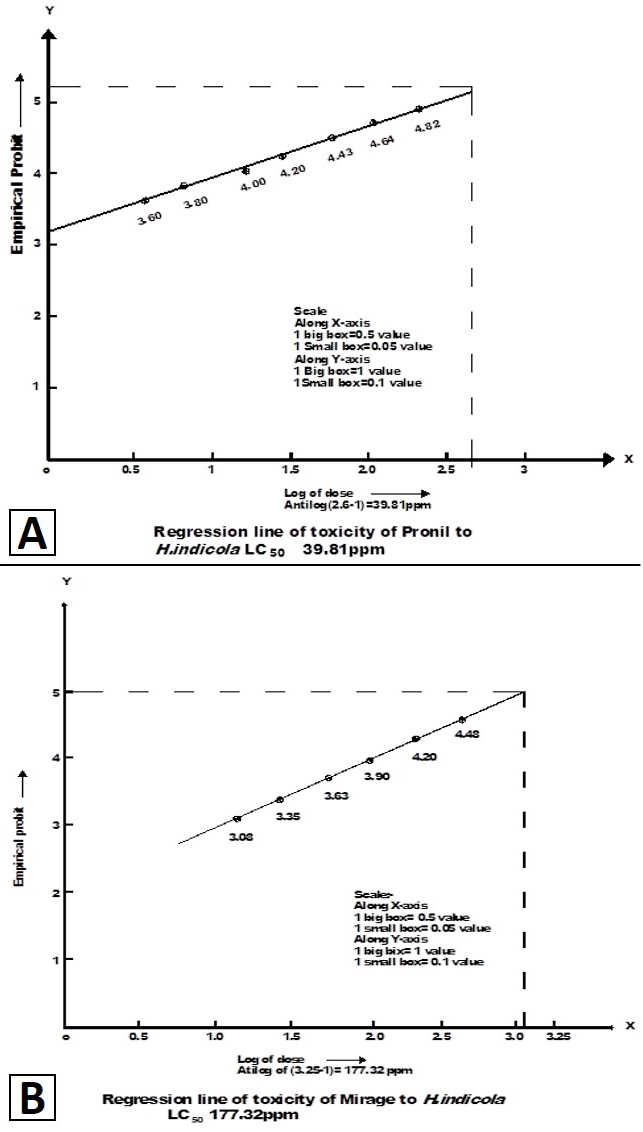
Regression lines of toxicity of Pronil (A) and Mirage (B) in 8 h against Heterotermes indicola. The LC50 values were calculated from lines according to Busvine (1971) and Finney (1971). The graphs were drawn on AutoCAD.
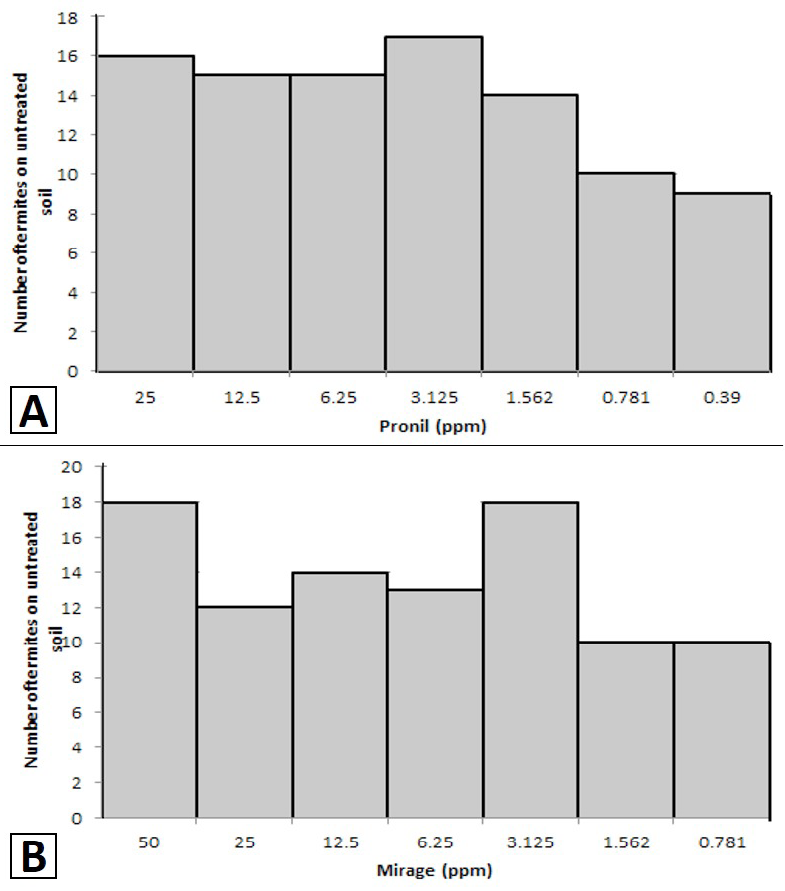
Repellent effects of Pronil (A) and Mirage (B) on H. indicola at their various concentrations.
References
- Acda, M.N., 2014. J. Insect Sci., 14: 1-4. https://doi.org/10.1093/jis/14.1.116[CrossRef]
- Afzal, M., Qureshi, N.A., Rasib, K.N. and Hussain, I., 2017. Pakistan J. Zool., 49: 785-792. http://dx.doi.org/10.17582/journal.pjz/2017.49.3.785.792[CrossRef]
- Busvine, J.R., 1971. A critical review of the techniques for teaching insecticides. CIE, CAB, London.
- Finey, O.J., 1971. Probit analysis. Cambridge University Press, England.
- Gautam, B.K., Henderson, G. and Wang, C., 2014. Insect Sci., 21: 174-180. https://doi.org/10.1111/1744-7917.12041[CrossRef]
- Hu, X.P., 2005. J. econ. Ent., 98: 509-517.
- Iqbal, N. and Saeed, S., 2013. Pakistan J. Zool., 45: 709-713.
- Manzoor, F., Sayyed, H.A., Rafique, T. and Malik, S.A., 2012. J. Anim. Pl. Sci., 22: 65-71.
- Neoh, K.B., Yeoh, B.H. and Lee, C.Y., 2014. J. econ. Ent., 107: 1563-1572.
- Rashid, M., Garjan, A.S., Naseri, B. and Saberfar, F., 2012. Munis Ent. Zool., 7: 1044-1050.
- Salihah, Z., Sattar, A., Farid, A. and Shakoori, A.R., 2012. Termites of Pakistan and their control. Zoological Society of Pakistan, University of the Punjab, Lahore, Pakistan.
- Saljoqi, A.U.R., Muhammad, N., Khan, I.A., Nadeem, M., Rehman, S. and Slim, M., 2014. Sarhad J. Agric., 30: 333-339.
- Sattar, A., Traniello, J.F.A., Salihah, Z. and Farid, A., 2002. The Nucleus (Pakistan), 39: 89-93.
- Sheikh, N., 2015. Pakistan Entomol., 37: 151-154.
- Smith, V.K., 1979. J. econ. Ent., 72 877-879.
- Tsunoda, K., 2003. Sociobiology, 41: 27-36.
- Verma, M., Sharma, S. and Prasad, R., 2009. Int. Biodeter. Biodegrad., 63: 959-972. https://doi.org/10.1016/j.ibiod.2009.05.009[CrossRef]
Supplementary material
Cited by 2 articles
In journals published by ResearchersLinks.
- Field Evaluation of Promising Botanical Extracts, Plant Essential Oils and Differential Chemistry Insecticides against Subterranean Termites Odontotermes obesus (Isoptera: Termitidae)Sarhad Journal of Agriculture · 2021
- Potential Fungal Control of the Subterranean Termite Heterotermes indicola (Wasmann)Pakistan Journal of Zoology · 2018
Services
Article usage statistics
Loading…