Effects of Gamma Irradiation on Morphological Characteristics and Nutrient Content of Arabic Chicken Egg Powder
· · · · · · · · · · ·
Affiliations & Notes ⌄
1Research Center for Food Technology and Processing, BRIN,Gunungkidul, Indonesia
2Faculty of Agricultural Technology, University of Jember, Jember, East Java, Indonesia
3Directorate of Laboratory Management, Research Facilities, and Science and Technology Park, BRIN, Sleman, Indonesia
4Research Center for Animal Husbandry, BRIN, Bogor, Indonesia
5Research Center for Radiation Process Technology, BRIN, South Jakarta, Indonesia
6Research Center for Appropriate Technology, BRIN, Subang, Indonesia
7Faculty of Animal Science, Universitas Gadjah Mada, Sleman, Indonesia. *Correspondence | Teguh Wahyono, Research Center for Food Technology and Processing, BRIN,Gunungkidul, Indonesia
The morphological characteristics of Arabic poultry egg powder were changed slightly through gamma irradiation.
The nutrient content of Arabic egg powder, such as moisture, protein, and fat are significantly affected by gamma irradiation.
The findings of microbial detection indicate that an irradiation dose of 5 kGy is a promising method for decontaminating Arabic egg powder materials.
This study demonstrated that gamma irradiation effectively reduces microbial contamination in egg powder without negatively affecting product quality.
Selected from the article's own text.
Abstract
Arabic chicken eggs are a notable functional food ingredient in Indonesia. Nevertheless, their powdered form is susceptible to microbial contamination and loss of quality. Gamma irradiation offers a practical solution for preserving these eggs. This research evaluates the influence of gamma irradiation on morphological characteristics, nutrient content and microbial count of Arabic chicken egg powder. The powdered Arabic chicken egg was exposed to 0, 2.5, 5, or 10 gamma irradiation doses. Morphological characteristics, nutrient content, and microbial count were analyzed in this study. Results showed that there is no effect on morphological characteristics of Arabic egg powder after gamma irradiation. However, as the radiation dose increases, the redness (a*) and yellowness (b*) values of hunter color decrease (p<0.05). Compared with untreated sample, protein and fat are significantly affected by gamma irradiation (p<0.05). Furthermore, after irradiation, moisture levels decreased (p<0.05). The optimal dose for microbial load elimination is 5 kGy. It was concluded that gamma irradiation effectively eliminates microbial contamination in Arabic egg powder without negatively affecting product quality (morphological characteristics and nutrient content).
As a functional food ingredient, Arabic chicken eggs can contribute to the growth of the superfood industry in Indonesia. Indonesia is estimated to produce 375,253 tons of native poultry eggs in 2022, representing increases of 2.74% and 4.5% from 2021 and 2020, respectively . An increase in the native poultry population of 7,709,715 over the prior year also contributed to the rise in egg production. Processing fresh eggs to egg powder is required to deal with the bulky and vulnerable to spoiling characteristics. Several factors will influence the growth of the egg powder industry in Indonesia: 1) the fluctuating cost of fresh eggs in recent years; 2) the industry participating concern in the availability of egg raw materials; and 3) the rising demand for functional foods in the form of native chicken eggs.
Spray drying has been implemented to produce powdered products in significant quantities due to its ability to continuously produce a consistent, high-quality product . Egg powders are highly regarded components in ready-to-eat foods due to their beneficial characteristics such as foamability and emulsion stability ; . Particularly, the use of egg powder has been steadily increasing because of its efficiency in food industry processing and home preparation, as well as its relatively lower price . With the development of food industry technology, the use of fresh eggs in food processing as a raw material has decreased, while egg-based product technology, such as egg powder, increased in popularity . Egg powder can be substituted for liquid egg in many food-processing applications. The structure of spray-dried egg powder is superior to that of powder produced through foam mat drying . He et al. (2023) reported that the structural characteristics of highland barley dough and its baking properties of highland barley bread were both improved by the inclusion of egg powder, offering bakers a different approach to processing highland barley bread. Additionally, egg powder requires preservation to increase its shelf life because lipid-containing . Preserving the original nutritional value of whole egg powder is essential as a healthy food and serves as a special additive with broad application potential .
Gamma irradiation treatment is a food processing technology innovation that aims to eliminate biological contamination in the form of pathogenic bacteria, viruses, fungi, and insects which have the potential to damage food ingredients and endanger consumers. By country-specific regulations, irradiation technology is considered secure for food preservation . Despite opposition from some groups, the application of this technology following established standards ensures that it poses no risk to human health or the environment . According to Froehlich et al. (2015), the optimal gamma irradiation dose for sterilizing egg flour was 2.28 kGy. This is because egg flour at this concentration is sterile against Salmonella with minimal changes to aroma and color. Al Bachir (2021) reported that irradiated egg powder showed superior solubility, oil holding capacity, foaming capacity, and emulsifying properties compared to unirradiated egg powder. Furthermore, irradiated egg powder may be a beneficial component in the production of bakery and confectionary foods. To the best of our knowledge, no research has been conducted to evaluate the application of gamma irradiation on Arabic chicken egg flour. Therefore, this study aims to determine gamma irradiation’s effect on morphological characteristics, nutrient content, and microbial count of Arabic chicken egg powder.
MATERIALS AND METHODS
Egg Powder Preparation
The egg powder was prepared using a modified method as described by Setiyawan et al. (2021). This investigation used the entire egg contents, including the yolk and white eggs. Following homogenization at 60oC for four minutes with a mixer, the mixture of Arabic poultry eggs is pasteurized. An airflow velocity of 50 m3/hour is utilized to dry the pasteurized eggs in a spray dryer with the following parameters: inlet temperature of 110-120oC, and discharge temperature of 60-70oC. As samples for characteristic evaluation, the egg powder results were subsequently collected.
Gamma Irradiation Treatment
Arabic egg powder was irradiated with doses of 0, 2.5, 5, and 10 kGy, at room temperature, using Gamma Cell 220 (Atomic Energy of Canada, Ottawa, Canada) with 60Co gamma source at a dose rate of 2.808 kGy h-1. The absorbed dose was monitored by Harwell Amber and Red Perspex dosimeters (England). The control and irradiated samples were stored for 7 days at room temperature (18 – 25 oC) under relative humidity (50-70%).
Morphological Evaluation
A scanning electron microscope (SEM) has been used to examine the morphological characteristics of egg flour. The sample was placed on a plate coated with palladium and gold for conducting objectives before observation. Acceleration energy of 15 kV enables observations. At magnifications of 500 and 1000 times, the structure and distribution of the particles were carefully examined.
Color Measurement
Color parameters were determined using approximately 3 g egg powder samples. Chromameter Konica Minolta (Konica Minolta, Tokyo, Japan) was applied to determine the color, which was expressed in regards to lightness (L*), redness (a*), and yellowness (b*).
Fourier Transform Mid-Infrared (FTIR) Evaluation
A preparation sample was created by mixing a ± 2 mg egg powder sample with 200 mg of KBr, then quickly and uniformly mixing using a mortar. Furthermore, a sample was analysed using the Vertex-80 Fourier Transform Mid-Infrared (Bruker®, Germany) in the wavelength range of 4000-500 cm-1 in approximately 60 seconds.
Moisture and Nutrient Content Evaluation
A sample weighing approximately 1 g was subjected to analysis using the MB120 Moisture Analyzer (OHAUS Instruments, Shanghai, China). The analysis was performed for an entire period of 30 minutes. The nutrient composition, including ash content, organic matter, protein, and fat has been evaluated using the method described in the AOAC (2005) procedure.
Mineral Content Evaluation
For determining mineral content, X-Ray Fluorescence (XRF) is utilized. After placing the egg powder sample through a pellet press to ensure uniform vacuuming, the sample was exposed to 50 kV X-rays. Around eight minutes is required to complete one sample measurement using the Panalytical Epilson 4 (Malvern, UK).
Microbial Analysis
The microbial evaluations used the total plate count (TPC) methodology. A volume of 45 ml of sterile NaCl 0.86% was used to dissolve five mg of the sample, which was then homogenized. A serial dilution was performed until a final concentration of 104 was reached. Plate Count Agar (PCA) medium (Merck, Germany) was applied for counting the total number of bacteria. This was accomplished by spreading 100 μl of the sample using the spread plate method across the three batches of the final dilution . Plates that had been inoculated were inverted and maintained at 37°C for a 24 h period. Plates containing viable colonies were recorded for 24 hours after incubation using a colony counter. The colony count is measured in colony-forming units (CFU/ml). The CFU/ml of the material was determined using the formula CFU/ml x dilution factor. Log10 of CFU/ml has been used to represent CFU/ml .
Statistical Analysis
Four irradiation doses with four replicates of each treatment were distributed in a randomized design. All data were analyzed using one-way analysis of variance (ANOVA) using SPSS 23.0 (IBM, Armonk, New York, USA). Means were separated using Duncan’s multiple range test. The significant differences were observed at p < 0.05 .
RESULTS
Morphological Characteristics
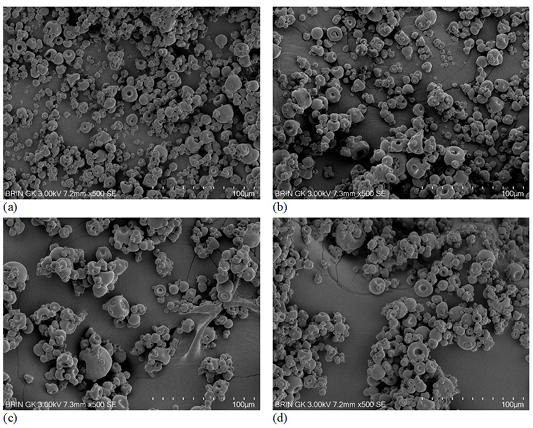
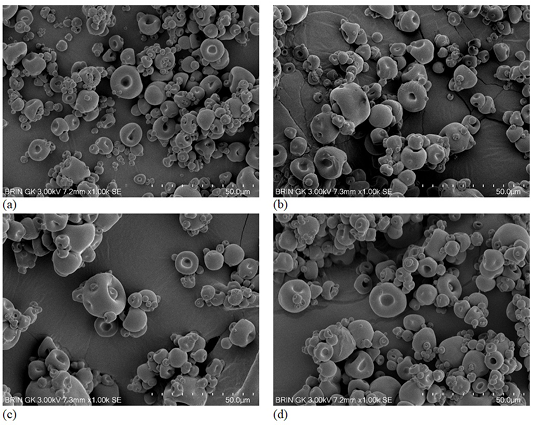
The SEM images at 500x and 1000x magnification (Figure 1 and 2, respectively) demonstrate the morphological appearance of Arabic chicken egg powder after gamma irradiation treatment. The appearance of globules formed from Arabic chicken egg powder was unaffected by irradiation at doses of 2.5, 5, and 10 kGy. However, there were cracks in some globules after irradiation treatment.
Color Measurement
Table 1 presents color expressed as lightness (L*), redness (a*), and yellowness (b*). The redness (a*) and yellowness (b*) of egg powder were decreased by irradiation treatment (p<0.05). Similar results are also shown in the lightness (L*) parameter. However, the lightness (L*) value when the raw material was irradiated at 10 kGy was significantly higher than other treatments (p<0.05).
Table 1: Hunter color value of gamma irradiated Arabic chicken egg powder.
Irradiation dose (kGy)
Hunter color
L*
a*
b*
0
87.82c
8.22d
26.02d
2.5
86.48b
7.21c
24.95c
5
86.33a
6.23b
23.78b
10
88.30d
3.84a
20.15a
SEM
0.255
0.489
0.667
a-d values with different letters within the same column differ significantly (p<0.05).
Fourier Transform Mid-Infrared (FTIR) Evaluation
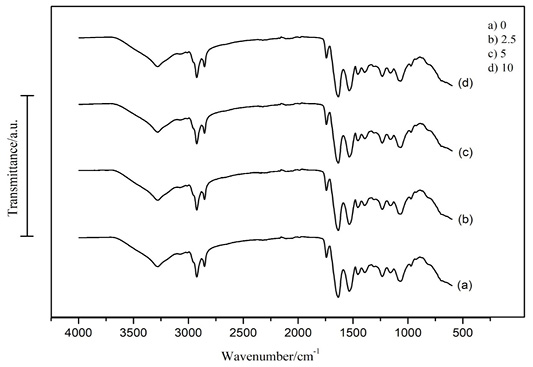
FTIR spectra for untreated and irradiated Arabic egg powder are shown in Figure 3. Several notable bands have been identified within the spectral range of 4000–600 cm−1. The peak band attributes of the FTIR spectra employed in this study are presented in Table 2. As a water band, the stretching O-H symmetric bond is observed at 3278-3279 cm-1. A band indicating fat content was observed in all four treatments, notably in regions 2923, 2853, and 1742 cm-1. Protein bands in amide I and II were also identified in four treatments, particularly in regions 1634 and 1534 cm−1. Bands in the 1455 cm−1 region were observed in all four treatments, indicating a concentration of protein and collagen. The band observed within the 2322 - 2339 cm−1 range is uniquely present in the Arabic chicken egg powder treated with gamma irradiation. This band suggests the concentration of dissolved CO2.
DISCUSSION
Moisture and Nutrient Content
Moisture and nutrient content of Arabic chicken egg powder after gamma irradiation treatment are shown in Table 3. The moisture content was decreased after irradiation, while fat and protein content in the irradiated sample were increased (p<0.05). No significant differences in ash and organic matter content were found after the Arabic chicken egg powder was treated with irradiation.
Table 2: The peak band characteristics of the FTIR spectrum employed in this study (Coates, 2006; Schadle et al. 2015; Nandiyanto et al., 2019).
Group
Wavenumber (cm-1)
Characteristics
O-H
3570-3200
Hydroxy group, H-bonded OH stretch
O-H
3400–3200
Normal ‘‘polymeric’’ OH stretch
C-H
2935–2915/2865–2845
Methylene C-H asymmetric/symmetric Stretch
O-CH3, C-H
2850–2815
Methoxy, methyl ether O-CH3, C-H stretch
C=O
2350-2260
Dissolved CO2
C≡C
2140–2100
Terminal alkyne (monosubstituted)
-NCS
2150–1990
Isothiocyanate
C(O)−N
1680–1630
Amide
-
1640–1620/1285–1270
Organic nitrates
-
1560–1540/1380–1350
Aliphatic nitro compounds
C-H
1485–1445
Methylene C-H bend
C-H
1470–1430
Methylene C-H asymmetric/symmetric Bend
Organic sulfates
1420–1370
Organic sulfates
P-O-C
1240–1190
Aromatic phosphates (P-O-C stretch)
C-H
1225–950 (several)
Aromatic C-H in-plane bend
C-N
1090–1020
Primary amine, CN stretch
Table 3: Moisture and nutrient content of gamma-irradiated Arabic chicken egg powder.
Irradiation dose (kGy)
Moisture
Nutrient content (% dry matter)
%
Ash
Organic matter
Protein
Fat
0
5.04b
5.84
94.16
46.31a
34.44a
2.5
4.60a
6.51
93.49
46.50ab
35.34b
5
4.62a
5.51
94.49
46.96c
35.76b
10
4.59a
6.14
93.86
46.72b
35.76b
SEM
0.074
0.176
0.176
0.079
0.198
a-c Values with different letters within the same column differ significantly (p<0.05).
Mineral Content
Table 4 presents gamma irradiation results on the macro and micro mineral composition of Arabic chicken egg powder. Gamma irradiation has no significant effect on the Mg, P, and K concentrations within the macromineral group. Furthermore, gamma irradiation has no significant impact on the microminerals Fe, Mo, and I concentrations. The Cl and S contents of samples treated with gamma irradiation at a dose of 2.5 kGy are higher than those treated at a dose of 5 kGy (p<0.05), but not significantly different from untreated samples. On the contrary, the Ca content was lower at a dose of 2.5 kGy than the upper dose (p<0.05). The mineral content of Arabic chicken egg flour remained unaffected by doses of 5 and 10 kGy.
Table 4: Mineral content of gamma-irradiated Arabic chicken egg powder.
Irradiation dose (kGy)
SEM
0
2.5
5
10
Macro-minerals (%)
Mg
0.48
0.49
0.42
0.51
0.028
P
14.14
14.44
13.29
14.08
0.193
S
15.82ab
16.10b
15.17a
15.73ab
0.150
Cl
21.06ab
21.57b
20.40a
21.11ab
0.158
K
29.05
28.50
29.87
29.07
0.230
Ca
19.22ab
18.67a
20.32b
19.26ab
0.269
Micro-minerals (ppm)
Zn
ND
ND
ND
ND
-
Cu
ND
ND
ND
ND
-
Mn
ND
ND
ND
ND
-
Fe
0.10
0.10
0.10
0.10
0.000
Co
ND
ND
ND
ND
-
Mo
26.13
26.20
30.90
26.80
1.510
I
58.13
62.40
59.33
51.93
2.530
Se
ND
ND
ND
ND
-
Cr
ND
ND
ND
ND
-
a-b Values with different letters within the same row differ significantly (p<0.05).
Microbial Count
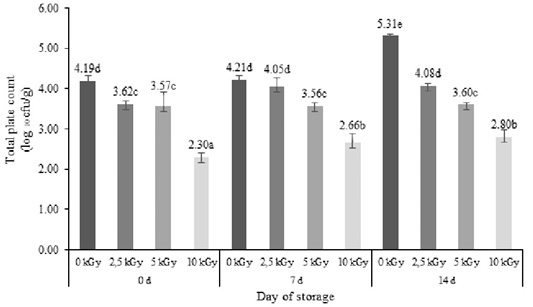
The microbial examination results are in Figure 4 and presented as TPC (log 10 CFU/g). Exposure to radiation doses of 5 and 10 kGy effectively decreased the microbial population in Arabic chicken egg powder during storage on days 0, 7, and 14 (p<0.05). The egg powder with no treatment had the largest microbial population on the 14th day of storage. The irradiation treatment with a dose of 10 kGy showed the lowest microbial population during all three storage periods (p<0.05).
Morphological Characteristics
Scanning electron microscopy (SEM) was employed to examine the microstructural characteristics of egg powder samples after treatment The distribution of globule particles in egg flour is relatively uneven. This finding is related to Wang et al. (2023). In our results, the impact of irradiation on the morphology of Arabic poultry egg flour globules was minimal. Our SEM observations were limited to a maximal magnification of 1000x. While in 8000x magnification, Liu et al. (2019) discovered numerous cracks and holes in the egg powder globules in their investigation after irradiation treatment. In our findings, a few globules became cracks after gamma irradiation, as shown in Figure 2B and 2D, on careful examination. Protein granules that are slightly wrecked may indicate protein scission following treatment with gamma irradiation. The scission protein in egg white powder can enhance its foaming capacity, resulting in a beneficial effect . The concave holes on the surface of the egg powder globules might be caused by the process of protein hydrolysis, which impacts the particle surface . To our knowledge, there is limited existing information regarding the investigation of the microstructure of egg flour following gamma irradiation. However, in nearly comparable treatments, there was no significant difference in the egg powder globules following microwave treatment .
Color Measurement
Color is an essential characteristic of food products, as it can either increase or decrease their consumer acceptability . The reduction in a* and b* values was due to the egg yolk’s reaction following gamma irradiation. The colour change might have been caused by the breakdown of carotenoids in the egg yolk, the rate of which was correlated to the radiation dose . However, the colour stability of irradiation powdered whole egg is attributed to its reduced carotenoid levels compared to the powdered yolk . Yolk carotenoids, which are vulnerable to oxidation similar to lipid oxidation and include unsaturated double bonds, change the colour of egg yolk . The reduction of carotenoids may have been promoted by the generation of free radicals in response to irradiation . Exposing irradiation on animal products-food based may result in a darkening of the material (reduced L* value), a reddening (increased a* value), and a yellowing (reduced b* value) of its color . The impact of irradiation on the colour material of food depends on the specific attributes of the food itself as well as the type of radiation employed, whether it be ionizing or non-ionizing . The findings from reported that gamma irradiation had a significant effect (p<0.05) on the lightness (L*) and yellowness (b*) of the samples. However, they did not affect the redness (a*) value. A difference was explicitly observed in the parameter “b” for irradiated whole egg powder compared to the non-irradiated control under the 3.0 kGy gamma treatment . Following 2.5 and 5.0 kGy irradiation, the Hunter color a* (redness) values decreased from 3.89 to 2.48 and 1.94, respectively .
Fourier Transform Mid-Infrared (FTIR) Evaluation
High irradiation doses affected the intermolecular reactions of proteins, including ionic connections, hydrogen bonds, hydrophobic relations, and disulfide bonds, and reduced the quantity of free and total sulphydryl groups . In our study, we noticed that receiving gamma irradiation resulted in oxidation, as demonstrated by a peak between 2322 and 2339 cm-1, indicating the availability of dissolved CO2. Interestingly, gamma irradiation induces an apparent shifting of the peaks in the 2923 and 2853 cm-1 areas. This could suggest the process of fat oxidation. Gamma irradiation also induces an apparent shifting of the peaks in 1455 cm-1 area, which are bonds of protein and collagen. This might probably explain the changes in the protein profile following irradiation treatment. The Amide B band at wave number 2923 cm-1 was observed in all four treatments, as described by Kudre et al. (2018). The amide I group is identified in egg powder, particularly in wave number 1634 cm-1 , and remains unchanged in the presence of gamma irradiation. Furthermore, the existence of peaks at 1534 and 1394 cm-1 in all four treatments suggests that the amide II and amide III bonds, which correspond to wave numbers between 1575–1480 cm−1 and 1400–1200 cm−1 respectively , are still maintained.
Moisture and Nutrient Content
Gamma irradiation is a potential non-thermal sterilization method employed to decrease the possibility of lipid peroxidation and protein denaturation . Therefore, nutrient changes in egg powder following gamma irradiation must be investigated. Regarding moisture content, gamma irradiation treatment reduced the concentration significantly (p<0.05). In a previous study, Jin et al. (2017) demonstrated that an irradiation treatment using electron beams resulted in a decrease in bound water content. This reduction may be attributed to changes in both the macro-structure and micro-structure. Furthermore, radiation irradiation may break secondary bonds in egg powder, such as hydrogen bonds. This may decrease the number of binding sites available for water molecules and break down the ability of polar groups to interact with water molecules. As this occurs, the water content of the bonds decreases. The low moisture content observed at a dose of 10 kGy can be attributed to the degradation of protein hydration capabilities in the flour-based product caused by gamma irradiation .
Similar findings were also reported by Reddy and Viswanath , Hamza et al. (2023) and Armah et al. (2024) who reported decreases in the moisture content of finger millet, date palm seed flour, and cassava chips for, respectively. Al-Bachir and Othman (2022) observed a slight reduction, although not significant, in moisture content following gamma irradiation at doses ranging from 5 to 15 kGy. The difference in our research findings may be attributed to the selection of Arabic chicken egg flour as the research material, which coincidentally contains different nutrients than layer chicken eggs. A decrease in moisture content also inhibits the growth of microorganisms in products derived from eggs .
The increasing protein content following irradiation may be attributed to alterations in the protein structure of Arabic egg powder. This is further demonstrated by a little change in the visual characteristics of the microstructure (Figure 2). Gamma irradiation induces several effects such as enhancing the positive charge of proteins, weakening the strength of hydrophobic interactions, and causing protein scission . Irradiation enhanced the hydrophobic characteristics of the protein by exposing nonpolar groups, creating optimal conditions for protein aggregation . Exposing egg powder proteins to radiation will be beneficial for enhancing antioxidant activity ; . Digestibility studies show that irradiated egg white powder exhibits exceptional in vitro digestibility, particularly in terms of protein content . In different objects, Jin et al. (2017) demonstrated that gamma irradiation significantly changed the chemical and physical characteristics of soy protein isolate and gluten protein. A 5 kGy dose promotes the release of small molecular protein fractions, potentially enhancing the nutritional value of irradiated infant formula powder . Previous research has demonstrated that exposing egg powder to gamma irradiation in a dosage range of 2.5-10 kGy effectively decreases the yellowness (b*) value. This reduction is attributed to alterations in the properties of the yolk ingredient. There is a suggested change in the fat composition of egg yolk following irradiation. The increase in fat content at high irradiation levels can be explained by the breakdown of lipid molecules by lipid radiolysis . Gamma irradiation may contribute to alterations in fatty acids, resulting in an increased fat content. Gamma irradiation caused minor changes in the amounts of various fatty acids, which varied depending on the dosage .
Mineral Content Evaluation
In general, exposure to radiation dosages of 5 and 10 kGy did not impact the mineral composition of Arabic egg powder. The constant mineral content directly relates to the unchanged ash content (Table 3). Due to the limited availability of data regarding the impact of gamma irradiation on the mineral composition of egg flour, we conducted a comparative analysis with different materials. Similar findings were also reported by Hassan et al. (2009), and Watkins et al. (2023) who reported gamma irradiation did not affect the mineral content of maize grains, pigeon pea flour, and milk powder, respectively. Normally, minerals remain stable when exposed to irradiation. However, their oxidation state may vary due to their different extraction capacity in a specific solvent .
Microbial Count
Our findings are related to Al Bachir (2021) who reported that A dosage of 10 kGy of irradiation shows great potential for removing contaminants from dried chicken egg powder products. Furthermore, This treatment is effective in eradicating or decreasing total viable counts (TVC), total coliform counts (TC), and mold and yeast counts (MYC), and in preserving materials of hygienic quality. Aquino et al. (2017) also demonstrated that the elimination of the microbial population in all samples of white egg powder was demonstrated by the gamma radiation mechanism at doses of 5 kGy and 10 kGy. To eliminate Salmonella contamination in egg powder, Froehlich et al. (2015) suggested a maximum dose of 2.28 kGy. This dose would guarantee the safety of those mentioned items without significantly affecting their sensory attributes. As reported by Kim et al. (2016), the application of low-dose electron beam irradiation (≤2 kGy) to white egg powder resulted in a reduction or elimination of pathogen risk and an improvement in foaming ability. Previous studies have demonstrated the efficacy of high-dose (>10 kGy) irradiation (gamma and electron beam) in removing microorganisms and ensuring sterilization in various kinds of food products . The irradiated egg powder according to evaluation shows considerable potential as a substitute component in the formulation of various food items, including desserts, puddings, and certain modified meat-based products .
The primary objective of this research is to eradicate pathogenic microorganisms from Arabic egg powder, demonstrating the role of gamma irradiation in product preservation. In our findings. The number of microorganisms decreased as the dose of gamma irradiation increased. The decrease in microbial population during storage can be attributed to the low moisture levels following irradiation treatment (Table 3). According to a study by Kim et al. (2016), the inactivation of microorganisms through irradiation treatment can be related to the inhibition of the DNA repair pathway. This inhibition occurs due to the elevated energy requirements for maintaining cell homeostasis. Absorption of energy occurs when ionizing radiation penetrates objects including food. The mechanisms of atoms and molecular interactions induced by absorbed energy cause microorganisms inactive . The effectiveness of irradiation is based upon multiple variables, including the composition of the objects the number of microbes (or spores) that were initially present, and the type and species of microbes .
CONCLUSIONS AND RECOMMENDATIONS
The morphological characteristics of Arabic poultry egg powder were changed slightly through gamma irradiation. As the radiation dose increases, hunter colour’s redness (a*) and yellowness (b*) values decrease. The nutrient content of Arabic egg powder, such as moisture, protein, and fat are significantly affected by gamma irradiation. Moisture content decreased following gamma irradiation, whereas protein and lipid content tended to increase. The findings of microbial detection indicate that an irradiation dose of 5 kGy is a promising method for decontaminating Arabic egg powder materials. This study demonstrated that gamma irradiation effectively reduces microbial contamination in egg powder without negatively affecting product quality. Further research is required to determine if gamma radiation treatment on Arabic chicken egg powder influences its antioxidant and amino acid profiles.
ACKNOWLEDGMENTS
The authors wish to express deep appreciation to the Deputy for Research and Innovation Infrastructure Technology, National Research and Innovation Agency for the facility support. This study was partly financed by Rumah Program “New Food and Agricultural Product Prototype”, Research Organization for Agriculture and Food, National Research, and Innovation Agency.
NOVELTY STATEMENTS
This study presents novel insights into the effects of gamma irradiation on Arabic chicken egg powder, highlighting slight changes in morphological characteristics and significant alterations in nutrient content, such as moisture, protein, and fat. The research demonstrates the efficacy of a 5 kGy irradiation dose in decontaminating the egg powder while preserving product quality, offering a promising method for food safety.
AUTHOR’S CONTRIBUTIONS
Kurniawan prepared raw sample, collected the data, and wrote the first draft manuscript; Firmansyah prepared raw sample and performed laboratory analysis; Setiyawan performed the sample preparation, and laboratory analysis; Rosyidah conducted nutrient measurements, microbiology assay, and analyzed the data; Yusmaman performed irradiation process; Belgis supervised the experiment and revised the manuscript; Anggraeny prepared raw sample and collected the data; Syahputra analyzed the data and visualization; Hariadi performed microbiology assay and wrote the first draft; Triyannanto designed the experiment and revised the manuscript; Wahyuningsih prepared raw sample and analyzed the data; Wahyono designed and supervised the experiment, analyzed the data, wrote the first draft, and revised the manuscript.
Conflict of Interest
The authors declare there is no conflict of interest.
Figures
Figure 1:.
Scanning electron microscopy (SEM) of untreated Arabic egg powder (a), treated with 2.5 kGy gamma irradiation (b), 5 kGy (c) and 10 kGy (d) at 500x magnification.
Figure 2:.
Scanning electron microscopy (SEM) of untreated Arabic egg powder (a), treated with 2.5 kGy gamma irradiation (b), 5 kGy (c) and 10 kGy (d) at 1000x magnification.
Figure 3:.
Fourier transform mid-infrared (FTIR) spectra of untreated Arabic egg powder (a), treated with 2.5 kGy gamma irradiation (b), 5 kGy (c), and 10 kGy (d).
Figure 4:.
Total plate count (log10 CFU/g) of Arabic chicken egg treated by gamma irradiation during storage for 0, 7 and 14 d at 25oC. a-e values with different letters differ significantly (p<0.05).
References
Adadi P, Obeng AK (2017). Assessment of bacterial quality of honey produced in Tamale metropolis (Ghana). J. Food Drug Anal., 25: 369–373. https://doi.org/10.1016/j.jfda.2016.07.005[CrossRef]
Al-Bachir M (2021). Functional properties of egg powder: effect of gamma irradiation. J. Agro. Process. Technol.,, 27(2): 113–121.
Al-Bachir M, Othman Y (2022). Composition and Physic-chemical Analysis of Fresh and Dehydrated Egg, and Gamma Irradiated Egg Powder. J. Stress Phys. Biochem., 18(4): 102–112.
AOAC (2005). Official Method of Analysis. Association of Official Analytical Chemists.
Aquino S, Lui CC, Corrêa B (2017). Gamma radiation treatment applied to microbial decontamination of products derived from eggs collected from the retail market in São Paulo. Arq.ivo Bras. Med. Vet. Zootecnia, 69(6): 1683–1692. https://doi.org/10.1590/1678-4162-9241[CrossRef]
Armah JO, Appiah V, Egblewogbe MNYH, Ocloo FCK (2024). Characterization of flour produced from gamma irradiated dried cassava (Manihot esculenta) chips. Rad. Phys. Chem., 218: 1–9. https://doi.org/10.1016/j.radphyschem.2024.111651[CrossRef]
Asghar A, Abbas M (2012). Dried egg powder utilization, a new frontier in bakery products. Agri. Bio. J. N. Am., 3(13): 493–505. https://doi.org/10.5251/abjna.2012.3.12.493.505[CrossRef]
Asghar S, Ayub H, Khalid N (2022). Food irradiation technology: prospects and future applications. Korean J. Food Preserv., 29(7): 1013-1021. https://doi.org/10.11002/kjfp.2022.29.7.1013[CrossRef]
Bamidele O, Akanbi C (2015). Effect of Gamma Irradiation on Amino Acids profile, Minerals and Some Vitamins Content in Pigeon Pea (Cajanus Cajan) Flour. Br. J. Appl. Sci. Technol., 5(1): 90–98. https://doi.org/10.9734/bjast/2015/10245[CrossRef]
Damayanti E, Shabrina N., Prihantoro FA, Shovitri M (2021). Antifungal activities of lactic acid bacteria and yeast isolated from various types of Tempe. IOP Conf. Ser. Mater. Sci. Eng., 1011. https://doi.org/10.1088/1757-899X/1011/1/012021[CrossRef]
Du M, Ahn DU (2000). Effects of antioxidants and packaging on lipid and cholesterol oxidation and color changes of irradiated egg yolk powder. J. Food Sci., 65(4): 625–629. https://doi.org/10.1111/j.1365-2621.2000.tb16062.x[CrossRef]
Froehlich Â, Franco BDG de M, Destro MT, Landgraf M (2015). Sensory aspects and reduction of Salmonella in irradiated egg powder. Ciencia e Agrotecnologia. 39(5): 506–513. https://doi.org/10.1590/S1413-70542015000500009[CrossRef]
Hamza H, Jiménez-Araujo A, Ben Miloud N, Guillén-Bejarano R, Ghorbal A, Rodríguez-Arcos R, Benabderrahim MA, Elfalleh W (2023). Impact of Gamma irradiation pretreatment on the characteristics of native and defatted date palm seed flour and oil. Food Bio., 56(October). https://doi.org/10.1016/j.fbio.2023.103288[CrossRef]
Hassan AB, Osman GAM, Rushdi MAH, Eltayeb MM, Diab EE (2009). Effect of gamma irradiation on the nutritional quality of maize cultivars (Zea mays) and sorghum (Sorghum bicolor) grains. Pakistan J. Nut., 8(2): 167–171. https://doi.org/10.3923/pjn.2009.167.171[CrossRef]
He Y, Wang A, Chen Z, Nie M, Xi H, Gong X, Liu L, Wang L, Sun J, Bai Y, Huang Y, Sun P, Wang F, Tong L T (2023). Effects of egg powder on the structure of highland barley dough and the quality of highland barley bread. Int. J. Bio. Mac., 240: 124376. https://doi.org/10.1016/j.ijbiomac.2023.124376[CrossRef]
Huang M, Liu Y (2022). Effect of electron beam irradiation treatment on the in vitro digestibility and structure of egg white protein powder. J. Radiat. Res. Radiat. Process, 40(5): 1-7. https://doi.org/10.11889/j.1000-3436.2022-0051[CrossRef]
Javed A, Imran M, Ahmad N, Hussain AI (2018). Fatty acids characterization and oxidative stability of spray dried designer egg powder. Lipids Health Dis., 17(1): 1–13. https://doi.org/10.1186/s12944-018-0931-1[CrossRef]
Jia J, Duan J, Jia X, Ge J, Dong M, Liu X, Yang X, and Duan X. (2024). Mechanism of enhancing rehydration capacity and foaming property of spray-dried egg white powder by lactic acid fermentation. Food Hyd. 153 (March): 110037. https://doi.org/10.1016/j.foodhyd.2024.110037[CrossRef]
Jin Y, Liang R, Liu J, Lin S, Yu Y, Cheng S (2017). Effect of structure changes on hydrolysis degree, moisture state, and thermal denaturation of egg white protein treated by electron beam irradiation. Lwt 77: 134–141. https://doi.org/10.1016/j.lwt.2016.11.025[CrossRef]
Jung K, Song BS, Kim MJ, Moon BG, Go SM, Kim JK, Lee YJ, Park JH (2015). Effect of X-ray, gamma ray, and electron beam irradiation on the hygienic and physicochemical qualities of red pepper powder. Lwt 63(2): 846–851. https://doi.org/10.1016/j.lwt.2015.04.030[CrossRef]
Kim HJ, Yong HI, Jayasena DD, Lee HJ, Lee H, Jo C (2016). Microbial safety and physicochemical characteristics of electron beam irradiated whole egg powder. Food Sci. Biotechnol., 25(2): 637–642. https://doi.org/10.1007/s10068-016-0089-4[CrossRef]
Koç M, Koç B, Güngör Ö, Ertekin FK (2012). The Effects of Moisture on Physical Properties of Spray-Dried Egg Powder. Drying Technol., 30(6): 567–573. https://doi.org/10.1080/07373937.2011.651546[CrossRef]
Koutchma T, Keener L, Kotilainen H (2018). Global Harmonization Initiative (GHI) Consensus Document on Food Irradiation. In Global Harmonization Initiative (GHI).
Kudre TG, Bejjanki SK, Kanwate BW, Sakhare PZ (2018). Comparative study on physicochemical and functional properties of egg powders from japanese quail and white leghorn chicken. Int. J. Food Prop., 21(1): 956–971. https://doi.org/10.1080/10942912.2018.1466320[CrossRef]
Li J, Sun J, Gu L, Su Y, Yang Y, Chang C, Han Q (2023). Foaming properties of dried egg white at different outlet temperatures. J. Food. Eng., 343:111379. https://doi.org/10.1016/j.jfoodeng.2022.111379[CrossRef]
Li P, Jin Y, Sheng L (2020). Impact of microwave assisted phosphorylation on the physicochemistry and rehydration behaviour of egg white powder. Food Hyd. 100(May 2019): https://doi.org/10.1016/j.foodhyd.2019.105380[CrossRef]
Liu X, Liu J, Zhang W, Han S, Zhang T, Liu B (2019). Electron beam irradiation-induced structural changes increase the antioxidant activities of egg white protein. LWT - Food Sci. Technol,. 111: 846–852. https://doi.org/10.1016/j.lwt.2019.05.066[CrossRef]
Liu Y, Huang M, Liu X, Hu M (2023). Structural characterization and functional properties of egg white protein treated by electron beam irradiation. Innovative Food Sci. Emerg. Technol., 84(September 2022): 103262. https://doi.org/10.1016/j.ifset.2022.103262[CrossRef]
Pandiselvam R, Mitharwal S, Rani P, Shanker MA, Kumar A, Aslam R, Barut YT, Kothakota A, Rustagi S, Bhati D, Siddiqui SA, Siddiqui MW, Ramniwas S, Aliyeva A, Mousavi Khaneghah A (2023). The influence of non-thermal technologies on color pigments of food materials: An updated review. Curr. Res. Food Sci., 6(February): https://doi.org/10.1016/j.crfs.2023.100529[CrossRef]
Pérez-Reyes ME, Tang J, Zhu MJ, Barbosa-Cánovas GV (2021). The influence of elevated temperatures and composition on the water activity of egg powders. J. Food Process. Pres., 45(4). https://doi.org/10.1111/jfpp.15269[CrossRef]
Reddy CK, Viswanath KK (2019). Impact of γ-irradiation on physicochemical characteristics, lipoxygenase activity and antioxidant properties of finger millet. J. Food Sci. Technol., 56(5): 2651–2659. https://doi.org/10.1007/s13197-019-03753-2[CrossRef]
Robichaud V., Bagheri L, Aguilar-Uscanga BR, Millette M, Lacroix M (2020). Effect of ɣ-irradiation on the microbial inactivation, nutritional value, and antioxidant activities of infant formula. Lwt 125. https://doi.org/10.1016/j.lwt.2020.109211[CrossRef]
Setiyawan AI, Khasanah A, Hintono A, Febrisiantosa A, Karimy MF, Pratiwi D (2021). Functional properties of spray-dried chicken egg with various fillers. Int. Sem. Livest. Prod. Vet. Tech., 22: 221-231.
Shahin AAM, Swailam HM, Abou Zeid AA (2006). Effect of gamma irradiation on hygienic quality and chemical characteristics of dehydrated ostrich eggs. Am. J. Food Technol., 8(2): 208–217.
Song HP, Kim B, Choe JH, Jung S, Kim KS, Kim DH, Jo C (2009). Improvement of foaming ability of egg white product by irradiation and its application. Rad. Phys. Chem., 78(3): 217–221. https://doi.org/10.1016/j.radphyschem.2008.10.001[CrossRef]
Statistics Indonesia (2024). Produksi Telur Ayam Buras menurut Provinsi (Ton), 2021-2023. Statistics Indonesia.
Steel RGD, Torrie JH (1960). Principles and procedures of statistics. McGraw.
Uygun-Sarıbay M, Ergun E, Kalaycı Y, Köseoğlu T (2017). The secondary structure of proteins in liquid, frozen, and dried egg-white samples: Effect of gamma irradiation treatment. Int. J. Food Prop., 20(2): 1195–1203. https://doi.org/10.1080/10942912.2016.1241263[CrossRef]
Wahyono T, Ujilestari T, Sholikin MM, Muhlisin M, Cahyadi M, Volkandari SD, Triyannanto E (2024). Quality of pork after electron-beam irradiation: A meta-analysis study. Vet. World, 17(1): 59–71. https://doi.org/10.14202/vetworld.2024.59-71[CrossRef]
Wang T, Chang C, Cheng W, Gu L, Su Y, Yang Y, Li J (2023). Combined effect of heating and enzymatic hydrolysis on the dispersibility and structure properties of egg white powder. J. Food Eng., 351(March). https://doi.org/10.1016/j.jfoodeng.2023.111503[CrossRef]
Watkins P, Knoerzer K, Ferlazzo ML, Banati RB, Adorno P, Stockham K, Stobaus T (2023). Infant Milk Powder After γ-Irradiation and Accelerated Storage as an Indicator for Space Food Stability. Adv. Astronautics Sci. Technol., 6(2–4): 117–132. https://doi.org/10.1007/s42423-023-00140-0[CrossRef]
Zang J, Qing M, Ma Y, Chi Y, Chi Y (2023). Shelf-life modeling for whole egg powder: Application of the general stability index and multivariate accelerated shelf-life test. J. Food Eng., 340(September 2022): 1–13. https://doi.org/10.1016/j.jfoodeng.2022.111313[CrossRef]
Zhang Y, Zhao J, He L, Zhu J, Zhu Y, Jin G, Cai R, Li X, Li C (2024). Irradiation-Assisted Enhancement of Foaming and Thermal Gelation Functionality of Liquid Egg White. Foods, 13: 1342. https://doi.org/https://doi.org/10.3390/ foods13091342[CrossRef]