
Alveolar echinococcosis is an important cestode diseases with a huge public health impact, it caused by larval of Echinococus multilocularis, whose life cycle requires a variety of canids and small mammals as hosts. The terminal hosts have received a lot of attention, while there are few studies on the distribution and abundance of intermediate hosts. A structural equation model was produced to demonstrate the effects of habitat factors on the distribution and abundance of intermediate hosts of E. multilocularis. Plateau pika (Ochotona curzoniae) act as the main intermediate hosts of E. multilocularis, whose effective cave density was 0.03/m2 to 0.32/m2, and it was negatively correlated with altitude at a high value (p = 0.010). Altitude regulates the distribution and abundance of plateau pika by influencing food resources and their fertility, which in turn affects the transmission of alveolar echinococcosis.
Short Communication · Volume 54, Issue 5, 19 July 2022 · Open Access
Effects of Altitude on the Transmission of Alveolar Echinococcosis
·
Affiliations & Notes ⌄
- 1Institute of Qinghai-Tibet Plateau, Southwest Minzu University, P.R. China * Corresponding author: lx-yk@163.com
Article Info ⌄
- Journal:
- Pakistan Journal of Zoology
- Published:
- 19 July 2022

From the article
- That is to say, the effective cave density of the intermediate hosts was 0.03/m2 to 0.32/m2.
- As for the species, the investigation found that all intermediate hosts were plateau pika except in one sample quadrat that had rodent mammals (Lasiopodomys fuscus), thus plateau pika is the main intermediate hosts for E. multilocularis in Shiqu County.
- In Shiqu County, the main intermediate hosts are Plateau pika, whose distribution and abundance are regulated by altitude, and it is speculated that the pikas select habitats depending on temperature and oxygen concentration.
Selected from the article's own text.
Abstract
Materials and methods
The intermediate hosts density was determined by the block-open method. 32 sample sites were choosed at random in Shiqu County, Sichuan province, China.
The sample sites were 25 m×25 m squares, with an altitude of 3924 m to 4249 m. The number of blocked caves was 47 to 226 among 32 sample sites, which depended on the number of caves in the sites (Supplementary Table I). Some indicators were recorded the next day, including the number of effective caves, the intermediate hosts species, and the distances from the sample sites to rivers, roads and human settlements. Caves provide mall mammals with shelter and protection, thus the number of effective caves can represent their density to some extent.
Then a structural equation model (SEM) was constructed by Amos software to analyze the relationship between the number of effective caves and other factors.
Results
In our study, as shown in Supplementary Table I, the number of effective caves was 17 to 201 per sample sites. That is to say, the effective cave density of the intermediate hosts was 0.03/m2 to 0.32/m2. As for the species, the investigation found that all intermediate hosts were plateau pika except in one sample quadrat that had rodent mammals (Lasiopodomys fuscus), thus plateau pika is the main intermediate hosts for E. multilocularis in Shiqu County.
In addition, the distances from the sample sites to the rivers, roads and human settlements were 30 m to 3000 m, 10 m to 800 m, and 0.21 m to 3000 m, respectively. Our SEM fits well with the following parameters: p = 0.411, RMSEA = 0.029, CFI = 0.945, CHI/DF = 1.025 (Fig. 1), because a SEM is regarded to match the data when p > 0.05, RMSEA < 0.08, 0.9 < CFI < 1, 1 <CHI/DF <3 (1 <CHI/DF < 2 is better). The model shows that the number of effective caves was directly affected by altitude with standardization coefficients of -0.40 (p = 0.010), and 48% of the number of effective caves explained by this model.
Discussion
Since the terminal hosts were strictly controlled in Shiqu County, we need to think about the effects of intermediate hosts for E. multilocularis. In this study, plateau pika is the main intermediate hosts in Shiqu County. According to the literature , the density of plateau pika (103.80/hm2) were higher than that of rodent (83.35/hm2), and AE infection rate of plateau pika (6.50%) were also higher than that of rodent (3.01%) in Shiqu County. Moreover, plateau pika was detected in 99% of Tibetan fox food and accounted for 53.7% of its stomach contents . As the plateau pika is preyed upon by the fox, E. multilocularis can develop from larval stage to adult worms which lay eggs, then becoming a source of infection. Therefore, plateau pika play an important role in the transmission of AE.
Plateau pika prefer some habitats, altitude and rivers are the main factors affecting their habitat selection . Our SEM indicated that the number of effective caves was negatively correlated with altitude at a statically significantly level. Plateau pika are more widely distributed at low altitudes, thus we speculated that the pika select habitats by depending on oxygen concentration and temperature. On the one hand, oxygen concentration affects the physiological structure in male and the foetuses number in female among pikas . Thus, the oxygen level, decreasing with altitude increases, regulates population quantity of this species. On the other hand, the temperature also decreasing with altitude increases. Plateau pika may fail to reproduce at low temperatures during the breeding season . Low temperature makes pikas consume a large amount of heat to resist the cold, which leads to an increasing demand for food resources- often limited and shortage supply at high altitude.
Conclusions
In Shiqu County, the main intermediate hosts are Plateau pika, whose distribution and abundance are regulated by altitude, and it is speculated that the pikas select habitats depending on temperature and oxygen concentration.
Acknowledgments
This work was supported by the National Natural Science Foundation of China (31070380), the Fundamental Research Funds for the Central Universities, Southwest Minzu University (2019XMJXPY07), funded by Science and Technology Department of Sichuan Province (2020YFH0107). In addition, the authors are most grateful to Hongqi Xie (Station master of Ganzi Grassland Workstation) for his support of this work.
Supplementary material
There is supplementary material associated with this article. Access the material online at: https://dx.doi.org/10.17582/journal.pjz/20210428030426
Statement of conflict of interest
The authors have no potential conflict of interest.
Figures
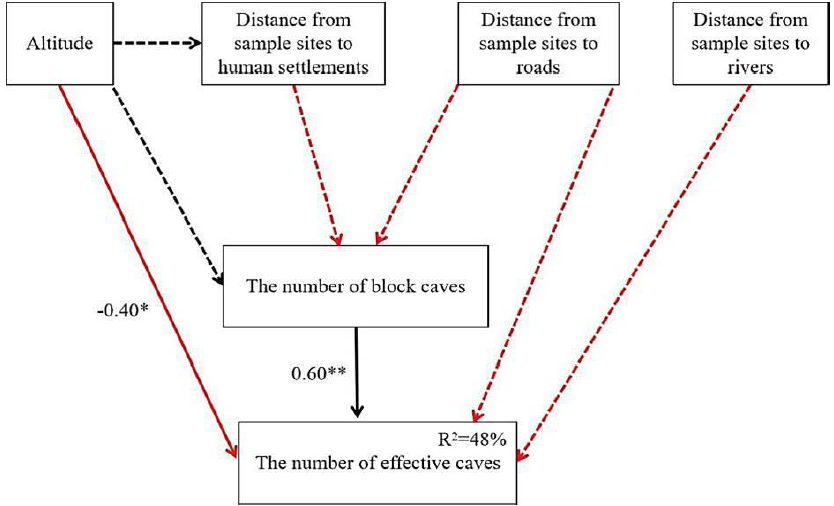
The SEM of the number of effective caves and habitat factors. The solid line indicates a significant correlation; * indicates p<05; ** indicates p<01; direction of the arrow changes from the latent variable to dependent variable; black arrow indicates a positive influence, red arrow indicates a negative influence; the full line indicates a significance, the dotted line indicates no significance; the number on the arrow is the normalized estimated coefficient.
References
- Harris, B., Jiake, Z., Yinqiu J., Kai, Z., Chunyan, Y. and Douglas, W., 2014. J. Mammal., 95: 1207-1221. https://doi.org/10.1644/14-MAMM-A-021[CrossRef]
- Belard, S., Tamarozzi, F., Bustinduy, A.L., Wallrauch, C., Grobusch, M.P., Kuhn, W., Brunetti, E., Joekes, E. and Heller, T., 2016. Am. J. trop. Med. Hyg., 94: 8-21. https://doi.org/10.4269/ajtmh.15-0421[CrossRef]
- Deyou, Y., Qian, W., Yan, H. and Liang, H., 2008. J. Pathog. Biol., 3: 621-622.
- Guoqiang, Z., Hongbing, Y., Li, L. and Wanzhong, J., 2019. Chinese J. Zoon., 35: 59-65.
- Jenkins, D.J., 2001. Int. J. Parasitol., 31: 1717-1718. https://doi.org/10.1016/S0020-7519(01)00318-6[CrossRef]
- Junli, L., Luju, L. and Jinqian, F., 2017. J. North Univ. China (Nat. Sci. Ed.), 38: 647-651.
- Lian, W., Chenlong, W., Lihua, L. and Dengbang, W., 2014. J. Qinghai Univ. (Nat. Sci. Ed.), 32: 1-5.
- Mengyuan, Z., Liying, W., Yayi, G. and Weiping, W., 2018. Chin. J. Parasitol. Parasit. Dis., 36: 156-160.
- Mingzhong, Z., Aiguo, Y., Zhexue, Z., Dongbo, Y., Li, G., Wei, H., Chaohui, Z., Duo, J., Zhiping, L., Yunfei, W., Lijun, Y. and Qian, M., 2017. Chinese J. Anim. Quarant., 34: 32-35.
- MARA, 2021. List of wildlife under key state protection. Announcement of the Ministry of Agriculture and Rural Affairs (MARA) of the National Forestry and Grassland Administration, No. 3, 2021. http://www.forestry.gov.cn/ccb/4872/20210208/235002335965591.html (accessed 27 Jun, 2021).
- Shengqing, L., Jiapeng, Q., Huhu, Y., Lihua, L. and Yanming, Z., 2015. J. Wildl., 36: 18-23.
- Shijie, Y., Hui, L., Benfu, L., Jinrong, Z. and Jia, P., 2018. Chin. J. Vector Biol. Contr., 29: 235-238. https://doi.org/10.1564/v29_oct_13[CrossRef]
- Sihui, W., Weiping, W., Shuai, H. and Chuizhao, X., 2020. Chin. J. Parasitol. Parasit. Dis., 15: 924-928.
- Tang, C.T., Quian, Y.C., Kang, Y.M., Cui, G.W., Lu, H.C., Shu, L.M., Wang, Y.H. and Tang, L., 2004. Parasitology, 128: 187. https://doi.org/10.1017/S0031182003004438[CrossRef]
- Weiping, W., Hu, W., Qian, W. and Xiaonong, Z., 2018. Chin. J. Parasitol. Parasit. Dis., 36: 1-14.
- Ye, L., Zhenyu, W., Xiang, Z. and Lei, S., 2014. Chin. J. Vector. Biol. Contr., 25: 28-31.
- Zhenghuan, W., Xiaoming, W. and Xiaoqing, L., 2008. Ecohealth, 5: 115-126. https://doi.org/10.1007/s10393-008-0174-0[CrossRef]
Supplementary material
Services
Article usage statistics
Loading…