It’s well-known that the pre-corneal tear film has different functions. One of them is the nourishment of the cornea. The surface of the eye is rapidly deteriorated in cases of decrease of tear production such as dry eye or keratoconjunctivitis sicca (Alkan et al., 2004; Chandler et al., 2013). Due to the most of anesthetic regimes are associated with changes of volume of tear. So, this study was conducted to investigate the effect of most common sedative and anesthetic drugs in Egypt on the tear production in dogs. The Schirmer tear test I (STT I) is a semiquantitave method used without topical anesthesia for determination of the baseline reflex secretion (Berger & King, 1998; Alkan et al., 2004).
According to the results of the present study, the Schirmer tear test I (STT I) values before the injection of drugs in different groups ranged from 14-20 mm/min. The previous studies reported the normal range of the Schirmer tear test in dogs ranged from 14-25 mm/min (Gelatt et al., 1975; Kaswan & Salisbury, 1990). The wide range may be due to several factors such as sex, breed, measurement sequences, daily time and light cycle (Alkan et al., 2004; Gianetto et al., 2009).
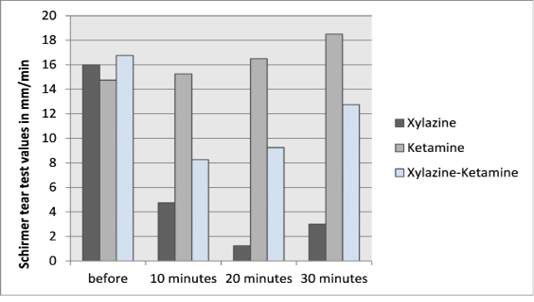
The drugs of this study were selected because they are generally used by veterinarians due to its availability and lower cost relative to other sedative and anesthetics. Xylazine HCl is considered the most common sedative drug used for different animals in Egypt. The effect of xylazine either alone or in combination with other drugs was studied before. Dodam et al. (1998), investigated its effect on tear production in dogs. They found xylazine HCl (0.5 mg/kg) alone did not affect the tear production, but when it combined with butarphanol (0.5mg + 0.5mg/kg) significantly decreased the tear production. The same result was reported in horse by Brightman et al. (1983). The results of the present study were not in consistent with the results of the previous studies. In the present study, xylazine HCl profoundly decreased the tear production in dogs which continued until 30 minutes post-injection. Also, this effect was clearly noted in the combination group (XK). The effect of xylazine persisted until 20 minutes after injection of ketamine HCl. The latter could not mask the effect of xylazine. The results of this study differed substantially from the previous studies. This may be due to the difference of xylazine doses which used in different studies. This attribution was confirmed by Kanda et al. (2016). They recorded the effect of 0.5 mg/kg of xylazine appeared after 30 minutes elapsed after its intramuscular injection in dogs. Moreover, the sensitivity of the different species to xylazine varied. The equine is less sensitive to xylazine effects compared to other species (Hall et al., 2001). In the present study, 1mg/kg of xylazine was used for sedation of dogs. Hall et al. (2001), and Kanda et al. (2016) reported the dose dependent effect of xylazine in animals. Thus, the increase of dose may increase the drug effect including the significant decrease of tear production. Also, the different results may be attributed to the unknown mechanism of action of xylazine. It was described as excitatory and inhibitory for both adrenergic and cholinergic neurons (Kronberg et al., 1966). On the other side, the results of xylazine in this study were in accordance with the results reported by Ghaffari et al. (2010, 2017) in cats and horses and Kanda et al. (2016, 2019) in dogs and cats. They recorded the decrease of tear production after injection of different doses of ὰ-2 agonists either medetomidine HCl or xylazine HCl in dogs. Although the results of the present study were consistent with the previous studies that xyalzine reduces the tear production profoundly, the difference was in the beginning time of this reduction. The present study revealed that significant decrease started 10 minutes and persisted to 30 minutes after injection of 1mg/kg of xyalzine. But, the study conducted on dogs by Kanada et al. (2016) reported the significant effect of 1mg/kg of xyalzine on tear production appeared after 0.5 hour from its injection. Actually the duration effect of xyalzine on tear production was not the aim of our study. Therefore, the effect of xylazine was not traced for long time.
Kanada et al. (2016) verified that the effect of xylazine on tear production is mediated through α2-adrenoceptor action and excluded effects on α1-adrenoceptors or imidazoline receptors. As well as, Komnenou et al. (2013), reported the adrenergic innervation of lacrimal glands in mice not in dogs. This means that the xylazine effect on tear production in dogs does not occur through the adrenergic receptors. The exact mechanism beyond the decrease of tear production after xylazine administration is not fully elucidated. But the suggested acceptable mechanism was the central effect of ὰ-2 agonists on the autonomic regulation of tear production. Additionally, it was recorded the vasoconstriction of the tear gland, alteration of the metabolism of its cells and suppression of reflex tear production through increased antinociception (Dodam et al., 1998; Sanchez et al., 2006; Komnenou et al., 2013). It is postulated that the decrease of tear flow may be attributed to reduction or inhibition of the parasymapathatic innervation to the tear gland by the xylazine through the central effect.
On the other hand, the present study revealed the significant increase of tear production in dogs after intramuscular injection of 5mg/kg of ketamine HCl. There were previous studies which suggested the decrease of tear production after using a combination of midazolam, ketamine and isoflurane in rabbits (Erol et al., 2018), and ketamine and acetylpromazine combination in atropine premedicated cats (Arnett et al., 1984). There was no previous study investigated the effect of ketamine as a sole agent on the tear production in dogs. The effect of ketamine in the present study was assessed alone and in combination with xyalzine HCl. In both treatments the significant effect of ketamine to increase the tear production or the values of STT I was noticed. The secretory effect of the lacrimal gland is mediated through the parasympathetic innervation conveyed through the cranial nerves V (ophthalmic and maxillary divisions), VII and pteropalatine ganglion (Garosi, 2012). The increase of tear production after ketamine injection indicates that the parasympathetic innervation to the tear gland was not blocked but stimulated. So, the authors postulated that the stimulatory effect of ketamine on tear flow might be ascribed to the ketamine is a dissociative anesthetic which may affect regions in brain and does not affect others. The nuclei of CNs V and VII may be in the regions away from ketamine effect. As well as, the increase of cardiac output, mean aortic pressure, pulmonary arterial pressure, central venous pressure, and heart rate after ketamine injection (Haskins et al., 1985) may increase the blood flow into different tissue including the tear gland.
In the group received xylazine and ketamine, there was a significant decrease of the tears after administration of xylazine which lasted to about 20 minutes after ketamine injection, then returned nearly to the normal values or the pre-anesthetic values after 30 minutes of ketamine and xylazine administration. This effect was nearly similar to the effect resulted from medtomidine-ketamine combination in cats (Di Pietro et al., 2016).
Regarding the physical signs, xylazine HCl caused significant increases in body temperature and significant decreases in both heart and respiratory rates (Table 2). These results were consistent with the results of the previous studies (Kolliasbaker et al., 1993; Pypendop & Verstegen, 1998; Sinclair, 2003; Lerche & Muir, 2004; Posner, 2018a). The increase in body temperature may be attributed to the peripheral vasoconstriction caused by ὰ-2 agonists. The decrease in heart rate may be due to the decrease of the release of norepinephrine and the heart is influenced mainly by the parasympathetic action (Posner, 2018a). It was reported that the decrease in respiratory rate after xylazine injection is centrally mediated (Kolliasbaker et al., 1993; Pypendop & Verstegen, 1998; Sinclair, 2003; Lerche and Muir, 2004).
Ketamine HCl did not affect the body temperature, but it significantly increased both the heart and respiratory rates. These results were in agreement with what was recorded previously by Haskins et al. (1985) and Posner (2018b). It increases the heart rate through the direct stimulation of the central adrenergic centers (i.e., increased sympathetic tone) and by inhibiting the neuronal uptake of catecholamines, especially norepinephrine (Annetta et al., 2005). Ketamine causes a moderate increase in carbon dioxide concentrations, so it considered respiratory stimulants, unlike other anesthetics which lead to respiratory depression and apnea (Posner, 2018b).
The addition of the respiratory depressant such as xylazine HCl with ketamine leads to the decrease of the respiratory rate and minute volume (Posner, 2018b). In the third group, there were non-significant decreases in the heart and respiratory rates. Therefore, this combination is so beneficial and safe to the patient. But the body temperature significantly decreased at 20 and 30 minutes post-injection of drugs relative to the body temperature at 10 minutes post-injection. These results were in agreement with Afshar et al. (2005) in goats. But the previous studies conducted by Kul et al. (2000) and Wyatt et al. (1989) did not show any significant changes in the body temperature in dogs and rabbits after xylazine-ketamine injection. The decrease of body temperature could not be elucidated, but the authors expected that the recumbency of animals due to the effect of the combined two drugs which might have the responsibility for the decrease in body temperature (Abdelhakiem et al., 2019).