The concentration of TRI-G increased in the group G2 compared to the groups G3 and G5 at the age of 14 days, and at the age of 21 days, it increased significantly.
Controversial data Table 8 indicate that there are no significant differences in the level of liver enzymes in broiler chickens at the age of 14 and 21 days, resulting from the group of hatching eggs with aromatase inhibitors.
The future implications of the study include treating chicken broilers with aromatase inhibitors or early feeding in the egg to increase the percentage of hatched male broilers and improve their subsequent performance, the best groups were G3, G4, and G5.
Selected from the article's own text.
Abstract
The study included two experiments to investigate the group of hatching eggs with aromatase inhibition solution (AIS) in the level of some hormones and the reproductive characteristics of broiler chickens; the first experiment was in an incubator for the period from 2-17-2022 to 3-8-2022, 300 eggs were incubated and divided into five experimental groups, each containing 60 eggs. The hatching egg groups were divided into five groups, which were G1, the control group without any group, G2 and G4 spray hatching eggs with an aromatase inhibitor at a level of 1 and 2 mg / 100 ml, G3 and G5, dipping hatching eggs in an aromatase inhibitor solution (AIS) at a concentration of 1 and 2 mg/100 ml, respectively. The second experiment carried out poultry farming from 3-8-2022 to 4-12-2022 was to explain the effect of (AIS) in the physiological traits from the age of one day to 35 days of chicks hatched from treated eggs from the first experiment. One hundred eighty chicks out of the total number of hatched chicks and 36 chicks were placed for each group. The chicks were divided into fifth groups. The hatched chicks groups taken according to the groups of the first experiment into five groups according to what was mentioned in the first experiment. A significant increase of group G4 over other groups and the superiority of the group G2 compared to G1, G3, and G5 at the age of 14 days, while at 21 days, the group G3 was significantly increased (P≤0.05) to G1, G2, G5 in the concentration of testosterone (TES), while for the estrogen (EST) hormone, there was a significant decrease in G2, G5 at 14 days old. At the age of 14 days a highly significant decrease (P≤0.01) in G2, G3, and G4 cholesterol (CHO) concentrations compared to G1. A highly significant decrease in the level of triglyceride (TRI-G) for all groups compared to G1 at the ages of 14 and 21 days; no significant differences were observed for the other characteristics taken in the study.
Novelty Statement | This study is notable for its first use of aromatase inhibitors by spray and dip method on broiler eggs and for its study of the sex hormones of broiler
Introduction
The crucial stage at the transformation of estrogen and testosterone (C 19 steroids) into ESTs (C 18 amphetamines) ; , also known as aromatization, is catalyzed by the enzyme or group of enzymes known as cytochrome P450 as aromatase, a gene governs it, and sexual differentiation depends on the hormone EST and its receptors, identifying a female’s sex, early analysis of a bipotential chick’s embryonic gonads ; a). Anti-Mullerian hormone (AMH), which testosterone is produced by the testicles, causes survival. The male ducts are alive, although both sexes’ embryonic gonads (testes and ovaries) are present to determine sex in birds in general and domestic birds in particular, Embryonic Anti-Müllerian Hormone (AMH), produced by the testes of developing male embryos, results in the regression of Müllerian (female) ducts which leads to the disappearance of Müllerian (female) ducts, which is known as anti-M; only male fetuses experience Müllerian duct regression due to high levels of AMH. The estradiol (E2) is what gives female chickens their ovarian structure and secondary sexual traits, including short, thin legs and a smaller comb; unlike mammals, male birds have homologous “ZZ” Chromosomes, while female birds have heterozygous “ZW” chromosomes, with additional feathering along the mid-back (Al–Daraji et al., 2010; ; a). The female genotype’s W chromosome regulates the production of the early aromatase enzyme, which causes the production of ESTs (aromatase regulation is complex and involves gene expression, not just presence of the W chromosome) , 2002). It is well known that male broiler chickens weigh more than females; the male broiler weighs more than the analogs due to this differential in body weight at marketing age, which has a live weight difference between them of approximately 400-500 g because the female reaches the marketable body weight a few days earlier, feed consumption is reduced, leading to a higher economic return ; Khalil et al., 2022). Therefore, this study aims to investigate the impact of treating hatching eggs (spraying and dipping) with (AIS) on the level of androgen and EST hormones and some physiological traits for the production of commercial broilers.
Materials and Methods
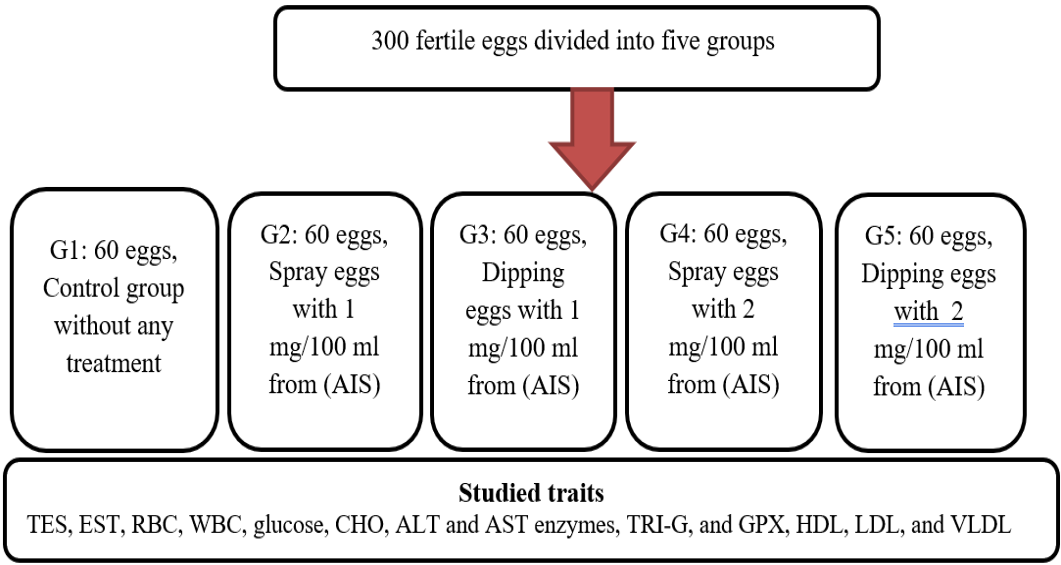
This study was carried out in the hatchery of Al-Anwar Poultry Company in the Al-Mouradia area, Babylon Governorate for the period 2-17-2022 until 3-8-2022; 300 eggs were incubated and divided into five experimental groups, each containing 60 eggs The eggs used in the experiment were treated before inserting them into the incubators by the following two methods it is the spray and dip method, the hatching eggs groups were divided into five groups which were: G1: Control group without any treatment, G2: Spray eggs with 1 mg/100 ml from (AIS), G3: Dipping eggs with 1 mg/100 ml from (AIS), G4: Spray eggs with 2 mg/100 ml from (AIS), G5: Dipping eggs with 2 mg/100 ml from (AIS).
The second experiment was carried out at the poultry farm in the Department of Animal Production, College of Agriculture, Al-Qasim Green University during the period from 8-3-2022 to 12-4-2022 for 35 days, 180 chicks were selected from the total number of hatched chicks (Chicks were randomly selected from the replicates of hatched eggs mentioned in the first experiment), 36 chicks were placed for each group, the chicks were distributed into 5 groups, with 3 replicates for each group, and each replicate contained 12 chicks. The groups for the hatched chicks were divided according to the first experiment’s groups into five groups and according to what was mentioned in the first experiment.
The chicks were fed three diets: starter, grower and finisher, containing protein (21.29, 19.34, 19.22 %) and energy (3027.37, 3054.67, 3093.47 kacl), respectively. followed the temperature, humidity, and ventilation guide according to the Ross 2023 Breeding Guide. As for the vaccination schedule, follow it according to the epidemiology of the region and as shown in the Table 1.
Anastrozole a medical preparation was obtained in the form of tablets (pills) manufactured by AstraZeneca, and it was ground and converted into powder using a sensitive balance. The concentrations used in this study were weighed, and after grinding, the concentrations were dissolved in distilled water at the concentrations mentioned in the groups to use.
Egg treatment
The eggs were treated according to the concentrations mentioned in the groups above. The dipping process was carried out as follows: The eggs were placed in a container after being removed from the cold storage and left to reach room temperature. A solution containing an AIS was then added to them according to the concentrations mentioned in the groups. They were left in the solution for one minute, then removed to dry completely before being placed in the incubator ; . As for the spraying process, the eggs were placed in an egg tray, and a water sprayer was used to spray the solution on the eggs. They were then left to dry completely before being placed in the incubator ; . The method of spraying and dipping used for the hatching eggs with an aromatase inhibitor before introducing the eggs into the incubators, assuming that the treated substance would enter through the pores of the egg shell into the egg, as is the case when the embryo breathes, and that the time during the spraying or dipping treatment was sufficient for the aromatase inhibitor to pass through the pores of the shell and for the reproductive system in the embryo to be formed at the age of 6 days. Therefore, it is assumed that the sex of the embryos will change to males and not just a hormonal change. In general, this matter requires a comprehensive histological study to follow the changes in the reproductive organs in the treated embryos.
Studied traits
Hormones
TES and EST hormone level serum were measured using ELISA technology by a kit) from the Chinese company (Bioassay Technology Laboratory) .
Physiological traits
Blood samples were collected from chicks at the ages of 14 and 21 days from the age of chicks (Days 14 and 21 of the chicks’ ages were used to take blood samples and measure blood parameters to further clarify the possibility of the physiological parameters of the chicks being affected by treatment with AIS and whether any other hormonal or physiological changes occur with age). Reed blood cells are calculated according to Pierson (2000); Arkan et al., (2025).
The level of glucose (GLU), CHO, ALT and AST enzymes, TRI-G, and GPX were calculated by using (Kit) from the German company Roche according to ; Franney and Elias, 1968; ; ; respectively, while the (HDL), (LDL), and (VLDL) was calculated according to the LDL concentration according to the equation indicated by Grundy et al. (2004).
Statistical analysis
Completely random design (CRD) was used to analyze data according (SAS, 2012; .
Results and Discussion
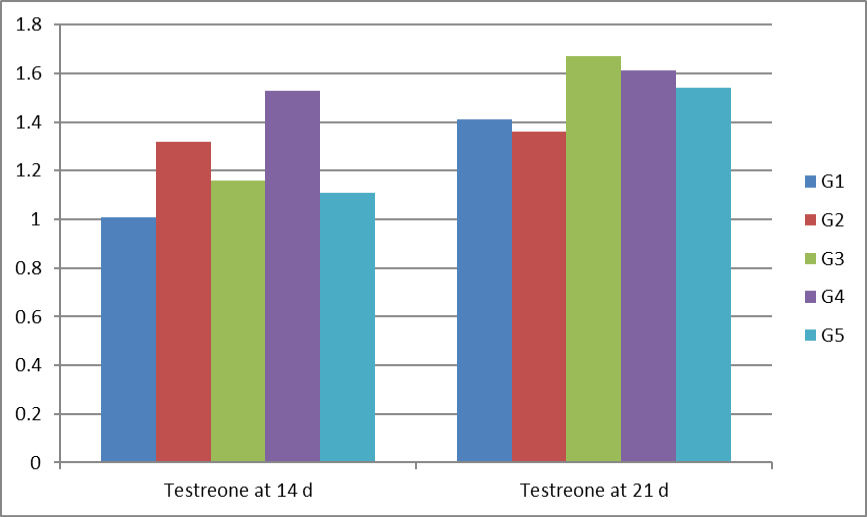
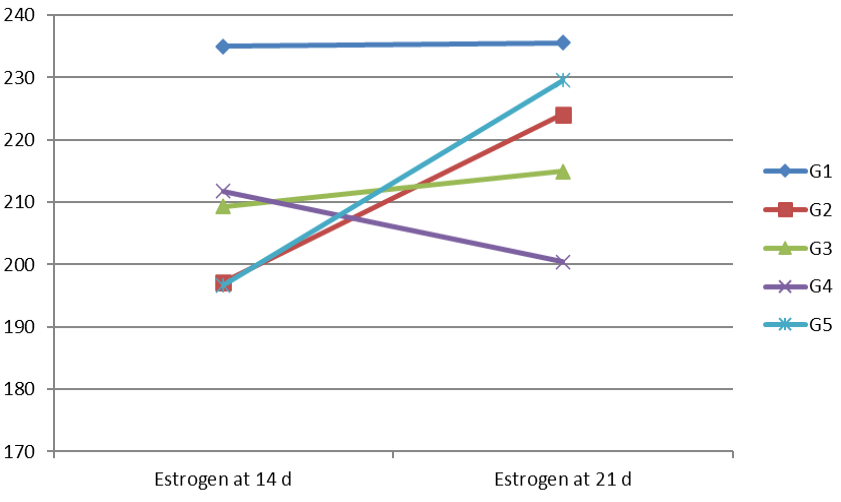
Table 2 and Figures 2, 3 shows the effect of treating hatching eggs with (AIS) on the level of androgen and EST hormones for broiler chickens at the age of 14 and 21 days. There was a significant superiority (P≤0.05) of group G4 compared to groups G1, G2, and G5 at the age of 14 days. At the age of 21 days, group G3 was significantly height (P≤0.05) than the group. G1, G2, and G5 group: The G5 group was significantly height (P≤0.05) than group G1 and G2 in EST concentration at the age of 14, and no significant differences appeared between groups G3 and G4 compared to the rest of the groups, and no significant differences appeared between groups in EST concentration at the age of 21.
Table 2: Effect of (AIS) in TES and EST of broiler chickens (Ross 308).
Groups
Mean ± Standard error
Tes. (14 d)
Tes. (21 d)
Est. (14 d)
Est. (21 d)
G1
1.01±0.30c
1.41±0.65c
235.03±9.22 a
235.60±1.98
G2
1.32±0.90b
1.36±0.40c
197.21±9.00 b
224.12±7.01
G3
1.16±0.65c
1.67±0.23a
209.31±6.35ab
214.97±6.48
G4
1.53±0.82a
1.61±0.11ab
211.81±4.51ab
200.47±2.25
G5
1.11±0.19c
1.54±0.50b
196.67±7.18b
229.56±2.50
Sig.
*
*
*
N.S.
Means including different litter defer at level *(P≤0.05); NS, Not Significant.
Table 3 indicates that there were no differences between the study groups in the numbers of red and white blood cells at the ages of 14 and 21 days.
Table 4 shows a highly significant decrease (P≤0.0١) in CHO concentration in the G2, G3, and G4 groups compared to the G1 group, and also a highly significant height (P≤0.0١) was obtained in the G2 group compared to the G3 and G4 groups, as well as the G3 group outperformed the G4 group at the age of 14 days, while no significant differences between the groups at the age of 21 days for the same trait.
Table 3: Effect of (AIS) in red and white blood cells of broiler chickens (Ross 308).
Groups
Mean ± standard error
RBC×106 (14 d)
RBC×106 (21 d)
WBC×103 (14 d)
WBC×103 (14 d)
G1
2.30±0.70
2.81±0.06
29.10±0.45
28.36±0.08
G2
2.41±0.40
2.92±0.09
30.00±0.24
28.99±0.01
G3
2.63±0.35
2.79±0.01
30.11±0.66
29.10±0.16
G4
2.13±0.12
2.74±0.01
30.51±0.31
28.31±0.11
G5
2.35±0.59
2.88±0.08
30.74±0.25
28.55±0.12
Sig.
N.S.
N.S.
N.S.
N.S.
NS, Not Significant.
Table 4: Effect of (AIS) in serum CHO of broiler chickens (Ross 308).
Groups
Mean ± standard error
14 Day
21 Day
G1
97.43±0.98 a
127.97±3.42
G2
91.11±0.23 b
116.80±6.66
G3
87.19±1.97 c
112.78±6.31
G4
80.85±1.45 d
101.35±2.78
G5
93.46±0.89 ab
108.08±2.91
Sig.
**
N.S.
Means including different litter defer at level **(P≤0.01): NS, Not Significant.
Table 5 indicates the effect of the studied groups on the level of TRI-G. A highly significant increase (P≤0.0١) in this characteristic is observed in the group G1 compared to the experimental groups. The concentration of TRI-G increased in the group G2 compared to the groups G3 and G5 at the age of 14 days, and at the age of 21 days, it increased significantly. The concentration of TRI-G in group G1 compared to the rest of the groups, and this characteristic increased significantly in group G2 compared to groups G3, G4, and G5, and this trait also increased significantly in group G3 compared to G4 and G5 at the age of 21 days.
Table 5: Effect of (AIS) on the level of TRI-G of broiler chickens (Ross 308).
Groups
Mean ± standard error
14 Day
21 Day
G1
291.05±3.70 a
257.49±6.02 a
G2
273.76±2.54 b
245.72±1.47 b
G3
260.66±0.67 bc
221.27±1.30 d
G4
254.60±1.60 c
235.65±1.44 c
G5
256.84±1.15 c
242.62±1.75 c
Sig.
**
**
Means including different litter defer at level **(P≤0.01)
Note from Table 6 that there were no differences in the level of GLU at the age of 14 and 21 days due to the group of hatching eggs with AIS.
Table 6: Effect of (AIS) in GLU of broiler chickens (Ross 308).
Groups
Mean ± standard error
14 Day
21 Day
G1
289.09±2.43
252.71±8.46
G2
275.75±18.45
251.00±16.80
G3
284.31±3.06
239.89±7.26
G4
289.90±4.60
257.42±7.26
G5
288.68±38.32
256.65±24.67
Sig.
N.S.
N.S.
NS, Not Significant.
It is noted from Table 7 that there were no significant differences in the level of GPX and the value of peroxide at the age of 14 and 21 days when the hatching eggs were treated with aromatase inhibitors.
Table 7: Effect of (AIS) in GPX level of broiler chickens (Ross 308).
Groups
Mean ± standard error
14 Day
21 Day
G1
٦١.66±6.46
72.65±25.49
G2
96.17±34.39
85.78±19.60
G3
74.68±1.70
110.18±12.40
G4
79.61±8.61
114.12±61.92
G5
106.18±7.42
110.93±24.06
Sig.
N.S.
N.S.
NS, Not Significant.
Controversial data Table 8 indicate that there are no significant differences in the level of liver enzymes in broiler chickens at the age of 14 and 21 days, resulting from the group of hatching eggs with aromatase inhibitors.
Table 8: Effect of (AIS) in AST and ALT enzyme of broiler chickens (Ross 308).
Groups
Mean ± standard error
AST (14 d)
AST (21 d)
ALT (14 d)
ALT (14 d)
G1
75.90±1.60
75.15±15.35
5.98±0.26
6.98±0.68
G2
72.82±1.30
75.99±3.14
5.53±0.19
5.37±0.30
G3
75.75±4.25
75.56±4.26
5.50±0.41
5.46±0.06
G4
68.44±6.92
71.34±10.21
5.70±0.81
5.78±0.09
G5
73.38±2.49
62.15±2.15
5.52±0.18
5.28±0.02
Sig.
N.S.
N.S.
N.S.
N.S.
NS, Not Significant.
Most aromatase inhibitors (such as letrozole, anastrozole, and fadrozole) are relatively small, lipophilic compounds (molecular weight 200–300 Da), which means they can penetrate the microscopic pores of the shell. Passive diffusion occurs across the membrane layers toward the lower concentration, provided there is sufficient contact between the shell and the solution for an appropriate period of time ; , short immersion (1–3 minutes) in a suitable solute of the aromatase inhibitor provides better penetration and ensures the compound reaches the egg interior, provided the solvent is safe and non-toxic to the embryo , spraying may also be suitable for rapid practical applications, but requires a higher concentration of the substance to achieve the same effect . The increase in testosterone in the aromatase inhibitor groups and the EST hormone in the control group may be due to the role of anastrozole (the aromatase inhibitor) in inhibiting the action of aromatase, and thus the increase in the testosterone and the decrease in the EST, as explained by Ali (2017) when using (AIS) led to inhibition of the aromatase enzyme Thus, an increase in the level of testosterone and a decrease in the level of EST, and (AIS) prevent the conversion of testosterone into EST , as the testosterone hormone turns into EST in a process called aromatization, which is carried out by the aromatase enzyme ; Bardal et a., 2011; Al-Daraji et al, 2002a, b; and therefore the group of hatching eggs with (AIS)limits this process, as indicated by Vaillant et al. (2001), exposure of embryos to (AIS) before the age of sexual differentiation (4-6 days of embryonic age) leads to sex change in chickens and an increase in testosterone levels. It also reduced the enzyme activity on the fourteenth and eighteenth day after hatching. Many studies have shown that the sex difference between females and males is based on the lack of aromatase and EST. While EST receptors are available in embryos before sexual differentiation, in males, both endocrine pathways and performance factors modulate the steroid hormone receptor, which in turn modulates insulin-like growth factors and estimated glomerular filtration rate . It reduces cell proliferation in both EST receptor-positive and EST receptor-negative cell lines for the inhibition of aromatase and 17-hydroxysteroid dehydrogenase and collaborates with (AIS) to lessen EST receptor outgrowth ; this explains the process of changing sex from females to males in the hatched chicks Mokarrami (2020), Abdulateef et al. (2021) indicated that injecting hatching eggs with a concentration of 0.1 mg/egg Anastrozole significantly improved the sexual ratio, embryonic growth rate, and hatched chicks characteristics. Anastrozole also reduces blood CHO and triglyceride levels, which improves the physiological status of birds.
Conclusions
Anti-aromatase compounds (anastrozole play roles in sex change, as well as their effect in improving the production traits of broiler chickens through improving physiological indicators, such as reducing the concentration of CHO and TRI-G in groups that were treated with aromatase inhibitors; this could also improve the characteristics of the carcass. The future implications of the study include treating chicken broilers with aromatase inhibitors or early feeding in the egg to increase the percentage of hatched male broilers and improve their subsequent performance, the best groups were G3, G4, and G5.
Declarations
Acknowledgement
The authors express their gratitude to Al-Anwar Poultry Company and the Physiology Laboratory at the College of Agriculture, Al-Qasim Green University.
Funding
The study received no external funding.
IRB approval
The Animal Production Department Council of Al-Qasim Green University, Iraq approved the study (8-2022)
Generative AI and AI-assisted technology statement
The authors confirm that they used artificial intelligence in preparing the manuscript, however the mansucript is carefully reviewed by the authors.
Statement of conflict of interest
The authors have declared no conflict of interest.
Figures
Figure 1:.
Experimental design diagram.
Figure 2:.
Effect of (AIS) in TES of broiler (Ross 308). The G3 and G4 treatments are observed to be superior at the ages of 21 and 35 days.
Figure 3:.
Effect of (AIS) in EST of broiler (Ross 308). G1 is superior at 21 days of age and there are no significant differences at 35 days of age.
References
Abdulateef, S.M., Majid, A.A., Al-Bayer, M.A., Shawkat, S.S., Tatar, A., Mohammed, T.T., Abdulateef, F.M. and Al-Ani, M.Q., 2021. Effect of aromatase inhibitors on sex differentiation and embryonic development in chicks. Vet. Med. Sci., 7: 2362-2373. https://doi.org/10.1002/vms3.623[CrossRef]
Ajafar, M., Al-Jebory, H.H. and Al-Saeedi, M.K.I., 2024a. Effect of in Ova injection of lysophospholipid in hatching traits, chick’s quality, and chicks physical traits of broiler (Ross 308). Adv. Anim. Vet. Sci., 12: 1206-1213. https://doi.org/10.17582/journal.aavs/2024/12.7.1206.1213[Full text][CrossRef]
Ajafar, M., Al-Jebory, H.H. and Al-Saeedi, M.K.I., 2024b. Effect of feed restriction and manganese supplementation on the immunological and physiological traits and glycogen level of broiler ross 308. Kufa J. Agric. Sci., 16: 141-150. https://doi.org/10.36077/kjas/2024/v16i4.11994[CrossRef]
Al-Daraji, H.J., Al-Rawi, A.J. and Al-Tikriti, B.T.O., 2002a. Study of the semen traits of Barred Plymouth Rock, New Hampshire, and local roosters. Iraqi J. Agric. Sci., 33: 255-260.
Al-Daraji, H.J., 2002b. Studies of semen characteristics of certain breeds of Iraqi cocks. Iraqi J. Agric. Sci., 33: 257-261.
Al-Daraji, H.J., Al-Mashadani, H.A., Al-Hayani, W.K., Al-Hassani, A.S. and Mirza, H.A., 2010. Effect of n-3 and n-6 fatty acid supplemented diets on semen quality in Japanese quail (Coturnix coturnix japonica). Int. J. Poult. Sci., 9: 656-663. https://doi.org/10.3923/ijps.2010.656.663[CrossRef]
Ali E., Zhandi, M., Towhidi, A., Zaghari, M., Ansari, M., Najafi, N., Deldar M., 2017. Letrozole, an aromatase inhibitor, reduces post-peak age-related regression of rooster reproductive performance, Anim. Reprod. Sci., 183: 110-117
Al-Jebory, H.H., Al-Saeedi, M.K.I., Ajafar, M. and Ali, N.A.L., 2024. Impact of melatonin on improving productive traits of broiler exposed to environmental stress. Adv. Anim. Vet. Sci., 12: 775-781. https://doi.org/10.17582/journal.aavs/2024/12.4.775.781[Full text][CrossRef]
Al-Jebory, H.H. and Ibrahim, M.K., 2021. Effect of adding bee propolis to diet on productive performance of broiler chickens. Indian J. Ecol., 48 (Spec. Issue 15): 203-207.
Al-Saeedi, M.K.I., Al-Jebory, H.H. and Ajafar, M., 2023. Effect of in ova injection with nano-copper in productive performance of Japanese quail exposed to pathological and environmental challenges. Ann. Agri-Bio Res., 28: 361-366.
Al-Saeedi, M.K.I., Ajafar, M. and Al-Jeobry, H.H., 2024. Immunity and glycogen metabolism of laying hens fed diets supplemented with manganese sulfate during the force molting. J. Anim. Hlth. Prod., 12: 413-419. https://doi.org/10.17582/journal.jahp/2024/12.3.413.419[Full text][CrossRef]
Al-Shammari, K.I.A., 2017. The use of chosen plant extracts in various aspects of Japanese quail production. PhD theses. Dissertation. University of Life Sciences in Lublin, Poland.
Alsudani, A.A., Al-Jebory, H.H. and Al-Saeedi, M.K.I., 2025. Effects of in-ovo injection of znic-methionine on some microbial and parameters of immunology of broiler. Punjab Univ. J. Zool., 40: 1-7. https://doi.org/10.17582/journal.pujz/2025/40.1.1.7[Full text][CrossRef]
Arkan, N.B., Al-Jebory, H.H. and Al-Khafaji, F.R.A., 2025. Impact of nano-encapsulated of anti-bacterial peptide on broiler growth performance under oxidative stress condition. Adv. Anim. Vet. Sci., 13: 1169-1179. https://doi.org/10.17582/journal.aavs/2025/13.6.1169.1179[Full text][CrossRef]
Bardal, S.K., Waechter, J.E. and Martin, D.S., 2011. Chapter 14-endocrinology: A Glucosidase Inhibitors (AGIs). Applied Pharmacolog. https://doi.org/10.1016/B978-1-4377-0310-8.00014-2[CrossRef]
Batkowska, J., Al-Shammari, K.I.A., Lukasz, W., Nowakowicz-Debek, B. and Gryzinska, M., 2018. Evaluation of propolis extract as a disinfectant of Japanese quail (Coturnix coturnix japonica) hatching eggs. Poult. Sci., 97: 2372–2377. https://doi.org/10.3382/ps/pey102[CrossRef]
Baylan, M., Akpınar, G.C., Canogullari, S.D. and Ayasan, T., 2018. The effects of using garlic extract for quail hatching egg disinfection on hatching results and performance. Braz. J. Poult. Sci., 20: 343-350. https://doi.org/10.1590/1806-9061-2017-0693[CrossRef]
Dabrosin, C., Chen, J., Wang, L. and Thompson, L.U., 2002. Flaxseed inhibits metastasis and decreases extracellular vascular endothelial growth factor in human breast cancer xenografts. Cancer Lett., 185: 31–37. https://doi.org/10.1016/S0304-3835(02)00239-2[CrossRef]
Deepika, T., Shalaka, H., Kaustubh, P., Vinod, J., Mahesh, S., Sivakami, S. and Dongre, P.M., 2017. A simple egg membrane model for understanding diffusion characteristics of nanoparticles and amino acids. Curr. Sci., 112: 7-10. https://doi.org/10.18520/cs/v112/i07/1574-1578[CrossRef]
Duncan, D.B., 1955. Multiple rang and multiple F-test. Biometrics, 11: 4-42. https://doi.org/10.2307/3001478[CrossRef]
Fossati, P. and Prencipe L., 1982. Determination TRI-G. Clin. Chem., 28: 2077-2080. https://doi.org/10.1093/clinchem/28.10.2077[CrossRef]
Franey, R.J. and Elias, A., 1968. Serum CHO measurement based on ethanol extraction and ferric chloride- sulfuric acid. Clin. Chem. Acta, 21: 255- 293. https://doi.org/10.1016/0009-8981(68)90135-6[CrossRef]
Friedewald, W.T., Levy, R.I. and Fredrickson, D.S., 1972. Estimation of the concentration of low-density lipoprotein CHO in plasma, without use of the preparative ultracentrifuge. Clin. Chem., 18: 499-502. https://doi.org/10.1093/clinchem/18.6.499[CrossRef]
Grudy, S.M., Cleeman, J.I., Merz, C.N.B., Brewer, H.B., Clark, L.T., Hunninghake, D.B. and Coordinating Committee of the National CHO Education Program, 2004. Implications of recent clinical trials for the national CHO education program adult group panel III guidelines. J. Am. Coll. Cardiol., 44: 720-732. https://doi.org/10.1016/j.jacc.2004.07.001[CrossRef]
Hafemann, D.G., Sunde, R.A. and Houestra, W.G., 1974. Effect of dietary selenium on erythrocyte and liver glutathione peroxidase in the rat. J. Nutr., 104: 580–584. https://doi.org/10.1093/jn/104.5.580[CrossRef]
Han, C., Chen, Y., Shi, L., Chen, H., Li, L., Ning, Z., Zeng, D. and Wang, D., 2023. Advances in eggshell membrane separation and solubilization technologies. Front. Vet. Sci., 10: 1116126. https://doi.org/10.3389/fvets.2023.1116126[CrossRef]
Joseph, A.E., 2019. Examining the effects of Fadrozole, an aromatase inhibitor, on testosterone and EST production of domestic chicken embryos (Gallus gallus). Honors Theses, 498. https://digitalcommons.bucknell.edu/honorstheses/498.
Khalil-Ibrahim, A-SM., Al-Jebory, H.H., and Hameed, A.M., 2022. Progress phenotypic traits of hatched chicks and growth indicators of broiler chicks fed embryonically with zinc methionine. Arch. Razi Inst., 77: 2139-2145.
Matsushita, S., Yamashita, J., Iwasawa, T., Tomita, T. and Ikeda, M., 2006. Effects of in ovo exposure to Imazalil and Atrazine on sexual differentiation in chick gonads. Poult. Sci., 85: 1641-1647. https://doi.org/10.1093/ps/85.9.1641[CrossRef]
McDaniel, C.D., Bramwell, R.K., Wilson, J.L. and Howarth, B.Jr., 1995. Fertility of male and female broiler breeders following exposure to elevated ambient temperatures. Poult. Sci., 74: 1029–1038. https://doi.org/10.3382/ps.0741029[CrossRef]
Mokarrami, T., 2020. The effect of In ovo injection of (AIS) on the performance of broilers. Iran. J. Appl. Anim. Sci., 10: 113-118.
NRC, 1994. Nutrient requirements of poultry 9th Ed. National Academy Press, Washington, DC.
Ritman, S. and Frankel, S., 1957. Acolorimetric method for the determination of serum glutamic oxaloacetic and glutamic pyruvic transaminases. Am. J. Clin. Pathol., 28: 56-63. https://doi.org/10.1093/ajcp/28.1.56[CrossRef]
Salman, K.A.A., Al-Saeedi, M.K.I. and Al-Jebory, H.H., 2024a. Impact of ova injection with zinc methionine on some blood parameters and glycogen level of broiler chickens exposed to feed fasting. Adv. Anim. Vet. Sci., 12: 1532-1538. https://doi.org/10.17582/journal.aavs/2024/12.8.1532.1538[Full text][CrossRef]
Salman, K.A.A., Al-Saeedi, M.K.I. and Al-Jebory, H.H., 2025. Effect of adding manganese sulfate for diet on the hormonal and histological response of aged roosters exposed to heat stress. Kufa J. Agric. Sci., 17: 131-141. https://doi.org/10.36077/kjas/2025/v17i1.12455[CrossRef]
Salman, K.A.A., Al-Saeedi, M.K.I., Al-Jebory, H.H. and Al-Jebory, R.F., 2024b. Effect of neem (Azadirachta indica) leaf powder supplementation on some blood parameters in broiler chickens exposed to heat stress. Punjab Univ. J. Zool., 39: 177-183. https://doi.org/10.17582/journal.pujz/2024/39.2.177.183[Full text][CrossRef]
Samson, O., Deborah, I. and Adewole. 2020. In ovo delivery of bioactive substances: An alternative to the use of antibiotic growth promoters in poultry production: A review. J. Appl. Poult. Res., 29: 3-744-763. https://doi.org/10.1016/j.japr.2020.06.002[CrossRef]
SAS, 2012. Statistical analysis system, user’s guide. Statistical. Version 9.1th ed. SAS. Inst. Inc. Cary. N.C. USA.
Shimada, K., 1998. Gene expression of steroidogenic enzymes in chicken embryo gonads. J. Exp. Zool., 281: 450-456. https://doi.org/10.1002/(SICI)1097-010X(19980801)281:5<450::AID-JEZ9>3.0.CO;2-N[CrossRef]
Shimada, K., 2002. Sex determination and sex differentiation. Avian Poult. Biol. Rev., 13: 1-14. https://doi.org/10.3184/147020602783698449[CrossRef]
Simpson, E.R., Clyne, C., Rubin, G., Boon, W.C., Robertson, K., Britt K., Speed, C. and Jones, M., 2002. Aromatase- A brief overview. Ann. Rev. Physiol., 64: 93-127. https://doi.org/10.1146/annurev.physiol.64.081601.142703[CrossRef]
Vaillant, S., Dorizzi, M., Pieau, C. and Richard-Mercier, N., 2001. Sex reversal and aromatase in chicken. J. Exp. Zool., 290: 727–740. https://doi.org/10.1002/jez.1123[CrossRef]
Verapeen, D.S. and Driver, M.F., 2000. Separate sex growing of Ross 208 Broilers and effects on broiler performance and carcass quality. Sci. Technol. Res. J., 4: 145-152.
Wang, C., Mäkelä, T., Hase, T., Adlercreutz, H. and Kurzer, M.S., 1994. Lignans and flavonoids inhibit aromatase enzyme in human preadipocytes. J. Steroid Biochem. Mol. Biol., 50: 205–212. https://doi.org/10.1016/0960-0760(94)90030-2[CrossRef]