INTRODUCTION
Animal trypanosomiasis is a serious problem in the livestock sector and presents a major constraint to the productivity of the livestock industry and international trade in developing countries such as Pakistan ; . Among the trypanosome parasites, T. evansi, T. brucei, T. vivax, and T. congelense are considered to be the most pathogenic to susceptible animals.
Trypanosoma evansi is mainly transmitted to animals by biting insects (Tabanus spp., and Stomoxys spp.) after undergoing a biological cycle of maturation in the insect host. Several studies on the camel trypanosomiasis in Asian countries including China, Nepal, India, Vietnam, Indonesia, and other South American and European countries reported an adverse impact of infection on the health and production of camels ; .
Camel trypanosomiasis can be clinically variable from acute to chronic form showing high fever, weakness, anaemia along with high morbidity and mortality .
Pakistan is ranked at third position among camel rearing countries and has about 1.1 million heads of camels. According to economic survey of Pakistan 2021-22, with an overall population (1.1 million heads), camel population is providing 944,000 tons of milk and meat for human consumption . According to Livestock Punjab Census 2017, Khushab has population of 3217 camel heads having two breeds i.e, Mareecha and Brella.
In Pakistan, camel is also known as the ship of the desert because of the capability to survive hot and arid environmental conditions due to its unique physiological system. However, the camel rearing system is facing health issues including trypanosomiasis. Therefore, continuous disease surveillance is now considered a breakthrough for controlling diseases and strengthens preventive measures, particularly in the endemic regions.
Keeping in view the importance of trypanosomiasis in camels, this study was conducted to know the prevalence in naturally infected camels with trypanosomiasis in two breeds of camels (Mareecha and Brella) reared in the desert and hilly area of the district Khushab.
MATERIALs AND METHODS
The current study was conducted to determine the prevalence of blood parasitic trypanosome infection in local breeds of camels residing in desert and hilly areas in district Khushab, a city in Punjab, Pakistan located at 32.30 latitude and 72.35 longitudes of 186 meters above sea level. Two sites including Tehsil Noorpur Thal (desert area) located at 31°87’8471 latitude (GPS coordinates of 31° 52’ 42.4956’’ N and 71° 53’ 55.0896’’ E) and tehsil Nowshera (hilly area) located at 32°34’08 latitude (GPS coordinates of 32.2955° N and 72.3489° E) were selected for sampling among camel population
Sample collection
From March 2019 to August 2019, a total of 600 blood samples (n = 300 each in the desert and hilly area) were collected from camels showing parasitic infestation, including pyrexia, anaemic condition, enlarged lymph nodes, loss in productivity, poor body condition, and history of abortion. For subject matter, 50 samples each were collected from camels of age above than 2 years every month during the study period.
Moreover (n=298 for Mareecha and n=302 for Barella) breed-wise and (n=148 male and n=452 female) for sex-based prevalence of T. evansi was also determined during study period. Approximately, a total of 3 ml blood sample was collected in an ethylene di-amine tetra acetic acid (EDTA) coated vacuum tube (XINLE®, Hebei Xinle Sci & Tech Co. LTD. China) as aseptically as possible using appropriate personnel protective equipment. The collected samples were stored at 4°C and transported to Disease Diagnostic Laboratory Khushab for further process.
Microscopic examination
One drop of each blood sample was used to make thin and thick blood smears on the glass slide following the previously described methodology . After drying, the smears were fixed in methyl alcohol for 3 minutes. Then the slides were immersed in 10% Giemsa stain for 20 minutes and were examined under an optical microscope (at 100x oil immersion objective) for the identification of differential trypanosome species .
Statistical analysis
The significant association of prevalence between different variables was estimated with the implementation of parametric one-way analysis of variance (ANOVA) using GraphPad Prism 8 version software. Odd ratio, chi-square, and confidence interval (C.I) at 95% were determined for the association between two groups.
RESULTS
Prevalence of T. evansi in desert and hilly areas
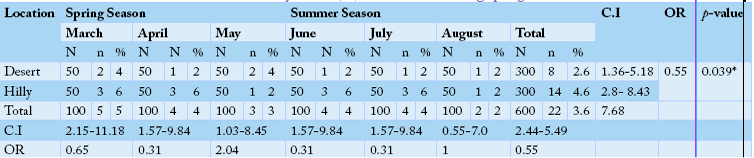
As shown in Table 1, the findings of the current study revealed an overall 3.6% prevalence of T. evansi with the highest prevalence in March month (5%) followed by April (4%), June (4%), July (4%), May (3%) and August (2%).
While comparing landscape geography, camels from hilly areas showed a higher prevalence (4.6%, 95% C.I: 2.8-8.43) of T. evansi compared to camels from desert areas (2.6%, 95% C.I: 1.36-5.18). A significant association for the prevalence of T. evansi (OR: 0.55; 95% C.I: 2.44-5.49; p<0.05) was observed between camel populations from desert areas and hilly areas (Table 1).
Breed-wise prevalence of T. evansi
Mareecha breed showed the highest prevalence of T. evansi in April month (7.69%) followed by June (5.66%), March (4.35%), July (4.16%), August (3.17%), and May (2.04%).
On the other hand, the Brella breed showed the highest prevalence of T. evansi in March month (5.55%) followed by May (3.92%), July (3.84%), June (2.12%), and April (1.64%). A lack of prevalence of T. evansi was observed in August month.
Overall, a significant association (OR: 1.48; p<0.05) for the prevalence of T. evansi was observed between different breeds of the camel with the highest prevalence in Mareecha breed (4.3%, 95% C.I: 2.57-7.32) compared to Brella breed (2.9%, 95% C.I: 1.58-5.57) as shown in Table 2.
Table 1: Prevalence of T. evansi in desert and hilly areas of district Khushab during spring and summer seasons
Abbrevations: N: total number of samples; n: number of positive samples; %: positive percentage; C.I: confidence interval at 95%; OR: Odds ratio.
*Significant (p<0.05) association between desert and hilly regions.
*Significant (p<0.05) association between Mareecha and Brella breeds.
*Significant (p<0.05) association between male and female camels.
Sex-based prevalence of T. evansi
Sex-based prevalence of T. evansi was observed higher among female camels (3.9%, 95% C.I: 2.53-6.2) as compared to male camels (2.7%, 95% C.I: 1.05-6.74) with a significant association (OR: 0.66; p<0.05). Male camels showed the highest prevalence of T. evansi in June month (12.5%) followed by March (5.3%) and July (4.3%). A lack of prevalence of T. evansi was observed in April, May, and August months. On the other hand, female camels showed the highest prevalence of T. evansi in April month (5.7%) followed by March (4.9%), May (4.1%), July (3.8%), August (2.9%), and June (2.4%) as shown in Table 3.
DISCUSSION
Trypanosomiasis is the most serious parasitic disease of camels in developing countries caused by Trypanosoma evansi and categorized under order Kinetoplastida and family Trypanosomatidae ; .
The prevalence of T. evansi was far lower than reported among the camel population in India 34.4% , Somaliland 26.4% , Southern Ethiopia 17.9% and Ismailia, Egypt 12% . Moreover, the finding of the current study on the prevalence of T. evansi (3.6%) is in accordance with previous evidence of T. evansi prevalence (3.3%) in the camel population in Punjab province (Hassan et al., 2006).
Comparatively, several studies reported variable prevalence of T. evansi among the camel population in Punjab and Sindh provinces, Pakistan. The current prevalence was far lower than reported among the camel population in Southern Punjab 15% , Sindh 11.25% and Bahawalpur 9.67% , 6.5% . On the other hand, the prevalence of T. evansi was higher than that reported (0.7%) in another study in Bahawalpur .
In the current study, a higher prevalence of T. evansi was observed in the Mareecha breed (4.3%) as compared to the Brella breed of camel (2.9%) is in accordance with the observation of .
Our study showed a higher prevalence of T. evansi in female camels (3.9%) as compared to male camels (2.7%). These findings are in agreement with observations reported in previous studies . Previously, in Pakistan, a higher prevalence of T. evansi was recorded in female camels than among male camels . So far, several studies suggested that a higher prevalence of T. evansi in females could be related to the physiological differences between female and male, where females are more susceptible to infection resulting stress during pregnancy, gestation, and breeding periods ; . Owing to production potential, female camels maintained for a longer period of time and thus increasing the likelihood for female camels to be exposed to infections ; .
Several studies have noted that geographical landscapes may have an influence on the higher incidence of T. evansi infection because of favorable conditions for survival, multiplication, and transmission of the biting flies as trypanosome carriers . Moreover, trypanosome infection was noted higher in the hilly areas due to environmental variations, local herd management system, in-sufficient veterinary facilities, control interventions practiced by the respective communities, types, and density of mechanical vectors .
In the current study, a high prevalence was observed during the spring season (March-May) as compared during the summer season (June-August). It is not unusual because several studies claimed a high incidence of T. evansi infection during spring and rainy seasons. Owing to the high multiplication of biting flies in the spring season and increased movement of camels at this time, a high prevalence rate is not uncommon. Similar observations reported with high prevalence have been linked to the presence of biting flies and seasons in the Northern regions of Ethiopia. It is believed that camels reared in ecological zones with spring-like seasons are more likely to be infected than those reared in moderate seasonal conditions
Conclusion
Animal trypanosomiasis is a serious problem in the livestock sector and presents a major constraint to the productivity of the livestock industry and international trade in developing countries such as Pakistan. High prevalence of Trypanosoma evansi in camels from district Khushab was recorded in March. Camels from hilly areas showed a higher prevalence compared to those from desert areas. On the other hand, female camels and Mareecha breed showed a high prevalence of trypanosomiasis when compared to male and Brella breed of camels.
Acknowledgements
The authors are greatful to AIOU Islamabad and Disease Diagnostic Laboratory of Livestock department district Khushab for conducting this study.
Conflict of interest
There is no conflict of interest
novelty statement
Trypanosomiasis greatly affects the productivity, fertility and draught power of camels. The current study investigated a significant influence of climatic changes on the prevalence of Trypanosoma evansi in two breeds of camels in district Khushab. The findings of the current study will help better understanding of its epidemiology to prepare appropriate control programs.
authors contribution
NM and MTT designed the study, NM and RKD conducted the experiments, RKD interpreted the results and wrote the manuscript, RKD and MTT reviewed the manuscript.