Théophile Godome1,2*, Dogbè Clément Adjahouinou1, DS. Juste Vital Vodounnou1, Nahoua Issa Ouattara2, Emile Didier Fiogbe1
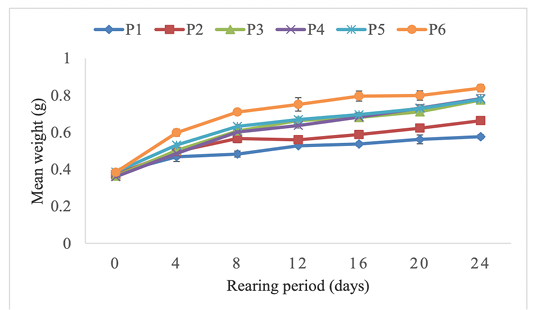
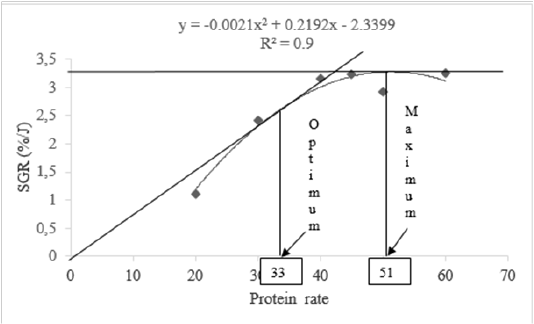
1Laboratory of Research on Wetlands, Department of Zoology, Faculty of Sciences and Techniques, University of Abomey-Calavi, BP: 526 Cotonou (Benin); 2Laboratory of Hydrobiology, UFR Biosciences, University Félix Houphouet-Boigny, 22 BP: 582 Abidjan 22, (Ivory Coast).Abstract | The current study aims at evaluating the effect of experimental feed protein rate on growth and feed utilization in Hoplobatrachus occipitalis tadpoles. Six same-energy feed diets containing crescent protein rates (20, 30, 40, 45, 50 and 60 %) were formulated and tested on Hoplobatrachus occipitalis tadpoles though initial mean weight was 0.380 ± 0.004 g. Each diet was tested in triplicate for 24 days. 55 tadpoles was stocked per pond containing 30L water. Survival rates recorded ranged between 85.454 and 92.727% for all treatments. Growth and feed utilization parameters varied significantly with feed protein rate (P < 0.05). The best growth performances were recorded with 60% protein diet. According to the mathematical model (polynomial regression II) used for analysis of specific growth rate variations in relation to feed protein rate, optimal and maximal protein needs of Hoplobatrachus occipitalis tadpoles are 33 and 51% respectively. The highest protein rate of tadpoles’ carcass was noticed in tadpoles fed on 45% protein diet. The highest rate of lipid and dry matter was observed in tadpoles fed on 50% protein feed. The optimum and maximum protein requirements for better growth of H. occipitalis tadpoles are 38.30% and 54.10%, respectively.
Keywords: Hoplobatrachus occipitalis, Tadpoles, Protein rate, Same-energy feed diet, Survival rates.