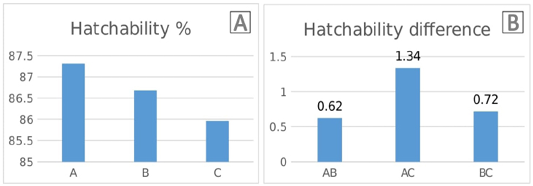
After fifteen successful hatches out for individual group, hatchabilities were recorded.
Group A showed better hatchability percentage and the average of fifteen hatches was recorded 87.31% as compared to B (86.68%) and control (85.96%) group (Figure 1A).
A) Hatchability (%) of individual groups; B) Hatchability differences between various groups.
A, pre-heated at 82°F for 5 hours; B, pre-heated at 82°F for 3 hours; C, without pre-heat treatment (control).
Selected from the article's own text.
Abstract
Adnan Yousaf, Adnan Jabbar, Yasir Allah Ditta
Sadiq Poultry (Pvt.) Limited, Chakri Hatchery Rawalpindi, Pakistan, 2Department of Animal Nutrition, University of veterinary and Animals Sciences Lahore
Abstract | Hatchability and early chick mortality are regarded as the parameters of assessment of a hatchery. The hatchery’s key aim is to provide an even and uniform start of growth for all embryos placed in incubator. The pre-warming process directly influences embryo capability and avoid condensation. In current study, three experimental groups each consist of 4, 03,920 eggs were pre-heated at 82oF for 5 hours (Group A), 82oF for 3 hours (Group B) or without pre-heat treatment (control, Group C) were selected to investigate the effect of pre-warming on hatchability and post-hatch performance. Each treatment group consists of fifteen hatch records of commercial hatchery. Results showed that significant differences (P <0.01) were documented in hatchability percentage between A and C groups (1.339±0.066) as compared to A and B (0.621± 0.059), or B and C groups (0.71±0.072). Mortality was reduced significantly (P<0.05) in A (3.18±0.77) and B (3.97±0.63) groups as compared to control (5.39±0.02). Weight gain was increased (P<0.01) in A (1955.66±21.82) and B (1896±83.97) groups than control group (1668.33±32.14). Feed conversion ratio were found significantly better (P<0.002) in A (1.49±0.06) and B (1.72±0.02) groups than C group (1.91±0.05). However, feed intake was not affected (P> 0.05) by the pre-warming regimen of eggs. These results suggested that pre-warming of eggs is a beneficial regimen, which may be used to enhance the hatchability and post-hatch performance of broilers.
The current study was performed at Sadiq Poultry (Pvt) Limited, Chakri Hatchery Rawalpindi, Pakistan, one of the largest commercial broiler hatchery of Asia.
Eggs Selection and Classification
Eggs (wt. 53-60 g) from broiler breeders (Ross 308, 45-50 weeks of age) were classified into three groups, such as A, B and C. Group C was served as control, while rest of two groups were treated with different duration of pre-warming in commercial single stage setters (Avida G4, Chick Master USA). Hatchable eggs were selected on the basis of shell quality, weight and color. Only oval shape good quality intact eggs were selected for hatching. The substandard eggs such as cracked, misshapen, blood-stained, dirty, toe-punched and elongated were rejected . These eggs were collected at farm and stored at 20°C and 75% relative humidity until used in hatching trail. Before, trail eggs were fumigated with 20 g KMnO4 and 40 ml formalin (40%), and 40 ml of water for 100 ft3 area for 15 minutes.
Pre-Warming Regimen
Each experimental group was consisting of 4,03,920 eggs. Group C (Setter) was served as control group, while group B was pre-heated at 82 oF for 3 hours and group A pre-heated at 82 oF for 5 hours inside incubators. After completion of pre-heating stage the incubator started automatically stage profile (Ross prime age recommended by Chicks Master, USA).
After completing 456 hours (19 days) in incubator the fertility of eggs was checked through candling process. All the infertile eggs were removed from the tray and just fertile eggs shifted to hatchers for next 50 hours (2 days and 8 hours). Hatch pulling was performed after 506 hours. Upon hatching of all chicks, hatchability percentage was calculated.
Poultry House Conditions
The chicks from six hatches were delivered to poultry houses through environmentally controlled vehicles (240C temperature and 65% humidity). At farm, chicks of all three groups were offered water and feed ad libitum. Continuous light was supplied during the whole experimental period. The chicks were fed with starter diets from 1 to 10 d (3010 Kcal ME/kg, 22% crude protein), grower diets from 11 to 20 d (3175 Kcal ME/kg, 20% crude protein) and finisher diets from 21 to 35 d of age (3227 Kcal ME/kg, 18% crude protein). The diet was formulated according to the recommendations of the NRC (1994) using WUFFDA formulation software program. Intake of feed and water was taken daily, while body weight and total feed consumed was recorded on weekly basis. Poultry house conditions were same for all experimental groups and were given in Table 1. For ventilation Viper Touch (Big Dutchman, Co., Germany) system was installed.
Table 1: Environmental conditions of poultry house
Parameters
Week
1st
2nd
3rd
4th
5th
Temperature (°C)
34-30
30-28
28-25
25-24
24
Humidity (%)
65
65
65
65
65
Ventilation
(m3/hour/bird)
0.07
0.25
0.40
0.59
0.87
Statistical Analyses
All data were analyzed by using Statistical Analysis System package software (SAS version 9.2, SAS Institute Inc., Cary, NC, USA). All means were compared using Duncan’s Multiple Range test and results were presented as mean ± SEM (standard error of mean). Results were considered significant if exist P < 0.05.
RESULT AND DISCUSSION
After fifteen successful hatches out for individual group, hatchabilities were recorded. Difference in term of hatchability percentage was found for groups A, B and C which was pre-heated for 5 hours, 3 hours and control, respectively. Group A showed better hatchability percentage and the average of fifteen hatches was recorded 87.31% as compared to B (86.68%) and control (85.96%) group (Figure 1A).
Similarly, difference between groups A and B, B and C and A and C were recorded and shown in Figure 1B. Significant difference (P <0.01) were found between AandC groups (1.339±0.066) as compared to A and B (0.621± 0.059) or B and C (0.71±0.072) groups.
During 35 d trail period, mortality, feed intake, weight gain and FCR was recorded and results were presented in Table 2. Interestingly, the effect of pre-warming on broilers performance was also found better as compared to control group. Mortality was reduced significantly (P<0.05) in A (3.18±0.77) and B (3.97±0.63) groups as compared to control (5.39±0.02) group. Weight gain (g/bird) was increased (P<0.01) in A (1955.66±21.82) and B (1896±83.97) groups as compared to control group (1668.33±32.14). Feed conversion ratio (FCR) was found significantly better (P<0.002) in A (1.49±0.06) and B (1.72±0.02) groups than C group (1.91±0.05). However, feed intake (g/bird) was not affected (P> 0.05) by the pre-warming regimen of eggs.
Table 2: Post-hatch performance of broilers
Parameters
Groups
A
B
C
Mortality
3.18±0.77a
3.97±0.63a
5.39±0.02b
FCR
1.49±0.06a
1.72±0.02b
1.91±0.05c
Weight gain (g/bird)
1955.66±21.82a
1896±83.97a
1668.33±32.14b
Feed intake (g/bird)
3048.43±
155.84
3179.14±
141.60
3068.87±3.51
a, b, c, Denotes significant difference in rows (P<0.05). A: Pre-heated at 82oF for 5 hours; B: Pre-heated at 82oF for 3 hours; C: Without pre-heat treatment (control); FCR: Feed conversion ratio
To achieve better hatchability uniform shell temperature is necessary (Renema et al., 2006). Pre-heating is a good tool to avoid condensation that results the improved hatchability . Hatchability and hatch window are critical factors to assess the performance of hatchery. Pre-heating provides uniform temperature for growing embryos result more chicks in short hatch window helps to achieve good quality chicks . Uniform temperature for developing embryos enhances the performance of chicks at farm resulting better FCR and less mortality .
In summary, the findings of current study tended to show that pre-warming to broiler breeder eggs at 82oF for 5 hours enhances the hatchability. Better performance in terms of weight gain and mortality was found for group A and B, while FCR was highest for A than B group, whereas it was poor for control group. Feed intake was same for all groups.
ACKNOWLEDGMENTS
The authors are thankful to respectable Director of Sadiq Poultry (Pvt) limited Mr. Salman Sadiq and Project Co-ordinator Engr. Jawad Kiwan Qazi for their full support, motivation, fruitful suggestions and encouragement during the whole period of research work. We are also grateful to hatchery supervisor Mr. Muhammad Ashfaq for his cooperation.
AUTHORS’ CONTRIBUTION
Dr. Adnan Yousaf and Dr. Adnan Jabbar are main authors have equally contribution in this work, while Dr. Yasir Allah Ditta help in analysis data statistically.
CONFLICT OF INTERESTS
The authors declare that they have no conflict of interest with respect to the research, authorship, and/or publications of this article.
References
Anonymous (2011). Food and Agriculture Organization of the United Nations. FAOSTAT.
FAO (2011). Per capita meat consumption declines by 1.7pc. Food and Agriculture Organization results. Brazil. J. Poult. Sci. 10: 17–22.
Fasenko GM, O’Dea EE (2009). Evaluation broiler growth and mortality in chicks with minor level conditions hatching. Poultry. Sci. J. 87: 594 -597
Hussain J, Rabbani I, Aslam S, Ahmad HA (2015). An overview of poultry industry in Pakistan. World Poult. Sci. J. 71(4): 689-700. https://doi.org/10.1017/S0043933915002366[CrossRef]
Khan A, Rind R, Shoaib M, Kamboh AA, Mughal GA, Lakho SA, Malhi KK, Nizamani AR, Yousaf A (2016). Isolation, identification and antibiogram of Escherichia coli from table eggs. J. Anim. Health Prod. 4(1): 1-5. https://doi.org/10.14737/journal.jahp/2016/4.1.1.5[Full text][CrossRef]
King’ori AM (2011). Review of the factors that influence egg fertility and hatchability in poultry. Indian J. Poult. Sci. 10: 483–492. https://doi.org/10.3923/ijps.2011.483.492[CrossRef]
Koka TD (2002). Effect of storage and pre heating during storage on hatchability. Poult. Sci. 12(8): 21-23.
Mahmud A, Khan MZU, Saima, Javed MA (2011). Effect of different storage periods and temperatures on the hatchability of broiler breeder eggs. Pakistan Vet. J. 31: 78–80.
Marandure T, Matondi GH, Nayamushamba GB, Ganyani B (2012). Effect of duration of pre heating broiler breeder eggs on hatchability, egg weight and chick uniformity posthatch. Res. J. Agric. Environ. Manage. 1 (1): 1-5.
Nazia, Malhi KK, Durrani NU, Kamboh AA, Lakho SA, Rind R, Abro SH, Soomro NM (2015). Prevalence of septic arthritis caused by Staphylococcus aureus in poultry birds at Tandojam, Pakistan J. Anim. Health Prod. 3(3): 73-77.
North MO, Bell D (1990). Commercial chicken production manual, 4th edition. Van Nostrand Reinhold, New York, USA.
Renama RA, Feddes JJR, Schunid KL, Ford MA, Kolk AR (2006). Internal egg temperature in response to preincubation warming in boiler breeder and turkey eggs. J. Appl. Poult. Res. 15: 1-8. https://doi.org/10.1093/japr/15.1.1[CrossRef]
Reijrink IAM, Meijehof R, Kemp B, Graat EAM, van den Brand H (2009). Influence of prestorage incubation on embryonic development, hatchability and chick quality. Poult. Sci. 88: 2649–2660. https://doi.org/10.3382/ps.2008-00523[CrossRef]
Silva FHA, Faria DE, Torres KAA, Faria Filho DE, Coelho AAD, Savino VJM (2008). Influence of egg pre-storage heating period and storage length on incubation of the United Nations (News-agencies 20/02/2010).
Tona K, Malheiros RD, Bamelis F, Careghi C, Moraes VMB (2003). Effects of storage time on incubating egg gas pressure, thyroid hormones, and corticosterone levels in embryos and on their hatching parameters. Poult. Sci. 82: 840–845. https://doi.org/10.1093/ps/82.5.840[CrossRef]