
Leuconostoc mesenteroides are well known for their probiotic effects and starter culture properties. Thermostability of starter cultures is a key factor for food product development. Current study was planned to test the thermodurability of seven strains of Ln. mesenteroides using pasteurization treatments. Both types of pasteurization treatments including High Temperature Short Time (HTST) and Low Temperature Long Time (LTLT) were applied to all of the strains. On applying LTLT treatment, maximum viability was found in the BSM-43 (42.84%) while minimum viability was shown by CYG-362 (26.10%). In case of HTST treatment maximum viability was shown by BSM-43 (41.67%) while minimally viable strain was CYG-362 (19.83%). Concludingly, Ln. mesenteroides strains tested in current study were more susceptible to LTLT pasteurization rather than HTST. Probiotic potential of these strains is being evaluated and employment of these strains in food fermentations is future prospect of the study.
Research Article · Volume 32, Issue 4, 19 November 2019 · Open Access
Effect of Pasteurization Treatments on Leuconostoc mesenteroides Strains Isolated from the Pakistani Foods
· · · · ·
Affiliations & Notes ⌄
- 1Institute of Agricultural Sciences, University of the Punjab, Lahore 54590 Punjab, Pakistan
- 2Department of Molecular Biosciences, The Wenner-Gren Institute, Stockholm University 10691 Sweden. sohaib.afzaal@hotmail.com
- 3Department of Botany, Government Murray College, Sialkot 51310 Punjab, Pakistan
- 4School of Biological Sciences, University of the Punjab, Lahore 54590 Punjab, Pakistan
Article Info ⌄
- Journal:
- Pakistan Journal of Agricultural Research
- Published:
- 19 November 2019
From the article
- Objective of the current study was to investigate the susceptibility of these strains to pasteurization conditions.
- All the strains tested in current study were more susceptible to LTLT treatment (63 0C for 30 min), though it was 90 times less duration as compared to HTST (72 0C for 20 sec).
- While minimum susceptibility was observed in the strain CYG-362 in both types e.g., LTLT and HTST as 26.10 % and 19.83% respectively (Table 2).
- Maximum viability difference among both types of treatments was observed in CYG-362 and WFD-111 as 6.72% and 5.70% respectively (Table 2).
Selected from the article's own text.
Abstract
Introduction
Leuconostoc mesenteroides is a genus belonging to the group of lactic acid producing bacteria (LAB). LAB strains are known as beneficial bacteria for the humans and being utilized as starter cultures for various food fermentation since centuries (Maini et al., 2016). Due to their versatile behaviors towards beneficial aspects, LAB have been proven as best probiotic agents till known. Ln. meseteroides is an agent of the group of LAB, which is being studied for their probiotic potential as well as starter culture properties now days. Various Ln. mesenteroides strains have been successfully employed as starter cultures in food fermentations around the globe ; ; . These studies focus on the isolation of Ln. mesenteroides strains from the local inhabitants and their characterization for probiotic potential. Ln. mesenteroides strains have been isolated from versatile environment including pharmaceutical wastes, bioproducts, food products etc.
Pasteurization is a common treatment applied to various foods to kill some pathogens i.e., Mycobacterium tuberculosis in milk. Pasteurization has two main types as low temperature long time (LTLT) and high temperature short time (HTST). These treatments are applied according to nature of foods and end product. Along-with the beneficial effects, pasteurization has been proved to impart some adverse effects in foods products especially on proteins in milk and immunoglobulin and lactoferrin are significantly reduced by pasteurization . Pasteurization may also affect some beneficial microbiota in foods products. Foltz et al. (2017) also studied the effects of HTST pasteurization on breast milk and concluded the less bacterio-flora in the HTST treated milk. During processing of foods, foods is to be treated with high temperatures directly and indirectly. There is always chances to decrease the nutritional quality, functionality of specific functional foods due to alteration of protein composition and minimizing the probiotics flora during various processing steps ; .
Pakistan has diversified climatic conditions, so it is hypothesized that there may be some thermoduric lactic acid bacteria prevailing in localized food systems, expecting to be good probiotic agents. Current study was conducted to check the ability of indigenous Ln. mesenteroides strains isolated from the traditionally processed food commodities of Pakistan to survive after pasteurization treatments.
Materials and Methods
Leuconostoc mesenteroides strains were isolated in our previous study from the traditionally processed foods of Pakistan. Bacterial cultures have been submitted in the First Culture Bank of Pakistan (FCBP) and 16s rDNA sequences have been submitted in NCBI, GenBank data base. Strains subjected to this study are listed in Table 1 along with their food sources, FCBP and GenBank accession number.
Table 1: Ln. mesenteroides strains subjected in current study.
| Strain | Source | FCBP No. | GenBank No. |
| BSM-41 | Cardamom Milk | MH155203 | FCBP-706 |
| BSM-43 | Raw Milk | MH155204 | FCBP-707 |
| WFD-111 | Wheat Dough | MH155205 | FCBP-708 |
| WFD-113 | Wheat Dough | MH248364 | FCBP-710 |
| WFD-131 | Wheat Dough | MH220794 | FCBP-715 |
| WFD-132 | Wheat Dough | MH220795 | FCBP-716 |
| CYG-362 | Camel Yogurt | MH570186 | FCBP-729 |
Two types of pasteurization treatments were applied to all the strains of Leuconostoc mesenteroides. Low temperature long time (LTLT) and High temperature short time (HTST) treatments . Briefly, all the strains were cultivated in MRS broth and during the stationary phase (cfu = C108; Absorbance600 was optimized spectrophotometrically and A600 of 1.0 = 109 cfu) cells were harvested using centrifugation at 13000 rpm for 4 min at 4 0C. Cells were washed twice with PBS (phosphate buffer) of pH 7.0 and resuspended in same buffer up to original volume. These cells (1% inoculum) were inoculated in MRS broth. Inoculated broth media was pasteurized in water bath with the conditions of low temperature long time (LTLT), 63 0C for 30 minutes and high temperature short time (HTST) treatment at 72 0C for 20 seconds in separate tubes. After pasteurization treatments, tubes were incubated at 35 0C for 24h. After 24h, absorbance (A600 nm) of each strain was measured using HOLO DB 20 Spectrophotometer (Dynamica). Experiment was performed in triplicates and obtained data was subjected to two-way analyses of variance (ANOVA) using Statistix 10.1 . Mean values obtained after ANOVA were subjected to graphical representation given in Figure 1.
Results and Discussion
Resistance of Ln. mesenteroides strains against pasteurization was measured using spectrophotometer, by calculating the absorbance at 600 nm (A600). Selection criteria for these strains is detailed discussed in our previous study . Briefly, these strains were isolated from traditionally processed foods of Pakistan and selected on the basis of their viability to grow at 44 0C. Their identification was performed using 16s rDNA sequencing analyses (accession numbers given in Table 1), while their strain differentiation was done using metabolic typing i.e., sugar fermentations and various biochemical tests.
Objective of the current study was to investigate the susceptibility of these strains to pasteurization conditions. Strains were cultured in de Man’s Rogosa and Sharpe (MRS) broth and treated with both type of pasteurization as mentioned in methodology. Absorbance (A600) values measured after 24 h at 35 0C are given in Figure 1.
Table 2: Percent (%) survival rate of Ln. mesenteroides strains after LTLT and HTST treatments. Difference means the difference in the survival rates after LTLT and HTST treatments.
| Strains | Survival rates (%) | ||
| LTLT | HTST | Difference | |
| BSM-41 | 36.13 | 32.03 | 4.10 |
| BSM-43 | 42.84 | 41.67 | 1.17 |
| WFD-111 | 36.35 | 30.65 | 5.70 |
| WFD-113 | 33.31 | 28.76 | 4.55 |
| WFD-131 | 31.73 | 27.65 | 4.08 |
| WFD-132 | 35.61 | 31.78 | 3.83 |
| CYG-362 | 26.10 | 19.83 | 6.72 |
All the strains tested in current study were more susceptible to LTLT treatment (63 0C for 30 min), though it was 90 times less duration as compared to HTST (72 0C for 20 sec). Foltz et al. (2017) concluded the same results that lactic acid bacteria are more resistant to LTLT treatment. Maximum susceptibility was shown by BSM-43 strains which was isolated from the cardamom sweetened loose milk in case of both types LTLT, and HTST as 42.84% and 41.67% respectively. While minimum susceptibility was observed in the strain CYG-362 in both types e.g., LTLT and HTST as 26.10 % and 19.83% respectively (Table 2). Maximum viability difference among both types of treatments was observed in CYG-362 and WFD-111 as 6.72% and 5.70% respectively (Table 2). These results were in accordance with the Holzapfel et al. (2015), that the viability of the Ln. mesenteroides is decreased with dextrose, in the absence of any other polysaccharides in the basal culture media. Basal media for this experiment was MRS containing the dextrose as carbohydrate source, so this may be a major reason for decreased viability.
Survival rates of Ln. mesenteroides strains subjected in current study were less than 50% among both types of pasteurization. Other lactic acid producing bacterial strains especially some agents from Enterococcus and Lactobacillus have been shown more than 60% survival rates . Holzapfel et al. (2015) has described that thermoduric potential of bacteria can be increased using the polysaccharides especially lactose. Ladero et al. (2011) have used skim milk as basal media with natural lactose, while in current study basal media was MRS. Probably this may be the major reason for decreased survival rates.
Concludingly, thermoduric ability of Ln. mesenteroides is strain dependent. Strains isolated from locally processed and raw milk samples (BSM-41 and BSM-43) showed the maximum susceptibility towards both types of pasteurization while strain isolated from locally processed yogurt (CYG-362) showed the minimum susceptibility towards both pasteurization types. These strains are being studied for their probiotic potential and employment of successful probiotic agents as starter cultures in food fermentations and disease curing will be the future prospects.
Authors Contribution
Sohaib Afzaal conceived the idea, experimental trial and written the first draft. Usman Hameed edited and reviewed the draft. Nasir Ahmad supervised the study. Klas Udekwu reviewed the manuscript. Paulina Pastuszek assisted in the experimental trials. Muhammad Saleem Haider provided the facilities to conduct the research.
Figures
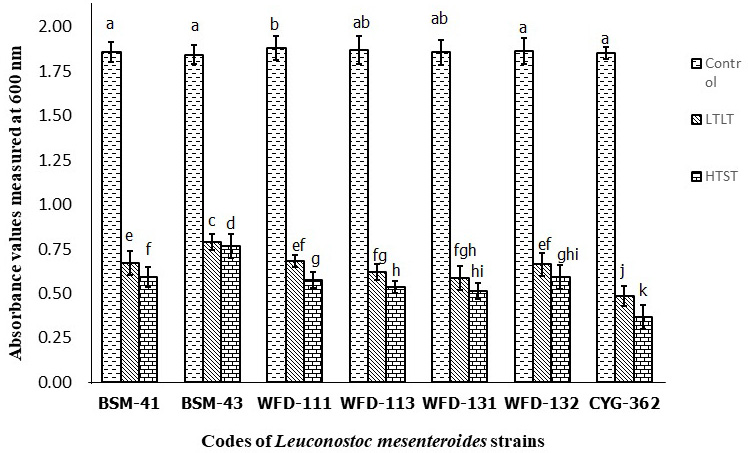
Absorbance values of Ln. mesenteroides with both pasteurization treatments. Data was subjected to two-way ANOVA. DF value was 27, F value 538.44 and P value was < 0.05. Strains are given at X-axis and A600 is on Y-axis. Control experiment indicates the strains normally grown on 37 0C without pasteurization treatment.
References
- Afzaal. S., U. Hameed, N. Ahmed, N. Rashid and M.S. Haider. 2019. Molecular identification and characterization of indigenous lactic acid producing bacterial strains isolated from traditional Pakistani foods. Pak. J. Zool. 51(3):1145-1153. https://doi.org/10.17582/journal.pjz/2019.51.3.1145.1153[Full text][CrossRef]
- Di Cagno. R., P. Filannino, O. Vincentini, A. Lanera, I. Cavoski and M. Gobbetti. 2016. Exploitation of Leuconostoc mesenteroides strains to improve shelf life, rheological, sensory and functional features of prickly pear (Opuntia ficus-indica L.) fruit puree. Food Microbiol. 59: 176-189. https://doi.org/10.1016/j.fm.2016.06.009[CrossRef]
- Foltz. E., D. Liu, B. Li, M.L. Everett, V. Fellner and W. Parker. 2017. The Effect of HTST and holder pasteurization on bacterial agglutination by breast milk. Curr. Nutr. Food Sci. 13(1): 29-36. https://doi.org/10.2174/1573401312666160922101230[CrossRef]
- Hellwig. M. and T. Henle. 2014. Baking, ageing, diabetes: a short history of the Maillard reaction. Angew. Chem. Int. Ed. 53(39):10316-10329. https://doi.org/10.1002/anie.201308808[CrossRef]
- Holzapfel, W.H., J.A. Björkroth and L.M. Dicks. 2015. Leuconostoc. In Bergey’s manual of systematics of archaea and bacteria (eds W.B. Whitman, F. Rainey, P. Kämpfer, M. Trujillo, J. Chun, P. DeVos, B. Hedlund and S. Dedysh).
- Jin. Q., L. Li, J.S. Moon, S.K. Cho, Y.J. Kim, S.J. Lee and N.S. Han. 2016. Reduction of d-lactate content in sauerkraut using starter cultures of recombinant Leuconostoc mesenteroides expressing the ldhL gene. J. Biosci. Bioeng. 121(5): 479-483. https://doi.org/10.1016/j.jbiosc.2015.09.007[CrossRef]
- Jung. J.Y., S.H. Lee, H.J. Lee, H.Y. Seo, W.S. Park and C.O. Jeon. 2012. Effects of Leuconostoc mesenteroides starter cultures on microbial communities and metabolites during kimchi fermentation. Int. J. Food Microbiol. 153(3): 378-387. https://doi.org/10.1016/j.ijfoodmicro.2011.11.030[CrossRef]
- Ladero. V., E. Sánchez-Llana, M. Fernández and M.A. Alvarez. 2011. Survival of biogenic amine-producing dairy LAB strains at pasteurization conditions. Int. J. Food Sci. Ttechnol. 46(3): 516-521. https://doi.org/10.1111/j.1365-2621.2010.02508.x[CrossRef]
- Lavigne. C., J.A. Zee, R.E. Simard and B. Beliveau. 1989. Effect of processing and storage conditions on the fate of vitamins B1, B2 and C and on the shelf-life of goat’s milk. J Food Sci. 54(1): 30-34. https://doi.org/10.1111/j.1365-2621.1989.tb08560.x[CrossRef]
- Manini. F., M.C. Casiraghi, K. Poutanen, M. Brasca, D. Erba and C. Plumed-Ferrer. 2016. Characterization of lactic acid bacteria isolated from wheat bran sourdough. LWT-Food Sci. Technol. 66: 275-283. https://doi.org/10.1016/j.lwt.2015.10.045[CrossRef]
- Marsman. M., L. Waldorp, F. Dablander and E.J. Wagenmakers. 2019. Bayesian estimation of explained variance in ANOVA designs. Stat. Neerl. 1: 1-22. https://doi.org/10.31234/osf.io/s6h7a[CrossRef]
- Peila. C., G. Moro, E. Bertino, L. Cavallarin, M. Giribaldi, F. Giuliani and A. Coscia. 2016. The effect of holder pasteurization on nutrients and biologically-active components in donor human milk: a review. Nutrients. 8(8): 477. https://doi.org/10.3390/nu8080477[CrossRef]
- Zhang. Z.H., L.H. Wang, X.A. Zeng, Z. Han and C.S. Brennan. 2019. Non-thermal technologies and its current and future application in the food industry: a review. Int. J. Food Sci. Technol. 54(1):1-13. https://doi.org/10.1111/ijfs.13903[CrossRef]
Services
Article usage statistics
Loading…