Diabetes is due to either the pancreas not producing enough insulin or the cells of the body not responding properly to the insulin produced. Type 1 diabetes is characterized by autoimmune destruction of insulin-producing cells in the pancreas by CD4+ and CD8+ T cells and macrophages infiltrating the islets, usually leading to absolute insulin deficiency. Type 2 diabetes is due to a progressive insulin secretory defect on the background of insulin resistance (Fagninou et al., 2019). STZ is the most common method for inducing diabetes in animal models today (Wszola et al., 2021).
STZ induces injury in the β-cells of the islets of Langerhans due to a decrease in insulin secretion, which further leads to the induction of diabetes and related complications (Guo et al., 2021).
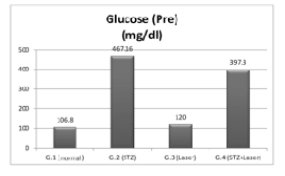
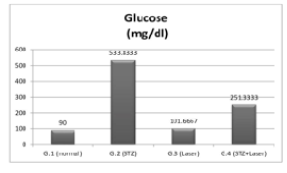
In the present study, we observed the clinical manifestations, glucose, and body weight, using a 45 mg/kg dose of Streptozotocin to ensure the induction of diabetes in rats. Hyperglycemia, hypoinsulinemia, polyphagia, polyuria, and polydipsia accompanied by weight loss were observed in rats exposed to Streptozotocin. The present study results are in agreement with those of former researchers (Nagarchi et al., 2015) and (Akbarzadeh et al., 2007), but they used 50 mg/kg, and 60 mg/kg BW streptozotocin, respectively.
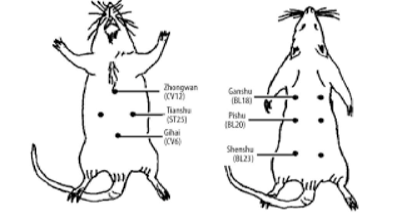
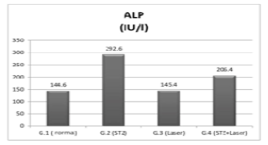
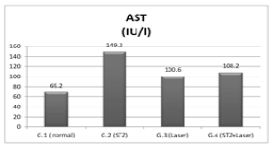
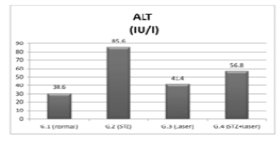
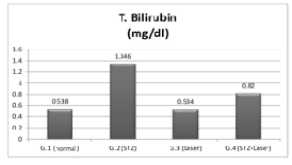
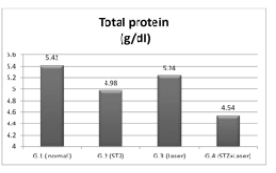
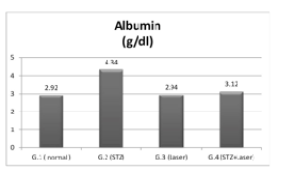
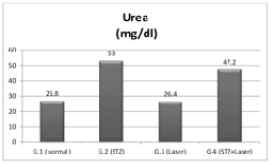
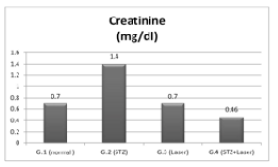
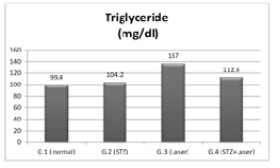
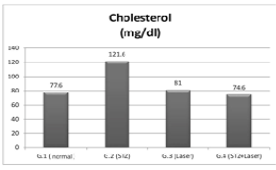
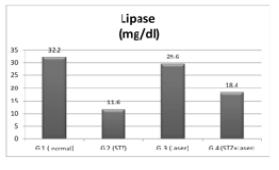
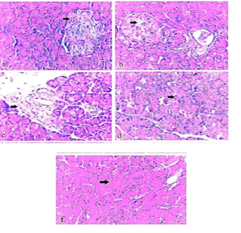
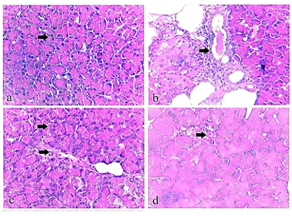
Acupuncture with laser therapy is a combination of acupuncture therapy with modern technology in the form of light therapy. Laser acupuncture uses lasers to stimulate acupuncture points (Sebayang et al., 2020). As for the exposure of healthy rats to the laser in acupuncturing points (BL18, BL20, BL23, CV12, ST25, CV6), as shown in group 3, There was no significant change in hepato-renal function, cholesterol, lipase, glucose, insulin, and C-peptide, While the results showed a defect in triglyceride when compared with the normal group. Histopathologically exposure to laser showed vacuolation of the pancreatic acini and vacuolation of the epithelial lining of the pancreatic acini. Blood vessels suffered from hemorrhage inside pancreatic acini and were filled with RBCs, besides slight dilatation with thickening of the blood vessels with inflammatory cells.
In a previous study an increase in serum triglyceride concentrations was observed in irradiated animals (Mafra et al., 2020).
It was said that the photo biological-photochemical phenomena caused by laser radiation to the tissues are similar to photosynthesis carried out by plants. To enable the visible light of low energy to affect any living biological system, the energy-carrying photons must be absorbed by electrons belonging to a photoreceptor or chromophore of the target biological system (Karoussis et al., 2018).
There are very promising and exciting LLLT applications with enormous potential in cell-based therapies. Many of these applications exploit the reciprocal interplay between upregulation of mitochondrial adenosine triphosphate (ATP) and downregulation of reactive oxygen species (ROS) in oxidatively stressed cells. The root cause for mitochondrial ATP upregulation in response to irradiation of cells with red-to-near infrared (R-NIR) light is the absorption of R-NIR photons by cytochrome c oxidase (CCO) (Sommer et al., 2019).
Laser radiation seems to act as a photo-stimulant, triggering a series of photochemical reactions that, in turn, can cause changes in cellular metabolisms, such as protein signaling (Karoussis et al., 2018).
LLLT stimulates low levels of Reactive Oxygen Species (ROS). ROS are well known to stimulate cellular proliferation at low levels, but inhibit proliferation and kill cells at high levels (Farivar et al., 2014).
The latest systematic review in 2019 showed that studies on acupuncture in DM mostly used manual acupuncture modalities. Selection of a manual acupuncture modality in patients with DM can increase the risk of infection in patients with uncontrolled blood glucose. Thus, a laser acupuncture modality can be used as a therapeutic option (Jusuf et al., 2021).
The laser-treated group showed improvement in most of the parameters, such as, decrease in blood sugar, and hepato-renal function. However, an increase in triglycerides was seen in this experiment compared to the other groups.
It was shown that a combination of metformin and acupuncture improved body mass index; body weight; fasting insulin, FBS, triglyceride, low-density lipoprotein cholesterol, and high-density lipoprotein cholesterol levels (Firouzjaei et al., 2016) and (Sui et al., 2020).
BL-23 (Shenshu) is one of the back-shu points (the points of bladder meridian, located on the back) that has a close relationship with kidney function (Yang et al., 2021).
In contrast to previous studies, LLLT did not suppress cholesterol synthesis but caused a redirection of serum lipids to fat reserves (in sedentary conditions) and an improved supply of substrate for energy expenditure (in trained conditions) (Aquino et al., 2013).
High levels of sugar in the blood cause damage to the liver cells, resulting in increased SGOT and SGPT levels, and the stimulation of the acupuncture points GB34 and BL18 results in a decrease in SGOT and SGPT levels (Jufriansjah et al., 2018).
Based on the results of histopathological kidney cells in mice with renal impairment, it can be concluded that exposure to 650 nm laser with 1 J energy results in a reduction of damaged cells (necrosis) and an increase of normal cells with the improvement of renal tubular cells. Therefore, the exposure to 650 nm LLLT on acupuncture points Shenshu (BL-23) has the ability to proliferate the renal tubular cells of mice (Astuti et al., 2017). The results were interpreted as LLLT facilitating differentiation of myofibroblastic cells during the early stages of the cicatricial repair process. Additionally, LLLT also appears to modulate the inflammatory response by downregulating lymphocyte proliferation Wavelength laser parameters also affect the ability of cell proliferation (Astuti et al., 2017).
Laser acupuncture at BL20 point in diabetes mellitus could increase beta-cell percentage and Langerhans area, and reduce fasting blood glucose level (Rayegani et al., 2017).
Both manual and laser acupuncture have been shown to improve the histological findings of Langerhans islets in type 2 diabetic rats. The morphology and cell density of Langerhans islets showed improved results with laser acupuncture. Both manual acupuncture and laser acupuncture are safe to use with minimal side effects (Jusuf et al., 2021).
The application of laser acupuncture stimulation to OLETF rats significantly reduced blood glucose concentrations, and this could be an effective treatment for type-2 diabetes mellitus (Nakamura et al., 2014).
It was mentioned that the acupoints, Zhongwan (CV12), Quchi (LI11), Hegu (LI4), Xuehai (SP10), Zusanli (ST36), and Yinlingquan (SP9) can improve glomerular filtration and reduce urinary albumin excretion rate (Feng et al., 2018).