
This study was conducted to evaluate the effect of probiotic bacteria Lactobacillus plantarum and Pediococcus pentosaceus on the growth performance of the genetically improved farmed tilapia (GIFT) (Oreochromis niloticus). A total of 120 fingerlings were acquired, assigned randomly into 4 groups (n=30/group) received one of four experimental diets each (30% crude protein supplemented with either T1-L. plantarum1×108 cfu), T2-(P. pentosaceus 1×10⁸ cfu), T3-(L. plantarum and P. pentosaceus1×108 cfu) or (T0-(No probiotics) for 60 days in a triplicate manner (n=10/replicate/aquarium of 1 ft3). Growth performance was assessed by final weight (FW) weight gain (WG), average daily weight gain (AWG), specific growth rate (SGR, %), percent % weight gain (% WG), and feed conversion ratio (FCR). Morphometry was also taken for total length (TL); standard length (SL); dorsal fin length (DFL); head length (HL); eye diameter (ED); pectoral fin length (PFL); pelvic fin length (PvFL); anal fin length (AFL), and caudal fin length (CFL). Fish treated with T3 had the highest growth performance indicated by FW (36.00±1.13g), WG (29.86±0.57g), AWG (0.49±0.01g), SGR (2.94±0.04% day-1) WG (%) (487.12±16.18) and FCR (1.35±0.02). T1 and T2 did not differ significantly (P>0.05) from each other but improved (P<0.05) as compared to control. Probiotic treatments significantly (P<0.05) affected the morphometric parameters also. The highest TL (13.94±0.33cm), SL (11.74±0.33cm), DFL (2.14±0.14cm), HL (3.4±0.09cm), ED (0.89±0.02cm), PFL (3.34±0.09cm), PvFL (2.44±0.11cm), AFL (1.88±0.09cm), and CFL (2.23±0.11cm) were observed in T3 followed by T1, T2, and control. The study concluded that probiotics bacteria supplementation in GIFT feed promoted growth performance and improved morphometry. The consortium form of probiotics L. plantarum and P. pentosaceus as feed additives could be used for improved growth performance.
Research Article · Volume 56, Issue 1, 30 November 2023 · Open Access
Effect of Lactobacillus plantarum and Pediococcus pentosaceus on the Growth Performance and Morphometry of the Genetically Improved Farmed Tilapia (Oreochromis niloticus)
· · · · · · ·
Affiliations & Notes ⌄
- 1Department of Zoology, Wildlife and Fisheries, PMAS-Arid Agriculture University Rawalpindi, 46300, Pakistan 2National Institute for Genomics, Advanced Biotechnology (NIGAB), National Agriculture Research Center, Park Road, Islamabad-44500, Pakistan * Corresponding author: zubair.anjum@uaar.edu.pk
Article Info ⌄
- Journal:
- Pakistan Journal of Zoology
- Published:
- 30 November 2023

From the article
- Significantly higher growth performance, lowest FCR, improved morphometric traits and more positive allometric weight-length correlation were examined in T3.
- The mixture of probiotics (L. plantarum +P. pentosaceus) caused improved growth performance, feed utilization and morphometry in GIFT as compared to L. plantarum or P. pentosaceus alone and control.
Selected from the article's own text.
Abstract
Introduction
Tilapia is the second most commercial farmed fish worldwide after carp . In 2018, tilapia production was approximately 6.882 million tonnes (FAO, 2020) anticipated it could be reached 7.3 million tonnes by 2030 . Tilapia production has increased fourfold over the past decade due to its suitability for aquaculture, consumer acceptability, and stable market prices .
Genetically improved farmed tilapia (GIFT), a high-quality strain of fish for freshwater aquaculture was developed between 1988 and 1997 in the Philippines through selective breeding of eight different wild and farmed Nile tilapia species . The enhanced growth rate, decent flavor and taste, omnivorous feeding behavior, and constant genetic features make the GIFT a key freshwater species worldwide . The genetic improvement in the Nile tilapia enhanced the productivity and quality and quantity of protein in low-income rural and urban populations around the world . GIFT strain plays a significant role in improving aquaculture outcomes and establishes farmers’ income in Asia .
The main issue in fish farming is low fish production, control of communicable diseases and cost-effectiveness. Antibiotics have been used for the prevention and treatment of diseases in aquatic animals to improve aquaculture production as a result antibiotics used produced antibiotics resistance bacteria, disturbed microbiota of the host, that destroy the host, aquatic environment, and reminders in the flesh are hazards for the consumer . Currently, synbiotics, probiotics and prebiotics are used in aquaculture as fed additives instead of antibiotics to enhance the growth rate and immunity of the host ; . The microorganisms either live, dead, or their components provide health benefits to their host when used for a specific duration and optimum concentrations are termed probiotics . Probiotics act as immune modulators, manipulate gut microbial community towards beneficial microbiota, have no side effects, ability to remove pathogens, and improve the growth of culture species. Probiotics are also defined as substances or microbes that can renovate microbial balance define by parker . According to World Health Organization (WHO) probiotics as live microorganisms either used as single strain or consortia forms of strains that provide health benefits to organisms by taking in recommended amounts . Probiotics are eco-friendly feed additives that increased fish production .
The most commonly used probiotics belong to Lactic acid bacteria Lactobacillus (acidophilus, fermentum, plantarum), Lactococcus, Pediococcus, Enterococcus, Bifidobacterium, and yeast such as Saccharomyces boulardii ; . Due to unique physiological, morphological, and metabolic characteristics lactic acid bacteria as well as secreting different enzymes (i.e. amylases, lipases, proteases) and a variety of health-promoting organic acid and aromatic compounds, make them effective probiotics. They secrete antimicrobial peptides, which are harmful to pathogens without any harm to the host . Probiotics tolerate gastrointestinal (GI) tract harsh environmental barriers such as acidic secretions, pH, enzymes, and bile acids because they ferment carbohydrates into short-chain fatty acids, which lower celiac pH .
The fish digestive tract also grants a site for attachment and multiplication of various bacteria (probiotics) that compete with pathogenic bacteria for the attachment site and nutrients to improve the fish immune system that provokes lysozyme and burst respiratory function, and stimulate a cellular immune response against pathogens. Probiotics also inhibit pathogens proliferation; by producing different substances such as bacteriocins, hydrogen peroxide, antibiotics, siderophores and lysozymes ;
There is no publication on probiotics bacteria Lactobacillus plantarum and Pediococcus pentosaceus on the growth performance and morphometric traits of the GIFT tilapia. Therefore, the purpose of this study was to assess the impacts of probiotics bacteria strains L. plantarum and P. pentosaceus on growth, and morphometry of the GIFT tilapia.
Materials and Methods
Ethical statement
All experiments were carried out following the rules and regulations adopted by the ethical committee of PMAS-Arid Agriculture University Rawalpindi, Pakistan.
Experimental site and fish collection
The research experiment was conducted at Aquaculture and Fisheries Laboratory, Department of Zoology, Pir Mehr Ali Shah, Arid Agriculture University Rawalpindi, Pakistan.
Genetically improved farmed tilapia (GIFT) (Oreochromis niloticus) fingerlings of initial means weight of 6.16± 0.78 g and morphometric parameters initial means values as followed: TL; 6.11± 0.40 cm, SL; 4.61±0.39 cm, DFL 0.77±0.10 cm, HL; 1.68±0.10 cm, ED; 0.39±0.20 cm, PFL; 1.67±0.12 cm, PvFL; 1.19±0.17 cm, AFL; 0.72±0.89 cm, and CFL; 1.50±0.12 cm were procured from Aquaculture and Fisheries Programs, National Agriculture Research Center (NARC), Islamabad, and have been transported in polythene bags filled with water and oxygen to the Aquaculture and Fisheries Laboratory. The probiotics (Lactobacillus plantarum and Pediococcus pentosaceus) based feed was taken from the National Institute for Genomics and Advanced Biotechnology, NARC, Islamabad.
Acclimatization of fish
The fingerlings (n=120) were randomly distributed to 12 aquaria having the size of 1×1×1 foot each, equipped with air stones for the supply of oxygen. Fish were acclimatized to the laboratory environment for 7 days and fed with basal diet, i.e., 30% crude protein (1.5mm) commercial feed (Marine Grow Fish Feed; Hi-Tech Feeds Private Limited, Pakistan).
Experimental setup
Four treatment groups (control, T1, T2 and T3) of aquaria in triplicate manner were established randomly containing 30 fingerlings in each group. The control group was treated with the T٠-basal diet; T1 was treated with the basal diet + L. plantarum; T2 was treated with the-basal diet + P. pentosaceus and T3 was treated with the basal diet + L. plantarum + P. pentosaceus. For the preparation of diet, the required amount of fluid suspended probiotics were taken when needed and dried by using a fan, and stored in airtight plastic jars at 4oC. The probiotics were sprayed on the stored basal diet after every 7 days to maintain the original 1×10⁸ cfu. Fish were fed two times per day at the rate of 5% body weight for 60 days. A total of 50% water was exchange every day to maintain the water quality.
Assessment of fish growth performance and feed utilization
For growth performance and morphometry measurements, 5 fish samples were randomly collected from each aquarium fortnightly. Fish were weighed with an electronic balance. After the measurement, fish were put to their corresponded aquarium. For evaluation of growth performance final body weight (FBW), average daily weight gain, weight gain, specific growth rate, percent weight gain and feed conversion ratio were taken. Growth performance calculations were carried out by using the following formulae; described by Chowdhury et al. (2020) and Panase and Mengumphan (2015).
Specific growth rate (SGR; %/ day) = 100 * [{Ln final weight (g) – Ln initial weight (g)}/ days]
Feed conversion rate (FCR) = feed given (g)/body weight gain (g)
Weight gain (WG; g) = Final weight (g) – initial weight (g)
Average daily weight gain (AWG; g day-1) = (Final body weight (g) – initial body weight (g))/days
Percent weight gain (WG %) = (Average final weight (g) – Average initial weight (g) *100)/ average initial weight
Morphometric traits measurements
Morphometric parameters were measured by standard protocol described by . Five fish samples were randomly collected from each aquarium for morphometric measurements. Morphometric traits were measured in centimeter, using a measuring board and transparent ruler. A total of nine morphometric parameters of GIFT were measured including; total length (TL) was measured from the tip of snout to the end the caudal fin, and standard length (SL) from the tip of snout to the start of caudal fin. Similarly, head length (HL) also measured the tip of snout to the most posterior part of the operculum. Dorsal fin length (DFL), pectoral fin length (PFL), pelvic fin length (PvFL), fin length (AFL) and caudal fin length (CFL)were measured from the base of fin to the most anterior tip of fin. The eye diameter (ED) was measured as space joining the front and lateral edges of eye in the longitudinal position.
Statistical analysis
The mean growth and morphometry parameters were analyzed by one-way analysis of variance (ANOVA)followed by Duncan’s multiple range test (DMRT) to identify the significant differences among the treatment groups in Statistical Package for the Social Sciences (SPSS) software. The level of significance was at P < 0.05. The results were presented as means ± standard deviation.
RESULTS
Growth performance and feed utilization
Growth rate and feed consumption evaluated in terms of FBW, WG, AWG, WG %, SGR and FCR are presented in Table I. Initial mean weight of control and treatments did not differ significantly (P > 0.05). Probiotics treatment groups (T1, T2 and T3) caused better growth performance and feed utilization (p < 0.05) than control (T0) in terms of FBW, WG, AWG, FCR, and SGR. The T3 group had significantly higher (P < 0.05) FBW (36.00±1.13g), WG (29.86±0.57g), AWG(0.49±0.01g) SGR (2.94±0.04% day-1), and WG (487.12±16.18%) as compared to the control and T1 and T2. T1 and T2 did not differ (P<0.05) from each other in growth performance and feed utilization but improved significantly than the control (P > 0.05) group. FCR (1.35±0.02) was observed significantly less (P<0.05) in T3 followed by T1, T2 and control.
Fortnightly growth performance
Fortnightly weight gains of T1, T2, and T3 groups were significantly better (P < 0.05) than the control (Fig. 1). However, weight gain was increased in T3 as compared to the control, T1 and T2 groups (P < 0.05).
Fortnightly growth performance
Fortnightly weight gains of T1, T2, and T3 groups were better significantly (P < 0.05) than the control (Fig. 1). However, weight gain was increased in T3 as compared to the control, T1 and T2 groups (P < 0.05).
Morphometrics traits
The morphometric parameters length values are presented in the Table II. Weight gain and morphometry are correlated Table III. In T3, TL, SL, DFL, HL, ED, PFL, PvFL, AFL and CFL lengths were increased significantly (P < 0.05) than the control and 2 other treatments. T1 and T2
Table I. Effect of probiotics on growth performance and feed utilization (means ± standard deviations) of genetically improved farmed tilapia (Oreochromis niloticus).
| Parameters | T0 (Control) | T1 | T2 | T3 |
| IBW(g) | 6.13±0.83 | 6.20±0.77 | 6.20±0.86 | 6.13±0.74 |
| FBW(g) | 26.33±1.04a | 30.26±1.27b | 30.80±1.14b | 36.00±1.13c |
| WG(g) | 20.20±0.20a | 24.06±0.11b | 24.60±0.34 | 29.86±0.57c |
| AWG(g/day) | 0.33±0.00a | 0.40±0.00b | 0.40±0.00b | 0.49±0.01c |
| FCR | 1.58±0.02a | 1.50±0.00b | 1.49±0.02b | 1.35±0.02c |
| SGR(%/day) | 2.42±0.02a | 2.63±0.00b | 2.66±0.06b | 2.94±0.04c |
| WG (%) | 329.42±7.04a | 388.16±1.86b | 397.15±17.77b | 487.12±16.18c |
Data are means ± standard deviation. Same superscript on the same row show no significant different (P > 0.05) but different superscript a, b and c showed significantly different (P < 0.05, Duncan test). IBW, initial mean body weight; FBW, final mean body weight; WG, means weight gain; DWG, daily weight gain; SGR, specific growth rate; FCR, feed conversion ratio. T0, basal diet (BS); T1, BS+ Lactobacillus plantarum; T2, BS+ Pediococcus pentosaceus; T3, BS+ Lactobacillus plantarum + Pediococcus pentosaceus.
Table II. Effect of probiotics on morphometric traits (means ± standard deviations) of genetically improved farmed tilapia Oreochromis niloticus.
| Parameters | T0 | T1 | T2 | T3 |
| TL (cm) | 11.65±0.52c | 12.63±0.27b | 12.62±0.33b | 13.94±0.33a |
| SL (cm) | 9.72±0.41c | 10.42±0.48b | 10.60±0.36b | 11.74±0.33a |
| DFL (cm) | 1.71±0.16c | 1.86±0.09b | 1.82±0.10b | 2.14±0.14a |
| HL (cm) | 3.06±0.10c | 3.21±0.08b | 3.08±0.9c | 3.46±0.09a |
| ED (cm) | 0.78±0.04b | 0.80±0.07b | 0.81±0.05b | 0.89±0.02a |
| PFL (cm) | 2.97±0.15c | 3.04±0.14bc | 3.07±0.10b | 3.34±0.09a |
| PvFL(cm) | 2.24±0.18b | 2.18±0.18b | 2.15±0.13b | 2.44±0.11a |
| AFL (cm) | 1.72±0.07b | 1.78±0.10b | 1.78±0.09b | 1.88±0.09a |
| CFL (cm) | 1.92±0.17b | 2.00±0.17b | 2.02±0.11b | 2.23±0.11a |
For statistical details and detail of different types of feed, see Table I. TL, total length; SL, standard length; DFL, dorsal fin length; HL, head length; ED= eye diameter; PFL, pectoral fin length; PvFL, pelvic fin length; AFL, anal fin length; CFL, caudal fin length; cm, centimetre.
differ non-significantly (P > 0.05) to each other in terms of TL, SL, OL, and PFL. There was no significant difference (P > 0.05) among T0, T1, and T2 in terms of ED, PvFL, AFL, and CFL. In T1, HL length increased significantly (P < 0.05) as compared to T2 and T0.
Table III. Weight-length correlation of GIFT fed with different probiotics.
| Treatments/ parameters | T0 | T1 | T2 | T3 | ||||
| r | p | r | p | r | p | r | p | |
| W-TL | 0.943 | 0.00 | 0.956 | 0.00 | 0.958 | 0.00 | 0.966 | 0.00 |
| W- SL | 0.934 | 0.00 | 0.938 | 0.00 | 0.951 | 0.00 | 0.961 | 0.00 |
| W-DFL | 0.800 | 0.00 | 0.840 | 0.00 | 0.887 | 0.00 | 0.878 | 0.00 |
| W_HL | 0.900 | 0.00 | 0.912 | 0.00 | 0.926 | 0.00 | 0.935 | 0.00 |
| W-ED | 0.913 | 0.00 | 0.930 | 0.00 | 0.945 | 0.00 | 0.920 | 0.00 |
| W-PFL | 0.887 | 0.00 | 0.886 | 0.00 | 0.927 | 0.00 | 0.894 | 0.00 |
| W-PvFL | 0.920 | 0.00 | 0.794 | 0.00 | 0.916 | 0.00 | 0.867 | 0.00 |
| W-AFL | 0.887 | 0.00 | 0.899 | 0.00 | 0.877 | 0.00 | 0.856 | 0.00 |
| W-CFL | 0.789 | 0.00 | 0.807 | 0.00 | 0.821 | 0.00 | 0.896 | 0.00 |
For statistical details and abbreviations, see Table II. r, coefficient correlation; W, weight.
DISCUSSION
Probiotics are successfully implemented in aquaculture due to their potential effects on aquatic animals and also used a bioremediation tools . For the sustainable aquaculture industry, probiotics were suggested to use for improving growth performance and well-being of aquatic animals (Ringo et al., 2020). According to author knowledge there is no data available on the effect of consortium (L. plantarum + P. pentosaceus) on the growth rate, feed utilization, and morphometrics traits of GIFT. In current study, significantly improved growth rate and feed utilization were observed in all probiotics treatment groups as compared to control. Significantly higher growth performance, lowest FCR, improved morphometric traits and more positive allometric weight-length correlation were examined in T3. The current study is in order with previous studies confirmed that tilapia fed with probiotics diet showed improved growth performance and feed consumption ; ; ; , and Labeo rohita . Possible reasons for improved growth rate and feed utilization in probiotics tested groups could be (1) by producing growth factors such as vitamins, co-factors, fatty acids, amino acids and essential amino acids (i.e. isoleucine, lysine, tryptophan, leucine and histidine) and non-essential) amino acids (i.e. glutamate, tyrosine and alanine) are released during fermentation process ; , and vitamins (i.e. vitamin C, vitamin B12, and vitamin B9) ; . These biologically active compounds might play vital role in food absorption, assimilation and growth of aquatic animals. (2) P. pentosaceus releasing extracellular enzymes such as amylases, proteases, and lipases reported in shrimp ; . Similar mechanism showen by P. pentosaceus fed to Cyprinus carpio . Likewise results of L. plantarum when fed to Nile Tilapia and also reported in other species ; which enhanced nutrients breakdown such protein, starch, and lipid, thereby improved growth rate and feed utilization of GIFT. (3) L. plantarum producing exopolysaccharides that increase intestinal adhesion and colonization of probiotics which turn to improve intestinal health . The intestinal surface area of GIFT was increased by increasing height, width of villi . (4) L. plantarum upregulated growth related genes expression such as glucose-6-phosphate dehydrogenase (G6PD), insulin-like growth factor (IGF-1) and down regulated fatty acid synthase (FAS) gene expression in the muscle and liver tissues of GIFT. The enhanced level of cellular respiration is the indication of high level of G6PD expression is responsible to maintains energy supplies needed for fish growth . Broiler chicken fed with L. plantarum also shows higher expression of IGF-1 and growth hormone receptor (GHR) . (5) probiotics suppressing pathogenic bacterial activities and modulated beneficial gut microbiota .
CONCLUSIONS
The mixture of probiotics (L. plantarum +P. pentosaceus) caused improved growth performance, feed utilization and morphometry in GIFT as compared to L. plantarum or P. pentosaceus alone and control. Therefore, these mixture probiotics could be a better option for culturing GIFT.
Statement of conflict of interest
The authors have declared no conflict of interest.
Figures
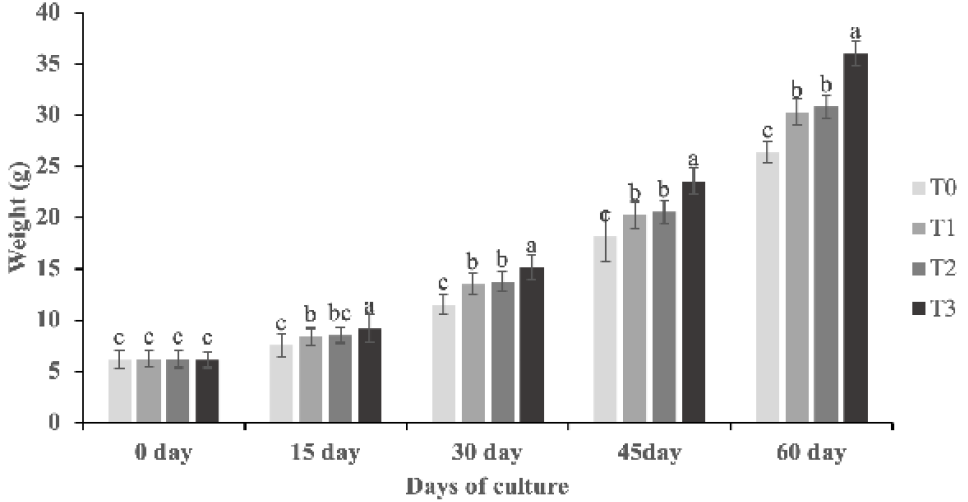
Duration wise growth rate of GIFT tilapia fed by different probiotic bacteria. The different superscript a, b and c specify significantly different among the groups (P < 0.05,) and the same superscripts showed non-significant difference (P > 0.05, Duncan test).
References
- Adel, M., Yeganeh, S., Dawood, M.A.O., Safari, R., and Radhakrishnan, S., 2017. Effects of pediococcus pentosaceus supplementation on growth performance, intestinal microflora and disease resistance of white shrimp, Litopenaeus vannamei. Aquacult. Nutr., 23: 1401–1409. https://doi.org/10.1111/anu.12515[CrossRef]
- Ahmad, H.I., Verma, A.K., Babitha Rani, A.M., Rathore, G., Saharan, N., and Gora, A.H., 2016. Growth, non-specific immunity and disease resistance of Labeo rohita against Aeromonas hydrophila in biofloc systems using different carbon sources. Aquaculture, 457: 61–67. https://doi.org/10.1016/j.aquaculture.2016.02.011[CrossRef]
- Ahmadifar, E., Sadegh, T.H., Dawood, M.A.O., Dadar, M., and Sheikhzadeh, N., 2020. The effects of dietary Pediococcus pentosaceus on growth performance, hemato-immunological parameters and digestive enzyme activities of common carp (Cyprinus carpio). Aquaculture, 516: 734656. https://doi.org/10.1016/j.aquaculture.2019.734656[CrossRef]
- Akhter, N., Wu, B., Memon, A.M., and Mohsin, M., 2015. Probiotics and prebiotics associated with aquaculture: A review. Fish Shellf. Immunol., 45: 733–741. https://doi.org/10.1016/j.fsi.2015.05.038[CrossRef]
- Apparao, B.Y.T., 1961. On some aspects of the biology of Lactarius lactarius (Schneider). Indian J. Fish., 13: 334–349.
- Balami, S., Paudel, K., and Shrestha, N., 2022. A review: Use of probiotics in striped catfish larvae culture. Int. J. Fish. aquat. Stud., 10: 41–49.
- Behera, B.K., Pradhan, P.K., Swaminathan, T.R., Sood, N., Paria, P., Das, A., Verma, D.K., Kumar, R., Yadav, M.K., Dev, A.K., Parida, P.K., Das, B.K., Lal, K.K., and Jena, J.K., 2018. Emergence of Tilapia Lake Virus associated with mortalities of farmed Nile Tilapia Oreochromis niloticus (Linnaeus 1758) in India. Aquaculture, 484: 168–174. https://doi.org/10.1016/j.aquaculture.2017.11.025[CrossRef]
- Bentsen, H.B., Eknath, A.E., Palada-de Vera, M.S., Danting, J.C., Bolivar, H.L., Reyes, R.A., Dionisio, E.E., Longalong, F.M., Circa, A.V., Tayamen, M.M. and Gjerde, B., 1998. Genetic improvement of farmed tilapias: growth performance in a complete diallel cross experiment with eight strains of Oreochromis niloticus. Aquaculture, 160: 145-173. https://doi.org/10.1016/S0044-8486(97)00230-5[CrossRef]
- Chowdhury, M.A., Roy, N.C., and Chowdhury, A., 2020. Growth, yield and economic returns of striped catfish (Pangasianodon hypophthalmus) at different stocking densities under floodplain cage culture system. Egypt. J. aquat. Res., 46: 91–95. https://doi.org/10.1016/j.ejar.2019.11.010[CrossRef]
- Dawood, M.A.O., and Koshio, S., 2016. Recent advances in the role of probiotics and prebiotics in carp aquaculture: A review. Aquaculture, 454: 243–251. https://doi.org/10.1016/j.aquaculture.2015.12.033[CrossRef]
- Dawood, M.A.O., Magouz, F.I., Salem, M.F.I., Elbialy, Z.I., and Abdel-Daim, H.A., 2020. Synergetic effects of Lactobacillus plantarum and β-Glucan on digestive enzyme activity, intestinal morphology, growth, fatty acid, and glucose-related gene expression of genetically improved farmed tilapia. Probiot. Antimicrob. Proteins, 12: 389–399. https://doi.org/10.1007/s12602-019-09552-7[CrossRef]
- Dawood, M.A.O., Mohsen, M., El-Dakar, A., Abdelraouf, E., Moustafa, E.M., and Ahmed, H.A., 2019. Effectiveness of exogenous digestive enzymes supplementation on the performance of rabbitfish (Siganus rivulatus). Slov. Vet. Res., 56: 409–419. https://doi.org/10.26873/SVR-779-2019[CrossRef]
- Dey, M.M., and Gupta, M.V., 2000. Socioeconomics of disseminating genetically improved Nile tilapia in Asia: An introduction. Aquac. econ. Manage., 4: 5–11. https://doi.org/10.1080/13657300009380257[CrossRef]
- Eissa, E.S.H., Baghdady, E.S., Gaafar, A.Y., El-Badawi, A.A., Bazina, W.K., Abd Al-Kareem, O.M., and Abd El-Hamed, N.N.B., 2022. Assessing the influence of dietary Pediococcus acidilactici probiotic supplementation in the feed of European sea bass (Dicentrarchus labrax L.) (Linnaeus, 1758) on farm water quality, growth, feed utilization, survival rate, body composition, blood bioch. Aquacult. Nutr., 2022: 1–11. https://doi.org/10.1155/2022/5841220[CrossRef]
- El-Saadony, M.T., Alagawany, M., Patra, A.K., Kar, I., Tiwari, R., Dawood, M.A.O., Dhama, K., and Abdel-Latif, H.M.R., 2021. The functionality of probiotics in aquaculture: An overview. Fish Shellf. Immunol., 117: 36–52. https://doi.org/10.1016/j.fsi.2021.07.007[CrossRef]
- Elsabagh, M., Mohamed, R., Moustafa, E.M., Hamza, A., Farrag, F., Decamp, O., Dawood, M.A.O., and Eltholth, M., 2018. Assessing the impact of Bacillus strains mixture probiotic on water quality, growth performance, blood profile and intestinal morphology of Nile tilapia, Oreochromis niloticus. Aquacult. Nutr., 24: 1613–1622. https://doi.org/10.1111/anu.12797[CrossRef]
- FAO, 2020. The state of world fisheries and aquaculture 2020. Sustainability in action. Rome.
- Gobi, N., Vaseeharan, B., Chen, J.C., Rekha, R., Vijayakumar, S., Anjugam, M., and Iswarya, A., 2018. Dietary supplementation of probiotic Bacillus licheniformis Dahb1 improves growth performance, mucus and serum immune parameters, antioxidant enzyme activity as well as resistance against Aeromonas hydrophila in tilapia Oreochromis mossambicus. Fish Shellf. Immunol., 74: 501–508. https://doi.org/10.1016/j.fsi.2017.12.066[CrossRef]
- Grassi, T.L.M., Paiva, N.M., Oliveira, D.L., Taniwaki, F., Cavazzana, J.F., da Costa Camargo, G.C.R., Diniz, J.C.P., Bermejo-Poza, R., Borghesi, R., Villarroel, M., and Ponsano, E.H.G., 2020. Growth performance and flesh quality of tilapia (Oreochromis niloticus) fed low concentrations of Rubrivivax gelatinosus, Saccharomyces cerevisiae and Spirulina platensis. Aquacult. Int., 28: 1305–1317. https://doi.org/10.1007/s10499-020-00527-y[CrossRef]
- Hill, M., 1993. Probiotics: The scientific basis. Gut, 34: 863–864. https://doi.org/10.1136/gut.34.6.863-c[CrossRef]
- Hoseinifar, S.H., Sun, Y.Z., and Caipang, C.M., 2017. Short-chain fatty acids as feed supplements for sustainable aquaculture: An updated view. Aquacult. Res., 48: 1380–1391. https://doi.org/10.1111/are.13239[CrossRef]
- Humam, A.M., Loh, T.C., Foo, H.L., Samsudin, A.A., Mustapha, N.M., Zulkifli, I. and Izuddin, W.I., 2019. Effects of feeding different postbiotics produced by Lactobacillus plantarum on growth performance, carcass yield, intestinal morphology, gut microbiota composition, immune status, and growth gene expression in broilers under heat stress. Animals, 9: 644. https://doi.org/10.3390/ani9090644[CrossRef]
- Jannathulla, R., Rajaram, V., Kalanjiam, R., Ambasankar, K., Muralidhar, M., and Dayal, J.S., 2019. Fishmeal availability in the scenarios of climate change: Inevitability of fishmeal replacement in aquafeeds and approaches for the utilization of plant protein sources. Aquacult. Res., 50: 3493–35024. https://doi.org/10.1111/are.14324[CrossRef]
- Kuebutornye, F.K.A., Abarike, E.D., Sakyi, M.E., Lu, Y., and Wang, Z., 2020. Modulation of nutrient utilization, growth, and immunity of Nile tilapia, Oreochromis niloticus: The role of probiotics. Aquacult. Int., 28: 277–291. https://doi.org/10.1007/s10499-019-00463-6[CrossRef]
- Levy, M., Kolodziejczyk, A.A., Thaiss, C.A., and Elinav, E., 2017. Dysbiosis and the immune system. Nat. Rev. Immunol., 17: 219–232. https://doi.org/10.1038/nri.2017.7[CrossRef]
- Mirzakhani, N., Ebrahimi, E., Jalali, S.A.H., and Ekasari, J., 2019. Growth performance, intestinal morphology and nonspecific immunity response of Nile tilapia (Oreochromis niloticus) fry cultured in biofloc systems with different carbon sources and input C:N ratios. Aquaculture, 512: 734235. https://doi.org/10.1016/j.aquaculture.2019.734235[CrossRef]
- Ndagijimana, M., Laghi, L., Vitali, B., Placucci, G., Brigidi, P., and Guerzoni, M.E., 2009. Effect of a synbiotic food consumption on human gut metabolic profiles evaluated by 1H Nuclear Magnetic Resonance spectroscopy. Int. J. Fd. Microbiol., 134: 147–156. https://doi.org/10.1016/j.ijfoodmicro.2009.04.016[CrossRef]
- Panase, P., and Mengumphan, K., 2015. Growth performance, length weight relationship and condition factor of backcross and reciprocal hybrid catfish. Int. J. zool. Res., 11: 57–64. https://doi.org/10.3923/ijzr.2015.57.64[CrossRef]
- Rehaiem, A., Belgacem, Z., Ben, Edalatian, M.R., Martínez, B., Rodríguez, A., Manai, M., and Guerra, N.P., 2014. Assessment of potential probiotic properties and multiple bacteriocin encoding-genes of the technological performing strain Enterococcus faecium MMRA. Fd. Contr., 37: 343–350. https://doi.org/10.1016/j.foodcont.2013.09.044[CrossRef]
- Ringø, E., Doan, H. Van, Lee, S., and Song, S.K., 2020. Lactic acid bacteria in shellfish: Possibilities and challenges. Rev. Fish. Sci. Aquacult., 28: 139–169. https://doi.org/10.1080/23308249.2019.1683151[CrossRef]
- Rodrigues, D., Santos, C.H., Rocha-Santos, T.A.P., Gomes, A.M., Goodfellow, B.J., and Freitas, A.C., 2011. Metabolic profiling of potential probiotic or synbiotic cheeses by nuclear magnetic resonance (NMR) Spectroscopy. J. Agric. Fd. Chem., 59: 4955–4961. https://doi.org/10.1021/jf104605r[CrossRef]
- Rossi, M., Corradini, C., Amaretti, A., Nicolini, M., Pompei, A., Zanoni, S., and Matteuzzi, D., 2005. Fermentation of fructooligosaccharides and inulin by bifidobacteria: A comparative study of pure and fecal cultures. Appl. environ. Microbiol., 71: 6150–6158. https://doi.org/10.1128/AEM.71.10.6150-6158.2005[CrossRef]
- Salminen, S., Collado, M.C., Endo, A., Hill, C., Lebeer, S., Quigley, E.M.M., Sanders, M.E., Shamir, R., Swann, J.R., Szajewska, H., and Vinderola, G., 2021. The international scientific association of probiotics and prebiotics (ISAPP) consensus statement on the definition and scope of postbiotics. Nat. Rev. Gastroenterol. Hepatol., 18: 649–667. https://doi.org/10.1038/s41575-021-00440-6[CrossRef]
- Sayes, C., Leyton, Y. and Riquelme, C., 2018. Probiotic bacteria as a healthy alternative for fish aquaculture. In: Antibiotics use in animals (ed. S. Savic). Intech Publishers, Rijeka, Croatia. pp. 115-132. https://doi.org/10.5772/intechopen.71206[CrossRef]
- Sehrawat, N., Yadav, M., Singh, M., Kumar, V., Sharma, V.R., and Sharma, A.K., 2021. Probiotics in microbiome ecological balance providing a therapeutic window against cancer. Semin. Cancer Biol., 70: 24–36. https://doi.org/10.1016/j.semcancer.2020.06.009[CrossRef]
- Siripornadulsil, W., Tasaku, S., Buahorm, J., and Siripornadulsil, S., 2014. Probiotic properties of lactic acid bacteria isolated from fermented food. Int. J. Bioeng Life Sci., 8: 376-378.
- Terpou, A., Papadaki, A., Lappa, I.K., Kachrimanidou, V., Bosnea, L.A., and Kopsahelis, N., 2019. Probiotics in food systems: Significance and emerging strategies towards improved viability and delivery of enhanced beneficial value. Nutrients, 11: 1591. https://doi.org/10.3390/nu11071591[CrossRef]
- Tran, N., Shikuku, K.M., Rossignoli, C.M., Barman, B.K., Cheong, K.C., Ali, M.S., and Benzie, J.A.H., 2021. Growth, yield and profitability of genetically improved farmed tilapia (GIFT) and non-GIFT strains in Bangladesh. Aquaculture, 536: 736486. https://doi.org/10.1016/j.aquaculture.2021.736486[CrossRef]
- Van Doan, H., Hoseinifar, S.H., Faggio, C., Chitmanat, C., Mai, N.T., Jaturasitha, S., and Ringø, E., 2018. Effects of corncob derived xylooligosaccharide on innate immune response, disease resistance, and growth performance in Nile tilapia (Oreochromis niloticus) fingerlings. Aquaculture, 495: 786–793. https://doi.org/10.1016/j.aquaculture.2018.06.068[CrossRef]
- Wanna, W., Surachat, K., Kaitimonchai, P., and Phongdara, A., 2021. Evaluation of probiotic characteristics and whole genome analysis of Pediococcus pentosaceus MR001 for use as probiotic bacteria in shrimp aquaculture. Sci. Rep., 11: 1–17. https://doi.org/10.1038/s41598-021-96780-z[CrossRef]
- Xia, Y., Lu, M., Chen, G., Cao, J., Gao, F., Wang, M., Liu, Z., Zhang, D., Zhu, H., and Yi, M., 2018. Effects of dietary Lactobacillus rhamnosus JCM1136 and Lactococcus lactis subsp. lactis JCM5805 on the growth, intestinal microbiota, morphology, immune response and disease resistance of juvenile Nile tilapia, Oreochromis niloticus. Fish Shellf. Immunol., 76: 368–379. https://doi.org/10.1016/j.fsi.2018.03.020[CrossRef]
- Xia, Y., Wang, M., Gao, F., Lu, M., and Chen, G., 2020. Effects of dietary probiotic supplementation on the growth , gut health and disease resistance of juvenile Nile tilapia (Oreochromis niloticus). Aquacult. Nutr., 6: 69–79. https://doi.org/10.1016/j.aninu.2019.07.002[CrossRef]
- Yasin, R., Samiullah, K., Fazal, R.M., Hussain, S., Mahboob, S., Al-Ghanim, K.A., Al-Misned, F.A., and Ahmed, Z., 2020. Combined effect of probiotics on prolonging the shelf life of GIFT tilapia fillets. Aquacult. Res., 51: 5151–5162. https://doi.org/10.1111/are.14853[CrossRef]
- Zhao, W., Peng, C., Sakandar, H.A., Kwok, L.Y., and Zhang, W., 2021. Meta-analysis: Randomized trials of Lactobacillus plantarum on immune regulation over the last decades. Front. Immunol., 12: 643420. https://doi.org/10.3389/fimmu.2021.643420[CrossRef]
Services
Article usage statistics
Loading…